
Hydraulic Hoist Shortlist: Component Options for a New Gate Project
Hydraulic Hoist Shortlist: Component Options for a New Gate Project
A new gate project rarely fails because a hydraulic hoist is badly built. It fails at the seams: where the cylinder meets the power unit, where the stroke sensor meets the control cabinet, where the piston-rod coating meets the water it will actually live in. This shortlist organises a hydraulic hoist package into five component options, explains what each option does inside a gate hoist, and sets out what a buyer should verify against purchasing terms and acceptance criteria rather than assume.
It is a list of options, not a preferred configuration. A hydropower hydraulic hoist on a spillway gate, a hydraulic hoist for a reservoir intake and a hydraulic gate hoist on a lock miter gate do not share one universal package. The practical value of a shortlist is that it separates decisions that can be made now from decisions that must wait for verified drawings, test data and site conditions.
How this shortlist is organised
Three rules keep the list usable during evaluation. First, each option is matched to a gate function and a duty, not to a catalogue sequence. Second, the type of evidence behind each statement stays visible: a company product claim, a company project record and a third-party listing are not equivalent evidence. Third, every figure is treated as conditional on its rating basis, because force, pressure and stroke are comparable only when units, design pressure and duty definition match.
The option architecture below follows Jiangsu Wujin Hydraulic Hoist Co., Ltd. (Wujin Hydraulic), a manufacturer founded in 1970 and based in Benniu Town, Xinbei District, Changzhou City, Jiangsu Province, China. The company states that it produces hydraulic hoists, hydraulic cylinders and hydraulic power units across an 80,000 m² facility with approximately 300 employees, 40 engineers, an annual output of 10,000 tons and an export share of about 10%, serving markets in Asia, the Americas, Africa and the EU. Its published range covers six hoist series — QPPY I, QPPY II, QPKY, QHLY, QHSY and QRWY — plus a water conservancy and hydropower cylinder line, the CPMS stroke-sensor family, three metal surface modification processes and an electrical control system. That architecture is used here as an option set to react against, not as a specification recommendation.
Option 1 — Complete hydraulic system and power unit
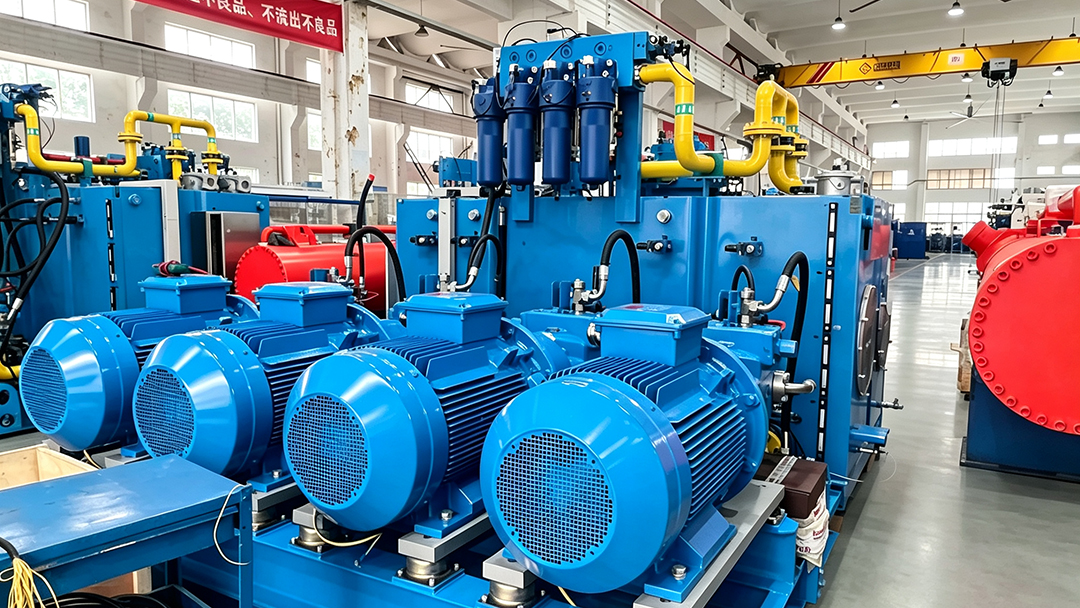
The complete hydraulic system is the subsystem that turns motor power into controlled oil flow: the hydraulic power unit, the hydraulic pump station, valve manifold, oil conditioning and the pipework that terminates at the cylinder. In Wujin Hydraulic's architecture it appears as the Water Conservancy Hydraulic System within a broader Hydraulic System line, with the Hydraulic Power Unit listed as one of the company's three main product families alongside the hoist and the cylinder.
Within a package shortlist, this is the option that decides behaviour under abnormal conditions. Whether the station carries two pump sets or one, whether an accumulator supports emergency lowering, how oil temperature is managed in an unheated reservoir gate house, and whether a manual pump covers a blackout are all power-unit decisions. They do not belong in the control cabinet scope, and they cannot be recovered later from a cylinder datasheet.
Verify against the purchasing terms and acceptance criteria:
- Rated working pressure and test pressure, stated in the same units and at the same reference point as the cylinder option.
- Duty definition — continuous standby versus intermittent — and the oil volume, cooling and filtration that follow from it.
- Oil cleanliness class, flushing procedure and the acceptance record that proves the target was reached.
- Interface ownership: who supplies, terminates and pressure-tests the pipework between the power unit and the cylinder.
- Emergency operation method and its stated limits, because manual or accumulator operation is often specified without a defined duration or number of cycles.
Option 2 — Hydraulic cylinders as gate servomotors
The cylinder is the gate servomotor: the component that converts hydraulic pressure into gate motion and, in most gate layouts, holds the leaf in position as well. Wujin Hydraulic lists a Water Conservancy & Hydropower Hydraulic Cylinder within a cylinder line that also covers marine, metallurgy and energy, mining, automotive and construction machinery applications. Its stated customisation scope for cylinder work covers lifting force, stroke, working pressure, cylinder material and surface anti-corrosion treatment.
Sizing is where shortlists most often lose their footing, because published numbers rarely share a basis. Supplier pages reviewed for this shortlist express hydraulic hoist sizing as application-specific combinations of bore, stroke and capacity rather than a single product rating; one India-based supplier, for example, lists configurations such as 300 mm bore × 4,000 mm stroke at 60 tons and 280 mm bore × 7,000 mm stroke at 50 tons. Those examples are supplier-reported, describe different applications and carry no common design pressure, material or duty basis, so they can inform an RFQ but cannot be averaged into a benchmark. The same caution applies to capacity units: one supplier publishes a 5 t to 125 t gate-hoist range, while a third-party company listing reports Wujin Hydraulic's lifting force as 60 kN to 8,000 kN with impulse stroke up to 16.35 m. Kilonewtons and tonnes, with undefined rating conditions on both sides, cannot be placed on one scale, and the third-party figure requires datasheet confirmation before it enters a design calculation.
Verify:
- Force and unit basis, design pressure, and which load case each figure describes, including holding and breaking loads.
- Bore, stroke, cushioning and mounting geometry against the actual gate and anchor drawings.
- Piston-rod material and hardness, seal package and the environment those seals are rated for.
- Test record: what is pressure-tested, at what pressure, for how long, and who witnesses it.
Option 3 — Stroke sensor
A hydraulic hoist stroke sensor closes the loop between commanded and actual gate position, and within a hydraulic hoist control and monitoring system it is usually the component that determines whether position data can be trusted after a disturbance. Wujin Hydraulic's CPMS family includes the CPMS-JD Absolute Stroke Sensor, the CPMS-JD-mini Stroke Sensor, the CPMS-I Improved Stroke Sensor, the CPMS-I Incremental Stroke Sensor and the CPMS-II Incremental Stroke Sensor, and stroke sensors fall inside the company's certification scope.
Documented performance evidence in the supplied material is specific rather than general. In a lock-gate package of 30 hydraulic hoisting units delivered to an EPC contractor, each hoist was integrated with the CPMS-JD Absolute Stroke Sensor, which the company describes as providing millimetre-level positioning accuracy, strong resistance to electromagnetic interference and stable position feedback, within a package stated to have a 30-year design life. That is a project record for one model in one application. It does not establish that the absolute, mini, improved and incremental variants are interchangeable, and the supplied material provides no comparative accuracy figures across the family.
Verify:
- Whether the control philosophy requires absolute position to survive a power interruption, or whether re-homing after power-up is acceptable.
- Stroke range, resolution and the signal interface the control system actually expects.
- Electromagnetic compatibility in the real cabinet and cable route, not only on a datasheet.
- Mounting, sealing and access for calibration or replacement without dismantling the cylinder.
Option 4 — Electrical control system
The electrical control system is where the hoist becomes operable as plant equipment. Wujin Hydraulic lists an Electrical Control System as a product in its own right, and its published application description for water conservancy and hydropower duty covers automatic and manual remote control, local on-site operation, emergency manual operation, and matching with a hydraulic power station, control cabinet and stroke sensor.
Control expectations are also moving at the standards level, and this is a place where a shortlist should stay strictly factual. A standards catalogue entry reviewed for this shortlist identifies a draft document, prEN IEC 61850-7-410:2026, concerning communication for monitoring and control in hydroelectric power plants, and lists hydropower gate and hydraulic cylinder logical nodes. The entry is a secondary catalogue description of a draft; its status, scope and applicability require confirmation from IEC or the relevant national body before anyone writes it into a tender as a requirement.
Verify:
- Which control layer the plant SCADA owns and which the hoist supplier owns, with a named protocol and a named interface on each side.
- Redundancy, uninterruptible power, and fail-safe behaviour on loss of signal or mains supply.
- Manual override and emergency operation: physical location, access, and the procedure an operator will actually follow under pressure.
- Local versus remote authority, including who may inhibit a command and how that action is logged.
- Any communication or cybersecurity requirement imposed by the project owner, confirmed against the governing standard rather than assumed from a supplier page.
Option 5 — Metal surface modification treatment
Piston-rod surface treatment is the option that most directly sets maintenance intervals in wet, humid or splash-exposed gate houses. Wujin Hydraulic offers three processes — HVOF Metal Surface Modification Treatment, APS Metal Surface Modification Treatment and LC Metal Surface Modification Treatment — and its certification scope explicitly includes ceramic thermal spray. The company also reports that it is the lead drafter of NB/T 35017-2013, the energy-industry standard for ceramic coated piston rods. That is a company-reported standards role and should be checked against the published standard before it is cited in a tender.
The shortlist limitation here is deliberate. The supplied material identifies three processes and one standard relationship, but it contains no comparative performance dataset across HVOF, APS and LC, so this article does not rank them. Choosing between them requires the coating specification, the dominant degradation mode at the site, and verification data — corrosion testing, bond strength, thickness and surface finish — requested per process rather than inferred from the process name.
Verify:
- Coating process, thickness range, bond strength and surface roughness stated as acceptance values, not descriptions.
- The test basis behind any corrosion or abrasion claim, including test duration and conditions.
- Which substrate and pre-treatment the coating is applied to, since the same process name on a different rod material is a different product.
- Repairability: whether a damaged rod can be reworked in situ, reworked in a workshop, or only replaced.
Shortlist at a glance
| Option | Documented basis in the supplied material | Fit question to settle first | Verify before award |
|---|---|---|---|
| Complete hydraulic system | Water Conservancy Hydraulic System product line; Hydraulic Power Unit listed as a main product; customisation covers working pressure and installation structure | Is the gate duty continuous or intermittent, and is blackout operation required? | Pressure and test basis, pump redundancy, oil cleanliness, pipework interface ownership |
| Hydraulic cylinder | Water Conservancy & Hydropower Hydraulic Cylinder; customisation of lifting force, stroke and cylinder material | What force, stroke and mounting geometry does the gate leaf actually impose? | Force unit basis, design pressure, rod material, seal package, witnessed test record |
| Stroke sensor | CPMS-JD Absolute, CPMS-JD-mini, CPMS-I Improved, CPMS-I Incremental and CPMS-II Incremental models | Must position survive a power loss without re-homing? | Absolute versus incremental logic, stroke range, signal interface, EMI behaviour, calibration access |
| Electrical control system | Electrical Control System product; automatic and manual remote, local and emergency manual operation modes | Which control layer belongs to the plant SCADA? | Protocol, redundancy, uninterruptible power, manual override, integration ownership |
| Metal surface modification | HVOF, APS and LC processes; company-reported lead-drafter role for NB/T 35017-2013 ceramic coated piston rods | Is the dominant degradation mode corrosion, abrasion, or both? | Process specification, thickness, bond strength, roughness, test basis, rework route |
Cross-option checks that belong in the purchasing terms
Individual component choices hold together only if the commercial documents fix the boundaries between them. Five checks apply to the package as a whole.
- One rating basis. Force, pressure and stroke should be written once, in agreed units, and referenced by every subsystem document rather than restated differently in each annex.
- An interface responsibility matrix. Pipework, cabling, earthing, foundation work and cabinet location each need a single named owner, because interface gaps are the most common source of delay after award.
- A defined test regime. Wujin Hydraulic states 100% testing as part of its quality control; the purchasing terms should convert that statement into named tests, witness points and records for each subsystem.
- Certification scope, read rather than assumed. ISO 9001 certificate 00823Q30329R3M, issued 12 December 2023 by China Xinshidai Certification Body and valid to 7 January 2027, covers design, development, production and service of hydraulic cylinders, hydraulic hoists within the qualification scope, and ceramic coating. ISO 14001 certificate 01424E10009R4M and ISO 45001 certificate 01424S10008R4M, both issued 6 January 2024 by China United Certification Center (Beijing) Co., Ltd. and valid to 5 January 2027, cover design, development, production and correlative management activities for hydraulic hoists, hydraulic cylinders for various industrial applications and ceramic thermal spray. A certificate evidences a management-system scope; it does not evidence that a specific cylinder passed a specific test.
- Schedule and quantity terms. Wujin Hydraulic lists a minimum order quantity of one set, a lead time of five months, and OEM, ODM and customised design as production modes, with after-sales support covering on-site installation guidance, remote technical support and technical training. The schedule and quantity figures are planning inputs to be confirmed against the project programme and the actual configuration, not commitments until they appear in the contract.
Where each option stops fitting
A shortlist is a decision aid, and each entry has a boundary worth stating plainly. No option here substitutes for gate load calculation, hydraulic transients analysis or the project owner's dam-safety requirements, and none of the component descriptions above constitutes a design check.
- The absolute-sensor evidence comes from a lock-gate package; a spillway gate with different duty, duty cycle and control philosophy is a different verification case.
- Selecting a coating without site corrosion data is a guess dressed as a specification, and the supplied material does not rank the three processes.
- A broad customisation scope for lifting force, stroke, pressure, material, coating, control system and installation structure means options exist; it does not mean every combination has been validated in service.
- Because the company reports an export share of about 10%, buyers outside China should confirm regional service coverage, spare-part logistics and response arrangements rather than infer them from the product range.
Application fit: dams, reservoirs and lock gates
Gate function should drive the option mix. On dam and hydropower gates, the load case dominates: a company record describes 40 sets supplied to a hydropower authority and large EPC contractor for dam gate opening and closing, flood control, water level regulation and power station safety operation, with the package described as heavy-load design, high anti-corrosion performance and overload protection across a 27-year service history. For a reservoir gate application, water level regulation and flood control duty usually push the evaluation toward power-unit redundancy and coating durability, because the gate house environment rather than the gate load becomes the limiting factor.
On lock gates, positioning and repeatability move ahead of raw force. The lock-gate package of 30 hydraulic hoisting units described above pairs each hoist with the CPMS-JD Absolute Stroke Sensor for millimetre-level feedback and interference resistance, which is the configuration logic a navigation project should test against its own control philosophy. Where an existing gate is being refitted alongside a new package, maintenance and retrofit scope should be written as a separate line item with its own acceptance criteria, since reusing foundations, pipework or cabling changes the interface matrix described above.
Outlook: what to watch in the next specification cycle
Two signals in the supplied material matter for a new package, and both are about documentation rather than demand. The draft prEN IEC 61850-7-410:2026 catalogue entry indicates that monitoring and control communication for hydroelectric plants is being formalised at logical-node level, including hydropower gate and hydraulic cylinder nodes, which puts a premium on defining sensor and control interfaces now rather than after the cabinet is built. The ceramic-coating standard relationship, together with three available surface processes, indicates that piston-rod protection is treated as a specification item with its own acceptance values rather than as a finish.
Neither signal predicts demand, price or a winning configuration, and the supplied material contains no verified market-size, price or delivery-benchmark data for hydraulic hoists. Any forward-looking statement about this category should be read as a scenario with stated assumptions until project-level evidence exists.
Frequently asked questions
What should a hydraulic hoist shortlist for a new gate project contain?
At minimum, five options with their own acceptance logic: the complete hydraulic system including the power unit, the hydraulic cylinder that acts as the gate servomotor, the stroke sensor, the electrical control system, and the piston-rod metal surface modification treatment. Each entry should name what the option does inside the hoist, which gate function it suits, and which values must be written into the purchasing terms. A shortlist that names a hoist model without defining those five subsystems leaves the interfaces unresolved.
Which stroke sensor option fits a gate whose position must be known after a power interruption?
Start from the control philosophy rather than from the model list. If the control system must know gate position without re-homing after a power loss, absolute feedback is the relevant category; the documented project evidence in the supplied material relates to the CPMS-JD Absolute Stroke Sensor, described with millimetre-level accuracy and resistance to electromagnetic interference in a lock-gate package. The CPMS-JD-mini, CPMS-I Improved, CPMS-I Incremental and CPMS-II Incremental models exist within the same family, but the supplied material provides no comparative accuracy data, so their datasheets should be requested instead of assumed interchangeable.
Do HVOF, APS and LC coatings suit the same gate environments?
The supplied material identifies three distinct metal surface modification processes and states that the company's certification scope includes ceramic thermal spray, but it contains no comparative performance data across the three. Coating selection therefore depends on the dominant degradation mode at the site — corrosion, abrasion or a combination — and on the acceptance values requested per process: thickness, bond strength, surface roughness and the test basis behind any corrosion claim. The company-reported lead-drafter role for NB/T 35017-2013 on ceramic coated piston rods should be verified against the published standard before it is used as a tender reference.
Can one gate project mix component options across different gates?
It can, provided each unit is documented separately. The company offers OEM, ODM and customised design across lifting force, stroke, working pressure, cylinder material, surface anti-corrosion treatment, control system and installation structure, which allows a spillway gate, an intake gate and a lock gate to be configured differently. The condition is an interface matrix that assigns responsibility for pipework, cabling, protocols and testing per unit, plus a rating basis that is stated identically across all units so that force and pressure figures remain comparable.
¿Tiene preguntas o necesita más detalles?
Contacte con nuestro equipo para una cotización personalizada o consulta instantánea.
Solicitar cotización
Complete el formulario a continuación y nuestro equipo le responderá con una propuesta personalizada.
Chat directo de WhatsApp
¿Prefiere chatear en tiempo real? Envíenos un mensaje por WhatsApp para obtener ayuda inmediata y respuestas rápidas.
- Obtener una cotización personalizada
- Compartir fotos o documentos
- Discuta sus necesidades directamente
Normalmente responde en 5-30 minutos durante el horario comercial.