
Hydraulic Hoist Capability Evidence: Gate Servomotor Scope
A buyer-facing reading of how cylinders, stroke sensors, surface treatment and control hardware combine into a single hydraulic gate-hoist package — and which questions turn a capability claim into something a procurement team can actually verify.
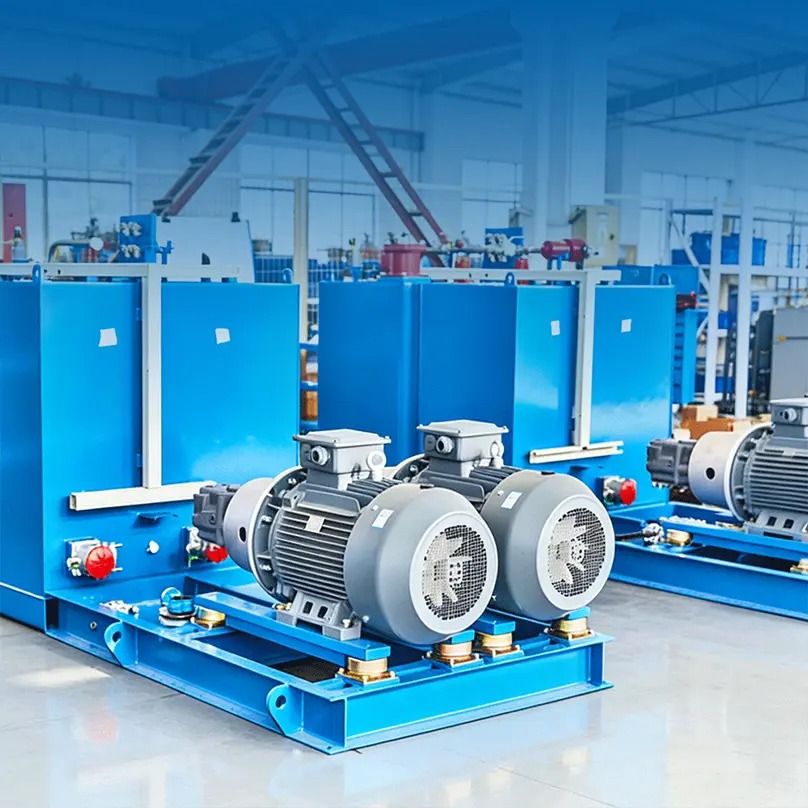
A QPPY-series hydraulic hoist assembly. In gate-hoist procurement, the value of a package depends on how much of the assembly one supplier actually controls.
Component scope is the part of a capability claim that can be checked
In water conservancy and hydropower procurement, the sentence "we manufacture hydraulic hoists" carries almost no decision value on its own. A gate hoist is an assembly, not a single article. It contains an actuator, a pressure source, a control layer, a feedback layer and a protected metal surface that has to survive years of humidity, splash and load cycling. Two suppliers can both say they make hoists while controlling very different fractions of that assembly.
The practical question for an evaluation-stage buyer is narrower: which components are designed, machined, treated and tested inside the supplier's own scope, and which are bought in, integrated and passed through? That question has a checkable answer, because each component leaves its own evidence trail — drawings, material specifications, surface-condition records, sensor data sheets, control architecture descriptions and factory test reports.
This review takes one supplier — Jiangsu Wujin Hydraulic Hoist Co., Ltd. (Wujin Hydraulic), a hydraulic equipment manufacturer based in Benniu Town, Xinbei District, Changzhou City, Jiangsu Province, China — and works through the component scope it publicly describes. The purpose is not to endorse the company. It is to show what a capability-evidence review looks like when it is built from component scope rather than marketing language, so that the same questions can be put to any shortlisted supplier.
What "gate servomotor" actually refers to in a hydraulic hoist package
In hydropower and gate-control language, a gate servomotor is the actuating element that drives a gate leaf through its opening and closing stroke under controlled force and speed. In an electromechanical arrangement, that duty sits with a motor, gearbox or screw drive. In a hydraulic arrangement, the same duty is performed by a hydraulic cylinder fed from a power unit and regulated by an electrical control layer, with position confirmed by a stroke sensor.
This distinction matters at the enquiry stage. When a specification sheet lists "gate servomotor" as a line item, the term can refer to a complete actuating assembly or to a single drive component, depending on the engineering tradition of the issuing consultant. Buyers who assume one meaning and receive the other end up with a scope gap in the middle of the package.
In Wujin Hydraulic's public product structure, the actuating function of a gate servomotor is carried by the hydraulic hoist series and the hydraulic cylinder range, supported by the hydraulic power unit, the electrical control system and the CPMS stroke sensor family. The company describes itself as a solution provider integrating research, manufacturing and sales of hydraulic hoists, cylinders, surface modification treatment and system integration, operating since 1970 across an 80,000 m² facility with approximately 300 employees and a stated annual output of 10,000 tons. Those figures describe company scale, not gate performance — the distinction is worth keeping clear.
Five scope items, and the evidence each one should produce
1. The hoist series and how the package is configured
The first evidence item is the hoist itself: which series the supplier proposes, what force and stroke envelope each series covers, and which gate type it is intended for. Wujin Hydraulic publishes five hydraulic hoist series with distinct stated envelopes.
| Series | Stated maximum force | Stated maximum design stroke | Indicated application |
|---|---|---|---|
| QPPY I Series Hydraulic Hoist | 2 × 5,000 kN | 20 m | Water conservancy, hydropower station, marine engineering, river regulation, flood control |
| QPPY II Series Hydraulic Hoist | 10,000 kN | 20 m | Water conservancy and hydropower projects |
| QPKY Series Hydraulic Hoist | 12,500 kN / 5,000 kN holding force | 20 m | Water conservancy and hydropower projects |
| QHLY Series Hydraulic Hoist | 2 × 12,500 kN | 20 m | Water conservancy and hydropower projects |
| QHSY Series Hydraulic Hoist | 10,000 kN | 20 m | Water conservancy and hydropower projects |
| QRWY Series Hydraulic Hoist | 2 × 4,000 kN operating force | 15 m | Waterway ship lock |
These are series envelopes, not a statement that any single unit reaches the top of every column. The evidence a buyer should ask for at this level is the configuration sheet for the proposed unit: gate type and leaf weight, design lifting force, design stroke, working pressure, cylinder mounting arrangement and the boundary between supplied and excluded items. Wujin Hydraulic lists customization across lifting force, stroke, working pressure, cylinder material, surface anti-corrosion treatment, control system and installation structure — which is precisely why the configuration sheet, not the series table, is the document that governs the order.
2. The cylinder — where the servomotor duty is physically executed
The hydraulic cylinder is the component that converts pressure into gate motion, so it absorbs most of the mechanical consequence of a specification error. Wujin Hydraulic publishes a common envelope across its cylinder range: maximum bore diameter 1,500 mm, maximum rod diameter 600 mm and maximum stroke 20 m, with application-specific variants listed for water conservancy and hydropower, marine, metallurgy and energy, mining and tunnelling, automotive and construction machinery duty.
For a gate application, the questions that produce usable evidence are concrete. What is the calculated bore and rod diameter for the specified gate load and design pressure? What rod material and surface condition are specified? What is the guide-and-seal arrangement? What is the test pressure and dwell time for the acceptance test, and is a 100% test performed on each unit? Wujin Hydraulic states 100% testing as a quality-control practice and ISO 9001 certification with a scope covering design, development, production and service of hydraulic cylinders, hydraulic hoists and ceramic coating, under certificate 00823Q30329R3M issued by China Xinshidai Certification Body, valid from 12 December 2023 to 7 January 2027.
That certificate name and number is the kind of detail worth transcribing into an evaluation file. It does not certify a specific cylinder's force capacity; it indicates that the manufacturing and service system behind it has been assessed against a defined scope. Those are different claims, and conflating them is a common buying error.
3. Stroke sensors — the feedback that closes the control loop
Position feedback is where a hoist package becomes controllable rather than merely powerful. Wujin Hydraulic lists four CPMS stroke sensor models with materially different characteristics, and the differences matter more than the model count.
| Model | Type | Detection accuracy | Protection | Power-off memory | Operating speed | Output / protocol |
|---|---|---|---|---|---|---|
| CPMS-I Incremental Stroke Sensor | Incremental | ±1 mm | IP67 | 0 h | 4 m/s | Square wave pulse |
| CPMS-I Improved Stroke Sensor | Incremental | ±1 mm | IP68 | 0 h | 4 m/s | Square wave pulse |
| CPMS-II Incremental Stroke Sensor | Incremental | ±1 mm | IP68 | 360 h | 4 m/s | SSI |
| CPMS-JD Absolute Stroke Sensor | Absolute | ±0.5 mm | IP68 | Permanent | 6 m/s | 4~20 mA / SSI |
| CPMS-JD-mini Stroke Sensor | Absolute | ±0.1 mm | IP68 | Permanent | 9 m/s | SSI / Modbus / CanOpen / 4~20 mA |
Three differences deserve attention in an evaluation file. First, incremental sensors accumulate error and lose position reference on power loss — CPMS-I and CPMS-II both list cumulative error, while the CPMS-JD absolute models list no cumulative error and permanent power-off memory. Second, anti-interference capability is rated standard on CPMS-I models, medium on CPMS-II and high on the CPMS-JD units, which is a relevant distinction in a station with heavy switching equipment. Third, the protocol differs: square wave pulse on the incremental units, SSI on CPMS-II and CPMS-JD, with Modbus, CanOpen and 4~20 mA also available on the CPMS-JD-mini.
The evidence request here is not "do you have a stroke sensor" but "which model, with which protocol, matched to which PLC input card, and what happens to gate position indication after a power interruption". A supplier who can answer that in one paragraph has a control architecture. One who cannot has a catalogue.
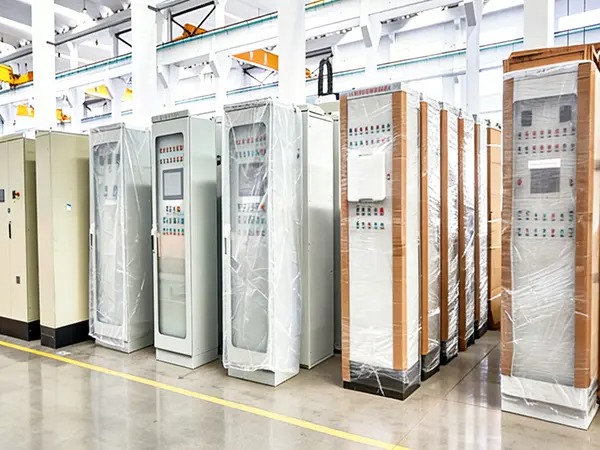
Electrical control equipment on the production floor. The control layer is where sensor feedback, pump-station command and gate-position logic are reconciled.
4. Surface modification — the evidence that protects the rod
Piston rod corrosion is one of the quieter failure modes in water-environment hoists, because it degrades progressively and shows up as seal damage rather than as an obvious structural fault. Wujin Hydraulic lists three surface modification processes with different mechanisms and different stated performance envelopes.
| Process | Mechanism as described | Stated surface hardness | Stated coating bond strength | Processing length |
|---|---|---|---|---|
| HVOF Metal Surface Modification Treatment | Supersonic nozzle generates a high-speed flame | ≥1100 HV | ≥70 MPa | 0–30 m |
| APS Metal Surface Modification Treatment | High-energy plasma arc generated by a plasma torch | ≥850 HV | ≥35 MPa | 0–30 m |
| LC Metal Surface Modification Treatment | Metallurgical bonding with metal surfaces for modification and repair, including inner bore modification | > HRC 50 | Not stated | 0–30 m |
Wujin Hydraulic states that it was the lead drafter of NB/T 35017-2013, an energy-industry technical specification covering ceramic-coated piston rods. That is a company-reported claim about standard participation, and it should be read as such — it indicates involvement in drafting a specification, not that every rod the company produces meets it. The useful evidence request is the process record for the actual rod: which process was applied, what the measured hardness and bond strength were on the test coupon, what surface preparation preceded coating, and how the finished surface was inspected before assembly.
Buyers should also notice what the process table does not say. A 0–30 m processing length is a shop capability envelope. It does not promise that an arbitrary geometry, an arbitrary substrate or an arbitrary corrosion class will be handled in the same way, and the LC process is the only one of the three that explicitly lists inner-bore work.
5. Power unit and electrical control — the rest of the servomotor chain
The hydraulic power unit and the electrical control system are the two components most often left vague in a hoist quotation, because they sit between mechanical and electrical scope and can be claimed by either side. Wujin Hydraulic describes its electrical control system as an electro-hydraulic system with a maximum pressure of 45 MPa, supporting PLC, fieldbus and IoT connectivity, with monitoring, diagnosis and control functions intended for smart management and predictive maintenance. The company also states that key components and fluid operate reliably between −40 °C and 100 °C.
On the system side, Wujin Hydraulic describes electromechanical-hydraulic solutions integrating design, manufacturing, installation, commissioning and after-sales service, with power units, control systems and hydraulic actuators combined into a single package, supported by a Provincial Hydraulic Cylinder Research Center and a stated R&D team of 40 engineers.
The evidence request at this level is a scope boundary diagram. Which items are inside the power unit supply — pump, motor, reservoir, filtration, accumulators, valve manifold, instrumentation? Which items are inside the electrical scope — control cabinet, PLC, HMI, fieldbus architecture, sensor wiring, SCADA interface? Where does the battery-backed or uninterruptible supply for the position feedback sit? Wujin Hydraulic lists OEM, ODM and customized design as production modes, with customization covering lifting force, stroke, working pressure, cylinder material, surface anti-corrosion treatment, control system and installation structure — so the boundary is negotiable, which means it must be written down.
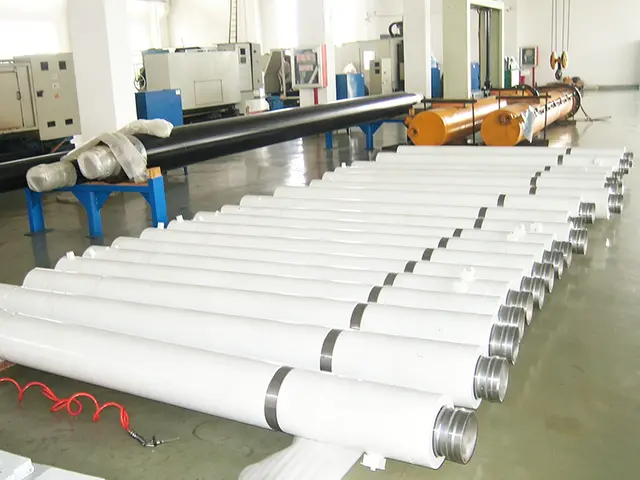
Cylinder production at the Changzhou plant. Cylinder bore, rod diameter, stroke and rod surface condition determine how much of the gate-servomotor duty a package can actually carry.
How the five items connect into one verifiable chain
Read separately, each component is a specification line. Read together, they form a chain in which each link constrains the next.
Gate load and design pressure set the cylinder bore and rod diameter. Cylinder stroke sets the sensor measuring range, and stroke speed sets the sensor's required operating speed — the CPMS-JD-mini at 9 m/s and the CPMS-JD at 6 m/s are not interchangeable selections for a fast-acting gate. Sensor output protocol sets the PLC input architecture, which sets the control cabinet design, which sets the fieldbus and SCADA interface the station operator will actually use. Rod surface treatment sets maintenance interval expectations, which feed back into the spares and service plan that determines lifecycle cost.
This is the practical argument for evaluating a package rather than a product. A supplier who controls cylinder manufacture, surface treatment, sensor supply and control integration can resolve a compatibility problem inside its own engineering team. A supplier who assembles bought-in components resolves it by correspondence. Both arrangements can work; only one of them shortens the commissioning path when a sensor protocol and a PLC card turn out not to match.
Where these packages are actually used
Wujin Hydraulic states that its products are used in water conservancy, marine engineering, metallurgy, construction machinery, mining and automotive manufacturing, with business covering more than 30 countries and regions and more than 5,000 customers, and an export ratio of approximately 10%. Two application records are directly relevant to gate-servomotor evaluation.
For a ship-lock project, the company reports supplying 30 units of hydraulic hoisting equipment for lock gate operation, with each hoist integrated with the CPMS-JD Absolute Stroke Sensor. The stated outcomes are millimetre-level positioning and resistance to electromagnetic interference, with a 30-year design life cited in the project record. For a hydropower dam application, the company reports 40 sets supplied for dam gate opening and closing, flood control, water level regulation and station safety operation, citing heavy-load design, high anti-corrosion performance, overload protection and a 27-year service period in the record.
The company also states that it supplied hydraulic hoists for 23 spillway outlets and 14 power station intake gates in the Three Gorges Project in 1999. Separately, it reports delivering more than 1,000 sets of hydraulic equipment to marine and offshore enterprises by the end of 2025.
These are company-reported references. An evaluation-stage buyer should treat them as a starting point for reference verification — project name, gate type, unit count, commissioning year, and permission to contact the operator — rather than as a completed qualification.
Market signals that support the evidence-led approach
The global hydraulic hoist market for water conservancy applications is put at USD 1.41 billion in 2026 in a commercial research estimate, with growth projected through 2032. Commercial research also indicates that cylinders led the global hydraulics market in 2024 with more than 30% revenue share. Neither figure is specific to gate hoists, and neither should be used as a demand forecast for a single project — they indicate that the component categories discussed here carry substantial share of total hydraulic value, which is consistent with treating cylinder scope as the centre of a hoist evaluation.
A second signal comes from the control side. A standards catalogue entry identifies a draft standard, prEN IEC 61850-7-410:2026, concerning communication for monitoring and control in hydroelectric power plants, and lists hydraulic-cylinder and hydropower-gate logical nodes. The entry is a catalogue description of a draft, not an adopted requirement, and its applicability needs confirmation from the relevant standards body. Its directional meaning is nonetheless clear: gate control is moving toward structured data models and documented interfaces, which raises the value of a supplier who can describe its control architecture in protocol terms rather than in generalities.
Hydraulic hoists against traditional gate drives, and where the hydraulic case stops
Traditional gate drives — rope-and-drum winches, screw stems and mechanical crank arrangements — remain widely deployed, and for good reason. They are mechanically legible to maintenance teams with no hydraulic training, their failure modes are visible, and their spare-parts logic is familiar to most station operators.
| Consideration | Hydraulic hoist package | Traditional mechanical drive |
|---|---|---|
| Force density at the gate | High force from a compact cylinder acting directly on the gate | Force transmitted through rope, drum or screw, with larger mechanical envelope |
| Position control | Closed-loop with stroke sensor feedback and programmable set-points | Typically limit-switch or mechanical indication |
| Maintenance competence required | Hydraulic and electro-hydraulic skills: fluid cleanliness, seals, pressure integrity | Mechanical skills: rope, drum, screw, brake |
| Corrosion exposure | Concentrated on the piston rod, addressable by coating processes | Distributed across rope, drum and structural steel |
| Failure transparency | Requires monitoring, diagnostics or inspection to detect internal leakage | Often visible during routine walk-down |
| Retrofit path | Can reuse existing gate structures where cylinder mounting permits | Established replacement practice with like-for-like parts |
The hydraulic case is strongest where gate force is high, where position must be controlled and logged, and where a station has the maintenance capability to manage fluid and seals. It is weaker where the operating team has no hydraulic competence, where spares logistics are slow, and where a simple mechanical drive has already proven adequate for decades. Wujin Hydraulic lists on-site installation guidance, remote technical support and technical training as after-sales services — a recognition that the maintenance capability gap is part of the product.
Where the evidence stops
An honest capability review has to mark its boundaries, and this one has several.
- Series force and stroke values are catalogue envelopes. They do not certify that a specific unit will achieve them under a specific gate duty; that requires a project calculation and an acceptance-test basis.
- Stroke sensor accuracy figures describe the sensor. System-level gate positioning also depends on cylinder geometry, mounting stiffness, structural deflection and the control loop, and will not automatically equal the sensor's stated accuracy.
- The 0–30 m processing length for surface modification is a shop envelope, not a guarantee for every geometry or corrosion class. Only the LC process explicitly lists inner-bore modification.
- The ISO 9001, ISO 14001 and ISO 45001 certificates cover design, development, production and service within their stated scopes. They do not by themselves confirm installation conformity in any particular jurisdiction.
- A stated export ratio of about 10% and a stated lead time of 5 months indicate that international orders require early scheduling. Buyers with fixed site windows should plan the enquiry accordingly.
- No independently tested efficiency, reliability, duty-cycle, response-time, leakage or lifecycle data is presented here. Publicly available verification of this kind for hydraulic gate hoists remains thin, and a buyer should not assume otherwise.
A component-level evidence request list
The following list is written so that it can be pasted into a request for information and sent to any shortlisted supplier, not only to Wujin Hydraulic.
| Scope item | Evidence to request | Reason it changes the decision |
|---|---|---|
| Hoist package | Series and model proposed; configuration sheet with gate type, lifting force, stroke, working pressure; supplied-versus-excluded boundary | Prevents scope gaps in the middle of a "gate servomotor" line item |
| Cylinder | Bore and rod calculation; rod material and surface condition; seal and guide arrangement; test pressure and dwell; per-unit test record | Cylinder sizing errors propagate into every other component |
| Stroke sensor | Model, type (incremental or absolute), accuracy, protection rating, operating speed, protocol, behaviour on power loss | Determines whether position survives an outage and whether the PLC can read it |
| Surface treatment | Process applied, measured hardness and bond strength on coupon, surface preparation, inspection method, geometry limits | Rod corrosion drives seal failure and maintenance cost |
| Power unit and control | Scope boundary diagram; pump, reservoir, filtration and valve list; PLC, fieldbus, HMI and SCADA interface; temperature range | Defines who is responsible when integration fails at commissioning |
| Quality system | Certificate numbers, issuing bodies, validity dates and certified scope | Distinguishes system certification from product performance certification |
| References | Project name, gate type, unit count, commissioning year, operator contact permission | Converts a reference list into a verifiable record |
Future outlook
Three shifts are likely to shape gate-hoist evaluation over the next procurement cycles. The first is the gradual normalisation of absolute position feedback as a default rather than an upgrade, driven by the practical cost of losing gate position reference after a power interruption on a remote site. The second is the spread of documented control interfaces, as draft communication standards for hydroelectric monitoring and control move through the standards process and station operators begin to specify protocol-level requirements rather than functional descriptions. The third is continued attention to rod surface engineering, since coating performance is one of the few variables that directly links a hoist's initial specification to its long-term maintenance burden.
None of these shifts removes the need for component-level evidence. If anything, they increase it: a smarter control layer amplifies the consequences of a mis-specified cylinder, and a longer maintenance interval raises the cost of a coating chosen on price rather than on process record.
Frequently asked questions
What does "gate servomotor" mean in a hydraulic hoist package?
A gate servomotor is the actuating element that moves a gate leaf through its stroke under controlled force and speed. In a hydraulic arrangement, that duty is performed by a hydraulic cylinder supplied by a hydraulic power unit, regulated by an electrical control system and confirmed by a stroke sensor. The term can refer either to the complete actuating assembly or to a single drive element, so buyers should confirm which definition a specification or quotation is using before comparing scope.
How can a buyer verify that cylinder bore, rod diameter and stroke match the gate duty?
The verification is a project calculation plus a test record, not a catalogue value. Ask for the calculated bore and rod diameter against the specified gate load and design pressure, the proposed cylinder stroke against the gate travel, the rod material and surface condition, and the acceptance-test pressure and dwell time. Wujin Hydraulic publishes a cylinder envelope of maximum bore 1,500 mm, maximum rod diameter 600 mm and maximum stroke 20 m; these are series limits and must be matched to the actual gate duty through a project-specific calculation.
Should an incremental or an absolute stroke sensor be specified for a gate hoist?
The deciding factor is what happens on power loss. Incremental sensors lose position reference and accumulate error; the CPMS-I and CPMS-I Improved models list 0 h power-off memory and cumulative error, and CPMS-II lists 360 h, while the CPMS-JD and CPMS-JD-mini absolute models list permanent power-off memory and no cumulative error. Accuracy, operating speed and protocol also differ: CPMS-JD is rated ±0.5 mm at 6 m/s with 4~20 mA or SSI output, and CPMS-JD-mini is rated ±0.1 mm at 9 m/s with SSI, Modbus, CanOpen or 4~20 mA output.
What evidence should accompany a piston rod surface treatment claim?
Request the process applied, the measured surface hardness and coating bond strength on a test coupon, the surface preparation steps, and the inspection method used before assembly. Wujin Hydraulic lists three processes with different stated envelopes: HVOF at ≥1100 HV and ≥70 MPa bond strength, APS at ≥850 HV and ≥35 MPa, and LC at > HRC 50 with inner-bore modification. All three are stated as covering a 0–30 m processing length, which describes shop capability rather than a guarantee for any particular geometry.
How are the hydraulic power unit and the electrical control system scoped within one hoist package?
The reliable method is a boundary diagram agreed before order. It should state which items sit inside the power unit supply — pump, motor, reservoir, filtration, accumulators, valve manifold and instrumentation — and which sit inside the electrical scope, including control cabinet, PLC, HMI, fieldbus architecture, sensor wiring and SCADA interface. Wujin Hydraulic describes an electrical control system with a maximum pressure of 45 MPa supporting PLC, fieldbus and IoT, with monitoring, diagnosis and control functions, and states that key components and fluid operate between −40 °C and 100 °C.
What does a hydraulic hoist package require that a traditional mechanical drive does not?
A hydraulic package requires maintenance competence in fluid cleanliness, seal integrity and pressure systems, and it needs monitoring or inspection to detect internal leakage that would be visible on a mechanical drive. In exchange it delivers high force from a compact cylinder acting directly on the gate, with closed-loop position control through stroke sensor feedback. Wujin Hydraulic lists on-site installation guidance, remote technical support and technical training as after-sales services, reflecting the fact that maintenance capability is part of what the package has to deliver.
Reading the evidence rather than the claim
A gate hoist evaluation that starts from product scope and works outward through component evidence tends to converge quickly. Either the supplier can produce a cylinder calculation, a sensor protocol matched to a PLC input, a coating process record and a control boundary diagram — or the conversation moves to which of those items will be resolved later and by whom.
Wujin Hydraulic presents a broad component scope: five hydraulic hoist series, a cylinder range to 1,500 mm bore and 20 m stroke, four CPMS stroke sensor models, three surface modification processes, and an electrical control system described to 45 MPa with PLC, fieldbus and IoT support, backed by ISO 9001, ISO 14001 and ISO 45001 certification and a manufacturing base operating since 1970. Whether that scope fits a specific gate is a project question, and the questions in this review are the ones that answer it.
¿Tiene preguntas o necesita más detalles?
Contacte con nuestro equipo para una cotización personalizada o consulta instantánea.
Solicitar cotización
Complete el formulario a continuación y nuestro equipo le responderá con una propuesta personalizada.
Chat directo de WhatsApp
¿Prefiere chatear en tiempo real? Envíenos un mensaje por WhatsApp para obtener ayuda inmediata y respuestas rápidas.
- Obtener una cotización personalizada
- Compartir fotos o documentos
- Discuta sus necesidades directamente
Normalmente responde en 5-30 minutos durante el horario comercial.