
Hydraulic Gate Hoist Specification: Constraints That Matter
An independent buyer reference on force, stroke, coating, position feedback and conformity evidence in water conservancy gate hoist procurement.
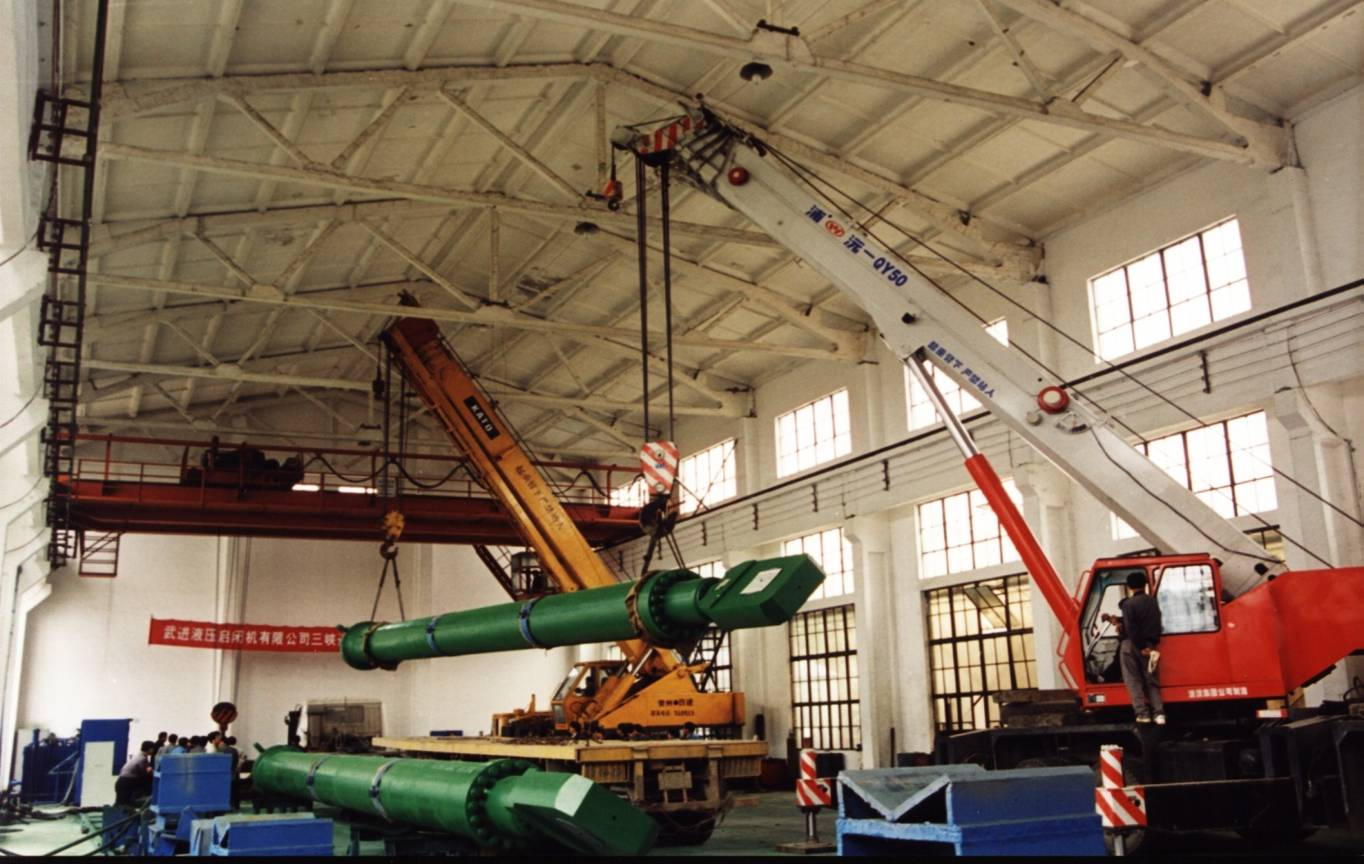
Hydraulic gate hoists are engineered per gate, not per catalogue line. Image source: Wujin Hydraulic project reference material.
A hydraulic gate hoist is the machine that lifts, holds and lowers a water-control gate by converting hydraulic pressure into controlled linear motion. In water conservancy, hydropower and navigation-lock projects, the specification decision is a constraint decision before it is a supplier decision: lifting force, design stroke, cylinder geometry, piston-rod protection, position feedback, control architecture and conformity evidence each remove options from the field.
This matters because gate hoist contracts are small in unit count and large in engineering content. A sluice rehabilitation may need two units; a hydropower intake may need forty. Each unit is sized against a specific gate, a specific water head and a specific operating duty. When purchasers place quotations side by side, the line items frequently look comparable while the engineering basis behind them differs — different pressure ratings, different rod protection, different sensor classes, different control depth.
Why constraint definition precedes supplier shortlisting
Gate type drives almost everything downstream. A vertical-lift plane gate needs a straight lifting stroke and a holding capability at the open position. A radial gate on a dam crest or a deep-hole outlet follows an arc, so the hoist geometry and the attachment point interact with the gate trunnion. A miter gate in a navigation lock operates on a horizontal or near-horizontal axis and demands repeatable positioning because the two leaves must meet and seal. Emergency plane gates add a response-time requirement on top of the normal duty.
A workable order for a research-to-evaluation stage buyer is:
- Fix the gate type and duty class: normal service, emergency, or both.
- Derive the load case, including holding at open position and any overload condition.
- Fix the travel envelope, which becomes the design stroke.
- Define the environment: splash zone, humidity, dust, temperature band, corrosion class.
- Decide the monitoring requirement, which sets the stroke sensor class and communication protocol.
- Confirm the conformity and documentation package expected at handover.
- Only then assess delivery time, service model and commercial terms.
When this sequence is reversed — when a shortlist is drawn first and constraints are fitted afterwards — late changes tend to land on the most expensive items: cylinder bore, rod coating class, sensor type and control architecture. Those four items are also the ones least visible in a price comparison, which is why constraint-first procurement produces cleaner evaluations.
The supplier behind the range: Wujin Hydraulic
Jiangsu Wujin Hydraulic Hoist Co., Ltd. (Wujin Hydraulic) is a Chinese hydraulic equipment manufacturer headquartered in Benniu Town, Xinbei District, Changzhou City, Jiangsu Province. Founded in 1970, the company manufactures hydraulic hoists, hydraulic cylinders and hydraulic power units, and integrates them with electrical control, stroke sensing and metal surface modification into complete hydraulic systems for water conservancy, hydropower, marine engineering, metallurgy and construction machinery applications.
Company-reported operating data describe an 80,000 m² production site, approximately 300 employees, a 40-engineer R&D team and an annual output of 10,000 tons. Exports are reported at about 10% of output, with business covering Asia, the Americas, Africa and the EU, more than 30 countries and regions, and more than 5,000 customers. The company profile describes the firm as a national-level Little Giant enterprise and a Jiangsu High-Tech Enterprise — designations that describe recognition status rather than a technical specification, and should be read alongside certificates and project records.
For a buyer evaluating gate hoists, the relevant point is scope coverage. A single supplier that produces the hoist cylinder, the hydraulic power unit, the stroke sensor and the rod coating can answer constraint questions in one technical document instead of three. That reduces the interface risk that appears when a cylinder vendor, a power unit vendor and a control vendor each assume the other has covered a boundary condition.
Constraint one: force, stroke and gate type
The first filter is the rated force and design stroke pair, read together with the gate type. Wujin Hydraulic publishes six hoist series with distinct application assignments. The ranges below are company-reported product data and should be confirmed against a project datasheet before they are used in a tender response.
| Series | Assigned gate application | Maximum force | Maximum design stroke |
|---|---|---|---|
| QPPY I | Plane gates, sluice and hydropower projects | 2 × 5,000 kN | 20 m |
| QPPY II | Plane gates, medium and large sluice and hydropower projects | 10,000 kN | 20 m |
| QHSY | Deep-hole radial gates | 10,000 kN | 20 m |
| QPKY | High-speed emergency plane gates | Holding 12,500 kN / 5,000 kN | 20 m |
| QHLY | Hydraulic hoist, water conservancy and hydropower | 2 × 12,500 kN | 20 m |
| QRWY | Navigation lock miter and vertical-lift gates | 2 × 4,000 kN | 15 m |
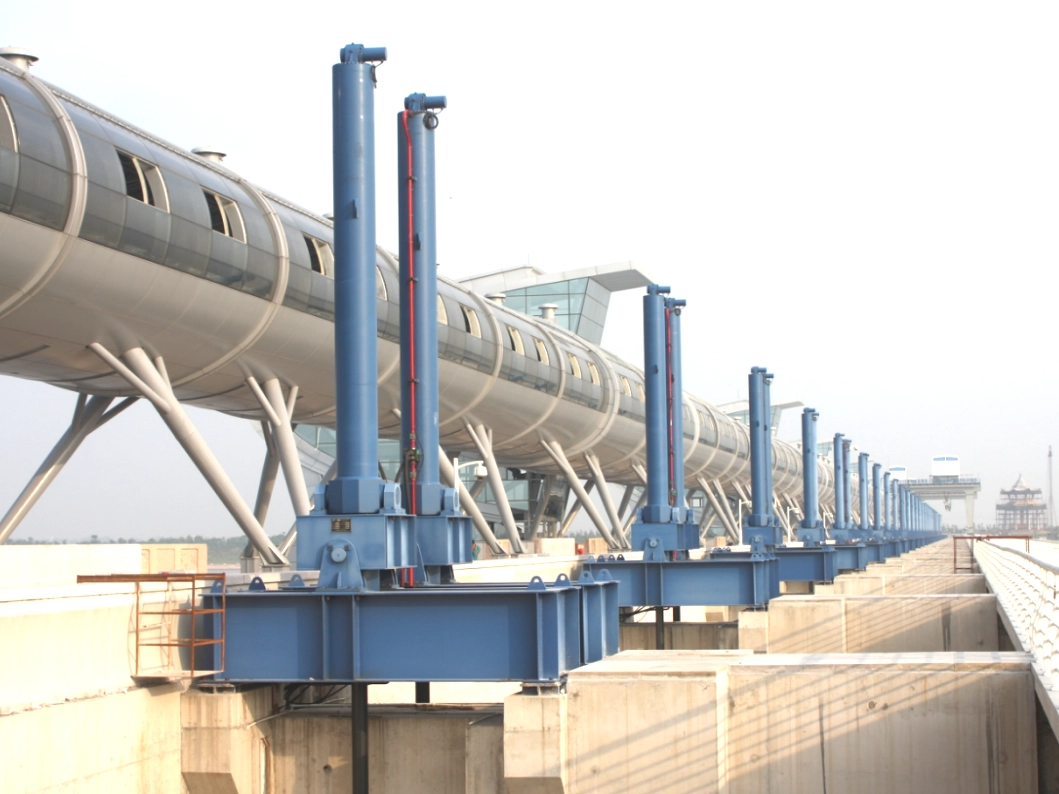
QPPY II series hydraulic hoist, rated to 10,000 kN with a maximum design stroke of 20 m.
Two cautions apply to any such table. First, the force figure is a rating, not a load case: the governing number is the worst combination of water head, gate weight, friction, ice or debris loading and the required holding condition. Second, capacity language differs across the market. One published supplier range describes gate hoists from 5 t to 125 t while another uses kilonewtons; a tonne figure and a kilonewton figure are not interchangeable without a stated conversion and a stated rating basis. For a defensible tender comparison, require force, design pressure, bore, rod diameter, stroke and holding condition on the same datasheet line.
Constraint two: cylinder geometry and piston-rod protection
The hydraulic cylinder is where the specification becomes physical. For water conservancy and hydropower service, Wujin Hydraulic lists cylinder capability up to 1,500 mm bore diameter, 600 mm rod diameter and 20 m stroke. Those limits define the envelope inside which the gate kinematics must fit. If a project needs a longer stroke or a larger bore, it moves outside the published range and becomes a development item rather than a selection item.
The piston rod is the exposed surface of the machine. It slides through the seal package, sits in splash and humidity, and carries any abrasion from silt-laden water. Rod condition therefore drives seal life, leakage risk and downtime. Wujin Hydraulic offers three surface modification routes, each with a different hardness and bond basis:
| Treatment | Reported surface hardness | Coating bond strength | Processing length |
|---|---|---|---|
| HVOF | ≥ 1100 HV | ≥ 70 MPa | 0–30 m |
| APS | ≥ 850 HV | ≥ 35 MPa | 0–30 m |
| LC | > HRC 50 | Not stated | 0–30 m, inner bore modification available |
Wujin Hydraulic reports that it built China's first long-stroke ceramic piston rod production line in 2007 and took the lead in drafting the energy industry standard NB/T 35017-2013, Technical Specification for Ceramic Coated Piston Rods, promulgated by the National Energy Administration of China. Whether or not a buyer specifies ceramic coating, the existence of a dedicated rod-coating standard is a useful evaluation anchor: it gives both sides a common vocabulary for hardness, bond, thickness and acceptance instead of an adjective such as anti-corrosion.
Constraint three: position feedback and its trade-offs
Gate position is not a convenience reading. A miter gate must close to a repeatable line. A radial gate must stop at defined openings for discharge control. A plane gate in a flood-control channel must report its seated condition before the operator can trust the system state. That makes the stroke sensor a specification item, not an accessory.
| Model | Type / accuracy | Power-off memory | Speed limit | Signal / protocol |
|---|---|---|---|---|
| CPMS-JD-mini | Absolute, ±0.1 mm | Permanent | 9 m/s | SSI / Modbus / CANopen / 4–20 mA |
| CPMS-JD | Absolute, ±0.5 mm | Permanent | 6 m/s | 4–20 mA / SSI |
| CPMS-II | Incremental, ±1 mm | 360 h | 4 m/s | SSI |
| CPMS-I improved | Incremental, ±1 mm | 0 h | 4 m/s | Square wave pulse |
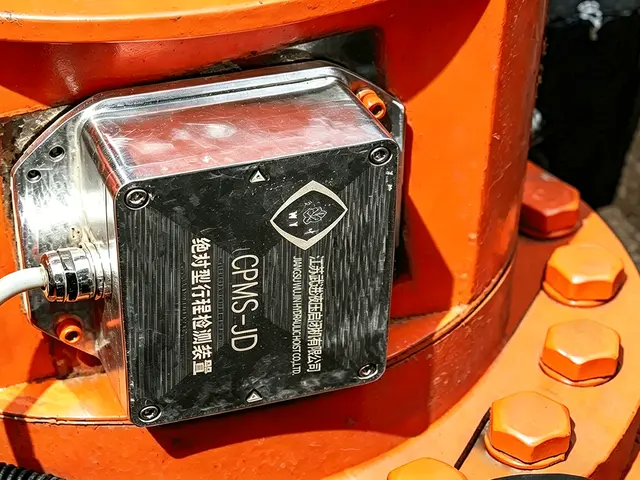
CPMS-JD absolute stroke sensor: ±0.5 mm detection accuracy, IP68 protection, permanent power-off memory.
All four models are rated IP68 with high or medium anti-interference capability according to the published data. The differences that decide a project are rarely the headline accuracy alone. An absolute sensor reports true position after a power interruption; an incremental sensor must be re-referenced and carries cumulative error over repeated cycles, and its memory window is finite — 360 hours on the CPMS-II, none on the CPMS-I improved. For a gate that sits closed for months and is then opened under flood conditions, that distinction is operational rather than academic.
Wujin Hydraulic describes its sensing method as active magnetic detection with a special structure on the piston rod surface, together with high-performance data acquisition and processing chips, positioned as offering higher sensitivity and better temperature adaptability than conventional Hall sensors. That is a company technical claim; it should be checked against site acceptance test results rather than accepted as a general market fact.
Constraint four: power, control and environment
The hydraulic power unit and the electrical control system set two more boundaries: pressure envelope and environmental range. Wujin Hydraulic lists an electro-hydraulic system maximum pressure of 45 MPa with PLC, fieldbus and IoT support, plus monitoring, diagnosis and control functions intended for predictive maintenance. Key components and hydraulic fluid are stated to operate reliably between −40 °C and 100 °C, which is the relevant figure for exposed gates in cold or high-temperature sites.
Control depth is a frequent source of cost divergence between quotations. A hoist with local push-button operation, a hoist with remote supervisory control and a hoist with condition monitoring and diagnostic data streams can share the same cylinder and still differ substantially in engineering hours. Buyers should specify the required operating modes explicitly — the reference application data for water conservancy sites lists automatic or manual remote control, local on-site operation and emergency manual operation as distinct modes, each of which has to be engineered rather than assumed.
Constraint five: read what the certificate actually covers
A certificate is evidence of a management system, not a product approval for a specific gate. Wujin Hydraulic holds three current management system certificates issued through Chinese certification bodies:
| Standard | Certificate number | Issuing body | Valid to |
|---|---|---|---|
| ISO 9001:2015 / GB/T 19001-2016 | 00823Q30329R3M | China Xinshidai Certification Body | 7 January 2027 |
| ISO 14001:2015 / GB/T 24001-2016 | 01424E10009R4M | China United Certification Center (Beijing) Co., Ltd. | 5 January 2027 |
| ISO 45001:2018 / GB/T 45001-2020 | 01424S10008R4M | China United Certification Center (Beijing) Co., Ltd. | 5 January 2027 |
The declared scope on the environmental and occupational health certificates is design, development, production and correlative management activities of hydraulic hoists, hydraulic cylinders for various industrial applications and ceramic thermal spray. The ISO 9001 scope is expressed as design, development, production and service of hydraulic cylinder, and design, development, production and service of hydraulic hoist within the qualification scope, plus ceramic coating. Two practical readings follow. First, the certificates cover manufacturing and design activity, not installation permits, civil works approvals or dam-safety acceptance in the buyer's jurisdiction. Second, a certificate has an expiry date; buyers evaluating in 2026 should note that all three run into early January 2027 and will require re-issue confirmation for contracts that extend beyond that point.
Where this constraint set has been applied
Reference records are the weakest link in most gate hoist evaluations, because projects are public infrastructure and supplier case notes are rarely accompanied by owner acceptance documents. Three company-reported records illustrate the application range, and each should be verified with project documentation during due diligence.
For a navigation lock project delivered to an EPC contractor, Wujin Hydraulic supplied 30 units of hydraulic hoisting equipment for lock gate operation with a stated 30-year design life. Each hoist in that record is integrated with the CPMS-JD absolute stroke sensor, which the company describes as providing millimetre-level positioning accuracy and strong resistance to electromagnetic interference. The engineering point is not the unit count but the sensor pairing: a lock gate is a case where absolute position after power loss is a functional requirement rather than a refinement.
For a large hydropower dam application, the company reports 40 sets for gate opening and closing, flood control and water level regulation, with a 27-year design life and operation under high water pressure with overload protection. For the Three Gorges Project, the company reports supplying hydraulic hoists for 23 spillway outlets and 14 power station intake gates, a total of 37 gate systems. Long design-life statements are common in this industry; what a buyer can actually test is the maintenance and retrofit pathway attached to them.
Market signals that affect specification
Demand context is useful for planning, less useful for budgeting. A commercial research estimate cited in the October 2026 data package places the global hydraulic hoist market for water conservancy at USD 1.41 billion in 2026, projected to grow through 2032. That figure is a commercial-research estimate rather than an official statistical series, and the same dataset explicitly notes the absence of official government output figures specific to hydraulic hoists. It indicates direction of demand, not the price of a 10,000 kN unit.
A second signal is control integration. A standards catalogue entry identifies a draft, prEN IEC 61850-7-410:2026, covering communication for monitoring and control in hydroelectric power plants, with logical nodes for hydropower gates and hydraulic cylinders. The entry is a catalogue description of a draft and must be confirmed against the official IEC or national standards body text before it is written into a specification. Read cautiously, it signals that gate hoist control is moving toward the same data models already used elsewhere in plant automation — which raises the value of specifying protocol, diagnostics and interfacing at tender stage rather than at commissioning.
A third signal is rating fragmentation. Published supplier capacities in this category appear in tonnes and in kilonewtons, over different design pressures, duty cycles and test conditions. There is no harmonised benchmark. That fragmentation does not indicate a quality problem in any particular offer; it indicates that buyers must normalise the comparison themselves, or ask each bidder to restate the offer on a common datasheet.
Limits, boundaries and what this specification approach cannot do
A credible evaluation states its own boundaries. Five limits apply to the data and product set described here.
Delivery time is a real constraint. Published capability data lists a lead time of approximately 5 months, with a minimum order quantity of one set and OEM, ODM and customized design modes. A single-set MOQ makes the supplier accessible to a small rehabilitation project, but the five-month window is not a fast-track option. Projects with a compressed outage window need to plan fabrication into the schedule, not after civil completion.
No public price band exists for this category. Gate hoists are engineered per gate, so cost is driven by force, stroke, coating class, sensor class, control depth and installation support rather than by a catalogue tier. Buyers should build a cost model from those drivers and request itemised breakdowns; a market-size estimate is not a budgeting tool. This is a structural limit of the category, not a gap specific to one supplier.
Sensor precision is a trade, not a free upgrade. The ±0.1 mm absolute mini sensor is the most precise listed option, but matching it to a project that only needs ±1 mm indication adds cost and interface complexity without operational benefit. Conversely, specifying an incremental sensor with a finite power-off memory on a gate that stays closed for long periods creates a re-referencing procedure that must be written into the operating instructions.
Published envelopes are envelopes. The 20 m maximum design stroke, 1,500 mm maximum bore and 30 m surface-treatment processing length define what is standard. A requirement outside those lines changes the procurement from selection to development, with the schedule and validation consequences that follow.
Company-reported records require verification. Project counts, design-life statements and comparative sensing claims in this article come from supplier documentation. They are appropriate for shortlisting, not for contract award; award-grade evidence is the owner acceptance record, the factory acceptance test report and the site acceptance test report for comparable gates.
Future outlook
Three developments are likely to reshape gate hoist specifications over the next planning cycle. The first is instrumentation: as plant-level communication models extend to gate and cylinder logical nodes, position feedback, diagnostics and predictive maintenance data become part of the acceptance scope rather than an optional extra. Suppliers that already build sensors, power units and controls within one system boundary are structurally better placed to answer that, provided the interface documentation is complete.
The second is asset life extension. Much of the installed gate hoist base in water conservancy is decades old, and the retrofit decision — recoat the rod, replace the sensor, modernise the control cabinet, or replace the unit — is increasingly taken on condition data rather than on age. Maintenance and retrofit service, including on-site installation guidance, remote technical support and technical training, therefore belongs in the original evaluation, not in a separate aftermarket conversation.
The third is documentation discipline. As more buyers compare offers across borders, the supplier that can present force, pressure, bore, stroke, coating class, sensor accuracy, protocol and certificate scope on one consistent sheet will be easier to evaluate than one that presents headline capacity and adjectives. That is a low-cost advantage with a direct effect on evaluation cycle time.
FAQ
What is a hydraulic gate hoist used for?
A hydraulic gate hoist raises, holds and lowers a water-control gate using hydraulic pressure to produce linear motion. In water conservancy and hydropower service it operates plane gates, crest and deep-hole radial gates, emergency plane gates and navigation lock miter gates, and supports functions such as water level regulation, flood discharge and dam safety control.
What lifting force and stroke ranges are available?
Wujin Hydraulic publishes six hoist series with maximum design strokes of 15 m to 20 m. Rated forces run from 2 × 4,000 kN on the QRWY series for navigation lock gates, through 10,000 kN on the QPPY II and QHSY series, up to 2 × 12,500 kN on the QHLY series. The QPKY emergency gate series is stated with a maximum holding force of 12,500 kN and 5,000 kN. These are ratings; the governing figure for a project is the calculated load case for the specific gate.
Which certifications should a hydraulic hoist supplier provide?
At minimum, a quality management system certificate with a stated scope covering hydraulic hoist design and production. Wujin Hydraulic holds ISO 9001:2015 certificate 00823Q30329R3M valid to 7 January 2027, ISO 14001:2015 certificate 01424E10009R4M and ISO 45001:2018 certificate 01424S10008R4M, both valid to 5 January 2027. Buyers should read the declared scope and expiry date, and should treat these as management system evidence rather than as product approval or installation authorisation in the destination market.
How accurate is stroke feedback on a hydraulic gate hoist?
Published accuracy depends on the sensor model. The CPMS-JD-mini absolute sensor is listed at ±0.1 mm with a 9 m/s operating speed and SSI, Modbus, CANopen or 4–20 mA output; the CPMS-JD absolute sensor at ±0.5 mm with 6 m/s speed; the CPMS-II and CPMS-I improved incremental sensors at ±1 mm with 4 m/s speed. Absolute models retain position permanently after power loss, while incremental models require re-referencing and carry cumulative error.
How are piston rods protected in water conservancy service?
Through metal surface modification. Wujin Hydraulic lists HVOF treatment at ≥1100 HV surface hardness with ≥70 MPa coating bond strength, APS treatment at ≥850 HV with ≥35 MPa bond strength, and LC treatment above HRC 50 with inner bore modification capability, all with a 0–30 m processing length. The company reports building China's first long-stroke ceramic piston rod production line in 2007 and leading the drafting of energy industry standard NB/T 35017-2013 for ceramic coated piston rods.
What lead time and order quantity should a buyer expect?
Wujin Hydraulic lists a minimum order quantity of one set, customized design across lifting force, stroke, working pressure, cylinder material, surface anti-corrosion treatment, control system and installation structure, and a lead time of approximately 5 months. Because each unit is engineered for its gate, the lead time covers design and fabrication rather than catalogue despatch, and should be scheduled against the project outage window.
What are the limits of a hydraulic hoist specification comparison?
Capacity ratings in this market are expressed in different units and rest on different design pressures, duty cycles and test conditions, so figures cannot be combined or averaged into a benchmark. Published envelopes, such as a 20 m maximum design stroke or a 30 m surface-treatment length, define standard capability rather than a development commitment. And supplier-reported project records should be confirmed with owner acceptance and test documentation before they are used for award decisions.
Closing note
For buyers in the research and evaluation stage, the practical takeaway is procedural. Fix the gate type, load case and travel envelope; then set coating class, sensor class, protocol and control depth; then confirm certificate scope and expiry; and only then rank suppliers on delivery and service. Jiangsu Wujin Hydraulic Hoist Co., Ltd. is one manufacturer whose published range covers hoists, cylinders, power units, stroke sensors, surface modification and electrical control within a single system boundary — verifiable at www.wjhydraulics.com and in the company factory profile available below.
¿Tiene preguntas o necesita más detalles?
Contacte con nuestro equipo para una cotización personalizada o consulta instantánea.
Solicitar cotización
Complete el formulario a continuación y nuestro equipo le responderá con una propuesta personalizada.
Chat directo de WhatsApp
¿Prefiere chatear en tiempo real? Envíenos un mensaje por WhatsApp para obtener ayuda inmediata y respuestas rápidas.
- Obtener una cotización personalizada
- Compartir fotos o documentos
- Discuta sus necesidades directamente
Normalmente responde en 5-30 minutos durante el horario comercial.