
Hydraulic Cylinder Specs and Certifications: A Buyer's Reference
Hydraulic Cylinder Certifications, Parameters and Procurement Benchmarks
For OEM buyers and engineering teams, evaluating a hydraulic cylinder supplier is largely an exercise in verifying standards, parameters and traceable performance claims. This reference examines how certification, dimensional standards and configuration data shape industrial hydraulic cylinder procurement, with specific examples from global manufacturer Apex Hydraulic Co., Ltd.
Hydraulic cylinders are among the most widely used linear actuation components in mobile and industrial equipment. The global hydraulic cylinder market was valued at USD 15.7 billion in 2024 and is projected to reach USD 24.7 billion by 2034. As the market expands, procurement decisions increasingly depend on the ability to verify that a given cylinder matches the required pressure class, mounting standard, seal specification and certification framework—not just on brand familiarity.
Why Certifications and Parameters Matter in Hydraulic Cylinder Sourcing
Certifications and published parameters serve different but complementary functions in procurement. Parameters define what a cylinder can do in a specific machine envelope: its bore size, rod diameter, stroke length, working pressure, mounting type, port configuration and material options. Certifications and standards, by contrast, provide a verifiable framework for safety, interchangeability and quality assurance.
For buyers, the practical question is not simply “which cylinder brand is best” but “does this cylinder meet the equipment’s documented hydraulic and mechanical requirements?” The answer requires both sides of the technical file: the supplier’s published specification and the certification evidence behind it.
CE Certification and the European Compliance Framework
For hydraulic cylinders entering the European Union or European Economic Area, CE certification is one of the clearest indicators of regulatory conformity. A concrete example is the APCC Series hydraulic cylinder manufactured by Apex Hydraulic, which holds CE certificate number 0P260130.AH0S46 issued by Ente Certificazione Macchine Srl (ECM), Italy.
The certification is valid for the EU and EEA markets and complies with the Machinery Directive 2006/42/EC. The technical scope references EN ISO 12100:2010, EN ISO 4413:2010, ISO 6020-1:2007 and ISO 10100:2020. For a procurement engineer, these references are meaningful: they connect the product to machinery safety principles, hydraulic system design rules and cylinder mounting dimension standards.
Buyers sourcing cylinders for equipment destined for Europe should request the certificate number, issuing body and applicable standards rather than accepting a general “CE compliant” statement. The certificate number and issuing body create a traceable compliance record that can be audited.
International Mounting and Dimensional Standards
Mounting dimensions are a central compatibility issue in hydraulic cylinder procurement. A cylinder with the correct force rating but the wrong mounting geometry will fail in the installation phase. International and regional standards reduce this risk by defining mounting dimensions for specific pressure classes.
| Standard | Scope | Relevance to Buyers |
|---|---|---|
| ISO 6022:2006 | Mounting dimensions for single rod hydraulic cylinders, 250 bar series | Ensures interchangeability for heavy-duty industrial cylinders |
| ISO 6020-2:2015 | Mounting dimensions for 160 bar series compact cylinders | Common in industrial automation and machine-building applications |
| NFPA/T3.6.7 R3-2009 (R2024) | Square head industrial cylinder mounting dimensions, North America | Foundation for many North American tie-rod and welded cylinder specifications |
| EN ISO 4413:2010 | General rules for hydraulic fluid power systems | Safety and performance requirements for system design |
Suppliers that publish their products against these standards give buyers a starting point for interchangeability evaluation. For example, Apex Hydraulic’s HTR and HTH tie-rod series are rated at 2,500 PSI and 3,000 PSI respectively, with bore diameters from 2 to 5 inches—commonly cross-referenced with North American agricultural and industrial mounting configurations. Final compatibility still requires verification of the customer’s original part number, dimensional drawing, port specification and application.
Parameter Benchmarks: What a Technical Specification Sheet Should Contain
A professional hydraulic cylinder specification should allow an engineer to determine fit, force, speed and environmental suitability. The following parameters appear consistently across industrial and mobile cylinder datasheets:
- Acting type: Single acting or double acting. Double-acting cylinders derive power from both full and annular bore areas, exerting force in both directions, which is a common requirement in construction and material handling equipment.
- Bore diameter and rod diameter: These determine output force and column stability. Bore sizes up to 150 mm hold 61.6% of the market, reflecting their prevalence in mobile and mid-range industrial equipment.
- Stroke length: Determines linear travel. For telescopic cylinders, stroke length and closed length must be evaluated together.
- Working pressure: For example, front-end telescopic cylinders for tipper trucks are commonly configured with a maximum working pressure up to 250 bar.
- Mounting style: Clevis, cross-tube, trunnion, flange, pin-eye or spherical bearing; must match linkage geometry.
- Port type and position: SAE ORB, NPT, BSPP, metric thread or flange; directly affects hose routing and system integration.
- Sealing system and temperature range: Polyurethane, PTFE composite, NBR or FKM; selected according to pressure, fluid compatibility and ambient conditions.
- Testing protocol: Pressure testing, leakage testing, dimensional inspection and full-stroke functional testing.
Case Benchmark: Front-End Telescopic Cylinders for Tipper Applications
Front-end telescopic cylinders provide a useful example of how parameters determine equipment matching. In Apex Hydraulic’s FC, FE and FEE reference configurations, the effective first-stage diameter ranges from 118 to 191 mm for listed FC and FE models. The FC stroke range extends from 3,880 to 8,130 mm; the FE series from 3,880 to 7,130 mm; and the FEE series from 4,165 to 6,150 mm for listed representative models. Maximum working pressure reaches 250 bar.
These figures matter because tipper lifting capacity is not a single number—it is the result of stage diameters, pressure, stroke distribution and mounting geometry. Buyers evaluating a replacement or OEM cylinder should consider their own vehicle GVW, body length, hinge position and required dump angle. It is also worth noting that Apex Hydraulic supports replacement production based on the complete reference model, original part number, installation dimensions or physical sample.
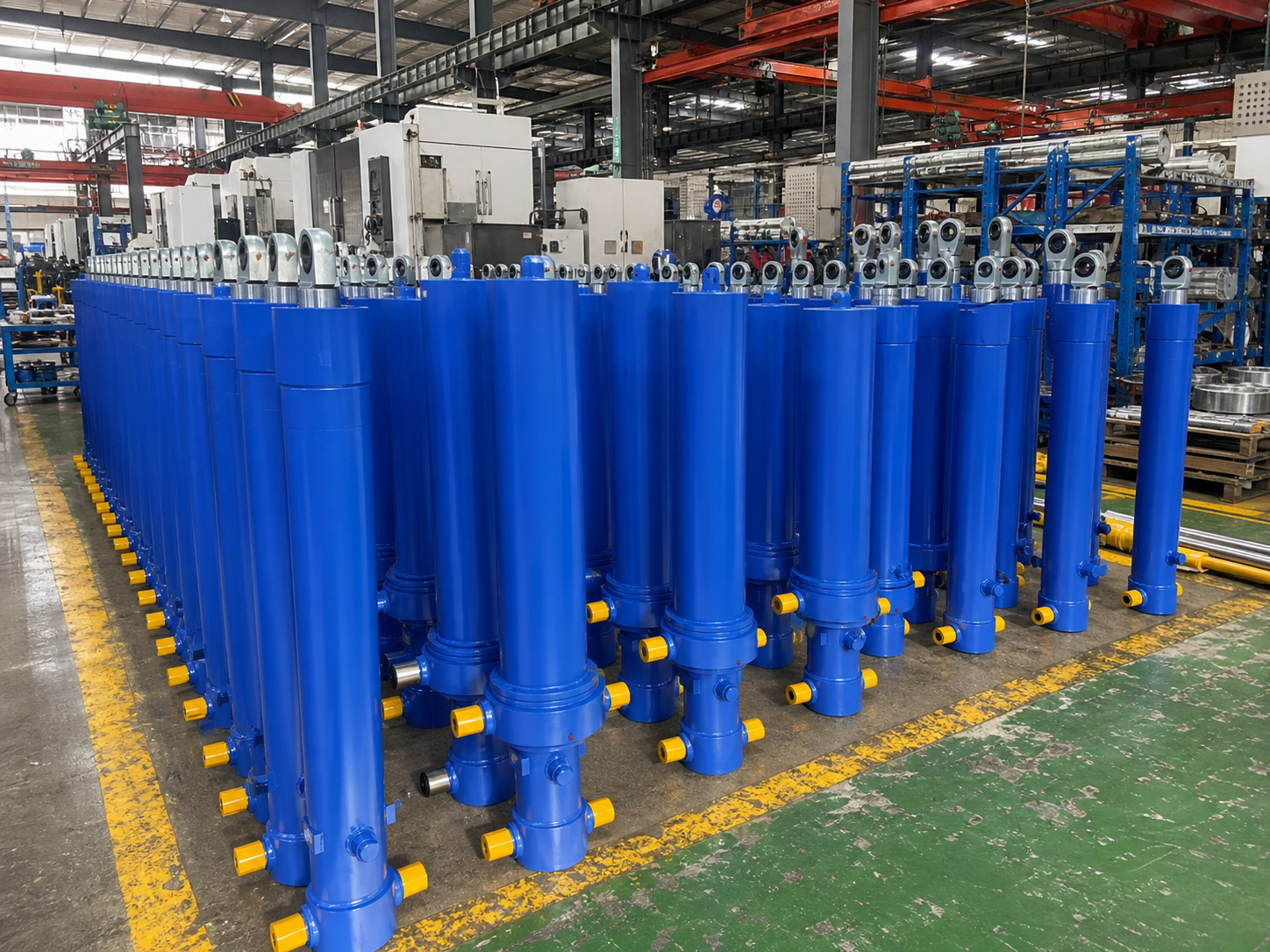
Front-end telescopic cylinders are commonly specified by stage count, effective diameter, total stroke and mounting configuration.
North American Replacement Configurations: The HTC Series Example
For the North American dump trailer market, replacement cylinders are frequently evaluated against established mounting and performance conventions. The Apex HTC-Compatible Series is a practical reference: it offers single-acting inverted telescopic cylinders with working pressure of 3,000 PSI, stroke options from 78 to 144 inches and retracted lengths from 34.75 to 48.75 inches.
Seven-ton and twelve-ton cross-reference configurations are available, subject to dimensional confirmation against the customer’s existing cylinder or approved installation drawing. Customization options include stroke, mounting, port, capacity and connection dimensions. The cylinder construction uses steel telescopic stages with a threaded ductile-iron end cap, V-packing and a polyurethane wiper—details that matter for serviceability in demanding trailer applications.
For a fleet buyer or trailer OEM, the value of these published parameters is that they reduce the engineering effort required to evaluate a replacement. The buyer can compare closed length, stroke, pin diameter, port type and capacity directly against the original cylinder data.
Materials and Surface Treatment: What the Datasheet Should Verify
Material selection affects pressure rating, fatigue life, corrosion resistance and service cost. In the welded hydraulic cylinder range from Apex Hydraulic—HBU, HCL and HTG series—the published material data includes precision-honed steel tube, induction-hardened steel rods with a core hardness of 45–50 HRC, hard chrome-plated surfaces with a final rod surface hardness of 69–71 HRC, and a published chrome thickness of approximately 0.001 inch.
The published corrosion test reference for this range is 96 hours according to ASTM B117-07a. This is a verifiable, quantifiable indicator of salt-spray performance—not a generic durability claim. Buyers working in road-salt, coastal or washdown environments should prioritize this type of evidence.
For corrosive and marine environments, stainless steel cylinder construction offers an alternative: the barrel, rod, ports, mountings and fasteners can be specified in corrosion-resistant materials. Seal materials can then be matched to the actual fluid, cleaning agent and process chemicals. In these applications, the procurement conversation should be about exposure levels, not just peak pressure.
Quality Inspection and Traceability
Because hydraulic cylinders often operate in safety-critical lifting or load-holding functions, the inspection protocol is as important as the design specification. Across Apex Hydraulic’s product range, standard quality inspection includes incoming material inspection, dimensional inspection, weld inspection, hydraulic pressure testing and leakage testing. Final inspection is performed on 100% of cylinders before shipment.
For position-sensing cylinders, testing extends to sensor-output and signal-repeatability, with documentation including an approved drawing, sensor datasheet, wiring diagram, inspection record and test report. For OEM buyers integrating cylinders into automated equipment, this documentation layer supports both machine commissioning and downstream maintenance.
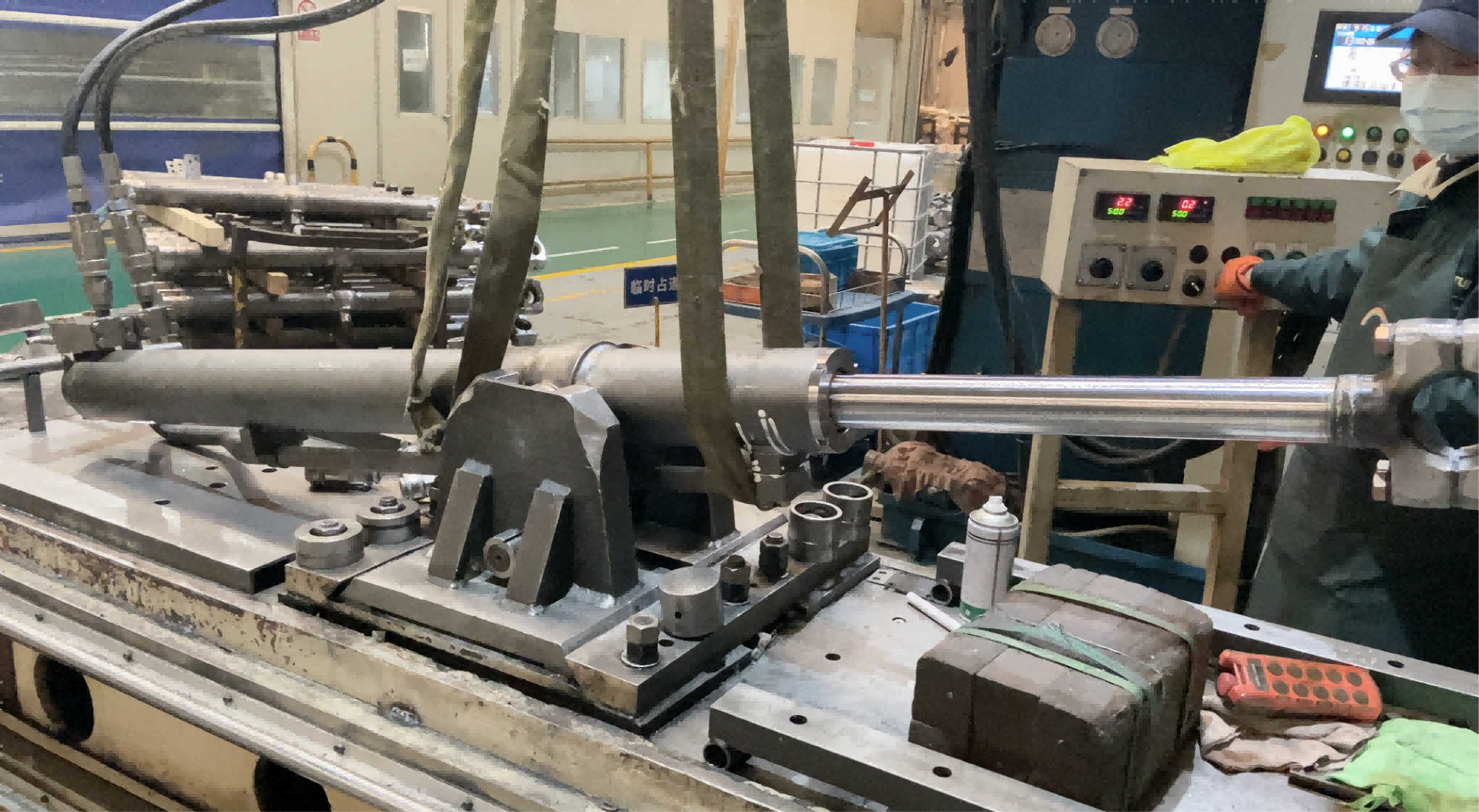
Pressure and leakage testing are standard quality gates before hydraulic cylinders are released for shipment.
Comparison with Traditional and In-House Supply Solutions
Many OEMs have historically relied on in-house cylinder manufacturing or on regional distributors offering only standard models. The comparison with an experienced global manufacturer is not one-sided, and buyers should weigh several factors:
| Factor | In-House / Local Standard Supply | Dedicated Cylinder Manufacturer |
|---|---|---|
| Customization depth | Often limited to standard bore and stroke combinations | Full engineering customization: bore, rod, stroke, mounting, seals, ports, sensors, valve integration |
| Standards coverage | Familiarity with local standards only | Multi-standard production: ISO, NFPA, CE, North American cross-reference series |
| Engineering documentation | May be limited to production drawings | Approved drawings, material records, test reports, sensor datasheets, wiring diagrams |
| Production scale | Batch or job-shop orientation | Dedicated capacity for high-volume OEM programs and replacement series |
| Traceability | May be internally managed | Part numbers, serial numbers, logos and traceability codes available |
Boundary of comparison: A global manufacturer is not always the most efficient choice. For applications requiring very small quantities of a simple standard cylinder with immediate local availability, a regional distributor’s standard stock may deliver lower logistics cost and faster delivery. Custom-manufactured cylinders also require engineering confirmation of dimensions and interfaces, which adds lead time compared with off-the-shelf replacements. The decision should be based on volume, customization complexity, verification requirements and acceptable lead time.
Application Trends Shaping the Industry
The hydraulic cylinder market is being shaped by several verifiable trends. Mobile equipment applications account for 51.8% of market demand, which is consistent with the continued expansion of construction, agricultural and waste-management machinery. Industrial manufacturing is projected to be the fastest-growing end-user segment, with a CAGR of 6.12% through 2031.
Customization and OEM services are also a growing segment as industries shift toward specialized automation machinery. This trend is reflected in the number of cylinder series developed for specific equipment functions—grapple cylinders, mill-duty cylinders, position-sensing cylinders and refuse-truck replacement cylinders—rather than generic universal models.
The U.S. hydraulic cylinder market is projected to reach USD 3.31 billion by 2032, supported by infrastructure modernization. In parallel, Asia Pacific commanded a 40.5% revenue share in 2025, led by China and India. For global buyers, this means sourcing options are increasingly diverse, but so is the need for thorough verification of supplier claims.
What Buyers Should Ask During Evaluation
During the Research and Evaluation stages, buyers should build a checklist that covers technical, compliance and supply-chain concerns. A practical starting point includes:
- Does the product datasheet include bore, rod, stroke, working pressure, mounting, ports and materials?
- Is the working pressure a rating or a tested maximum? What is the proof-test pressure?
- Which standards does the cylinder reference—ISO 6020, ISO 6022, NFPA, CE Machinery Directive?
- Is the certificate number and issuing body available for verification?
- What testing is performed on every cylinder before shipment?
- Can the supplier manufacture from my drawing, part number or sample?
- What documentation will be provided: approved drawing, material records, inspection reports, sensor datasheets?
- What are the lead times for standard products, customized products and large OEM projects?
A supplier that can answer these questions with written evidence is providing more than a product—it is providing a procurement-grade technical foundation.
Future Outlook
The next phase of hydraulic cylinder development will likely emphasize three areas: sensor integration for position feedback and predictive maintenance, corrosion-resistant materials for expanding environmental requirements, and deeper OEM customization of mounting, valve and seal configurations. Certification frameworks will continue to play a gatekeeping role in regulated markets, particularly the EU and North America.
Buyers who treat hydraulic cylinders as engineered components—rather than commodity parts—will be better positioned to reduce downtime, improve energy efficiency and manage total lifecycle cost. The suppliers that will lead the market are those that combine manufacturing capacity with transparent, verifiable technical documentation.
FAQ
Is the APCC Series hydraulic cylinder CE certified, and for which markets?
Yes. The APCC Series hydraulic cylinder holds CE certificate number 0P260130.AH0S46, issued by Ente Certificazione Macchine Srl (ECM), Italy. The certification applies to the European Union and European Economic Area markets and complies with the Machinery Directive 2006/42/EC and EN ISO 12100:2010.
What are the available stroke ranges for front-end telescopic cylinders for tipper trucks?
For the listed standard models in Apex Hydraulic’s reference configurations, the FC series stroke range is 3,880 to 8,130 mm, the FE series stroke range is 3,880 to 7,130 mm, and the FEE series stroke range is 4,165 to 6,150 mm for listed representative models.
What is the maximum working pressure for front-end telescopic cylinders in tipper applications?
The maximum working pressure is up to 250 bar. The effective first-stage diameter ranges from 118 to 191 mm for listed FC and FE configurations. Final model selection must be verified against the vehicle configuration and approved drawings.
Can the Apex HTC-Compatible Series cylinder be customized?
Yes. Customization options include stroke, mounting, port, capacity and connection dimensions. Seven-ton and twelve-ton cross-reference configurations are available, subject to dimensional confirmation against the customer’s existing cylinder or approved installation drawing.
What construction and sealing features does the HTC-Compatible Series use?
The cylinder is constructed of steel with a threaded ductile-iron end cap and features precision-finished telescopic stages. The sealing system includes V-packing and a polyurethane wiper. Material grades, surface hardness, plating thickness and seal brands are confirmed according to the approved Apex Hydraulic production drawing.
What quality inspections are performed on hydraulic cylinders before shipment?
Quality inspection typically includes dimensional inspection, pressure testing, leakage testing and full-stroke functional testing. For specific product ranges, additional checks such as stage sequence testing, sensor-output testing and weld inspection are performed according to the confirmed specification. 100% final inspection is conducted before shipment.
Can replacement production be based on an existing reference model, part number or sample?
Yes. Replacement production can be based on the complete reference model, original part number, installation dimensions or physical sample. Compatible replacement configurations can be manufactured against verified reference model codes, dimensions or customer-approved drawings.
¿Tiene preguntas o necesita más detalles?
Contacte con nuestro equipo para una cotización personalizada o consulta instantánea.
Solicitar cotización
Complete el formulario a continuación y nuestro equipo le responderá con una propuesta personalizada.
Chat directo de WhatsApp
¿Prefiere chatear en tiempo real? Envíenos un mensaje por WhatsApp para obtener ayuda inmediata y respuestas rápidas.
- Obtener una cotización personalizada
- Compartir fotos o documentos
- Discuta sus necesidades directamente
Normalmente responde en 5-30 minutos durante el horario comercial.