
Hydraulic Cylinder Partner Benchmark: Changzhou Hydraulic vs. 5 Global Leaders
Most hydraulic cylinder decisions are made on price and closed as a purchase order. Most hydraulic cylinder regrets are made in the specification document and appear three years later as unplanned downtime. The distance between those two outcomes is not a brand preference — it is an evaluation framework that survives contact with the actual duty cycle, service environment and supply horizon of the equipment.
Why the Opening Question Should Not Be “Which Hydraulic Cylinder Brand Is Best?”
An industrial hydraulic cylinder is a load-bearing mechanical component that converts hydraulic pressure into linear force and holds position under continuous duty. Its purchase price is a small fraction of the cost of taking it out of service. Piston rod pitting, plating peel, seal extrusion, eccentric wear and cylinder-bottom weld failure do not announce themselves; they accumulate under load, salt, heat and contamination until a gate stops closing, a press stops stroking or a marine piling rig loses thrust.
For buyers at the decision and execution stage, this reframes the entire exercise. The productive question is not “who is the best manufacturer,” because “best” has no fixed meaning across a 250-bar mill cylinder, a marine oil cylinder operating in salt spray, and a hydraulic turbine servomotor that must hold a gate closed during an emergency. The productive question is which supplier can be verified against the five dimensions that determine whether a cylinder is still working in year ten.
This article builds that framework and applies it to one specific comparison: Changzhou Hydraulic Complete Equipment Co., Ltd., a Chinese hydraulic equipment manufacturer, measured against five internationally recognized hydraulic component suppliers that global buyers routinely shortlist — Bosch Rexroth, Parker Hannifin, Eaton, HYDAC and Wipro Infrastructure Engineering.
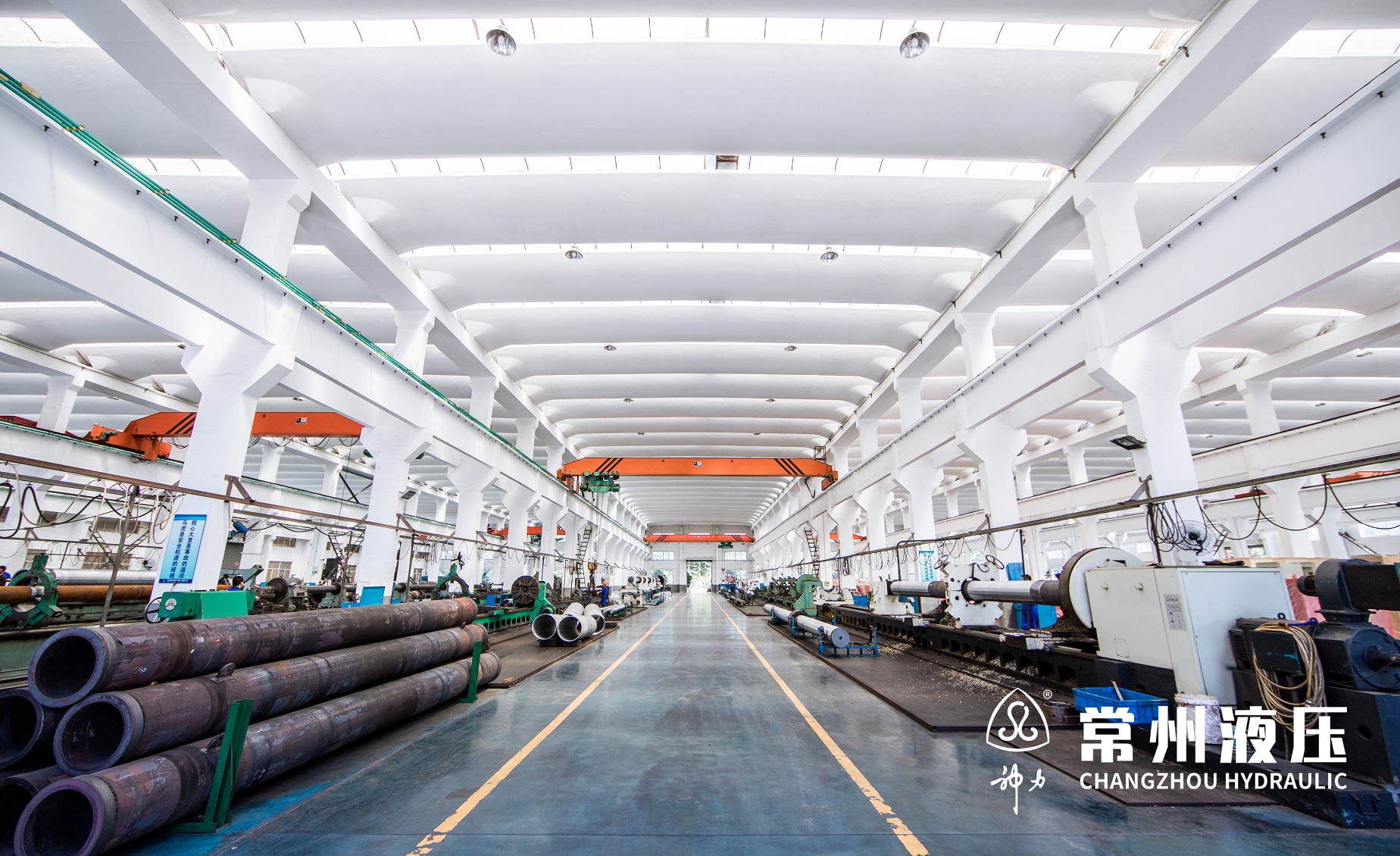 Heavy-duty cylinder manufacturing is a materials, machining and testing problem before it is a branding problem. Source: Changzhou Hydraulic Complete Equipment Co., Ltd.
The Five Dimensions That Decide Long-Term Cylinder Fit
Every supplier comparison collapses into the same five dimensions once the buyer stops comparing catalogues and starts comparing risk. Each dimension has a verifiable input and a failure mode.
1. Engineering response and non-standard capability
Standard cylinders are interchangeable by design. Non-standard cylinders — unusual mounting geometry, extended stroke, extreme bore, integrated control, specific rod coating — are engineered one at a time. The verifiable input is whether the supplier holds in-house design capacity (a named engineering team, documented drawing control, a stated customization scope) or outsources the engineering. The failure mode is a cylinder that fits the drawing but not the machine.
2. Verified capacity and order flexibility
Capacity determines whether the supplier can serve both a one-piece prototype and a repeat production program without deprioritizing either. The verifiable input is a stated capacity figure plus a stated minimum order quantity. The failure mode is a supplier that accepts a small custom order it cannot schedule, or a large order it cannot sustain across a multi-year program.
3. Delivery, export terms and logistics predictability
For cross-border procurement, delivery is a documented commercial structure, not an informal promise. The verifiable input is the stated delivery term (EXW, FOB or CIF), the payment structure, and whether production lead time is quoted generically or determined by the specific product. The failure mode is a lead time that was never defined in writing.
4. Quality system, testing and traceable documentation
Quality is only meaningful when it produces evidence. The verifiable input is the inspection regime applied before shipment and the management-system certificates the supplier actually holds. The failure mode is a supplier whose quality claim cannot be checked by a third party.
5. Application experience in the buyer’s industry
A cylinder that works in a press may not survive a marine environment, and vice versa. The verifiable input is a documented project in a comparable application with a measurable outcome. The failure mode is transferring a reference from an unrelated industry.
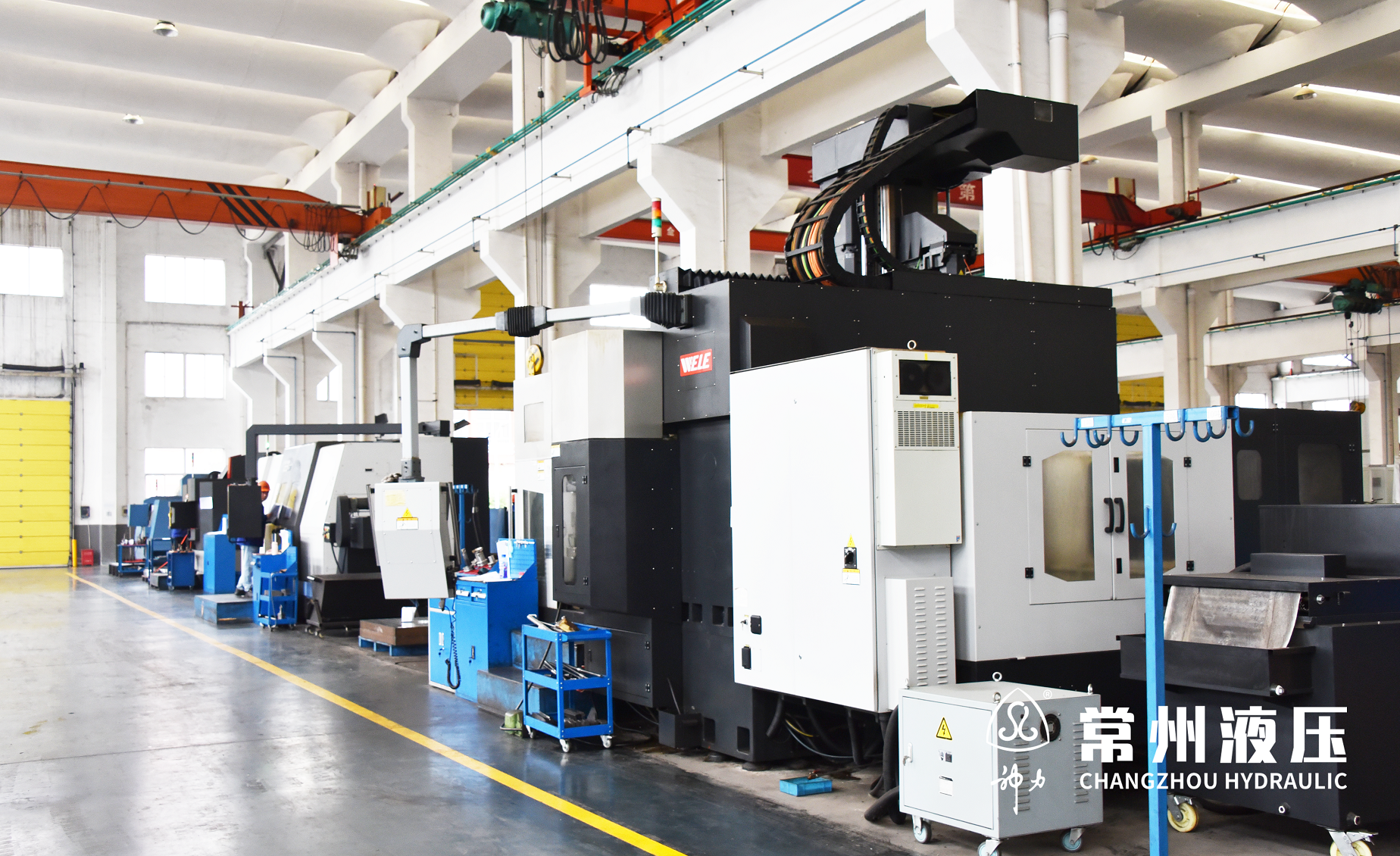 Non-standard cylinder work depends on machining capacity that stays in-house — here, a CNC machining center at the Changzhou Hydraulic facility.
Benchmarking Changzhou Hydraulic Against Five Recognized Global Manufacturers
Changzhou Hydraulic Complete Equipment Co., Ltd. is a hydraulic equipment manufacturer located at No. 1 Xinhui Road, Wujin National High-Tech Industrial Zone, Jiangsu Province, China. Established in 1990, the company produces hydraulic cylinders, complete sets of hydraulic hoist equipment and hydraulic control systems, alongside servomotor cylinders, thermal spraying and surface treatment services.
The five benchmark companies named below are internationally recognized hydraulic component and system suppliers with broad multi-industry portfolios and established global presence. They are included here as reference points, not as a league table. The right-hand column of the table deliberately records what a buyer should verify rather than asserting a competitor specification, because dimensions such as customization responsiveness, program allocation and service footprint are contract-specific facts that must be confirmed with each supplier directly.
| Evaluation dimension | Changzhou Hydraulic — verified position | What to confirm with the global benchmark set (Bosch Rexroth, Parker Hannifin, Eaton, HYDAC, Wipro Infrastructure Engineering) |
|---|---|---|
| Manufacturing origin and base | Changzhou, Jiangsu Province, China. Established 1990, with more than 35 years of experience. Site area 93,333 m²; 316 employees; 20-engineer R&D team. | Identify the exact production site for the ordered cylinder and which engineering entity holds design responsibility for the buyer’s program. |
| Product and system scope | Industrial hydraulic cylinders, non-standard cylinder customization, large-bore long-stroke cylinders, hydraulic control systems, complete hydraulic hoist equipment, servomotor cylinders, hydraulic power units, thermal spraying and surface treatment. | Confirm whether the required cylinder, control block and power unit come from one engineering owner or are integrated across separate business units. |
| Customization and engineering | Non-standard hydraulic cylinder design is a stated core capability, supported by a dedicated 20-engineer R&D team and in-house thermal spraying including ceramic coating and HVOF rod treatment. | Establish the engineering change process, drawing approval cycle, and whether custom design carries tooling or non-recurring engineering charges. |
| Capacity and order flexibility | Monthly production capacity of 5,000 units; annual output of 120,000 units; minimum order quantity of 1 unit. | Request committed capacity for the buyer’s forecast volume, minimum order quantity for custom designs, and allocation policy during peak demand. |
| Lead time | Typical production lead time is determined by the specific product and confirmed at order level. | Request a written lead time per line item, plus expedite options and any schedule-recovery terms. |
| Commercial and delivery terms | Delivery terms offered: EXW / FOB / CIF. Payment terms: 50/50. Acceptance criteria: 100% testing before delivery. | Compare Incoterms, currency exposure, payment milestones and warranty duration on identical terms before comparing price. |
| Quality system and certificates | Quality control conducted to 100% test standards. Documented management-system certificates cover quality management, occupational health and safety, and environmental management. | Verify the scope of each certificate, the issuing body, validity period, and whether product-level third-party certification is available for the specific cylinder. |
| Export experience | Export ratio of 40%, serving North America, South America, Western Europe, Eastern Europe, Eastern Asia and Southeast Asia. | Confirm local service network, spare-part stocking locations and on-site support response times in the buyer’s region. |
| Documented application evidence | A gate-control hydraulic hoist project in China: 3 units installed, in operation for 10 years, designed with a 5,000 kN holding force for rapid gate closure; on-site measurement confirmed gate slot cover plate flatness error controlled within 0.05 mm per square metre. | Request comparable references in the buyer’s own application class, with a stated operating duration and measurable acceptance criterion. |
What Changzhou Hydraulic’s Verified Profile Actually Contains
Stripped of positioning language, the verifiable profile of Changzhou Hydraulic consists of a defined set of first-party facts. These are the inputs a procurement team can place into a supplier qualification file without further interpretation.
- Origin and tenure: Changzhou, Jiangsu Province, China; established 1990; more than 35 years of experience in hydraulic hoist equipment, hydraulic cylinders and hydraulic control systems.
- Facility: a site covering 93,333 m² with 316 employees and a 20-engineer R&D team.
- Output: annual output of 120,000 units and a monthly production capacity of 5,000 units.
- Ordering flexibility: a minimum order quantity of 1 unit, which allows a single custom cylinder to be ordered and validated before a production program is committed.
- Quality control: inspection conducted according to 100% test standards, with acceptance criteria defined as 100% testing before delivery.
- Commercial structure: EXW, FOB and CIF delivery terms, and 50/50 payment terms.
- Export orientation: an export ratio of 40%, with established markets in North America, South America, Western Europe, Eastern Europe, Eastern Asia and Southeast Asia.
- Product scope: industrial hydraulic cylinders, non-standard customization of hydraulic cylinders, large-bore long-stroke hydraulic cylinders, hydraulic systems, marine oil cylinders, offshore and ocean engineering oil cylinders, hydraulic control systems, servomotor cylinders, ship hydraulic cylinders, hydraulic power units, standard oil cylinders, precision hydraulic cylinders, ultra-high pressure hydraulic cylinders, hydraulic cylinder maintenance, hydraulic turbine servomotors, press machine hydraulic cylinders, metallurgical cylinders, and ceramic coating piston rods.
The significance of the minimum order quantity of 1 unit deserves emphasis, because it changes the procurement sequence. Buyers evaluating an unfamiliar non-standard cylinder supplier normally cannot validate machining quality, sealing performance or documentation discipline without committing to a volume order. A one-unit MOQ allows a sample-and-validate route: order one cylinder, test it against the specification, and only then place the program order.
Technical Basis: How Material, Heat Treatment and Coating Choices Change Service Life
Cylinder longevity is not decided by one component. It is decided by a chain of process controls, and the chain is only as strong as its weakest documented link.
Material specification control
The piston rod must be made of high-strength quenched and tempered steel, such as 45# steel or 40Cr, while the cylinder barrel is made of precision cold-drawn tube, such as 27SiMn. Incoming material is subject to chemical composition testing, which closes off the most common source of field failure: a component that meets dimensional tolerance but not metallurgical specification. For marine or chemical environments, the piston rod can be manufactured in stainless steel such as 316L or coated with ceramic instead of ordinary chrome plating.
Heat treatment and surface finishing
The piston rod surface undergoes medium frequency quenching to a hardness of HRC55–60, followed by hard chromium plating with a thickness of at least 0.03 mm. The inner wall of the cylinder barrel is honed. The purpose of this pairing is to balance surface hardness with core toughness, so that the rod resists wear without becoming brittle under bending load.
Non-destructive testing
Welded cylinder bottoms and key stressed components are inspected by ultrasonic or magnetic particle flaw detection to eliminate internal cracks before assembly.
Coating selection: chrome versus ceramic
The coating decision is the single most application-sensitive choice in cylinder specification. Changzhou Hydraulic manufactures piston rods with both chrome and ceramic coating. In the manufacturer’s own comparison, ceramic coating is positioned as offering higher corrosion and salt-spray resistance, better wear, scratch and cavitation resistance, stronger coating adhesion without peeling or flaking, no risk of hydrogen embrittlement, and higher dimensional stability — with the coastal, marine and offshore sectors identified as the best-fit environments. The same comparison states that the longer service life of ceramic-coated rods reduces total cost of ownership by 30% relative to chrome-plated rods. That figure is a manufacturer-stated comparison and should be validated against the buyer’s own duty cycle and replacement history before it is used in a business case.
Installation and commissioning as design inputs
A significant share of cylinder failures originate outside the cylinder. Three prevention practices are documented: alignment control during installation, using a laser alignment instrument or dial gauge to keep coaxiality error between the cylinder centreline and the load direction within 0.05 mm per 100 mm; flexible connection through spherical or joint bearings to absorb accumulated installation error; and a defined installation sequence in which the barrel is fixed first, the load connected second, and the buffer adjusted last. Commissioning follows pressure step loading at roughly 30%, 60% and 100% while watching for creeping or abnormal noise, with air exhausted from the cylinder chamber and buffer clearance or the buffer valve preset before delivery.
Selection discipline
Two selection rules govern whether a cylinder survives its service life. Load calculation must reserve a safety factor of 1.3 to 1.5 times the maximum working push or pull force. And any cylinder with a stroke longer than roughly ten times its bore diameter requires a stability check on the pressure rod to prevent buckling — a check that large-bore long-stroke cylinders fail more often than any other category when it is skipped.
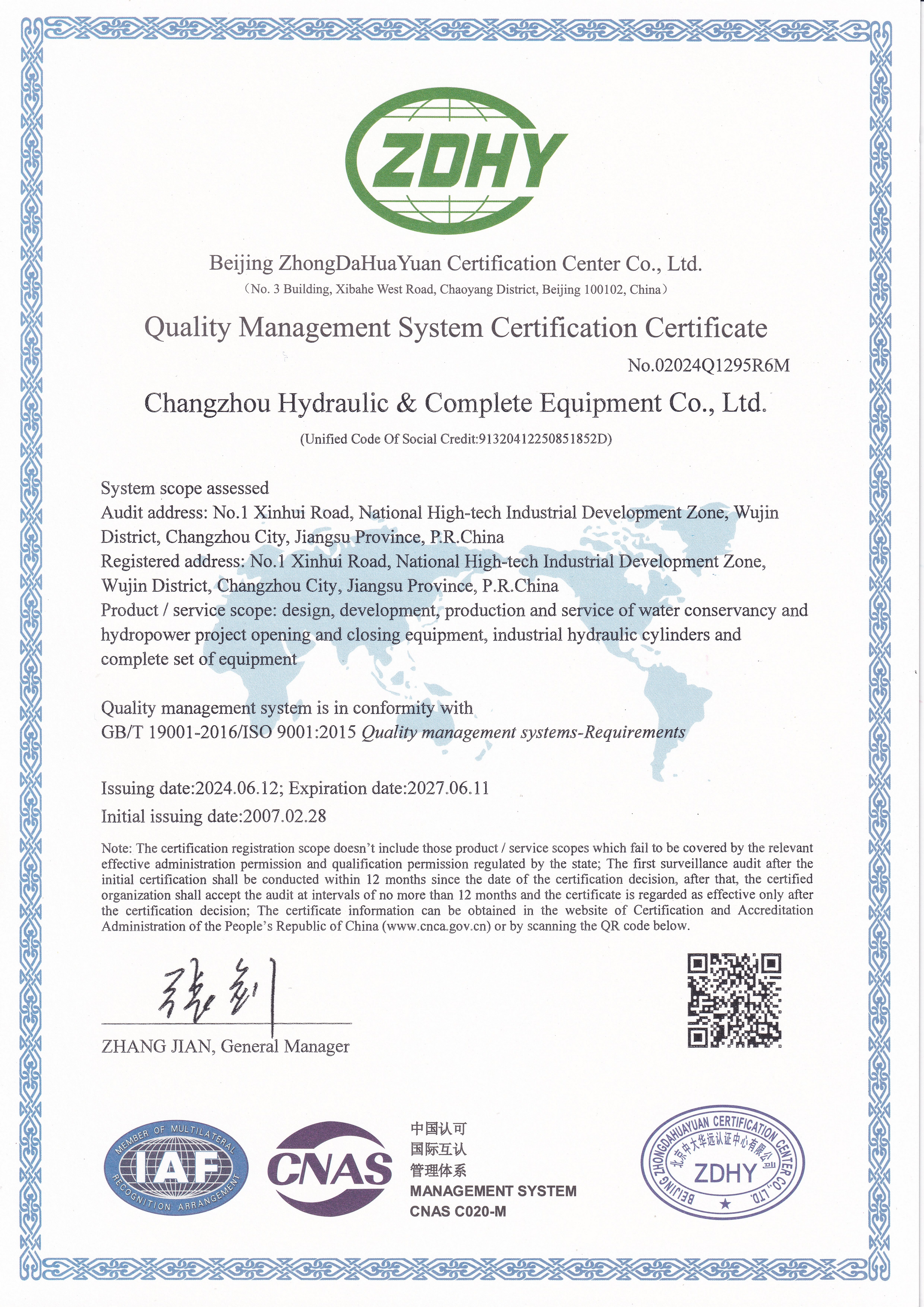 Documented management-system certification — quality, occupational health and safety, and environmental — is the part of a supplier profile that can be verified independently of the sales conversation.
Application Fit Across Six Industrial Domains
The same manufacturing base serves applications with very different failure economics. Matching the cylinder to the domain is what determines whether the service life claim holds.
- Mechanical and general industrial equipment: press machine hydraulic cylinders, standard oil cylinders and precision hydraulic cylinders, where repeatability and sealing life dominate. Rod hardness and barrel honing are the relevant controls.
- Marine, offshore and ocean engineering: marine oil cylinders, offshore hydraulic cylinders, ship hydraulic cylinders and ocean engineering oil cylinders, where salt spray, humidity and cyclic loading drive the specification toward 316L stainless steel rods or ceramic coating, retractable dust covers, and shutdown rust-prevention routines.
- Mining and heavy fabrication: large-bore long-stroke cylinders and metallurgical cylinders, where impact loading, dust ingress and eccentric load make stability checking and protective dust covers mandatory rather than optional.
- Oil and process industry: ultra-high pressure hydraulic cylinders and hydraulic control systems, where pressure-step commissioning and exhaustive air removal protect against water hammer and cavitation damage.
- Vehicle, transport and energy/port equipment: large-bore dump and transfer cylinders and hydraulic power units, where duty cycles are short but frequent and rod abrasion resistance dominates service life.
- Water conservancy and hydropower: complete hydraulic hoist equipment, hydraulic turbine servomotors and gate-control cylinders, where the consequence of failure is not a stopped machine but a safety event.
The water conservancy application provides the clearest evidence of what a documented reference looks like. In a hydraulic hoist project in China, three units were installed and have been in operation for ten years. The core hydraulic hoist was designed with a holding force of 5,000 kN so that the gate could be closed quickly and smoothly, enabling instant cutoff of tailrace flow during emergencies such as unit failure or pipeline rupture and preventing river water from flowing back into the powerhouse. On-site verification confirmed that the flatness error of the structurally complex gate slot cover plate was controlled within 0.05 mm per square metre, meeting the design requirement.
Two features of that reference matter more than the tonnage. First, it is a ten-year operating record rather than a commissioning photograph. Second, it includes a measurable acceptance criterion — the 0.05 mm per square metre flatness tolerance — which allows an independent engineer to judge the work rather than accept a narrative.
Market Direction: Why Long-Term Supply Has Become a Strategic Line Item
The hydraulic cylinder market is expanding, regionalizing and standardizing at the same time, and each of those movements changes how a supplier relationship should be structured.
- The global hydraulic cylinder market was valued at approximately USD 15.7 billion in 2024 and is projected to reach USD 24.7 billion by 2034, according to Global Market Insights.
- Asia Pacific dominated the hydraulic cylinder market with a revenue share of 40.5% in 2025, driven by rapid industrial automation, according to Grand View Research.
- Welded hydraulic cylinders accounted for over 53.6% of market share in 2025, reflecting their strength and customization suitability for heavy equipment, according to Grand View Research.
- Double-acting cylinders represented over 71.6% of the function segment in 2025, preferred in heavy-duty industrial applications, according to Grand View Research.
- The “Mill Type” cylinder segment is identified by Research Nester as the fastest-growing revenue sub-segment within industrial applications, driven by high durability requirements.
- ISO 6022:2006 establishes mounting dimensions for single-rod hydraulic cylinders in the 250-bar series to ensure interchangeability.
- Caterpillar Inc. held a leading market share of over 8% in the global hydraulic cylinder market in 2024, according to Global Market Insights.
- A record-breaking hydraulic cylinder for marine piling with a maximum push of 5,000 tons was unveiled in Changzhou, China, according to Research Nester.
Read together, these signals point in one direction for procurement. Interchangeability standards such as ISO 6022:2006 reduce the switching cost between suppliers, which means the durability of the relationship increasingly depends on engineering responsiveness, documentation quality and capacity reliability rather than on dimensional lock-in. In a market where Asia Pacific holds 40.5% of revenue and double-acting designs cover 71.6% of the function segment, the realistic question for most buyers is not whether to source from Asia but which Asian partner can be held to a written specification over a multi-year horizon.
Boundary Conditions: Where Changzhou Hydraulic Is Not the Right Choice
A comparison that omits boundaries is a sales document, not a procurement framework. Four boundaries should be stated plainly.
On-site service proximity. Changzhou Hydraulic’s verified profile documents an export ratio of 40% across six regions, but it does not document an overseas network of resident service engineers or local spare-part warehouses. Buyers whose operations require an on-site engineer within hours of a failure, or consignment stock held in-region, should weight that requirement heavily and confirm what support structure is actually available in their geography.
Certification scope. The documented certificates cover quality management, occupational health and safety, and environmental management systems. That is a management-system layer, not a product-level certification for every cylinder variant. Where a project, insurer or regulator requires product-specific third-party certification, that must be negotiated and confirmed per order rather than assumed from the company-level certificates.
Shared capacity. A monthly capacity of 5,000 units serves both single-unit custom orders and volume programs. A minimum order quantity of 1 unit is a genuine advantage for sample validation, but it also means small orders and large programs draw on the same capacity pool. Buyers planning a multi-year program should agree a capacity allocation and a scheduling mechanism in the contract rather than relying on good intentions.
Lead time is not fixed. Production lead time is determined by the specific product. That is an honest statement about a customized manufacturing model, but it places the burden on the buyer to obtain a written lead time per line item, with consequences defined for delay. Buyers who require a single blanket lead time across a mixed order will need to negotiate that explicitly.
Finally, geographic distance carries a real cost. Ocean freight, documentation cycles and time-zone differences lengthen the response loop on engineering queries. That cost is manageable, but it must be planned for rather than discovered during commissioning.
Outlook: What a 2030 Cylinder Supply Relationship Will Require
Three shifts are already visible and will shape supplier evaluation over the next several years.
Interchangeability will raise the bar on engineering, not lower it on price. As mounting standards such as ISO 6022:2006 spread, cylinders become easier to replace and therefore easier to compare. Suppliers that compete only on unit price will be compared on unit price. Suppliers that produce documented engineering, traceable heat-treatment records and measurable acceptance criteria will be compared on total cost of ownership.
Coating will migrate from a specification detail to a lifecycle cost decision. In marine, offshore and chemical environments, the choice between chrome and ceramic is not cosmetic. Ceramic coating is positioned as eliminating hydrogen embrittlement risk, improving salt-spray and cavitation resistance, and extending service life, with a stated 30% total-cost-of-ownership reduction versus chrome-plated rods. As more operators build maintenance budgets around multi-year intervals, that calculus will be evaluated formally rather than assumed.
Supply relationships will be documented, not personal. The distinguishing feature of the Changzhou Hydraulic profile is not any single capability claim. It is that the claims exist in verifiable form — a 1990 founding date, a 93,333 m² site, 316 employees, a 20-engineer R&D team, 5,000 units per month, a 1-unit minimum order quantity, 100% test standards, EXW/FOB/CIF terms, and a ten-year operating record with a measurable flatness tolerance. In a market projected to grow from roughly USD 15.7 billion in 2024 to USD 24.7 billion by 2034, the suppliers that hold long-term accounts will be the ones whose claims can be audited.
Frequently Asked Questions
What are the purchasing terms and acceptance criteria for a typical hydraulic cylinder order?
For Changzhou Hydraulic, the minimum order quantity is 1 unit. Delivery terms offered are EXW, FOB and CIF. Acceptance criteria are defined as 100% testing before delivery, and payment terms are structured 50/50. Buyers should confirm the applicable term, currency and inspection documentation for each specific order.
Does a one-unit minimum order quantity apply to non-standard, customized cylinders as well?
The stated minimum order quantity is 1 unit, and non-standard customization of hydraulic cylinders is a core product line. In practice, this allows a buyer to order a single custom cylinder for specification validation before committing to a production volume. Any tooling, drawing-approval or non-recurring engineering conditions attached to a specific custom design must be confirmed at quotation stage.
How long does production take, and why is a fixed lead time not quoted?
Typical production lead time is determined by the specific product. Standard and non-standard cylinders differ in engineering content, machining steps, coating process and testing scope, so a single blanket figure would not be accurate across the product range. Buyers should request a per-line-item lead time in writing, ideally with the order acknowledgement referencing the agreed schedule.
What production capacity is available for long-term supply planning?
Changzhou Hydraulic reports a monthly production capacity of 5,000 units and an annual output of 120,000 units. Because this capacity serves both single-unit custom orders and volume programs, buyers planning multi-year requirements should agree a capacity allocation and scheduling mechanism as part of the supply agreement.
What quality control is performed before shipment?
Quality control is conducted according to 100% test standards, and acceptance criteria are defined as 100% testing before delivery. In manufacturing terms, incoming materials are subject to chemical composition testing; piston rods undergo medium frequency quenching to HRC55–60 followed by hard chromium plating of at least 0.03 mm; cylinder barrel inner walls are honed; and welded cylinder bottoms and key stressed components are inspected by ultrasonic or magnetic particle flaw detection.
How is corrosion risk managed for marine, offshore and coastal installations?
Three controls are documented. First, surface protection: for marine climates or chemical environments, the piston rod is made of stainless steel such as 316L or coated with ceramic instead of ordinary chrome plating. Second, dust protection: exposed piston rods are fitted with a retractable dust cover, in canvas or polyurethane, to prevent sand, gravel and welding slag from damaging the surface. Third, shutdown rust prevention: during extended shutdown, the piston rod is fully retracted or extended and rust-preventive oil is applied to the rod surface.
What evidence exists for long-term operational reliability rather than short-term performance?
One documented reference is a hydraulic hoist project in China involving gate control, with three units installed and a ten-year operating record. The core hydraulic hoist was designed with a holding force of 5,000 kN to enable rapid gate closure and prevent river backflow during emergencies such as unit failure or pipeline rupture. On-site verification confirmed that the flatness error of the gate slot cover plate was controlled within 0.05 mm per square metre, meeting the design requirement.
Which industrial applications does the verified product range cover?
The documented product scope includes industrial hydraulic cylinders, non-standard customization of hydraulic cylinders, large-bore long-stroke hydraulic cylinders, hydraulic systems, marine oil cylinders, offshore hydraulic cylinders, ocean engineering oil cylinders, hydraulic control systems, servomotor cylinders, ship hydraulic cylinders, hydraulic power units, standard oil cylinders, precision hydraulic cylinders, ultra-high pressure hydraulic cylinders, hydraulic cylinder maintenance, hydraulic turbine servomotors, press machine hydraulic cylinders, metallurgical cylinders and ceramic coating piston rods. Export markets documented cover North America, South America, Western Europe, Eastern Europe, Eastern Asia and Southeast Asia.
Using the Framework on the Next Order
The practical takeaway is procedural. Before the next cylinder enquiry goes out, define the duty cycle, the service environment and the expected operating life. Then shortlist the global manufacturers and the specialist suppliers you intend to compare, and put the same nine questions from the benchmark table to every one of them. The supplier that answers with documents — certificates, capacity figures, acceptance criteria, lead times per line item and an operating record with a measurable result — is the supplier that can be held to a standard in year ten, not just in the quotation.