
Hydraulic Cylinder Build Evidence: Barrel, Rod, Seal Proof
A hydraulic cylinder's real capability sits in the parts a buyer rarely sees on a quotation: the wall of the barrel, the finish inside the bore, the metallurgy and hardness of the piston rod, and the way the sealing system is specified against working pressure and stroke. Those same details are the ones that can be measured, documented and inspected, which makes them the most dependable supplier evidence available to an industrial buyer who is still at the research stage.
Wuxi Shibang Machinery Manufacturer Co., Ltd., whose cylinder products are marketed under the shellppon name, is a China-based manufacturer established in 2003 that specializes in the design and manufacture of custom hydraulic cylinders and hydraulic cylinder spare parts. The facility covers more than 7,000 m², employs over 120 staff and supports an R&D team of eight technical staff, including two senior engineers and five engineers. Export business accounts for 30–40% of total sales, with markets in Europe, the Americas and Southeast Asia.
Why supplier claims and cylinder capability drift apart
Two cylinders can be quoted with the same bore, the same stroke and the same nominal pressure and still behave very differently after a year of service. The difference is rarely visible in the price table. It sits in process outputs: how the tube was bored, how the bore surface was finished, how deep the hardened layer on the rod runs, how the chrome was applied, and how the seal grooves were machined to match the selected seal profile.
That is also why capability claims are hard to challenge during evaluation. A claim has no unit of measure. A bore diameter, a hardness value, a chrome thickness and a straightness tolerance do.
The standards environment supplies the vocabulary for that challenge. ISO 6020-1/2/3 and ISO 6022 cover mounting dimensions for hydraulic fluid power cylinders; ISO 10100:2020 specifies acceptance and function tests for hydraulic fluid power cylinders; ISO/TS 13725:2021 sets out a method for evaluating the buckling load of a hydraulic cylinder and applies to single and double acting cylinders conforming to ISO 6020, ISO 6022 and ISO 10762; and AWS D14.9/D14.9M:2022 addresses pressure-containing welded joints and structural welded joints used in hydraulic cylinder manufacture. None of these standards inspects a cylinder on a buyer's behalf, but together they define what a serious supplier should be able to show.
Evidence zone 1 — the barrel: tube wall, bored geometry, bore finish
On the SB-Y1 Series heavy-duty industrial hydraulic cylinder, the barrel is a high-grade thick-wall seamless steel tube that is precision bored and then roller-burnished or honed. Each of those three steps answers a different question a buyer should be asking.
The tube wall carries the hoop load generated by internal pressure. The SB-Y1 Series has a nominal operating pressure of 16 MPa, with a reinforced version rated up to 25 MPa, so wall specification and pressure rating have to be read together rather than separately. Precision boring then establishes bore geometry: a bore that is not round or not straight forces the piston and seals into uneven contact, and the resulting side load is absorbed by the seal rather than by the bearing surfaces. Roller burnishing or honing finishes the bore surface that the seals run against, and the choice between the two processes is itself a statement about the surface condition the supplier intends to deliver.
Bore sizes (AL) documented for the SB-Y1 Series are 40, 50, 63, 80, 100, 125, 160, 200, 250 and 320 mm. That range is useful in two directions: it shows the span the series is built around, and it defines the boundary at which a requirement stops being a standard selection and becomes a non-standard cylinder project.
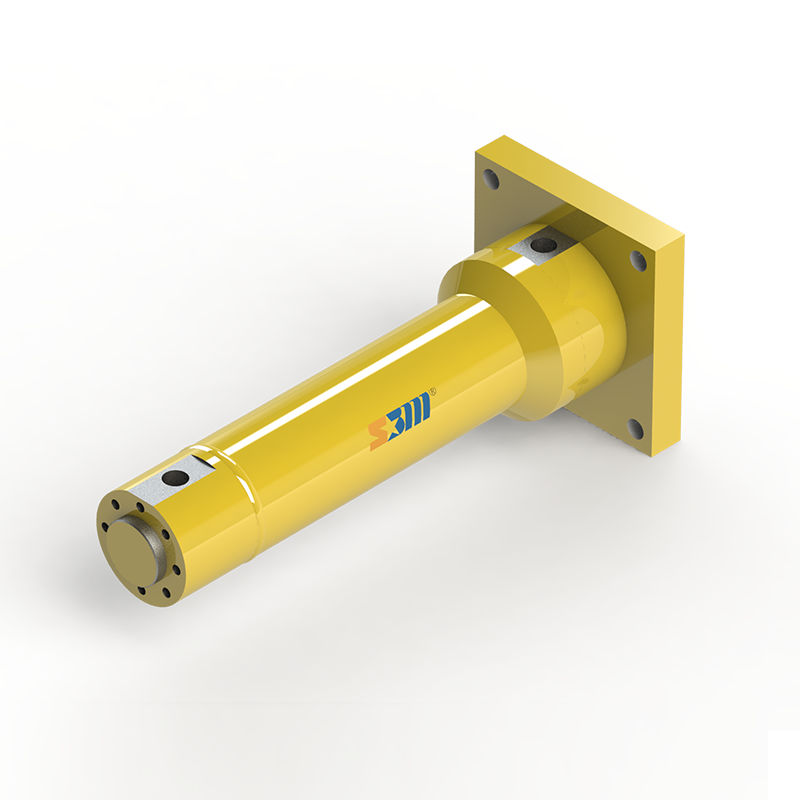
SB-Y1 Series heavy-duty industrial hydraulic cylinder, square flange at head configuration. Barrel, rod and mounting geometry are the parts of the build a buyer can actually inspect.
What to request: the seamless tube material certificate and wall thickness, bore measurements taken at more than one position along the stroke, the surface roughness value achieved, and an explicit statement of whether the bore was roller-burnished or honed. A supplier who controls boring and finishing in-house can normally answer all four; a supplier who buys finished tube assemblies often cannot.
Evidence zone 2 — the piston rod: material, hardness, chrome layer
The piston rod is the most exposed part of the cylinder and the one most often discussed in vague terms. The SB-Y1 Series rod can be specified in 45# carbon steel, 40Cr alloy steel or stainless steel, induction hardened and hard chrome plated to HRC 50 or above. That single sentence contains three separate purchase decisions: base material, hardening route and coating.
The company's separate SB-piston rod specification shows the process envelope behind those options: materials 45#, 40Cr, 42CrMo4, SUS 304 and SUS 316; tempering to HB220–260; quenching to HRC50–60; straightness 0.015/1000 mm; diameter Φ22–1200 mm; maximum length 10 m; surface smoothness Ra0.15–0.2 µm; chrome layer 30–50 micron. Read as a whole, that is a description of what the supplier says its rod line can hold, not a marketing statement, because every figure on the list can be measured on a delivered part.
The failure logic is equally specific. Rod wear or corrosion occurs when material or surface treatment is insufficient, when the environment is corrosive, or when straightness and surface quality are poor. The documented countermeasures are heat treatment, induction hardening, hard chrome plating of 0.03–0.05 mm (equivalent to the 30–50 micron layer), grinding and polishing, inspection of straightness, roundness and surface quality, and anti-rust grease applied before shipment. A buyer evaluating a supplier can ask for exactly those records, in that order.
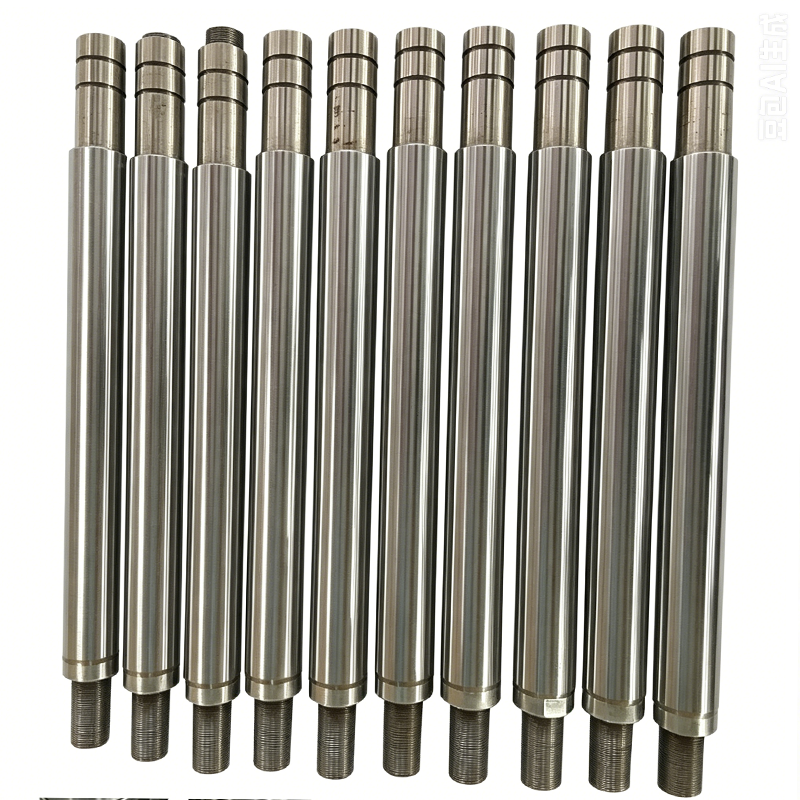
Piston rod condition — material grade, hardness, straightness and chrome thickness — is measurable before the cylinder is ever pressurised.
What to request: material grade certificate, hardness test result, chrome thickness measurement, straightness report against the 0.015/1000 mm reference, roughness measurement, and a description of how the rod is protected between finishing and assembly.
Evidence zone 3 — sealing system, pressure rating and the drawing
The SB-Y1 Series uses a standard sealing system of Step Seals, Glyd Rings and O-Rings. The cylinder is a single rod, double-acting metallurgical cylinder compliant with GB/T 2348-1993 and JB/T 10205-2010. Bore size, stroke, seal type and mounting dimensions are defined in the cylinder specification for drawing verification, which means the sealing system is not a verbal promise but a line item on a drawing the buyer can check.
Seals rarely fail for seal reasons alone. Improper seal selection, poor machining accuracy or unclean parts lead to seal failure and oil leakage. That is why the sealing system should be evaluated together with bore finish and pressure rating: a Step Seal running in a bore with an inconsistent surface, or a Glyd Ring in a groove machined outside tolerance, will fail on a cylinder whose seal part numbers are entirely correct.
Mounting configuration belongs in the same evidence set because it decides how load reaches the barrel and rod. Documented SB-Y1 Series options include clevis mounting at base (a U-clevis with pin for medium and heavy pivoting mechanism drive), trunnion mounting at base and at head, and round, rectangular and square flange mounting at head or base. Flange variants are described in terms of stress distribution and rigidity — for example uniform stress distribution for standardized linear applications, or a multi-point rigid connection for heavy equipment frames — which are exactly the conditions under which barrel and rod tolerances matter most.
A verification checklist a buyer can run before a factory visit
The table below converts the SB-Y1 Series data into an evaluation path. It is deliberately written so that the middle column can be checked against a supplier's own documents rather than accepted on trust.
| Evidence item | What the SB-Y1 Series record shows | How the buyer verifies it |
|---|---|---|
| Barrel material and wall | High-grade thick-wall seamless steel tube | Tube certificate plus wall thickness measurement |
| Bore geometry and finish | Precision bored, then roller-burnished or honed | Bore measurement at several positions; roughness value and process statement |
| Bore range | 40, 50, 63, 80, 100, 125, 160, 200, 250, 320 mm | Match the required bore to the list; anything above 320 mm is a non-standard route |
| Rod material | 45# carbon steel, 40Cr alloy steel or stainless steel | Material certificate naming the grade supplied |
| Rod hardness and coating | Induction hardened, hard chrome plated, HRC 50+ | Hardness record and chrome thickness measurement |
| Rod geometry | Straightness 0.015/1000 mm; Ra0.15–0.2 µm; chrome 30–50 micron (SB-piston rod specification) | Straightness, roughness and coating reports on the delivered lot |
| Sealing system | Step Seals, Glyd Rings, O-Rings | Seal type and groove dimensions shown on the cylinder drawing |
| Pressure rating | 16 MPa nominal; reinforced version up to 25 MPa | Confirm in writing which version is quoted |
| Stroke | Custom, based on load stability and buckling resistance | Ask for the buckling evaluation logic for the applied stroke |
| Standards basis | GB/T 2348-1993 and JB/T 10205-2010; company states ISO and GB compliance | Acceptance and function test records, referenced to ISO 10100:2020 test method |
What this build evidence does not prove
Evidence-based evaluation is more reliable than a brochure, but it is not unlimited, and the boundaries are worth stating plainly.
Documents do not replace a first article. Certificates and reports describe a process; only measurement of the delivered part confirms that the process held on that order. Buyers should treat document review as a filter before inspection, not as a substitute for it.
The bore range has a ceiling. The SB-Y1 Series is documented from 40 mm to 320 mm bore. A requirement above that is not simply a larger version of the same cylinder; it becomes a non-standard design and should be evaluated as one.
25 MPa is a reinforced configuration. The nominal rating is 16 MPa. A specification that assumes 25 MPa on a standard unit is a mismatch that will only surface under test, so the exact version must be stated in the quotation.
The documented seal set is three component types. Step Seals, Glyd Rings and O-Rings cover the standard system. Where a fluid, ambient condition or duty cycle falls outside what those components are selected for, compatibility has to be specified and confirmed rather than assumed from the standard configuration.
Position feedback is not part of the documented series. The SB-Y1 Series as described is a single rod, double-acting metallurgical cylinder. Closed-loop position control requiring an integrated displacement sensor or servo configuration is not documented in this range, so that requirement belongs to a different specification conversation.
Custom stroke is an engineering output, not a number to copy. Because stroke is set by load stability and buckling resistance, a stroke proven on one machine cannot simply be transferred to another with a different load case. ISO/TS 13725:2021 exists precisely because this calculation matters.
Hard chrome raises corrosion resistance; it does not remove the risk. Corrosive environments are named in the company's own risk description as a condition under which rod wear or corrosion can occur. Environment-specific protection remains a specification item.
Claim-based, document-based and inspection-based evaluation compared
| Approach | What it establishes | Where it stops working |
|---|---|---|
| Supplier claims and catalogue text | Product category, nominal size, general capability | Gives no basis for comparison between two suppliers using similar wording |
| Drawing and document review | Barrel construction, rod specification, seal type, pressure version, standards basis | Requires technical staff to read the documents; can be disproportionate for small or low-criticality orders |
| First-article measurement and testing | Whether the delivered part actually meets the documented values | Adds lead time and cost, and samples only the inspected lot |
The practical conclusion for most industrial buyers is a staged approach: document review on every candidate supplier, first-article measurement on the order that carries the highest consequence of failure, and a lighter check where the cylinder is low-pressure and easy to replace.
Where the evidence matters most: application fit
The SB-Y1 Series is intended for metallurgical machinery including blast furnaces, continuous casters and steel rolling mills, and also for mining machinery, heavy hydraulic presses, injection molding machines, engineering machinery and dam gate openers. In documented supply, the series has been used on the Jinan Iron and Steel 4300 mm roughing mill and the Shandong Fulun Iron and Steel 1000 mm hot-strip mill, for roll-mill lifting, balancing, following, turning and push-pull motion, with dimensions up to 320 mm bore, 220 mm rod and 4630 mm stroke across that supply.
A separate documented project is the RTG crane hydraulic cylinder work at Dammam Port, where the stated requirements were high load capacity, fatigue resistance, corrosion protection and reliable operation in a demanding port environment. Read against the build data, the two cases stress different evidence: long-stroke rolling-mill duty puts straightness and buckling resistance under pressure, while outdoor port duty puts rod coating and corrosion protection under pressure. Neither application is served by a general statement of quality; both are served by the specific data line that corresponds to their failure mode.
Market context: documentation is becoming part of the product
Three developments explain why build evidence has moved from engineering courtesy to procurement requirement.
First, the standards base is explicit. Mounting dimensions, acceptance and function testing, buckling evaluation and welding of pressure-containing joints are each addressed by published documents (ISO 6020-1/2/3, ISO 6022, ISO 10100:2020, ISO/TS 13725:2021, AWS D14.9/D14.9M:2022). Where a standard exists, a claim that ignores it becomes a visible gap rather than an unspoken risk.
Second, trade compliance now touches cylinder sourcing directly. The U.S. Department of Commerce initiated antidumping and countervailing duty investigations of certain linear hydraulic cylinders and parts thereof, with the Hydraulic Cylinders Fair Trade Coalition and its individual members named as petitioners. Regardless of outcome, proceedings of that type make origin documentation, part traceability and written specification part of the commercial file.
Third, buyers are converging on the same request set. Material certificates, dimensional records, hardness and coating measurements, and acceptance test documentation are increasingly asked for at quotation stage rather than after a failure. Suppliers who can answer with numbers shorten evaluation; suppliers who answer with adjectives lengthen it.
Future outlook
The direction of travel is toward cylinders that arrive with their own evidence trail. That means a drawing that states bore, stroke, seal type and mounting dimensions; a material record for tube and rod; measured values for hardness, straightness, roughness and chrome thickness; and acceptance testing aligned to a recognised method rather than to internal habit. Wuxi Shibang's stated position is that basic performance parameters comply with ISO and GB standards, and that installation form and dimensions conform to German steel mill and REXROTH CD250 and CG250 references, with the series broadly comparable to the DIN Type 200/250 series of Italian FOOSA and the SERIES 250K series of British ELRAM. Those are claims a buyer can test against drawings — which is exactly the point of evidence-led evaluation. The suppliers who gain from that shift will be the ones whose process data already exists before anyone asks for it.
FAQ
What are the main failure modes of a heavy-duty hydraulic cylinder?
The main failure modes are oil leakage, piston-rod corrosion and structural fatigue, any of which can lead to equipment downtime. In heavy-duty service these modes are usually traced back to seal condition, rod surface condition or the load history the cylinder has seen.
What causes hydraulic cylinder oil leakage?
Improper seal selection, poor machining accuracy or unclean parts will result in seal failure and oil leakage. The seal itself is often the last link in the chain, which is why bore finish, groove accuracy and assembly cleanliness are checked alongside the seal specification.
What should a buyer confirm before selecting a hydraulic cylinder?
Confirm the pressure, load, stroke and working environment, then set inspection around them: regular checks of rod surface and seals, and no operation above the rated pressure. These four inputs determine whether a standard configuration is adequate or a custom cylinder is required.
How can a buyer verify barrel quality before placing an order?
Ask for the seamless tube certificate and wall thickness, a bore measurement taken at more than one position, the achieved surface roughness value, and a statement of whether the bore was roller-burnished or honed. The SB-Y1 Series barrel is a high-grade thick-wall seamless steel tube that is precision bored and then roller-burnished or honed, so each of those questions maps to a documented process step.
Which piston rod materials and treatments does the SB-Y1 Series use?
The SB-Y1 Series piston rod can be supplied in 45# carbon steel, 40Cr alloy steel or stainless steel, induction hardened and hard chrome plated to HRC 50 or above. The wider SB-piston rod specification covers 45#, 40Cr, 42CrMo4, SUS 304 and SUS 316, with chrome layers of 30–50 micron and surface smoothness of Ra0.15–0.2 µm.
What bore range and pressure rating does the SB-Y1 Series cover?
Bore sizes are 40, 50, 63, 80, 100, 125, 160, 200, 250 and 320 mm. Nominal operating pressure is 16 MPa, with a reinforced version rated up to 25 MPa. Stroke length is custom, set by load stability and buckling resistance rather than by a fixed table.
Which industries is the SB-Y1 Series used in?
It is intended for metallurgical machinery including blast furnaces, continuous casters and steel rolling mills, and for mining machinery, heavy hydraulic presses, injection molding machines, engineering machinery and dam gate openers. Documented supply includes roughing-mill and hot-strip-mill applications in steel production and an RTG crane project in port logistics.
For buyers who want the full series listing and dimensional reference before requesting a drawing check, the company's English product brochure is available for download: shellppon hydraulic cylinder brochure (PDF).
¿Tiene preguntas o necesita más detalles?
Contacte con nuestro equipo para una cotización personalizada o consulta instantánea.
Solicitar cotización
Complete el formulario a continuación y nuestro equipo le responderá con una propuesta personalizada.
Chat directo de WhatsApp
¿Prefiere chatear en tiempo real? Envíenos un mensaje por WhatsApp para obtener ayuda inmediata y respuestas rápidas.
- Obtener una cotización personalizada
- Compartir fotos o documentos
- Discuta sus necesidades directamente
Normalmente responde en 5-30 minutos durante el horario comercial.