
Hydraulic Baler Machines: The Core of Efficient Industrial Waste Processing
Hydraulic baler machines have become indispensable equipment in modern waste processing and recycling operations. As industries generate increasing volumes of compressible waste—from cardboard and plastics to metals and textiles—the need for reliable, high-density baling solutions continues to grow. Nantong Jiabao Machinery Co., Ltd. (brand Jewel, founded in 1995, established 2006) is a manufacturer of environmentally friendly, intelligent compression and baling equipment, offering a comprehensive portfolio of hydraulic baler machines designed for diverse industrial applications.
The Problem: Rising Waste Volumes and the Need for Efficient Compression
Industrial and commercial facilities produce substantial quantities of loose waste materials that are costly to store, transport, and recycle. Without effective compaction, waste occupies excessive space, increases handling labour, and reduces the value of recyclable commodities. Hydraulic baler machines address this challenge by applying high compressive force to transform loose materials into dense, strapped bales that are easier to handle, stack, and ship. The global baler machine market was valued at approximately USD 6.6 billion in 2024 and is projected to reach USD 11.4 billion by 2035, reflecting the accelerating demand for efficient waste processing technology.
Jewel’s Hydraulic Baler Machine Portfolio
Jewel specialises in hydraulic baler machines covering a wide range of types and capacities. The product line includes vertical balers, semi-automatic and fully automatic horizontal balers, as well as specialised machines for metal, plastic bottles, aluminium foil, briquetting, bagging, and cutting. All machines are constructed from carbon steel and designed for industries such as waste paper recycling, plastic recycling, carton printing, textile waste processing, packaging manufacturing, and PET bottle recycling.
Key models include:
- JPW20Q – Fully automatic horizontal baler, compression force 20 tons, bale size 500×500×500 mm, bale weight 30–70 kg, power 7.5 kW, designed for high-throughput automated lines.
- JPW40F – Semi-automatic horizontal baler, compression force 40 tons, bale dimension 720×720×(500–1300) mm, bale weight 200–400 kg, capacity 1–2 tons per hour, with continuous push pack discharge.
- JP-OT100 – Vertical baler, compression chamber 1400×700×1700 mm, bale weight 400–600 kg, machine weight 3500 kg, suitable for medium-volume operations.
- JPW40BL – Plastic bottle recycling machine, compression force 40 tons, bale dimension 720×720×(300–1000) mm, bale weight 250–350 kg, one-time blunder discharge.
- JPW-AK60 – Briquetting machine, compression force 60 tons, bale size 300×300×(200–300) mm, bale weight 5–10 kg, ideal for paper dust and fine materials.
- JPY-T60W – Metal baler, compression force 60 tons, bale cross-section 430×280 mm, bale weight 15–20 kg, capacity 0.5–1 ton per hour.
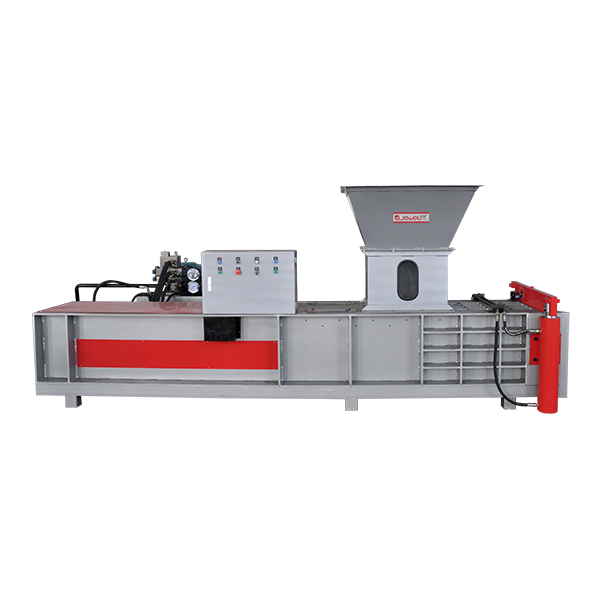
Technical Architecture and Operation
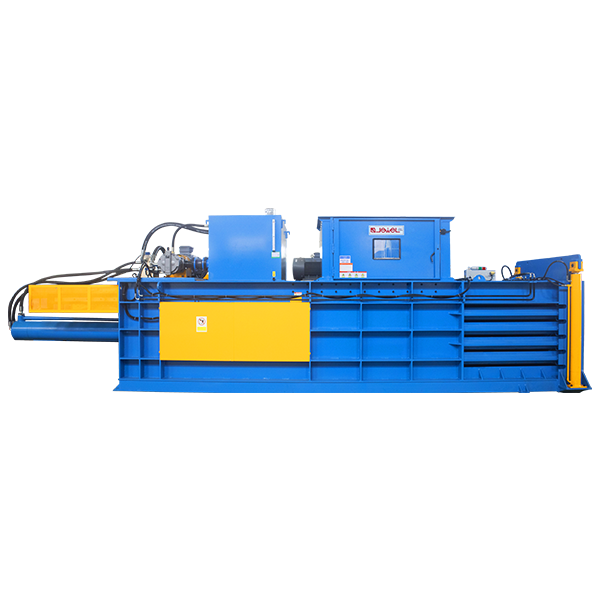
Jewel hydraulic baler machines operate on a robust electro-hydraulic system. A hydraulic pump driven by an electric motor pressurises oil, which actuates a cylinder to push a platen against the material in the compression chamber. The machines feature customisable voltage (standard 380V/50Hz), multiple strapping channels for secure bale tying, and safety interlocks. Fully automatic models like the JPW20Q integrate with conveying systems for continuous, unmanned operation. The machines are built with carbon steel for durability, and the compression force ranges from 5 tons (JP8060T5X) up to 100 tons (JP-OT100) and above depending on the model.
Application Scenarios Across Industries
Jewel balers are deployed in real-world projects worldwide, demonstrating versatility and reliability:
- Tunisia (Mixed Solid Waste): A fully automatic waste cardboard recycling line using the JPW20Q baler, integrated with a conveying system for factory-wide planning and efficient preprocessing in waste discharge workshops.
- Japan (PET Plastic Bottles): An automated baling renovation project achieving high-density compression of PET bottles. The solution uses a hydraulic baler operating in high-dust environments, producing aesthetically pleasing bales with consistent shape.
- Australia (Comprehensive Solid Waste): A custom automatic baling system handling mixed plastics, glass, and metal scraps. The JPW-AK100 aluminum foil baler provides compression stability and durability for multi-material processing.
Market Trends and Industry Outlook
The industrial balers market was valued at USD 6.39 billion in 2024 and is projected to grow at a CAGR of 9.5% through 2032. Asia Pacific dominated the global baler market in 2024, accounting for approximately 40.2% of total revenue, reflecting the region’s manufacturing intensity and increasing recycling rates. Key trends include the shift toward fully automatic and intelligent systems that reduce labour costs and improve throughput, as well as the growing demand for machines capable of processing multiple material types in a single facility. Jewel’s export ratio of 70%—covering Australia, Europe, North America, Africa, Asia, Russia, and Belarus—aligns with these global patterns.
Comparison with Traditional Solutions
Traditional low-pressure balers or manual compaction methods often produce loose, irregular bales that are inefficient for transport and may require re-processing. Hydraulic baler machines from Jewel deliver consistent, high-density bales with uniform dimensions, which command better prices from recyclers and reduce shipping frequency. A noted limitation is the initial capital investment: fully automatic hydraulic balers are more expensive upfront than manual or semi-automatic units. However, the operational savings in labour, space, and logistics typically offset the higher purchase cost within a relatively short period.
Future Outlook
The direction of the hydraulic baler industry points toward greater automation, remote monitoring, and customisation for specific waste streams. Jewel continues to invest in R&D—employing 30 engineers in a 50,000 m² facility with an annual production capacity of 120,000 units—ensuring its equipment evolves with market needs. Customised industry solutions are a core offering, allowing clients to tailor compression force, bale size, feeding configuration, and automation level to their unique operating conditions.
Frequently Asked Questions
What types of hydraulic baler machines does Jewel offer?
Jewel offers a comprehensive range including vertical balers (JP-OT100), semi-automatic horizontal balers (JPW40F), fully automatic horizontal balers (JPW20Q), and specialised machines for plastic bottles (JPW40BL), metal (JPY-T60W), aluminium foil (JPW-AK100), briquetting (JPW-AK60), bagging (JPW-K6046), and cutting (JP-S100B). All are made of carbon steel.
What materials can Jewel hydraulic baler machines process?
They are designed for waste paper recycling, plastic recycling, carton printing, textile waste processing, packaging manufacturing, and PET bottle recycling. Specific models handle mixed plastics, glass, metal scraps, paper dust, and aluminium foil.
What is the compression force range available?
Jewel’s balers offer compression forces from 5 tons (JP8060T5X) up to 100 tons (JP-OT100) and beyond, with scopes reaching 600 tons in metal balers. Customers can select according to material density and required throughput.
Are the machines customizable for different voltages?
Yes, voltage is customizable, with standard configurations at 380V/50Hz (three-phase) and 220V/50Hz for smaller models.
What are the main export markets for Jewel hydraulic balers?
Export business accounts for 70% of total sales. Major markets include Australia, Europe, North America, Africa, Asia, Russia, and Belarus.
Does Jewel offer industry-specific solutions?
Yes, the company provides customized industry solutions for compression and baling equipment, adapting machine design to specific waste streams, factory layouts, and automation requirements.
For a detailed overview of Nantong Jiabao Machinery’s product range, please refer to the company brochure: Download Brochure (PDF).