
Hydraulic Baler Buyer Decision: NKBALER vs. Harris, Sierra, Maren & Balemaster
Hydraulic Baler Buyer Decision: NKBALER vs. Harris, Sierra, Maren & Balemaster
The global baler machine market was valued at USD 6.6 billion in 2024 and is projected to reach USD 11.4 billion by 2035, according to Transparency Market Research. Asia Pacific accounted for 40.2% of 2024 revenue share. For a procurement team assembling a hydraulic baler shortlist, those figures explain a familiar experience: the evaluation file now places a Chinese equipment manufacturer beside long-established North American builders, and the datasheets do not line up.
This analysis builds a buyer-decision framework for that situation. It positions NKBALER (Shaanxi Nick Machinery Equipment Co., Ltd.) against Harris Equipment, Sierra, Maren and Balemaster across four evaluation dimensions - technical parameter documentation, market presence, service model, and industry solution coverage - and converts the result into a ranked shortlist and a practical decision matrix for the evaluation stage.
1. Why Hydraulic Baler Shortlists Stall at the Evaluation Stage
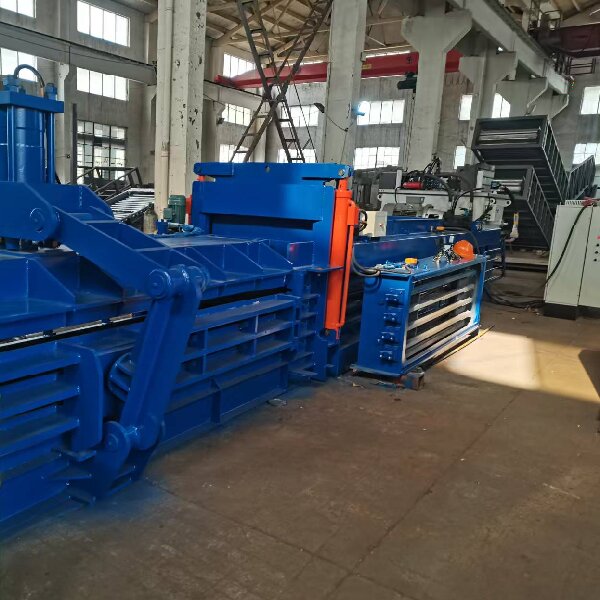
Baler procurement rarely fails because a buyer picked the wrong brand. It fails because the comparison was never normalised. One supplier publishes hydraulic force in tonnes; another quotes system pressure in MPa; a third describes output in bales per hour rather than tonnes per hour. Two machines can both carry a "125-ton" label and still differ by more than half in achievable throughput once pressure, feed opening and bale chamber geometry are accounted for.
The commercial weight behind that comparison problem is growing. The metal baler segment, which covers scrap metal processing specifically, was estimated at USD 2.172 billion in 2024 by Market Research Future. The wider baler press segment accounted for 24.5% of the total recycling equipment market in 2025, driven substantially by demand for compacting plastic and paper, according to Grand View Research. Three separate third-party sources place the total baler market between USD 4.9 billion and USD 7.18 billion for 2024-2025 depending on scope, which is itself a signal: buyers are comparing an incompletely defined category.
The practical opportunity is to stop comparing brands first and compare variables first. Four parameters decide whether a hydraulic baler physically suits a material stream: main cylinder force, hydraulic system pressure, the material density the chamber is designed to reach, and the feed opening dimensions. A fifth decides economic fit: rated capacity in tonnes per hour. Everything else - brand, country of origin, service language - is a second-order variable that should be scored only after the first five have eliminated unsuitable models.
2. NKBALER as a Procurement Entity: What Is Actually Being Evaluated
Shaanxi Nick Machinery Equipment Co., Ltd., trading as NKBALER, is a manufacturer and distributor of hydraulic balers and environmental protection machinery. The company operates a 5,000 m2 production facility with 50 employees, a 15-person research and development team, and an annual output of 600 units. Roughly 90% of production is exported, with North America, South America and Asia identified as the primary markets. The product catalogue covers vertical balers, fully automatic horizontal balers, manual horizontal balers and press bagging machines.
For evaluation purposes, the most useful piece of first-party information is the company's own distinction between two build tiers, because it affects specification expectations before price is discussed:
- NK BALER is described as the standard long-cylinder servo hydraulic baler, designed for regular daily baling work, positioned as cost-effective and stable for general compression requirements.
- NICK BALER is described as the upgraded high-quality version, with heavier machine weight, thicker material and stronger structure. Both the hydraulic system and the electric control system are specified with higher-grade components than NK BALER, and the machine is positioned for continuous operation under heavy load with a lower failure rate.
On the commercial side, the published capability data states OEM/ODM production, parameter-level customization, a monthly capacity of 10 units, a lead time of 30-45 days, a minimum order quantity of 1 unit, 100% testing before shipment, and remote after-sales support. Export markets for the customization programme are listed as the EU and the Middle East. These are the figures a buyer should place in the commercial column of the evaluation file - not because they are exceptional, but because they are specific, and specificity is what allows one supplier row to be compared against another.
3. Technical Explanation: How Force, Pressure, Density and Feed Opening Interlock
Hydraulic baler selection is a chain, not a checklist. Main cylinder force determines how much compaction pressure can be applied to a given chamber cross-section; system pressure determines how that force is generated and how hard the hydraulic system works to sustain it; the density figure tells the buyer what bale mass the chamber can realistically reach for a given material; and the feed opening determines which material forms can enter the machine at all without pre-shredding or manual breaking.
NKBALER's horizontal Q-series publishes all four variables together, which makes model-by-model comparison possible. The table below reproduces the verified figures.
| Model | Main cylinder force | Capacity | System pressure | Material density | Feed opening (L x W) | Bale size (W x H x L) | Mainframe weight |
|---|---|---|---|---|---|---|---|
| NKW80Q | 80 T | 3-5 t/h | 21 MPa | 300-400 kg/m3 | 1500 x 800 mm | 1100 x 800 x approx. 1600 mm | 15 t |
| NKW100QT | 100 T | 4-6 t/h | 21 MPa | 400-500 kg/m3 | 1800 x 1000 mm | 1100 x 850 x approx. 1200 mm | 20 t |
| NKW125Q | 125 T | 10-12 t/h | 21 MPa | 500-600 kg/m3 | 2000 x 1100 mm | 1100 x 1100 x approx. 1600 mm | 22 t |
| NKW160Q | 160 T | 12-15 t/h | 25 MPa | 400-600 kg/m3 | 2000 x 1100 mm | 1100 x 1250 x approx. 1600 mm | 28 t |
| NKW200Q | 200 T | 12-15 t/h | 30.5 MPa | 650-700 kg/m3 | 2400 x 1100 mm | 1100 x 1100 x approx. 1800 mm | 34 t |
Three engineering observations follow from this data set. First, density and force rise together: the 80-ton NKW80Q is rated for 300-400 kg/m3, while the 200-ton NKW200Q is rated for 650-700 kg/m3 - a 34-ton mainframe is the physical cost of reaching that density. Second, throughput does not scale linearly with force. NKW125Q and NKW160Q both exceed 10 t/h, whereas NKW100QT sits at 4-6 t/h despite carrying 100 tonnes of cylinder force; the limiting factor at that tier is chamber cross-section and feed opening, not clamping power. Third, feed opening is a hard gate. A 1500 x 800 mm opening (NKW80Q) will not accept the same material formats as a 2400 x 1100 mm opening (NKW200Q), and no amount of hydraulic force compensates for material that cannot physically be loaded.
A comparison of the Q-series against the BD-series inside the same catalogue is instructive for buyers who assume force class alone defines a machine. Both series publish 80-ton, 125-ton and 180-ton classes, but the performance envelopes differ:
| Force class | BD-series model | BD capacity / pressure | Q-series model | Q capacity / pressure |
|---|---|---|---|---|
| 80 T | NKW80BD | 2-3 t/h at 18 MPa | NKW80Q | 3-5 t/h at 21 MPa |
| 125 T | NKW125BD | 5-7 t/h at 20 MPa | NKW125Q | 10-12 t/h at 21 MPa |
| 180 T | NKW180BD | 6-8 t/h at 21 MPa | NKW180QT | 12-15 t/h at 30.5 MPa |
The 125-ton pair is the clearest illustration: identical nominal force, but the Q-series is rated at roughly double the throughput of the BD-series. A buyer who shortlists on force class alone will compare two machines that are not substitutes. The BD-series machine weights (14,500 kg for NKW80BD, 18,000 kg for NKW125BD, 24,000 kg for NKW180BD) also matter for floor loading and transport planning, as does the 30,000 kg mainframe of the 250-ton NKW250BD, which is rated at 10-15 t/h and 23 MPa.
4. Vertical and Bagging Options in the Same Evaluation File
Horizontal machines dominate high-volume recycling discussion, but a significant share of industrial baling demand sits in vertical and bagging formats, where floor space, capital cost and material segregation - not throughput - drive the decision. NKBALER publishes a vertical range spanning 10 to 200 tonnes of hydraulic force, each tied to a defined material type.
| Model | Type | Force | Pressure | Output | Bale weight |
|---|---|---|---|---|---|
| NK6040T10 | Waste paper baler | 10 T | 10 MPa | 6-8 bales/h | 50-80 kg |
| NK1070T60 | Cardboard box baler | 60 T | 60 T rated | 5-8 bales/h | Not stated |
| NK60LT | Textile / clothes baler | 60 T | 25 MPa | 10-12 bales/h | 150-200 kg |
| NK-T90L | Double-chamber clothes baler | 90 T | 25 MPa | 10-12 bales/h | 75-150 kg |
| NK080T100 | Cans / PET bottle baler | 100 T | 100 T rated | 3-6 bales/h | 200-350 kg |
| NK110T150 | Fiber / coco coir baler | 150 T | 150 T rated | 4-6 bales/h | 400-500 kg |
| NKOT150 | Tire baler | 150 T | 150 T rated | 4-5 bales/h | 1000-1500 kg |
| NK1580T200 | Vertical metal baler | 200 T | 200 T rated | 3-6 bales/h | 1000-2000 kg |
The NK1580T200 is worth flagging for metal-processing buyers: it is the only vertical model in the published range with an automatic door, a 1500 x 800 mm feed opening and a bale size of 1500 x 800 x 1100 mm, which places it in a different handling category from the smaller vertical units. The NKC150 cutting machine sits adjacent to this range rather than inside it, with a 1500 mm cutting width, 1000 mm cutting stroke, 150-ton hydraulic power and a 40-50 second cycle.
Bagging machines complete the picture for buyers whose output must leave the site as a weighed, sellable unit rather than a compressed block. The NKB220 block making machine is rated at 200 tonnes with a working pressure of 21 MPa, a 22-second compress time, 90 blocks per hour and 2.5-3 t/h output at 30-35 kg per bag, with a stated moisture requirement of 13% or under. For agricultural streams, NKB280 and NKB280-1 are configured for alfalfa, wheat straw and peanut hay, producing 30-32 bales per hour at 10-12 t/h and 4-6 t/h respectively, with dry bale weights of 400-450 kg and 300-400 kg. Two constant-weight units, NKB10 and NKB20, cover precision bagging at 1-1.5 kg and 20 kg bale weights.
5. Application Fit: What Verified Installations Show
Two reference installations are documented in NKBALER's case data, and both are more useful for evaluation than a generic list of industries.
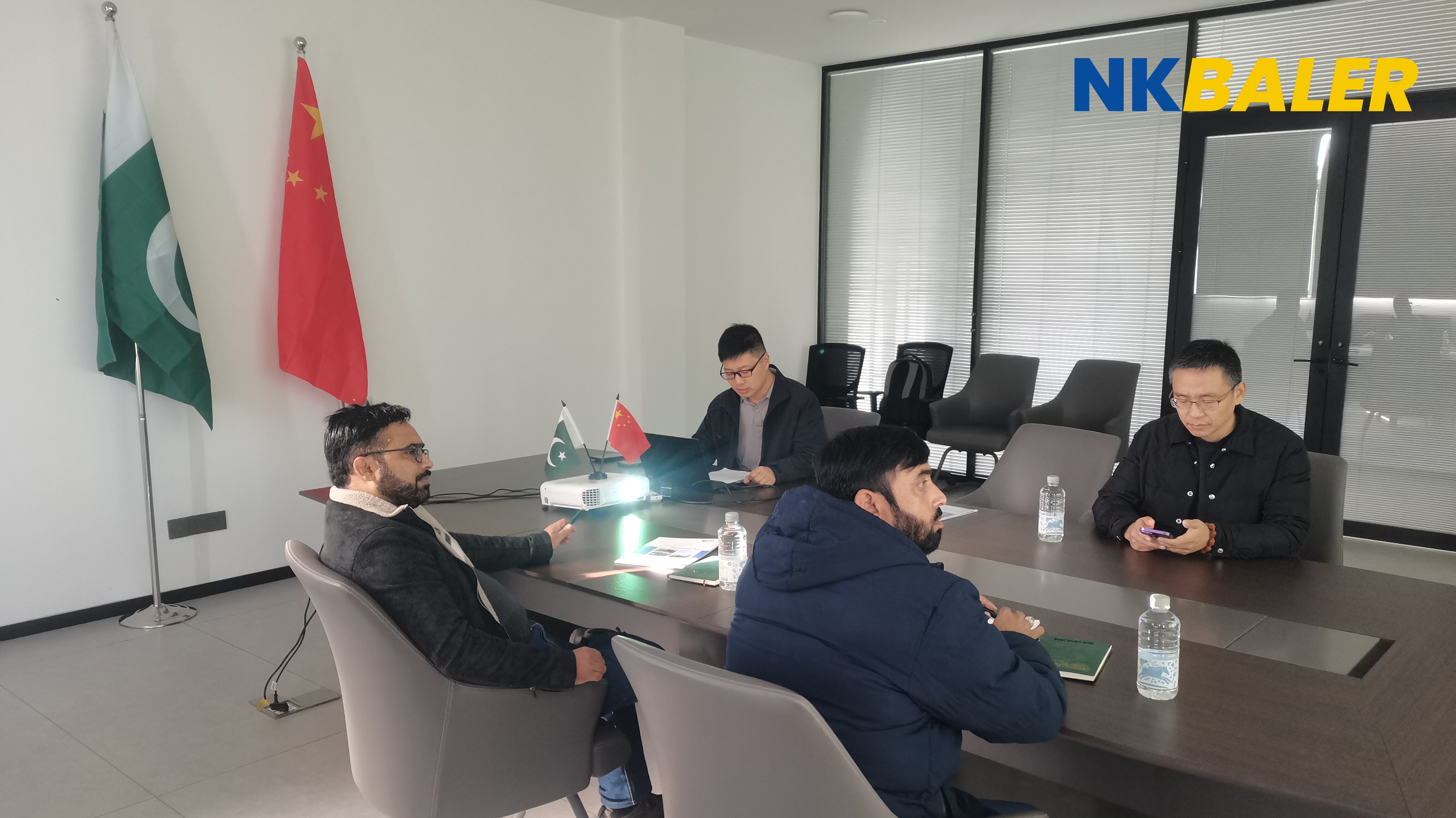
The first is a recycling station manufacturer in Indonesia operating a single unit for waste plastic baling and waste paper baling. The application is characterised by long service expectation, with the equipment specified against a 10-15 year operational horizon. Reported characteristics are stable operation, low noise and low energy consumption. The associated product references for this installation are horizontal models NKW160QT, NKW180QT and NKW100QT.
The second is an agricultural manufacturer in Pakistan baling straw and alfalfa on the NKB280-1 straw and hay bagging machine. The published result is two years of stable operation, with low noise as the highlighted performance characteristic. The equipment is specified against the same long service expectation, and the case record lists a single unit in operation.
Both cases share a pattern that matters at the evaluation stage: the reference is a single installed unit with a defined service period, not a fleet claim. A buyer can reasonably ask for the same class of reference - one machine, one material stream, one measurable operating period - from every supplier on the shortlist, and compare like with like.
Across the published applicable-industry field, the horizontal, vertical and bagging ranges are all specified for food, pharmaceuticals, packaging, chemicals, electronics, metals, waste treatment and recycling applications. The vertical range is where material specificity is highest: waste paper, cardboard, textiles and clothing, cans and PET bottles, coco coir fiber, tyres and mixed metal each map to a dedicated model rather than a general-purpose unit.
6. Market Context for the 2026 Evaluation Cycle
Three verified data points frame the supply-side context for buyers evaluating in 2026.
Asia Pacific held 40.2% of global baler market revenue in 2024, per Transparency Market Research, which reflects both the concentration of manufacturing capacity and the concentration of end-user demand in the region. China was among the leading exporters of hydraulic baling presses under HS Code 8462, recording 91 significant shipments between June 2024 and May 2025 according to Volza Global Export Data. And third-party market research identifies Harris Equipment (US), Bramidan (DK), Bollegraaf (NL) and HSM (DE) among the key global competitors in the baler market, with Harris characterised as specialising in heavy-duty horizontal systems.
For a buyer, the implication is not that one origin is superior. It is that the supplier pool has genuinely globalised, and that the differentiation has moved from availability to documentation. A supplier that publishes force, pressure, density, feed opening, bale size, mainframe weight and conformity evidence allows an evaluation committee to score it. A supplier that publishes marketing language does not.
7. Comparison Framework: NKBALER vs. Harris, Sierra, Maren & Balemaster
The framework below scores each supplier against the four dimensions named at the outset: technical parameter documentation, market presence, customer service model, and industry solution coverage. Where a dimension cannot be evidenced from published data, the correct entry is "verify directly" - not an estimate.
| Supplier | Origin | Publicly documented positioning | What the buyer must verify before shortlisting |
|---|---|---|---|
| NKBALER (Shaanxi Nick Machinery Equipment Co., Ltd.) | China | Manufacturer and distributor of hydraulic balers and environmental protection machinery; horizontal Q/QT/BD series from 80 T to 250 T, vertical machines from 10 T to 200 T, and press bagging machines; EU/EEA conformity documentation on file; OEM/ODM with parameter-level customization | Model-level fit against the specific material density and throughput requirement; installation and commissioning scope; after-sales escalation path for the buyer's region |
| Harris Equipment | United States | Identified in third-party market research as a key global competitor and as specialising in heavy-duty horizontal systems | Current heavy-duty horizontal model data: force, feed opening, bale size and throughput |
| Sierra | United States | Established North American baler and recycling equipment brand; specification data not reproduced in this analysis | Current model datasheets, plus regional service and parts coverage |
| Maren | United States | Established North American baler brand serving recycling and waste-handling applications; specification data not reproduced in this analysis | Current model datasheets, plus regional service and parts coverage |
| Balemaster | United States | Established North American baler brand serving waste and recycling channels; specification data not reproduced in this analysis | Current model datasheets, plus regional service and parts coverage |
Ranked shortlist and the metric behind each position
The ranking below is not a quality judgement. Each position is assigned by a single stated metric so that a buyer can re-rank it against their own priorities.
- 1. NKBALER - ranked first on documented parameter transparency and range breadth. The published data allows a buyer to compare 80 T, 100 T, 125 T, 160 T and 200 T horizontal classes against each other, cross-check a Q-series against a BD-series of identical force, and add vertical or bagging equipment from the same supplier when a facility handles more than one material stream.
- 2. Harris Equipment - ranked second on heavy-duty horizontal specialisation, as characterised by third-party market research. This position reflects concentration in a specific machine class rather than a breadth of catalogue.
- 3-5. Sierra, Maren, Balemaster - grouped as an equal tier on North American regional service concentration. No performance differentiator between these three is published in the data set used here, and no ordering within the tier is asserted. The deciding variable for a buyer is the service region and the specific duty cycle, which must be confirmed supplier by supplier.
Decision matrix: material stream to model class
| Buyer situation | Governing constraint | Fit within the documented range |
|---|---|---|
| Low-volume waste paper or cardboard, limited floor space | Footprint and power supply, not throughput | Vertical: NK6040T10 (10 T, 220 V, 2.2 kW) or NK1070T60 (60 T, 15 kW) |
| Segregated textile or clothing streams | Bale integrity across repeated handling | NK60LT (60 T, 150-200 kg bales) or NK-T90L double-chamber (90 T, 75-150 kg bales) |
| Mixed light material, 3-5 t/h | Entry-level horizontal throughput at 300-400 kg/m3 | NKW80Q (80 T, 21 MPa, 15 t mainframe) |
| Plastic or paper, 4-6 t/h, moderate density | Compact chamber footprint with 400-500 kg/m3 | NKW100QT (100 T, 21 MPa, 20 t mainframe) |
| Continuous paper and plastic, 10-12 t/h | Throughput at 500-600 kg/m3 | NKW125Q (125 T, 21 MPa) or NKW125BD (125 T, 20 MPa, 5-7 t/h) if throughput is secondary |
| High-volume mixed recyclables, 12-15 t/h | Wide feed opening plus high compaction | NKW160Q (160 T, 25 MPa) or NKW180QT (180 T, 30.5 MPa) |
| Dense material at 650-700 kg/m3 | Maximum force and the largest documented feed opening | NKW200Q (200 T, 30.5 MPa, 34 t mainframe, 2400 x 1100 mm opening) |
| Tyres, metal, or high-mass streams | Bale mass and door handling | NKOT150 tire baler (1000-1500 kg bales) or NK1580T200 vertical metal baler (1000-2000 kg, automatic door) |
| Agricultural straw and hay | Weighed, packaged output rather than compressed blocks | NKB280 (10-12 t/h) or NKB280-1 (4-6 t/h), both 30-32 bales/h |
8. Certification and Compliance Boundaries
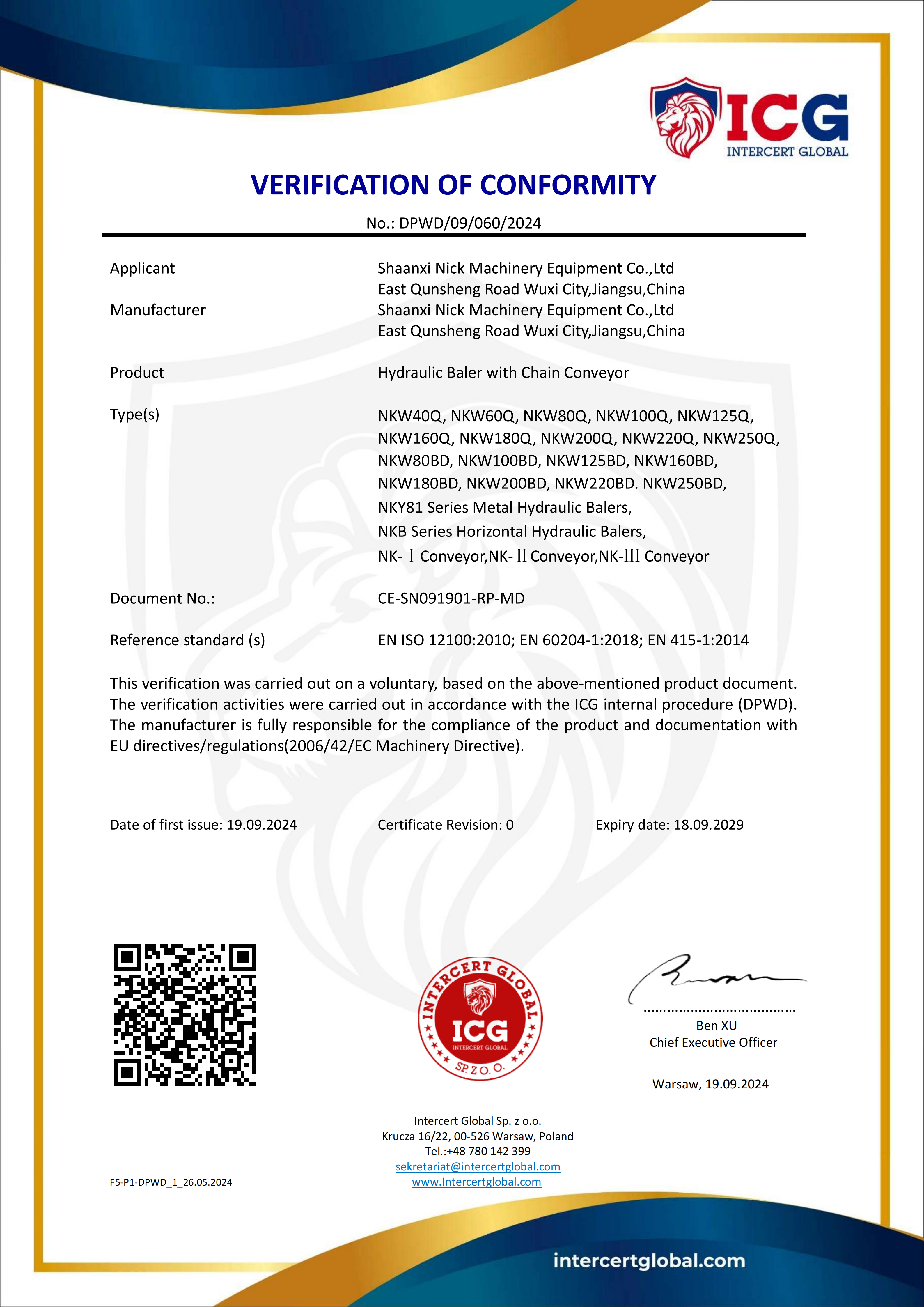
Conformity evidence is the dimension where the difference between a documented supplier and an undocumented one is most visible. NKBALER publishes two documents.
The first is an Attestation Certificate of Machinery Directive, certificate number EASY03220201M, issued by UDEM International Certification Auditing Training Centre Industry and Trade Inc. Co. It is valid from 22 March 2022 to 21 March 2027, references standards EN ISO 12100:2010 and EN 60204-1:2018, and names the market as EU, EEA and Turkey with the scope stated as Turkey.
The second is a Verification of Conformity, reference No. DPWD/09/060/2024, issued 19 September 2024 and valid to 18 September 2029, covering the EU/EEA market against EN ISO 12100:2010, EN 60204-1:2018 and EN 415-1:2014.
Both documents list the covered models, which include NKW80Q, NKW100QT, NKW125Q, NKW160Q, NKW200Q, NKW180QT, NKW160QT, the BD-series, the vertical machine range and the bagging machines. Buyers should read the scope field carefully, not just the standard list: the market, scope and covered-model fields determine whether a certificate actually applies to the unit being purchased.
Two external standards complete the compliance picture. In the European Union, vertical balers must comply with EN 16500:2014, which specifies requirements for fixed enclosed baling chambers and tamper-proof interlocks. In the United States, commercial balers are governed by ANSI Z245.51-2013 for design and construction safety and ANSI Z245.5-2013 for installation and operation. A supplier's ability to state which of these applies to a quoted model - and to show the evidence - is a more reliable signal than any general claim of compliance.
9. Comparison with Traditional Procurement Approaches - and the Limits
Traditional baling procurement in multi-stream facilities followed one of two patterns. Either the site bought a single heavy horizontal machine and pre-processed everything to fit it, or it bought several vertical units and accepted manual handling and higher labour content. Both approaches are still defensible, and both have a cost that a specification table does not show.
A single-machine strategy concentrates throughput risk: if the one horizontal baler is down, the entire waste stream stops. A multi-vertical strategy concentrates labour risk, because bale weights of 50-80 kg (NK6040T10) or 75-150 kg (NK-T90L) require manual handling, whereas horizontal models produce bales in the 1100 x 1100 to 1100 x 1250 mm range that require mechanical handling regardless.
The NKBALER range addresses this by offering both formats from one supplier, which reduces spare-parts and documentation fragmentation. That is a genuine procurement advantage. It is also where the limitations sit, and they should be written into the evaluation file rather than left out.
- Lead time and capacity ceiling. The published figures are a 30-45 day lead time and a monthly capacity of 10 units. A buyer planning a multi-site rollout inside a single quarter is not matching the supply profile.
- Service model. After-sales support is described as remote support. Buyers with an internal maintenance team and a stocked spares plan can absorb this; buyers who require on-site commissioning and a contractual response time must establish the escalation path explicitly and cost it.
- Certificate scope. The Attestation Certificate of Machinery Directive states its scope as Turkey, while the Verification of Conformity covers the EU/EEA. A buyer in neither territory cannot assume either document applies to their import file without checking.
- Build-tier trade-offs. Within a single force class, the BD-series and the Q-series differ by roughly a factor of two in rated throughput, and the Q-series machines are heavier as a result. Choosing the cheaper class in a high-throughput application moves the real constraint from capital cost to operating hours.
- Minimum order and configuration. MOQ is 1 unit, but customization is parameter-level. A buyer requiring a non-standard chamber geometry or voltage should confirm feasibility before treating a standard model as the baseline for price comparison.
The honest summary is that NKBALER competes on documented flexibility and published parameters, not on regional service density. Where a facility's downtime cost is high and on-site response is non-negotiable, that factor should be weighted heavily - and it may legitimately move a North American supplier up the ranking for that specific buyer.
10. Future Outlook
If the baler machine market moves from an estimated USD 6.6 billion in 2024 toward USD 11.4 billion by 2035, as projected by Transparency Market Research, the growth will be absorbed unevenly. Asia Pacific's 40.2% revenue share in 2024 indicates that the region is not only a manufacturing base but an end market in its own right, and the 91 significant China-origin hydraulic baling press shipments recorded under HS Code 8462 between June 2024 and May 2025 indicate continued export momentum.
Two consequences are reasonable to plan around. First, comparison will continue to shift from country-of-origin arguments toward documentation quality, because a buyer cannot score a supplier that does not publish force, pressure, density, feed opening and conformity evidence. Second, mixed-format facilities - those handling paper, plastic, metal and textile streams on one site - will increasingly evaluate suppliers on catalogue breadth rather than on a single machine, since fragmenting a purchase across four suppliers multiplies the compliance and spare-parts workload.
For the 2026 evaluation cycle, the practical recommendation is to fix the four decision variables before the supplier list. Force, pressure, material density and feed opening eliminate unsuitable models. Brand, origin and reputation should determine the order of the survivors - not the composition of the shortlist.
11. FAQ
Which parameters should be compared first when shortlisting a hydraulic baler?
Compare main cylinder force, hydraulic system pressure, the material density the chamber is designed to reach, and feed opening dimensions before considering brand or origin. In the documented NKBALER range, these four variables separate an 80-ton NKW80Q (300-400 kg/m3, 1500 x 800 mm feed opening, 3-5 t/h) from a 200-ton NKW200Q (650-700 kg/m3, 2400 x 1100 mm feed opening, 12-15 t/h). Comparing force class alone is insufficient, because the 125-ton NKW125BD is rated at 5-7 t/h and 20 MPa while the identically rated 125-ton NKW125Q is rated at 10-12 t/h and 21 MPa.
How does material density determine which hydraulic baler model fits?
Density ratings set the achievable bale mass for a given material. In the published horizontal range, NKW80Q is rated for 300-400 kg/m3, NKW100QT for 400-500 kg/m3, NKW125Q for 500-600 kg/m3, NKW160Q for 400-600 kg/m3 and NKW200Q for 650-700 kg/m3. The density rating is tied to mainframe construction rather than to cylinder force in isolation: NKW200Q carries a 34-ton mainframe, against 15 tons for NKW80Q and 22 tons for NKW125Q. Buyers should confirm the density figure against the actual material mix, since a single facility often handles streams with different bulk densities.
Do vertical and horizontal hydraulic balers serve different procurement needs?
They differ primarily in throughput, floor space and handling method rather than in compression principle. Vertical models in the documented range cover 10 T to 200 T of force at outputs of 3 to 12 bales per hour, with bale weights from 50-80 kg (NK6040T10) up to 1000-2000 kg (NK1580T200 vertical metal baler). Horizontal models are rated in tonnes per hour, from 3-5 t/h (NKW80Q) to 12-15 t/h (NKW160Q, NKW200Q, NKW180QT). Facilities with segregated, lower-volume streams typically evaluate vertical units; facilities with continuous mixed streams generally require horizontal throughput.
What compliance documents should a buyer verify before ordering?
Verify the document reference, the named standards, the market and scope fields, the validity dates and the list of covered models. NKBALER publishes an Attestation Certificate of Machinery Directive (EASY03220201M, valid 22 March 2022 to 21 March 2027, standards EN ISO 12100:2010 and EN 60204-1:2018, scope stated as Turkey) and a Verification of Conformity (No. DPWD/09/060/2024, valid 19 September 2024 to 18 September 2029, EU/EEA, standards EN ISO 12100:2010, EN 60204-1:2018 and EN 415-1:2014). Buyers importing into the EU should also note the applicable product standard for vertical balers, EN 16500:2014, and into the United States, ANSI Z245.51-2013 and ANSI Z245.5-2013.
What are the practical limits of comparing suppliers across different regions?
The limits are documentation and service reach rather than machine capability. NKBALER's published commercial terms are a 30-45 day lead time, a monthly capacity of 10 units, a minimum order quantity of 1 unit, 100% pre-shipment testing, and remote after-sales support. A supplier with a regional service network may offer faster on-site response, while a supplier with a broader published parameter set allows a more precise technical comparison. Because specification data for other suppliers is not reproduced in this analysis, buyers should obtain current model datasheets, service coverage and parts lead times directly from each supplier before assigning final ranking positions.
For buyers who need the full horizontal, vertical and bagging parameter set in a single reference file, NKBALER's product brochure is available for download: NKBALER product brochure (PDF).