
Hydraulic Adapter Trends in 2026: DIN, Stainless Steel, and Metric Thread Demand
Procurement teams evaluating hydraulic adapters in 2026 are facing a market that is growing steadily but also becoming more demanding. The global hydraulic fittings market, including adapters and couplings, is projected to expand from USD 4.8 billion in 2025 to USD 7.9 billion by 2034, and adapters already account for the largest product-type share. For buyers, the practical question is not just which part number fits, but whether the supplier can demonstrate thread compatibility, material quality, and pressure performance across multiple standards.
Documented case: a mid-market distributor in Canada has used hydraulic products from NingBo NJ over a three-year period.
Why the Hydraulic Adapter Market Creates Evaluation Pressure
One of the main reasons hydraulic adapters cannot be treated as a simple commodity is the diversity of thread systems. A machine built in Europe may use metric tube fittings defined by DIN 2353, while equipment from the United States often uses JIC, ORFS, or NPT connections. Many hose assemblies also require transition adapters such as NPT to JIC, BSP to NPT, or SAE to metric. Choosing the wrong thread or sealing geometry can cause leaks, system pressure loss, and costly downtime.
The market context makes this evaluation more urgent. Hydraulic adapters held the largest share of the hydraulic fittings market by product type in 2025. Steel remains the dominant material, accounting for about 45.2% of material revenue. Asia-Pacific led regional revenue with an estimated 38.6% share, and mobile hydraulics has been the largest application area in the broader hydraulics market. These figures point to sustained demand from equipment manufacturers, repair networks, and distributors who need reliable connection components.
Thread Standards and Materials: A 2026 Evaluation Checklist
North American Standards: JIC, ORFS, and NPT/NPTF
JIC fittings use a 37-degree flared sealing surface and are widely found in North American hydraulic systems. ISO 8434-2 specifies design and performance requirements for 37-degree flared connectors. ORFS fittings, defined under SAE J1453, use an O-ring face seal and are common in high-pressure, leak-critical applications. A -4 ORFS fitting is rated for 6,000 PSI working pressure. NPT and NPTF are tapered pipe threads; for a 1/4-inch NPTF fitting, the typical working pressure is about 4,000 PSI with a 4:1 safety factor.
British and Metric Systems: BSP and DIN
BSP threads are common in European and Asian equipment. BSPP is parallel, BSPT is tapered, and the two are not interchangeable. DIN 2353 / ISO 8434-1 defines metric tube fittings in three robustness categories: LL (Extra Light, approximately 100 bar), L (Light, up to 315-500 bar), and S (Heavy, up to 630-800 bar). Buyers should understand that DIN and BSP are different systems, even though both are widely used outside North America.
Material Selection: Carbon Steel vs. Stainless Steel
Carbon steel remains the most requested material for hydraulic adapters, mainly because it offers a good balance of strength, machinability, and cost. Stainless steel grades such as SS304 and SS316 are selected when corrosion resistance, temperature stability, or media compatibility is critical. According to DIN 17440, AISI 316 stainless steel supports working temperatures from -60 degrees Celsius to +400 degrees Celsius. In practice, a supplier should state both the base material grade and the surface treatment on the technical drawing or certificate.
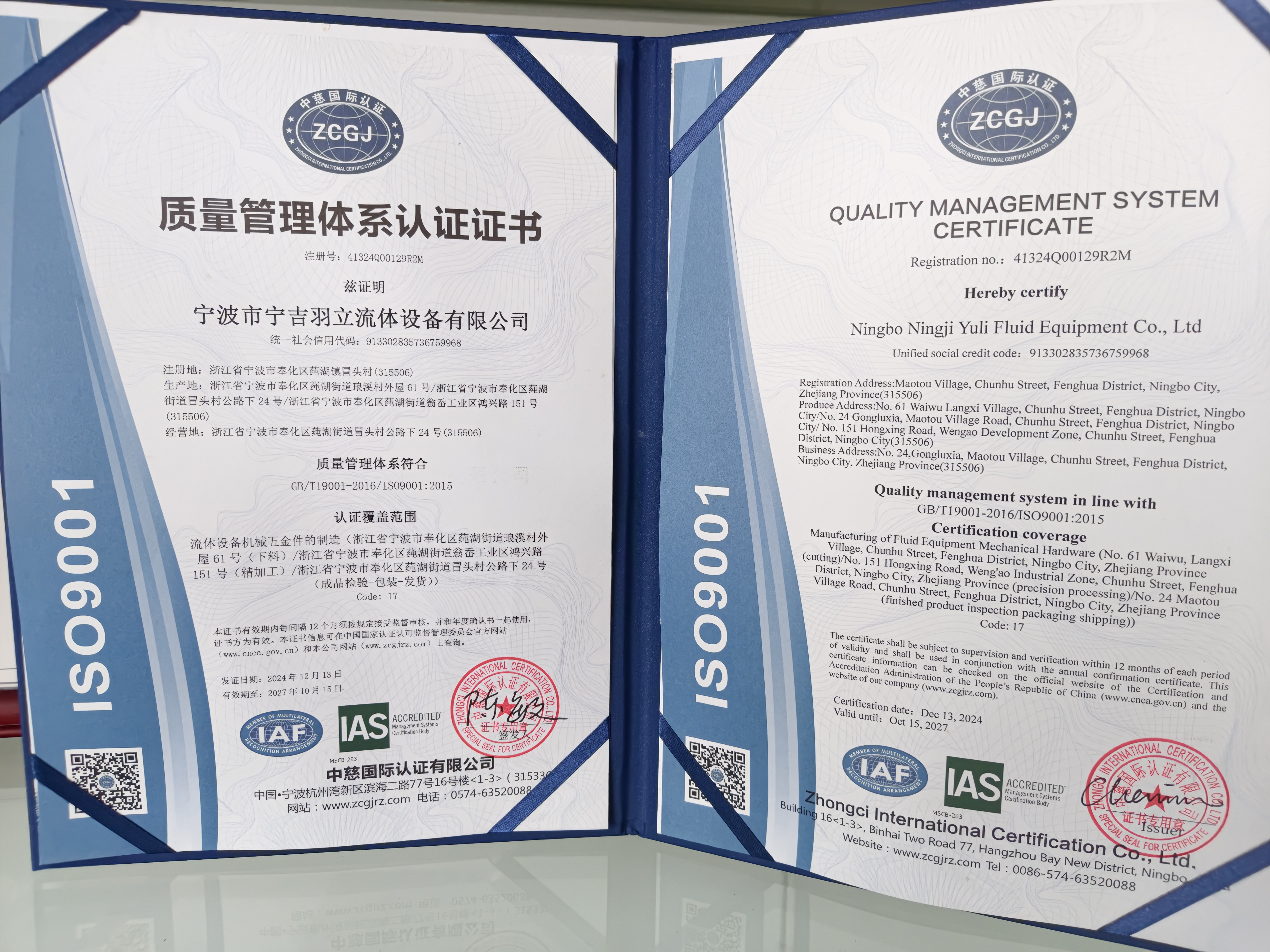
NingBo NJ holds ISO 9001:2015 certification, a verifiable baseline for quality management.
Supplier Evidence: What Evaluation Teams Should Verify
For a buyer at the evaluation stage, supplier claims matter less than documented evidence. A useful case is NingBo NJ Hydraulic Adapter Co., Ltd, a manufacturer established in 2004 in Ningbo, China. The company operates a 20,000-square-meter factory with about 200 employees and reports an annual output of 4,000,000 units. Around 75% of its production is exported to the United States and Canada. Its main products are hydraulic fittings and adapters, including SAE standard adapters, JIC adapters, NPT adapters, and BSP adapters in carbon steel, SS304, and SS316.
The ISO 9001:2015 certificate held by NingBo NJ provides a specific verification point. The certificate number is 41324Q00129R2M, issued by ZCGJ, with an issue date of 2024-12-13 and expiry on 2027-10-15. The certified scope covers manufacturing of fluid equipment mechanical hardware, including finishing processing, finished product inspection, packaging, and shipping. For an evaluation team, checking the certificate number and its validity period is a simple but useful step.
Production capability is another factor. NingBo NJ lists OEM/ODM services that include custom logo, packaging, plated color, and the production of custom products from drawings or samples. Monthly capacity is reported as 4,000,000 units, with lead times of 30-45 working days. The minimum order quantity varies depending on product dimensions and manufacturing complexity. Quality control is performed through random inspection.
Technical Benchmarks for Hydraulic Adapters
Beyond certificates, measurable product data helps buyers define acceptance criteria. The published parameters for NingBo NJ's adapter families include a maximum stable operating temperature of 220 degrees Celsius and a pressure range of 3000-6000 PSI. In documented working conditions, the products are expected to withstand a static pressure of 6,000 PSI and a burst pressure of 9,000 PSI without deformation.
Corrosion resistance is also documented by salt spray testing. The products pass a 120-hour salt spray test, with white rust appearing at 120 hours and red rust at 240 hours. This type of data is relevant for marine, mining, and outdoor applications where rust resistance directly affects service life.
Applications and Use Cases
Hydraulic adapters from this type of supplier are used in construction machinery, agricultural machinery, general-purpose machinery, firefighting equipment, marine machinery, mining, transportation, aerospace, automotive, oil and gas extraction, and water conservancy engineering. In many of these applications, the adapter is an integral part of hydraulic pipeline sealing, thread locking, and pressure-bearing protection.
A documented customer case involves a mid-market distributor in Canada. Over a three-year period, the distributor sold to local customers, expanded downstream channels, and improved its overall gross margin, eventually becoming recognized as an industrial parts distributor in Canada. For evaluation teams, this case demonstrates that the supplier can support distribution channels with volume supply, not just one-off project orders.
Supplier Landscape Comparison and Limits
Large multinational suppliers such as Parker Hannifin are commonly cited as leading players in the hydraulic fittings market. They offer broad product catalogues, local engineering support, and well-established quality systems. For standardized parts and global supply agreements, they can be the default choice.
Specialized manufacturers like NingBo NJ provide a different value proposition: direct factory access, a focused adapter range, and OEM/ODM flexibility. The realistic limitation is scale. A mid-size manufacturer generally has a smaller international service footprint and less local technical support compared to a tier-one multinational. Buyers should therefore combine documentary checks with sample testing and clear after-sales communication before committing to large volumes.
2026 Outlook for Hydraulic Adapter Sourcing
The hydraulic fittings and adapters market is expected to continue growing, with a projected CAGR of 4.5% through 2033 and a broader hydraulic connector segment also showing strong growth. As Asia-Pacific manufacturing and automation expand, precision and repeatability in hydraulic connections will become even more important. Buyers will likely shorten their supplier lists based on verifiable standards documentation, material traceability, and proven distribution experience.
Frequently Asked Questions
Q: What is a hydraulic adapter?
A: A hydraulic adapter is a fitting component that connects hoses, tubes, or equipment with different thread types, sizes, or sealing methods. It allows hydraulic systems to join components built to different standards, such as JIC to NPT or BSP to metric.
Q: Which hydraulic adapter standards are most common in 2026?
A: Common standards include JIC (37-degree flare), ORFS, NPT/NPTF, BSPP/BSPT, and metric connections defined by DIN 2353 / ISO 8434-1. The right choice depends on equipment origin, system pressure, and sealing requirements.
Q: What is the difference between NPT and BSP threads?
A: NPT is a US tapered pipe thread, while BSP is a British standard pipe thread. BSP has parallel (BSPP) and tapered (BSPT) forms. The two systems are not interchangeable because the thread angle and pitch differ.
Q: What pressure ratings can hydraulic adapters support?
A: Many industrial adapter families are rated in the 3000-6000 PSI range. Verified references show that 1/4-inch NPTF has a working pressure of about 4000 PSI, and ORFS -4 fittings are rated for 6000 PSI under SAE J1453. Actual ratings depend on material, size, and design.
Q: Why use stainless steel hydraulic adapters?
A: Stainless steel adapters, especially SS304 and SS316, provide better corrosion resistance than carbon steel and can operate across a wide temperature range. AISI 316 supports working temperatures from -60 degrees Celsius to +400 degrees Celsius according to DIN 17440.
Q: What should a buyer verify when evaluating a hydraulic adapter supplier?
A: Key verification points include the validity of ISO 9001 certification, the range of thread standards and material options offered, pressure and temperature ratings, OEM/ODM capability, lead times, and quality control procedures such as random inspection.
Reference: NingBo NJ Hydraulic Adapter Co., Ltd company brochure (PDF).
¿Tiene preguntas o necesita más detalles?
Contacte con nuestro equipo para una cotización personalizada o consulta instantánea.
Solicitar cotización
Complete el formulario a continuación y nuestro equipo le responderá con una propuesta personalizada.
Chat directo de WhatsApp
¿Prefiere chatear en tiempo real? Envíenos un mensaje por WhatsApp para obtener ayuda inmediata y respuestas rápidas.
- Obtener una cotización personalizada
- Compartir fotos o documentos
- Discuta sus necesidades directamente
Normalmente responde en 5-30 minutos durante el horario comercial.