
Hydraulic Adapter FAQ: BSPP vs BSPT, Materials, Ratings, Nut Adapters
Hydraulic Adapter FAQ: BSPP vs BSPT, Materials, Ratings, Nut Adapters
Most hydraulic adapter failures are decided before the order is placed: a thread is identified from the wrong reference, a material is selected for a corrosion environment it will never actually see, a pressure figure is read outside the size and thread family it belongs to, or the crate arrives complete except for the nut, sleeve or plug that makes the joint usable. This reference answers the recurring technical and procurement questions behind those four failure points, with specific attention to nut-type adapters — cap nuts, lock nuts, tube nuts, sleeves and bore-to-port connectors. These are frequently ordered alongside a main adapter line and are frequently the reason an assembly line stops.
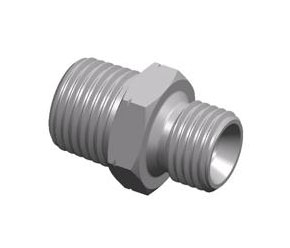
1BT — a straight adapter presenting a BSPP end and a BSPT end. Cross-system connections are made with dedicated parts, not by forcing threads.
Why thread and nut questions dominate adapter procurement
The global hydraulic fittings market, which includes adapters and couplings, was valued at USD 4.8 billion in 2025 and is projected to reach USD 7.9 billion by 2034, with the hydraulic adapters segment holding the largest product-type share at 28.4% in 2025 (Dataintelo). Steel accounted for 45.2% of material revenue share in 2025, and mobile hydraulics took more than 58% of total hydraulics market revenue in 2024 (Grand View Research).
The practical consequence is that most adapter volume moves into mobile equipment, where the joint is exposed to vibration, temperature cycling and field assembly. In that setting the small parts — lock nuts, tube nuts, sleeves and caps — determine whether the joint can be completed to specification at all. A distributor can hold the correct adapter and still be unable to close a work order because the sleeve was short-shipped.
Thread identity: BSPP versus BSPT, and what actually seals
What is the functional difference between a BSPP adapter and a BSPT adapter?
BSPP (British Standard Pipe Parallel) uses a parallel thread, so sealing is achieved at a face, a bonded washer or an O-ring rather than by the thread itself. BSPT (British Standard Pipe Tapered) uses a tapered thread, and sealing develops as the threads engage and deform along their length, normally with a thread sealant. In the NingBo NJ Hydraulic Adapter Co., Ltd catalog the two systems are separated by designation: BSPP models are grouped under B (for example 1B, 1BJ, 5BN, 6B, 9B), while BSPT models sit under T (for example 1T, 1T9, 1ST9, 4T, 5T).
Can a BSPP male adapter be installed into a BSPT port if sealant is used?
No. Sealant does not convert a parallel thread into a tapered seal. The parallel male will start into the tapered female because the pitch is compatible, but the engagement geometry is wrong: there is no controlled interference along the thread length and no defined face for a washer to compress against. Cross-family connections in the catalog are handled with dedicated parts. The 1BT straight adapter, for example, presents a BSPP thread end and a BSPT thread end, so each side of the connection meets the system it was designed for.
The same logic applies to BSPP-to-NPTF conversion. The 5BN (Male BSPP x Female NPTF straight) and 1NB (Male NPTF pipe x Male BSPP straight) parts exist precisely because the two systems cannot be joined directly. For buyers, the procurement rule is simple: if a drawing shows one thread system on the hose side and another on the port side, the part number must be a conversion adapter — not a standard adapter plus a different sealant.
How do NPT, NPTF, JIC and SAE/ORFS threads relate to BSP?
NPT and NPTF are tapered pipe threads; NPTF is the dryseal variant designed to seal on the thread itself, without a separate sealing face. JIC is a 37° flare connection, covered internationally by ISO 8434-2, which specifies design and performance requirements for 37° flared connectors suitable for tubes from 6 mm to 50.8 mm. The SAE family covers O-ring boss (ORB) and O-ring face seal (ORFS) connections; ORFS for dash size -4 (1/4 in) is rated at 6000 PSI working pressure under SAE J1453.
In the NingBo NJ catalog, these families appear both as dedicated lines and as conversion parts. Examples include the 1JT (Male JIC x Female BSPT straight), 2404 (Male JIC x Male NPTF pipe straight), 2501 (Male JIC x Male NPTF pipe 90° elbow), 6801 (Male JIC x Male Adjustable ORB 90° elbow) and 6802 (Male JIC x Male Adjustable ORB 45° elbow).
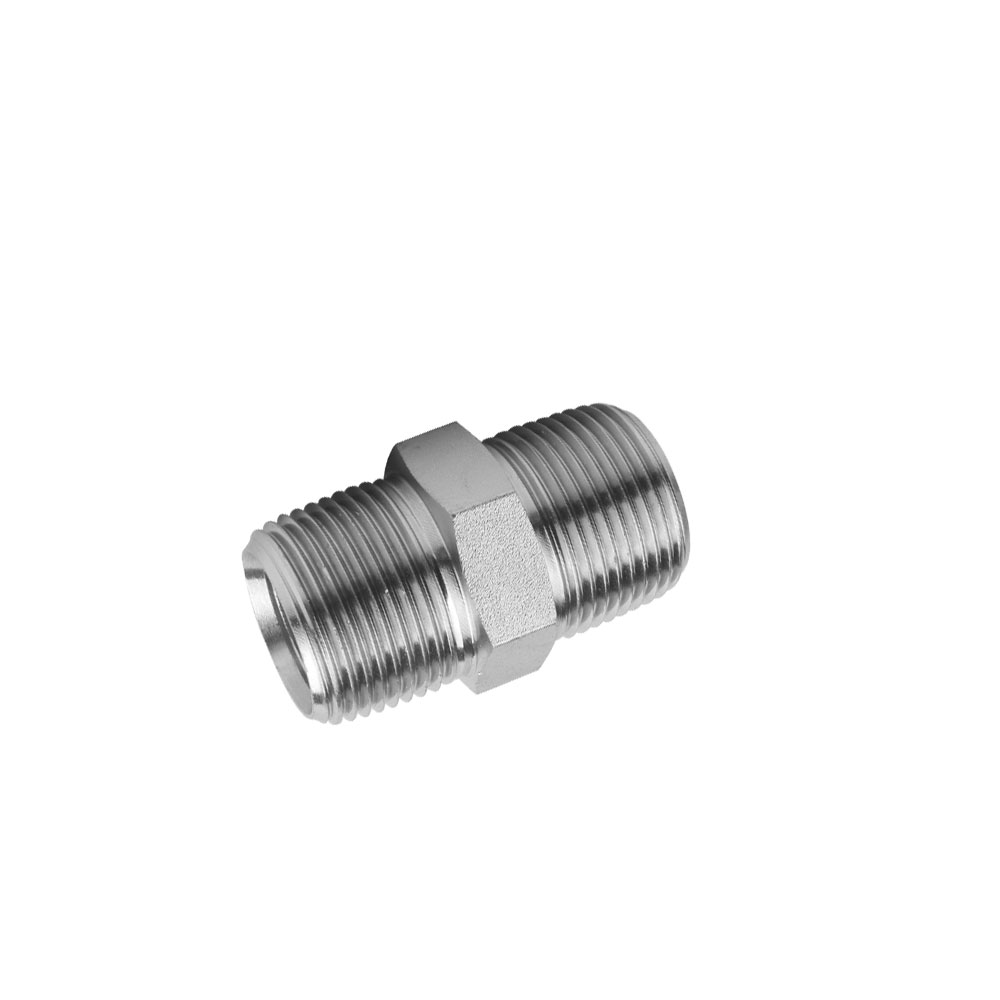
5404 — Male NPTF pipe x Male NPTF pipe straight. NPT/NPTF designations sit in the 5000–5600 model range.
Material selection: carbon steel, SS304 or SS316
How should a buyer choose between carbon steel, SS304 and SS316?
All three options are listed across the adapter lines, including the nut adapter family. The selection logic is environment-led rather than price-led. Carbon steel is the default for mobile hydraulic duty where the external environment is controlled or the part carries a protective finish. SS304 is specified where atmospheric corrosion or wash-down exposure is present. SS316 is the choice where chlorides are present — marine machinery is the clearest documented case, and chloride-bearing water environments also appear in parts of the water conservancy and firefighting segments.
Steel's position in the market is consistent with that logic: steel material held 45.2% of hydraulic fitting revenue share in 2025, which reflects how much hydraulic duty sits in benign or coated environments rather than in aggressive ones. The trade-off for stainless is cost, and — importantly — the fact that stainless is chosen for a different set of failure modes, not as a universal upgrade.
What does a 120-hour salt spray result actually tell a buyer?
For these adapter lines, the stated result is a 120-hour salt spray test, with white rust appearing at 120 hours and red rust at 240 hours. White rust is corrosion of the plated surface layer; red rust indicates that the underlying steel has begun to corrode. The test therefore measures the durability of the coating system on a given substrate under accelerated conditions.
Two conclusions can be drawn, and one cannot. It can be used to compare finishes between suppliers on a like-for-like basis. It can be used as an internal control that the plating process is stable. It cannot be converted into a service-life prediction for a specific port, wash-down regime or chemical exposure. Buyers should also note that quality control on this line is carried out by random inspection, which means salt spray results describe process capability at batch level rather than a per-piece certification.
Pressure and temperature ratings, read in context
What do the 3000–6000 PSI range and the 220°C limit cover?
The adapter lines are stated with a pressure range of 3000–6000 PSI and a maximum stable operating temperature of 220°C. In the construction machinery scenario these components are documented as capable of withstanding a static pressure of 6,000 PSI and a burst pressure of 9,000 PSI without deformation, while maintaining continuous operation and seal integrity.
Those two figures should not be treated as equivalents. The burst figure is a limit, not a working pressure. Specification should sit inside the working range appropriate to the specific size, thread family and material, and the 220°C value is the ceiling for the line — a maximum stable operating temperature, not a comfortable continuous set point.
Do pressure ratings carry across thread families and sizes?
No. Ratings attach to a thread family and a size, and the published anchors show how wide the spread can be. A 1/4 in NPTF connection is typically listed at 4000 PSI working pressure with a 4:1 safety factor, while an ORFS dash -4 (1/4 in) connection is rated 6000 PSI working under SAE J1453. Same nominal bore, different family, different number.
Where metric tube fittings are involved, DIN 2353 / ISO 8434-1 sorts fittings into three robustness categories: LL (extra light, 100 bar), L (light, up to 315–500 bar) and S (heavy, up to 630–800 bar). This is a useful reminder in two directions: a metric thread designation describes a thread standard, not a pressure class, and a system assembled from parts of different robustness categories will rate at the weakest link, not the average.
Reading model designations across BSP, NPT, JIC and SAE
What does the designation pattern tell you?
The catalog is organised by thread family first, then by end configuration within that family. The table below maps the main prefixes to the systems they belong to, using designations and configurations documented in the product data.
| Prefix group | Thread system | Example designations | Example configurations |
|---|---|---|---|
| 1B, 2B, 5B, 6B, 7B, 9B, EB | BSPP | 1B, 1BJ, 1NB, 5BN, 6B, 9B | 1B Male BSPP x Male BSPP straight; 6B Male BSPP x Male BSPP bulkhead straight; 9B Female BSPP plug |
| 1T, 1BT, 4T, 5T | BSPT | 1T, 1T9, 1BT, 1ST9, 4T, 5T | 1T Male BSPT x Male BSPT straight; 1T9 Male BSPT 90° elbow; 4T Male BSPT plug |
| 2400, 2500, 2600, 2700 | JIC | 2403, 2404, 2408, 2500, 2504, 2700, 2701 | 2403 Male JIC x Male JIC straight; 2500 90° elbow; 2504 45° elbow; 2700 bulkhead straight; 2701 bulkhead 90° elbow |
| 5000, 5400, 5500, 5600, 5650 | NPT / NPTF | 5404, 5406, 5603, 5605, 5652 | 5404 Male NPTF pipe x Male NPTF pipe straight; 5603 tee; 5652 four-way cross |
| 6800 | SAE — JIC / ORB / ORFS | 6801, 6802, 6803, 6815, 6835 | 6802 Male JIC x Male Adjustable ORB 45° elbow; 6815 Male Adjustable ORB x Female ORB 90° elbow |
| 0300, 0400, 0500, FS0 | Nut adapter family | 0304C, 0306, 0318, 0319, 0403, 0500, FS0403 | 0306 JIC bulkhead lock nut; 0318 JIC tube nut; 0319 JIC tube sleeve; 0304C Female JIC cap |
Two cautions apply. First, the number inside a family encodes an end configuration rather than a universal code: 2500 is a Male JIC x Male JIC 90° elbow, while 2501 is a Male JIC x Male NPTF pipe 90° elbow, and 2504 is a Male JIC x Male JIC 45° elbow. The same prefix can therefore carry different end combinations. Second, the reliable route is confirmation against the catalog caption or drawing at order entry, not recall. A one-character misreading inside the 0300 series changes the part from a lock nut to a tube nut.
Nut adapters: the small parts that decide whether a joint is complete
The nut adapter family is listed as hydraulic cap nut and lock nut, with models 0304C, 0306, 0318, 0319, 0403, 0500, FS0304C, FS0306, FS0318 and FS0319. It carries the same material options (carbon steel, SS304, SS316), the same pressure range of 3000–6000 PSI and the same maximum stable operating temperature of 220°C as the main adapter lines, and the same 120-hour salt spray result.
What does each nut-type part do in a joint?
- Closure: the 0304C Female JIC cap closes an unused port or protects a thread during transport and storage.
- Fastening: the 0306 JIC bulkhead lock nut locks a bulkhead adapter through a panel, which is the standard arrangement where a hose passes through a wall, frame or bulkhead.
- Flare compression: the 0318 JIC tube nut and the 0319 JIC tube sleeve are a compression pair — the sleeve seats on the tube, and the nut draws it into the flare seat.
- Bore-to-port connection: the 0403 and 0500 bore-to-male JIC connectors and the FS0403 bore-to-male O-ring face seal connector adapt a bore to a male threaded end.
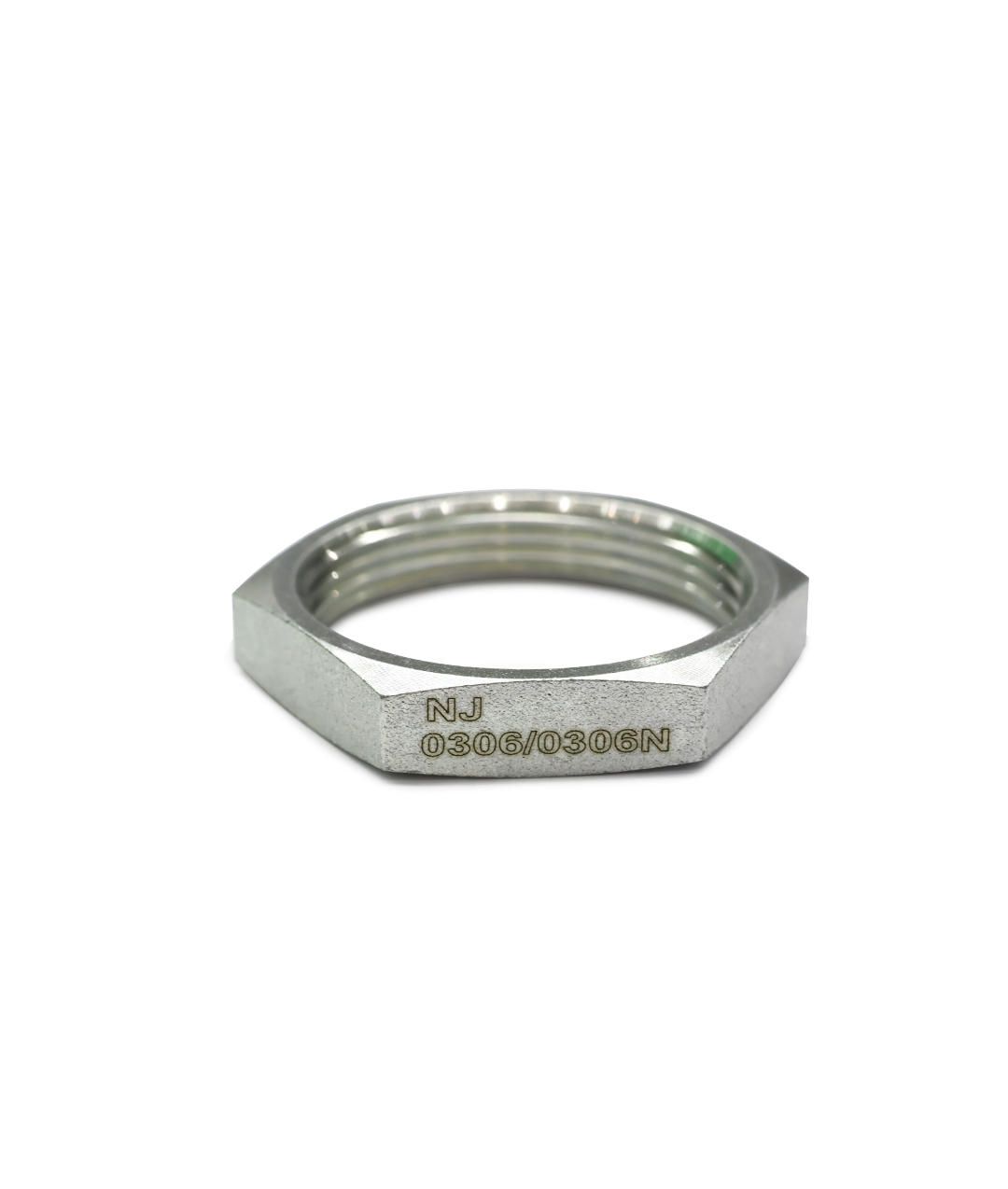
0306 — JIC bulkhead lock nut, part of the nut adapter family that carries its own pressure and temperature envelope.
Why are these parts a procurement risk rather than a consumable accessory?
A missing sleeve or lock nut is not a cosmetic shortage. A 37° flare joint cannot be completed to specification without its tube nut and sleeve pair, and a bulkhead adapter cannot be fastened without its lock nut. Substituting a plain nut of similar thread does not reproduce the function, because the geometry that seats the flare or clamps the panel is part of the part.
This is why these items carry their own model numbers, their own material specifications and their own stated ratings. For distributors, the practical implication is stocking policy: nut-level parts are high-frequency, low-unit-value items, and a shortage of them blocks the sale of the higher-value adapters they support.
What is the correct process when accessories are missing or wrongly delivered?
The documented procedure is straightforward. The recipient supplies photographs of the missing or wrong-delivered items. After verification, replacement accessories are arranged and shipped by sea or air depending on urgency and quantity. Nothing about that process is unusual in industrial supply; what determines whether it works smoothly is preparation on the receiving side.
Two practices reduce exposure. First, check the shipment against the packing list at model level before crates are put away — 0306 and 0318 differ by a single character and by function. Second, raise the claim while the shipment is still identifiable as a shipment, rather than after the parts have been absorbed into general stock, because verification depends on being able to match items to an order line. Inventory planners should also note that production lead time on this line runs 30–45 working days, which sets the floor for how quickly a corrective shipment can follow a commercial one.
Scenario fit: where these adapters are used, and one distributor case
The documented application profile for these adapters is high-temperature and high-pressure hydraulic service across thirteen industries: construction machinery, agricultural machinery, general-purpose machinery, firefighting equipment, marine machinery, mining, transportation, aerospace, automotive, oil and gas extraction, iron and steel metallurgy, and water conservancy engineering. The matched equipment list is equally specific — hydraulic hoses, hydraulic cylinders, threaded bolts, pipe joints, hydraulic pumps and mechanical cylinder assemblies — and the stated special requirements are rust resistance, high-temperature resistance and high-pressure resistance.
For project planning, those four elements answer the question buyers usually ask first: this is not a general hardware category, it is a pressure-retaining category. The function is hydraulic pipeline sealing, thread locking and fastening, and pressure-bearing protection for mechanical hydraulic assemblies, which is why the selection criteria differ from those applied to non-pressure pipe fittings.
What does a distributor case demonstrate about nut-level demand?
A documented case involves a mid-market distributor in Canada that purchased hydraulic cap nut models 0304C and 0306 — the cap nut and lock nut end of the catalog — in a quantity of 20,000,000 units over a project that ran for three years. The products were resold to other local customers with demand. The reported outcome was expansion of downstream client channels and an improvement in overall gross profit margin.
The structural detail matters more than the headline: the case sits in the nut-type portion of the product range, not in the flagship adapter models. That is consistent with how industrial distribution actually works — repeat order flow in hydraulic fittings is driven by the frequently consumed, frequently short-shipped small parts, and a supplier that can hold those parts available protects the distributor's ability to serve its own accounts. The Canadian distributor relationship is also consistent with the company's export profile: NingBo NJ Hydraulic Adapter Co., Ltd exports approximately 75% of output, with the USA and Canada as its main markets.
Limits and boundaries buyers should verify
Adapter specification fails when a rating is assumed rather than confirmed. The following boundaries apply to the range described in this reference and should be checked against the specific part number before commitment.
- Temperature. 220°C is the stated maximum stable operating temperature for these adapter lines. A wider envelope exists in general stainless standards — AISI 316 is described in DIN 17440 as covering -60°C to +400°C — but a standard range does not transfer to a specific adapter unless the supplier states it for that part.
- Pressure. 3000–6000 PSI is a line-level range, not a per-part guarantee. The applicable figure depends on size, thread family and material, and should be confirmed item by item.
- Corrosion data. The 120-hour salt spray result is accelerated test data on coating performance — white rust at 120 hours, red rust at 240 hours. It does not predict service life in a specific chloride, chemical or wash-down environment.
- Material substitution. Carbon steel requires a protective finish and is not interchangeable with stainless in wet or chloride-bearing service. Material choice is an environment decision, not a price decision.
- Thread interchange. Tapered and parallel thread systems are not interchangeable as sealing solutions. Converting between systems requires a dedicated cross-thread adapter such as the 1BT, 5BN or 1NB parts.
- Order parameters. Minimum order quantity varies depending on product dimensions and manufacturing complexity, and production lead time runs 30–45 working days. Both affect recovery options if a shortage is discovered late.
- Inspection scope. Quality control on this line is by random inspection. Buyers who require a defined sampling protocol or source inspection should agree that protocol before the order is placed rather than at receiving.
Market trend signals worth tracking
Three documented signals shape how adapter specification is likely to evolve. Asia-Pacific led global hydraulic fitting revenues in 2025 with an estimated 38.6% share, and Asia accounted for 74% of global industrial robot installations in 2024 — both of which increase the density of precise hydraulic connections per machine and raise the cost of a single incorrect thread specification. Mobile hydraulics held more than 58% of total hydraulics market revenue in 2024, keeping field assembly conditions and vibration exposure at the centre of adapter design requirements.
On the material side, steel still carried 45.2% of revenue share in 2025, while stainless and metric thread configurations continue to appear in more project specifications. The procurement consequence is not that one material replaces another, but that the specification step becomes more consequential: the same adapter envelope now serves more environments, and each environment has its own material and rating answer.
FAQ
What material should be specified for a marine hydraulic adapter?
SS316 is the choice where chlorides are present, which is why marine machinery appears among the documented applications. Note the boundary: SS316 is listed as an available material for these adapter lines, and the line's stated maximum stable operating temperature of 220°C applies regardless of material. Stainless selection addresses corrosion exposure, not a higher temperature ceiling.
How should a bulkhead nut adapter be specified?
Specify the nut and the adapter as a matched pair. The 0306 JIC bulkhead lock nut is the fastening element, while bulkhead adapters such as the 6B (Male BSPP x Male BSPP bulkhead straight) or the 2700 (Male JIC x Male JIC bulkhead straight) carry the connection. Confirm that both parts sit in the same thread series and dash size before ordering, and confirm whether the assembly requires a straight or angled bulkhead configuration.
Is a 4:1 safety factor universal for hydraulic adapters?
No. The 4:1 figure is published as typical for a 1/4 in NPTF connection rated 4000 PSI working pressure. ORFS dash -4 (1/4 in) is rated 6000 PSI working under SAE J1453, which is a different family with a different rating basis. Safety factors are applied per thread family and size, so a number taken from one family should not be assumed for another.
What is the difference between a cap nut, a lock nut, a tube nut and a sleeve in this catalog?
The names describe function in the joint. The 0304C Female JIC cap closes a port or protects a thread. The 0306 JIC bulkhead lock nut fastens a bulkhead adapter through a panel. The 0318 JIC tube nut and 0319 JIC tube sleeve work as a compression pair that seats and retains the flare. All four are grouped under the hydraulic cap nut and lock nut family and share the same material and rating envelope.
How quickly can a missing-parts claim be resolved?
Resolution depends on verification and shipping mode. The documented process requires photographs of the missing or wrongly delivered items, verification, and then replacement shipment by sea or air. Because production lead time runs 30–45 working days and minimum order quantity varies by dimensions and complexity, corrective shipments are usually fastest when the receiving check is completed immediately and the claim is raised against an identifiable order line.