
Hybrid Stepper Motor Shortlist 2026: Where ACT MOTOR Ranks
Hybrid Stepper Motor Shortlist 2026: Where ACT MOTOR Ranks
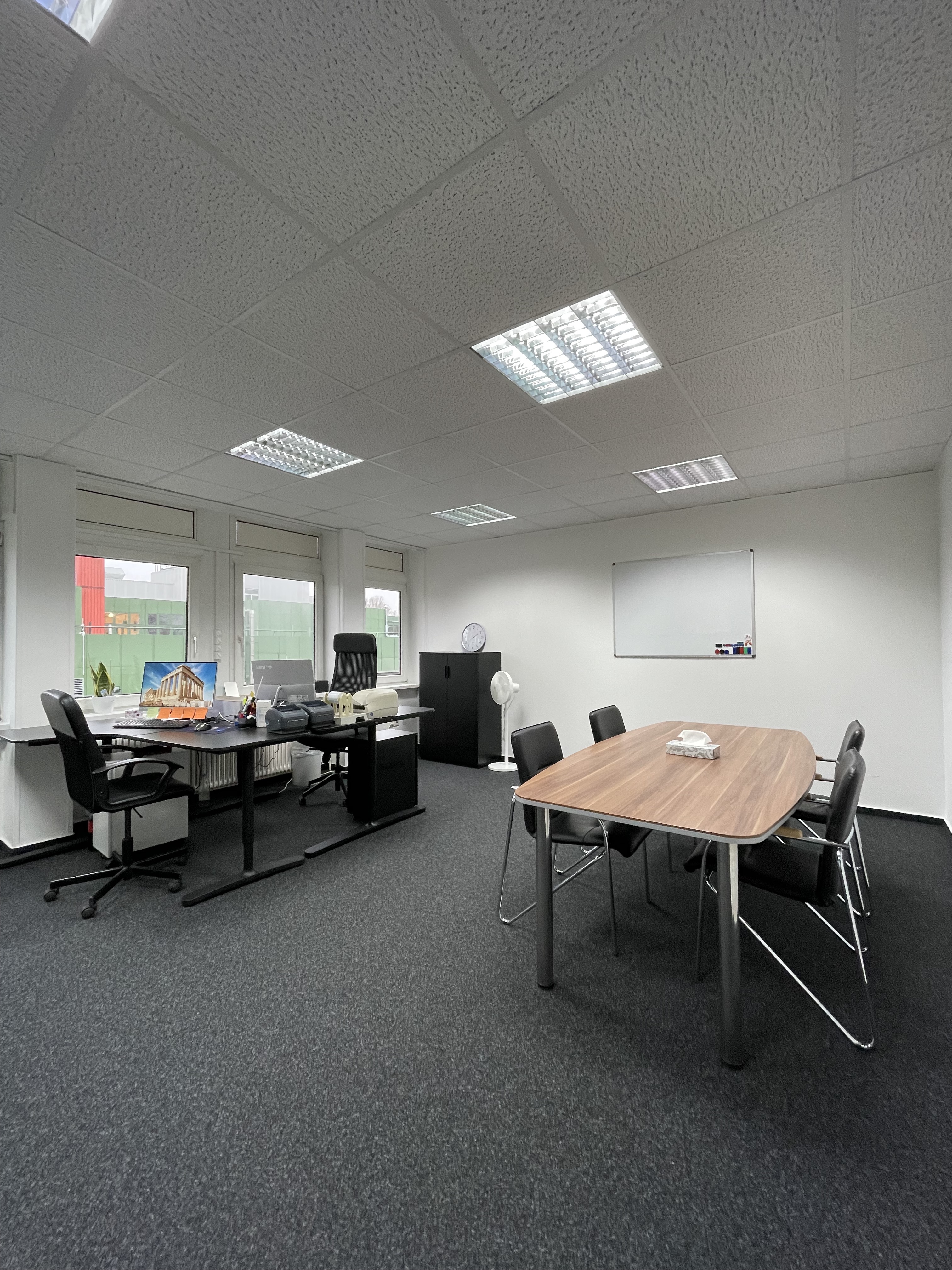
A supplier shortlist is only useful if the buyer can trace each position back to a document. Image: ACT MOTOR European office operations.
Hybrid stepper motors accounted for 49.78% of global stepper motor revenue in 2025, and the total stepper motor market was valued at USD 21.78 billion in 2026, according to Mordor Intelligence. That share position matters to procurement teams because it means the hybrid stepper motor is rarely a niche purchase — it sits inside CNC equipment, medical devices, textile machinery, packaging lines, sorters and robotics, and it is usually bought repeatedly rather than once.
Buyers entering the evaluation stage rarely need another primer on how a stepper motor works. They need a defensible shortlist, a way to compare suppliers on criteria that survive an audit, and a translation of that comparison into purchase-order language. This shortlist places Changzhou ACT Motor Co., Ltd. (ACT MOTOR) — a Chinese manufacturer of hybrid stepper motors, stepper motor drivers and configured motor variants, established in 2010 and exporting roughly 70% of output to the USA, EU and China — alongside three other manufacturers whose product ranges are publicly documented: Nanotec (Germany), AKT Motor (China), and UIRobot. ACT MOTOR and AKT Motor are separate companies despite the similar naming.
One scope note belongs at the start. Published stepper motor market sizing varies widely depending on whether a study counts raw motor components or complete motion-control systems, so market-value figures should be treated as directional rather than as a procurement benchmark. Nothing in this article should be read as a market-share claim for any individual supplier.
How This Shortlist Was Built
Four evaluation dimensions drive the ranking: technical R&D capability, market share and position, customer service responsiveness, and industry solution coverage across medical, logistics and industrial automation. These are the same dimensions a procurement team would use to justify a supplier to an internal review board.
The ranking is built on publicly verifiable facts only. Where a dimension cannot be evidenced for a given supplier, the article says so rather than filling the gap with an estimate. This produces an important asymmetry: none of the four suppliers has a verified, supplier-level market share figure in the public domain, so the market-position dimension is assessed through documented proxies — stated production capacity, frame-size range, export footprint and certification scope — and is labelled as a proxy rather than as share.
The resulting order reflects the depth of verifiable evidence available across the four dimensions, with customization depth and scalable supply used as the tie-breaker. It is an editorial shortlist built for procurement screening, not an audited industry league table.
The 2026 Hybrid Stepper Motor Shortlist at a Glance
| Position | Supplier | Documented strength | Evidence boundary |
|---|---|---|---|
| 1 | ACT MOTOR (China) | Highest customization depth evidenced; explicit MOQ, lead time, monthly capacity, certification numbers and named application segments | Capacity figures are company-reported; no verified market share |
| 2 | Nanotec (Germany) | Widest documented frame-size span among the four, listed from NEMA 6 to NEMA 42 | Frame-size breadth is not evidence of market share or delivery performance |
| 3 | AKT Motor (China) | Documented NEMA 8–NEMA 34 range, 0.9° and 1.8° step angles, series holding torque from 3 Ncm to 1300 Ncm, encoder and gearbox options | Torque values are manufacturer-listed series values, not tested benchmarks |
| 4 | UIRobot | Documented integrated closed-loop models, including NEMA 8 at 0.038 N·m, NEMA 17 at 0.43 N·m and NEMA 23 at 1.26 N·m | Torque basis and test conditions are not established in the available listing |
Dimension 1: Technical R&D Capability
R&D capability in hybrid stepper motors is not measured by headcount alone. What a buyer can actually verify is the number of variables a supplier is willing to change under a controlled process, and whether the supplier can hold those variables stable from sample to volume.
ACT MOTOR documents an OEM/ODM customization scope covering ten parameters: step angle, motor length, rated voltage, rated current, phase resistance, phase inductance, holding torque, detent torque, rotor torque and lead wires. Its R&D team is listed at five engineers, and the wider portfolio spans hybrid stepper motors, stepper motor drivers, lead screw stepper motors, geared stepper motors, gearbox stepper motors, brake stepper motors, integrated stepper motors, ball screw stepper motors, encoder-equipped variants and closed-loop variants for industrial robots.
That ten-parameter scope is the most concrete customization evidence in this peer set. It also carries a boundary worth stating plainly: a five-engineer R&D team is small relative to multinational motion suppliers, so depth should be confirmed through a design review on a specific model rather than assumed from the list. The practical test is whether the supplier can return a marked-up drawing with the changed parameters, tolerances and validation plan — ACT MOTOR's documented workflow includes motor design and drawing revision stages.
Among the comparison suppliers, Nanotec lists hybrid stepper motors across flange sizes from NEMA 6 to NEMA 42, the broadest documented span in this set. AKT Motor lists NEMA 8 through NEMA 34 with 0.9° and 1.8° step-angle options and series holding torque from 3 Ncm on a NEMA 8 series to 1300 Ncm on a NEMA 34 series, plus encoder and gearbox options. UIRobot documents integrated closed-loop models. Across all four, no independent laboratory performance data, speed-torque curves, thermal data or life-test results were available in the evidence reviewed — which means R&D claims must be validated at sample stage by every buyer, regardless of rank.
Dimension 2: Market Share and Position
Category-level data is available and useful. Hybrid stepper motors held 49.78% of the stepper motor market in 2025, making them the dominant technology type in the category. China's exports under HS 850110 — motors with output of 37.5 W or less, the classification commonly used for small-frame stepper motors — totalled USD 2.6 billion for January to August 2026, with 11.1% destined for the USA, according to Chinese customs statistics. That export profile explains why China-based hybrid stepper motor capacity is a routine part of Western sourcing strategies.
Supplier-level share is a different question, and this is where most shortlists become unreliable. No verified market-share figure for ACT MOTOR, Nanotec, AKT Motor or UIRobot appeared in the evidence reviewed. Any article that assigns percentage share to individual private manufacturers without a cited audit is presenting an estimate as a fact.
Position therefore has to be assessed through documented proxies. ACT MOTOR reports annual output of 2 million sets, a monthly capacity of 200,000 units, a 70,000 m² production footprint, a workforce of 126, an export ratio near 70% across the USA, EU and China, and a European branch in Bremen, Germany, supported by offices in Shanghai and Jinan. These are company-reported figures and should be treated as capacity indicators subject to audit, not as share. What they do establish is scale sufficient for multi-container programmes rather than one-off orders — the relevant question for a buyer sizing a twelve-month supply plan.
Dimension 3: Customer Service Responsiveness
Service responsiveness is the dimension buyers most often describe qualitatively and least often measure. A useful assessment separates structure from performance: structure can be documented in advance, performance only after an RFQ and a claim.
ACT MOTOR's documented service structure includes a Bremen, Germany branch for European market access, domestic offices in Shanghai and Jinan, and an after-sales scope covering free technical consultation, professional technical support, customized solutions and after-sales technical maintenance. Commercially, it states a minimum order quantity of 2 units and a 30-day lead time — a combination that lets a buyer run a genuine prototype stage without committing to volume tooling, then scale on the same supplier.
Comparable service-response evidence was not available for Nanotec, AKT Motor or UIRobot in the material reviewed, and it should not be inferred from company size. For all four suppliers, the reliable approach is to test service before contracting: send a technical question with a non-standard load case, record the time to first substantive answer, ask who signs off on a deviation, and request one rejected-part disposition example. Those responses are more predictive of a production-phase relationship than any published capability statement.
Dimension 4: Industry Solution Coverage
Application lists are weak differentiators on their own, because most established manufacturers name overlapping sectors. AKT Motor, for example, lists laboratory and medical equipment, security cameras, telecommunications equipment, 3D and inkjet printers, CNC machines, vending machines and textile machines. Breadth of application language therefore tells a buyer little; what differentiates is whether the supplier maps a specific motor configuration to a specific machine requirement.
ACT MOTOR's portfolio is structured by application rather than only by frame size. The documented range includes stepper motors for syringe pumps and a dedicated Medical Equipment Hybrid Stepper Motor line for medical dosing and fluid-handling equipment; a Logistics Sorter Pushing Hybrid Stepper Motor for parcel and warehouse sorting actuators; closed-loop stepper motors for industrial robots and high-torque stepper motors for automated packaging lines; stepper motors for textile machinery; plus High-Precision and Intelligent Load-Adaptive Hybrid Stepper Motor variants. In industrial automation the documented footprint extends to CNC equipment, robotics and electronics manufacturing.
Deployment evidence backs part of this. An Italian CNC machinery manufacturer used 1,000 sets over a two-year period for carving applications, reporting stable operation with low noise and fast speed. A Spanish 3D printing manufacturer used 2,000 sets over two years for DIY applications with the same reported outcome. Two cases are not a statistical sample, but they do provide referenceable installations in precision machining and additive manufacturing — the kind of reference a procurement team can call.
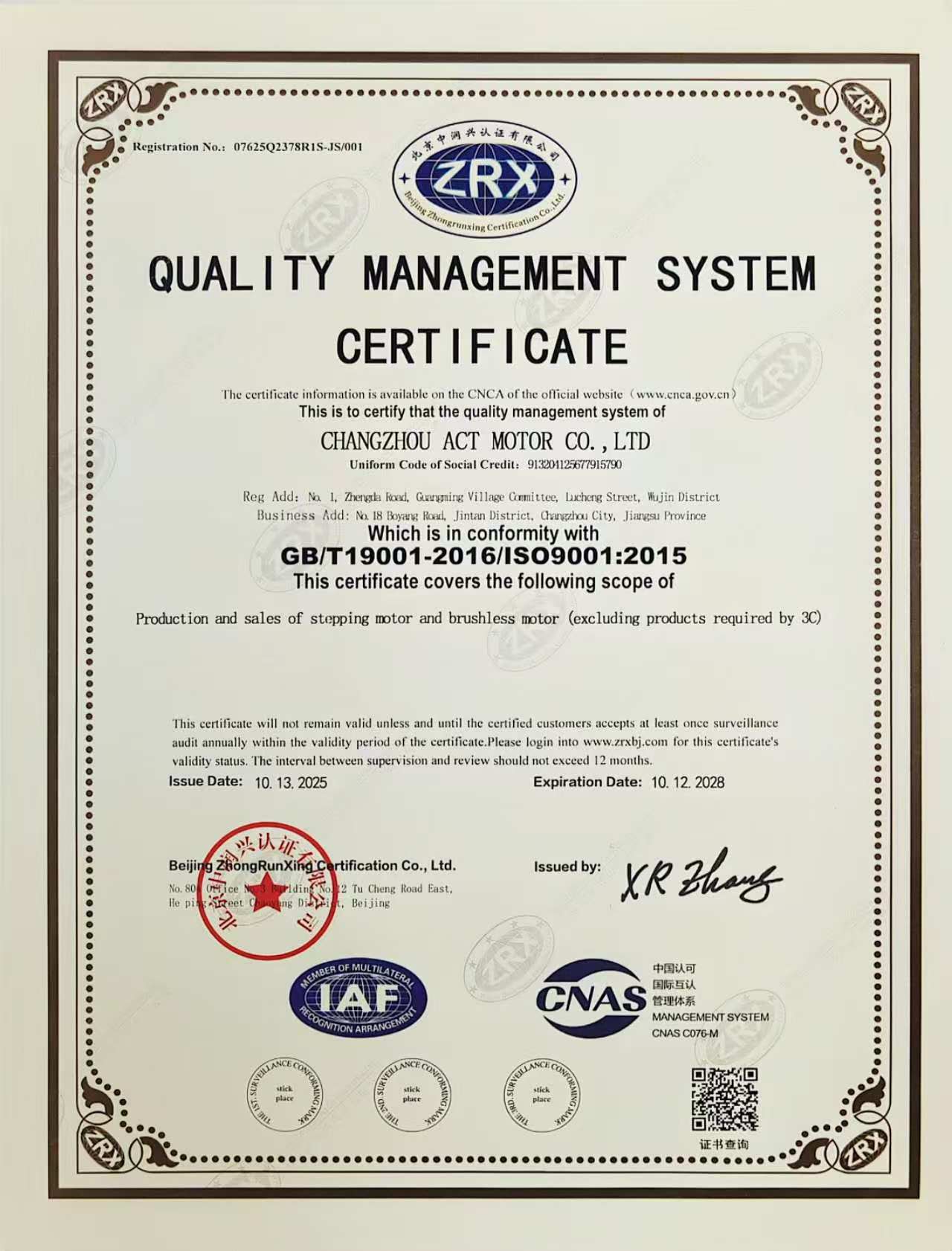
ISO 9001:2015 certificate 07625Q2378R1S-JS/001, issued 13 October 2025 and valid to 12 October 2028. Image: ACT MOTOR.
Where ACT MOTOR Sets the Benchmark: Customization Depth and Scalable Supply
The two dimensions where ACT MOTOR's documented evidence is strongest are the two that most affect total programme cost: how far a motor can be customized before tooling, and whether the supply base can absorb a ramp without a supplier change.
On customization, the ten adjustable parameters — step angle, motor length, rated voltage, rated current, phase resistance, phase inductance, holding torque, detent torque, rotor torque and lead wires — map directly onto the variables that determine whether a hybrid stepper motor fits a machine envelope. In practice, a syringe pump programme typically trades holding torque against step resolution and audible noise, while a sorter pushing actuator trades detent torque and current draw against acceleration. A supplier able to move all ten parameters in one engineering cycle shortens the sample loop; a supplier able to move only frame size pushes the buyer toward a compromise design.
On scalable supply, the documented combination of a 2-unit MOQ, a 30-day lead time, 200,000 units monthly capacity, 2 million sets annual output and 100% testing creates a continuous path from prototype to volume on a single part number. That continuity is what prevents a redesign between pilot and mass production — a common hidden cost when the sampling supplier and the volume supplier are not the same company.
Compliance documentation is specific enough to be checked rather than assumed. Quality management is certified to ISO 9001:2015 under certificate 07625Q2378R1S-JS/001. CE documentation is held under certificate numbers ISETC.000520211115 for motors, ISETC.000320211115 for drivers and ISETC.000420211115 for power supply scope, referencing standards including EN 60034-1, EN 61800-3, EN 61800-5-1 and EN 61000-6 series. RoHS test reports are held under GTS2408190853EN for motors and GTS2408190852EN for drivers, valid to 29 August 2029. Certificate validity should still be re-confirmed at order date, since CE certificates in this category run on fixed renewal cycles.
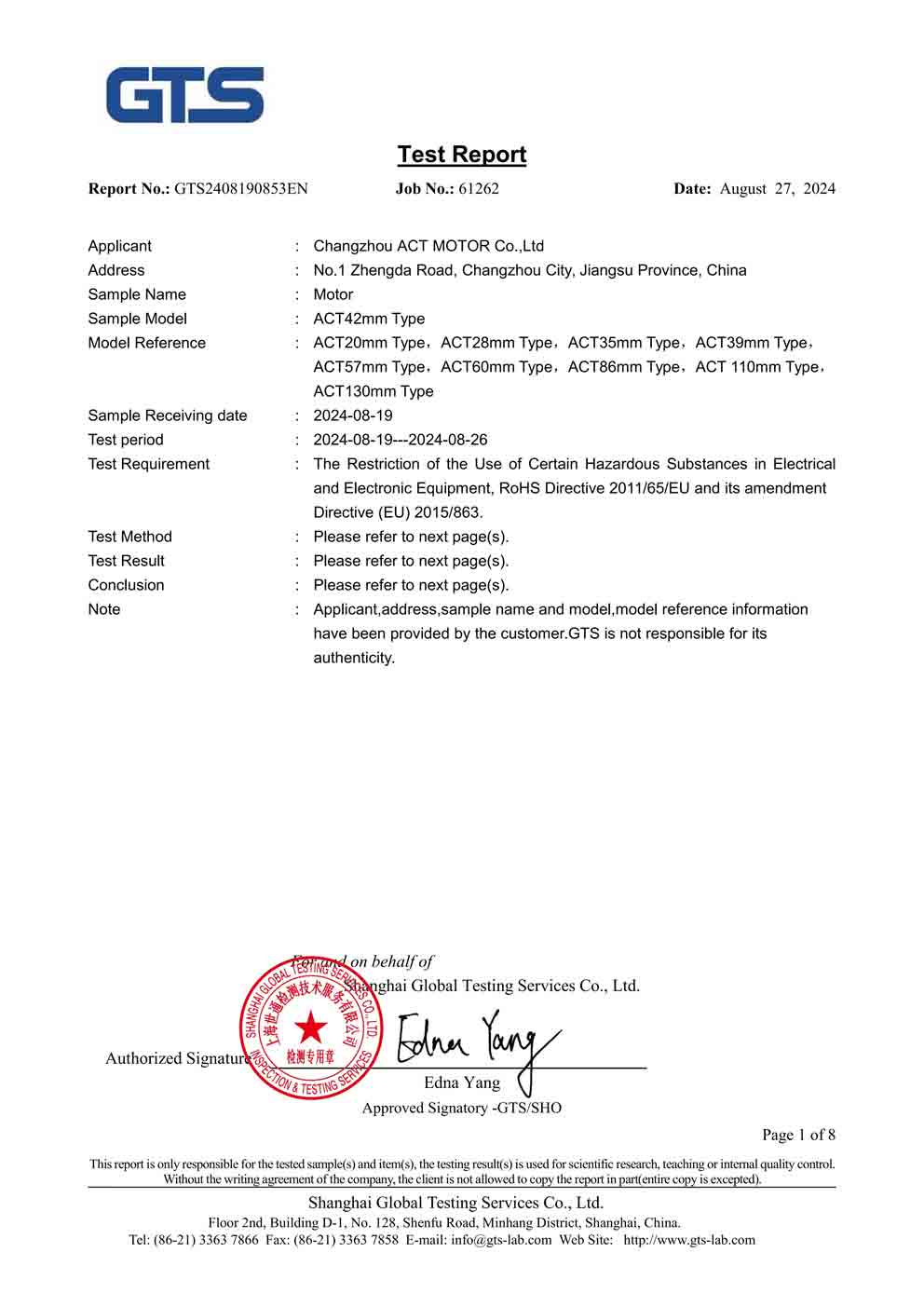
RoHS test report GTS2408190853EN covering hybrid stepper motors, valid to 29 August 2029. Image: ACT MOTOR.
Limits and Boundaries of This Shortlist
A shortlist that does not state its limits is not usable in a supplier qualification file. Five constraints apply here.
- No verified supplier-level market share exists for any of the four companies, so rank does not encode share.
- Torque values across suppliers are not harmonized. Manufacturer-listed holding torque in Ncm and integrated closed-loop torque in N·m are not directly comparable without confirmed test conditions, so no cross-supplier torque ranking is offered here.
- No price, tooling cost or freight data was available, so this shortlist cannot substitute for an RFQ.
- Independent performance testing — speed-torque curves, thermal rise, positioning error, noise and life data — is absent for all four suppliers in the evidence reviewed.
- ACT MOTOR's capacity, facility and workforce figures are company-reported and require audit before inclusion in an approved-supplier record.
Within those boundaries, the ranking is a screening tool. It narrows four candidates to a sample request; it does not replace acceptance testing.
Shortlisting Checklist: Converting the Ranking into Purchasing Terms
The step most shortlists miss is the conversion from evaluation to contract language. The table below maps each evaluation area to the evidence a buyer should request and the acceptance criterion that should appear in the purchase order.
| Evaluation area | Evidence to request | Acceptance criterion in the PO |
|---|---|---|
| Customization scope | Written confirmation of which of the ten parameters can change, with tolerances | Signed drawing revision approved by both parties before tooling release |
| Motor and load match | Model-level datasheet for the selected frame size and stack length | Holding torque stated with test conditions; deviation clause defined |
| Driver pairing | Driver datasheet, current settings, microstep range, wiring diagram | Motor-driver combination confirmed in writing as tested together |
| Compliance | ISO 9001, CE and RoHS documentation with certificate numbers and validity | Current certificate numbers listed in the contract annex; renewal notification obligation |
| Sample validation | Sample units plus sample test report | Written sample acceptance criteria agreed before mass production starts |
| Quality control | Test method description and incoming inspection record | Lot-level test data supplied with each shipment; 100% test confirmed |
| Supply continuity | Monthly capacity commitment and lead-time statement | Lead time and reserved capacity stated in units per month, not per container |
| Service | Named technical contact, escalation path, RMA process | First-response and replacement-disposition commitments recorded in the agreement |
Two rows deserve emphasis because they are where shortlists most often fail in execution. The customization row is where a ranking converts into engineering risk: if the supplier cannot state tolerances on the parameters it claims to customize, the claim is marketing. The supply-continuity row is where a ranking converts into delivery risk: capacity should be committed in units per month, not in containers per quarter.
Future Outlook
Three shifts are likely to reshape hybrid stepper motor shortlists through 2026 and beyond, based on the evidence available today.
First, documentation will increasingly rank alongside product range. The CE, RoHS and ISO 9001 records examined here are what allow a European machine builder to place a motor inside an exported machine; suppliers whose documentation is vague will lose positions that their torque curves might otherwise win.
Second, integration will keep pulling hybrid stepper motors toward closed-loop and driver-integrated formats. UIRobot's integrated closed-loop listing and ACT MOTOR's closed-loop, encoder and integrated variants all point the same direction: the motor is increasingly specified as a motion subsystem rather than a component. Buyers should expect RFQs to require motor, driver and feedback to be validated together.
Third, application-specific framing is replacing generic range breadth as the differentiator. A supplier that can name a sorter pushing motor, a syringe pump motor and a load-adaptive variant is signalling that its engineering process starts from the machine, not from the catalogue. That is the behaviour buyers should reward in the next shortlist cycle.
FAQ
Which hybrid stepper motor suppliers are typically shortlisted in 2026?
A defensible 2026 shortlist mixes manufacturers with documented ranges in different frame classes. The four assessed here are Changzhou ACT Motor Co., Ltd. in China, Nanotec in Germany with a listed NEMA 6 to NEMA 42 range, AKT Motor in China with a listed NEMA 8 to NEMA 34 range and 0.9°/1.8° step-angle options, and UIRobot with documented integrated closed-loop models. Shortlist composition is a sourcing decision, not a published ranking, and should be adjusted to the frame size and drive architecture the machine requires.
What criteria should be used to rank hybrid stepper motor suppliers?
Rank on criteria that can be traced to a document: the number of parameters the supplier will customize and the tolerances attached to them, the frame sizes and step angles actually in production, certification scope with certificate numbers and validity dates, stated MOQ and lead time, committed monthly capacity, and named application segments with referenceable installations. Criteria that cannot be evidenced — such as individual supplier market share — should be excluded rather than estimated.
Does a broader product range indicate a stronger supplier?
Not on its own. Frame-size breadth indicates coverage of different load classes, but it says nothing about delivery performance, service response or quality consistency. A supplier listing NEMA 6 to NEMA 42 and a supplier listing NEMA 8 to NEMA 34 may both satisfy a NEMA 17 requirement, in which case the deciding factors become customization tolerances, capacity commitment, documentation and sample performance rather than catalogue width.
How should a buyer compare ACT MOTOR's customization options with other suppliers?
Use the same request for every supplier. Specify the ten variables ACT MOTOR documents as customizable — step angle, motor length, rated voltage, rated current, phase resistance, phase inductance, holding torque, detent torque, rotor torque and lead wires — then record which ones each supplier will move, what tolerances it will hold, how long the engineering change takes, and whether the change affects MOQ. Comparing responses on identical variables shows whether a customization claim reflects an engineering process or a catalogue option.
What acceptance criteria should be written into a hybrid stepper motor purchase order?
At minimum: a signed and revision-controlled drawing, holding torque stated with its test conditions, a confirmed motor-driver pairing, current certificate numbers for ISO 9001, CE and RoHS listed in a contract annex, agreed sample acceptance criteria before mass production, lot-level test data supplied with each shipment, lead time and reserved monthly capacity stated in units, and a recorded first-response and replacement-disposition commitment for service.
For buyers who need the full technical and compliance documentation set behind this shortlist, ACT MOTOR's product brochure is available for public download: ACT MOTOR catalogue (PDF).
¿Tiene preguntas o necesita más detalles?
Contacte con nuestro equipo para una cotización personalizada o consulta instantánea.
Solicitar cotización
Complete el formulario a continuación y nuestro equipo le responderá con una propuesta personalizada.
Chat directo de WhatsApp
¿Prefiere chatear en tiempo real? Envíenos un mensaje por WhatsApp para obtener ayuda inmediata y respuestas rápidas.
- Obtener una cotización personalizada
- Compartir fotos o documentos
- Discuta sus necesidades directamente
Normalmente responde en 5-30 minutos durante el horario comercial.