
Hybrid Solar Inverter CE Certification: The SYP Model Signals
A CE mark on a hybrid solar inverter is the visible end of a documentation chain that most buyers never open. Under EU rules that chain normally includes at least two separate directives - the Low Voltage Directive and the Electromagnetic Compatibility Directive - each supported by named standards, an accredited testing body and a certificate number that resolves to a specific model list. The SYP series of off-grid hybrid inverters from GOTOSOLAR, the brand of FOSHAN SOLARUP TECHNOLOGY CO., LTD, is a workable example for importers who want to read that chain properly. Its CE documentation is split into a safety file based on EN 62109-1 and EN 62109-2 and an EMC file based on the EN IEC 61000-6 series, and both documents only become useful when they are read next to declared limits such as IP21 ingress protection, an operating range of -10 degC to 60 degC and a maximum operating altitude of 4000 m.
Why CE Documentation Has Become a Procurement Filter
The global solar hybrid inverter market was valued at USD 10.7 billion in 2024, according to Grand View Research. The residential sub-segment alone was valued at USD 4.55 billion in 2023, according to Markets and Data. Trade flows of that scale move through customs systems, and hybrid inverters are generally classified under HS Code 8504.40 as static converters. The customs code decides duty treatment; the CE file decides whether the product may legally be placed on the EU market at all.
That is the practical gap in off-grid sourcing. Suppliers frequently present a single self-declaration, or a certificate whose model list does not match the unit actually being shipped. When a distributor, an EPC contractor or a technical buyer in Europe opens the technical file, three questions decide whether the purchase proceeds: which directives were applied, which standards were tested, and which models are named inside the certificate.
The opportunity sits on the other side of the same question. Buyers who understand the structure of a CE file can evaluate smaller and mid-sized manufacturers on evidence rather than on brand recognition, which matters in a market where a small number of large suppliers hold a disproportionate share of inverter revenue. For importers of off-grid equipment, certification reading is not an administrative task; it is the first technical filter.
What a Complete CE File Actually Contains
CE marking is not issued by the European Union. It is a declaration by the manufacturer that the product meets the applicable harmonised legislation, supported by test evidence. For a hybrid solar inverter sold into the EU, two directives normally apply:
- Low Voltage Directive 2014/35/EU - covers the electrical safety of equipment within defined voltage limits. For photovoltaic power converters, the relevant product standard family is EN 62109.
- EMC Directive 2014/30/EU - covers electromagnetic emissions and immunity, typically tested against generic standards in the EN IEC 61000-6 series and harmonic or voltage fluctuation standards in the EN 61000-3 series.
It is also worth separating this from other regional frameworks. IEC 62109 is the international standard for PV power converters, while UL 1741 is the primary safety standard for grid-connected inverters in North America, according to UL Solutions. A European CE file therefore supports EU market access; it does not, by itself, authorise grid-connected installation in the United States or Canada.
Applied to the SYP hybrid inverter family, the CE documentation resolves into two traceable records:
| Document | Directive | Standards cited | Certificate number | Issuing body | Scope |
|---|---|---|---|---|---|
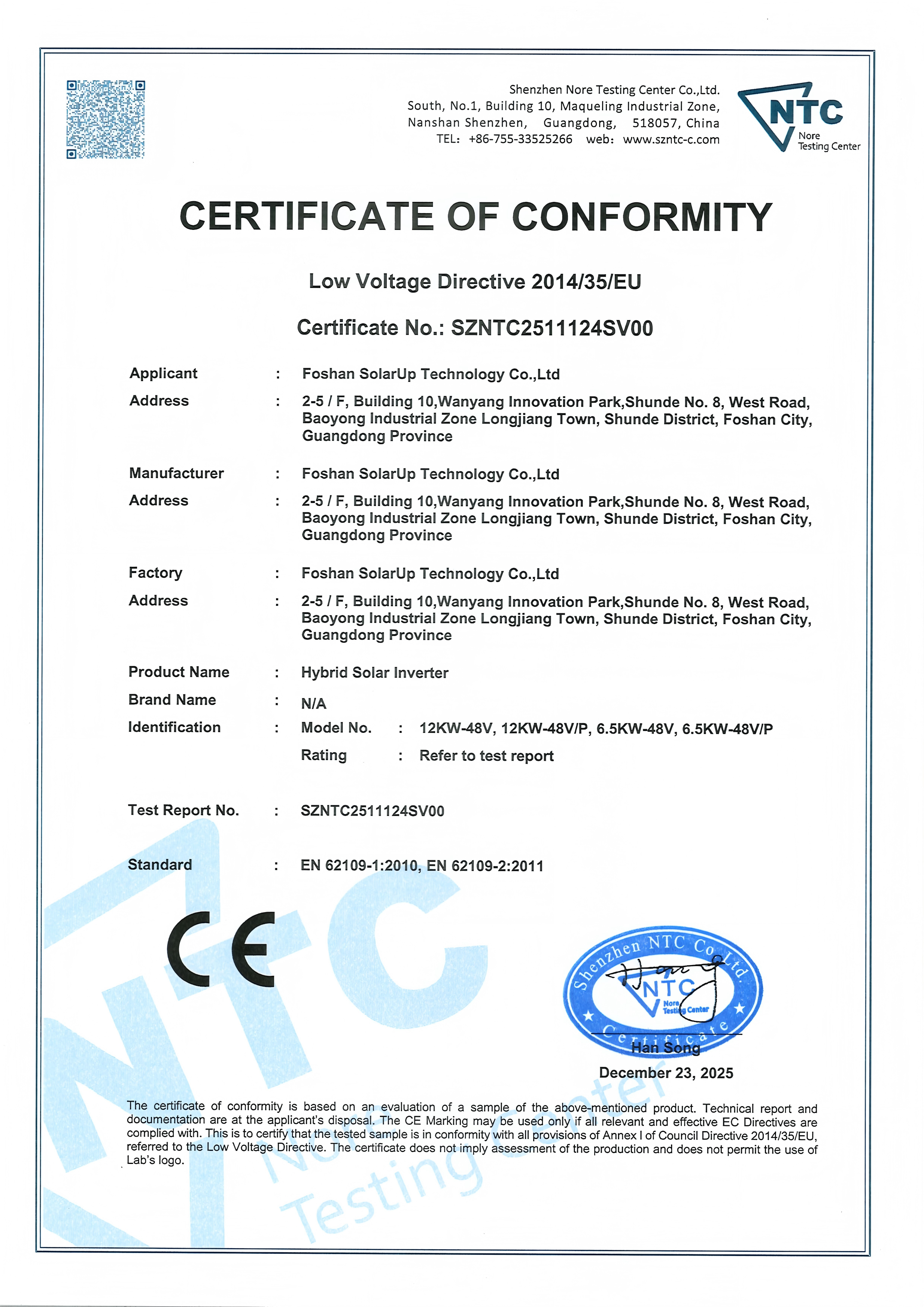
| CE-LVD | Low Voltage Directive 2014/35/EU | EN 62109-1:2010; EN 62109-2:2011 | SZNTC2511142SV00 / SZNTC2511124SV00 | Shenzhen Nore Testing Center Co., Ltd. (NTC) | Hybrid solar inverter, SYP series |
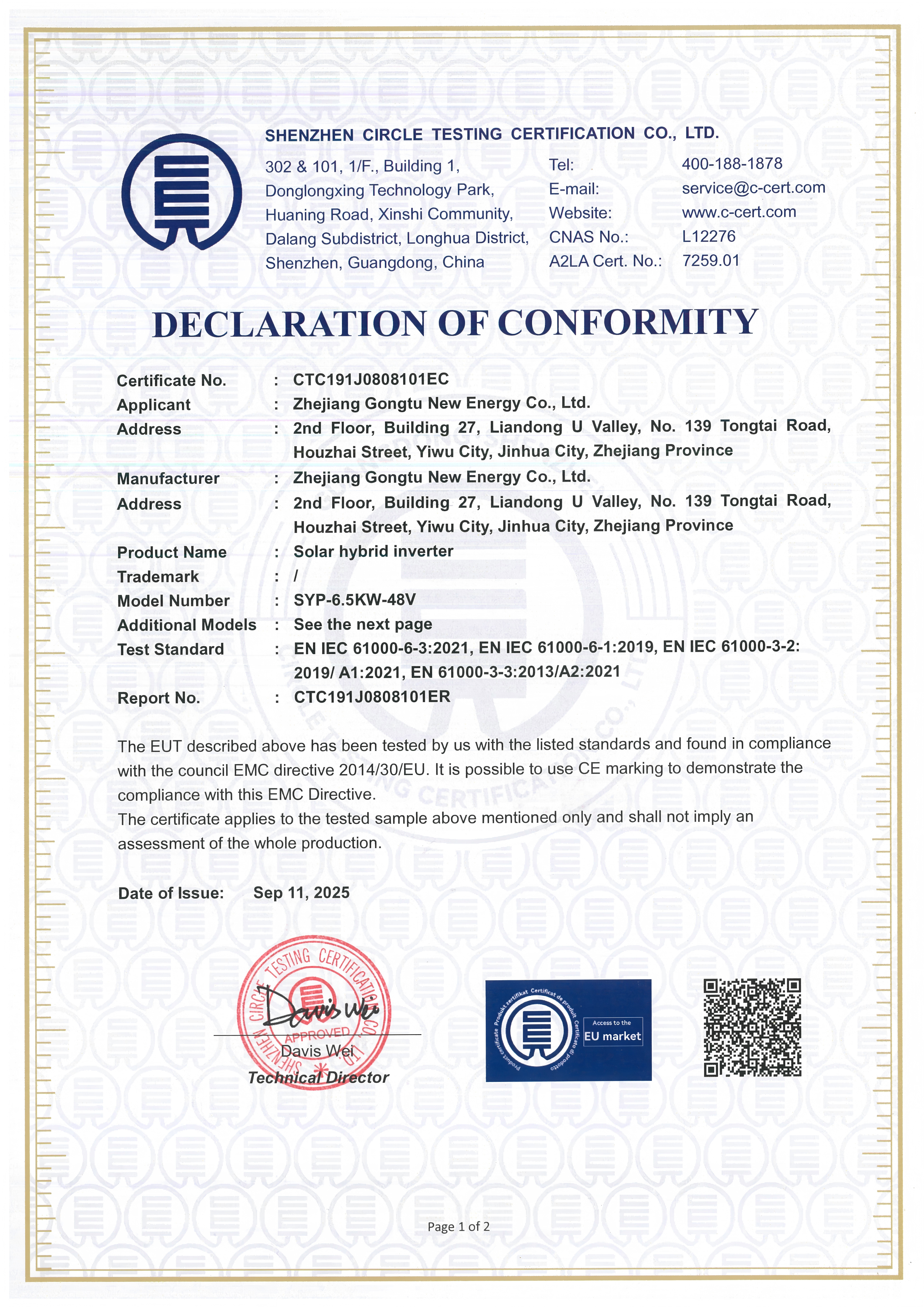
| CE-EMC | EMC Directive 2014/30/EU | EN IEC 61000-6-3:2021; EN IEC 61000-6-1:2019; EN IEC 61000-3-2:2019/A1:2021; EN 61000-3-3:2013/A2:2021 | CTC191J0808101EC | Shenzhen Circle Testing Certification Co., Ltd. (C-CERT) | Solar hybrid inverter, model SYP-6.5KW-48V, with additional models listed on the certificate |
The second point is that the two records come from two different accredited laboratories - NTC for safety and C-CERT for electromagnetic compatibility. This is normal practice rather than a weakness, but it means an importer should hold both documents. A safety certificate alone does not demonstrate EMC conformity, and an EMC certificate alone does not demonstrate electrical safety.
The SYP Range Behind the Certificate Numbers
The SYP family is an off-grid solar inverter platform that spans six listed models: SYP1.5KW12V, SYP2.5KW12V, SYP4.0KW24V, SYP6.5KW48V, SYP12.0KW48V and SYP12.0KW48V/P. Safety documentation is issued under two certificate numbers, reflecting the two voltage architectures in the range: one covering the 24 V group (3.6 kW, 4 kW and 5 kW variants) and one covering the 48 V group (6.5 kW and 12 kW variants).
This matters because the first failure mode in inverter sourcing is a model mismatch - a certificate that covers a 24 V unit being presented for a 48 V shipment, or a lower-capacity unit being presented for a higher-capacity order. Importers should verify three things on the certificate before releasing a purchase order: the model designation, the rated capacity, and the nominal battery voltage. On the SYP documentation, the 48 V hybrid inverter series is certified separately from the 24 V series, which makes that check straightforward.
Where Certification Meets Environmental Ratings
Safety standards in the IEC 62109 family assess a converter under declared environmental conditions. That is why operating temperature, humidity, altitude and ingress protection are normally stated on the same datasheet as the certificate reference - they define the envelope the certificate was written against. A unit that is compliant at one installation site can be out of its declared envelope at another.
For the SYP 6.5KW48V model, that envelope is documented as follows:
| Parameter | Declared value | What it changes for the buyer |
|---|---|---|
| Ingress protection | IP21 | Protected against solid objects larger than 12.5 mm and vertically falling water drops. Suited to indoor installation or a protected outdoor position such as under an eave; direct rain exposure is outside the rating. |
| Operating temperature | -10 degC to 60 degC | Defines ambient conditions, not enclosure temperature. Installation in an unventilated cabinet in a hot climate requires the cabinet itself to be assessed. |
| Storage temperature | -15 degC to 60 degC | Relevant for container transport, warehouse conditions and long distribution chains. |
| Relative humidity | 5% to 95%, non-condensing | Condensation, not humidity percentage, is the risk factor in coastal and tropical installations. |
| Maximum operating altitude | 4000 m, with derating above 1000 m | Highland projects need a derating calculation. The certificate does not remove that engineering step. |
| Dimensions and weight | 410 x 336 x 110 mm; 8.4 kg net | Relevant for wall-mounting structure, cabinet sizing and freight planning. |
| Battery interface | 48 V nominal; float 54 V; overcharge protection 61 V | Sets the DC design window for the battery bank and the protection thresholds. |
Read together, the certificate and the environmental data describe a specific product type: an indoor or sheltered hybrid inverter intended for continuous duty in ambient temperatures up to 60 degC, subject to altitude derating above 1000 m. IP21 and CE conformity are not competing claims; they describe different things. CE conformity covers electrical safety and electromagnetic behaviour, while IP21 defines where the enclosure may be installed.
Inside the Electrical Envelope of the SYP 6.5KW48V
The technical profile behind the certified model is worth reading in the same way, because several parameters interact directly with application planning.
- AC input and output: rated input voltage 208 / 220 / 230 / 240 VAC on L + N + PE, with an input voltage range of 90 to 280 VAC (plus or minus 3) in normal mode and 170 to 280 VAC (plus or minus 3) in UPS mode. This wide normal-mode window is what allows the unit to keep operating on unstable grid or generator supply.
- Output characteristics: rated capacity 6.5 kW, surge power 12 kVA, power factor 1, pure sine wave output, 50 / 60 Hz auto-adaptive with plus or minus 0.1% frequency stability. Overload capacity is 1 minute at 102% to 120% load and 10 seconds above 120% load.
- Switching behaviour: transfer time of 10 ms in both normal and UPS mode. This is the parameter that determines whether computers, routers and control electronics ride through a grid failure without restarting.
- Solar input: MPPT charger type, maximum PV input current 27 A, maximum PV input power 9000 W, MPPT operating window 60 to 450 VDC, and maximum PV open circuit voltage 500 VDC.
- Charging: maximum PV charge current 120 A, maximum AC charge current 120 A and combined maximum charge current 120 A, with maximum battery-mode efficiency of 94% at 48 VDC.
- Interfaces: LCD human-machine interface, RS232 / RS485 / USB communication, and WiFi monitoring available as an internal or external option.
Two procurement consequences follow. First, PV array design must stay inside the 500 VDC open-circuit limit and the 60 to 450 VDC MPPT window; a string designed for a wider-voltage inverter may not suit this platform. Second, because WiFi monitoring is an option rather than a default, remote-monitoring requirements should be confirmed at the configuration stage rather than assumed at delivery.
Application Fit: Where an IP21 Off-Grid Hybrid Inverter Belongs
The combination of a 6.5 kW single-phase rating, a 12 kVA surge capability and an IP21 enclosure points to a defined set of installation environments.
- Residential rooftop storage: the unit is typically wall-mounted indoors - a utility room, garage or dedicated cabinet - with the PV array on the roof. The 10 ms transfer time supports household loads that cannot tolerate a restart.
- Small commercial and light industrial sites: the 12 kVA surge capacity covers motor-starting loads such as pumps and compressors within the stated overload window.
- Telecommunications and remote power: off-grid base stations and remote sites that need continuous DC-coupled storage and stable AC output.
- RV, marine and mobile power: installation inside a vehicle or vessel compartment keeps the unit within its IP21 rating, provided ventilation and condensation control are addressed.
- Distribution stocking: the 24 V and 48 V configurations allow a distributor to cover both entry-level and higher-capacity residential demand from one certified product family.
Field evidence from a large-scale deployment supports the application logic. A solar EPC contractor and renewable energy system integrator operating in South Africa received two 40HQ containers, approximately 3,000 to 4,000 units, for a large residential solar storage project and regional distribution stocking. The systems have run continuously for over three years with a failure rate below 1%, replaced diesel generators and reduced fuel costs by 80%, and operated stably under high temperature conditions around 45 degC without derating. That last point sits inside the declared 60 degC operating limit and is consistent with the altitude derating condition, which applies to altitude rather than ambient temperature.
How This Compares with Traditional Off-Grid Architectures
Comparing a certified hybrid inverter against older configurations clarifies what the CE file is actually buying.
Hybrid inverter versus separate MPPT controller, charger and inverter
A separate architecture uses three or more enclosures, each with its own warranty, its own failure points and its own documentation. A hybrid unit consolidates DC-to-AC conversion, MPPT solar charging and AC charging into a single certified enclosure with one model list. The trade-off is redundancy: in a multi-unit architecture a single failure may leave part of the system running, while in an integrated hybrid a fault affects the whole conversion path. Where uptime is critical, parallel or spare-unit strategies are more appropriate than component-level redundancy.
Hybrid inverter versus diesel generation
Diesel remains common in off-grid projects, but the operating economics differ sharply. In the deployment described above, replacing diesel generation reduced fuel costs by 80% and removed the fuel logistics chain from the site. The limitation is that a hybrid system requires a battery bank, an indoor or sheltered mounting position and a PV array, none of which a diesel generator needs. For short-duration or highly intermittent load profiles, the payback case is weaker.
IP21 versus IP65 enclosures
IP21 is a genuine constraint, not a marketing detail. It supports indoor installation or a protected outdoor position, and it is unsuitable for direct rain exposure or wash-down environments. Higher-rated IP65 enclosures allow more exposed mounting, but their sealing is tighter and maintenance or inspection generally requires qualified personnel, which is not ideal for ordinary household environments. For residential indoor use, an IP21 hybrid inverter is often the more practical choice.
CE versus North American approval
A CE file supports EU market access. It does not replace UL 1741 for grid-connected inverters in North America. An importer planning multi-region distribution should treat the two frameworks as separate qualification paths, even when the hardware platform is the same.
A documentation boundary worth checking
Certification is issued per product scope, and scope can vary within one manufacturer. The RoHS documentation held by this manufacturer names solar charge controller models rather than the SYP hybrid inverter series, while the company states that its product ranges are certified against ISO 9001:2015, CE, RoHS, EN and IEC standards. Buyers who require RoHS evidence specifically for the SYP inverter should request that document for the exact model rather than assume it is contained in the CE file.
Market Trend Analysis
Three patterns in the available market data shape how buyers should read certification in this category.
First, the market is large enough to support specialised off-grid suppliers. The global hybrid inverter market reached USD 10.7 billion in 2024, with the residential segment at USD 4.55 billion in 2023. Demand is not confined to large infrastructure projects; it is distributed across households, small businesses and remote sites.
Second, product structure is still weighted toward three-phase. Three-phase hybrid inverters held over 61.3% of global hybrid inverter revenue in 2024. That leaves single-phase and lower-capacity units concentrated in residential and off-grid applications, where IP21 indoor enclosures, wide AC input windows and UPS-grade transfer times matter more than three-phase balancing. This is the segment the SYP range addresses.
Third, supply is highly concentrated at the top. Huawei and Sungrow combined for 55% of the global PV inverter market share in 2024, according to Wood Mackenzie. Below that tier, competition rests less on scale and more on documentation quality, configuration flexibility, lead time and after-sales support. Manufacturing capability in this segment is organised around OEM, ODM, OBM and JDM production modes, with standard-model capacity of 60,000 units per month and customized-model capacity of 20,000 units per month at the manufacturer in question.
Verification Before Execution: Aging Test and Acceptance Terms
Certification is issued at design level. Shipment-level confidence comes from production testing, which is the part of the file that buyers in the Execution stage should verify directly.
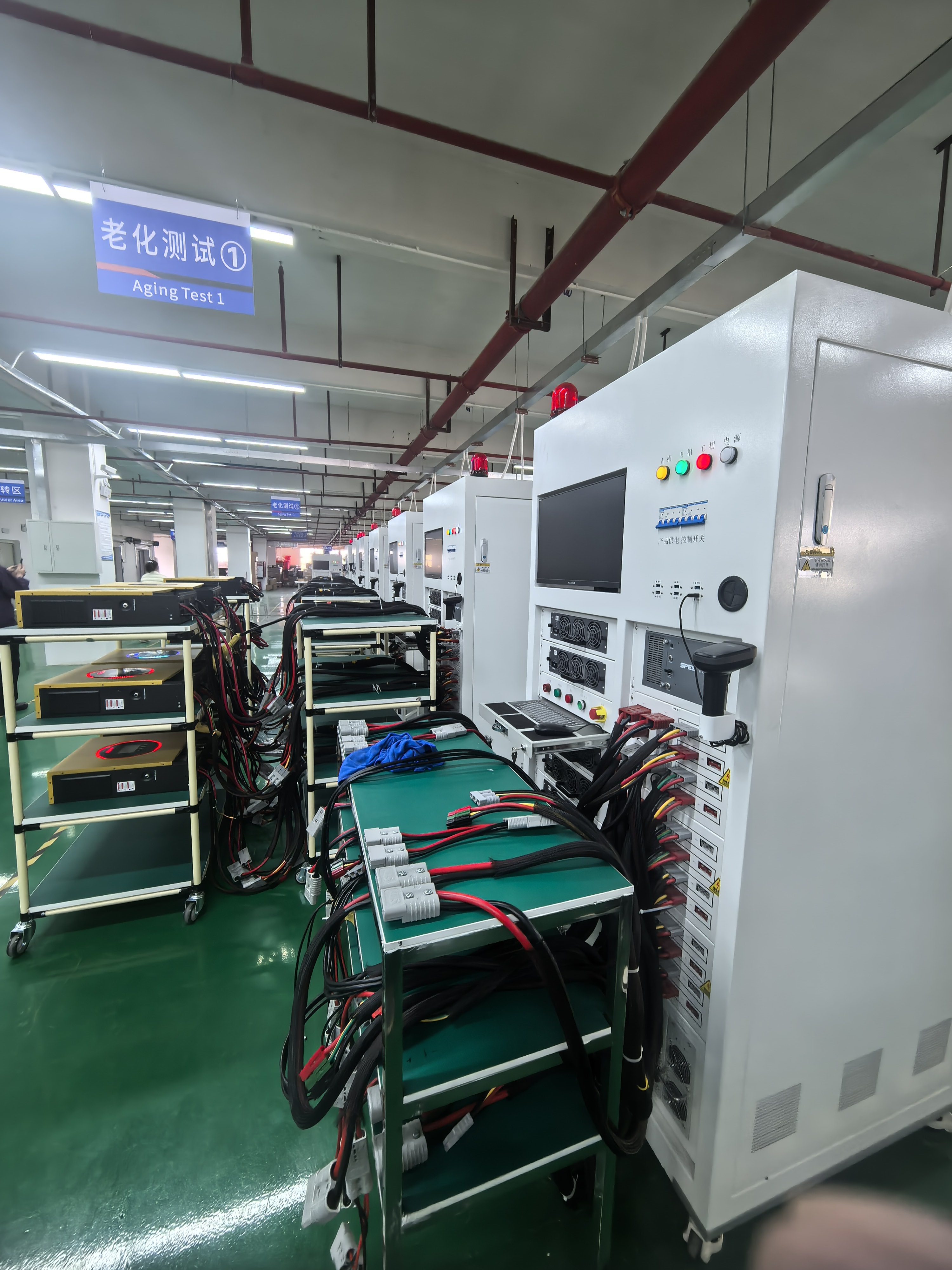
Quality control runs through incoming quality control, in-process quality control, a 100% aging test of 4 to 8 hours, final quality control and an out-of-box audit, with burn-in testing for high-power units. All goods receive 100% full-function testing before delivery. For overseas orders, the stated acceptance criteria are a 100% aging test before shipment, video confirmation of testing data, and openness to third-party inspection by SGS or TUV. Delivery terms are FOB, with payment at 30% deposit and 70% balance before shipment by T/T, and L/C at sight accepted for large orders.
Lead times are quoted at 7 to 10 days for samples, 15 to 20 days for small orders below 500 pieces, and 30 to 45 days for bulk orders depending on customization complexity. Standard models support trial orders, while customized configurations carry a higher minimum order quantity negotiated against mould cost. Customization covers hardware - PCB layout, enclosure material and colour, terminal type and display screen - as well as software such as startup logo, UI language, charging algorithms and communication protocols, plus packaging including colour box design and manual language.
Future Outlook
Certification in this category is likely to become a living document rather than a one-time milestone. As hybrid inverters move from niche off-grid applications into mainstream residential and light commercial storage, importers increasingly ask for the model list, the standards cited and the issuing laboratory before they ask for price. That shift favours manufacturers who can present certification as a structured file rather than a logo.
A second change concerns environmental declarations. As installations move into highland regions, hot climates and coastal zones, the parameters that sit next to the certificate - altitude derating thresholds, ambient temperature windows, humidity conditions and ingress protection - are becoming part of technical due diligence rather than datasheet footnotes. Buyers comparing an IP21 indoor unit with an IP65 exposed unit are effectively choosing an installation environment, not simply a protection number.
A third consideration is regional qualification. Manufacturers serving both EU and North American channels will continue to maintain separate documentation tracks, and importers planning multi-region distribution should plan for that cost and lead time. The most durable advantage for a mid-sized supplier is not a single certificate but a repeatable certification and testing process that can be extended to new models as the range grows.
FAQ
For the SYP series it covers two directives. Low Voltage Directive 2014/35/EU is supported by the standards EN 62109-1:2010 and EN 62109-2:2011 under certificate numbers SZNTC2511142SV00 and SZNTC2511124SV00, issued by Shenzhen Nore Testing Center Co., Ltd. (NTC). EMC Directive 2014/30/EU is supported by EN IEC 61000-6-3:2021, EN IEC 61000-6-1:2019, EN IEC 61000-3-2:2019/A1:2021 and EN 61000-3-3:2013/A2:2021 under certificate number CTC191J0808101EC, issued by Shenzhen Circle Testing Certification Co., Ltd. (C-CERT). Electrical safety and electromagnetic compatibility are separate evidence streams and both documents are required.
The SYP hybrid inverter range comprises SYP1.5KW12V, SYP2.5KW12V, SYP4.0KW24V, SYP6.5KW48V, SYP12.0KW48V and SYP12.0KW48V/P. Safety documentation is issued under two certificate numbers, corresponding to the 24 V group (3.6 kW, 4 kW and 5 kW variants) and the 48 V group (6.5 kW and 12 kW variants). The EMC certificate names the SYP-6.5KW-48V model explicitly and refers to additional models listed on the certificate. Buyers should match model designation, rated capacity and nominal battery voltage against the certificate before shipment.
IP21 indicates protection against solid objects larger than 12.5 mm and against vertically falling water drops. It is designed for indoor installation or for protected outdoor environments such as under an eave, and direct rain exposure should be avoided. IP21 is a lower protection class than IP65; the trade-off is that higher-rated sealed enclosures generally require qualified personnel for maintenance and inspection, which is not suitable for typical household installations.
The declared battery type is lithium and lead-acid, with a 48 V nominal DC rating, 54 V floating charge voltage and 61 V overcharge protection threshold on the 48 V model. The unit supports both high-voltage and low-voltage lithium chemistries (LiFePO4 and Li-ion) as well as lead-acid batteries; the specific BMS communication protocol should be checked against the compatibility list for the intended battery brand.
Transfer time is 10 ms in both normal mode and UPS mode. This is the interval during which sensitive loads such as computers, servers and network equipment must ride through a grid failure without interruption. It applies within the declared AC input range of 90 to 280 VAC in normal mode and 170 to 280 VAC in UPS mode.
The declared operating temperature range is -10 degC to 60 degC, storage temperature is -15 degC to 60 degC, and relative humidity is 5% to 95% non-condensing. Maximum operating altitude is 4000 m with derating required above 1000 m. Ingress protection is IP21, so an indoor or sheltered mounting position is required, and humid or coastal sites should be assessed for condensation rather than humidity percentage alone.
Acceptance criteria are a 100% aging test before shipment, video confirmation of testing data, and openness to third-party inspection by SGS or TUV. Delivery terms are FOB. Payment terms are T/T with 30% deposit and 70% balance before shipment, with L/C at sight accepted for large orders. Standard models support trial orders, while customized configurations carry a higher minimum order quantity negotiated against mould cost. Lead times are 7 to 10 days for samples, 15 to 20 days for orders below 500 pieces, and 30 to 45 days for bulk orders depending on customization complexity.
Production quality control covers incoming quality control, in-process quality control, a 100% aging test of 4 to 8 hours, final quality control and an out-of-box audit, with burn-in testing for high-power units and 100% full-function testing of all goods before delivery. The manufacturer states a standard 2-year warranty for hybrid inverters, with warranty arrangements of 1 to 3 years available for replacement or repair depending on the agreement, and free spare parts equal to 1% to 2% of order quantity included with bulk orders to reduce downtime.
Closing Note
For importers evaluating off-grid hybrid inverters, the SYP example shows that certification is best treated as a structured document set - directive, standard, certificate number, issuing laboratory and model list - that must be read alongside the environmental envelope the product was assessed against. The complete specification and model range are available in the manufacturer catalogue for download: GOTOSOLAR Hybrid Inverter Catalogue 2025.