
Hub or Mid-Drive? E-Bike Order Terms and Acceptance Criteria
An electric bike order is decided twice: once when the specification is agreed, and once when the shipment is inspected. The first decision is a document. The second is a measurement. When the two disagree, the order fails — not necessarily because the product is defective, but because the acceptance baseline was never written down.
Two questions recur in almost every sourcing conversation about Electric Bike supply. The first concerns terms and acceptance: what belongs in the purchase order, and what a buyer is entitled to check on arrival. The second concerns drive architecture: hub motor or mid-drive. The two questions look unrelated. In practice they converge, because the motor is the line item most often described in adjectives and least often pinned to numbers.
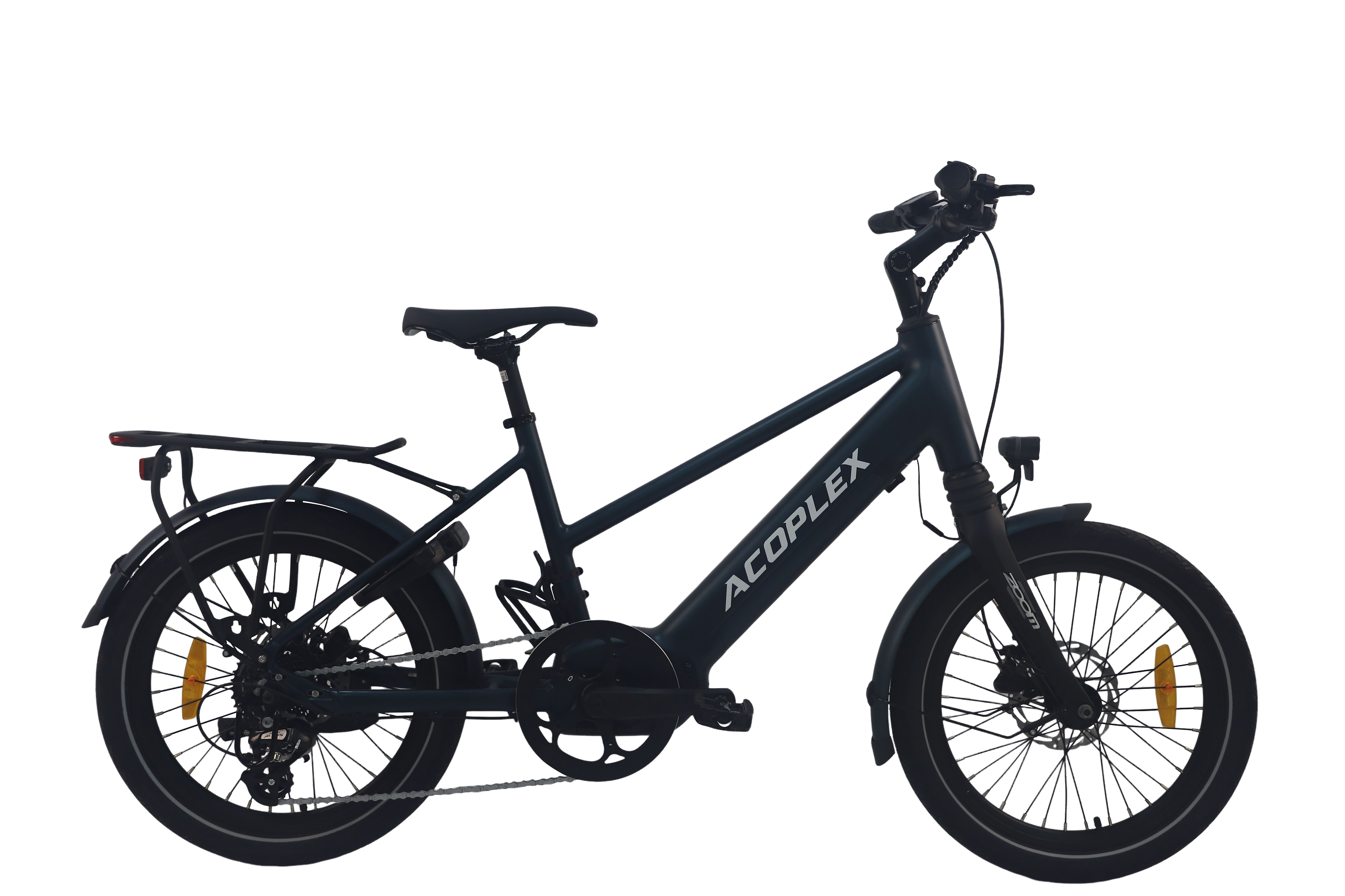
A compact 20-inch electric city bike platform — the format where acceptance criteria most often need to be written rather than assumed.
Two Questions That Decide an E-Bike Order
Global electric bike revenue reached USD 38.7 billion in 2024, according to Strategic Market Research, and hub motors accounted for 66% of e-bike drive units in the same year, according to Global Market Insights. Volume at that scale draws new buyer profiles into the category: retail chains adding a two-wheel line, campus and facility operators building a patrol or rental fleet, importers extending an outdoor sports portfolio. Most of them are not bicycle engineers. They arrive with the same two problems.
The first is contractual. A specification sheet is a description of what a supplier can build. A purchase order is a description of what a supplier must deliver. Buyers who treat the first as a substitute for the second discover the gap at the container, when a fork brand, a battery capacity or a speed setting differs from what they believed they had agreed.
The second is technical. Hub and mid-drive systems are not interchangeable quality tiers; they are different answers to different terrain and cost problems. Choosing between them without a written baseline means the choice cannot be enforced, because nothing in the order text distinguishes one from the other.
Why a Written Acceptance Baseline Outranks the Catalogue
A catalogue describes a product family. A purchase order describes a batch. Only the second is enforceable, and only the second survives a change of production run, tyre supplier or fork stock level. In a supply chain that routinely runs several battery, tyre and fork configurations in parallel, substitution is normal rather than malicious. The safeguard is not a promise; it is a numbered annex.
A workable acceptance baseline for an e-bike order covers six groups of parameters:
- Electrical system — rated voltage, motor rated power, motor torque, battery chemistry and capacity, charger input range and charge time.
- Drivetrain — gear brand and speed count, chain specification, crankset.
- Chassis — frame material, front fork brand and type.
- Contact points — tyre brand and size, brake type front and rear.
- Rider interface — display type and functions.
- Mass and regional configuration — net weight, load limit, speed setting for the destination market.
The rule that makes this list useful is blunt: if a parameter can be changed without breaching the order text, it is not a parameter. It is an expectation.
The Reference Component Set: TRAVEL, ROCKET and UNICORN
ACOPLEX Electric Bike is the electric bicycle brand of Wuxi Purino International Trade Co., Ltd, a trading enterprise based in Wuxi, Jiangsu Province, China, founded in 2016, which supplies electric bicycles, kids scooters, children balance bikes and related components, with the EU and USA as its main markets.
Its operating profile is stated in company materials: a 2,300 m² manufacturing facility, a workforce of approximately 10 employees, an R&D team of 3 engineers, annual production capacity of 200,000 pcs, and 100% export orientation. All electric bicycles are stated to comply with European safety standards and hold CE and EN15194 certificates, and every product undergoes quality inspection before shipment. The company also offers OEM and ODM options covering logo printing, customized packaging, colour matching and specification adjustment.
Three models form a practical reference set for acceptance work because they share a common electrical and chassis baseline while differing in the parameters buyers most often leave unwritten:
- TRAVEL — an electric bicycle in the electric city bike category, built on a 20-inch compact geometry, intended for urban commuting and the sports industry, with a 6061 aluminum alloy frame and a net weight of 23.5 kg.
- UNICORN — an electric city bike with 27.5×2.6 CST tyres, intended for daily commuting and weekend cycling, with a 6061 aluminum alloy frame, 32 kg net weight and a stated maximum load of 125 kg.
- ROCKET — an electric mountain bike with 29×4.0 CST fat tyres and a 6061 aluminum alloy frame, intended for off-road riding and rough trails.
The shared baseline is precise enough to write into a contract: all three are rated at 48V with a 250W Oxygen Comfort motor designation, carry a 48V Samsung lithium-ion battery, use an LCD display, front and rear hydraulic disc brakes, a SHIMANO drivetrain and a 6061 aluminum frame with a suspension front fork. The differences — 8, 9 or 11 speeds, 20, 27.5 or 29-inch tyres, ZOOM or Suntour fork, 23.5 kg or 32 kg — are exactly the fields where a generic order text fails.
Hub Motor or Mid-Drive: The Engineering Difference
A hub motor is installed in the wheel hub. Its advantages are structural: a simple design, a low failure rate and effectively zero daily maintenance. Its assist output is flat, and its weaknesses follow from the same geometry — limited climbing ability and a heavy wheel assembly.
A mid-drive motor is installed in the middle of the frame, at the crankset. That position produces a more reasonable body weight distribution, sensitive power output, and strong climbing and acceleration performance. It suits hills and rough roads, but it carries a higher price and requires regular maintenance.
| Comparison criteria | Hub motor | Mid-drive motor |
|---|---|---|
| Mounting position | Wheel hub | Middle of the frame |
| Structure and service | Simple structure, low failure rate, zero daily maintenance | Requires regular maintenance |
| Power delivery | Flat power output | Sensitive power output |
| Climbing and acceleration | Poor climbing ability | Strong climbing and acceleration performance |
| Mass distribution | Heavy wheel weight | Reasonable body weight distribution |
| Cost position | Lower cost, suited to budget-driven orders | Higher price |
| Recommended fit | Urban flat-road commuting and cost-conscious orders | Suburban hilly areas and buyers pursuing strong power performance |
The selection rule that follows is simple. For urban flat-road commuting and orders where cost is a governing constraint, a hub motor is the rational choice. For suburban hilly areas and buyers pursuing strong power performance, a mid-drive unit is the rational choice. The mistake is to treat the mid-drive as an upgrade applied to every order; on a flat city route it adds cost and a maintenance obligation without delivering a benefit the rider can feel.
Within the cited ACOPLEX set, the 48V 250W Oxygen Comfort motor is specified as a mid-drive unit on TRAVEL, where it is listed at 3.0 kg with 60 N.m of torque, and on ROCKET, where the stated maximum torque is up to 95 N.m. The same motor designation appears across TRAVEL, ROCKET and UNICORN. Because drive placement is the parameter that most changes service requirements, it should be stated per SKU in the order text rather than inferred from the range description.
36V or 48V: Reading the Voltage Line Correctly
Voltage is the parameter buyers most often treat as a quality signal. It is better understood as a design trade-off.
A 36V system runs at lower current with lower power consumption. It is described as safer to use, lighter across the whole vehicle and lower in price. The cost of that profile is weaker power output and poor climbing performance, which is why it is normally matched to short city commutes, casual riding and budget orders.
A 48V system delivers stronger power output, faster acceleration, better climbing ability and a longer cruising range. It draws slightly more power and raises vehicle cost. It is the appropriate match for long-distance riding, multi-slope road conditions and high power demand.
On the reference set the question is already resolved: TRAVEL, ROCKET and UNICORN are all rated at 48V, with the battery and motor both listed at 48V. For a buyer, that means the order text should say “48V rated system” once, in the electrical section, and reference it from every downstream clause — including the charger, whose compatibility depends on it. It should not be left to the model name or the marketing paragraph.
Building the Acceptance Checklist
The parameters that must be written
The table below converts the cited component set into an acceptance matrix. Every cell is a condition a buyer can measure, photograph or test at inspection — which is the only test that matters for acceptance purposes.
| Parameter | TRAVEL | UNICORN | ROCKET |
|---|---|---|---|
| Category | Electric city bike | Electric city bike | Electric mountain bike |
| Rated voltage and motor power | 48V, 250W | 48V, 250W | 48V, 250W |
| Motor torque | 60 N.m | Confirm per SKU in writing | Up to 95 N.m |
| Battery | 48V 7AH Samsung lithium-ion | 48V 7AH Samsung lithium-ion | 48V Samsung lithium-ion |
| Charging | 3–4 hours with smart charger; 40–50 km practical range stated | AC 100V–240V smart 4.5A charger; 4–6 hours | 4–6 hours with smart charger |
| Display | LCD | LCD | LCD with USB port |
| Drivetrain | SHIMANO 8-speed, KMC chain, 52T aluminum crankset | SHIMANO 9-speed | SHIMANO 11-speed, KMC chain |
| Brakes and tyres | Front and rear hydraulic disc; 20×2.0 CST | Front and rear hydraulic disc; 27.5×2.6 CST | Front and rear hydraulic disc; 29×4.0 CST |
| Frame and fork | 6061 aluminum; ZOOM suspension fork, aluminum alloy | 6061 aluminum; Suntour suspension fork, aluminum alloy | 6061 aluminum; Suntour suspension fork, aluminum alloy |
| Mass and load | 23.5 kg | 32 kg net; 125 kg maximum load | Specify in order text |
| Speed setting | Set per destination market | Factory programmed: 25 km/h for EU, 32 km/h for USA and Canada | Set per destination market |
The parameters usually left out — and should not be
In audit terms, the failures cluster in a predictable set of gaps:
- Torque per SKU. A single figure quoted for a platform is not a figure for every model. If the order does not state it, a higher or lower torque unit can be fitted without breaching the text.
- Drive placement. Whether the unit is a hub or a mid-drive changes servicing, weight distribution and climbing behaviour. It belongs on the line item.
- Battery capacity against a headline range claim. Capacity is the parameter most often expressed in two places — a descriptive range sentence and a parameter row. Where the two differ, the purchase order should state explicitly which figure governs.
- Charger specification. Input range, current rating and charge time. A 100V–240V 4.5A smart charger is a different line item from a market-specific unit.
- Component brands. SHIMANO speed counts, CST tyres and Suntour or ZOOM forks are substitution risks when the order names only the category.
- Speed configuration by destination. Regional programming should be stated per market rather than left at factory default.
- Mass tolerance. A stated net weight without a tolerance band cannot be accepted or rejected objectively.
Turning the list into order text
Three drafting habits do most of the work. First, number the parameter annex and reference the number from the purchase order body, so a substituted part is a documented deviation rather than an interpretive dispute. Second, pair each parameter with a check method — label photograph, measured weight, gear count on the drivetrain, charger label. Third, approve a retained sample against the annex before mass production, and treat the approved sample as the reference in the acceptance clause.
Acceptance Is Also a Document Set
An e-bike order is accepted on paperwork as much as on hardware. The supplier states that every product undergoes quality inspection before shipment, and that its electric bicycles hold CE and EN15194 certificates. Those two statements translate into five documents a buyer should require with each shipment: the pre-shipment inspection record, current copies of the CE and EN15194 certificates, a packing list that maps each carton to a model and configuration, the charger rating label as fitted, and a signed declaration of any deviation from the parameter annex.
The last item is the one that prevents most disputes. A declared deviation can be accepted or rejected before release. An undeclared one is discovered by the end user.
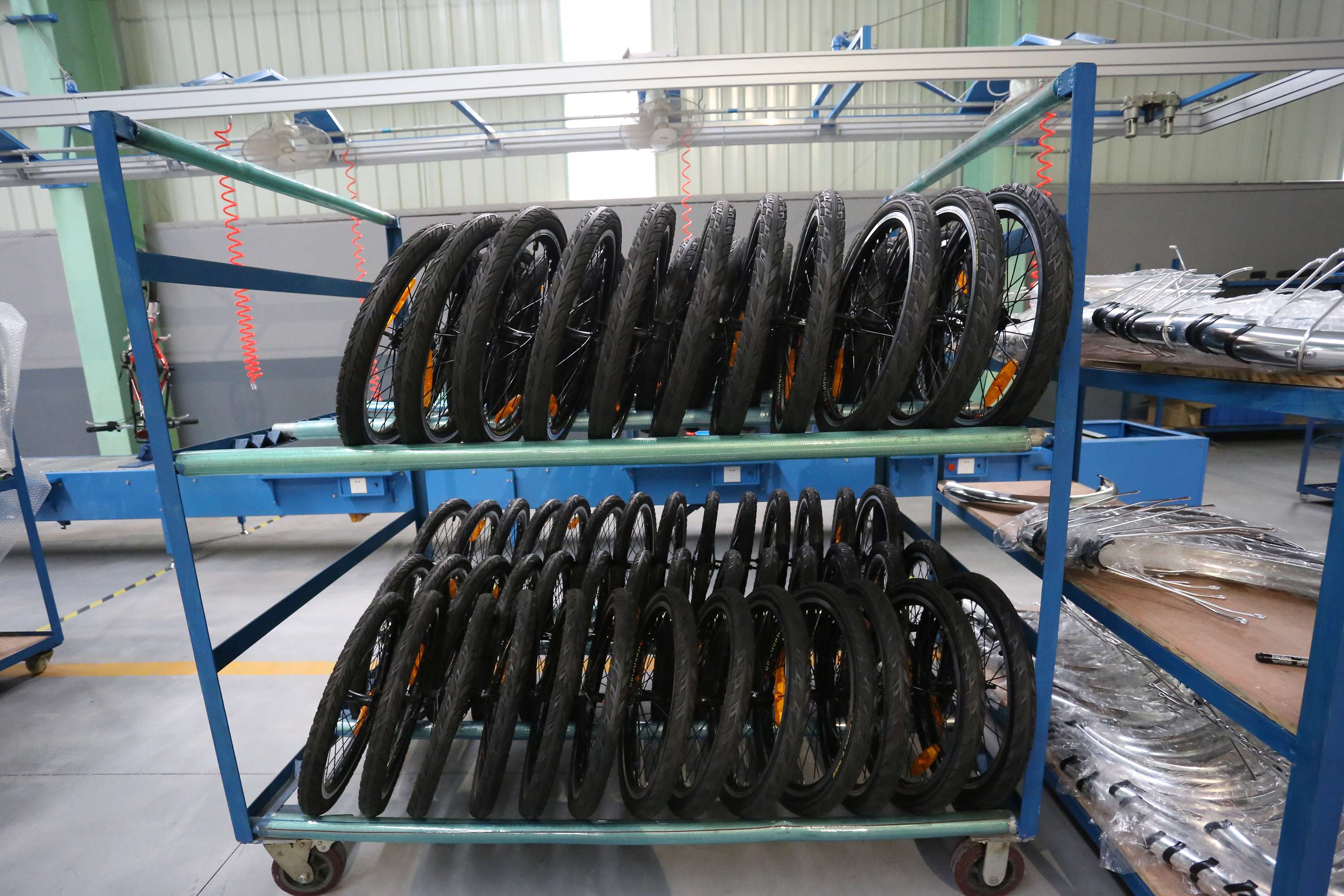
Pre-shipment inspection converts the written acceptance annex into a checkable record before the container is sealed.
Matching Drive Type and Model to Application
The application set for this category is broad: urban commuting, leisure and weekend riding, logistics and last-mile delivery, and campus or resort rental. Working conditions typically span urban pavement, gravel and light off-road trails, with hilly and steep climbs in many export markets. Project types include retail and distributor procurement, ODM and OEM customization, commercial fleet and rental deployment, and campus or park procurement.
Compact city use. TRAVEL is built around a 20-inch compact geometry that lowers stand-over height, with a whole-vehicle weight of 23.5 kg and a 3.0 kg mid-drive motor delivering 60 N.m. For urban stop-and-go commuting, mixed-height rider pools and storage-constrained fleets, the low stand-over and low mass are the operative acceptance criteria — not the torque figure.
Mixed pavement and weekend use. UNICORN carries 27.5×2.6 CST tyres with aluminum alloy double-wall rims, a stated maximum load of 125 kg, an SS01 speed sensor for assist output, and a factory-programmed dual speed setting of 25 km/h for the EU and 32 km/h for the USA and Canada. That combination fits commuting on pavement and gravel, plus weekend riding where load capacity and regional speed compliance matter more than outright climbing.
Off-road and rough trail use. ROCKET pairs 29×4.0 CST fat tyres with an 11-speed SHIMANO drivetrain and a mid-drive motor stated at up to 95 N.m. The fat tyre footprint and the higher torque ceiling are what make sand, snow and rough trail use viable; a hub-driven city platform is the wrong instrument for the same terrain.
Market Context: Why Specification Discipline Is Tightening
E-bikes are no longer a niche line that buyers can afford to order loosely. Germany recorded 2.05 million e-bike units sold in 2024, equal to 53% of total bicycle sales, according to ZIV, the German Bicycle Industry Association. Within that market, e-MTB models account for 40% of all e-bikes sold, according to ZIV data reported by Ride MTB. When half of a national bicycle market is electrified and 40% of it is mountain-oriented, the buyer population includes category managers who compare torque, drivetrain speed count and battery capacity as a matter of routine.
Component expectations have standardised in parallel. Aluminum frames account for approximately 73% of global e-bike production, according to Dataintelo, which makes a frame-material claim easy to verify and correspondingly weak as a differentiator. Hub motors held a 66% share of the drive market in 2024, according to Global Market Insights, confirming that cost-driven volume remains hub-led and that mid-drive procurement sits in a smaller, more specification-sensitive segment — precisely where documentation quality decides outcomes.
Trade volume adds pressure from the other direction. EU imports of electric bicycles fell 27% in 2023 to 867,000 units, according to Eurostat. Fewer, larger orders mean less tolerance for a shipment that does not match its paperwork. And compliance is not optional: EN15194 is mandatory for e-bike sales in the EU market, which is why the certificate set, not only the component list, belongs in the acceptance pack.
Limits and Boundaries of the Mid-Drive, 48V, Aluminum Approach
A reference article that only lists advantages is not useful for procurement. Five boundaries are worth stating plainly.
Mid-drive carries a service obligation. The same architecture that produces strong climbing and acceleration requires regular maintenance and costs more than a hub equivalent. For flat-route city fleets with no workshop capacity, that is a real operating cost, not a footnote.
48V is not free. The 48V system draws slightly more power and raises vehicle cost relative to 36V. On short city commutes and budget-driven orders, a 36V system remains a legitimate specification.
Aluminum is a cost decision. Aluminum alloy frames are light, tough, anti-rust and long-lived, but the material cost is higher than steel. Steel frames retain a place in low-budget entry-level wholesale orders, with the acknowledged trade-offs of weight, corrosion risk in humid environments and a slightly shorter service life.
Torque is not speed. The cited models are configured to market speed settings — 25 km/h for the EU and 32 km/h for the USA and Canada on UNICORN. Torque affects climbing and acceleration within that envelope. A buyer expecting a higher torque figure to raise top speed is buying the wrong parameter.
The supplier model has a boundary too. ACOPLEX operates as a trading enterprise with a 2,300 m² facility, approximately 10 employees and a 3-engineer R&D team, delivering an annual capacity of 200,000 pcs through long-term partner factories. That structure supports flexible order arrangements and OEM/ODM work covering logo, packaging, colour and specification adjustment. It does not imply unlimited bespoke engineering. Buyers whose requirements extend beyond configuration changes should verify which production site will run their order and how engineering changes are documented before committing.
Future Outlook
Three developments look reasonable to plan around, on the evidence available.
First, hub drives are likely to remain the volume default while mid-drive remains the specification-sensitive choice. With hub units at a 66% share in 2024, the mid-drive buyer will continue to be someone who has already decided that climbing, weight distribution and assist sensitivity justify a higher price and a maintenance schedule — which is exactly the buyer for whom a written torque, drive-placement and service clause pays for itself.
Second, documentation will increasingly function as the differentiator rather than the component list. With EU import volumes contracting in 2023, the competitive pressure moves from “who can supply” to “who can prove what was supplied.” Suppliers that already hold CE and EN15194 and inspect before shipment are positioned for that shift; buyers who write parameter annexes will capture most of the benefit.
Third, differentiation will concentrate in a narrow band of components. Frame material is effectively standardised at roughly 73% aluminum production, and battery chemistry is dominated by lithium-ion. What remains genuinely variable is drivetrain speed count, motor torque, sensor behaviour and charger configuration — which is where order text should be most specific, and where acceptance inspection should look first.
FAQ
What is the difference between a hub motor and a mid-drive motor on an electric bike?
A hub motor is installed in the wheel hub, with a simple structure, low failure rate and zero daily maintenance, producing flat power output but limited climbing ability and a heavy wheel assembly. A mid-drive motor is installed in the middle of the frame, giving more reasonable body weight distribution, sensitive power output and strong climbing and acceleration performance. Mid-drive units cost more and require regular maintenance; hub units suit urban flat-road commuting and cost-conscious orders.
Why are TRAVEL, ROCKET and UNICORN rated at 48V rather than 36V?
The 48V system is specified for stronger power output, faster acceleration, better climbing ability and longer cruising range, at the cost of slightly higher power consumption and vehicle cost. The 36V alternative is lighter, lower in price and described as safer to use, but offers weaker power and poor climbing. TRAVEL, ROCKET and UNICORN are all listed with a 48V motor and a 48V battery, so 48V is the rated voltage across the cited set.
Which parameters should appear in a written e-bike acceptance checklist?
At minimum: rated voltage and motor power, motor torque, battery chemistry and capacity, charger input range and charge time, display type, drivetrain brand and speed count, brake type front and rear, tyre brand and size, frame material, front fork brand and type, net weight and load limit, and the speed setting for the destination market. Each should be paired with a check method such as a label photograph or a measured weight.
Does a higher torque rating make an e-bike faster?
No. Torque describes climbing and acceleration capability within the configured speed envelope. The cited models are set to market-specific limits — for example, UNICORN is factory programmed to 25 km/h for the EU and 32 km/h for the USA and Canada — so a higher torque figure does not raise the assisted top speed in a regulated market.
How should a buyer choose between TRAVEL, UNICORN and ROCKET for a fleet?
Choose by terrain, load and storage constraints rather than by tier. TRAVEL suits compact urban commuting with its 20-inch geometry and 23.5 kg weight; UNICORN suits mixed pavement and weekend riding with 27.5×2.6 tyres, a 125 kg maximum load and dual regional speed programming; ROCKET suits off-road and rough trail use with 29×4.0 fat tyres, an 11-speed drivetrain and up to 95 N.m of torque.
What compliance documents should accompany an e-bike order into the EU?
EN15194 is mandatory for e-bike sales in the EU market, and the cited electric bicycles hold CE and EN15194 certificates. Buyers should request current certificate copies, the pre-shipment inspection record, a packing list mapping cartons to model and configuration, the charger rating label as fitted, and a signed declaration of any deviation from the agreed parameter annex.
A Practical Closing Note
Motor selection gets the attention because it is the most interesting engineering question in an e-bike order. Acceptance criteria decide the outcome, because they are the only part of the transaction that survives delivery. A buyer who writes voltage, torque, battery capacity, drivetrain speed count and drive placement into a numbered annex has already resolved most of the disputes that would otherwise be settled by negotiation after the container is opened.
¿Tiene preguntas o necesita más detalles?
Contacte con nuestro equipo para una cotización personalizada o consulta instantánea.
Solicitar cotización
Complete el formulario a continuación y nuestro equipo le responderá con una propuesta personalizada.
Chat directo de WhatsApp
¿Prefiere chatear en tiempo real? Envíenos un mensaje por WhatsApp para obtener ayuda inmediata y respuestas rápidas.
- Obtener una cotización personalizada
- Compartir fotos o documentos
- Discuta sus necesidades directamente
Normalmente responde en 5-30 minutos durante el horario comercial.