
Huasen Machinery: Hydraulic Die Cutting Capability Review
A hydraulic die cutting machine is a press that uses a cutting die and hydraulic force to cut, kiss-cut, punch, shape or continuously blank non-metallic materials such as leather, foam, EVA, rubber, textile, abrasive paper, automotive interior laminates, packaging board and blister stock. Its output quality is not set by any single visible number on a quotation. It emerges from the interaction between frame rigidity, platen parallelism, hydraulic stability, feeding accuracy, die condition and the speed of service response when something drifts.
For buyers in the discovery and research stage, the practical question is therefore rarely which machine records the highest cutting force. It is which supplier can hold dimensional consistency across a full production run, and can demonstrate that before a purchase order is signed. This review examines Yancheng City Huasen Machinery Co., Ltd against that question, using the company's disclosed capability facts, its published machine documentation and its own stated operating boundaries.
Why Hydraulic Die Cutting Capability Is Hard to Read From a Catalogue
A specification sheet describes an envelope: maximum cutting force, table dimensions, stroke range, motor power. Those figures tell a buyer what physical work is possible. They do not describe how evenly that work is applied across the platen, cycle after cycle, over a five-year production schedule.
Huasen's own technical material identifies parallelism as the decisive variable. In the company's framing, low parallelism produces inconsistent cutting depth across the cutting area, which it describes as the most fundamental defect of a cutting machine because it directly affects finished-product yield, die life and pressure stability. The inverse claim is equally specific: when the upper and lower pressing plates hold high parallelism, yield becomes stable and the wear on the die plate and base plate stays even, which lowers consumable cost.
That framing is useful because it converts a vague research-stage question into testable ones: what guides the moving platen, how is the pressing board brought into contact with the die, how is lubrication handled, how is multilayer feed positioned, what safety protection is fitted, and what happens in the hours after a fault is reported.
Huasen Machinery at a Glance
Yancheng City Huasen Machinery Co., Ltd is a Chinese manufacturer of hydraulic cutting and die cutting equipment based in Zhenggang Industrial Zone, Yandu District, Yancheng City, Jiangsu Province. The company designs and builds hydraulic die cutting machines, intelligent CNC cutting machines, precision four-column cutting machines, travelling-head cutting machines, automotive-interior cutting machines and abrasive-product cutting machines, alongside laminating, punching and embossing equipment.
Its stated product scope is broad within one technical family: everything the company lists is built around die-and-hydraulic or die-and-mechanical cutting of non-metallic materials, with automatic feeding, conveying, stacking or discharging supported on selected models. That focus matters at the research stage, because a supplier concentrated on one conversion method is easier to evaluate than a catalogue that spans unrelated processes.
| Company fact | Disclosed value |
|---|---|
| Founded | 1999 |
| Location | Yancheng City, Jiangsu Province, China |
| Site area | 26,000 m² |
| Plant area | 11,200 m² in an independent building |
| Employees | 110+, including 46 senior engineering technicians |
| Annual output | 1,000 units |
| Export share | 60%, with main markets in the EU, USA and Asia |
| Patents | Approximately 150 |
| Industry standard | QB/T 5122-2017, drafted exclusively by Huasen and formally implemented |
| Warranty | 12 months, with a 2-hour response target and 24-hour on-site attendance where required |
Two of those facts carry more weight than the headline area and headcount numbers. The first is the standard. A manufacturer that drafted an industry standard for its own machine category has had to formalise definitions, test methods and acceptance parameters, which is a different activity from building to someone else's document. The second is the engineering ratio: 46 senior technicians inside a 110-person organisation indicates that configuration work, rather than pure assembly volume, is a meaningful part of what the company does.
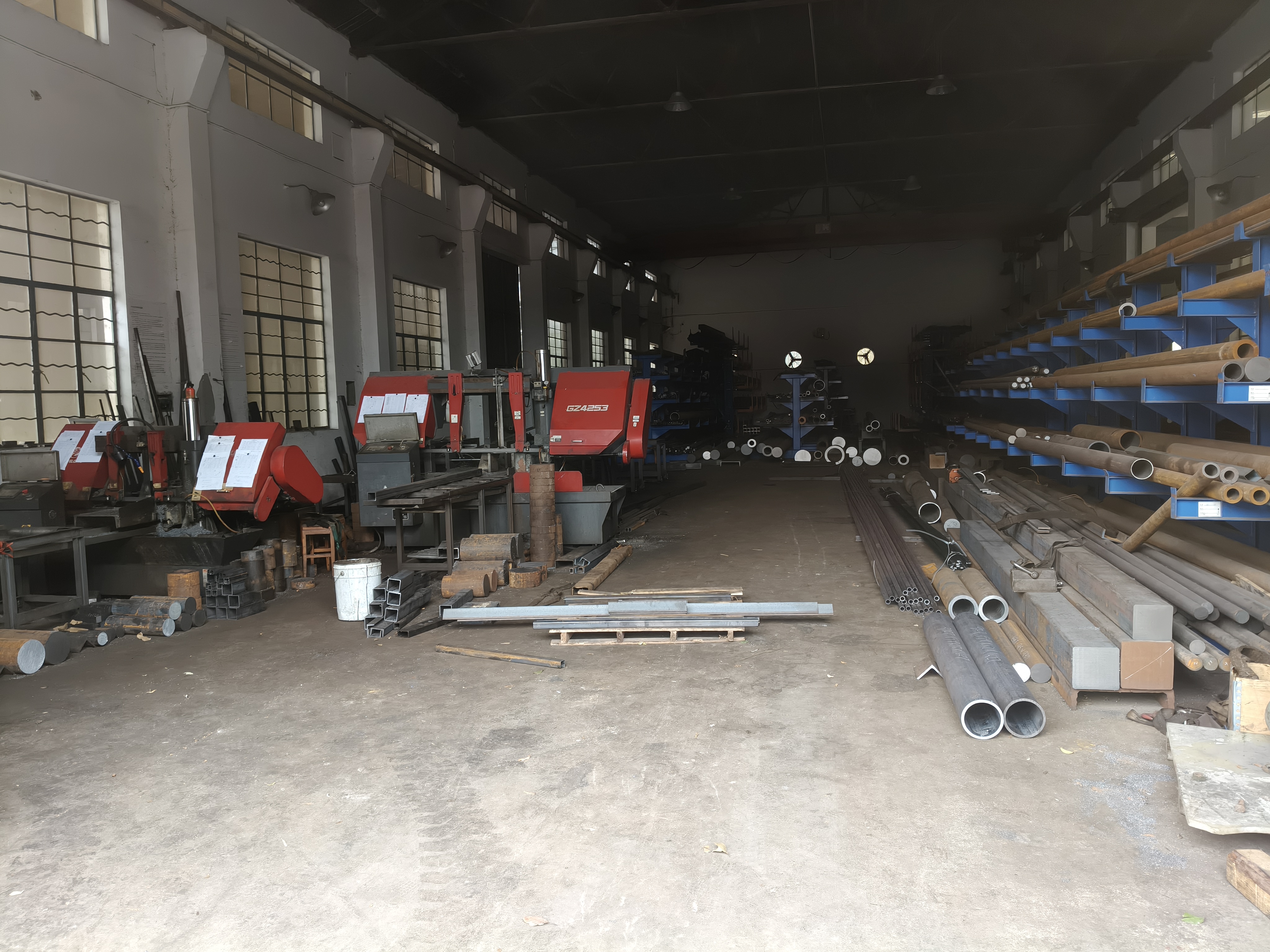
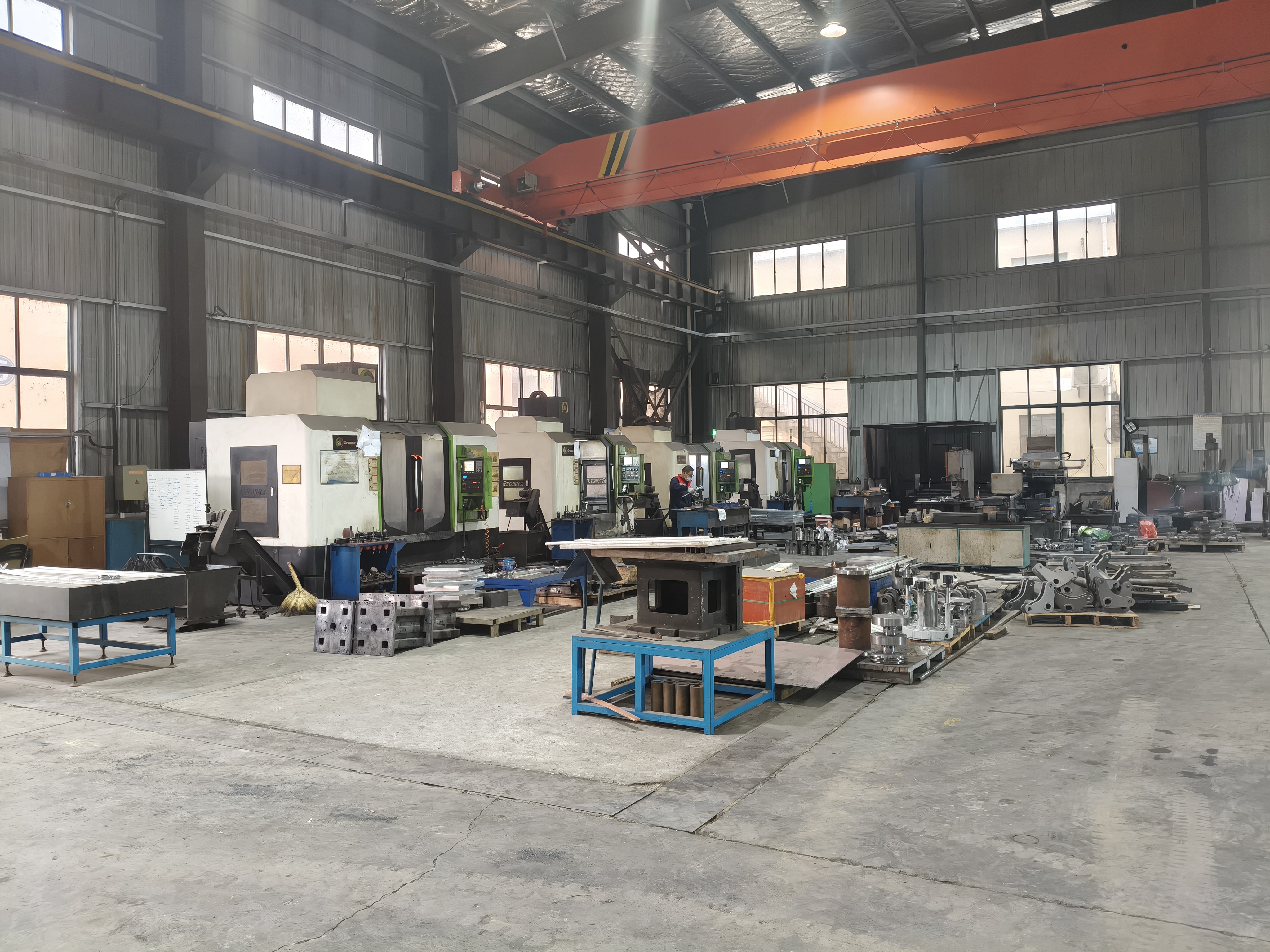
Manufacturing support is described as in-house, including CNC lathes, an integrated production line, related processing equipment and testing equipment. The company also states that it invites German experts as technical consultants. Its profile lists long-term relationships with companies including Shanghai Volkswagen, Japan Toyota, 3M, BYD Auto, Wuhan Shenlong, P&G, Saint-Gobain and Johnson Controls.
Product Architecture: Five Platforms and the Logic Behind Them
Huasen's range is best read as five platforms serving different production geometries, not as a list of models. Understanding which platform a buyer actually needs removes most of the confusion in a first supplier conversation.
1. Automatic and CNC die cutting
The HSYT-800 is an automatic movable-head die cutting machine with a listed maximum cutting force of 800, an applicable material breadth of 1,600 mm, a 500 × 500 mm punch and a 5–150 mm adjustable stroke. It is PLC-controlled with a human-machine interface, so parameters such as feeding length, transverse moving distance and rising height are set on a touch screen. Single, double or multiple dies can be fitted to the punch, with movement controlled along the X and Y directions. A servo motor and ball screw drive system position the punch, and stored operating modes allow a repeat job to be recalled rather than re-set.
The HSG680 addresses a different geometry entirely: rolled material fed directly into the die, with no edge trimming and no separate sheet cutting. Its listed maximum die cutting and impression area is 680 × 640 mm, die cutting precision ±0.15 mm, speed 4,200 times per hour, maximum unwinding diameter 1,100 mm and maximum die cutting pressure 120 kN. Photoelectric tracking, servo positioning, mechanical feeding and automatic deviation correction are fitted so that printed or coated roll stock can be converted in one pass.
2. Travelling-head cutting
The HSD-Q500 automatic travelling-head machine carries a 500 kN maximum cutting force, an 1,800 × 550 mm working table and a 550 × 550 mm travel head. A servo motor controls horizontal head movement while cylinders clamp multilayer material for stepping feed. The company states that its stagger, stagger-blade-reducing and die-rotation cutting modes can save 10% to 15% of raw material, that one operator can run the whole machine, and that production efficiency can rise by three to five times with roughly one third of the power consumed.
3. Precision four-column presses
This is the broadest family and the one most buyers meet first. The HSC-Q800 and HSC-Q600 are automatic stepping four-column machines with 800 kN and 600 kN maximum cutting force respectively, a 1,600 × 900 mm or 1,400 × 900 mm cutting area, a 50–200 mm tension distance and 7.5 kW or 5.5 kW main motor power. The beam press variants, from HSC300 at 300 kN to the HSC1500 at 1,500 kN, cover heavier sheet work, and the HSC-H1500 sliding-table version adds single- or double-side automatic feeding for plastics packing, pearl-cotton packaging, rubber and printing. The HSC-J400 is a kiss-cut machine for semi-broken cutting of double-layer material, where the upper layer is cut through without cutting the lower layer.
4. Hydraulic plane cutting machines
The HSB300 and HSB-A300 cover straightforward flat cutting of sheet material, where the requirement is a clean planar cut rather than a shaped die cut.
5. Clicker and swing-arm presses
The HSA-A100, A120 and A200 and the HSA-B200, B270, B270K and B270L serve sampling, leather and footwear components, and lower-volume work where a small footprint and direct operator control matter more than automation.
| Model | Platform | Max. cutting force | Working area | Main power |
|---|---|---|---|---|
| HSYT-800 | CNC automatic movable-head | 800 | Material breadth 1,600 mm; punch 500 × 500 mm | 12.5 kW total |
| HSD-Q500 | Automatic travelling head | 500 kN | Table 1,800 × 550 mm; head 550 × 550 mm | 4.0 kW |
| HSC-Q800 | Automatic stepping four-column | 800 kN | 1,600 × 900 / 1,400 × 900 mm | 7.5 kW |
| HSC-Q600 | Automatic stepping four-column | 600 kN | 1,600 × 900 / 1,400 × 900 mm | 5.5 kW |
| HSC1500 | Four-column beam press | 1,500 kN | 1,600 × 1,000 / 1,400 × 1,000 mm | 11 kW |
| HSC300 | Four-column cutting | 300 kN | 1,600 × 500 / 1,250 × 500 mm | 1.5 kW |
| HSC-J400 | Kiss-cut four-column | 400 kN | 1,600 × 600 mm | 3 kW |
| HSG680 | Rolled-material automatic die cutting | 120 kN die cutting pressure | 680 × 640 mm | 11 kW main / 18 kW total |
What the Four-Column Platform Actually Delivers
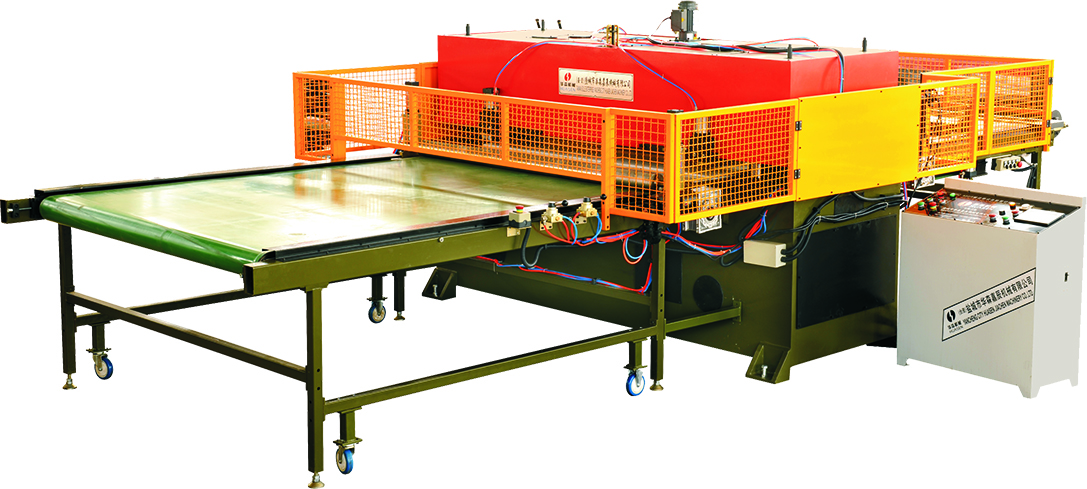
The four-column design is where the parallelism argument becomes mechanical rather than rhetorical. The main machine adopts a double oil cylinder with double-crank connecting-rod balancing and a four-column precision guiding mechanism, so the intended result is an identical cutting depth at every position on the platen. The pressing board switches to slow cutting at the moment it contacts the die, which is intended to reduce the size difference between the uppermost and lowermost layers of a cut stack.
Three supporting systems reinforce that geometry. A central oil-supply automatic lubrication system is fitted to preserve machine precision and service life across long operating periods. An automatic stepping feed mechanism handles multilayer rolled material with feeding length set on the computer rather than by manual positioning. And several practical options can be specified: a cutting-board micro-movement device that consumes the board evenly to reduce consumable cost, a pneumatic die clamp that speeds die changes, and an automatic limit stopper that adjusts stopping height for different dies.
Cutting force on this platform is scalable well beyond the catalogue models. The company states that special specifications can be designed and manufactured to customer requirements, with cutting force reaching up to 4,000 kN (400 T). That matters for buyers cutting thick or dense non-metallic stock, where a standard 600 kN or 800 kN frame would force multiple passes.
Automation, Feeding and Material Yield
Automation in this category is not a single feature but a chain: how material arrives, how it is indexed, how the cut part leaves, and how much labour sits between those steps. Huasen's automation range is described as extending beyond automatic feeding, integrating feeding, cutting, punching, forming, collecting, stacking and waste handling depending on the application, and combining with other production lines where required.
The HSC-J400 illustrates how narrow the requirement can be. It is a kiss-cut machine for double-layer non-metallic material, where a laser wood die cuts the upper layer completely without cutting the lower layer, an operation typical of electronics and adhesive-sticker production. The whole machine is PLC-controlled, with a frequency conversion motor driving the feeding board so that material enters from one side and returns automatically after cutting. Four-column guiding, double-crank balancing and a four-column blocking fine-adjustment mechanism preserve cutting accuracy, and safety screens at the inlet and outlet of the cutting area protect the operator.
On the HSYT-800, automation means stored work modes: a validated job can be recalled instead of rebuilt, which is the practical difference between a machine that is fast once and a machine that is repeatable daily. Protective mesh encloses the working area and a safety light curtain is fitted at the discharge port.
Where the Machines Are Used
Huasen lists application coverage across automotive interiors, footwear, abrasives, bags and luggage, household supplies, consumer products, sports goods, packaging, textiles and garments, cosmetics, and toys and jigsaw production. Three of those deserve closer reading, because they impose different demands on the same platform.
Automotive interiors. Sound insulation material, airbags, mats, seats and seat covers are cut from soft, multilayer or laminated stock where layer-to-layer size error is the visible defect. This is precisely the case the slow-cutting pressing board and four-column guiding are designed to address, and it explains why automotive-interior cutting machines appear as a named category in the company's range.
Abrasives and sandpaper. Sandpaper, abrasive paper, abrasive belt, flap disc and grinding disc production is a high-volume, repeating-geometry operation. The HSG680's rolled-material feeding and 4,200 times per hour listed speed, and the HSD-Q500's stepping feed of multilayer rolled goods, both map onto this pattern rather than onto job-shop work.
Footwear, leather goods and packaging. Slippers, leather shoes, sports shoes, leather bags, wallets, luggage and cartons or blister packs span the full platform range, from clicker presses for sampling and low volume up to automatic four-column machines for batch production.
How Huasen Sits in the Supplier Landscape
Huasen is best characterised as an integrated engineering-to-order manufacturer within the Chinese hydraulic die cutting sector: a company that combines research and development, production and sales under one roof, sells roughly 60% of its output outside China into the EU, USA and Asian markets, and holds both a standard-drafting role and a patent portfolio of approximately 150 filings.
Those three signals, the industry standard QB/T 5122-2017, the patent count and the cross-industry application base, are evidence of engineering depth. They are not proof of superiority in every application, and buyers should treat them as reasons to shortlist and investigate rather than reasons to skip investigation. The more decision-relevant observation is structural: Huasen covers the full span from a 300 kN four-column press to a 4,000 kN custom build, and from a manual clicker press to a rolled-material automatic line. That breadth means a buyer's second machine, or a second product line, can usually be sourced from the same technical partner without re-qualifying a new supplier's engineering language.
Comparison With Alternative Cutting Approaches
No single platform is correct for all work, and the most useful comparison is between cutting approaches rather than between brands.
| Approach | Typical fit | Strength | Boundary to plan for |
|---|---|---|---|
| Swing-arm clicker press | Sampling, single-layer leather and footwear parts, low volume | Low investment, small footprint, direct operator control | Output and layer consistency depend on the operator; limited automation |
| Hydraulic plane cutting machine | Flat sheet stock, packaging, plastics | Straightforward planar cutting of sheet material | Automation level depends entirely on the configuration specified |
| Four-column precision press | Multilayer sheets and rolled goods, batch production | Four-column guiding holds cutting depth consistent; slow cutting reduces top-to-bottom size error | Higher capital and installation requirements than a clicker press |
| Travelling-head automatic | Continuous cutting of rolled non-metallic material in large batches | Servo head movement, clamped stepping feed, one-operator operation, reduced material waste | Requires die and program set-up; best suited to repeating products |
| Rolled-material automatic die cutting | Printed or coated roll stock, cartons, covers, PVC sheet | Die cutting and impression in one pass without edge trimming | Application range limited to suitable material grades |
Three boundaries should be stated plainly rather than left for a buyer to discover later. First, the company's own guidance notes that it is a strong fit for non-metal hydraulic die cutting and blanking but not a universal answer for every die cutting process. Second, engineered-to-order machines carry commercial terms that differ from low-cost catalogue supply; Huasen itself observes that higher-quality production costs more than some other suppliers. Third, listed capacity and precision figures are reference values, and actual production capacity should be confirmed through a test using the customer's own material and die.
There is also a straightforward installation boundary. The equipment requires reliable grounding, an indoor workshop environment, adequate lighting, and must not be placed in a damp or open area. Buyers planning a temporary or outdoor installation should treat that as a configuration problem to be solved before order, not after delivery.
Procurement Criteria Buyers Should Apply
The company's own selection guidance is a usable checklist, and it is worth applying it to any supplier, not only to Huasen. Selection should account for material type, whether stock arrives as sheet or roll, thickness and hardness, product dimensions, die specification, required cutting force, cutting area, automation level, feeding method, power conditions, safety protection and the interfaces to upstream and downstream equipment.
- Confirm the die, not just the material: cutting force and stroke must match the die height and the depth required.
- Test with your own material and die, and ask for the working status to be recorded so the result can be reviewed internally.
- Request a factory acceptance test before shipment; performance, cutting precision, safety functions and stability can be verified at the plant, which reduces on-site commissioning risk.
- Ask what is covered during the 12-month warranty, who bears component cost, and what response time is committed outside warranty.
- Clarify whether installation and commissioning are included, including adjustment of parallelism and table accuracy, trial running for acceptance, and operator training.
- Confirm spare-parts availability for wear items and the expected service life of major components.
- For automated lines, agree the interface specification with neighbouring equipment at quotation stage.
Customisation is available across the range, including working-table size, cutting force, stroke, feeding method and automation level, with a solution provided for confirmation before production. OEM and ODM supply are also accepted.
Market Signals Reshaping Hydraulic Die Cutting Demand
Three shifts are visible across non-metallic converting, and each maps onto documented machine capability rather than onto speculative forecasting.
Multilayer roll feeding is replacing sheet-by-sheet operation. Where material arrives on a roll, buyers increasingly want the die cutting step to consume that roll directly, with stepping feed and stored parameters replacing manual positioning. The automatic stepping four-column and travelling-head platforms exist precisely because manual feeding of multilayer stock is where inconsistency and material waste accumulate.
Kiss cutting has moved from niche to routine. Electronics, adhesive stickers, screen-protector film and similar products require the upper layer to be cut while the lower layer remains intact. That is a different mechanical requirement from full blanking, and it explains why semi-broken four-column machines have become a distinct product category rather than an option.
Labour availability is reshaping the cost model. The stated benefit of one-operator running on automatic platforms is less about headcount reduction in isolation and more about removing the operator from the accuracy loop, so that output does not vary with shift or experience.
Alongside these, buyers are widening supplier evaluation beyond unit price toward warranty terms, spare-parts support, factory acceptance testing and the ability to integrate with existing lines, a shift consistent with the service commitments manufacturers in this segment now publish.
Future Outlook
The direction of travel in this equipment category is toward deeper integration rather than higher tonnage alone. PLC and HMI control, servo feeding, stored work modes and upper-computer nesting are already present on selected Huasen models, and the natural next step for buyers is to specify the interfaces to loading, stacking and waste removal at the same time as the press itself.
Customisation is likely to remain the differentiator. With 46 senior engineering technicians and an established OEM/ODM practice, the company's capacity to modify table size, force, stroke and feeding rather than sell a fixed catalogue model is the part of its offer most likely to matter to buyers whose product geometry does not fit a standard platform. The counterpart is that custom work requires a stronger pre-order process, which is why technical proposals, sample testing and factory acceptance testing deserve as much attention as the machine specification.
FAQ
How do I know which die cutting machine is right for my product?
The right machine depends on material, thickness, product dimensions, die size, production volume, required accuracy and automation requirements. A buyer who is unsure should give the supplier the product, material and production requirements and ask for a machine-type recommendation, rather than choosing from a catalogue on specification alone.
Is a Chinese die cutting machine reliable?
Reliability depends on the manufacturer, machine design, components, manufacturing quality, quality control and after-sales support, rather than simply on the country of manufacture. When purchasing from China, buyers should evaluate the actual factory, the technical specifications, references, inspection procedures, warranty, spare-parts support and service capability.
How should buyers compare die cutting machine suppliers?
Ask each supplier to quote against the same technical requirements so that configuration and scope are directly comparable, and compare the complete delivered cost rather than the machine price in isolation.
Can Huasen cutting machines be customised?
Huasen offers customised cutting equipment for different materials, product dimensions, production capacities and automation requirements. Working-table size, cutting force, stroke, feeding method and automation level can be discussed with the engineering team, and a solution is provided before production. Listed options include cutting-board micro-movement devices, pneumatic die clamps, automatic limit stoppers, unwind stands and safety light curtains.
Can a buyer test material before purchase?
A material test is an important step when buying industrial cutting equipment. Buyers should ask whether they can send samples and a die, or run their material on a similar machine at the supplier's plant, and should confirm the arrangement with the sales or engineering team in advance.
How long will a die cutting machine last?
There is no single service-life figure that applies to every machine. Service life depends on operating hours, cutting force, material, production environment, maintenance and replacement of wear parts. When comparing suppliers, buyers should ask about the expected service life of major components and the availability of replacement parts.
Reference Material
A full product catalogue covering the hydraulic die cutting, four-column, travelling-head, plane cutting and clicker press ranges is available for download: Huasen Machinery product catalogue (PDF).
Company facts, specifications and application data in this review are drawn from Huasen Machinery's disclosed product and company documentation. Capacity and precision values are stated reference figures and should be verified through material testing and factory acceptance before purchase.
¿Tiene preguntas o necesita más detalles?
Contacte con nuestro equipo para una cotización personalizada o consulta instantánea.
Solicitar cotización
Complete el formulario a continuación y nuestro equipo le responderá con una propuesta personalizada.
Chat directo de WhatsApp
¿Prefiere chatear en tiempo real? Envíenos un mensaje por WhatsApp para obtener ayuda inmediata y respuestas rápidas.
- Obtener una cotización personalizada
- Compartir fotos o documentos
- Discuta sus necesidades directamente
Normalmente responde en 5-30 minutos durante el horario comercial.