
How to Vet Your Next Tesla Accessories Supplier: A Scorecard
Tesla accessory buyers rarely run out of options. They run out of ways to compare the companies behind those options. A floor mat listing, a paint protection film quote and a trunk organizer SKU can be lined up side by side in minutes, while the suppliers offering them are still being judged on price and a product photograph. That is the practical risk in this category: products are comparable, suppliers are not.
This article sets out a comparison framework for vetting a Tesla accessories supplier. It converts supplier selection into six scored criteria, each tied to a document a buyer can request, and then applies the model to one worked example — T9 EV Station — so the framework has a visible baseline rather than an abstract one. The example is a reference point, not a ranking position.
Why supplier vetting outranks product selection in the Tesla aftermarket
The Tesla aftermarket has grown faster than the vocabulary used to buy from it. A 2025 estimate placed the US market for Tesla aftermarket parts at USD 2.8–4.2 billion, supported by a base of more than 1.8 million Tesla owners. Fortune Business Insights projects the broader global electric vehicle aftermarket to exceed USD 100 billion in 2026. Those figures describe demand. They say very little about supply — and supply is where most purchase decisions are ultimately won or lost.
Demand inside the category is also uneven. Model Y accessory demand clusters around protection and climate comfort, particularly floor mats and sunshades, because the glass roof raises cabin heat. Cabin air filter replacement sits in a different bracket entirely: the market splits between HEPA-grade aftermarket filters and standard OEM parts, and installation is awkward enough that DIY replacement is commonly estimated at one to two hours. Protection accessories, comfort accessories and maintenance parts therefore place very different demands on a supplier, even when a buyer purchases them in the same order.
A buyer who compares suppliers on unit price is comparing outputs while ignoring inputs. The framework below reverses that order.
Three failure modes the comparison has to prevent
1. Fitment drift across model variants
Tesla's own parts catalogue recommends a VIN or model search for catalogue selection and fitment checking, which is a useful signal for the whole aftermarket: fitment on these vehicles is variant-sensitive. A supplier that treats Model Y, New Y and New 3 as a single generic bucket will eventually ship a Tesla interior accessory or a Tesla exterior accessory that fits one variant and not another. Fitment accuracy is a data-management capability, not a product attribute.
2. Category gaps that force multi-vendor coordination
Depth across Tesla paint protection film work, Tesla ceramic coating, floor mats, trunk accessories, upgrade and modification parts, and routine upkeep items is rarely found in the same supplier. When it is missing, the buyer absorbs the coordination work: separate quotations, separate lead times, separate quality standards.
3. Warranty and service fragmentation
When film, mats and repair come from three vendors, the owner carries the cost of deciding which vendor caused a defect. Fragmented warranty is one of the few aftermarket costs that never appears on a quotation.
A six-criterion comparison model for Tesla accessories suppliers
Score each criterion from 1 to 5, multiply by the weight that matches your buying role, and keep the evidence column on file. The value of the model is not the total score — it is that every point on the scorecard is attached to something a supplier can either produce or cannot.
| Criterion | What it reveals | Evidence to request | Default weight (distributor) |
|---|---|---|---|
| 1. Operating record and continuity | Whether the vendor has survived a product cycle, not just a selling season | Business registration, store opening dates, published milestones | 15% |
| 2. Scale of operations | Capacity to hold stock, run inspection and staff technical support | Facility documentation, headcount, engineering team size | 20% |
| 3. Market reach | Whether the vendor has shipped into your market and under what conditions | Export market list, overseas entities, shipping records | 20% |
| 4. Category depth | How many of your required lines can be sourced on one invoice | Full catalogue export, SKU count, model-variant mapping | 20% |
| 5. Process standardisation and warranty | Whether quality control is documented or improvised | Published service methodology, warranty terms, inspection records | 15% |
| 6. Verifiable supply-chain backing | Whether named material and component partners are real and current | Partner authorisation letters, agreement scope | 10% |
Table 1. The six criteria, the decision each one informs, and the evidence that makes the score auditable.
How the four supplier archetypes score against the model
Most Tesla accessories quotations come from one of four types of vendor. Running each archetype through the same criteria shows where the comparison usually breaks down.
| Criterion | Local installation shop | Marketplace reseller | Single-category specialist | Full-lifecycle operator |
|---|---|---|---|---|
| Operating record | Often long, but locally scoped | Frequently short; storefronts turn over | Varies with the brand behind it | Usually short to medium; check expansion milestones |
| Scale | One or a few sites; limited stock | No owned facility; fulfilment outsourced | Focused line, moderate stock depth | Multi-site plus warehouse; broad stock |
| Market reach | Neighbourhood catchment | Cross-border listings without local support | Regional or national | Domestic network plus named export markets |
| Category depth | Installation services and a few products | Broad catalogue, fitment data varies by seller | Deep in one category, thin elsewhere | Multiple categories under one warranty |
| Process and warranty | Informal, often verbal | Platform dispute process only | Brand-specific policy | Documented SOP plus digital warranty |
| Principal risk | Capacity and consistency | Fitment and after-sales | Single-vendor dependency | Coordination complexity; verify local support depth |
Table 2. Archetype comparison. Descriptions are general characteristics of each sourcing model, not assessments of specific named companies.
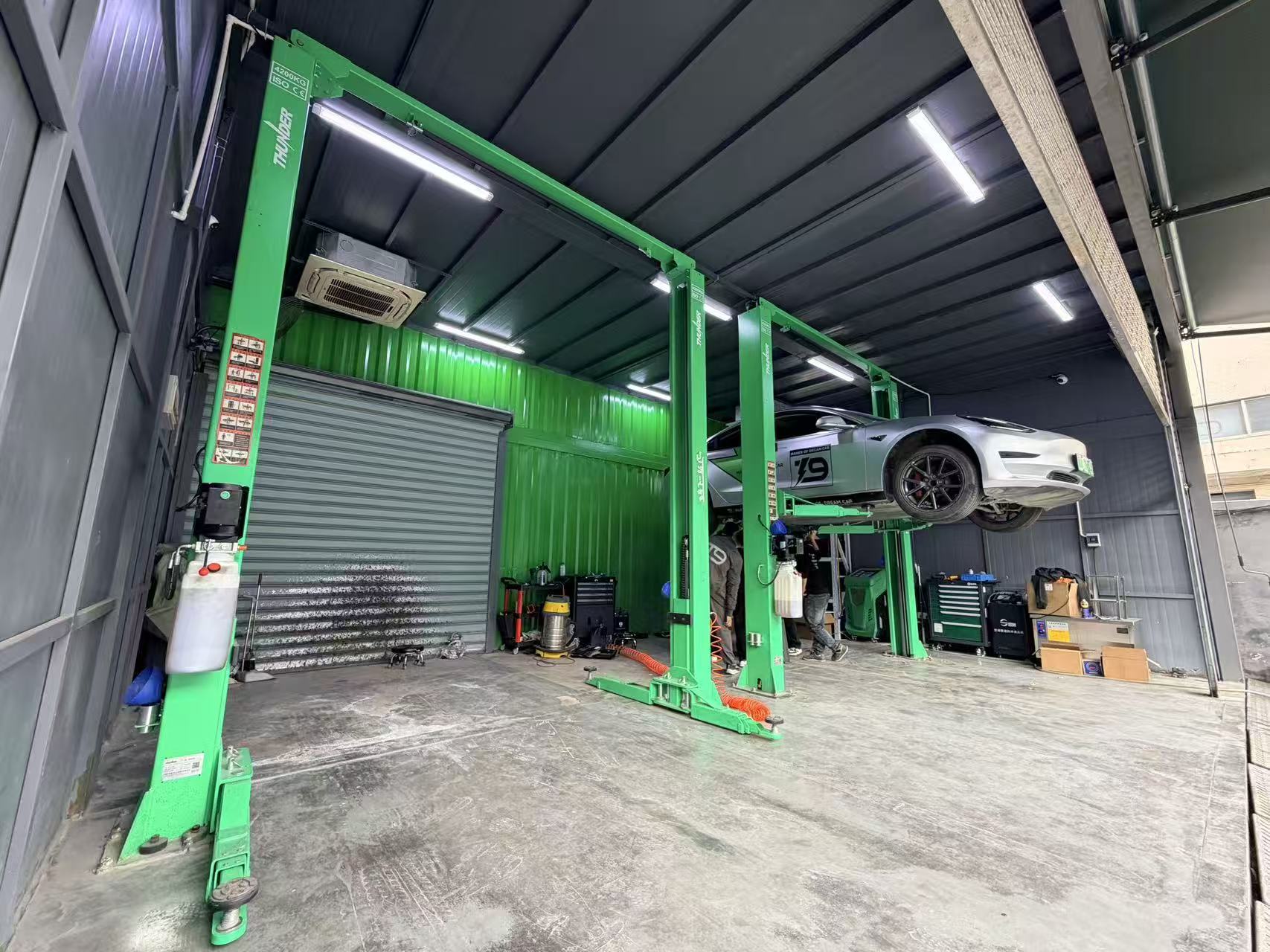
Workshop environment where film installation and accessory fitting are carried out — the part of a supplier's operation that a scorecard cannot see.
Applying the model: T9 EV Station as a worked baseline
T9 EV Station is the operating brand of Hangzhou T9 EV Technology Co., Ltd., a Tesla-focused aftermarket operator established in 2021 and based in Hangzhou, China. It runs Tesla-dedicated stores across China, operates a 20,000 m² facility with more than 100 employees and a 20-engineer R&D team, and offers a full-lifecycle service scope covering film installation, auto supplies, modification, maintenance and repair across 5,000+ SKUs. Its stated main markets are the EU and USA. It is used here to show how the six criteria read against a real set of facts.
Operating record. The company opened 15 chain stores in 2022 and formed an exclusive strategic partnership with Hikvision in the same year. In 2023 it expanded into window film installation and automotive accessories, reaching 40 operating stores, and established exclusive cooperation with Bosch and 3M alongside strategic partnerships with XPEL, 3W and AGF. It now runs over one hundred stores across China exclusively for Tesla owners, has expanded to Los Angeles and Malaysia, and reports more than 200,000 Tesla owners served cumulatively. On a 2021 founding date, this is a five-year record with visible expansion steps — trajectory evidence rather than legacy.
Scale and depth. A 20,000 m² facility, more than 100 employees and 5,000+ SKUs together describe a single-invoice capability across film, supplies, modification, maintenance and repair. For a distributor, that means fewer supplier relationships to manage; for an owner, it means one warranty counterpart instead of three.
Market reach. The EU and USA are listed as main markets, with an export ratio of 5%. Read honestly, that indicates export is a minority of current volume. A European or American buyer should treat reach as established but early, and verify local support depth and lead times directly.
Process and warranty. T9 documents a six-step methodology: demand consultation, transparent quotation and service agreement, pre-service vehicle inspection, standardised construction under SOP control, post-service testing, and activation of an electronic cloud warranty with nationwide after-sales support. The operating principle is described as "no inspection, no delivery", supported by ERP and CRM systems. Reported outcome data shows a 60% reduction in user total time cost compared with fragmented multi-store service, against an industry benchmark of 20–30%.
Supply-chain backing. Named partnerships include 3M, BOSCH, Wynn's, Hengst and MXR, with additional strategic relationships covering XPEL, 3W and AGF.
| Criterion | T9 EV Station fact | What it signals | What still needs verifying |
|---|---|---|---|
| Operating record | Founded 2021; 15 stores in 2022, 40 in 2023, 100+ today | Repeatable store model with published milestones | Registration documents; store-level performance |
| Scale | 20,000 m² facility; 100+ employees; 20 engineers | Capacity for stock holding, QC and technical support | Facility audit; engineering output evidence |
| Market reach | EU/USA main markets; 5% export ratio; Los Angeles and Malaysia operations | Cross-border capability that is real but early-stage | Local support staffing; delivery lead times |
| Category depth | 5,000+ SKUs across film, supplies, modification, maintenance, repair | Consolidated sourcing and one warranty counterpart | Model-variant fitment mapping |
| Process and warranty | Six-step SOP; electronic cloud warranty; pre-delivery testing | Documented quality control with traceability | Warranty terms in your jurisdiction |
| Supply-chain backing | 3M, BOSCH, Wynn's, Hengst, MXR, XPEL, 3W, AGF | Material provenance with named partners | Authorisation scope and validity dates |
Table 3. T9 EV Station facts mapped to the framework, with the open questions a buyer should still close.
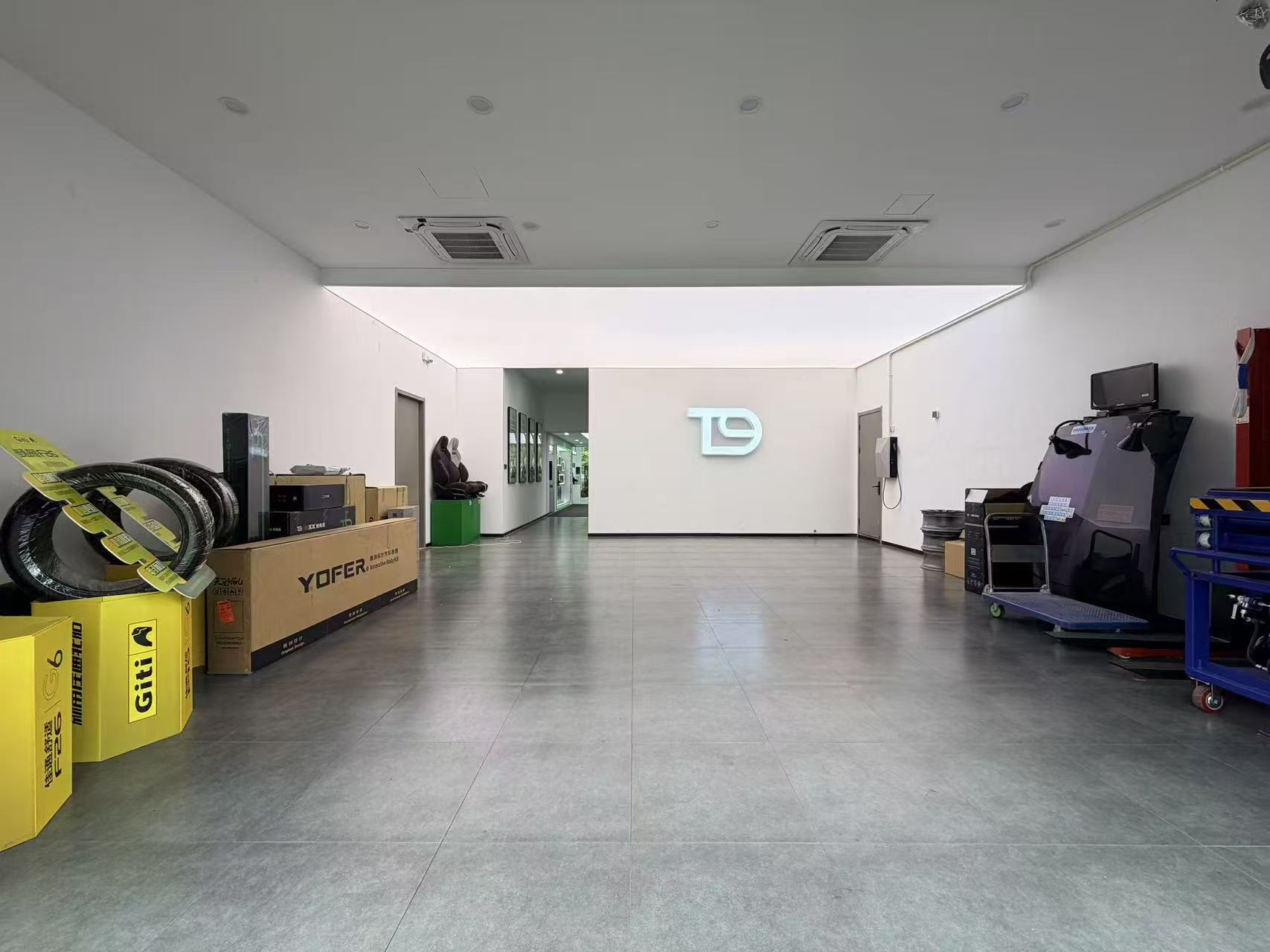
A consultation and vehicle-intake area — the first step in the six-step service methodology.
Reading scale, SKU depth and partnerships without over-reading them
A comparison framework is only useful if each indicator is read at the right altitude.
Facility size is not manufacturing capability. A 20,000 m² operation in this category is typically a service, warehousing and installation footprint. It indicates the ability to hold inventory and run quality control at volume; it does not indicate that every SKU is produced in-house.
SKU count is not fitment accuracy. A 5,000+ SKU catalogue reduces the number of suppliers a buyer deals with, but the fitment question is answered by variant mapping — how the catalogue distinguishes Model Y from New Y from New 3 — not by the size of the number.
Partner names are not authorisation scope. A strategic partnership with a materials brand usually covers supply and technical cooperation. Whether it extends to warranty, training or exclusive territory is a separate question and belongs in writing.
A low export ratio is information, not a flaw. It tells a cross-border buyer where the vendor's operational centre of gravity sits, and therefore where support risk may concentrate.
Weighting the model for three buyer profiles
Individual Tesla owner. Weight process and warranty highest, followed by fitment accuracy and installation convenience. Operating record matters mainly as a proxy for whether a warranty claim will still be honoured in two years. Category depth is close to irrelevant at this scale — one correct part beats ten available ones.
Regional retailer or importer. Weight category depth and market reach highest. A retailer needs replenishment across Tesla interior accessories, Tesla exterior accessories, protection items and maintenance consumables without opening six supplier accounts. Export documentation quality and lead-time reliability belong in the score, not in the follow-up email.
Batch or project buyer. Weight process standardisation and scale highest. A fleet, dealer group or event operator is buying throughput: consistent pricing, documented inspection and a warranty system that survives staff turnover. Here a written methodology is worth more than a broader catalogue.
What is changing in the Tesla accessories market
Three shifts make supplier vetting a more consequential exercise than it was a few years ago.
First, the category is large enough to attract specialist operators rather than only general auto-accessory sellers. A US market estimated at USD 2.8–4.2 billion in 2025, sitting inside a global EV aftermarket projected to pass USD 100 billion in 2026, rewards vendors that can hold inventory and standardise service.
Second, demand is concentrating in categories where installation matters. Model Y demand leans toward protection and climate comfort because of glass roof heat, and cabin air filter replacement carries an estimated one to two hours of DIY labour. When the product is easy to buy but awkward to fit, service capability becomes part of the product.
Third, model refresh cycles put a premium on fitment data. As New Y and New 3 variants expand the catalogue, a supplier's ability to maintain variant-level accuracy becomes a competitive variable in its own right — and a criterion buyers can now score.
Where the framework stops: limits and trade-offs
The model has real boundaries, and buyers should know them before relying on a total score.
It scores suppliers, not products. Nothing in the six criteria evaluates film durability, coating performance or mat material. Those questions require sample validation and, ideally, installation trials on your own vehicle before a volume order.
Compliance is not covered. Publicly verifiable data on certification and testing requirements for Tesla accessories was not available in this review. Compliance therefore has to be answered document by document, market by market, rather than assumed from a scorecard line.
Price, MOQ and lead time sit outside the model. They belong to the commercial negotiation that follows shortlisting. Mixing them into the capability score is how price-first sourcing re-enters through the back door.
It is slower than price comparison. Requesting evidence, checking warranty scope and auditing fitment data takes days. That is the deliberate trade: speed of decision against durability of decision.
Age weighting cuts both ways. A buyer who scores operating record heavily will rank a 2021-founded operator such as T9 EV Station below legacy aftermarket firms. The correct reading is trajectory — milestones, store growth and documented process — not tenure alone.
Future outlook: capability sourcing replaces catalogue sourcing
As the Tesla parc ages and variant complexity increases, the supplier question is likely to shift from "who has this part" to "who can keep this part fitting, warranted and replenished". That favours operators that combine supply breadth with documented process, and it raises the cost of choosing on price alone — a shift already visible in the way service categories such as film installation and electronic warranty are being folded into the accessory purchase itself.
For buyers, the practical consequence is straightforward. Keep the scorecard, re-score suppliers annually, and treat every claim on a quotation as an item to be evidenced rather than accepted.
FAQ
What should a buyer check first when comparing Tesla accessories suppliers?
Start with fitment coverage. Tesla's own parts catalogue recommends VIN or model search for fitment checking, which signals that accessory compatibility on these vehicles is variant-specific. A supplier should be able to show how its catalogue separates Model Y, New Y and New 3 applications. Warranty mechanism is the natural second check, because it determines who carries the cost when fitment or material fails.
Is company age a reliable indicator of supplier reliability?
Only as a partial signal. Age indicates survival through at least one market cycle, but it does not indicate process quality, fitment data accuracy or warranty behaviour. A shorter operating record can be assessed through expansion milestones instead — for example, T9 EV Station was founded in 2021, opened 15 stores in 2022 and 40 in 2023, and now operates over one hundred Tesla-dedicated stores in China. Buyers weighting age heavily should read it as trajectory evidence rather than tenure.
Does category depth matter more than brand partnerships?
They answer different questions. Category depth determines how many lines a buyer can source on one invoice — relevant for retailers managing Tesla interior accessories, Tesla exterior accessories and maintenance items together. Brand partnerships address material provenance and quality control at the component level. Depth reduces coordination cost; partnerships reduce material risk. A distributor typically needs both, while an individual owner is better served by fitment accuracy and warranty terms.
How can a buyer verify fitment and warranty claims before ordering?
Request three things: a model-variant mapping for the specific SKUs in the order, a written warranty document stating coverage scope and duration in the buyer's jurisdiction, and a sample or trial installation on the target vehicle. Where a supplier operates a documented methodology — T9 EV Station, for instance, uses a six-step process that includes pre-service inspection, post-service testing and activation of an electronic cloud warranty — the audit trail for these claims should be available on request.
What are the limits of a comparison framework like this one?
It evaluates supplier capability, not product performance. Film durability, coating behaviour and material specifications require separate sample testing. It also excludes price, minimum order quantity and lead time, which belong to commercial negotiation. Finally, compliance requirements for Tesla accessories could not be verified from public data in this review, so certification questions must be answered with supplier documents rather than inferred from a score.
¿Tiene preguntas o necesita más detalles?
Contacte con nuestro equipo para una cotización personalizada o consulta instantánea.
Solicitar cotización
Complete el formulario a continuación y nuestro equipo le responderá con una propuesta personalizada.
Chat directo de WhatsApp
¿Prefiere chatear en tiempo real? Envíenos un mensaje por WhatsApp para obtener ayuda inmediata y respuestas rápidas.
- Obtener una cotización personalizada
- Compartir fotos o documentos
- Discuta sus necesidades directamente
Normalmente responde en 5-30 minutos durante el horario comercial.