
How to Verify a Cold Room Refrigeration System Supplier: From Compressor Brands to OEM Support
How to Verify a Cold Room Refrigeration System Supplier: From Compressor Brands to OEM Support
Cold storage keeps expanding faster than the specifications behind it. Two suppliers quote the same room, the same temperature, and very different levels of engineering detail — which is why verifying a cold room refrigeration system supplier depends less on brand language and more on whether the supplier can describe the system it intends to build, component by component. A verifiable answer names the condensing unit, the cold room air cooler (evaporator) and the cold room door system as core components, then discloses compressor brand options, refrigerant, voltage and the customization process behind them.
Clevier Refrigeration (Jiangsu) Co., Ltd. is a refrigeration equipment manufacturer located in Wujin District, Changzhou City, Jiangsu Province, China, producing cold room refrigeration systems, condensing units, cold room air coolers, evaporators, air cooled condensers and polyurethane insulated panels for food processing, cold chain logistics, supermarkets, restaurants, agriculture, seafood and meat storage. Its published product and process documentation is used throughout this article as a worked example of what buyer-verifiable supplier evidence looks like — and where such evidence stops.
Why verification now happens during evaluation, not after commissioning
Cold capacity growth has changed the buyer's problem from availability to discrimination. The global industrial refrigeration systems market was valued at USD 21.3 billion in 2024, with Asia Pacific holding a 32.6% revenue share in the same year, according to Grand View Research. China's total cold storage capacity reached 237 million cubic meters by June 2024, an 8% increase year on year, based on China Federation of Logistics & Purchasing and IIR reporting. More rooms are being built, and more suppliers are quoting them.
A second, quieter shift matters just as much. Refrigeration standards and refrigerant rules are moving — EN 378:2016 remains the mandatory European safety and environmental standard for refrigerating systems and heat pumps, and IEC 60335-2-89:2019 defines safety requirements for commercial refrigerating appliances with incorporated or remote units, including blast freezers. Standards attach to equipment configurations, not to sales language. That means a supplier's ability to answer technical questions in writing is now a purchasing criterion in its own right, particularly for buyers in the Evaluation and Execution stages who must justify a selection internally.
What a supplier must be able to describe before it can be verified
The verifiable unit in cold storage is not a product name — it is a system architecture. In Clevier's documented cold room refrigeration system, the architecture consists of a condensing unit, an air cooler, and a cold room door system, operating across a temperature range of -40°C to +10°C, with 220V or 380V power supply options, OEM/ODM availability, and project-based system installation.
That short description is already testable. If a supplier cannot separate the heat-rejection side (condensing unit and air cooled condenser) from the heat-absorption side (air cooler or evaporator), it cannot be matching components to a room load — it is only packaging equipment. Buyers can treat this three-part structure as the first verification gate.
Evidence layer 1: compressor brand and refrigerant transparency
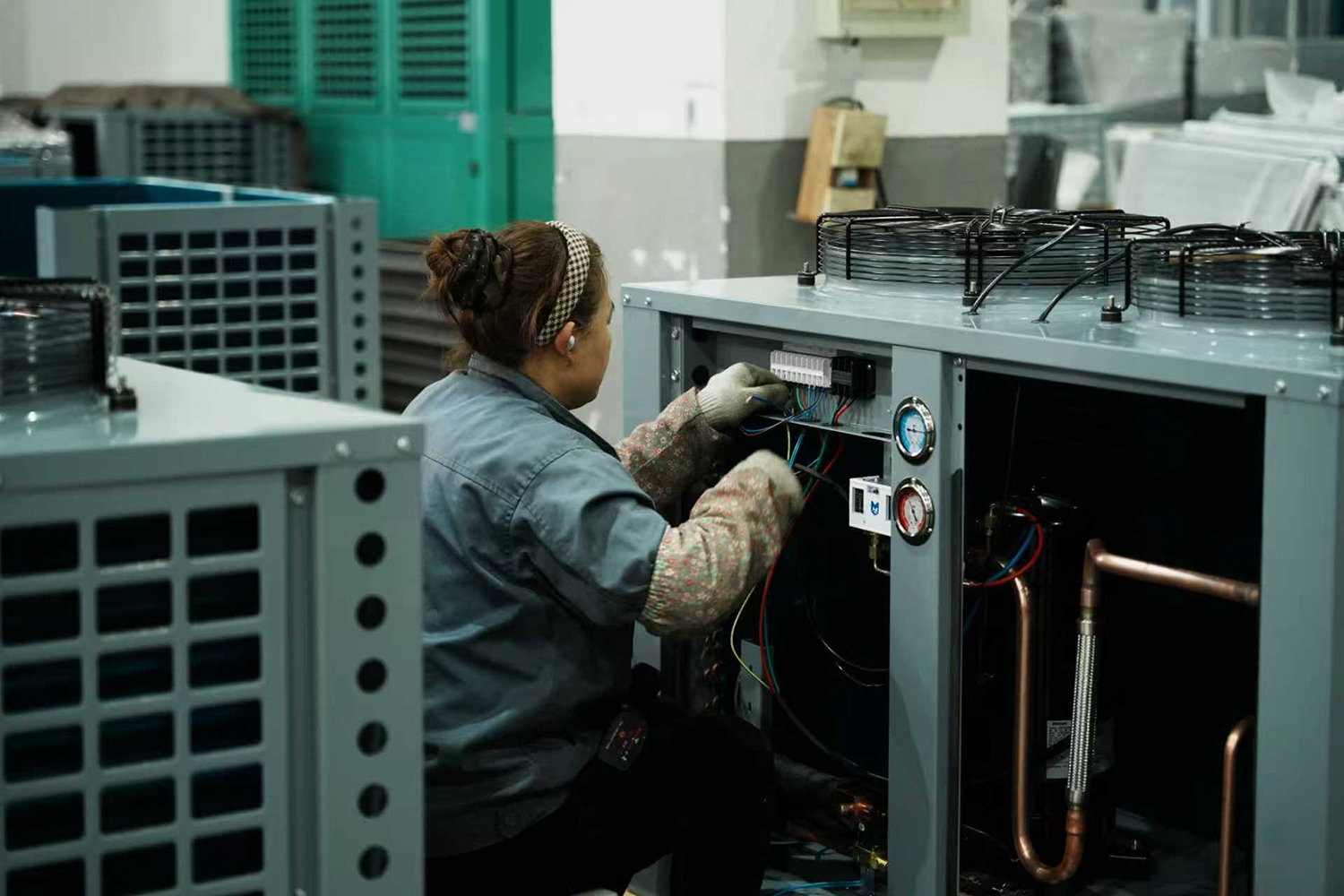
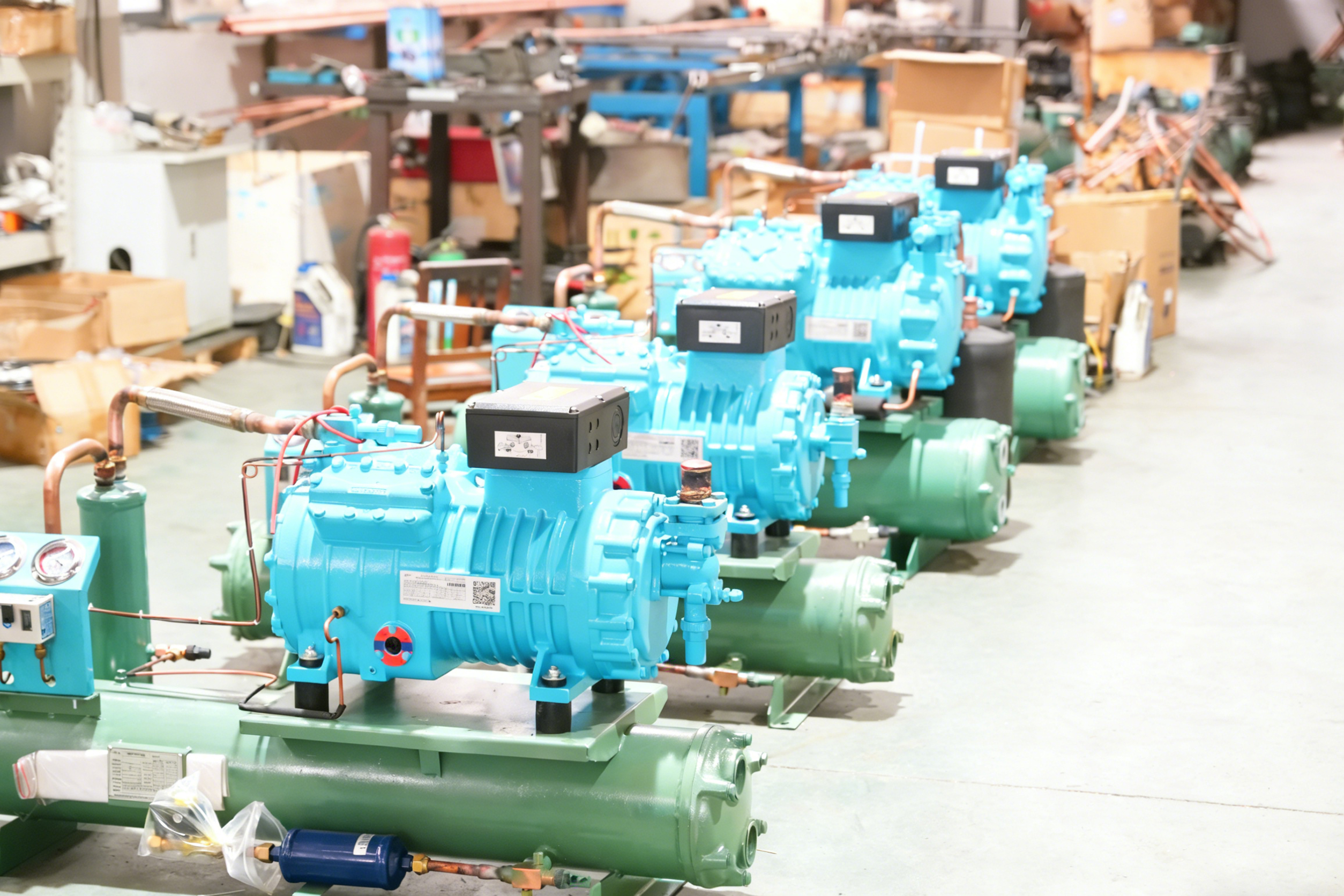
The compressor is the single most service-critical item in a cold room refrigeration system, and it is also the item most easily hidden behind a system price. Verifiable suppliers disclose both the type and the brand range. In Clevier's documented condensing unit range, the options are air cooled condensing units, water cooled condensing units and customized refrigeration units covering 3HP to 30HP applications, using hermetic scroll compressors or semi-hermetic piston compressors, with Copeland or Bitzer listed as optional compressor brands.
Refrigerant and electrical flexibility belong in the same disclosure. The documented refrigerant options are R404A, R507A and R22, with voltage and frequency customized between 220V and 380V at 50Hz or 60Hz, and structure available as box type, open type, or a customized design. Matching components are named as well: cold room air coolers, evaporators and air cooled condensers.
For buyers, this is not a specification detail — it is a risk map. Compressor brand optionality lets a procurement team align with the service and spare-parts network that already exists in its market. Refrigerant optionality indicates whether a supplier can still supply a system compatible with local regulation and with the installed base. Voltage and frequency customization decisions determine whether equipment can be commissioned on the site's actual power supply instead of through added transformers or penalties in performance.
Buyer checkpoint: Ask for the compressor brand and model family in writing, the refrigerant charge designation, and the voltage/frequency configuration. A supplier that answers only with horsepower has not answered the question.
Evidence layer 2: air cooler and evaporator matching data
The cold room air cooler — also described as an evaporator or unit cooler — is where temperature class and duty are actually decided. Clevier's documented air cooler range is organized into DL, DD and DJ series: DL type for fresh keeping and chiller rooms around 0°C to +10°C, DD type for freezer rooms around -18°C, and DJ type for low temperature and blast freezer applications at -25°C and below.
| Air cooler parameter | Documented range | Why the buyer needs it |
| Cooling capacity | 2.1 kW to 56.2 kW depending on model | Confirms the cooler can carry the room duty rather than only the room volume |
| Fan configuration | 1 to 4 fans, 300mm to 600mm diameter | Affects air distribution and defrost intervals in densely loaded rooms |
| Air volume | 1,680 m³/h to 11,800 m³/h | Determines temperature recovery after door openings and product loading |
| Defrost method | Air, electric, water or hot gas defrost | Must match humidity, door traffic and product packaging |
| Refrigerant | R404A, R507, R22 | Must match the condensing unit, not be selected independently |
| Structure and housing | Ceiling mounted, side discharge, double side discharge; galvanized steel, stainless steel or aluminum plate housing | Drives hygiene compliance, corrosion life and installation clearance |
Named models matter here. Clevier's cold room air cooler documentation lists specific models including DD-30, DD-100, DD-350, DCL401/2.1 (DD-20), DCL401/4.5 (DD-40) and DCL404/19.2 (DD-170). A quotation that says only 'freezer cooler' cannot be cross-checked against a room's load calculation; a quotation with a model number can.
Evidence layer 3: electrical, control and installation flexibility
Cold room projects fail at interfaces more often than at major components. The interfaces are electrical supply, control logic, and physical installation. Clevier's documented customization scope explicitly covers voltage, size, capacity, material, structure, control system and installation solution — which means these are treated as engineering variables rather than fixed catalogue attributes.
The same flexibility appears on the heat-rejection side. The air cooled condenser range is documented as H type, V type and U type configurations with copper tube aluminum fin coils, 1 to 4 fans, 300mm to 600mm fan diameter, and approximately 22 m² to 400 m² heat transfer area depending on model, with voltage, fan quantity, coil material, casing color and structure size open to customization. For an exporter shipping into markets with differing grid conditions and ambient temperatures, that configurability is the practical difference between a system that runs at design condition and one that is derated on site.
Evidence layer 4: OEM and ODM support that can be audited
OEM and ODM claims are almost universal in refrigeration sourcing, which makes them almost useless as differentiators until they are broken into auditable elements. Clevier's documented production mode is OEM, ODM and custom project manufacturing, with a stated monthly capacity of 8,000 to 15,000 units across mixed products, a lead time of 15 to 30 days depending on order quantity, and a minimum order quantity of 1 set for sample or system orders.
Three of those numbers are unusually informative. A minimum order of one set means a buyer can validate a configuration with a real system before committing to volume. A 15 to 30 day lead time expressed as dependent on order quantity signals that the supplier plans capacity rather than holding speculative stock. A monthly capacity band stated for mixed products tells a buyer that capacity is shared across evaporators, condensing units and related equipment — useful when timing a multi-phase cold chain project.
Quality control is the second auditable element. Documented practice is 100% testing before shipment, comprising performance testing and pressure testing. Acceptance criteria are documented as 100% pre-shipment testing, performance inspection and function testing, with payment terms of T/T, 30% deposit and 70% before shipment. Buyers evaluating suppliers at Execution stage should read those clauses together: testing before shipment is what makes a pre-shipment balance payment defensible.
Evidence layer 5: certification scope and what it does not cover
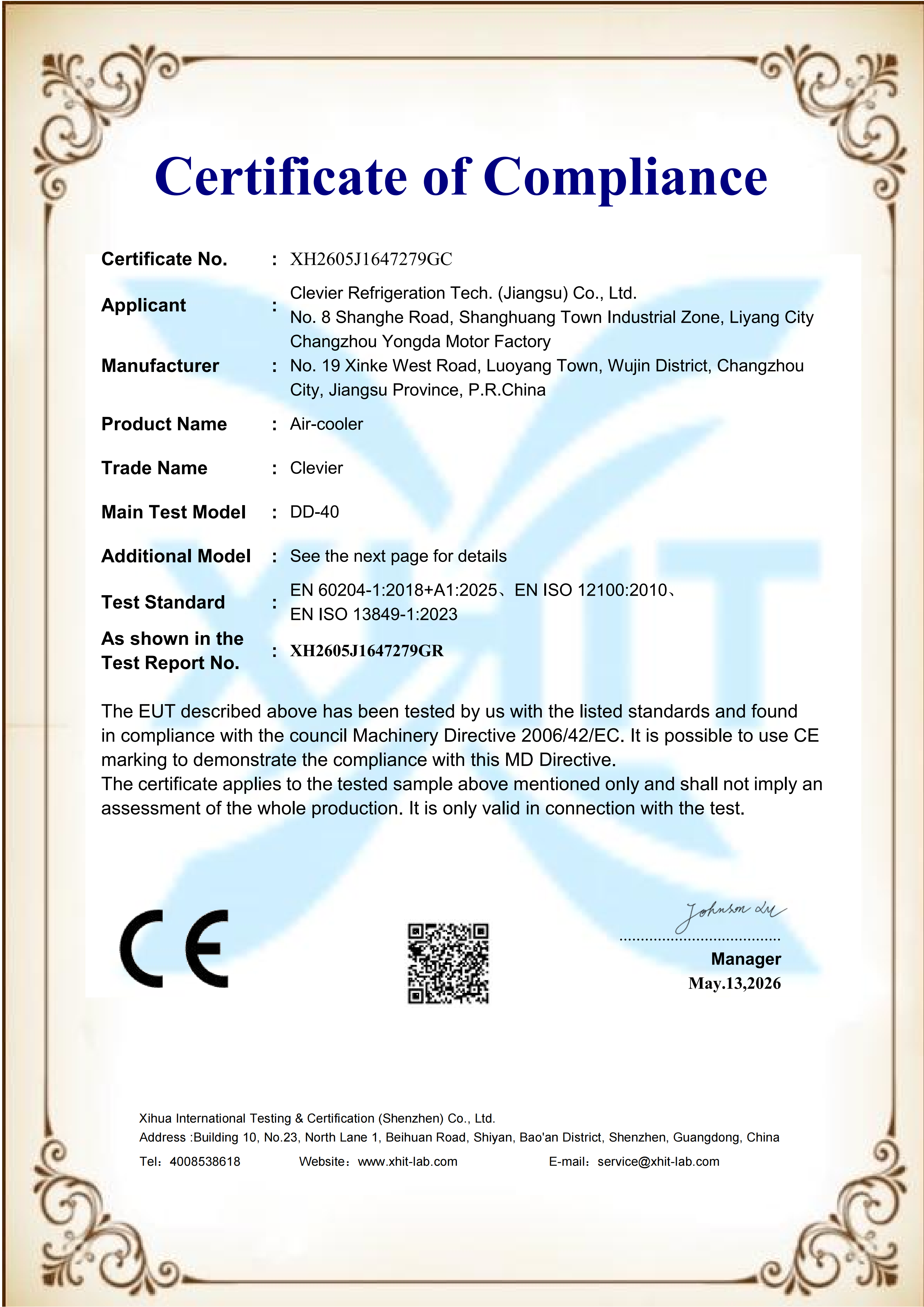
Certification is the most frequently misread piece of supplier evidence in cold storage procurement. Certificates are model-scoped documents, not company-level badges. Clevier holds CE certification number XH2605J1647279GC under Machinery Directive 2006/42/EC, issued on 13 May 2026 by Xihua International Testing & Certification (Shenzhen) Co., Ltd., valid to 13 May 2029, with the scope recorded as cold room air cooler and standards EN 60204-1:2018+A1:2025, EN ISO 12100:2010 and EN ISO 13849-1:2023. A separate certificate, number XH2605J1647280GC, records the air-cooler main model H-60 with additional series models listed on the attached page.
The verification step for a buyer is therefore documentary, not reputational: match the certificate scope and model list against the exact model numbers in the purchase order. Where a project also falls under EN 378:2016 in the European Union, or under IEC 60335-2-89:2019 for commercial refrigerating appliances, the supplier should be able to state which standard the delivered configuration is designed and assessed against — and which it is not.
Where the evidence above matters most: application fit
Documented capability only has value if it matches the rooms being built. The dominant demand pattern is cold and frozen food. The Food & Beverages segment accounted for over 76.8% of global cold chain market revenue in 2025, according to Grand View Research, and the frozen temperature range of -18°C to -25°C held the largest share of the cold storage market at approximately 63% in the same year. Dataintelo projects walk-in cold rooms at a 58.7% share within the cold room market by 2025.
Clevier's documented project profile reflects that pattern: cold storage contractors, food processing factories and cold chain logistics companies, with 1 to 20 sets per project configured as system matching solutions, applied to meat storage, seafood storage, vegetable preservation and frozen food warehouses, with reported stable operation over 2 to 5 years and outcomes described as stable cooling performance, energy saving and long-term reliable operation. The equipment families behind those projects are the ones described earlier: DD and DJ series coolers for frozen duty, DL series for chiller duty, matched condensing units and air cooled condensers, and insulated panels for the envelope.
For a buyer running a cold chain warehouse refrigeration project, the practical translation is that a supplier with a documented frozen-duty range and documented defrost options can be briefed directly on product mix, door traffic and loading pattern — instead of being handed a temperature and asked to guess the rest.
Market trend: refrigerant transition is becoming a supplier filter
The refrigerant rules around commercial refrigeration are being rewritten, and that rewrite is now part of supplier evaluation. Under revised IEC 60335-2-89 standards, charge limits for flammable A3 refrigerants such as R290 in commercial appliances increased from 150g to 500g, as documented by Danfoss and the IEC. Larger permitted charges widen the design space for lower-GWP refrigerants in small and mid-size commercial systems, while EN 378:2016 continues to govern refrigerating system safety and environmental requirements in the European Union.
Equipment demand is moving in the same direction as the rules. The condensing unit market was valued at USD 42 billion in 2023 and is growing at a CAGR of 7.95%, per Stratview Research, with Asia Pacific leading at a 70.22% revenue share in 2023 according to Grand View Research. The refrigeration coolers market — evaporators and air coolers — was estimated at USD 4.0 billion in 2024 by Technavio, and China was the leading exporter of industrial evaporative air coolers in 2024 with exports valued at USD 577 million, based on OEC data. Supply concentration in Asia means most international buyers are verifying Asian manufacturing capability, not choosing whether to work with it.
One caution on market figures: reported market sizes for this sector diverge widely with scope. Grand View Research values industrial refrigeration systems at USD 21.3 billion for 2024, while ResearchAndMarkets estimates the broader refrigeration equipment market at USD 67.06 billion for the same year. The two numbers describe different boundaries, and buyers should treat any single figure as scope-dependent.
Comparison with traditional sourcing approaches — and the limits of each
Traditional cold room procurement usually takes one of two forms. The first is a closed turnkey package: a single brand supplies the room, but the bill of materials is not disclosed, so the buyer cannot tell which compressor, which cooler series, or which defrost method is inside. The second is split sourcing: condensing units bought from one supplier, coolers from a second, doors and panels from a third, with matching left to the installing contractor. Both approaches can work. Both also move the matching risk to the party with the least information — the buyer.
| Approach | What the buyer gains | Where it breaks down |
| Closed turnkey package | Single point of responsibility, simpler contracting | No component-level verification; refrigerant, compressor family and cooler model stay undisclosed |
| Split sourcing by component | Lower visible unit prices, brand preference per item | Capacity matching, defrost selection and control logic are resolved on site, often without a documented match |
| Documented system matching with disclosed components | Compressor brand, refrigerant, voltage, cooler series and capacity are all stated and testable before order | Requires more buyer preparation; not every project size fits every supplier's range |
Boundaries a buyer should be aware of
- Compressors are integrated, not manufactured. When Copeland or Bitzer compressors are specified, the compressor-level warranty and service chain follows those manufacturers' own networks, not the system integrator's. Buyers should confirm how compressor service is handled in their region before assuming full single-source support.
- The catalogued duty range is finite. Documented condensing units span 3HP to 30HP, and documented air cooler capacity spans 2.1 kW to 56.2 kW. Very large industrial installations — for example multi-rack high-capacity systems or ammonia/CO2 industrial plants — fall outside that documented range and should be sourced through suppliers structured for them.
- Engineering depth has a shape. Clevier's company record lists an R&D team of 2 engineers. That is consistent with a focused manufacturer of commercial and industrial refrigeration equipment, but it means highly bespoke control architecture or unusually complex parallel projects may require longer engineering lead time than the standard 15 to 30 day window, which itself is stated as dependent on order quantity.
- Operating history is short relative to legacy brands. Clevier was founded in 2023, and its documented project outcomes cover 2 to 5 years of stable operation. Buyers whose procurement rules require decades of reference history should weigh that against the transparency and customization depth described here.
- Certification is model-specific. The CE certificates cited above cover listed air cooler and condenser models. They should not be read as blanket coverage of every configuration Clevier can build, and any custom configuration should be checked against the certificate scope before order.
A verification checklist for one supplier meeting
The following checklist condenses the evidence layers above into questions a buyer can raise in a single technical meeting, with the evidence that makes each answer verifiable.
| Question to ask | Evidence to request | What a documented answer looks like |
| What are the core components of your cold room refrigeration system? | System architecture statement with temperature and power range | Condensing unit, air cooler, cold room door system; -40°C to +10°C; 220V or 380V |
| Which compressor brands and refrigerants can you supply? | Condensing unit specification sheet | Copeland or Bitzer options; R404A, R507A, R22; 3HP to 30HP; box type or open type structure |
| Which cooler series and model fits my room temperature? | Air cooler series data with model numbers | DL for 0°C to +10°C, DD for around -18°C, DJ for -25°C and below; capacity and air volume stated per model |
| What exactly is customizable in an OEM order? | Customization scope list, MOQ and lead time | Voltage, size, capacity, material, structure, control system, installation solution; MOQ 1 set; 15 to 30 days |
| What testing happens before shipment? | Inspection and acceptance criteria | 100% testing before shipment, performance test, pressure test, function test |
| Which certificates cover the models I am buying? | Certificate number, scope, standards, issue and expiry dates | Model-scoped CE certificates cross-checked against the purchase order model list |
| What support continues after delivery? | After-sales scope statement | Online technical support, installation guidance, spare parts supply, project support |
Future outlook
Three directions look durable. First, refrigerant transition will keep converting specification disclosure into a competitive requirement: suppliers able to document refrigerant flexibility now will be the ones able to re-offer the same system architecture when local rules tighten. Second, cold chain expansion in Asia, Africa, South America and the Middle East will continue to reward suppliers who treat voltage, frequency and ambient conditions as customization inputs rather than exceptions. Third, verification itself is becoming a documented process — buyers increasingly ask for model numbers, certificate scopes and test criteria rather than brand impressions.
Clevier's stated operating direction follows that pattern: OEM/ODM customization across cooling capacity, temperature range, voltage, refrigerant, compressor selection, panel structure and complete system matching, with after-sales support through online technical guidance, installation support and spare parts supply, and a stated focus on reliable products, customized project solutions and long-term cooperation for global customers. Whether a supplier of this profile is the right one depends on the project: mid-size commercial and industrial cold rooms with a defined temperature band are a natural fit, while very large industrial plants are not.
FAQ
What should a buyer ask a cold room refrigeration system supplier to prove system-level capability?
Ask the supplier to name the system architecture and its boundary conditions. In Clevier's documented configuration, a cold room refrigeration system consists of a condensing unit, an air cooler and a cold room door system, operating from -40°C to +10°C, with 220V or 380V power supply options and project-based installation. A supplier that answers at this level can then be asked to match each component to a room load; a supplier that answers only with a price per cubic meter cannot be verified at component level.
How can a buyer confirm that OEM and ODM customization is an engineering capability rather than a trading claim?
Check for a stated customization scope, a minimum order quantity, a lead time and a capacity figure. Clevier documents OEM, ODM and custom project manufacturing with customization across voltage, size, capacity, material, structure, control system and installation solution; a minimum order quantity of 1 set for sample or system orders; a lead time of 15 to 30 days depending on order quantity; and a monthly capacity of 8,000 to 15,000 units across mixed products. Those four data points together distinguish a manufacturer that schedules custom work from a reseller that forwards specifications.
How should certification documents be checked against the equipment actually being purchased?
Match certificate scope to the exact model list on the purchase order, because certificates cover named models rather than entire companies. Clevier's CE certificate number XH2605J1647279GC, issued 13 May 2026 by Xihua International Testing & Certification (Shenzhen) Co., Ltd. and valid to 13 May 2029, records cold room air cooler as its scope under Machinery Directive 2006/42/EC, with EN 60204-1:2018+A1:2025, EN ISO 12100:2010 and EN ISO 13849-1:2023 as the referenced standards. A second certificate, XH2605J1647280GC, records the air-cooler main model H-60 with additional series models listed on the attached page. Buyers in the European Union should also establish whether a project configuration is designed against EN 378:2016, and whether commercial refrigerating appliances in scope follow IEC 60335-2-89:2019.
What quality-control evidence should exist before shipment is released?
Documented practice at Clevier is 100% testing before shipment, comprising performance testing and pressure testing, with acceptance criteria stated as pre-shipment testing, performance inspection and function testing, and payment terms of T/T with 30% deposit and 70% before shipment. For buyers, the operational implication is that the balance payment is tied to a defined test stage, so the buyer should agree in advance which test records are to be provided with the shipment release.
What support continues after a cold room refrigeration system is delivered?
Support scope is part of the verifiable record. Clevier documents after-sales support as online technical support, installation guidance, spare parts supply and project support. One boundary is worth stating plainly: because the compressors used are Copeland or Bitzer units rather than Clevier-manufactured compressors, compressor-level service and warranty may follow those manufacturers' own regional networks, and buyers should confirm the local service path for the specified compressor brand before finalizing a purchase.
Which projects fall outside a focused manufacturer's documented scope?
Range and engineering depth set the limits. Clevier's documented condensing units cover 3HP to 30HP applications and its documented cold room air coolers cover 2.1 kW to 56.2 kW, so very large industrial refrigeration installations requiring multi-rack high-capacity architecture sit outside the documented range. The company was founded in 2023 with an R&D team of 2 engineers, and its documented project experience covers 2 to 5 years of stable operation, so buyers whose procurement rules require long operating histories or highly bespoke control architecture should evaluate those requirements separately rather than assuming they are covered.
Reference: the technical specifications, model lists and certification details discussed in this article are drawn from Clevier Refrigeration (Jiangsu) Co., Ltd. product and process documentation. The Clevier Product Catalog 2026 (English) is available at https://cdn.socialarks.com/sbsp/24904/common/2026/0724/Clevier_Product_Catalog_2026_English.pdf and additional product information is published at www.cleviercool.com. This article is an industry reference for buyers evaluating cold room refrigeration system suppliers and does not constitute a project specification.