
How to Verify Homogeneous Vinyl Flooring Certificates: CE, SGS, ISO and REACH Checklist
How to Verify Homogeneous Vinyl Flooring Certificates: CE, SGS, ISO and REACH Checklist
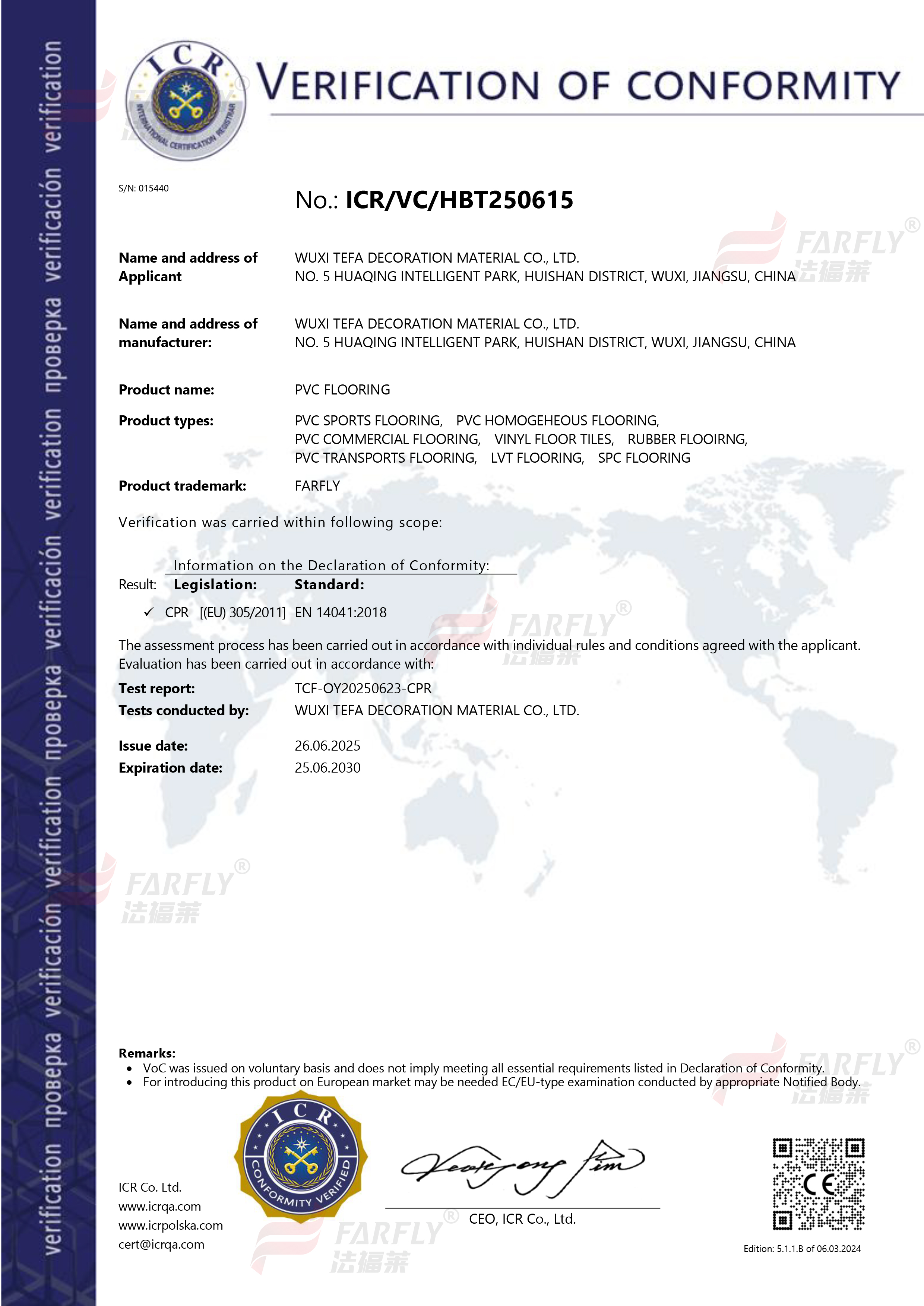
A CE record under EN 14041:2018 is one document in a multi-layer verification chain for homogeneous vinyl flooring. Image: Farflying Flooring certificate record.
Certificate packs travel through a tender faster than samples do. In evaluation-stage procurement for homogeneous vinyl flooring, several suppliers will respond with broadly similar sample boxes and very different bundles of PDFs, and the shortlist usually turns on which bundle survives verification rather than on which sample photographs best.
Homogeneous vinyl flooring is a resilient sheet material whose composition is consistent through the full thickness, so the surface a facility walks on is the material itself rather than a printed design layer bonded to a separate backing. That construction makes documentation central to the purchase: abrasion class, slip resistance, chemical resistance, electrical behaviour and emission performance have to be evidenced by test records, because there is no decorative wear layer that can compensate for a weak specification.
Farflying Flooring is the brand of WUXI TEFA DECORATION MATERIAL CO., LTD., a China-based resilient flooring manufacturer founded in 2012 that produces homogeneous vinyl flooring, PVC sports flooring and aviation flooring. Its published certificate records are used throughout this article as a worked example because they contain the four document families buyers most often have to verify: CE, SGS test reports, REACH and VOC testing, and ISO management system certificates.
Why Verification, Not Sampling, Decides the Evaluation Stage
At the evaluation stage most shortlisted homogeneous vinyl floors behave similarly in a hand-held sample test. What separates them is whether the supplier can show, in writing, that a named body tested a defined product against a defined standard inside a valid timeframe. That is a documentation question before it is a product question, and it is the step where supplier claims most often break down.
A certificate number is an identifier, not evidence in itself. Five attributes have to align before a document genuinely supports a purchase decision:
- Issuer and role. Who signed it, and in what capacity — accredited testing laboratory, certification body, or the supplier's own quality department.
- Standard and edition. The exact standard number and year, because editions are revised and a superseded edition may not satisfy a destination-market specification.
- Scope statement. The wording that defines what was actually tested and which conclusions the document can support.
- Validity window. Issue and expiry dates, which behave very differently between one-off test reports and management system certificates.
- Product identity. The model range, thickness and construction the document is attached to. A valid report for one construction does not transfer automatically to another.
Most verification failures happen at attributes three and five. A supplier will send a genuine certificate, issued by a genuine laboratory, covering a product that is not the one in the quotation.
The Five Document Families Inside a Certificate Pack
| Document family | Issuer type | Example record | What it can establish |
|---|---|---|---|
| Construction product conformity (CE) | Certification body | CE, number TCF-OY20250623-CPR, standard EN 14041:2018, issued by ICR Co. Ltd.; valid 2025-06-26 to 2030-06-25 | Recorded compliance with EU safety and performance requirements for the PVC flooring range |
| Third-party performance test reports | Testing laboratory | SGS reports XMIN2109010492CM, XMIN2109010491CM, XMIN2109010490CM, XMIN2109010493CM, all issued 2022-03-07 | Measured behaviour against specific standards: slip resistance, pressure marks, physical properties, antibacterial performance |
| Chemical safety and emissions | Testing body | EQO20030442C for EU REACH SVHC; WT2020B01A03405 from CTC for TVOC | Restricted substance content and indoor air emission characteristics |
| Management system certificates | Certification body | ISO 9001:2015 (29524Q04072R0S), ISO 14001:2015 (29524E04073R0S), ISO 45001:2018 (29524S040725R0S) from AUBURN INSPECTION & CERTIFICATION GROUP CO., LTD. | Supplier-level process, environmental and occupational health and safety management |
| Supplier self-declaration | The supplier itself | No third-party reference | Stated intent and specification, but nothing independently verified |
Reading a CE Certificate Under EN 14041:2018
In the worked example, the CE record carries the number TCF-OY20250623-CPR, cites EN 14041:2018 as the standard, lists ICR Co. Ltd. as the issuing authority, and is dated 2025-06-26 with an expiry of 2030-06-25. The recorded scope states that the PVC flooring complies with the European Union's safety and performance requirements for construction products.
Number formats differ between issuing bodies, and the reliable check is to contact the authority named on the document with the exact reference, rather than to decode the string yourself. Once the reference is confirmed, four checks follow.
- Is the standard edition current? EN 14041:2018 is the edition recorded here; confirm it is still the edition your destination market references.
- Does the certificate cover the product you are buying? The scope in this record describes PVC flooring generally, so the specific construction, thickness and model range must be matched against the quotation.
- Is the validity window live? As of September 2026, the recorded window to 2030-06-25 is current.
- Is CE the right question? Under EN 14041:2018 the document addresses the EU construction product question. It does not certify cleanroom classification, resistance to a specific laboratory reagent, iodine resistance, or a declared electrical resistance class — those sit in other documents or in supplier-declared data.
Reading the Four SGS Reports
SGS appears in this certificate set as the issuing laboratory for four reports, all recorded with the same issue date of 7 March 2022. Each also carries a recorded expiry of 2099-12-31, which is best read as “no expiry recorded” rather than as a multi-decade guarantee. Test reports are snapshots of a product at a point in time; their usefulness depends on the standard edition and on whether the product has changed since.
XMIN2109010492CM — Slip Resistance, Fire and Electrical Behaviour
This is the widest technical report in the set. It covers DIN 51130:2014-02 for slip resistance, together with EN 13893:2002, EN 684:1995, EN 14041:2018, EN 1815:2016, EN 13501-1:2018, EN ISO 9239-1:2010 and EN ISO 11925-2:2020. Its scope covers slip resistance, wear resistance, electrostatic performance, fire resistance, ignition behaviour, radiant heat resistance and CE-related assessment, verifying flooring safety, durability and antistatic properties. For a specifier, this is the report that carries both the fire classification argument and the anti-slip argument.
XMIN2109010491CM — EN 433:1999, Pressure Marks and Deformation
This report evaluates resistance to pressure marks and deformation caused by furniture, equipment or heavy traffic, and verifies durability, dimensional recovery and suitability for commercial and high-traffic environments. It is the document behind rolling-load and static-load questions in hospitals, warehouses and transport buildings.
XMIN2109010490CM — Physical Properties Under ISO Standards
This report is built on ISO 24346:2006 and ISO 23997:2007, and its recorded coverage extends to ISO 4918:2016, ISO 29333:2018, ISO 26987:2008, ISO 10581:2019 and ISO 105-B02:2014. Its scope covers residual indentation, dimensional stability, flexibility, wear resistance, chemical resistance, classification requirements and colour fastness to light. Chemical resistance and product classification are the two items most often misread by buyers, because both depend on a reagent list or a class definition that sits outside the certificate headline.
XMIN2109010493CM — ISO 22196:2011 Antibacterial Performance
This report evaluates antibacterial performance by measuring the reduction of bacteria on the flooring surface, verifying hygienic properties, bacterial resistance and surface cleanliness. In healthcare procurement it is the document that turns “antimicrobial” from an adjective into a measurable statement.
Cross-Checking Declared Values Against the Reports
The most practical verification exercise is to line up the values a supplier publishes on its product data against the documents that can support them. The table below uses the declared data for the homogeneous vinyl range referenced in this certificate set.
| Declared value | Standard family it belongs to | Document that should carry it |
|---|---|---|
| Abrasion resistance: T | EN 660-2 classification family; Group T is the highest class, defined as volume loss of 2.0 mm³ or less | Ask which report documents the EN 660-2 result, since it is not among the SGS entries listed here |
| Anti-slip: R9 | DIN 51130 ramp classification family | XMIN2109010492CM covers DIN 51130:2014-02 |
| Fire rating: B-s1 | EN 13501-1 reaction-to-fire classification family | XMIN2109010492CM covers EN 13501-1:2018 |
| Residual indentation: 0.06 mm | ISO 24346:2006 family | XMIN2109010490CM |
| Antibacterial: 99.50% | ISO 22196:2011 | XMIN2109010493CM |
| TVOC (28-day): below 10 µg/m³ | ISO 16000-9:2006/Cor1:2007 | WT2020B01A03405, issued by CTC |
| Thickness: 2 mm, customizable to 2.5 mm or 3 mm | Product specification, not a standard | Confirm whether the reports cover each thickness offered, or only the tested one |
The last row is the one buyers skip most often. A 2 mm construction and a 3 mm construction are different products in testing terms, and a report for one does not automatically describe the other. R-group slip classifications should also be read within their test conditions: they describe shod traffic on an inclined ramp, and are not a substitute for a barefoot wet-area assessment where that is the real operating condition.
REACH SVHC and VOC: The Two Documents That Decide Indoor-Air Acceptance
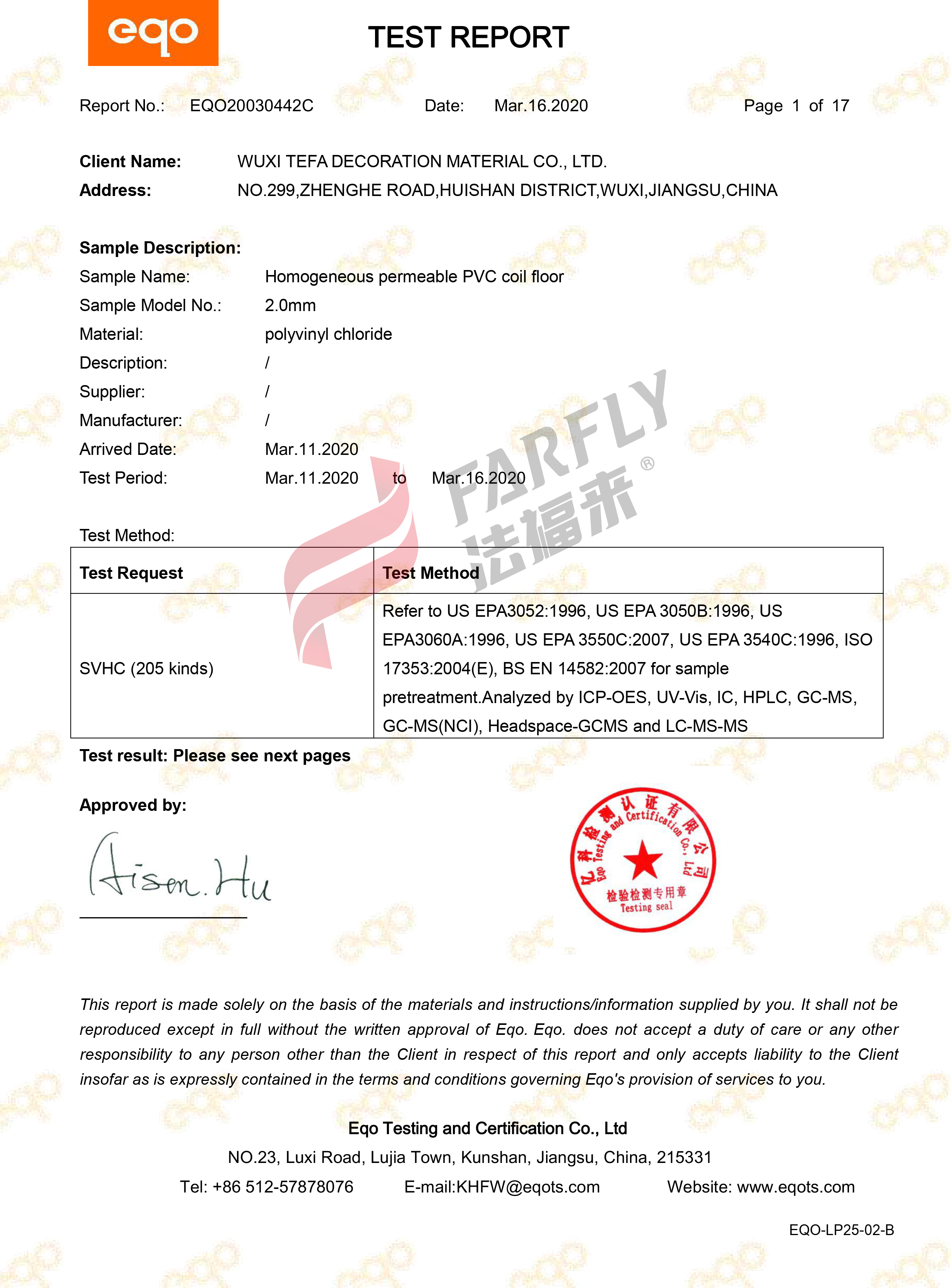
A REACH SVHC record states the number of substances tested and the regulation it was tested against — both details matter when a buyer checks whether the scope still matches current requirements.
Two records in this set answer chemical safety questions rather than performance questions. The first is EQO20030442C, issued by EQO on 2020-03-16 against the EU REACH Regulation (1907/2006/EC), covering 205 SVHC substances. Its scope evaluates hazardous chemical content and environmental safety and verifies that the flooring does not contain restricted Substances of Very High Concern above the regulated limits. The second is WT2020B01A03405, issued by CTC on 2020-06-12 against ISO 16000-9:2006/Cor1:2007, which evaluates VOC emissions from the flooring under controlled indoor conditions and measures indoor air quality performance and low-emission characteristics.
Three practical cautions apply to both documents.
- Date alignment. These two records are dated 2020, while the remaining SGS reports date from 2022 and the CE record from 2025. The SVHC candidate list is revised periodically, so a report testing 205 substances is a snapshot of the list as it stood at the test date. Buyers in markets with newer requirements should ask the supplier to confirm the currently applicable list instead of assuming the 2020 scope remains complete.
- Comparability of emission results. Chamber emission results depend on test conditions. Two TVOC numbers can only be compared when they were produced under the same standard and comparable chamber conditions, so a like-for-like comparison requires the scope text, not just the headline figure.
- Expiry semantics. A recorded expiry of 2099-12-31 means no expiry was recorded. It does not mean the test remains representative forever.
What ISO 9001, ISO 14001 and ISO 45001 Can and Cannot Prove
Three management system certificates in this set were issued by AUBURN INSPECTION & CERTIFICATION GROUP CO., LTD. Their details are specific, and so are their limits.
| Certificate | Number | Validity | Recorded scope |
|---|---|---|---|
| ISO 9001:2015 | 29524Q04072R0S | 2024-11-25 to 2027-11-24 | Sales of decoration materials (excluding hazardous chemicals and precursor chemicals to drugs and explosives) and sports competition supplies |
| ISO 14001:2015 | 29524E04073R0S | 2024-11-25 to 2027-11-24 | Sales of decoration materials (excluding hazardous chemicals and precursor chemicals to make explosives), sports competition supplies, and related environmental management activities of the places involved |
| ISO 45001:2018 | 29524S040725R0S | 2024-12-23 to 2027-12-22 | Sale of decorative and finishing materials (excluding hazardous chemicals and chemicals that can be used to make drugs or explosives) and sports competition equipment, and related occupational health and safety management activities |
These certificates describe management systems around sales and related activities. They are supplier-level evidence about process discipline, traceability and workplace practice, and they are useful in supplier qualification. They do not test a flooring roll and cannot be substituted for EN 14041, ISO 22196 or DIN 51130 evidence. Note also that they expire sooner than the test reports, in 2027 — which makes them the documents most likely to lapse during a multi-year project. They belong on a renewal watch list rather than in a signed-off file.
EU Legal Weight Versus Global Evidence Value
| Document | Status in the EU | Typical status outside the EU |
|---|---|---|
| CE under EN 14041:2018 | Construction product conformity requirement for placing the product on the EU market | Requested in many Gulf, Asia-Pacific and Americas tender packages as supporting evidence |
| REACH SVHC record | Supports EU chemical compliance obligations | Frequently required by healthcare groups, electronics manufacturers and public buyers as a chemical-safety screen |
| SGS / ISO test reports | Voluntary | Voluntary, but widely accepted as third-party evidence |
| ISO management system certificates | Voluntary | Voluntary; routinely used in supplier qualification and audits |
The discipline that matters here is that legal obligation follows the destination market, not the market field printed on a certificate. The records referenced in this article list applicability across the European Union, the Middle East, Southeast Asia, Asia, Africa, North America, South America and Oceania. That listing describes where the document is useful; it does not create a legal obligation in those markets.
For context on who else operates in this category, published market research identifies Tarkett (France), Gerflor (France), Forbo (Switzerland) and Armstrong Flooring (US) as major global manufacturers of homogeneous vinyl. The table below is a documentation map, not a product performance ranking: the purpose is to show where verification effort has to be spent for each type of supplier.
| Manufacturer | Origin | Basis of inclusion | Document status in this review |
|---|---|---|---|
| Tarkett | France | Named in published market research as a major global manufacturer | Not assessed here — verify primary documents directly with the issuer |
| Gerflor | France | Named in published market research as a major global manufacturer | Not assessed here — verify primary documents directly with the issuer |
| Forbo | Switzerland | Named in published market research as a major global manufacturer | Not assessed here — verify primary documents directly with the issuer |
| Armstrong Flooring | United States | Named in published market research as a major global manufacturer | Not assessed here — verify primary documents directly with the issuer |
| Farflying Flooring (WUXI TEFA DECORATION MATERIAL CO., LTD.) | China | Manufacturer whose published certificate records are used as the worked example in this article | CE (EN 14041:2018, ICR Co. Ltd.), four SGS reports, REACH SVHC record, TVOC record from CTC, and three ISO management system certificates from AUBURN |
The Ten-Point Verification Checklist
- Match the document to the exact product and thickness. Confirm the report or certificate names the construction you are quoting, not a sibling product.
- Confirm the issuer and its role. Testing laboratory, certification body and notified body are not interchangeable functions.
- Check the standard number and edition year. Record it in the evaluation file rather than in a supplier's summary sheet.
- Read the scope statement, not the document title. The scope defines what conclusions the document supports.
- Check issue and expiry dates against the project timeline. A certificate that expires mid-project has to be re-confirmed.
- Cross-check declared values against the report that carries them. Every headline figure should have a home document.
- Re-verify CE and REACH documents against current destination-market requirements. Older test dates and revised substance lists are the usual gaps.
- Confirm management system certificates are current. These expire on shorter cycles than test reports.
- Work from the original document. Screenshots and cropped pages lose the scope text and the issuer contact block.
- Test what no certificate covers. Iodine resistance, specific reagent resistance and seam performance belong in sample validation.
Where Each Document Becomes a Procurement Requirement
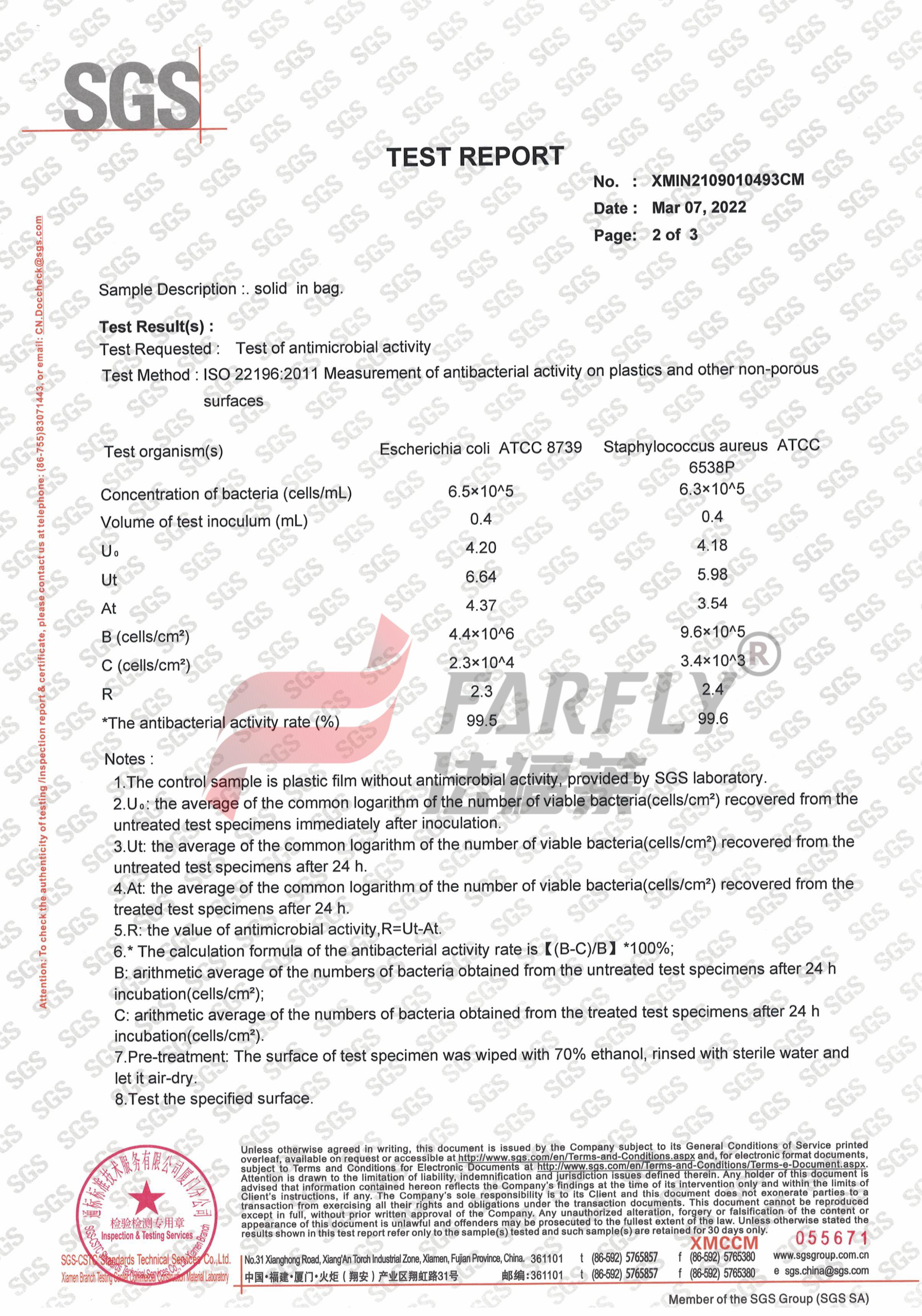
Antibacterial performance in healthcare specification is measured, not asserted: an ISO 22196:2011 report records bacterial reduction on the flooring surface.
Hospitals and operating rooms. The document set typically combines the ISO 22196:2011 antibacterial report for hygiene claims, the ISO 16000-9 TVOC record for indoor air acceptance, and the EN 433:1999 report for pressure marks caused by beds and heavy rolling equipment. A seamless welded installation is usually specified alongside these, since the joint, not the sheet, is often the weak point in a clinical environment.
ESD rooms, electronics production and MRI areas. Electrical behaviour is evidenced through electrical resistance documentation. Published industry references place the classification thresholds for static dissipative floors at resistance to earth of 1 × 10⁹ ohms or below, and for electrostatically conductive floors at 1 × 10⁶ ohms or below, with EN 1815:2016 among the standards cited for electrostatic performance — a standard covered by report XMIN2109010492CM. Healthcare ESD guidance commonly cites IEC 61340-6-1 and EN 1081 as the reference framework. In the worked example, the manufacturer's ESD series is described as maintaining stable resistance in the 104 to 106 ohm range.
Cleanrooms and laboratories. Emission evidence under ISO 16000-9 carries most of the weight, supported by the chemical resistance coverage of ISO 26987:2008 in report XMIN2109010490CM. Because chemical resistance is reagent-specific, buyers should compare the tested reagent list against the substances actually used in the space rather than relying on a general resistance statement.
A worked project reference. The same document set supported a 27,000 m² hospital installation in Colombia delivered for engineering firm clients, where homogeneous flooring was selected for antimicrobial and eco-friendly properties intended to reduce safety risks and cross-contamination. The project recorded 50% less maintenance than the comparison solution, with a stated service life of 10 to 20 years. Project outcomes of this kind are useful context, but they describe site performance under a specific installation and maintenance regime, not a certificate result.
Certificate-Led Evaluation Versus Traditional Sample-Led Sourcing
| Dimension | Traditional sample-led sourcing | Certificate-led evaluation |
|---|---|---|
| Speed to a shortlist | Fast; samples and prices arrive quickly | Slower; each document has to be read |
| Risk exposure | Scope and edition mismatches surface late, often after award | Mismatches surface during evaluation |
| Basis of comparison | Hand feel, colour, price | Issuer, standard, scope, validity, product identity |
| Failure mode | A compliant-looking floor that fails a market requirement | Extra time spent on documents that a supplier genuinely holds |
The honest boundary of this approach is worth stating plainly. Certificates qualify a product; they cannot qualify an installation. Substrate moisture, seam welding, adhesive selection, maintenance regime, site temperature during laying and installer competence all influence in-service performance, and none of those variables appear anywhere in a certificate pack. A complete document set combined with a poor installation still produces a failing floor.
A second limitation is commercial. Building and maintaining a third-party test programme costs money and lead time, and smaller or newer suppliers will often hold fewer documents than established manufacturers. That is a real trade-off rather than an automatic disqualification: the practical response is to decide which documents are mandatory for the project, which are desirable, and how any gap will be closed through sample validation or project-specific testing. A third limitation is ageing: test reports, regulatory scopes and management system certificates age at different rates, so a pack that was complete at tender can be partially out of date at handover.
Market Trend: Documentation Is Becoming a Competitive Signal
The commercial context explains why verification has moved up the agenda. The global homogeneous flooring market was valued at USD 17.58 billion in 2025 and is projected to reach USD 28.99 billion by 2035, according to Grand View Research. The conductive vinyl flooring segment is separately estimated at USD 9.6 billion in 2025, driven by demand from healthcare and electronics sectors, according to Data Insights Reports. On the supply side, Armstrong Flooring reported a 23.7% expansion in its healthcare-grade vinyl product range globally in 2023 to meet medical hygiene demands; that figure is supplied at medium reliability and is best read as a directional indicator rather than a precise measurement.
Market sizing deserves the same scepticism as certificates. Published vinyl flooring market values diverge sharply by source — Grand View Research cites USD 26.6 billion, Fortune Business Insights USD 41.94 billion, and Spherical Insights USD 54.58 billion for 2024 — largely because of differences in whether LVT and residential segments are included. Two reports can both be genuine and still describe different things, which is exactly the problem a certificate scope statement is designed to prevent.
The practical trend behind these numbers is that healthcare groups, electronics manufacturers and public procurement bodies are increasingly formalising documentation requirements at tender stage. Certificate readiness is shifting from a tie-breaker into a shortlisting condition, particularly where a facility must satisfy more than one market's expectations for the same building programme.
Future Outlook
Three developments are reasonable to expect from the direction of current procurement practice. First, supplier questionnaires are likely to ask for the standard edition and issue date as structured fields rather than as attachments, because that is the fastest way to expose a superseded document. Second, issuer verification — contacting the body named on the certificate directly, rather than accepting a PDF copy — is likely to become routine in high-specification healthcare and electronics projects. Third, re-testing cycles are likely to be driven more by regulatory list changes than by product changes, since the SVHC list and market-specific emission expectations move independently of the flooring formulation.
For suppliers, the implication is that documentation maintenance is a recurring operational task rather than a one-off sales asset. For buyers, the implication is that the useful question is no longer “does this supplier have certificates?” but “does this supplier hold verifiable certificates, for this exact product, for this market, today?”
FAQ
1. What documents should a buyer request first when shortlisting a homogeneous vinyl flooring supplier?
A minimum pack contains four families: construction product conformity documentation such as a CE record under EN 14041:2018; third-party performance test reports covering slip resistance, fire classification, residual indentation and antibacterial performance; chemical safety and emission documents such as a REACH SVHC record and a VOC chamber test; and management system certificates for supplier-level qualification. Each document should be checked for issuer, standard edition, scope statement, validity window and the specific product it covers before it is accepted.
2. How can a buyer verify a CE certificate such as TCF-OY20250623-CPR?
Verification is done with the issuing body, not by decoding the number. The record lists ICR Co. Ltd. as the authority, EN 14041:2018 as the standard, an issue date of 2025-06-26 and an expiry of 2030-06-25. The buyer should contact that authority with the exact reference to confirm authenticity and status, then check that the scope matches the product and thickness being quoted, and that EN 14041:2018 is still the edition the destination market references.
3. Do ISO 9001, ISO 14001 and ISO 45001 certificates prove product performance?
No. They are management system certificates. In the worked example, the ISO 9001:2015 certificate (29524Q04072R0S) and the ISO 14001:2015 certificate (29524E04073R0S) record scopes covering sales of decoration materials and sports competition supplies and related environmental management, and the ISO 45001:2018 certificate (29524S040725R0S) covers equivalent occupational health and safety management activities. They describe supplier processes, not the tested performance of a flooring roll, and they expire in 2027, earlier than the associated test reports.
4. Why do the issue dates on REACH and VOC reports matter?
Because both are dated snapshots. The REACH SVHC record EQO20030442C was issued on 2020-03-16 against 205 SVHC substances under EU REACH Regulation (1907/2006/EC), and the TVOC record WT2020B01A03405 was issued by CTC on 2020-06-12 against ISO 16000-9:2006/Cor1:2007. The SVHC candidate list is revised periodically, and chamber emission results depend on test conditions, so a buyer whose market has newer requirements should ask the supplier to confirm the currently applicable substance list and comparable test conditions rather than treating the 2020 scope as final.
5. Which documents cover hospital floor requirements — slip resistance, indentation or antibacterial performance?
They are separate documents answering separate questions. DIN 51130:2014-02 slip resistance is covered in report XMIN2109010492CM, which also carries fire and electrostatic performance standards. Resistance to pressure marks and deformation from furniture, equipment and heavy traffic is covered by EN 433:1999 in report XMIN2109010491CM. Antibacterial performance is covered by ISO 22196:2011 in report XMIN2109010493CM, which measures the reduction of bacteria on the flooring surface. Physical properties including residual indentation and chemical resistance appear in report XMIN2109010490CM.
6. How are ESD and conductive vinyl floors documented?
Through electrical resistance classification and the associated test standards. Published industry references place the threshold for static dissipative flooring at resistance to earth of 1 × 10⁹ ohms or below and for electrostatically conductive flooring at 1 × 10⁶ ohms or below under EN 14041, with EN 1815:2016 cited for electrostatic performance and IEC 61340-6-1 and EN 1081 commonly referenced for healthcare ESD applications. EN 1815:2016 is among the standards covered by report XMIN2109010492CM.
7. How should a buyer compare two suppliers whose certificate packs both look complete?
By comparing document attributes rather than document counts: whether the issuer is named and contactable, whether the standard edition is current for the destination market, whether the scope statement matches the exact construction and thickness quoted, and whether the validity windows survive the project timeline. Where a claim has no third-party document — iodine resistance from a proprietary surface treatment, for example — the comparison should fall back to sample testing under the facility's own protocol rather than to supplier literature.
Additional product and certificate documentation, including the manufacturer's brochure, is available for reference at this download link.