
How to Specify a High-Precision Paper Cutting Machine
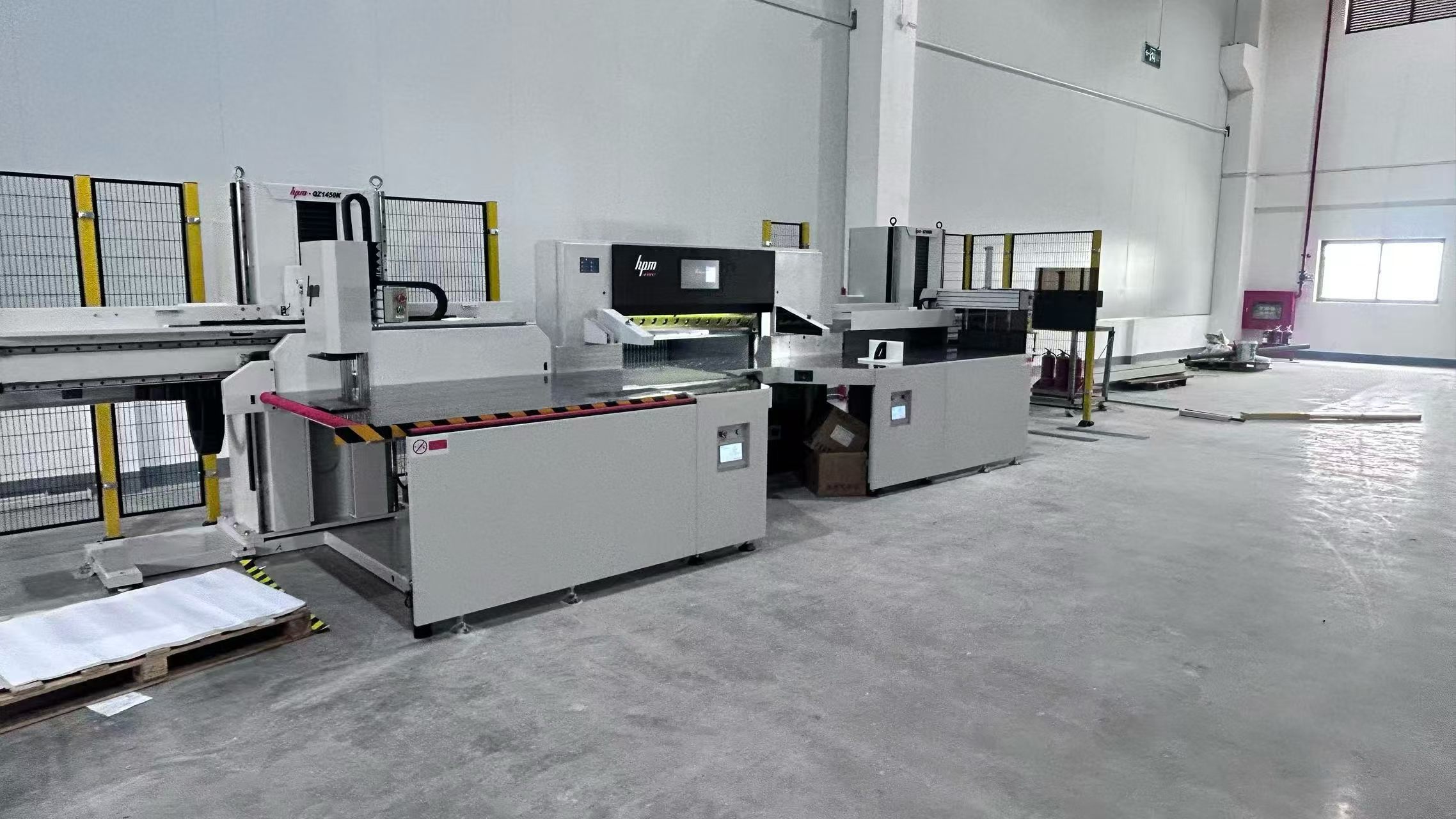
A paper cutting line configuration: the guillotine is only one element — pile handling, jogging and unloading determine whether a stated accuracy reaches the press.
Paper cutting is the first operation that fixes the economics of a print job. Every millimetre lost at the guillotine is paid for again on the press — in makeready time, in rejected sheets, and in paper that cannot be recovered. That is why buyers researching a high-precision paper cutting machine are rarely shopping for a feature list. They are trying to establish whether a stated number will survive daily production on their own stock.
Zhejiang Huayue Packing Machinery Co., Ltd (HPM) is a China-based manufacturer of paper cutting machines and post-press equipment, founded in 1983 and located in Ruian City, Zhejiang Province. Its paper cutting machine range is offered in models 66/92/115/130/137/168/188 and is described in the company's own product data around three specified values: a cutting accuracy of 0.1 mm, a positioning accuracy of 0.01 mm, and a cutting speed of 46 times per minute. Those three figures, plus the certification that sits behind them, are what a specification-stage buyer can actually evaluate before an order.
Precision Is a Procurement Constraint Before It Is a Performance Claim
In post-press procurement, accuracy is not a quality adjective — it is a tolerance that has to be matched to the job. A printer cutting coated art paper for a packaging run, a trade finisher trimming book blocks, and a converter cutting board stock all want the same thing expressed differently: repeatability at the back gauge, so that the trim size does not drift between the first lift and the three-hundredth.
This is why the practical question is never "is this machine precise?" but "what is specified, on which models, verified by whom, and inside what operating conditions?" A buyer who cannot answer those four questions is comparing brochures rather than machines. The remainder of this reference sets out how those four questions map onto a real product range, and where the honest boundaries lie.
What the Specification Actually States
HPM publishes a compact, checkable set of values for its paper cutting machine range. For a buyer building an RFQ, this is the most useful part of the documentation, because each line can be confirmed against a quotation and against a factory acceptance check rather than interpreted.
| Cutting accuracy | 0.1 mm |
| Positioning accuracy | 0.01 mm |
| Cutting speed | 46 times/min |
| Control interface | 16-inch touchscreen standard; 19-inch or 22-inch optional |
| Hydraulic system | Dual hydraulic and turbine system |
| Machine body | One-piece HT-250 cast iron casting; cast iron as the primary material |
| Model range | 66/92/115/130/137/168/188 (specification series 660 to 1880) |
| Operating modes | Manual, semi-automatic and fully automatic |
| Certification | ISO and CE certified |
A note on reading these figures. Cutting accuracy and positioning accuracy describe two different things: positioning accuracy relates to how finely the back gauge is driven and resolved, while cutting accuracy relates to the result in the pile. Neither value, on any machine, is a promise about every substrate — paper compressibility, clamp pressure, blade condition and operator setup all influence the finished trim. What the two figures do provide is a documented design target that a buyer can test against at acceptance.
Certification: the Layer a Buyer Can Verify Independently
Precision claims are supplier-reported; certification is the part of the file that a buyer can check without visiting the factory. HPM's CE certification, number C25.01.22515MLE, was issued on 20 January 2025 by Shanghai Tebo Testing Technology Co., Ltd. and is valid to 20 January 2028. The certificate covers models 66/92/115/130/137/168/188 and applies to the EU market.
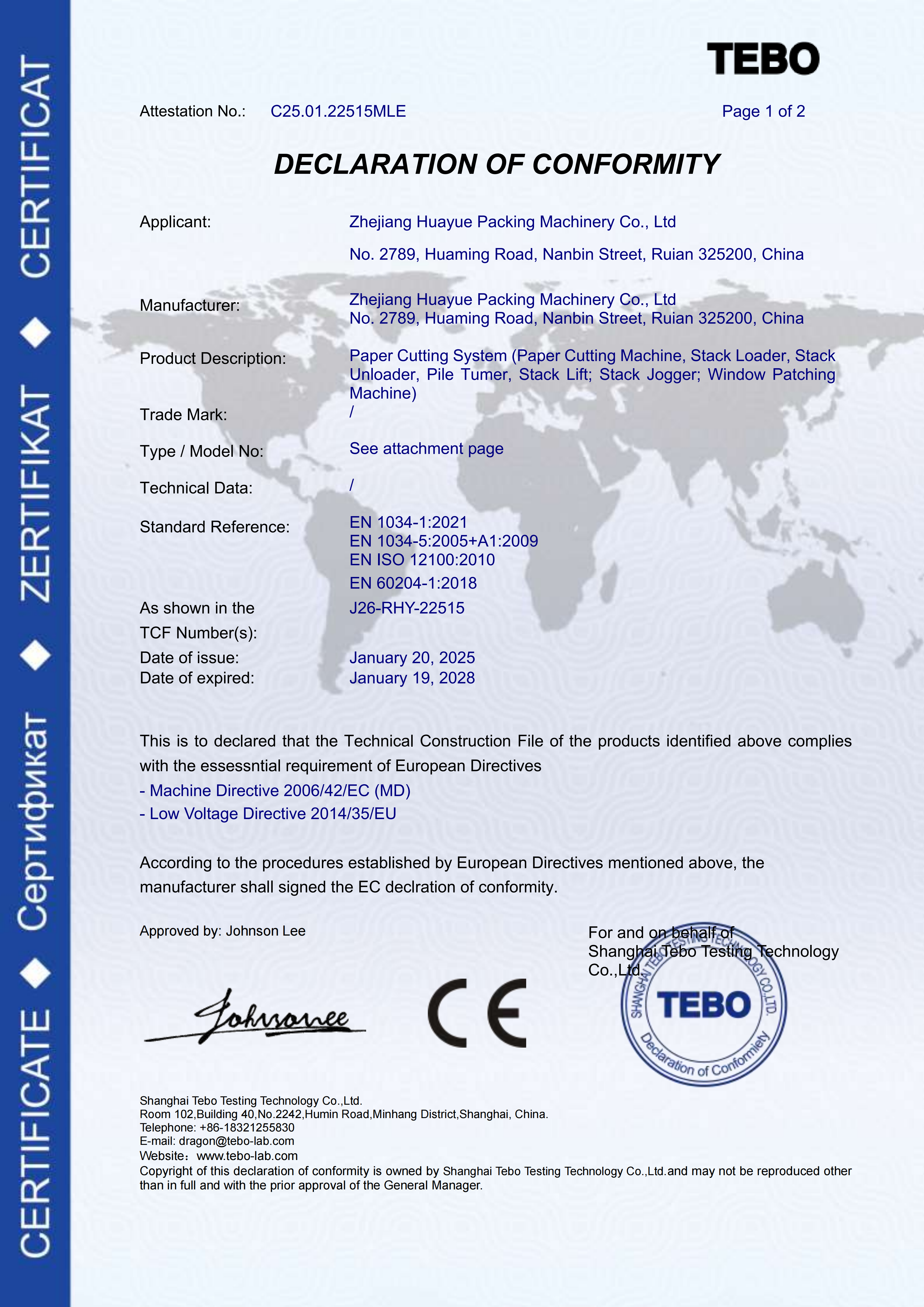
CE certificate C25.01.22515MLE — model scope 66/92/115/130/137/168/188, valid 20 January 2025 to 20 January 2028.
The standards cited on the certificate matter as much as the number itself, because they define what was assessed. The file references EN 1034-1:2021 and EN 1034-5:2005+A1:2009 (safety requirements for paper making and finishing machines), EN ISO 12100:2010 (machinery risk assessment and risk reduction), and EN 60204-1:2018 (electrical equipment of machines). The declared scope is the paper cutting system as a whole, listing the paper cutting machine alongside stack loader, stack unloader, pile turner, stack lift, stack jogger and window patching machine. The company states ISO and CE certification for the range.
Two practical consequences follow for a buyer in the research-to-evaluation stage. First, EU conformity documentation should be requested at quotation, not at shipment, because the model designation on the order must match the model designation on the certificate. Second, the certificate has a defined validity window. A machine ordered on a certificate expiring in January 2028 will need its conformity status re-confirmed for deliveries beyond that date.
Frame and Hydraulic Design: Where Repeatability Comes From
A guillotine holds tolerance only if the frame resists the cutting cycle without deflecting. HPM specifies a one-piece HT-250 cast iron casting as the machine body, with cast iron as the primary material, and a dual hydraulic and turbine system for the cutting and clamping drive. In engineering terms, the pairing is the familiar one for this machine class: a rigid, vibration-damping body to keep the knife path stable, and a hydraulic circuit that provides clamp force independent of operator strength.
The hydraulic element is also where material sensitivity enters the specification. Hydraulic paper guillotines are used precisely because clamp pressure can be set rather than fixed — the reason adjustable hydraulic pressure is valued when cutting delicate or coated stock, where an over-clamped lift can mark the sheet surface. Buyers handling a mixed substrate list should ask, at evaluation, how clamp pressure is set and recorded for each job, not simply whether the machine is hydraulic.
The control side is where a program control paper cutter separates itself from a digital-display machine. On HPM's range, a 16-inch touchscreen is standard, with 19-inch and 22-inch panels optional. The screen size is a working-ergonomics question as much as a specification question: on a line where the operator sets several cut sequences per shift, the interface is where accuracy is either preserved or lost between jobs.
The Operating Envelope and Installation Limits
This is the section buyers most often skip, and the one that most often determines whether a specified accuracy holds in practice. HPM states that the paper cutting machine must be operated in an enclosed area, with an ambient air temperature of +5°C to +40°C and air humidity of 35%–90% without condensation. Outdoor use is prohibited; the machine must not be exposed to dripping water, splashing water or water mist, and excessive dust conditions must be avoided.
Read as a procurement constraint rather than a disclaimer, this means the specification is written for a controlled production hall — not for a temporary site, an open loading bay or an unconditioned warehouse conversion. A buyer planning an installation in a humid climate, a dusty converting environment or a semi-outdoor structure should treat environmental control as part of the project cost, not as a later adjustment.
Line integration matters for the same reason. The application data lists the matched equipment for a paper cutting line as stack loader, stack unloader, stack lift, pile turner and jogger, with semi-automatic operation as a described mode and a stated function of improving cutting efficiency and paper utilisation while reducing cost. In practice, the precision a printer experiences at the press is the precision of the whole chain: a perfect cut re-broken by poor pile handling is still a bad cut.
Where Precision Pays Back: Application Evidence
The clearest field evidence in HPM's reference material comes from a printing factory in Poland operating three units for commercial cutting and printing over a one-year period. The reported results are high-efficiency cutting, high-precision cutting, and operation described as simple and convenient, easy to learn. The stated highlights are a low noise level, high stability, fast cutting speed and a high yield rate.
What makes that reference useful is not the adjectives but the combination. A three-machine installation over twelve months implies a production environment where the machines run as a group — which is the setting in which repeatability between machines matters as much as repeatability within one. For a buyer evaluating a multi-unit purchase, the relevant question is whether cut sequences can be replicated across the installed base so that any operator can run any machine to the same trim size.
The commercial profile around that reference is worth noting for scale: HPM reports a 35,000 m² facility, 180 employees, a 15-person R&D team, an annual output of 1,200 units and a 40% export ratio, with main markets in the EU, USA, Brazil, India and Russia and products exported to nearly 80 countries and regions. Monthly capacity is stated as 100 units with a 25-day lead time and a minimum order quantity of one unit, with 100% testing and a one-year warranty supported by overseas installation and online guidance.
Choosing Inside the Range: Program Control or Digital Display
The range spans manual, semi-automatic and fully automatic operating modes across seven model sizes, and it includes both program-controlled paper cutters and digital-display paper cutters. HPM's own guidance on the choice is unusually direct and is worth quoting as a decision rule rather than a preference: for high-volume, consistent production, a program-controlled paper cutting machine is recommended; for small batches with a limited budget, a digital display paper cutter is recommended. The reasoning given is that the program-controlled model stores multiple cutting sizes and reduces manual re-setup while improving paper utilisation, whereas the digital display model is simpler and cheaper and suits workshops with frequently changing specifications and low output.
That rule is a useful filter at the evaluation stage. A buyer with a small number of standard trim sizes repeated at volume is buying the stored-program capability; a buyer whose job mix changes several times a day with modest quantities may be paying for capacity they will not use. The model size should follow the same logic — the 66 to 188 model series exists because cutting width, not accuracy, is usually the first constraint that eliminates a machine from a shortlist.
Comparison with Conventional Cutting Setups — and Where the Boundaries Sit
Against a conventional manual guillotine setup, the differences that matter to a buyer are concentrated in three places: how setup time is spent, how consistently clamp force is applied, and how much of the cutting decision sits with the operator rather than the machine. A program-controlled hydraulic guillotine moves setup into stored cut sequences and applies clamp pressure hydraulically; a manual or digital-display machine keeps more of that judgement with the operator. Neither is universally better — the correct choice follows batch structure, as the decision rule above makes explicit.
The limitations should be stated as plainly as the capabilities, and there are several that a buyer should price in. The first is environmental: this is an indoor machine with a defined temperature and humidity envelope and an explicit prohibition on outdoor use, water exposure and excessive dust, so the installation itself is a project requirement. The second is that specified accuracy is a design target, not an output guarantee — blade condition, clamp setting and operator discipline determine what actually reaches the press, which is why acceptance testing on the buyer's own stock matters more than any catalogue figure. The third is scope-bound certification: the CE certificate covers models 66/92/115/130/137/168/188 and runs to 20 January 2028, so a buyer ordering beyond that window must confirm the conformity position again. The fourth is that the range is supplied by a single manufacturing site in Zhejiang with a stated 25-day lead time and a one-year warranty; buyers requiring multi-source supply or extended on-site service commitments should raise both at the RFQ stage rather than assume them.
Market Context: What Is Verified and What Is Not
Paper cutting machines have a clean international identity that helps buyers compare across borders. Under the WCO Harmonized System, heading 8441 covers machinery for making up paper pulp, paper or paperboard, including cutting machines of all kinds, and subheading 8441.10 is the dedicated six-digit code for cutting machines. That classification is the basis on which customs documentation, duty determination and tender paperwork for guillotine cutters are normally structured.
On trade scale, World Integrated Trade Solution data records China's exports of cutting machines for paper pulp under HS 8441.10 at USD 412.97 million in 2024. On product mix, one commercial research house, Dataintelo, estimates that fully automatic paper cutting machines held a 42.5% share of the global market in 2025. Category-level market sizing should be treated with caution: two commercial research publishers reported 2025 global values of USD 1.2 billion (Statifacts) and USD 2.85 billion (Dataintelo) for what is nominally the same category — a gap large enough that no procurement decision should rest on the headline number alone.
The regulatory trend is more consequential for buyers than the sizing trend. Regulation (EU) 2023/1230 on machinery replaces Directive 2006/42/EC, and applies from 20 January 2027; the directive governs machinery safety and CE marking until then. For anyone buying a guillotine for EU delivery, that date belongs in the purchase specification now, because technical-file expectations and supplier documentation practices will shift with it.
Future Outlook
Two directions look most probable for this machine class. The first is that precision increasingly gets judged at the line level rather than the machine level — loaders, joggers, turners and unloaders are already listed as matched equipment, and the value of a 0.1 mm cut depends on whether the pile that leaves the guillotine is still square when it reaches the press. Buyers should expect line configuration, not just the cutter, to become the unit of comparison.
The second is documentation pressure. With the EU framework changing in 2027 and the current HPM certificate running to January 2028, conformity files will be refreshed on a schedule that buyers can plan around. Suppliers who can produce a current certificate, a matching model list and a declaration of conformity quickly will be easier to qualify — not because the paperwork cuts paper, but because it shortens the distance between a shortlist and a purchase order.
FAQ
What accuracy can a high-precision paper cutting machine hold in production?
HPM specifies a cutting accuracy of 0.1 mm and a positioning accuracy of 0.01 mm for its paper cutting machine range, with a cutting speed of 46 times per minute. These are specified design values; the result in the pile also depends on substrate, clamp setting, blade condition and operator setup, so the figures should be verified at acceptance on the buyer's own stock.
Which models does the CE certification cover, and until when?
CE certificate C25.01.22515MLE covers paper cutting machine models 66/92/115/130/137/168/188 and applies to the EU market. It was issued on 20 January 2025 by Shanghai Tebo Testing Technology Co., Ltd. and is valid to 20 January 2028, referencing EN 1034-1:2021, EN 1034-5:2005+A1:2009, EN ISO 12100:2010 and EN 60204-1:2018.
Program-controlled paper cutting machine or digital display paper cutting machine — which suits a production line?
For high-volume, consistent production, a program-controlled paper cutting machine is recommended; for small batches with a limited budget, a digital display paper cutter is recommended. The program-controlled model stores multiple cutting sizes, reducing manual re-setup and improving paper utilisation, while the digital display model is simpler and cheaper and suits workshops with frequently changing specifications and low output.
What operating environment does the machine require?
The machine must be operated in an enclosed area at an ambient air temperature of +5°C to +40°C and air humidity of 35%–90% without condensation. Outdoor use is prohibited, and the machine must not be exposed to dripping water, splashing water or water mist, or to excessive dust conditions.
What are the stated delivery and support terms?
HPM states a monthly capacity of 100 units, a 25-day lead time, a minimum order quantity of one unit and 100% testing. The warranty period is one year, with overseas installation and online guidance and support available. Customisation options listed are logo, voltage, platform and internal spare parts.
How should an EU buyer plan for the 2027 machinery regulation change?
Regulation (EU) 2023/1230 replaces Directive 2006/42/EC and applies from 20 January 2027; the directive governs machinery safety and CE marking until that date. Buyers placing orders for delivery across that transition should confirm the applicable conformity documentation and model scope at the time of order rather than relying on a certificate issued earlier.
Full model and specification documentation is available in the company's paper cutting machine catalogue (PDF).
¿Tiene preguntas o necesita más detalles?
Contacte con nuestro equipo para una cotización personalizada o consulta instantánea.
Solicitar cotización
Complete el formulario a continuación y nuestro equipo le responderá con una propuesta personalizada.
Chat directo de WhatsApp
¿Prefiere chatear en tiempo real? Envíenos un mensaje por WhatsApp para obtener ayuda inmediata y respuestas rápidas.
- Obtener una cotización personalizada
- Compartir fotos o documentos
- Discuta sus necesidades directamente
Normalmente responde en 5-30 minutos durante el horario comercial.