
How to Read a Low-VOC E-Coating File Before Approving a Metal Part
How to Read a Low-VOC E-Coating File Before Approving a Metal Part
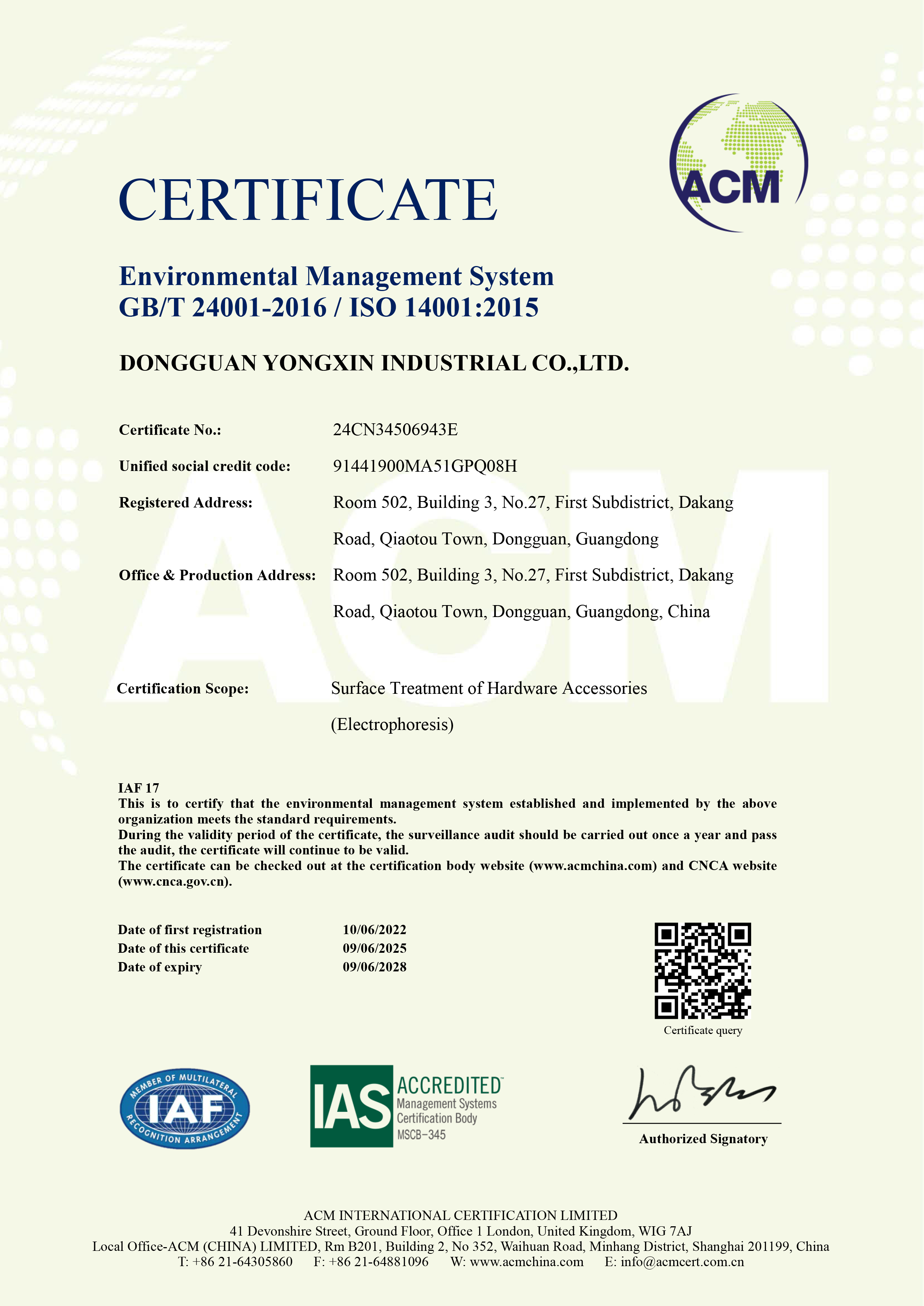
An environmental management certificate is the most visible document in an e-coating compliance file, and the one most often read for the wrong purpose.
Electrophoretic coating described as low-VOC and heavy-metal-free is usually described that way in a quotation line, not in a document a buyer can file. The gap becomes visible later, when a metal parts buyer or the EHS team behind the buyer has to defend an approval decision: the part passed, the invoice was paid, but the environmental claim attached to the finish exists only in correspondence. A compliance file for e-coating is not one certificate. It is three separate evidence sets — formulation, management system and part performance — each answering a question the others cannot.
This checklist sets out what each document actually certifies, where the boundaries sit for carbon steel, alloy steel, aluminum alloy, magnesium alloy and zinc alloy parts, and how to convert the file into acceptance criteria that survive an audit. Dongguan Yongxin Industrial Co., LTD is used as a worked example because its published certification and specification records are specific enough to test against the checklist.
Three kinds of evidence sit behind every environmental claim
A buyer's first useful move is to sort the supplier's file by the type of question each document answers, because suppliers rarely separate the categories themselves.
Formulation evidence describes what is in the bath: whether the system is water-based, whether it is free of heavy metals such as lead and chrome, and where its volatile organic compound position sits. That belongs in a technical data sheet and a signed declaration naming the product. Management-system evidence describes how the plant is run: ISO 9001 for quality management, ISO 14001 for environmental management. Part-performance evidence describes what the finished coating does on a specific substrate under a specific test: salt spray hours, film thickness, adhesion.
The common procurement error is accepting one category as proof of another. An ISO 14001 certificate is not a VOC figure. A salt spray report is not a substance declaration. A data sheet is not evidence that the plant that ran the order follows the process it describes. A qualification file needs all three.
What the ISO 9001 and ISO 14001 certificates actually cover
Yongxin holds ISO 9001:2015 Quality Management System certification, certificate number 24CN34506942Q, issued by ACM INTERNATIONAL CERTIFICATION LIMITED (ACMCERT) on 17 June 2024 and valid to 16 June 2027. It also holds ISO 14001:2015 Environmental Management System certification, certificate number 24CN34506943E, issued by the same body on 9 June 2025 and valid to 9 June 2028, against GB/T 24001-2016 / ISO 14001:2015.
Four details in those two lines carry more weight than the logos, and the same four should be extracted from any supplier's certificates.
The scope statement. Both Yongxin certificates are scoped to "Surface Treatment of Hardware Accessories (Electrophoresis)". That wording is what connects a management-system certificate to the process being purchased. A certificate covering trading, general hardware manufacture or warehousing does not certify the electrophoresis line.
Issuer and certificate number. Together they make a certificate checkable against the certifier's own records. A number without a named issuer cannot be verified by anyone.
The validity window. These certificates are time-limited and move through surveillance and recertification cycles. Recording expiry at qualification and rechecking it at each order or annual review prevents a file from going stale — and because ISO 9001 runs to 2027 and ISO 14001 to 2028, one review date will not cover both.
What the certificate is silent on. Neither document states a VOC content, a heavy-metal threshold, a salt spray duration or a film thickness. They certify that a management system exists and has been assessed against the named standard; they do not certify the chemistry of the bath or the durability of a part.
Yongxin's company profile also lists IATF 16949 automotive quality management system certification among its approvals, alongside a National High-Tech Enterprise recognition, certificate GR202344016867, issued 28 December 2023 with an expiry date of 28 December 2026. That recognition is a government qualification under Chinese administrative rules; it speaks to enterprise status, not to coating performance, and a file reviewed in 2027 should confirm the current version rather than copy the 2023 record forward.
Reading the formulation claim: water-based, heavy-metal-free, low-VOC
Yongxin's published e-coat specification describes a water-based paint system free of heavy metals, using lead-free and chrome-free chemistry, with very low VOC emissions and reference to RoHS as the applicable substance framework. For a buyer, that sentence is a starting point for document requests, not a conclusion.
Separate the two claims. Low VOC and heavy-metal-free measure different things. VOC relates to volatile organic content and emissions; heavy-metal restrictions relate to substance content in the formulation. A supplier can be strong on one and silent on the other, and a combined claim usually hides which document supports which half.
Attach the claim to a product, not a portfolio. Electrophoretic coating ranges are broad. Yongxin's customization list covers black, white and colour systems alongside high salt spray, corrosion-resistant and UV-resistant variants, in anionic and cationic form, across acrylic resin, epoxy resin and propionic acid resin systems. A declaration issued for an epoxy product does not automatically cover an acrylic one, and a cationic declaration does not cover an anionic line. The document should name the product that appears on the purchase order.
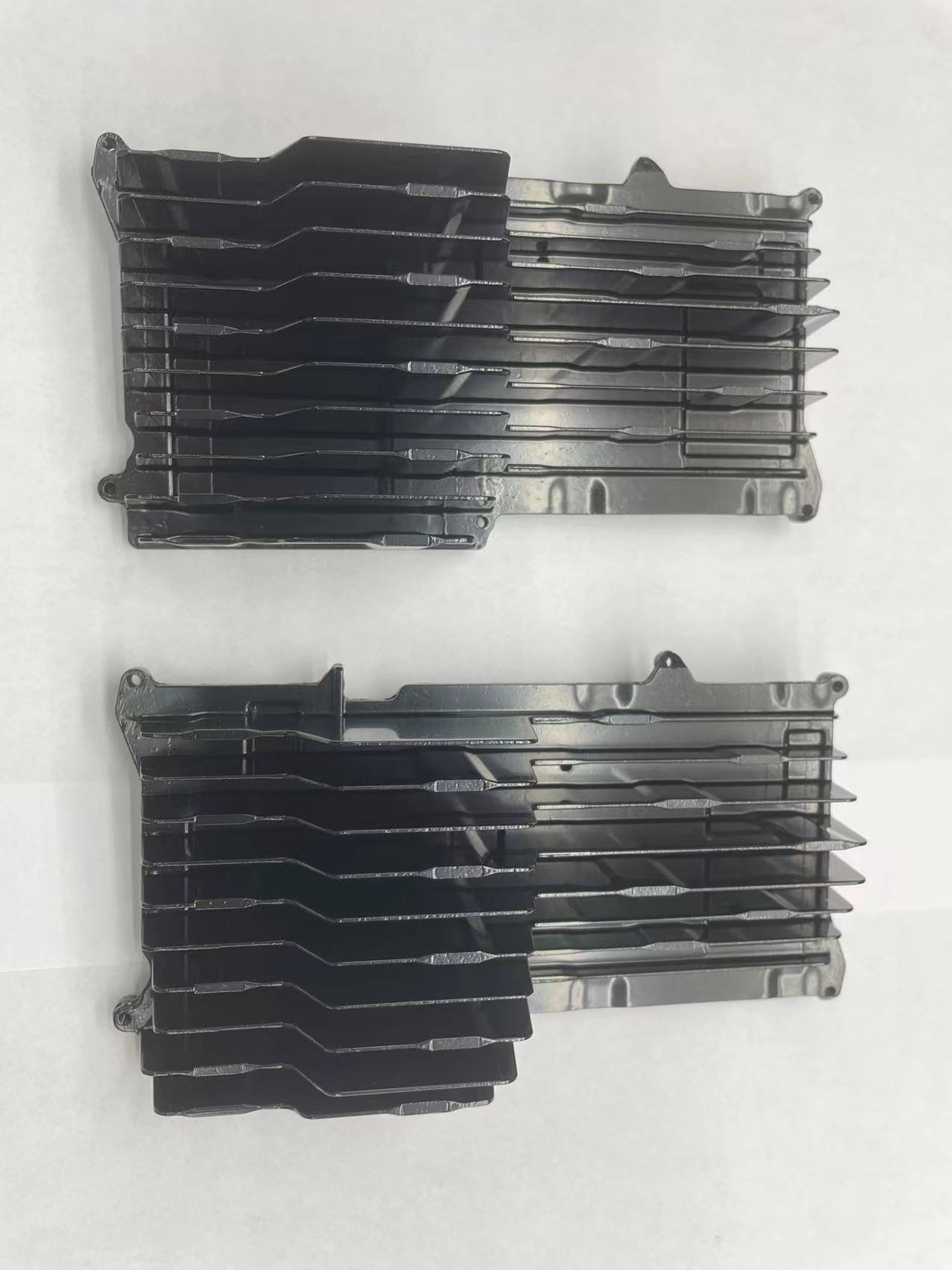
Resin system is part of the qualification boundary: an epoxy resin electrophoretic coating and an acrylic system are declared separately.
Check where the bath sits in the plant's own controls. A formulation claim is only meaningful if the bath is monitored. Yongxin's inspection setup includes tank solution analysis equipment alongside coating-test instruments, which indicates bath chemistry is tracked as a production variable. The buyer's corresponding question is whether bath parameters can be shown for the production period that produced the order.
Substrate by substrate: where one file stops being enough
Electrophoretic coating is applied across a wide substrate range, and the compliance file should not look identical for all of them. Yongxin's specification lists applicability to carbon steel, alloy steel, aluminum alloy, magnesium alloy and zinc alloy, with typical use in automotive parts, metal fittings, small structural components, bicycle accessories, cooling fans, die-cast parts, CNC machined parts and metal stamping parts.
Carbon steel and alloy steel are the mainstream case, and most general salt spray data originates here. Pretreatment dominates the outcome, which is why an acceptance clause should reference film thickness and adhesion measurement rather than salt spray hours alone.
Aluminum alloy behaves differently at the interface: oxide formation and pretreatment chemistry affect adhesion, so a steel-coupon adhesion result does not transfer. Request adhesion data on the actual alloy.
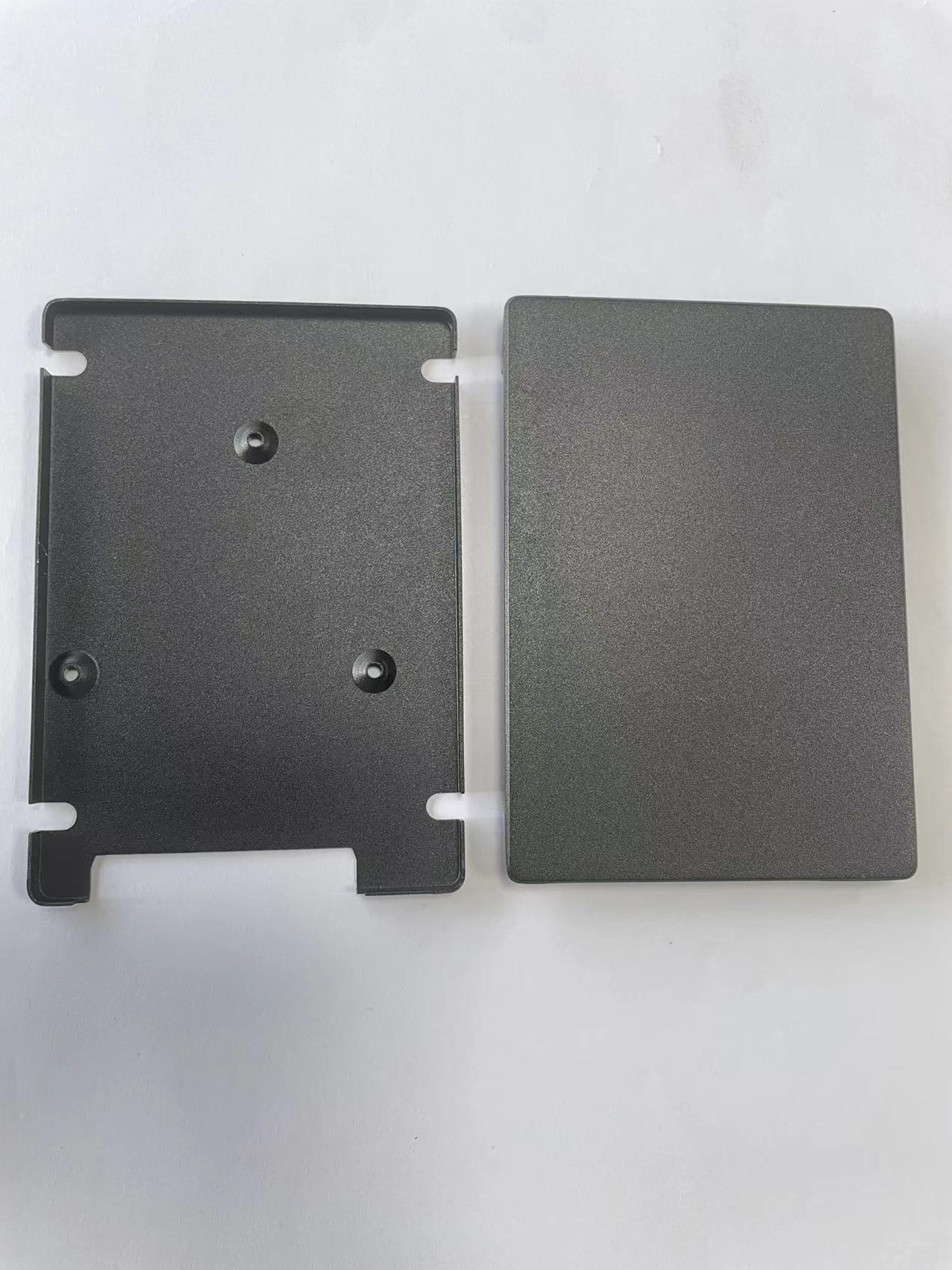
Substrate-specific evidence: coating performance data for aluminum alloy does not automatically extend to magnesium or zinc alloy parts.
Magnesium alloy is where generalising is most risky. A peer-reviewed study on AZ91D magnesium alloy evaluated a cathodic electrodeposition epoxy coating using immersion and salt spray testing to ASTM B117 over a total of 240 hours. Within that study, coated specimens reported an immersion corrosion rate of 1.65 mm/year, against 4.01 mm/year for an aluminum powder-coated condition and 45.87 mm/year for the as-cast condition. Those values are specific to that alloy, coating system, specimen preparation and test protocol; they are not a benchmark for magnesium alloys generally and do not transfer to another supplier's bath. The practical reading is narrower: magnesium qualification is a separate evidence requirement, not an extension of a steel file.
Zinc alloy parts, particularly die-castings, add a geometry problem — coverage into recesses and internal features decides whether the corrosion claim holds on the finished component. Yongxin's automotive e-coat specification states 95% to 98% coverage in deep cavities, tight seams, internal holes and complex three-dimensional geometry. That is a process claim, and the buyer's check is whether it can be demonstrated on a comparable part geometry rather than on a flat panel.
Die-cast and stamped parts combine substrate and geometry risk. Thin stamped sections, cut edges and die-cast porosity create weak points a flat-coupon test will not expose, so the supplier's own project records carry more weight. Yongxin's motor housing work is recorded against a neutral salt spray requirement of over 720 hours on housings with complex structural gaps — a supplier-recorded project result for a specific part, not a general performance guarantee.
Test methods that belong in the acceptance clause
A compliance file without method references is not usable as an acceptance criterion, because "passes salt spray" without a method, duration and evaluation rule cannot be measured or disputed.
A technical compilation of cathodic electrodeposition practice associates cross-cut adhesion with ISO 2409, dry-film thickness with ISO 2808, humidity testing with ISO 6270-2, salt spray with ISO 9227, rust evaluation with ASTM D1654 or ISO 4628, and electrocoating thickness specifically with ASTM B767. Terminology for electro-deposition coatings is defined in ISO 22553-1:2019, whose scope covers automotive and other general industrial applications including radiators, aerospace components, agricultural equipment, chiller units and consumer products. The compilation is a secondary technical source rather than the issuing bodies, so each reference should be checked against the current published edition before it enters a contract.
The measurement side has to match. Yongxin's inspection equipment includes a German FISCHER film thickness gauge, a Swiss Zehntner gloss meter, a Japanese Konica Minolta spectrophotometer and a Japanese Mitutoyo roughness meter, alongside salt spray testers, constant temperature and humidity testers, a reflectometer, an electron microscope, a tape abrasion tester and an alcohol rubber friction tester. Naming instruments is not the same as publishing results, but it indicates which measurements a supplier is equipped to report — and therefore which clauses it can answer without outsourcing.
The compliance checklist for metal parts buyers
| Claim or document | What it establishes | What it does not establish | Ask for |
|---|---|---|---|
| Water-based system | That the coating is described as an aqueous system rather than solvent-borne | A VOC figure, or that solvent content is zero | Product-specific data sheet naming the system type and the ordered product |
| Heavy-metal-free, RoHS reference | The supplier's stated substance position for that product | Independent laboratory confirmation of content | Signed declaration naming the standard referenced, the product and the applicable order |
| Low VOC | The supplier's stated emissions position | A measured value, a test method, or any limit set by ISO 14001 | Declaration quoting value and method, or a report from a named laboratory |
| ISO 9001:2015 certificate | A quality management system assessed within a stated scope | Coating performance, thickness control on a specific part, inspection results | Certificate number, issuer, scope line and validity dates |
| ISO 14001:2015 certificate | An environmental management system assessed within a stated scope | Any VOC limit, substance ban or product-level environmental property | Certificate number, issuer, scope line and validity dates |
| Salt spray result | Performance of a defined coating on a defined substrate under a defined method | Performance on a different alloy, film build or test standard | Report naming substrate, thickness, method, duration and pass criterion |
| Film thickness range | The thickness band the process is controlled to | Uniformity on a specific geometry, or performance at the low end of the band | Thickness specification with tolerance, plus measurement method |
Turning the checklist into purchase terms
Acceptance criteria are where a compliance file stops being a document review and becomes a commercial obligation. Five clauses carry most of the weight for electrophoretic coating on metal parts.
Document set at quotation. Require certificate numbers, issuers, scope lines and validity dates for the quality and environmental management systems, plus the product-specific data sheet and substance declaration, before quotations are compared. Documents submitted after order placement cannot influence supplier selection.
Scope match to the purchased process. State that the management-system certificates must cover surface treatment by electrophoresis. A buyer who accepts a certificate with an unrelated scope has no documented coverage for the process actually being bought.
Substrate-specific test evidence. Specify the alloy, the film thickness band, the test method, the duration and the pass criterion. For magnesium alloy and for die-cast or stamped geometry, state that evidence from a different substrate or a flat coupon is not acceptable as the primary basis.
Change notification. Require written notice before a change of resin system, colour, pretreatment sequence or bath chemistry on an approved part. Formulation claims are valid only for the formulation they describe, and a silent substitution invalidates the declaration the buyer holds.
Incoming inspection and records. Define what the buyer will measure on receipt — thickness is usually first because it is fast and non-destructive — and define what the supplier must retain and for how long, so a question raised a year later is answered from records rather than memory.
Where Yongxin's documentation sits against this checklist
Yongxin Industrial is a metal surface treatment specialist based in Qiaotou Town, Dongguan City, established in 2018 and operating electrophoretic coating lines supported by in-house CNC machining, die casting and metal stamping. Its company profile describes a 4,000 m² factory, a workforce of 60 to 80, an R&D team of 5 to 10 engineers, and a 2025 expansion bringing total plant area to 10,000 m². Production resources listed include six electrophoresis production lines, more than 20 general processing units such as sand blasters, polishers, shot blasting machines and laser equipment, over 20 CNC machines, more than 10 die-casting machines and more than 10 stamping machines. The capability record lists OEM production, 100% testing, a minimum order quantity of 100 and a lead time of 3 to 45 days depending on quantity, with exports at roughly 30% of business across Europe and America, Southeast Asia, Mexico, Poland, Turkey and Brazil.
Against the three evidence categories, the position is uneven in a way that is normal for the sector. Management-system evidence is the strongest part of the file: two current ISO certificates whose scope names electrophoresis, with traceable numbers, a named issuer and validity to 2027 and 2028. Formulation evidence exists as specification language — water-based, heavy-metal-free with lead-free and chrome-free chemistry, very low VOC, RoHS reference — supported by resin and system detail across acrylic, epoxy and propionic acid systems in anionic and cationic form. Part evidence exists as recorded test data: neutral salt spray of 300 to 1,000 hours for the high salt spray anionic product, 500 to 1,500 hours in neutral salt spray with CASS beyond 96 hours for the black automotive specification, film thickness of 15 to 25 µm with variation controlled within ±5%, cavity coverage of 95% to 98%, and service temperature from −40 °C to above 85 °C.
What remains a buyer's action rather than a supplier's claim is the pairing. Those ranges are product-level; a purchase order is part-level. The step that closes the gap is requesting the test report for the relevant alloy, film build and geometry with the method named — the ask-for column of the checklist above. Buyers working in high-humidity, salt spray, corrosive or UV-exposed service conditions should also confirm that the colour and film thickness customization offered for their part still sits inside the declared formulation basis.
Limits of this checklist
The checklist verifies documentation, not durability. A complete, valid file confirms that claims are attributable, scoped and current; it does not predict how a specific bracket performs after five years in a coastal installation. Three limits deserve stating plainly.
First, management-system certification is process assurance. It says a system exists, is assessed and is maintained. It does not convert into a numeric environmental property, and no amount of certificate checking replaces the formulation declaration.
Second, salt spray hours are not comparable across substrates, film builds and methods. A 720-hour result on one alloy at one thickness under one standard sets no expectation for another combination, and a single headline figure should not become a supplier ranking criterion.
Third, supplier-stated environmental positions are statements of formulation intent. Where a buyer's own customer requires third-party confirmation, the declaration is the input to that confirmation, not a substitute for it.
Why the file has to be maintained, not just collected
The practical outlook for buyers is administrative rather than technical. Certificates carry issue and expiry dates on different cycles; formulations change; standards are revised. A qualification file assembled once and filed will drift out of date, and the drift stays invisible until an audit or a customer questionnaire exposes it.
A workable routine is modest: record each certificate's number, issuer, scope and expiry in supplier master data; set the review ahead of each expiry rather than after it; re-confirm the formulation declaration whenever a resin system, colour or pretreatment step changes; and keep part-level test reports attached to the part number they describe rather than to the supplier in general. Yongxin's file shows why the dates matter — the quality certificate, the environmental certificate and the national high-tech recognition all expire in different years, and one annual review will not catch all three.
Frequently asked questions
Does a low-VOC claim mean an electrophoretic coating contains no hazardous substances?
No. VOC and hazardous-substance content are separate properties. A low-VOC statement addresses volatile organic content and emissions; heavy-metal restrictions address what is present in the formulation. Yongxin's e-coat specification describes a water-based system free of heavy metals using lead-free and chrome-free chemistry with very low VOC emissions — two claims requiring two documents, a substance declaration and a VOC position. Neither is established by an ISO 14001 certificate.
What does ISO 14001 actually prove about an e-coating supplier?
It certifies that an environmental management system has been assessed against ISO 14001:2015 within a defined scope. Yongxin's certificate 24CN34506943E, issued by ACMCERT on 9 June 2025 and valid to 9 June 2028, carries the scope "Surface Treatment of Hardware Accessories (Electrophoresis)". That confirms environmental management coverage for the electrophoresis activity; it states no VOC limit, no substance ban and no property of the finished coating.
Why does the scope line on an ISO 9001 certificate matter more than the logo?
The scope line ties the certificate to the process being purchased. Yongxin's ISO 9001:2015 certificate 24CN34506942Q, issued 17 June 2024 and valid to 16 June 2027, is scoped to surface treatment of hardware accessories by electrophoresis. A certificate covering an unrelated activity gives a buyer no documented assurance about the coating line, even when the issuer and standard are identical.
Which test standards should an acceptance clause for e-coating reference?
A commonly cited set associates adhesion with ISO 2409, dry-film thickness with ISO 2808, humidity with ISO 6270-2, salt spray with ISO 9227, rust evaluation with ASTM D1654 or ISO 4628, and electrocoat thickness with ASTM B767; terminology for electro-deposition coatings is defined in ISO 22553-1:2019. Because that compilation comes from a secondary technical source, each standard should be checked against the current edition from the issuing body before it enters a contract, and the clause should name substrate, thickness band, duration and pass criterion alongside the method.
Do the same compliance documents cover aluminum, magnesium and zinc alloy parts?
No. Formulation documents can cover a product family, but performance evidence is substrate- and geometry-specific. Yongxin's specification lists applicability to carbon steel, alloy steel, aluminum alloy, magnesium alloy and zinc alloy, yet magnesium behaviour is studied separately: a peer-reviewed AZ91D study tested a cathodic epoxy coating to ASTM B117 over 240 hours and reported results specific to that alloy, coating system and protocol. Buyers should require test evidence for the actual alloy and, for die-cast or stamped parts, evidence on a comparable geometry.
The environmental claim on an electrophoretic coating is only as strong as the document behind it. Sorting the file into formulation, management-system and part-performance evidence, reading certificate scope and validity rather than logos, and writing substrate-specific methods into the acceptance clause converts a supplier statement into something a buyer can defend. The full coating and surface treatment range is summarised in the Yongxin electrophoretic coating solutions brochure.
¿Tiene preguntas o necesita más detalles?
Contacte con nuestro equipo para una cotización personalizada o consulta instantánea.
Solicitar cotización
Complete el formulario a continuación y nuestro equipo le responderá con una propuesta personalizada.
Chat directo de WhatsApp
¿Prefiere chatear en tiempo real? Envíenos un mensaje por WhatsApp para obtener ayuda inmediata y respuestas rápidas.
- Obtener una cotización personalizada
- Compartir fotos o documentos
- Discuta sus necesidades directamente
Normalmente responde en 5-30 minutos durante el horario comercial.