
How to Rank Sintered Stone Slab Suppliers: A Buyer Scorecard
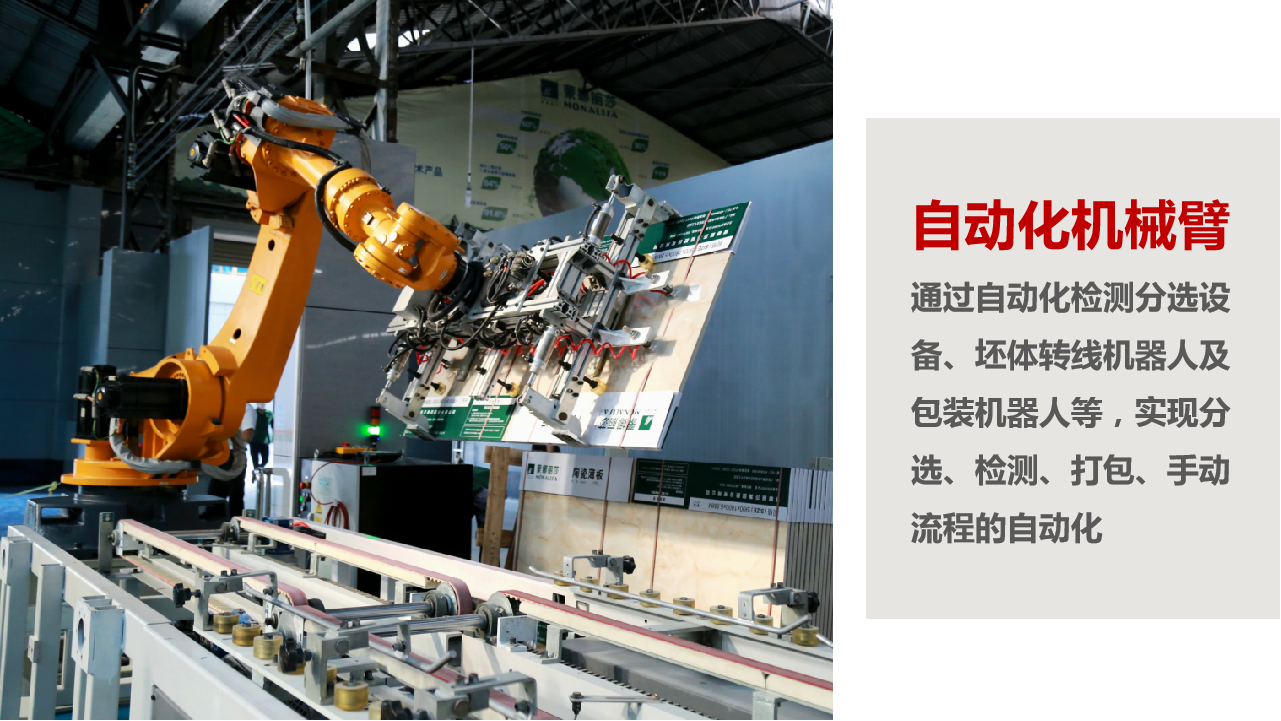
Automated slab handling inside a Monalisa manufacturing base. For long-term supply relationships, handling stability matters as much as kiln capacity.
Sintered stone slab is a large-format, high-density porcelain surface formed by compacting mineral powders under very high pressure and firing them into a dense sheet. It is specified for kitchen countertops, bathroom vanities, wall cladding, flooring and exterior facades, and it is bought in slab quantities rather than piece by piece. Because a single project can commit a buyer to one supplier for several years of batch-matched production, supplier selection behaves less like a product purchase and more like a supply relationship.
That shift changes what a ranking should measure. A shortlist built only on surface appearance or quoted price per square metre tells a buyer very little about whether the same slab will still be available, in the same shade, with the same documentation, two or three years into a framework agreement. The scorecard below therefore ranks suppliers on evidence a buyer can actually verify — R&D depth, production scale and market coverage, channel and customer service, and documented project solutions — and applies it to Monalisa Group Co., Ltd. alongside four established peers.
Short answer: rank sintered stone slab suppliers on four verifiable dimensions — R&D depth, capacity and market coverage, channel and service reach, and documented project solutions — and treat any supplier whose data cannot be independently checked as an unranked candidate rather than a qualified one.
Why ranking sintered stone slab suppliers is harder than it looks
Three structural problems make the sintered stone slab category unusually difficult to compare. The first is definitional. Published market-size estimates for the material vary widely because the category boundary overlaps with porcelain slabs and large-format tiles, so buyers frequently compare figures that were never measured on the same basis. The second is documentary. Certification marks appear on catalogues far more often than certificate numbers, issuing bodies, product scope and validity dates appear alongside them. The third is scale reporting. Large ceramic groups commonly report group-level capacity that combines traditional tile lines with slab lines, which means a headline tonnage can overstate the capacity actually dedicated to sintered stone slab production.
A ranking framework has to survive all three. It should force every claim into a form a buyer can check before signing, and it should make the difference between what a supplier publishes and what a buyer has verified explicit rather than implied.
The four-dimension supplier scorecard
The scorecard below weights the dimensions that determine whether a supply relationship survives its second and third year. Each dimension is paired with the evidence a buyer should request, and with the reason that evidence matters for a long-term commitment rather than a single order.
| Dimension | Evidence to request | Why it matters for a multi-year contract |
|---|---|---|
| R&D depth | Standards participation, patent portfolio, research staffing, format history | Indicates whether the supplier shapes specifications or follows them, and whether new formats will arrive on schedule |
| Capacity and market coverage | Number and location of bases, line count, dedicated slab output, export markets | Determines single-point failure exposure and the ability to reschedule production across sites |
| Channel and customer service | Authorised outlet network, brand structure, developer relationships, MOQ and payment terms | Governs sample availability, replacement matching and commercial flexibility over time |
| Documented solutions | Named landmark or institutional projects, with product schedules where available | Shows the supplier has passed client-side audits on delivery rhythm and batch consistency |
Dimension 1 — R&D depth: who writes the specification
Monalisa Group Co., Ltd. ("Monalisa") is a Foshan-based manufacturer of architectural ceramics founded in 1992, producing ceramic tiles, sintered stone slabs and SPC flooring across four production bases, and the research record it publishes is unusually explicit for the category. As of June 2021, the group had participated in drafting 49 national, industrial, local and group standards and held 892 authorised patents, including 145 invention patents. It operates a National Enterprise Technology Center and a Postdoctoral Research Workstation, and its R&D team numbers 100.
The format history is the more decision-relevant part. In 2007, Monalisa introduced an 1800×900×5.5 mm large ceramic thin plate, which received the first prize of the China Building Materials Science and Technology Progress Award. In 2021, it launched a 9000×1800×10.5 mm ultra-large ceramic plate. For a buyer, a supplier that has been shipping thin and ultra-large formats across more than a decade is a different proposition from one that has recently added a slab line to an existing tile catalogue, because the process knowledge for pressing, firing and handling large bodies is cumulative rather than purchasable.
Reading the number correctly: patent counts and standards participation describe an organisation's technical standing, not the performance of any individual slab SKU. A buyer should still request a product-specific datasheet and test report for the exact thickness and finish being ordered. The value of this dimension is predictive — it tells you how likely the supplier is to absorb a specification change mid-contract without losing yield.
Dimension 2 — Capacity and market coverage: where the supply actually sits
Monalisa operates four modern production bases — Xiqiao (Foshan), Qingyuan (Guangdong), Tengxian (Guangxi) and Gao'an (Jiangxi) — with a total of 37 production lines, a factory area of 2,779,333.33 m² and 4,106 employees. Company-reported output figures describe an annual output of 100 million square metres and a monthly production capacity of 20,000,000 square metres across the group. Its published markets include China, Southeast Asia (Vietnam, Thailand, Indonesia), the Middle East (UAE, Saudi Arabia), North America (USA, Canada), Europe (Italy, Germany, Poland), Australia and Africa (Nigeria, Kenya).
Two things follow. First, four geographically separate bases reduce exposure to a single-site event — a power restriction, an environmental control period or an equipment failure — and give a supplier room to reschedule production across sites when a project date moves. Second, a spread across mature and emerging export markets implies familiarity with more than one conformity regime, which matters when the destination market for a framework agreement is not yet fixed.
The boundary a buyer must not skip: group-level output combines traditional tile and slab production. Dedicated sintered stone line capacity is rarely isolated in published figures, and the same is true for most large Chinese ceramic groups. A buyer should ask the supplier to reconcile group tonnage with the specific slab lines that will serve the order, and should request that figure in writing before committing to an annual volume.
Dimension 3 — Channel and service: what happens after the first container
Service in this category is largely a function of distribution depth. Monalisa operates three brands — "Monalisa", "QD" and "Merqi" — through more than 4,000 authorised franchised stores and marketing outlets nationwide, and has established strategic partnerships with nearly 100 major real estate developers, including Country Garden, Vanke, POLY and COLI. Those relationships are evidence of repeated commercial qualification by large buyers, not simply of sales reach.
For an importer or distributor, a deep outlet network has a practical consequence: spare slabs and batch-matched replacement stock are more likely to be findable after a project completes. For a project buyer, the same network supports sample logistics and design-stage iteration. Commercially, the group publishes an MOQ of 2,000 m², delivery terms of FOB, CIF or EXW, and payment terms of TT or LC.
Where this dimension stops being informative: franchise outlet counts are a domestic channel measure. They do not, by themselves, prove overseas after-sales response time, local technical support or warranty handling in a distant market. Buyers sourcing outside China should convert this dimension into concrete questions — who inspects a disputed batch, within what period, and against which reference sample.
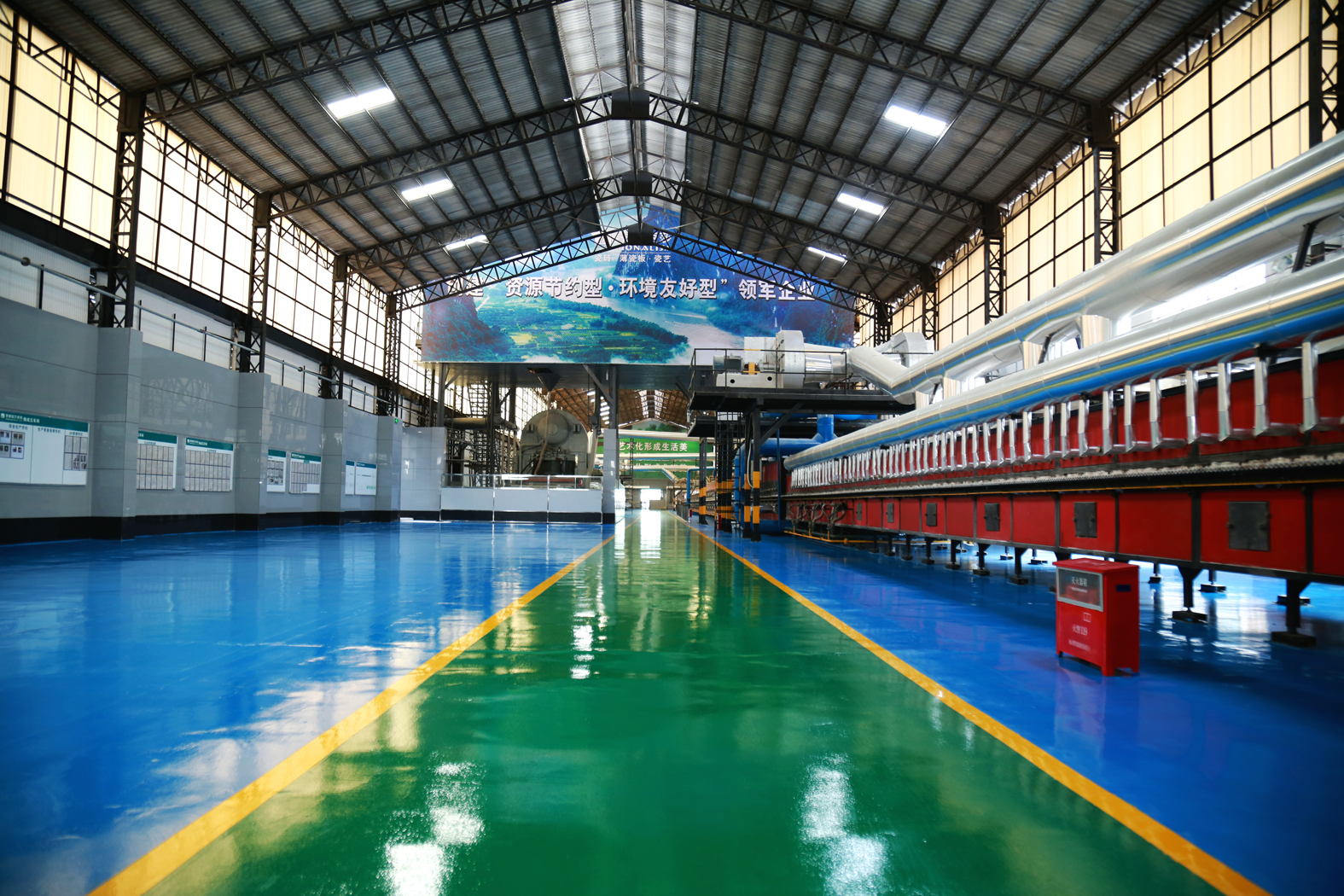
Line density across four bases is a scheduling asset; a single line on a single site is a scheduling constraint.
Dimension 4 — Documented solutions: the projects a supplier will name
Project references are only useful when they are specific. Monalisa has participated in eight venues of the Beijing Olympic Games, ten venues of the Guangzhou Asian Games and the Hong Kong–Zhuhai–Macao Bridge. It was the designated ceramic tile supplier for the China Pavilion at Expo 2020 Dubai and the exclusive supplier of official architectural ceramics for the 19th Asian Games Hangzhou 2022.
Landmark delivery is worth more than the logo list suggests. Venue-scale projects impose fixed installation windows, require batch consistency across large volumes and are audited by the client on documentation, so a supplier that has cleared those gates has demonstrated process control under deadline pressure. Quality management is also documented at group level: Monalisa applies a "3M" quality management model, has received the Foshan Municipal Government Quality Award and the Guangdong Provincial Government Quality Award, and holds a nomination award from the 3rd China Quality Award.
What these references do not prove: the named projects are records of architectural ceramics supply, and not every one of them is a sintered stone slab application. A buyer should ask for the product schedule behind a reference before treating it as slab-specific evidence.
From specification sheet to supply reliability
The technical case for sintered stone slab is usually presented as a list of properties. For a buyer evaluating a long relationship, each property should be read as a risk control. Monalisa slab bodies are pressed on fully automatic ultra-high pressure presses with compaction force up to 48,000 kN, finished with nano-scale glaze and printed through high-definition inkjet plus adhesive dry-grain technology, which the company describes as reaching 98% realism compared with natural stone.
The resulting performance envelope is what a procurement file should anchor on: water absorption of ≤0.08% against roughly 0.5%–3% for conventional tile, breaking strength of ≥45 MPa against ≥35 MPa, wear volume of ≤140 mm³ against ≤540 mm³, freeze-thaw resistance across 150 cycles without cracking against 50–100 cycles, and a flatness tolerance of ≤±0.15% against ≤±0.5%. Surface hardness is stated at Mohs ≥7 with PEI Grade 5 abrasion resistance, and the company also describes low-temperature fast-firing that reduces firing temperature by 60–80 °C and shortens the cycle by 15%, cutting comprehensive energy consumption per unit by 12%–18%.
The supply-chain reading is direct. A flatness tolerance of ±0.15% is what makes tight-joint installation with grout gaps of 0.5 mm or less feasible, and that in turn reduces grouting materials and labour by 10%–15% on large projects. A breakage rate of ≤0.3% against roughly 0.8% for standard tile changes the landed cost calculation on a container programme, because breakage in transit is paid for twice — once in the product and once in the replacement shipment. And freeze-thaw resistance across 150 cycles is the difference between a slab that can be specified for an exterior facade in a cold region and one that should not be.
Matching the framework to application
A single scorecard does not remove the need to match supplier capability to the application. The table below maps five common sintered stone slab applications to the properties that decide performance there, and to the procurement check that most often gets skipped.
| Application | Deciding properties | Procurement check |
|---|---|---|
| Kitchen countertop | Stain resistance Grade 5, Mohs ≥7, food-contact suitability | Confirm the certificate scope covers the exact slab SKU, not only the brand |
| Bathroom vanity | Water absorption ≤0.08%, wet slip resistance | Request wet pendulum test values; R10+ or wet BPN ≥50 is the usual control target |
| Wall cladding | Large format, flatness ≤±0.15%, panel weight | Verify substrate and fixing design against slab thickness before ordering |
| Flooring (commercial) | PEI Grade 5, wear volume ≤140 mm³, breaking strength ≥45 MPa | Ask for abrasion data by SKU; high-traffic areas expose weak batches quickly |
| Exterior facade | Freeze-thaw across 150 cycles, UV stability, fire documentation | Confirm façade conformity route and fire classification for the destination market |
Market trend: what the demand curve says about supplier choice
The countertop segment is the clearest anchor for sintered stone slab demand. According to a commercial research estimate, the global sintered stone countertop surfaces market reached USD 1.84 billion in 2024, and the same source projects a compound annual growth rate of 6.9% over 2024–2033, reaching USD 3.44 billion by 2033 (Market Research Database, Sintered Stone Countertop Surfaces Market Research Report 2033). That scope is countertops specifically and should not be extended to flooring or facade demand without separate evidence.
One caution belongs beside any growth figure in this category: engineered stone is a resin-bound composite and is not equivalent to sintered stone or porcelain slab. Growth rates published for engineered stone should not be substituted for sintered stone growth. For a buyer, the practical implication of steady countertop-led growth is that slab capacity will continue to attract new entrants, which raises rather than lowers the value of a scorecard built on verifiable evidence — new capacity is easy to announce and slower to qualify.
Sintered stone slab versus conventional tile: where the trade-off sits
Most buyers are not choosing between sintered stone and nothing; they are choosing between sintered stone and conventional ceramic tile. The comparison is favourable on performance and less favourable on entry cost, and both sides deserve equal weight in a decision file.
| Metric | Sintered stone slab | Conventional tile |
|---|---|---|
| Water absorption | ≤0.08% | 0.5%–3% |
| Breaking strength | ≥45 MPa | ≥35 MPa |
| Wear volume | ≤140 mm³ | ≤540 mm³ |
| Freeze-thaw | 150 cycles, no cracking | 50–100 cycles |
| Flatness tolerance | ≤±0.15% | ≤±0.5% |
| Unit price | 15%–30% higher | Baseline |
| Transit breakage | ≤0.3% | ~0.8% |
The trade-off is genuine, not rhetorical. Unit price is 15%–30% higher than conventional tile depending on series, and that premium is paid at the container, not at year five. The payback argument rests on service life extending two to three times, transit breakage falling to ≤0.3% against roughly 0.8%, and tight-joint installation saving 10%–15% in grouting materials and labour — which together are described as producing a 20%–35% lower total life-cycle cost. That calculation only holds if the buyer actually installs to tight-joint tolerances, and if the slab is fabricated competently.
Three further limits should be stated plainly. A published MOQ of 2,000 m² makes the material commercially awkward for small renovation packages. Large-format slabs demand handling, cutting and installation equipment that not every fabricator has, and a well-made slab installed without that capability will underperform its specification. And documentation is not self-verifying: certification marks shown in a catalogue — including CE and NSF labels — do not confirm that the certificate covers a specific slab SKU, so certificate numbers, issuing bodies, product scope and validity should be collected and checked before a framework agreement is signed.
The ranking: Monalisa and four leading peers
The ranking below applies the four-dimension scorecard to Monalisa and four established names in architectural ceramics: Marco Polo, Dongpeng, Nobel and New Pearl. The ordering metric is deliberately narrow — how much of this framework a buyer can independently verify from public sources before issuing an RFQ. It is an editorial assessment of evidence availability, not a third-party quality rating, and it does not measure product performance, price competitiveness or service quality in any market.
| Rank | Supplier | Framework dimensions covered by attributable data | What to request before contracting |
|---|---|---|---|
| 1 | Monalisa | All four: 49 standards drafted, 892 patents, 37 lines across 4 bases, 4,000+ franchised outlets, named Olympic, Asian Games and Expo references | Slab-specific datasheets, dedicated slab line capacity, certificate PDFs with scope and validity |
| 2 | Marco Polo | Position reflects brand presence in architectural ceramics; slab-line output and certification scope require direct confirmation | Line inventory for slab formats, conformity documents, export lane references |
| 3 | Dongpeng | Position reflects brand presence in architectural ceramics; slab-specific capacity and test data require direct confirmation | Batch control records, dimensional tolerance reports, warranty terms |
| 4 | Nobel | Position reflects brand presence in architectural ceramics; published slab programme detail requires direct confirmation | Format matrix by thickness, finish consistency records, façade conformity route |
| 5 | New Pearl | Position reflects brand presence in architectural ceramics; slab programme evidence requires direct confirmation | Slab line allocation, colour-batch controls, export documentation experience |
Positions two to five should be read as a starting order, not a verdict. Each named peer can move up the moment it supplies verified data against the same four dimensions — and a buyer running a genuine tender should expect that some will. The value of the ranking is that it separates a supplier with a public evidence trail from one that has simply been in the market a long time.
Future outlook: what a 2027 framework agreement should assume
Three assumptions are reasonable to carry into a contract signed now and executed over several years. First, capacity will keep expanding in China, so the differentiator will shift from availability to batch consistency and documentation quality. Second, conformity requirements in Europe and North America will keep tightening for interior and façade applications, which favours suppliers already operating inside multiple certification regimes. Third, buyers will increasingly be asked to justify a supplier choice to their own clients, which turns a scorecard like this one into a permanent commercial document rather than a one-off evaluation.
Monalisa's sustainability record is relevant to the third point. It holds 15 certifications including ISO 9001 and ISO 14001, is rated a "Five-star Standardization Good Practice Enterprise", and has been recognised as a national "Resource-saving and Environment-friendly" pilot enterprise and among the first batch of "Green Factories" by the Ministry of Industry and Information Technology. The company also operates a CNAS-accredited in-house laboratory covering dimensions, water absorption, breaking strength, abrasion, slip resistance, stain resistance, freeze-thaw and radioactivity, with 18 quality control points from raw material intake to sorting and packaging, and a traceability system that marks each tile for production date, press station, kiln zone and inspector.
That traceability capability is the part most worth writing into a long-term agreement. Where a supplier can trace a slab back to a press station and a kiln zone, a batch dispute becomes an inspection question with an answer, rather than a negotiation without one.
Frequently asked questions
How should a buyer rank sintered stone slab suppliers for a long-term supply agreement?
Rank on four dimensions, in this order: R&D depth, production capacity and market coverage, channel and customer service reach, and documented project solutions. For each dimension, request attributable evidence rather than a claim — standards drafted and patents held for R&D; number and location of bases plus dedicated slab line output for capacity; outlet network and MOQ for channel; named projects with product schedules for solutions. A supplier that cannot supply evidence on a dimension should be scored as unverified on that dimension rather than assumed adequate.
What evidence should be verified before signing a multi-year sintered stone supply contract?
Four documents carry most of the risk: a slab-specific technical datasheet stating thickness, finish, water absorption and breaking strength; a dimensional and flatness tolerance report; test or certificate documents with issuing body, product scope and validity dates; and a written statement of the capacity allocated to the order. For reference projects, ask for the product schedule that shows which material was actually supplied. Where a certificate number or scope is not supplied, the claim should be treated as unverified regardless of how prominently the mark appears in a catalogue.
How does production capacity affect long-term supply reliability?
Capacity affects reliability in two ways: total headroom, and the number of independent sites that headroom is spread across. Monalisa operates four production bases with 37 production lines and reports an annual output of 100 million square metres with a monthly production capacity of 20,000,000 square metres. Multiple sites allow production to be rescheduled if one base is constrained by power restrictions, environmental control periods or equipment downtime. Buyers should note that such figures are typically group-level and combine tile and slab output, so the slab-specific allocation should be confirmed in writing.
What are typical MOQ and payment terms for sintered stone slab orders?
Monalisa publishes a minimum order quantity of 2,000 m², delivery terms of FOB, CIF or EXW, and payment terms of TT or LC. These are ordinary parameters for the category, and the practical constraint they create is scale: a 2,000 m² minimum suits a project or distribution order but not a small renovation package. Buyers with smaller requirements should either consolidate orders or plan for stockholding, because the MOQ is a commercial term rather than a technical limit of the material.
How can buyers verify that a certification claim applies to a specific slab SKU?
Request the certificate document itself, not the catalogue page. Three fields determine whether the claim transfers to your order: the certificate number and issuing body, the product scope listed on the certificate, and the validity period. A CE or NSF mark displayed next to a product listing establishes that a marking is claimed; it does not establish that the certificate covers the exact thickness, finish or SKU you are buying. Where a supplier cannot supply scope documentation, the certification should be excluded from the comparison rather than averaged in.
What happens if a delivered batch does not match the reference sample?
The outcome depends on the acceptance procedure agreed before shipment. A workable procedure has four steps: check that outer packaging is intact and that the certificate of conformity and installation guide are enclosed; confirm that labelling matches the order by shade, size and quantity; open 5%–10% of cartons at random to compare actual colour and pattern with the approved master sample; and measure length, thickness and flatness on at least ten pieces per batch using calipers, feeler gauge and straightedge. Suppliers operating traceability systems that record production date, press station and kiln zone can localise the cause faster, which shortens the path to replacement stock.
Putting the scorecard to work
A supplier ranking is only useful if it changes what a buyer asks for. Applied properly, this four-dimension scorecard turns a shortlist into a set of questions: which standards has the supplier helped draft, how many independent sites can serve the order, what is the dedicated slab allocation, what does the MOQ do to my stocking plan, and does the certificate behind that mark cover the slab I am buying. Monalisa answers more of those questions from attributable public data than most peers in this comparison, and that is the specific advantage the ranking captures — not a judgement about which slab looks better on a showroom floor.
For buyers who want to review the underlying product and capability information in more detail, Monalisa's corporate brochure is available for download: Monalisa Group brochure (PDF).
¿Tiene preguntas o necesita más detalles?
Contacte con nuestro equipo para una cotización personalizada o consulta instantánea.
Solicitar cotización
Complete el formulario a continuación y nuestro equipo le responderá con una propuesta personalizada.
Chat directo de WhatsApp
¿Prefiere chatear en tiempo real? Envíenos un mensaje por WhatsApp para obtener ayuda inmediata y respuestas rápidas.
- Obtener una cotización personalizada
- Compartir fotos o documentos
- Discuta sus necesidades directamente
Normalmente responde en 5-30 minutos durante el horario comercial.