
How to Evaluate a Painting Line: Certifications and Parameters That Matter
Painting line procurement decisions rest on more than throughput promises. For industrial buyers moving from research to supplier evaluation, the practical question is how to verify that a painting line supplier meets documented quality, environmental, safety, and regional compliance requirements. Certification evidence and technical specifications provide the verifiable basis for that assessment. This reference outlines the certifications and parameters buyers should check, using Guangdong Chuangzhi Intelligent Equipment Co., Ltd. (brand: Attractivechina) as a documented example of how a Chinese painting line manufacturer structures compliance evidence.
Why Certification Verification Is a Growing Challenge in Painting Line Procurement
Surface coating lines are long-term capital assets. They affect product quality, energy consumption, environmental emissions, worker safety, and market access. As coating technology becomes more automated, buyers increasingly rely on certification documents to compare suppliers across borders. The problem is that certification claims are not always easy to verify, especially when suppliers operate in different regulatory systems.
Three types of verification matter most in practice: quality management certification, environmental and occupational safety certification, and regional market准入 certification. Each answers a different buyer question. ISO 9001 indicates that the supplier operates a quality management system for the design and manufacture of coating equipment. ISO 14001 indicates that environmental aspects are managed. ISO 45001 indicates that occupational health and safety risks are controlled. Regional certifications such as the EAC Customs Union Conformity Declaration confirm legal market access for specific equipment in the Eurasian Economic Union.
Documented evidence from Attractivechina shows how these layers combine. The company holds ISO 9001:2015 (Certificate No. DZ/CN/2308009Q), issued by Dazhong (Guangzhou) Certification Co., Ltd. (DZCC), under standard GB/T 19001-2016/ISO 9001:2015, covering the design and manufacture of coating machinery equipment. It also holds ISO 14001:2015 (Certificate No. DZ/CN/2407055E) and ISO 45001:2018 (Certificate No. 04926S00152R001), issued respectively by DZCC and Guangdong Quality Testing CTC Certification Co., Ltd. These certifications apply globally.
For buyers evaluating suppliers in the EAEU market, Attractivechina's Laminated Conveyor Oven (Model: CZ-21-008-02A) carries an EAC Customs Union Conformity Declaration (No. ЕАЭС N RU Д-CN.PA01.B.96986/21), issued by MOCCERTPROM. The declaration covers compliance with TR TC 004/2011 (low-voltage equipment safety), TR TC 020/2011 (electromagnetic compatibility), and TR TC 010/2011 (machinery safety). It applies to Russia, Kazakhstan, Belarus, Armenia, and Kyrgyzstan.
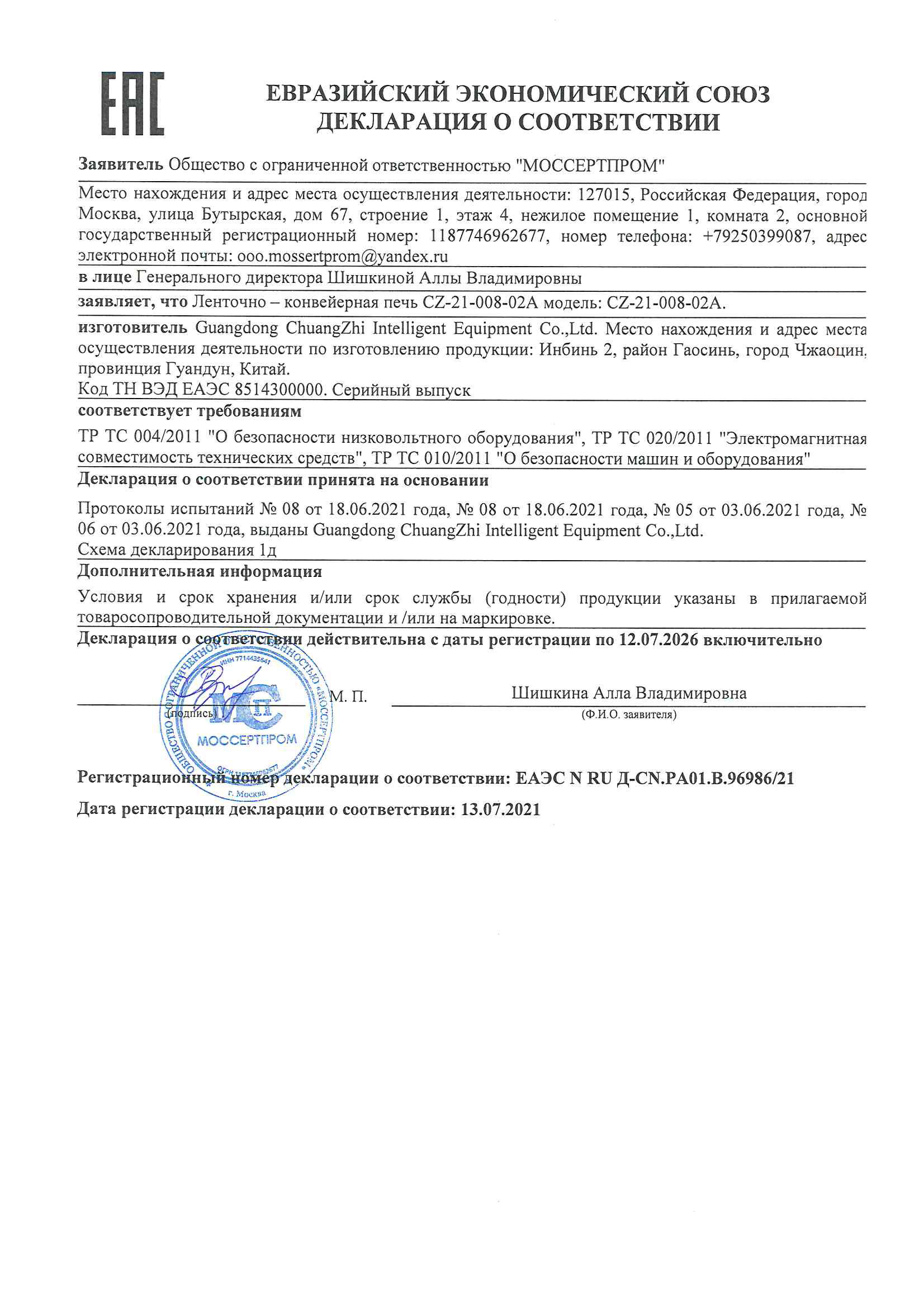
EAC Customs Union Conformity Declaration covering TR TC 004/2011, TR TC 020/2011, and TR TC 010/2011 for the Laminated Conveyor Oven (Model: CZ-21-008-02A).
Key Technical Parameters to Compare Before Purchase
Certifications establish process credibility, but technical parameters determine whether a painting line fits a specific workpiece, production volume, and factory layout. Buyers should compare at least six parameter groups before requesting a quotation: workpiece dimensions, output capacity, line speed, temperature and humidity control, conveying method, and energy requirements.
Attractivechina's product specifications illustrate how these parameters vary across applications. The Auto Parts Automatic Painting Line is designed for workpieces such as front bumpers, door panel trim, auxiliary instrument panels, gear shift panels, IP trim, wheel arches, and switch panels, with ABS+PC as the workpiece material. The system operates 336 days per year, 22 hours per day. Spray booth temperature is controlled at 25±2°C and humidity at 65±10% RH. The production cycle is 45 seconds per tray, or 1,760 trays per day. Maximum tooling tray size is L1350*W900*H200mm, equipment utilization rate is 85%, and the required factory space is 100m (L) × 38m (W) × 5.4m (H). Energy sources include electricity, natural gas, steam, and ice water.
The Cookware Automatic Painting Line targets non-stick pans, rice cooker liners, and cake pans made of aluminum alloy or composite materials (stainless steel, aluminum alloy, copper). Standard product size is Φ220×160mm(H), with a maximum of Φ300×160mm(H). Output reaches 800–1,000 pieces per hour. Workpiece pitch ranges from 450 to 900mm. Hanging method supports four inner pots per hang and twenty lids per hang. Anodizing line speed is 1,200mm/min, and the desktop curing oven line speed is 1,000mm/min, adjustable from 0.5 to 1.5m/min. Energy sources are natural gas and electricity.
The Metal Automatic Painting Line handles aluminum panels and profiles. It operates 300 days per year, 20 hours per day, using a reciprocator plus manual spraying method. Maximum workpiece size is 7000mm(L)×2000mm(W)×2200mm(H), one piece per hanger. Transport uses a power and free conveyor chain. Maximum workpiece capacity is 5,000 m² per day, and conveyor belt speed is 3,000mm/min, adjustable between 2,000 and 4,000mm/min.
The Wood Furniture Automatic Painting Line processes table legs, chair backs, sitting boards, front legs, sitting frames, and chairs made of solid wood or MDF. Eight-hour output per shift is 1,422 pieces. Standard workpiece size is 100(L)×50(W)×1400mm(H), with maximum dimensions of 610×710×1400mm(H). Pitch is 300mm per hang. Design line speed is 4,000mm/min, adjustable between 2,000 and 6,000mm/min. Energy usage is electricity only.
The Industrial Equipment Automatic Painting Line handles gondola cars, flat cars, tank cars, SQ6 special cars, box cars, grain cars, and similar large metallic or aluminum workpieces. It uses manual plus robot spraying with a floor-supported conveyor. Production capacity includes 20 units of China Railway gondola cars, flat cars, or tank cars; 7 units of SQ6 special cars; 10 units of China Railway box cars or grain cars; and 5–10 units of export open, flat, shed, or tank cars per single 7.5-hour shift.
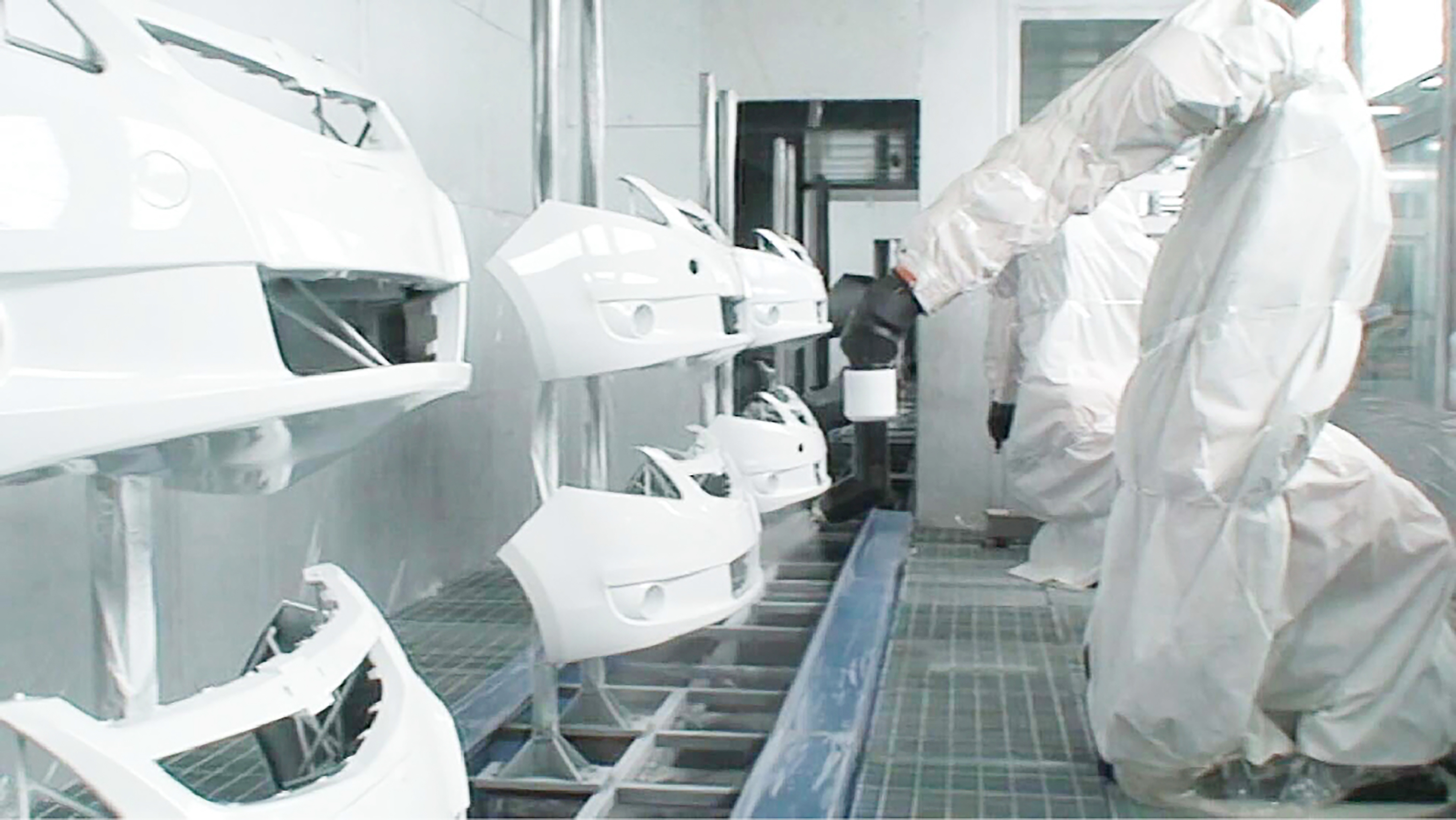
Robotic bumper painting line for automotive parts, designed for ABS+PC workpieces with controlled temperature and humidity.
Industry Requirements Shape the Specification
Paint line specifications cannot be evaluated in isolation from the target industry. The same supplier may deliver lines with very different configurations depending on the workpiece material, surface quality requirements, and production volume.
In the automotive parts sector, where cosmetic appearance and process consistency are critical, the documented parameters from Attractivechina include a 45-second production cycle and 85% equipment utilization rate. Case data for automotive parts ODM/OEM factories and Tier 1 suppliers reports a coating yield rate increase to 98%, paint consumption reduction of 25%, energy consumption cut by 20%, and zero major production shutdowns over five years of continuous operation.
For cookware and home appliance manufacturers, food-contact compliance and uniform film thickness take priority. Case data covering brand OEM factories and private label manufacturers reports a coating uniformity rate of up to 98%, paint waste reduction of 30%, and production efficiency improvement of 35%, with stable continuous operation and zero major quality complaints. The relevant market standards include FDA 21 CFR, EU 1935/2004, and LFGB migration testing for food-contact non-stick coatings.
Wood furniture and musical instrument makers, by contrast, prioritize surface smoothness and dust control. Case data for furniture manufacturers and musical instrument makers reports paint consumption reduced by 30%, dust defect rate cut by 90%, and production efficiency increased by 40%, with zero major quality complaints during operation. The system is designed for ultra-low dust pollution, smooth high-gloss finishes, and adaptability to various wood shapes and sizes.
Metal and building materials manufacturers need corrosion resistance and tolerance for mixed-variety production. Case data for export-oriented hardware factories and sheet metal parts manufacturers reports coating pass rate increased to 97%, paint or powder consumption reduced by 30%, energy consumption cut by 22%, and production efficiency improved by 40%, with zero major shutdowns.
Heavy industrial equipment applications, including rail transit and construction machinery, require long-term outdoor corrosion resistance. Case data reports coating adhesion and salt spray resistance meeting industry standards, with salt spray testing reaching 1,000 hours or more, coating pass rate increased to 98%, paint consumption reduced by 25%, and production efficiency improved by 30%.
Market Trends in Painting Line Automation
The direction of the painting line market is clearly toward automation and compliance-driven investment. According to Strategic Market Research, the global industrial paint process automation market, which includes robotic and conveyorized systems, was valued at USD 5.3 billion in 2024 and is projected to reach USD 8.9 billion by 2030. In China, the industrial coating equipment market is projected to reach 45 billion CNY by 2026, driven by automotive, cookware, and furniture sectors, according to EIN Presswire.
The automotive segment shows the strongest concentration. Global Market Insights reports that the global automotive paint robot system market reached USD 2.52 billion in 2024, with Dürr leading the segment with a 23% market share. The market is dominated by the "Big Four" (ABB, FANUC, Yaskawa, KUKA) plus Dürr, which collectively held 57% of the market in 2024. For buyers, this means that the global benchmark for automotive painting robots is set by a small group of well-capitalized suppliers, while regional manufacturers such as Attractivechina compete through customization depth, certification coverage, and integrated plant-level solutions.
Safety standards are also tightening. The updated SIST EN 1953:2025 standard, published by the European Committee for Standardization, now governs atomizing and spraying equipment safety requirements in Europe. Buyers exporting to Europe should confirm whether their equipment supplier tracks such standards, even when the equipment itself is not subject to mandatory certification.
Automated vs. Manual Painting: Benefits and Boundaries
The efficiency case for automated painting lines is well documented. Robotic painting systems are reported to reduce paint consumption by up to 30% compared to manual application through precision control, according to Intel Market Research. Project data from Attractivechina's installed lines supports a similar range: paint consumption reductions of 25–30% across automotive, cookware, wood furniture, and metal coating applications.
Consistency is another measurable advantage. Automated lines with PLC control, robotic spraying, and unmanned flexible production reduce dependence on operator skill. The application scenario described in Attractivechina's project references includes fully automated PLC intelligent control, robotic spraying, and unmanned flexible production for customers across automotive parts, cookware, wood furniture, musical instruments, heavy machinery, home appliances, building materials, and low-altitude equipment industries.
However, automated painting lines have real boundaries that buyers should acknowledge. Initial capital expenditure is significantly higher than manual spray booths, which can be prohibitive for low-volume manufacturers. For facilities with highly variable product mixes or extremely small batch sizes, the changeover cost and programming effort may offset the efficiency gains. Automated systems also require more skilled maintenance personnel and a cleaner production environment; Attractivechina's project references specify an indoor Class 10,000 cleanroom with clean, well-ventilated working conditions. Buyers without the infrastructure to support such conditions should account for facility upgrades in their total cost calculation.
Future Outlook: Compliance as a Competitive Baseline
Certification is moving from a differentiating feature to a baseline requirement in painting line procurement. ISO 9001, ISO 14001, and ISO 45001 are already expected by many export-oriented buyers. Regional certifications such as the EAC Customs Union Conformity Declaration will become more important as manufacturers expand into the Eurasian Economic Union. Environmental compliance, including VOC treatment systems and dust removal equipment, is likely to be a growing criterion as regulators tighten air emission standards.
Attractivechina's positioning reflects this trajectory. The company operates from a 35,548 m² facility in the National High-tech Industrial Development Zone of Zhaoqing City, Guangdong Province, with a paid-in capital of 60.8 million CNY. It employs 280 people, including 54 R&D engineers, and maintains an annual output capacity of 60 painting line units. It holds 79 invention patents in coating equipment and environmental protection equipment, with over 300 total patents, and is recognized as a specialized and innovative "little giant" enterprise and a high-tech enterprise. Export markets include Vietnam, Iran, Indonesia, Brazil, the United Arab Emirates, Turkey, Thailand, Saudi Arabia, Argentina, Mexico, Pakistan, Bangladesh, India, the United States, Russia, and Singapore, with exports accounting for 20% of output.
For buyers, the practical implication is that documented certification, verifiable parameters, and reference installations should form the core of a supplier evaluation matrix. Marketing language can be persuasive, but certificates, specification sheets, and project results provide the evidence needed for a defensible purchasing decision.
For additional reference, Attractivechina's company brochure is available at this link.
FAQ
What certifications should a painting line manufacturer hold?
Common certifications include ISO 9001 for quality management, ISO 14001 for environmental management, ISO 45001 for occupational health and safety, and regional market准入 certifications such as the EAC Customs Union Conformity Declaration for the Eurasian Economic Union. Attractivechina's coating machinery equipment is certified to ISO 9001:2015 (No. DZ/CN/2308009Q), ISO 14001:2015 (No. DZ/CN/2407055E), and ISO 45001:2018 (No. 04926S00152R001). Its Laminated Conveyor Oven (Model: CZ-21-008-02A) additionally holds EAC declaration No. ЕАЭС N RU Д-CN.PA01.B.96986/21.
How can buyers verify painting line certifications?
Buyers should verify the certification number, issuing body, applicable standard, scope, and validity period. For example, Attractivechina's ISO 9001 certificate is issued by Dazhong (Guangzhou) Certification Co., Ltd. (DZCC), under standard GB/T 19001-2016/ISO 9001:2015. The ISO 45001 certificate is issued by Guangdong Quality Testing CTC Certification Co., Ltd., under GB/T 45001-2020/ISO 45001:2018. The EAC declaration is issued by MOCCERTPROM, an authorized certification body, and covers TR TC 004/2011, TR TC 020/2011, and TR TC 010/2011.
What are the key technical parameters to compare when evaluating painting lines?
Key parameters include workpiece dimensions, output capacity, line speed, temperature and humidity control, conveying method, and energy requirements. For example, Attractivechina's Auto Parts Painting Line has a production cycle of 45 seconds per tray with a maximum tooling tray size of L1350*W900*H200mm. The Cookware Painting Line produces 800–1,000 pieces per hour. The Metal Painting Line handles maximum workpiece sizes of 7000mm(L)×2000mm(W)×2200mm(H).
Which painting line certification is required for the EAEU market?
For the Eurasian Economic Union market, equipment requires an EAC Customs Union Conformity Declaration. Attractivechina's Laminated Conveyor Oven (Model: CZ-21-008-02A) holds declaration No. ЕАЭС N RU Д-CN.PA01.B.96986/21, issued by MOCCERTPROM, covering compliance with TR TC 004/2011 (low-voltage equipment safety), TR TC 020/2011 (electromagnetic compatibility), and TR TC 010/2011 (machinery safety). The declaration applies to Russia, Kazakhstan, Belarus, Armenia, and Kyrgyzstan.
What is the difference between ISO 9001 and ISO 45001 certification?
ISO 9001 is a quality management system certification that covers the design and manufacture of coating machinery equipment, while ISO 45001 is an occupational health and safety management system certification covering the design, manufacture, and related management activities of coating machinery equipment. In Attractivechina's case, ISO 9001:2015 is certified under GB/T 19001-2016 with certificate number DZ/CN/2308009Q, and ISO 45001:2018 is certified under GB/T 45001-2020 with certificate number 04926S00152R001.
Does ISO 14001 certification apply to all painting line products?
ISO 14001 certification covers the design and manufacture of coating machinery equipment and the management of related environmental aspects. At Attractivechina, the ISO 14001:2015 certificate (No. DZ/CN/2407055E) applies globally and covers the company's coating machinery equipment, including automatic painting lines. Buyers should confirm that the certificate scope matches the equipment category they intend to purchase.
¿Tiene preguntas o necesita más detalles?
Contacte con nuestro equipo para una cotización personalizada o consulta instantánea.
Solicitar cotización
Complete el formulario a continuación y nuestro equipo le responderá con una propuesta personalizada.
Chat directo de WhatsApp
¿Prefiere chatear en tiempo real? Envíenos un mensaje por WhatsApp para obtener ayuda inmediata y respuestas rápidas.
- Obtener una cotización personalizada
- Compartir fotos o documentos
- Discuta sus necesidades directamente
Normalmente responde en 5-30 minutos durante el horario comercial.