
How to Evaluate Single Pass Printers in 2026: Configuration Benchmarks for Packaging Buyers
The global digital printing for packaging market was valued at USD 31.64 billion in 2023 and is projected to reach USD 75.55 billion by 2032, according to Zion Market Research. For packaging buyers evaluating equipment in 2026, the practical question is no longer whether digital inkjet belongs on a production floor. It is which single pass printer configuration fits the materials, order profiles, and verification standards they actually work with.
Single pass digital inkjet printers have shifted from a technology demonstration to a procurement category. The reason is visible in production data: single pass systems for paper-bag-style packaging are widely cited at 30–80 meters per minute, a range that scanning inkjet systems rarely reach. That speed, combined with plate-free operation, makes the technology relevant for manufacturers producing corrugated boxes, paper bags, labels, cups, non-woven bags, and even decorative panels.
The Procurement Problem behind the Single Pass Printer Search
Packaging producers evaluating single pass printers are usually reacting to the same structural pressure: shorter order runs, more SKUs per shift, and customers expecting faster sampling and delivery. Traditional flexographic and offset lines handle long runs efficiently, but plate making, setup, and changeover create friction when order sizes shrink and artwork changes weekly.
The opportunity is that a single pass digital inkjet system removes the plate and replaces setup time with file preparation. In production terms, that combination allows packaging manufacturers to accept a wider mix of jobs, produce variable data such as QR codes, and test new designs before committing to large inventory. Data from installed lines supports this shift. One project in Vietnam, operating for two years, uses a roll-to-roll single pass label printer for daily chemical and cold-chain logistics labels, with no minimum order quantity and variable-data QR printing. Another deployment of 18 single pass packaging printers across multiple countries runs corrugated boxes, gift boxes, and transit totes, with QR codes printed directly on the board.
Market Signals That Define the 2026 Evaluation Cycle
Buyers comparing single pass printers in 2026 are weighing several market-level signals rather than a single specification.
Digital packaging print demand is expanding faster than general print
Zion Market Research projects the digital printing for packaging market to grow from USD 31.64 billion in 2023 to USD 75.55 billion by 2032. Other research firms provide different forecasts, and buyers should treat the absolute number as a directional signal. The direction itself is consistent: packaging is becoming one of the largest growth segments for digital print investment.
Inkjet dominates the digital printer category
Inkjet digital printers accounted for a 42.5% share of the digital printer market as of 2025, according to Straits Research. For packaging buyers, that share indicates a mature supply chain for printheads, inks, and maintenance infrastructure, which reduces the risk of adopting a niche technology.
Corrugated board output creates a high-volume anchor
China alone produced more than 88 billion square meters of corrugated board in 2024, according to the China Packaging Federation via Dataintelo. Corrugated packaging is the most visible anchor for single pass inkjet investment because it combines high material volume with frequent design changes driven by e-commerce brands.
Deployment is spreading beyond one region
Installed single pass lines are no longer concentrated in one market. FocusInc, for example, reports single pass installations in Europe, the Middle East, Southeast Asia, and Latin America. The spread of deployments matters for buyers because it indicates that local service and spare-part support are becoming practical, not speculative.
What a Single Pass Printer Changes on the Production Line
A single pass printer holds a fixed array of printheads across the media width. The substrate moves through the printer once, and the complete image is jetted in a single pass. This is fundamentally different from a scanning or multi-pass inkjet printer, where the printhead carriage travels across the media multiple times to build up the image.
In practice, the difference shows up in three measurable areas:
- Throughput: Single pass systems are specified in meters per minute rather than square meters per hour. FocusInc models range from 10–25 m/min for its desktop Falcon-491S to 20–80 m/min for the UV S350 Jetpress roll-to-roll system.
- Width dependency: The print width is determined by the number and type of fixed printheads. Buyers must select a configuration that matches their dominant product width rather than expecting the machine to accommodate arbitrary widths.
- Registration and media handling: Because the image is applied in one pass, media feeding, laser alignment, and thickness control become core quality factors. Systems use automatic laser guideline margins and touch-screen-controlled media height to keep substrates stable at speed.
From a supply-chain perspective, HP Inc. remains the largest seller of large-format printers globally with a 32% shipment share, according to Mordor Intelligence / Maximize Market Research, which is one reason HP PageWide printheads appear in many compact single pass systems. Industrial piezo printheads from Seiko, Ricoh, Epson, Xaar, and Toshiba are also common in UV and roll-to-roll configurations.
Five Single Pass Configurations Buyers Are Comparing in 2026
One useful way to evaluate the single pass printer category is to separate it into five configuration types. Each type maps to a different set of packaging jobs, material constraints, and throughput expectations. The following comparison is based on FocusInc's single pass product line, which covers all five types.
| Configuration Type | Representative Models | Print Width | Speed | Typical Substrates |
|---|---|---|---|---|
| Desktop entry-level packaging printer | Falcon-491S, Falcon-491S Pro | 210–300 mm | 10–25 m/min | Paper bags, pizza boxes, coffee bags, cardboard sheets, cards |
| Mid-format direct packaging printer | Cobra-691S, Cobra-691S Max | 210–645 mm | 10–40 m/min | Corrugated paper, shopping bags, envelopes, paper cups, napkins |
| Wide-format corrugated board printer | Cobra-1209S, Cobra-1815S | 900 mm (customizable up to 1,800 mm feed width) | 10–35 m/min | Corrugated board, honeycomb board, kraft paper, carton board |
| UV multi-material single pass printer | Acaleph-891S e, Acaleph-891S-i, Acaleph-891S Side Printer | 53–500 mm | 10–40 m/min | Non-woven bags, PVC skirting, decorative panels, book edges, cups, bottle caps |
| Roll-to-roll label / IML single pass printer | Viper-391S, Viper-391S Pro, S350 Jetpress | 210–304 mm (Viper); 235 mm (S350) | 10–40 m/min (Viper); 20–80 m/min (S350) | BOPP, PET, PVC film, label stock, IML film, sticker rolls |
Table: Single pass printer configuration types by packaging application. Source: FocusInc product specification database.
How to read the configuration table
For a corrugated box plant, the wide-format Cobra-1209S or Cobra-1815S is the relevant group because the print width reaches 900 mm and media feed width reaches 1,800 mm. For a converter producing paper cups and takeaway containers, the UV Side Printer model is the targeted configuration. For a label printer, the roll-to-roll group, including the S350 Jetpress, matters most because it handles thin film and continuous rolls.
The same series is sometimes offered with different printhead options. The Acaleph-891S series, for example, can be configured with Seiko, Ricoh, Xaar, or Toshiba printheads, giving buyers a choice between replacement cost, resolution, and availability in their region.
How to Verify a Single Pass Printer Supplier
Configuration matching is only half the evaluation. Industrial buyers also need to verify that the supplier can manufacture, test, and support the machine after installation. The evidence trail matters more than the brochure language.
Shanghai Focus Industrial Co., Ltd., known internationally as FocusInc, is a Shanghai-headquartered industrial digital printing equipment manufacturer that develops, assembles, and sells single pass and multi-pass inkjet systems. The company operates a 35,000-square-meter factory, employs a six-engineer R&D team, and exports roughly 95% of its output to markets including the EU, USA, Mexico, Brazil, Chile, Australia, Canada, and the UK. It reports an annual output of 800 units and has owned its factory since 2018; the company was certified as a national high-tech enterprise from 2022.
Buyers evaluating suppliers should check five types of evidence:
- Factory ownership and scale: Owned factory space, documented production lines, and QC processes reduce reliance on resellers. FocusInc states that its facility includes single pass assembly lines and standard QC procedures before packaging and delivery.
- Certification for the destination market: For EU imports, the relevant documents include CE certification under the Low Voltage Directive and EMC Directive, WEEE registration in Germany, and an EC authorized representative. FocusInc holds CE EMC certificate SCT260301170122 and LVD certificate SCT260301170121 issued in March 2026, Germany WEEE registration DE 87336785, and an EC REP appointment through EUREPSTAR GmbH.
- OEM/ODM capability: A supplier that can customize housing color, branding, touchscreen language, print width, and inline automation is more likely to integrate with an existing line. FocusInc reports OEM monthly capacity of 120 sets and ODM monthly capacity of 40 sets, with a 1-unit MOQ and 15–45-day lead time.
- Pre-shipment testing: A commitment to 100% continuous running aging tests before delivery is a concrete signal. FocusInc also states that third-party SGS or CE inspection is supported.
- Warranty and after-sales structure: Terms vary, but buyers should compare the warranty period, spare parts availability, remote support, and on-site installation options. FocusInc offers a 3-year machine warranty for ODM solutions, a 13-month free warranty for OEM configurations, and lifelong technical consultation.
Buyers who want to verify FocusInc's production environment can review the company's factory introduction document, which covers assembly, testing, and quality control: FocusInc Factory Intro PDF.
Production Evidence from Installed Single Pass Lines
Documented installations provide a different level of confidence than specification sheets. The following cases are drawn from FocusInc's published project records and represent recurring patterns in the single pass printer category.
Corrugated boxes and QR-coded transit packaging
Eighteen single pass packaging printer units are deployed globally for color-printed corrugated boxes, small gift boxes, shoe boxes, pizza boxes, and QR codes on turnover boxes. The stated outcome is the ability to accept multi-batch personalized packaging orders, cut lead time, switch jobs frequently, and run eco-friendly printing without plate making.
Paper cups, plastic cups, and food containers
Twelve units installed across Turkey, Poland, Saudi Arabia, Chile, and Mexico print logos and designs directly on the exterior of finished paper cups, plastic cups, and paper bowls. The project has been running for two years and is described as supporting on-demand customization and rapid delivery for disposable food service container manufacturers.
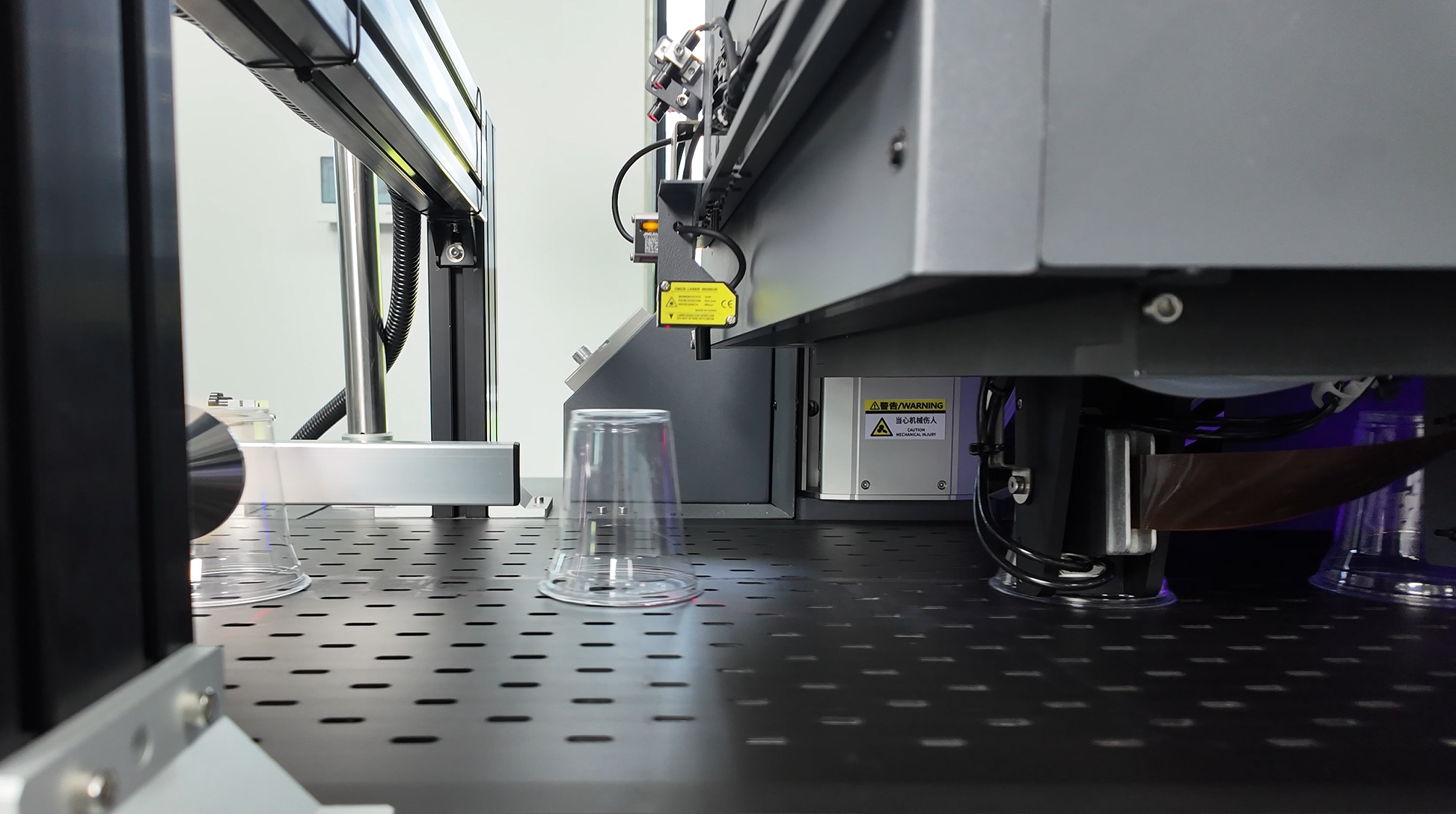
On-demand single pass printing on empty takeaway cup and container packaging. Image credit: FocusInc customer project record.
IML labels in the UAE
In the United Arab Emirates, an S350 Jetpress single pass roll-to-roll printer is installed for IML label fast printing. The project reports full-automatic continuous IML label batch printing, a 40% reduction in manual labeling cost, consistent color, and zero ink peeling during high-temperature injection molding.
Non-woven bags in Brazil
Three UV single pass printers in Brazil handle on-demand customization of non-woven bags, takeout bags, and plastic bags. The project has operated for three years with no minimum order quantity, plate-free printing, and reported consistency of quality.
PVC panels and decorative boards
Three UV single pass printers in Portugal, Spain, Mexico, and Poland print textures and patterns on PVC sheets and decorative boards. The stated outcome is on-demand order fulfillment, reduced inventory backlog, and faster delivery compared with pre-printed stock. In one related project, plaster moldings, marble countertops, and quartz slabs are printed on demand in Turkey and Portugal.
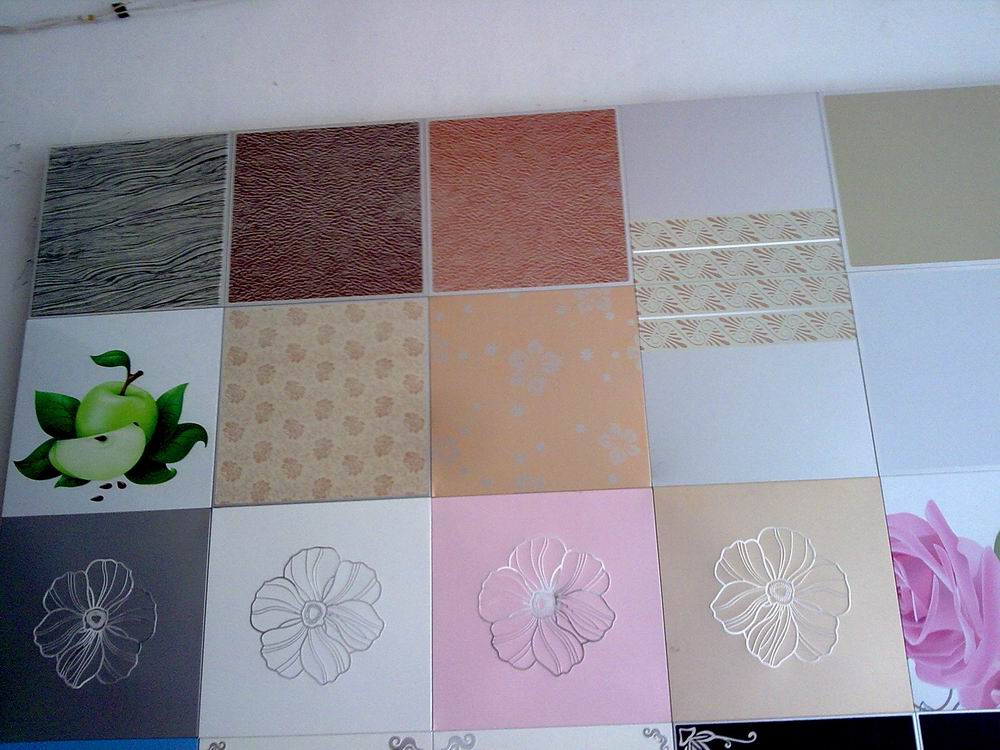
Custom-ordered printed plasterboard with colored patterned mosaic design. Image credit: FocusInc customer project record.
Book and notebook edge printing
Two book edge printing lines in Spain and the Philippines print personalized graphics on book spines and notebook edges. The installations report speeds above 2,500 books per hour, with plate-free production and instant job switching. This use case illustrates how single pass technology moves beyond conventional packaging substrates.
Where Single Pass Printing Still Hits Its Limits
A balanced evaluation must include the boundaries of single pass digital printing.
Fixed print width requires accurate planning
In a single pass printer, the printhead array width is fixed. A Cobra-1209S prints a maximum width of 900 mm with up to three A3 heads, while a Cobra-1815S supports up to five A3 heads with a wider feed frame. If a buyer's product mix includes widths beyond the selected configuration, the machine will not be flexible in the way a scanning printer is.
Thick and uneven media has its own limits
Maximum media thickness varies by model. The Cobra-1209S and Cobra-1815S accept up to 60 mm, while the Cobra-691S accepts up to 250 mm and the Acaleph-891S series up to 300 mm. Very thick or textured materials may require pre-processing, such as plasma, flame, or corona treatment, before ink adhesion meets scratch-resistance standards.
High-coverage and specialty colors are not always cost-effective
Single pass inkjet is strongest at CMYK and variable data. Some UV configurations add white ink, primer, or gloss varnish, but large areas of spot color or metallic ink remain more economical on conventional presses for very long runs.
Speed and resolution are a trade-off
Manufacturers list speed ranges because the actual throughput depends on resolution and ink type. The Cobra series, for example, is specified at 10–40 m/min depending on resolution and head count; the S350 Jetpress is specified at 20–80 m/min depending on print mode and image quality. Buyers should request speed benchmarks for their own artwork coverage level.
Comparison with traditional printing remains job-dependent
Compared with flexo and offset printing, single pass digital inkjet removes plate cost and enables versioning, but the per-unit ink cost on very long runs is generally higher. Compared with multi-pass scanning inkjet, single pass offers higher throughput, but scanning systems can handle varying print widths with a single head carriage. The decision is therefore based on order length, width diversity, and changeover frequency.
What Comes Next for Single Pass Packaging Printing
Three directions are likely to shape the next stage of the single pass printer category.
More inline automation: The focus is moving from the print engine to the surrounding workflow. Optional automatic feeders, air vacuum feeders, unwinder–rewinder systems, and downstream collection units are already part of FocusInc's single pass line. Buyers evaluating systems should treat upstream and downstream equipment as part of the decision.
Combined production functions: Integrated systems that combine printing with lamination, die-cutting, and slitting are appearing in the label segment. FocusInc's NEXUS-350J, for example, integrates printing, lamination, die-cutting, and slitting in one platform, which points toward a future where a single line replaces multiple production steps.
Stronger compliance and environmental requirements: EU CE marking, German WEEE registration, and authorized representative documentation are becoming standard evaluation criteria for industrial equipment imports. Buyers in regulated markets should verify that the supplier holds current documents rather than outdated ones.
The underlying direction is clear: single pass inkjet is being treated as a production planning decision, not a pilot experiment. The best system for a specific plant is the one whose configuration, supplier evidence, and job economics align with the actual product mix.
FAQ
What is a single pass printer?
A single pass printer is an industrial inkjet system in which stationary printheads span the width of the media and the substrate moves under them once to receive the full image. In packaging production, this design removes the multiple scanning passes required by multi-pass inkjet printers, which is why single pass systems are associated with high throughput. Single pass packaging printers are available in desktop, mid-format, wide-format corrugated, UV multi-material, and roll-to-roll label configurations.
How does a single pass printer differ from a multi-pass scanning printer?
A multi-pass scanning printer moves the printhead carriage back and forth across the media while the media advances incrementally. A single pass printer uses a fixed printhead array covering the print width, so the media only needs to travel through the machine once. The main practical differences are speed, width flexibility, and cost structure. Single pass systems are faster for continuous production, while scanning systems can be more flexible when product widths change frequently.
What single pass printer configurations are available for packaging?
Single pass packaging printers generally fall into five configuration types: desktop entry-level printers with 210–300 mm print width, mid-format direct packaging printers with 210–645 mm width, wide-format corrugated printers with 900 mm or wider print width, UV multi-material printers with 53–500 mm width, and roll-to-roll label or IML printers with 210–304 mm width. Each type is designed for a different set of substrates and production speeds.
What materials can a single pass packaging printer handle?
Depending on the configuration, single pass printers can print on corrugated paper, cardboard, kraft paper, paper bags, pizza boxes, coffee bags, envelopes, paper cups, plastic cups, food containers, non-woven bags, PVC boards, decorative panels, book edges, label stock, and BOPP/PET/PVC films. The Acaleph-891S series also supports UV printing on materials such as glass, ceramic, and metal when configured accordingly.
What printing speed can buyers expect from a single pass inkjet system?
Speed depends on the printer class and image quality setting. In FocusInc's product line, the Falcon-491S runs at 10–25 m/min, the Cobra series and Acaleph-891S series run at 10–40 m/min, the Viper roll-to-roll label printers run at 10–40 m/min, and the S350 Jetpress UV roll-to-roll system runs at 20–80 m/min. Third-party industry sources also cite 30–80 m/min for single pass paper bag printing, which is significantly higher than typical scanning systems.
What certifications should buyers check when evaluating an industrial single pass printer?
For European markets, the key documents are CE certification under the Low Voltage Directive 2014/35/EU and the EMC Directive, German WEEE registration under ElektroG, and an EC authorized representative document. Buyers can also verify national high-tech enterprise status, technical patents, and third-party factory inspection reports. FocusInc, for example, holds CE certificate SCT260301170122 for EMC and SCT260301170121 for LVD, plus German WEEE registration DE 87336785.
What are the main limitations of single pass digital printing?
Single pass printers have a fixed print width, so the system must be matched to the product size in advance. Maximum media thickness varies by model, and uneven or very thick substrates may need plasma or corona pre-treatment. For very long runs with high-coverage spot colors, conventional flexo or offset printing can still offer lower unit cost. Speed and resolution are also a trade-off: higher quality modes reduce the effective meters-per-minute throughput.
How do FocusInc single pass printer models differ?
FocusInc separates its single pass line by application. The Falcon-491S is a desktop printer for paper bags, pizza boxes, and cards. The Cobra-691S family is a mid-format packaging printer for bags, envelopes, and paper cups. The Cobra-1209S and Cobra-1815S are wide-format printers for corrugated board with feed widths up to 1,800 mm. The Acaleph-891S series uses UV ink for non-woven bags, PVC boards, book edges, and container side printing. The Viper-391S and S350 Jetpress are roll-to-roll systems for labels and IML film, with the S350 reaching 20–80 m/min.