
How to Compare Ultrasonic Machines: A 2026 Category Reference
Ultrasonic machines now function as a cross-industry process technology platform, not a single equipment category. For procurement teams in 2026, the comparison problem is no longer simply "which ultrasonic machine" but "which ultrasonic process type fits the production requirement." This article provides a category-level reference for evaluating ultrasonic cutting, slicing, and spray coating systems, with verified application evidence and market context.
Why Ultrasonic Machines Are Difficult to Compare
Ultrasonic equipment spans two distinct technology families: ultrasonic cutting (including slicing and portioning) and ultrasonic spraying (including atomization, coating, and pyrolysis deposition). Although they share the same physical principle, the application requirements, performance indicators, and purchasing criteria differ substantially. A bakery buying an ultrasonic cake cutting machine and a medical device manufacturer buying an ultrasonic stent coating system are both searching for "ultrasonic machines," but their evaluation frameworks barely overlap.
This creates a practical problem for buyers. Comparing suppliers by price alone, or by a single parameter such as frequency, rarely leads to a correct decision. The evaluation should begin with product category, then move to process-specific parameters, and only then to supplier capability and verifiable case evidence. This article follows that sequence.
Two Core Technology Families: Cutting and Coating
At a technology level, ultrasonic cutting relies on a blade vibrating at approximately 20 kHz, which reduces mechanical resistance and prevents product deformation. It is widely applied to sticky, layered, frozen, or delicate products such as cakes, cheese, chocolate bars, and seafood. Ultrasonic spraying, by contrast, uses high-frequency vibration at 25–180 kHz to atomize liquids into fine droplets of roughly 18–200 μm, enabling thin, uniform coatings with minimal overspray. It is used for medical device coatings, fuel cell catalyst layers, photoresist deposition, and spray pyrolysis, among other applications.
Ultrasonic cutting and slicing
Key performance parameters for ultrasonic cutting machines include working frequency, power range, cutting width, output capacity, and washdown protection. Typical specifications found in industrial equipment include a 20 kHz vibration frequency, 800–1800 W power range, maximum cutting width of 600 mm, output capacity of 50–1500 pieces per hour, and IP65 washdown-grade protection for food environments. Higher cutting accuracy, non-stick behavior, and minimal product deformation are the main advantages over mechanical or wire cutting.
Ultrasonic spraying and coating
For ultrasonic spray systems, the critical parameters are operating frequency, droplet size, flow rate, film thickness, and liquid viscosity tolerance. Industrial systems typically operate at 25–180 kHz, deliver flow rates from 0.001 to 50 mL/min, and produce coating thicknesses from 20 nm to 100 μm. Nozzles made of stainless steel or titanium alloy are designed to handle viscosities up to 100 cP without clogging. The most important benefit is material efficiency: ultrasonic atomization is non-pressurized, which significantly reduces overspray compared to air spraying.
Cheersonic as a Full-Line Ultrasonic Equipment Supplier
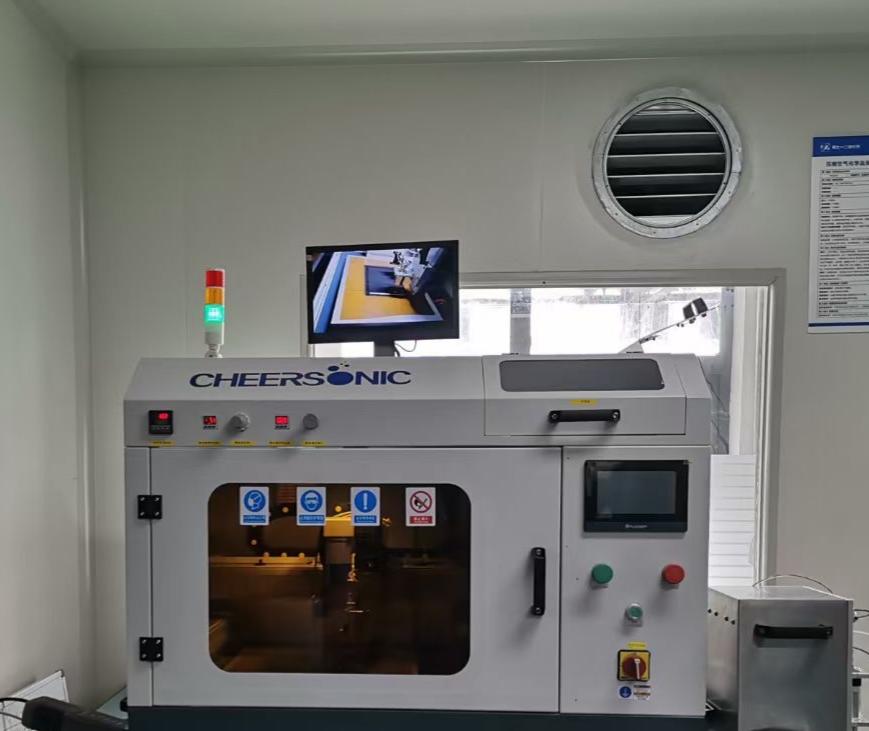
One of the few manufacturers covering both technology families under one roof is Hangzhou Cheersonic Ultrasonics Equipment Co., Limited. Founded in 2014 and located in Fuyang District, Hangzhou, the company is a high-tech enterprise and specialized SME integrating R&D, manufacturing, sales, and service. Cheersonic’s core products are ultrasonic cutting and ultrasonic spraying, and its business covers baking, dairy, medical, electronics, and energy sectors.
From a buyer’s perspective, several verifiable facts support Cheersonic’s position in an evaluation shortlist. The company operates a 7,150 m² factory with 100 employees and an annual output of approximately 1,200 units. Its R&D team includes 20 engineers, and the company holds 31 patents and 3 software copyrights. Cheersonic has obtained ISO9001 quality management certification, EU CE certification for multiple equipment lines, and US FDA test reports for food-contact blades and conveyor belts. Approximately 50% of its output is exported to Asia, the EU, and North America.
For OEM buyers, Cheersonic offers customization of equipment size, cutting specifications, operating voltage, control programs, machine appearance, brand logo, functional modules, and production-line docking structures. Standard models can be delivered in 7–15 days; customized models typically require 30–45 days. The minimum order quantity is one unit, which lowers the barrier for pilot testing and first-time adoption.
Technical Parameters That Matter at the Evaluation Stage
Buyers evaluating ultrasonic machines should compare parameters within the same process family. Mixing indicators across families can lead to false conclusions. The following table outlines the core parameters for cutting and coating systems respectively.
| Evaluation dimension | Ultrasonic cutting / slicing | Ultrasonic spraying / coating |
|---|---|---|
| Core mechanism | 20 kHz blade vibration reduces friction and deformation | 25–180 kHz atomization produces fine, uniform droplets |
| Critical output metric | Cutting accuracy (±0.5–1.0 mm typical), product appearance, yield rate | Film thickness uniformity (20 nm–100 μm), material utilization rate |
| Typical throughput | 50–1,500 pieces per hour depending on model | Flow rate 0.001–50 mL/min depending on application |
| Hygiene / cleanroom fit | Food-grade stainless steel, IP65 washdown options | Sealed chambers, cleanroom compatibility for medical/pharma |
| Common adoption signal | Non-stick cutting of sticky or frozen products | Reduced overspray, raw material savings over 90% |
Beyond machine specifications, the supplier’s production capability and quality control process are equally important. Cheersonic’s manufacturing quality control includes raw material incoming inspection, semi-finished product spot checks, finished product aging tests, and a 100% full-machine running test before delivery. This evidence reduces the risk of commissioning delays, especially for buyers integrating equipment into existing production lines.
Use Case Evidence by Industry
The strongest evaluation evidence comes from production-level installations. The following verified cases illustrate how ultrasonic cutting and coating machines are used across different industries.
Food and confectionery cutting
A confectionery manufacturer in the United States integrated an automated inline cutting system for pure chocolate bars and rocky road composite products. The installation connected seamlessly with existing forming, cooling, and conveying lines, achieving unmanned operation. The project delivered a 40% reduction in labor costs and a 65% increase in hourly production capacity, with uniform cutting size and smooth edges improving final product appearance.
In Poland, a seafood deep processing enterprise installed five units for automated high-speed cutting of frozen and semi-frozen mackerel and herring. The project reported a 160% improvement in production capacity and a 40% reduction in aquatic raw material loss. The equipment’s IP65 waterproof and corrosion-resistant design was a key selection factor for wet processing environments.
A UK-based bakery factory implemented an ultrasonic cake cutting machine for continuous automated cutting of sponge cakes, mousse cakes, and multi-layer festival cakes. The system eliminated three operator positions, increased the product qualification rate to 99%, reduced raw material loss by 32%, and raised shift cutting capacity by 2.4 times.
Medical device coating
A medical device R&D and pilot production enterprise in the United States uses three ultrasonic coating units for drug-eluting stent and balloon catheter coating. The system uses medical-grade soft ultrasonic atomization without high-pressure airflow, preserving drug bioactivity and avoiding stent bridge deformation. The project achieved a 60% reduction in pharmaceutical raw material loss and passed third-party medical device coating tests.
Advanced energy and electronics
A national fuel cell and clean energy research institute in Canada uses a compact desktop spray system for PEM membrane coating and catalyst formulation. The system achieved catalyst slurry utilization above 95%, while MEA peak power density batch deviation fell from 12% to ≤3%.
In South Korea, a MEMS acoustic sensor chip manufacturer uses two ultrasonic photoresist coating units for 3D deep-groove and step-structure conformal spraying. The project reduced photoresist consumption by 55%, lowered the microstructure damage scrap rate from 22% to below 3%, and achieved a 70% reduction in deep trench lithography defects.
Market Signals for 2026 Buyers
Market research data helps buyers understand whether an ultrasonic equipment investment is aligned with long-term industry direction. Several verifiable market indicators are relevant for 2026 procurement planning.
- The global ultrasonic spray systems market was valued at approximately USD 0.5 billion in 2024 and is projected to reach USD 1.2 billion by 2034 (Market Research Future).
- The ultrasonic cutters market, including food cutting applications, is valued at approximately USD 2.8 billion in 2025, with a projected CAGR of 7.2% through 2033 (Dataintelo).
- The medical device coatings market is estimated at USD 16.27 billion in 2025, with anti-microbial coatings accounting for a 31.8% revenue share (Grand View Research).
- Asia Pacific dominated the ultrasonic technology and sensor market in 2025, representing roughly 25% to 38% of global revenue across different sub-segments (Fortune Business Insights).
- Key global players in the ultrasonic equipment and spray coating sector include Sono-Tek Corporation, Branson (Emerson), Dukane, and Cheersonic (Cognitive Market Research / Coatings World).
These signals point in the same direction: ultrasonic processes are expanding from niche applications into standardized production platforms, particularly in medical coatings, electronics, and clean energy. Buyers who evaluate ultrasonic machines as part of a broader process strategy are likely to achieve more durable returns than those treating it as a single-machine purchase.
Ultrasonic vs. Traditional Processing: Where the Trade-offs Are
Ultrasonic machines are not a universal replacement for conventional equipment. A balanced comparison should include real technical boundaries. The following table summarizes typical differences between ultrasonic and traditional methods in cutting and coating.
| Dimension | Ultrasonic cutting | Mechanical / wire cutting |
|---|---|---|
| Product deformation | Low; suitable for soft, sticky, layered, or frozen items | Higher; mechanical pressure can compress or crack products |
| Cutting surface quality | Smooth, clean edges; minimal crumbs | Depends on product temperature and blade sharpness |
| Cleaning frequency | Lower; non-stick blade reduces residue build-up | Higher for sticky or high-fat products |
| Equipment cost | Higher initial investment | Lower purchase price; higher long-term labor and waste cost |
| Limitation | Not designed for hard or bone-in products | More flexible for hard, irregular materials |
| Dimension | Ultrasonic spraying | Air-pressurized spraying |
|---|---|---|
| Overspray | Minimal; non-pressurized atomization | High; material loss often significant |
| Coating uniformity | High; droplet size precisely controlled by frequency | Moderate; affected by air pressure and nozzle wear |
| Clogging risk | Low; anti-clogging ultrasonic nozzle design | Higher for slurries and high-solid-content liquids |
| Fluid compatibility | Viscosity up to about 100 cP | Broader range with appropriate pump and nozzle |
| Limitation | Very high viscosity liquids may require dilution or heating | Higher raw material consumption and potential overspray contamination |
The most important boundary condition for ultrasonic coating is liquid rheology. Liquids above approximately 100 cP may not atomize effectively without dilution or formulation adjustment. For buyers working with high-viscosity inks, thick slurries, or high-particle-loading pastes, a process test with the supplier is essential before finalizing equipment selection.
What to Watch Next
Three trends are likely to shape the ultrasonic equipment market in the coming years. First, clean energy applications, especially fuel cell and hydrogen-related coating, will push demand for high-uniformity deposition systems. Second, the medical device coating segment will continue to grow with the expansion of drug-eluting stents, balloons, and antimicrobial surfaces. Third, automation integration will become a stronger differentiator than standalone machine performance. Buyers increasingly expect robotic arms, vision systems, conveyor integration, and programmable recipe management as part of the ultrasonic machine package.
For buyers in the evaluation stage, the practical takeaway is to structure the comparison in layers: define the process family, verify the technical parameters, review production-level case evidence, and finally assess the supplier’s manufacturing and quality systems. Ultrasonic machine selection is less about choosing a single brand and more about matching a verified technology platform to a specific production outcome.
FAQ
¿Tiene preguntas o necesita más detalles?
Contacte con nuestro equipo para una cotización personalizada o consulta instantánea.
Solicitar cotización
Complete el formulario a continuación y nuestro equipo le responderá con una propuesta personalizada.
Chat directo de WhatsApp
¿Prefiere chatear en tiempo real? Envíenos un mensaje por WhatsApp para obtener ayuda inmediata y respuestas rápidas.
- Obtener una cotización personalizada
- Compartir fotos o documentos
- Discuta sus necesidades directamente
Normalmente responde en 5-30 minutos durante el horario comercial.