
How to Compare Cordless Power Tools: A 2026 Buyer’s Framework for Performance, Safety and TCO

A manufacturer’s production environment is part of the comparison evidence when procuring cordless power tools.
Why Cordless Power Tool Comparison Is More Than a Spec Sheet Exercise
Procurement decisions for cordless power tools are no longer a simple choice between corded and battery-operated equipment. As the cordless segment expands faster than the overall power tool market, buyers must compare platforms that differ in motor architecture, battery management, safety certification, and long-term ownership cost. A disciplined comparison framework is more useful than a list of advertised specifications.
The global cordless power tools market was valued at USD 13.44 billion in 2024 and is projected to reach USD 32.58 billion by 2033. Drilling and fastening tools alone account for 36.51% of the market, while angle grinders represent a USD 3.2 billion segment and impact wrenches add an estimated USD 2.68 billion. Such scale attracts a wide range of suppliers, including established global brands and export-oriented Chinese manufacturers. For the buyer, this means more options but also more variability in quality claims.
Problem / Opportunity: The Hidden Cost of Low-Price Bids
China’s power tools market reached USD 5.30 billion in 2024 and functions as a major global export hub for cordless lithium technology. The opportunity is that buyers can now access a wider supplier base and potentially lower unit costs. The problem is that the gap between a low upfront price and a genuinely low total cost of ownership can be very large, especially when battery failures, warranty returns, or safety incidents are factored in.
Benchmarking data used in supplier comparisons illustrate the point: brushless cordless platforms can show a defect rate of roughly 0.5%, while low-cost generic tools often run at 3–5%. On a 1,000-unit order, this can mean a difference of up to 45 additional defective units. Those failures translate into dealer complaints, end-user safety exposure, and brand damage. The real comparison, therefore, should be built on performance evidence, safety controls, and cost over the product lifecycle.
A Decision Framework for Cordless Power Tool Comparison
A practical comparison framework for cordless power tools should include the following dimensions. The table below summarises what to check and why each element matters.
| Comparison dimension | What to check | Why it matters |
|---|---|---|
| Motor architecture | Brushless vs. brushed motor | Brushless motors offer higher efficiency, longer service life, and longer battery runtime under sustained use. |
| Battery safety | A-grade cells, BMS, overcharge / overdischarge / short-circuit protection | Reduces fire risk and transport delays; protects users and equipment. |
| Certification coverage | IEC/UL 62841-1, IEC/UL 62133, UN38.3 | Required for many export markets; proves that tools and batteries meet internationally recognised safety levels. |
| Defect control | Documented defect rates and testing processes | Shows whether the supplier can maintain consistent quality across production runs. |
| Total cost of ownership | Purchase price + battery replacement + maintenance + downtime | Reveals whether a higher upfront price is justified by lower long-term costs. |
| Customisation capability | OEM/ODM support, engineering resources | Allows buyers to request private label branding or application-specific modifications. |
Brand Solution: Geakita as a Comparison Reference
Geakita (Xiamen Tiangong Kaiwu Technology Co., Ltd.) is a China-based professional power tool manufacturer founded in 2009. The company is a member of the Power Tool Sub-Association of the China Electrical Equipment Industry Association and operates a modern industrial production base covering 40,000 m² of floor space. Geakita employs more than 300 staff, including an R&D team of 25 engineers.
In 2024, Geakita reported RMB 230 million in lithium power tool sales, with RMB 190 million from the domestic market and RMB 40 million from overseas. Total shipments reached approximately 1.5 million units, and exports accounted for 20% of revenue. Since 2023, the company has expanded its distribution channels in Europe, Southeast Asia, and the Middle East. These figures provide a verifiable baseline for buyers comparing supplier scale and international readiness.
Technical Explanation: What Actually Drives Performance Differences
Brushless vs. Brushed Motors
The core technical comparison in modern cordless power tools is between brushless and brushed motor systems. Brushless motors use electronic commutation, which reduces friction and wear, improves efficiency, and lowers maintenance requirements. The table below presents commonly used benchmarking values for brushless platforms versus traditional brushed and low-cost generic tools.
| Metric | Brushless platform advantage |
|---|---|
| Working efficiency | Up to 30% higher |
| Service life | Up to 50% longer |
| Battery runtime | Up to 20% longer |
| Energy efficiency | Up to 25% higher |
| Defect rate | ~0.5% vs. 3–5% for low-cost generic tools |
| Maintenance frequency | Up to 50% less |
| Total cost of ownership over 3 years | 10–15% lower |
| Maintenance cost | Up to 20% lower |
These differences are most visible in heavy-duty applications such as construction, automotive repair, and industrial maintenance, where a tool may operate for hours each day. Higher energy efficiency also helps the battery stay cooler and can extend its cycle life.
Battery and Safety Systems
Battery safety is a decisive comparison point. The international safety framework for power tools includes IEC/UL 62841-1 for electric motor-operated hand-held tools, IEC/UL 62133 for lithium-ion cells, and UN38.3 for the transport of lithium batteries. A responsible supplier should be able to demonstrate compliance with these standards and describe concrete internal controls.
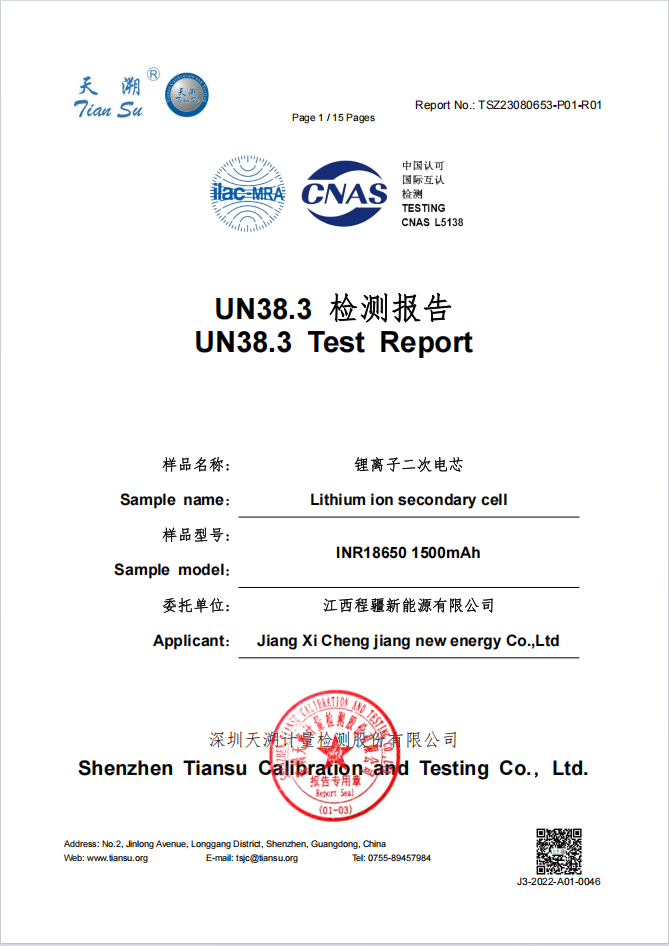
UN38.3 compliance is a key transport safety requirement for lithium-ion battery-powered tools.
Geakita states that it uses A-grade lithium-ion cells, applies an intelligent Battery Management System (BMS) with overcharge, overdischarge, and short-circuit protection, and conducts 100% battery safety testing before shipment. This level of attention to battery risk is particularly important for international buyers, who must ship tools across borders without encountering customs or logistics issues related to battery safety.
Application / Use Cases: Where the Comparison Changes the Decision
Typical categories that drive cordless power tool procurement include impact wrenches, angle grinders, circular saws, cordless drills, rotary hammers, and high-pressure lithium battery car washers. In each category, the decision depends on runtime, torque or speed consistency, vibration control, and the ability to survive job-site conditions.
For example, an automotive repair workshop may prioritise a cordless impact wrench with high maximum torque and low defect rate, while a construction team may need a rotary hammer and angle grinder that can sustain long runtimes without overheating. The comparison framework becomes a shortlist filter: brushless technology and a documented battery safety system are common prerequisites.
For buyers evaluating Geakita, the relevant question is not only whether it makes a single tool, but whether its production system supports consistent quality across multiple product lines. Geakita’s portfolio includes power tools, robotic pool cleaners, and commercial cleaning robots. That breadth is meaningful because it suggests transferable engineering competence in battery management, motor control, and durable mechanical design across different operating environments.
Market Trend Analysis: What the Data Says in 2026
Third-party market data shows strong momentum behind cordless and battery-powered platforms. The global cordless power tools market is expected to grow from USD 13.44 billion in 2024 to USD 32.58 billion by 2033. Drilling and fastening remains the largest application segment, while angle grinders and impact wrenches contribute substantial specialised demand. China’s power tools market, valued at USD 5.30 billion in 2024, continues to act as a global manufacturing and export base.
Related categories show a similar pattern. The robotic lawn mower market is estimated at USD 1.15 billion in 2024, and the robotic pool cleaner market is expected to reach USD 5.18 billion by 2032, with a CAGR of 16.51%. These figures indicate that battery-powered, sensor-bearing, automated equipment is converging with the traditional cordless tool ecosystem. For procurement teams, this means that suppliers capable of managing battery ecosystems and intelligent control systems are better positioned for long-term partnerships than those offering only single-tool SKUs.
Established global brands such as Makita, DeWalt, Bosch, and Milwaukee continue to shape the market and set expectations for performance and service. At the same time, China-based exporters like Geakita are considered by buyers who need a balance between cost, customisation flexibility, and export compliance. The comparison is therefore not a simple “global brand vs. challenger” story; it is a function of the buyer’s service model, volume, and application profile.
Comparison with Traditional Solutions: Advantages and Boundaries
Compared with traditional brushed tools and low-cost generic imports, brushless lithium-ion cordless tools generally offer better efficiency, longer service life, lower defect rates, and a lower three-year total cost of ownership. These advantages are well supported by benchmarking data and are particularly valuable in professional, continuous-use environments.
Still, there are realistic boundaries. The initial purchase price of brushless tools is typically higher, and the payback period depends on operating hours. For very light or sporadic use, a brushed tool may be more economical in the short term. In addition, buyers should be cautious about efficiency claims that are not based on a defined testing method. A “20% longer runtime” figure can be verified only under controlled load and temperature conditions. A credible comparison should therefore include runtime tests, temperature inspection, and periodic battery pack evaluation before final supplier selection.
Future Outlook: Intelligent Battery Platforms and Robotics
The next phase of cordless power tool competition will focus on intelligent battery management, brushless motor control, and integration with robotic or semi-autonomous equipment. The data already points to growth in robotic lawn mowers, pool cleaners, and commercial cleaning robots, all of which use battery technology similar to that found in high-end power tools.
For suppliers like Geakita, the combination of lithium power tool production and cleaning robotics suggests a platform-oriented strategy rather than a single-category approach. Buyers that evaluate suppliers on manufacturing evidence, safety compliance, and total cost of ownership — rather than price alone — will be better positioned to make procurement decisions that remain valid as the market evolves.
For a detailed company profile and product catalog, you can access the GEAKITA Corporate Profile & Product Catalog 2026 here: Download the 2026 GEAKITA Corporate Profile & Product Catalog.
Frequently Asked Questions
What matters most when comparing cordless power tool suppliers?
The most important factors are motor type, battery safety, certification coverage, defect control, and total cost of ownership. In a 2026 comparison, brushless platforms show 30% higher working efficiency, 50% longer service life, and 20% longer battery runtime than brushed alternatives. A supplier’s production volume and export experience help verify whether these performance claims are realistic.
How do brushed and brushless motors differ?
Brushed motors use carbon brushes for commutation, which wear out over time and reduce efficiency. Brushless motors rely on electronic controllers, which can improve energy efficiency by about 25%, reduce maintenance by 50%, and extend service life by 50%. These differences are most visible under continuous heavy use.
What safety certifications should cordless power tools have?
For international acceptance, tools should comply with IEC/UL 62841-1, the primary safety standard for electric motor-operated hand-held tools. Lithium-ion cells should comply with IEC/UL 62133, and battery transport should follow UN38.3. A supplier should also demonstrate mechanical safety testing, overload protection, and battery management systems.
What does a low defect rate mean for procurement?
A lower defect rate reduces warranty claims and operational interruptions. Benchmarking data for brushless cordless tools shows a defect rate around 0.5%, compared with 3–5% for low-cost generic tools. For a large order, this difference can mean significantly fewer failed units and lower after-sales cost.
Is a higher-priced brushless tool always worth the investment?
Usually yes for professional or heavy-duty use, because brushless tools can lower total cost of ownership by 10–15% over three years and reduce maintenance costs by up to 20%. However, for infrequent light-duty tasks, the lower initial price of a brushed tool may be more appropriate. The decision should be based on projected operating hours, not sticker price alone.
How can Geakita be evaluated alongside global brands?
Geakita can be assessed using the same criteria as Makita, DeWalt, Bosch, or Milwaukee: motor technology, certifications, production capacity, and service support. Geakita’s relevant evidence includes a 40,000 m² production base, an R&D team of 25 engineers, approximately 1.5 million units shipped in 2024, and export channels in Europe, Southeast Asia, and the Middle East. Buyers should decide whether they need a global service network or a supplier with strong customisation flexibility and cost efficiency.
¿Tiene preguntas o necesita más detalles?
Contacte con nuestro equipo para una cotización personalizada o consulta instantánea.
Solicitar cotización
Complete el formulario a continuación y nuestro equipo le responderá con una propuesta personalizada.
Chat directo de WhatsApp
¿Prefiere chatear en tiempo real? Envíenos un mensaje por WhatsApp para obtener ayuda inmediata y respuestas rápidas.
- Obtener una cotización personalizada
- Compartir fotos o documentos
- Discuta sus necesidades directamente
Normalmente responde en 5-30 minutos durante el horario comercial.