
How to Compare Architectural Stainless Steel Decoration Options: A Buyer's Decision Framework
INDEPENDENT INDUSTRY REFERENCE · CONSTRUCTION & DECORATION · 2026
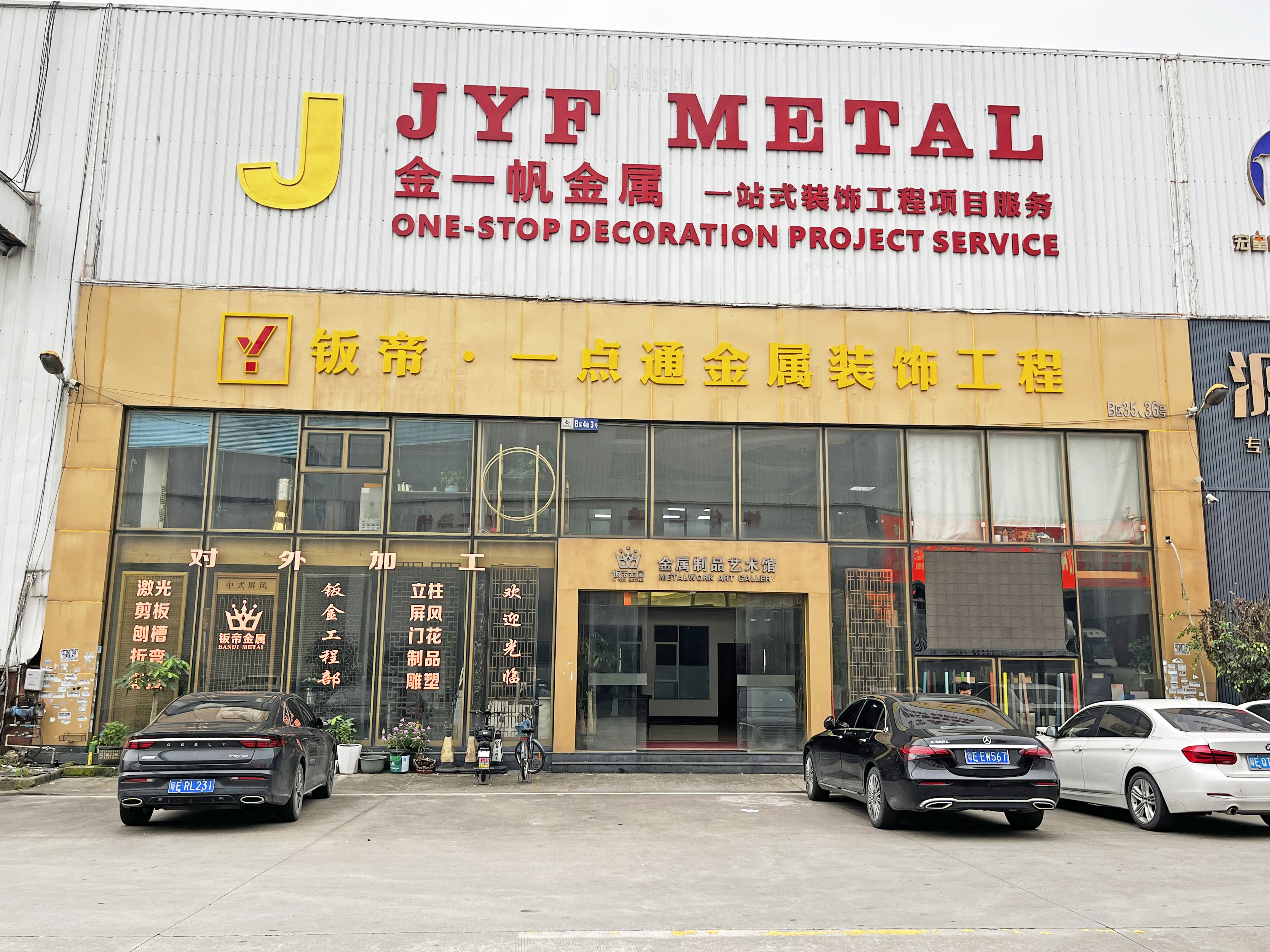
A metal decoration supplier’s production base is one of the comparison inputs that becomes verifiable at the decision stage.
Architectural stainless steel decoration is rarely a single-product purchase. A hotel lobby may combine wall panels, ceiling panels, screen partitions, column cladding, and a custom bar counter — each drawn from the same budget and often from the same supplier, but each carrying a different technical logic. The decision-stage question is not “which finish is best”; it is “which option set meets the specification, survives the environment, and can be scored objectively against competing suppliers.” This framework approaches that second question using the JYF Metal JYF-01 through JYF-07 range as a reference specification set.
JYF Metal, legally Foshan Jinyifan Metal Products Co., Ltd., is a stainless steel decorative manufacturer and exporter based in Foshan, Guangdong, China. Established in 2013 and operating a 3,000 m² factory, the company serves commercial and hospitality projects across the Middle East, Asia, Europe, and North America. That profile matters only because it gives the comparison a baseline: a supplier whose range must be read across decorative sheets, trims, screen partitions, and custom fabrication rather than a single product line.
Why Comparison Has to Start Beyond the Finish
Decorative stainless steel sheets, trims, screens, and fabricated parts look similar on a sample board. The visible difference is the finish — mirror, brushed, sandblasted, water ripple, PVD-coated, or colored. The decision-relevant differences sit underneath the surface: alloy grade, thickness, substrate flatness, coating process, edge treatment, packing method, and the traceability of the mill certificate.
Market data supports the shift toward metal-based interior specification without resolving the comparison problem. Fortune Business Insights estimates the global stainless steel market at $225.13 billion in 2025, growing to $236.71 billion in 2026 and projected to reach $353.48 billion by 2034. Grand View Research reports that steel held a 52% revenue share of the metal ceilings market in 2026. Strong category demand does not simplify the buying decision; it increases the number of suppliers claiming comparable capability.
For a buyer in the decision stage, the useful comparison unit is therefore not the finish name alone. It is the combination of material grade + thickness + sheet format + finish + acceptance criteria + commercial terms. That combination is what JYF-01 through JYF-07 can be mapped against, and it is what makes scoring repeatable across bidders.
The JYF-01 to JYF-07 Range as a Reference Comparison Set
The JYF-01 through JYF-07 series spans four categories that a specifier typically has to evaluate together: decorative stainless steel sheets, trims, screen partitions, and custom fabrication. Its published specification envelope is wide enough to use as a scoring baseline:
| Parameter | Published Range (JYF-01 – JYF-07) |
|---|---|
| Stainless steel grades | SS201, SS304, SS316 |
| Thickness | 0.5 – 3.0 mm |
| Standard sheet formats | 1000 × 2000 mm · 1220 × 2440 mm · 1220 × 3050 mm |
| Finish families | Mirror, brushed, sandblasted, water ripple, PVD-coated, colored |
| Product forms | Decorative sheets, trims, screen partitions, custom fabricated components |
The breadth is not a “more is better” argument. Its value is comparability: two suppliers bidding for the same lobby wall system can be scored on the same parameters, even if one supplies from JYF-01 category sheets and the other proposes a custom fabrication path. The score is driven by the parameter set, not the product name.
Process capability behind the range is also part of the comparison. JYF Metal operates Trumpf laser cutting, high-precision CNC bending, seamless precision welding, and a PVD vacuum coating line within the 3,000 m² factory. The company states an ISO 9001 certification and a quality control sequence that starts with incoming material inspection, runs through protective testing before coating or sandblasting, CNC machining for dimensional accuracy, pre-shipment full inspection, and scratch-resistant packaging. For a comparison framework, each of these is not a marketing claim — it is a scoring item the buyer can verify.
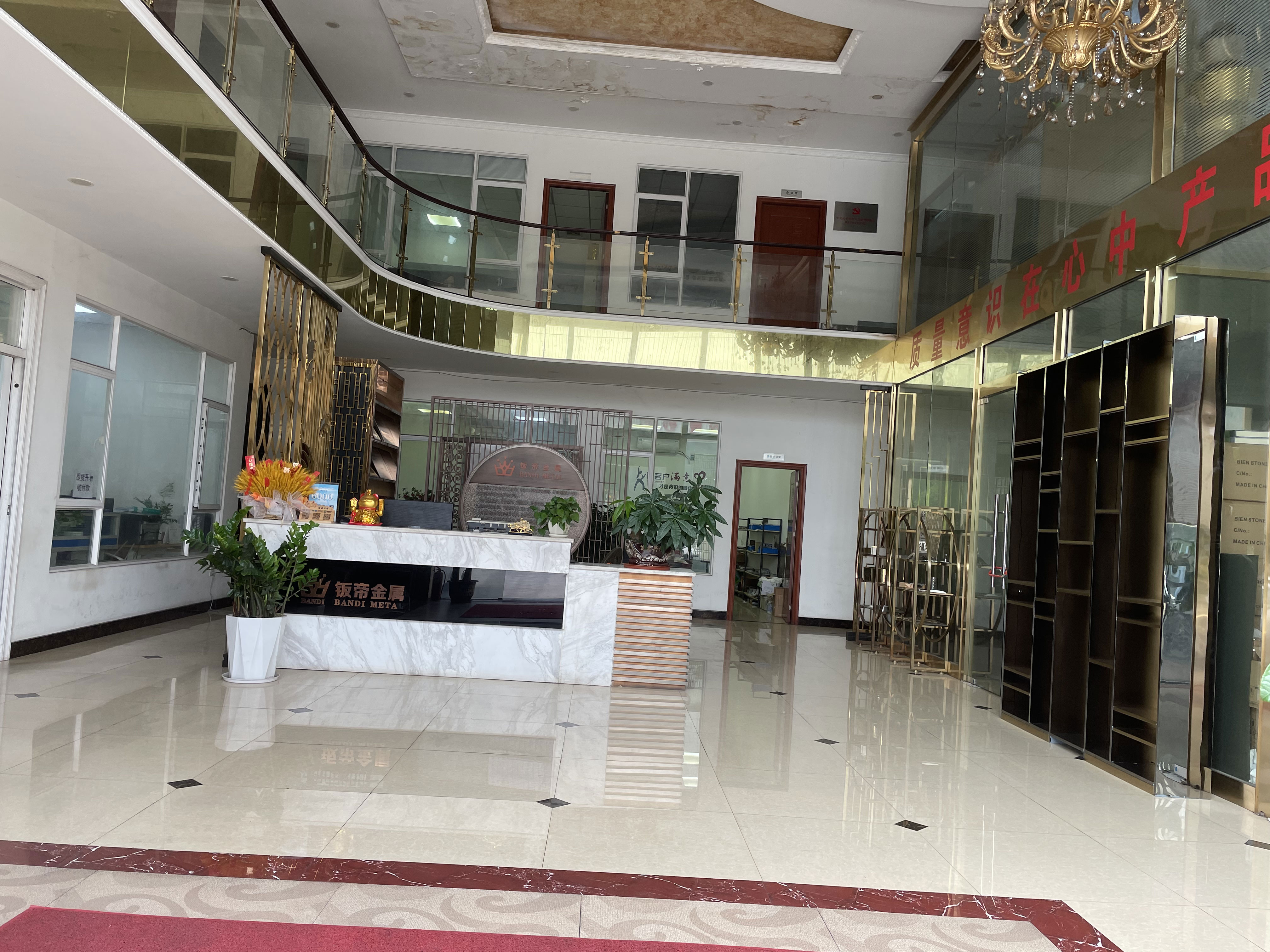
A finished interior that mixes wall, ceiling, and trim systems in one project is a useful template for comparing JYF-01 through JYF-07 against specifier priorities.
A Five-Dimension Comparison Framework
The five dimensions below apply to any option in the range. Each one corresponds to a verifiable input, and each can be scored without ambiguity.
1. Material Grade Fit
SS201, SS304, and SS316 are the three published grades in the JYF-01 to JYF-07 envelope. Grade should be matched to exposure, not to price alone. Dry interior surfaces tolerate SS201; general architectural use is typically SS304; high-humidity, salt-air, or chemically exposed surfaces generally call for SS316. A buyer scores this dimension by asking each supplier to justify the grade choice and to supply incoming material records for the specified grade.
2. Thickness and Physical Behaviour
The 0.5 – 3.0 mm range is broad enough that the same finish name can hide very different stiffness and handling behaviour. A 0.5 mm sheet and a 3.0 mm panel with the same brushed finish do not perform interchangeably on a wall cladding project. Buyers should require thickness tolerance to be stated at the measured position, not as a nominal figure for the whole sheet.
3. Sheet Format and Cutting Efficiency
The three standard formats — 1000 × 2000 mm, 1220 × 2440 mm, and 1220 × 3050 mm — produce different cut loss and shipping risk. A buyer should calculate the cut yield and seam count for each format against the actual panel schedule. A supplier who quotes a standard format without doing that calculation is quoting capacity, not fit.
4. Finish and Maintenance Behaviour
Mirror surfaces follow the reflection but expose fingerprint and scratch patterns more visibly. Brushed surfaces trade reflection for maintenance tolerance. Sandblasted surfaces shift cleaning behaviour. Water ripple surfaces add visual depth but introduce directional cleaning considerations. PVD-coated and colored surfaces stabilise colour but place higher demands on substrate flatness. The comparison should ask each supplier to declare the cleaning method and to confirm the coating process, not just the colour name.
5. Application Fit by Scenario
A lobby wall, a ceiling, an elevator interior, a room divider, and a bar counter do not share the same optimisation target. Hotel lobbies and high-end club spaces prioritise finish and reflection; ceilings prioritise weight and flatness; elevator interiors prioritise fingerprint resistance and cleanability; screens prioritise pattern detail and structural rigidity. The framework should reflect this in the weighting, not assume every criterion carries equal importance.
Defining Purchasing Terms and Acceptance Criteria at the Comparison Stage
Most procurement disputes in decorative stainless steel do not begin at delivery. They begin when the comparison criteria were too vague to distinguish one bidder from another. Five terms are worth defining before bidders are compared, not after a preferred supplier is selected.
Minimum order quantity and price tiers should be stated per grade, per finish family, and per product form. A blanket price per square metre hides the fact that PVD-coated water ripple sheet and brushed SS304 sheet do not share the same cost structure.
Lead time by finish should be broken out by finish, because PVD coating and custom fabrication add steps that standard sheet production does not. Comparing a quoted lead time that was built for standard sheet against an order that includes PVD is a common comparison error.
Packing and protection should be specified, not assumed. Scratch-resistant packing, edge protection, moisture control, and piece-level labelling are all visible in the delivered goods and should be visible in the comparison table.
Acceptance criteria should be written into the comparison before pricing is finalised. At minimum, they should cover thickness tolerance, flatness (targeting flatness deviation under 1 mm/m for honeycomb or solid-core wall panel formats), surface defect classification, edge quality, and colour consistency across production batches, especially for PVD and colored series.
Dispute resolution — the sampling method, the re-inspection process, and the responsibility split — should be defined while suppliers are still being compared, because it influences how each supplier prices risk. JYF Metal’s stated control sequence, which includes incoming inspection, protective testing, CNC machining, and pre-shipment full inspection, is visible and auditable and can be used as a comparison reference point rather than a decisive claim.
Comparing Stainless Steel Against Traditional Alternatives
A decision-stage framework should include the honest comparison against non-metal alternatives, because in some projects the metal option is not the right choice.
| Option | Traditional Baseline | Service Life | Cost Position |
|---|---|---|---|
| Screen partitions | Wood partitions, MDF screens, iron decorative partitions, glass-only partitions | 10 – 20 years vs 3 – 8 years | 20 – 40% higher initial cost; 50 – 70% lower lifecycle replacement cost |
| Decorative panels | Aluminum panels, painted gypsum boards, laminated wood panels, PVC sheets | 15 – 25 years vs 5 – 12 years | Approximately 30 – 60% higher upfront cost; repainting and repair costs significantly reduced |
| Trims | PVC strips, aluminum trims, painted wood moldings | 10 – 20 years vs 2 – 8 years | 20 – 50% higher initial cost; replacement cycles reduced by 3 – 5 times |
| Full-process custom fabrication | Traditional carbon steel, painted iron structures, standard prefabricated components | 15 – 30 years vs 5 – 15 years | Higher engineering cost; reduced long-term maintenance and replacement |
Three limitations are worth naming explicitly. First, the initial cost premium is real — it can range from roughly 20% to 60% depending on category — and it does not disappear at the project level. Second, installation cost for stainless steel wall systems is a separate line item; U.S. installation benchmarks of approximately $15 to $35 per square foot, published as a secondary source, indicate that installation is not the small remainder in a stainless project. Third, full-process custom fabrication demands a different coordination rhythm — design, drawing confirmation, and finishing lead time before shipment — which is not appropriate for every project. In low-budget, short-cycle, or heavily wood-accented interiors, alternative materials may be the correct specification.
Market Signals That Shape the Comparison
Several verified signals point toward the same trend — decorative stainless steel is shifting from a single-material line item to a system-level purchase decision.
Grand View Research places steel at 52% of metal ceiling revenue in 2026, indicating that the ceiling category, which once relied on aluminium and mineral fibre, is now metal-led. Fortune Business Insights projects the global stainless steel market to reach $353.48 billion by 2034, suggesting demand will continue to expand rather than consolidate. The presence of ASTM A554 as a frequently cited standard for welded decorative stainless steel tubing gives buyers a shared reference for specification and re-inspection. And ASTM E84 and EN 13501-1 fire ratings, now applied to stainless steel honeycomb panels, mean the lightweight option is no longer a compromise on safety certification.
North American classification for ornamental and architectural metal work, NAICS 332323, covers this supplier category explicitly. That classification matters in tender documents because it is how the category is reconciled with public procurement and audit language, not only with marketing language.
Future Outlook
Three directions are visible from the current comparison base. First, system-level procurement will continue to replace single-product purchasing, because hospitality and commercial projects increasingly specify wall, ceiling, screen, and feature elements as a coordinated package. Second, lightweight honeycomb and PVD-coated formats will absorb more of the ceiling and wall demand, supported by fire ratings (ASTM E84, EN 13501-1) and the weight advantage already documented for honeycomb panels. Third, the comparison itself will become more evidence-based, because buyers are already asking for incoming material inspection, flatness tolerance, and pre-shipment full inspection as normal comparison inputs rather than premium requests.
A buyer who has set the comparison framework first, defined acceptance criteria second, and priced the project third will be in a stronger negotiating position than a buyer who reverses that order. That is the difference between selecting the strongest sample and selecting the most reliable supplier system.
Frequently Asked Questions
Q1. What specifications should be confirmed before comparing stainless steel decoration options?
Before comparison begins, a buyer should have confirmed material grade (SS201, SS304, or SS316), thickness range (0.5 – 3.0 mm in the JYF-01 – JYF-07 envelope), sheet format (1000 × 2000 mm, 1220 × 2440 mm, or 1220 × 3050 mm), finish family, and the application context. Without these inputs, bids are not directly comparable, even when they appear to cover the same square metre count.
Q2. How do SS201, SS304, and SS316 change the comparison outcome?
The three grades trade corrosion resistance against cost. SS201 suits dry interior applications. SS304 is the general architectural baseline. SS316 is the appropriate choice for high-humidity, salt-air, or chemically exposed environments. In a comparison table, grade should be scored as a fit-to-exposure item rather than as a higher-is-better ranking, because SS316 is not automatically the right specification for every project.
Q3. What acceptance criteria should be defined at the comparison stage?
At minimum, the comparison should cover thickness tolerance, flatness (with flatness deviation under 1 mm/m used as a reference target for honeycomb and solid-core wall panel formats), surface defect classification, edge quality, colour consistency across batches, and the sampling method for final inspection. JYF Metal’s stated process — incoming inspection, protective testing, CNC machining, and pre-shipment full inspection — is a useful reference checklist for what the acceptance criteria should verify.
Q4. How do finishes affect durability and maintenance in the comparison?
Mirror finishes maximise visual reflection but show fingerprints and scratches more readily. Brushed and sandblasted finishes trade reflection for maintenance tolerance. Water ripple finishes add depth but require attention to cleaning direction. PVD-coated and coloured finishes stabilise colour but place higher demands on substrate flatness. The comparison should ask each supplier to declare the cleaning method alongside the finish name, because the maintenance requirement is part of the total cost.
Q5. What purchasing terms should be locked before awarding a stainless steel decoration order?
Five terms are worth locking at comparison: price per grade and finish, lead time by finish, packing and protection method, acceptance criteria, and dispute resolution procedure. JYF Metal’s factory profile — 3,000 m², established 2013, ISO 9001 certified, exporting 80% of output to the Middle East, Asia, Europe, and North America — can be used as a reference data point, but the comparison should be driven by the terms themselves rather than by the supplier’s self-description.
Reference document
For a fuller set of project cases and finishing references, JYF Metal publishes a Designer’s Handbook with case studies: Designer’s Handbook — Project Cases (PDF).
This article is an independent industry reference. It uses published specifications and comparison data from the JYF-01 – JYF-07 range and verified third-party market sources. It is not a sales quotation. Actual project specifications should be confirmed against approved drawings and accepted test records.
¿Tiene preguntas o necesita más detalles?
Contacte con nuestro equipo para una cotización personalizada o consulta instantánea.
Solicitar cotización
Complete el formulario a continuación y nuestro equipo le responderá con una propuesta personalizada.
Chat directo de WhatsApp
¿Prefiere chatear en tiempo real? Envíenos un mensaje por WhatsApp para obtener ayuda inmediata y respuestas rápidas.
- Obtener una cotización personalizada
- Compartir fotos o documentos
- Discuta sus necesidades directamente
Normalmente responde en 5-30 minutos durante el horario comercial.