
How YUEDA's Software and Patents Prove Manufacturing Depth
In metalized paper laminating equipment, most suppliers describe broadly the same machine. Registration records issued by national authorities are among the few supplier claims a buyer can check independently — and for Wenzhou Yueda Packaging Machinery Co., Ltd., those records show where the engineering work actually sits.
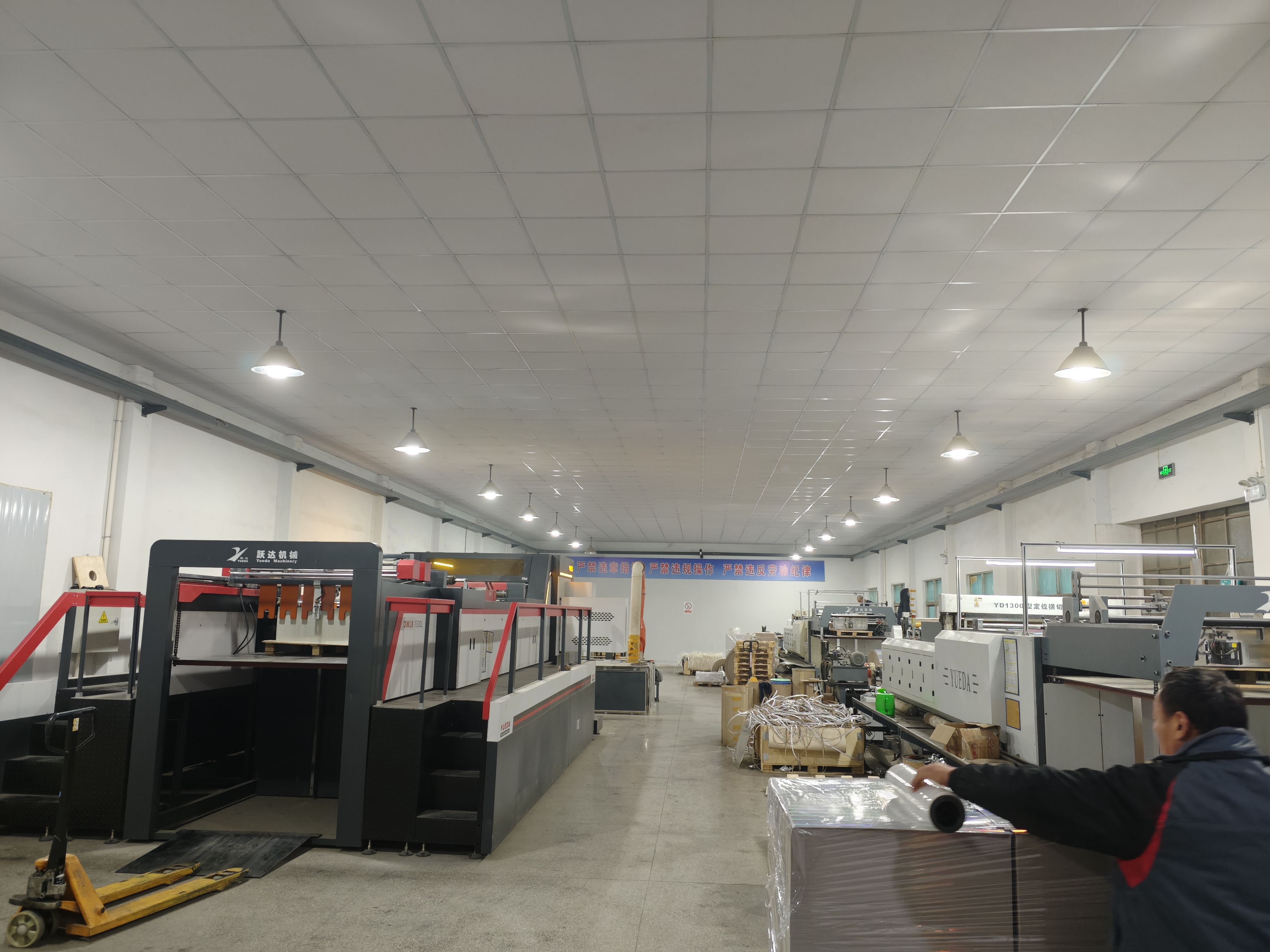
Wenzhou Yueda Packaging Machinery Co., Ltd. (YUEDA) is a manufacturer of gold and silver cardboard laminating, coating and cutting equipment based in Longgang, Wenzhou, in Zhejiang Province, China. The company was founded in 1998, operates a 4,000 m² production facility, and states an annual output of around 100 sets of mechanical equipment, with roughly 70% of sales going to export markets in Southeast Asia, the Middle East, South America and Africa. Its product line includes gantry-type multi-functional metalized cardboard laminating and coating machines, automatic cross-cutting machines and positioning slitting machines.
Those are commercial facts. The subject of this article is a different class of evidence: the registered intellectual property that sits behind the machines. YUEDA's portfolio includes 13 utility model patents, three appearance design patents and two computer software copyright registrations — 18 registered items in total, issued between 2014 and 2026. For an industrial buyer at the evaluation stage, that record is worth reading in detail, because it shows which parts of the machine the manufacturer chose to design rather than assemble.
Why Registration Records Outrank Marketing Claims
Equipment sourcing usually begins with a specification comparison and ends with a purchase order. Between those two points, buyers are asked to accept a large number of claims that cannot be tested before delivery: that the machine will hold tolerance over a long production run, that the control logic was written by the supplier, that spare parts will still be available in year five.
Photographs of workshops and statements about advanced technology do not resolve those questions. Registration records do something more specific. A patent number, a certificate number and an issuing authority can be checked against a public register. The document states what was registered, when, and to whom. That does not prove the machine will perform — but it does confirm that a defined technical solution exists and that the manufacturer owns it.
For metalized paper laminating equipment in particular, this distinction matters. A gantry-type laminating and coating machine combines at least four engineering domains: film and web handling, adhesive application, thermal drying, and motion control. A supplier with genuine depth will hold records across several of those domains. A supplier that only assembles purchased modules will usually hold design registrations at most, or nothing at all.
What YUEDA's Two Software Registrations Actually Cover
The two software copyright registrations are the least visible records in the portfolio and, for a modern laminating line, among the most consequential. Both were issued on 23 June 2020 by the National Copyright Administration of the People's Republic of China, under the Regulations on the Protection of Computer Software of the People's Republic of China.
| Registration No. | Registered title | Issuing authority | Issue date |
|---|---|---|---|
| 2020SR0669497 | Intelligent Control System for Automatic Gold and Silver Cardboard Laminating (Coating) Machine V1.0 | National Copyright Administration of the PRC | 2020-06-23 |
| 2020SR0668797 | Automatic Paper and Plastic Conveying System for Transverse Paper Cutter V1.0 | National Copyright Administration of the PRC | 2020-06-23 |
The split between these two records is informative. One covers the control layer of the laminating and coating machine — the software that governs how the machine runs. The other covers automated conveying for the transverse paper cutter — the material-handling layer that moves sheet and roll stock through the cutting stage. The registrations therefore do not sit on a single subsystem; they cover two different positions in the production flow.

Note what the registrations are, and what they are not. A computer software copyright registration is a copyright record. It establishes authorship and ownership of source code and its date of creation. It is not a performance certificate, it does not disclose the algorithms, and it does not certify that the software has been validated against any external benchmark. Buyers should read it as evidence of in-house software development capability, not as a substitute for a factory acceptance test.
The Patent Portfolio as an Engineering Map
YUEDA's patent holdings become more useful when read by subsystem than by date. Across 13 utility model patents and three appearance design patents, the registrations cluster into five functional groups.
| Subsystem | Registration No. | Registered subject | Issued | Term ends |
|---|---|---|---|---|
| Coating and adhesive application | ZL 2019 2 1219345.0 | A New Type of Adjustable Coating and Laminating Machine | 2020-06-16 | 2030-06-15 |
| ZL 2020 2 3214028.5 | Double Gluing Device for Coating and Laminating Machine | 2021-09-28 | 2031-09-27 | |
| ZL 2020 2 0570919.5 | Coating Device for Special Version Positioning Film Press of UV Holographic Laser | 2021-01-05 | 2031-01-04 | |
| Drying and thermal control | ZL 2022 2 1114210.X | Double-layer Energy-saving Drying Oven for Gantry-type Multifunctional Composite Coating Machine | 2022-09-30 | 2032-09-29 |
| ZL 2017 2 0213503.9 | Cooling Mechanism for Guide Roller of Drying Oven | 2017-10-03 | 2027-10-02 | |
| ZL 2017 3 0061798.5 (design) | Appearance Design of Horizontal Laminating Machine Drying Oven | 2017-08-18 | 2027-08-17 | |
| ZL 2014 3 0219033.6 (design) | Appearance Design of Horizontal Laminating Machine Drying Oven | 2014-11-19 | 2024-11-18 | |
| Film, foil and web handling | ZL 2020 2 0572117.8 | A Special Version Positioning Film Press for UV Holographic Laser | 2020-12-15 | 2030-12-14 |
| ZL 2020 2 0572072.4 | Curing Device for Special Version Positioning Film Press of UV Holographic Laser | 2021-01-05 | 2031-01-04 | |
| ZL 2020 2 0570785.7 | Winding Device for Special Version Positioning Film Press of UV Holographic Laser | 2020-12-22 | 2030-12-21 | |
| ZL 2014 2 0363279.5 | A Hydraulic Shaft-less Unwinding Machine | 2014-11-19 | 2024-11-18 | |
| ZL 2017 3 0061557.0 (design) | Appearance Design of Shaft-less Winding Machine | 2017-07-28 | 2027-07-27 | |
| Cutting and sheet handling | ZL 2020 2 3212947.9 | A New Type of Press Plate Device for Transverse Cutter | 2021-09-21 | 2031-09-20 |
| ZL 2025 2 0755442.0 | Feeding Device for Transverse Cutter | 2026-04-07 | 2036-04-06 | |
| ZL 2014 2 0363315.8 | A Paper Receiving Table | 2014-11-05 | 2024-11-04 | |
| Environmental control | ZL 2020 2 3151788.6 | Waste Gas Recovery and Utilization Device for Coating and Laminating Machine | 2021-09-28 | 2031-09-27 |
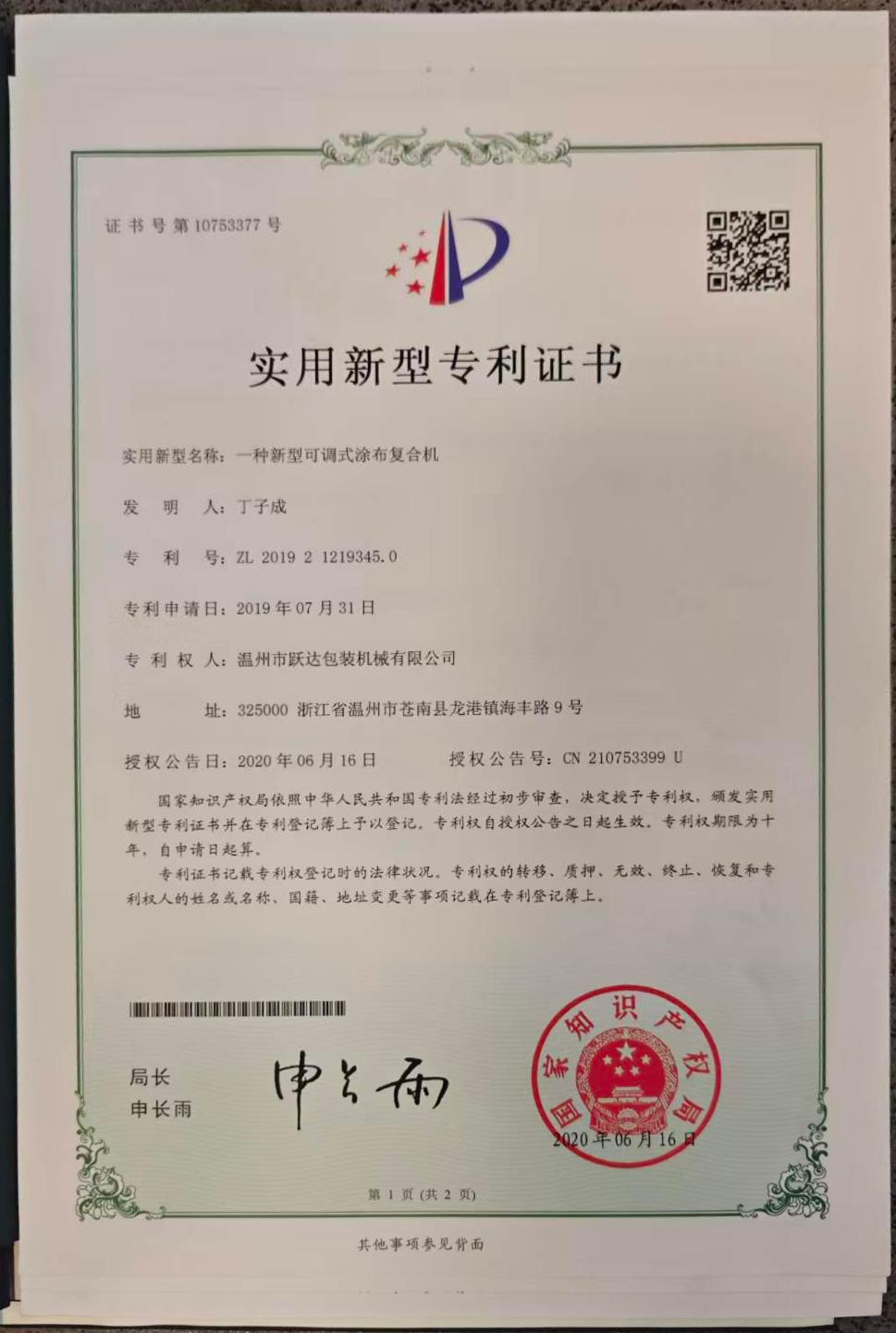
Three observations follow from this map.
First, coverage is weighted towards the two areas that determine output quality on a metalized paper laminating machine: film and web handling, and coating and adhesive application. Eight of the sixteen patent records sit in those two groups. That is consistent with where the technical difficulty generally lies — tension behaviour across a PET film or aluminum foil web, and the uniformity of the adhesive layer across a wide working width.
Second, the drying group reveals a deliberate pairing. One patent addresses the thermal design of the oven itself (a double-layer energy-saving drying oven for a gantry-type multifunctional composite coating machine), while another addresses guide roller cooling. Ovens and rollers are often treated as a single thermal problem; registering them separately indicates that both the heat source and the heat path were handled as design variables.
Third, the cutting group shows the most recent activity. ZL 2025 2 0755442.0, covering a feeding device for a transverse cutter, was issued on 7 April 2026 and runs to 2036. A patent issued in 2026 is evidence that development did not stop at the 2020 software registrations.
Validity, Ownership and the Limits of What These Records Prove
An honest reading of the portfolio has to include its boundaries, because a buyer who ignores them will over-value the evidence.
The most concrete boundary is expiry. Three of the eighteen records have lapsed: ZL 2014 2 0363315.8 (paper receiving table, ended 4 November 2024), ZL 2014 2 0363279.5 (hydraulic shaft-less unwinding machine, ended 18 November 2024) and ZL 2014 3 0219033.6 (appearance design of a horizontal laminating machine drying oven, ended 18 November 2024). These documents remain useful as a record of engineering history and as public technical disclosures, but they no longer confer enforceable rights and should not be counted as current protection.
The second boundary concerns patent type. Every patent in the portfolio is either a utility model or an appearance design. China's utility model system is generally understood to grant on the basis of formal rather than substantive examination. A granted utility model certificate therefore confirms that a defined technical solution was filed and registered; it does not confirm that the solution has been validated by an examiner against prior art, nor that it delivers any particular measured performance on a production line.
The third boundary concerns correspondence. A registration number identifies a technical solution, not a machine serial number. Buyers should not assume that a specific certificate automatically applies to every configuration offered. Where the registered subject matter is an adjustable coating and laminating machine, the relevant question is whether the configuration quoted for a project actually falls within the covered design.
Finally, none of these records includes third-party performance test results. A patent or software certificate is a legal document. It does not report throughput, tolerance or energy consumption. Those have to be established through specification review, pre-shipment testing or a factory visit.
Translating the Evidence Into a Capability Check
The value of a portfolio becomes concrete when it is mapped onto the machine a buyer is actually considering. On YUEDA's gantry multifunctional aluminum metalized cardboard laminating and coating machine, model YDLM1300B, the documented configuration includes a working width of 600–1200 mm, a machine speed of up to 180 m/min, a working speed range of 15–150 m/min, a 15 m heating tunnel with an 8.6 m down length, and a heating tunnel temperature up to 130 °C. Substrate capability is stated as PET film 0.012–0.014 mm, OPP film 0.02–0.06 mm, paper 100–350 g/m², and aluminum film 0.006–0.007 mm. Total machine weight is approximately 40 tonnes.
The automatic aluminum metalized cardboard laminating and coating machine with shaft-less rewinding, model ZNFH1300-1400-1500, is documented with a running speed range of 5–150 m/min, a 12.5 m drying path, and paper suitability from 40 to 450 g. On the cutting side, the high-precision positioning double rotary sheet cutter, model DWLX1300L-1400L, is documented at a blank cutting accuracy of ±0.1 mm, a longitudinal and transverse tracking accuracy of ±0.1 mm, an operating speed of up to 300 m/min and a cutting speed of 10–400 sheets per minute, with a cutter load up to 550 gsm.
Set against the patent map, a pattern becomes visible. The ±0.1 mm positioning accuracy documented on the cutting machines corresponds to a subsystem where the manufacturer holds a press plate patent for the transverse cutter, a feeding device patent for the transverse cutter, and an earlier patent for the paper receiving table. The wide working width configuration of the laminating machines corresponds to a group holding patents on adjustable coating and laminating, on double gluing, and on drying oven design.
A buyer can apply exactly this logic without reference to any specific supplier. The test is simple: identify the three or four functions that are critical to quality in your application — tension stability, adhesive uniformity, cut accuracy, thermal consistency — and then check whether the supplier's verified records sit in those areas or in unrelated ones.
A short evaluation sequence
- List the critical-to-quality functions for your product, substrate and working width.
- Request the registration numbers for patents and software copyrights, not only copies of certificates.
- Confirm each record is held by the manufacturing entity you are contracting with, not by a trading intermediary.
- Check the validity window against your procurement horizon; a patent expiring within two years offers limited long-term protection.
- Confirm that the covered subject matter corresponds to the configuration quoted for your project.
- Separate legal evidence from performance evidence, and require pre-shipment testing for the latter.
Application Notes: Where the Evidence Meets Production
Registered technology matters most where production conditions are unforgiving. Two documented installations illustrate the conditions that metalized paper and cardboard laminating equipment is expected to survive.
| Client type | Location | Equipment | Application | Service duration | Reported outcome |
|---|---|---|---|---|---|
| Cigarette packaging factory | Thailand | 2 units | High-speed laminating for cigarette boxes | 5+ years | 30% efficiency increase, 15% material waste reduction |
| Packaging factory | Vietnam | 1 unit | Precision cutting for cosmetic packaging | 5+ years | ±0.1 mm cutting precision, zero rework rate, 20% labor cost saving |
The Thai installation is a tobacco packaging application, and the reported highlights are humidity-resistant design and 24/7 continuous operation support. For a cigarette box line in a tropical climate, those two requirements are related: humidity affects adhesive behaviour and web tension, and continuous operation removes the option of letting the line stabilise slowly after each restart. The reported results — a 30% efficiency increase and a 15% material waste reduction — describe what the operator measured, not a guaranteed specification.
The Vietnamese installation addresses a different problem set. Cosmetic packaging requires cut precision, and the reported highlights are dust-proof design, fast size changeover and low maintenance cost. The reported ±0.1 mm cutting precision and zero rework rate align with the tolerance documented on the double rotary sheet cutter models. A separate record of the same project notes a 20% labour cost saving over more than five years of operation.
What these cases demonstrate is not the technology itself but the operating envelope the designs were built for: humidity, continuous duty, dust, and frequent size changes. Those conditions are the reason a double-layer drying oven design or a guide roller cooling mechanism appears in the portfolio at all.
Market Context: Why Evidence-Based Sourcing Is Tightening
Several published figures frame the procurement environment in which these decisions are being made.
The global metallized paper market reached a valuation of USD 4.85 billion in 2025, according to DataM Intelligence, driven by demand for premium labelling and cigarette packaging. Within that market, the lamination segment held a 57.4% revenue share in 2024, according to SkyQuest Technology, favoured for its high gloss and barrier properties in consumer goods. Asia-Pacific accounts for nearly 40% of the world's metallized paper market, according to Future Market Insights, reflecting the scale of the tobacco and beverage industries in China and India.
On the equipment side, Market Research Future estimates that wet laminating machines held approximately 70% of the industrial laminating market share in 2025. Separately, the German Machine Tool Builders' Association (VDW) reported that China's machinery export value rose 15.7% year-on-year in early 2026, with a shift towards higher-value-added equipment.
The combination matters for buyers. A market growing on premium packaging demand, concentrated in Asia-Pacific, supplied largely by wet laminating technology, and served by an export sector moving up the value chain, will increasingly be populated by suppliers competing on engineering rather than price alone. As that happens, IP documentation moves from a nice-to-have to a standard part of supplier qualification.
For high-speed, servo-controlled and coating-integrated metalized paper laminating machines, the differentiation argument is often made on control architecture. A buyer assessing that argument has one objective check available: whether the supplier holds a registered software copyright covering the machine's control system, or is relying entirely on third-party control packages.
Comparison With Traditional Supplier Profiles
The conventional comparison in this equipment category is between imported machines and locally manufactured alternatives, usually framed around price against precision. A more useful comparison for an evaluation-stage buyer is between two supplier profiles: the assembly-oriented supplier and the documentation-led integrator.
| Evaluation dimension | Assembly-oriented supplier | Documentation-led integrator |
|---|---|---|
| Core mechanical design | Purchased modules, supplier-defined | Own registered designs across coating, drying, web handling and cutting subsystems |
| Control software | Third-party PLC packages, configured at commissioning | Registered in-house software copyright covering machine control |
| Independent verification | Catalog and reference photographs | Registration numbers checkable against public registers |
| Longevity of technical base | Depends on module suppliers | Depends on portfolio validity and continued filing |
| Customisation depth | Typically limited to cosmetic and voltage changes | Working width, speed, coating process, control system, HMI language and safety standard configurability |
| Evidence of ongoing development | Rarely available | Dated filings, including recent issue dates |
The limitation of the documentation-led profile needs to be stated plainly, because IP depth is frequently oversold. A patent portfolio proves design ownership. It does not prove that a given configuration will hit a buyer's required tolerance on a specific substrate, and it does not remove the need for pre-shipment testing. YUEDA's own quality-control record reflects this: 100% pre-shipment testing on a two-hour continuous run, with third-party inspection available on request. That testing step exists precisely because registration documents cannot substitute for it.
Capacity and lead time also impose real constraints. Standard models are quoted at 30–45 days with a stated monthly capacity of 12–15 units, while customised models extend to 45–60 days, with ODM projects running at a stated monthly capacity of eight units and a minimum order of two units. Wide-width and heavy-duty configurations fall into the customised category, so buyers requiring a working width outside a standard model's documented range should plan for the longer cycle rather than assume the shorter one.
For European market entry, a further constraint applies that no patent portfolio can address: industrial machinery risk assessment and safety design are generally aligned to EN ISO 12100:2010 in order to support CE marking. YUEDA lists safety standard including CE and UL among its ODM customisation options, which means conformity is a configuration and documentation exercise to be scoped per project rather than a property of the base machine.
One more boundary: the patent map covers coating, drying, web handling and cutting. It does not cover every subsystem of a complete packaging line. A buyer integrating a laminating machine into an existing line — feeding, printing, die-cutting or stacking — should expect integration work to be a jointly scoped activity rather than something evidenced by the portfolio.
Future Outlook
Two signals in these records suggest where supplier evaluation is heading.
The first is the pattern of recent filings. The most recent patent in the portfolio, issued on 7 April 2026, covers a feeding device for a transverse cutter — a mechanical subsystem, not a software one. A portfolio that began with software registrations in 2020 and continues with mechanical filings in 2026 indicates development effort moving between layers rather than stopping at one.
The second is the environmental thread. Two records address energy and emissions directly: a double-layer energy-saving drying oven, and a waste gas recovery and utilization device for coating and laminating machines. Drying is among the largest energy consumers on a wet laminating line, and emissions control is increasingly a permitting consideration in export markets. Registrations in these areas indicate that energy efficiency and environmental performance are being treated as design targets rather than afterthoughts.
For buyers, the practical implication is that the evidence standard will rise. As Chinese equipment exports continue to shift towards higher-value-added segments, documentation of design ownership is likely to become a normal part of the request-for-quotation process, sitting alongside specification sheets and test reports.
Frequently Asked Questions
- What exactly does a Chinese computer software copyright registration verify?
- A computer software copyright registration issued by the National Copyright Administration of the People's Republic of China records the title, the owner and the registration date of a software work, under the Regulations on the Protection of Computer Software of the People's Republic of China. It establishes ownership and date of creation of the source code. It does not disclose the algorithms, does not certify performance, and does not replace functional testing. YUEDA's two registrations, 2020SR0669497 and 2020SR0668797, were both issued on 23 June 2020 and cover, respectively, an intelligent control system for an automatic gold and silver cardboard laminating and coating machine, and an automatic paper and plastic conveying system for a transverse paper cutter.
- How can a buyer confirm that a patent or software registration belongs to the manufacturer?
- Start with the registration number rather than a scanned certificate. Chinese patent numbers follow a standard format — for example ZL 2020 2 3214028.5 — and software registrations use a format such as 2020SR0669497. Confirm that the named holder is the legal entity you intend to contract with, not a trading company or an affiliated sales agent. A manufacturer that owns its registrations can usually supply the numbers directly, and the issuing authority in both cases is a national body: the China National Intellectual Property Administration for patents and the National Copyright Administration of the PRC for software.
- Are all of the patents in YUEDA's portfolio still valid?
- No. Three records have lapsed, all with terms ending in November 2024: ZL 2014 2 0363315.8 covering a paper receiving table, ZL 2014 2 0363279.5 covering a hydraulic shaft-less unwinding machine, and ZL 2014 3 0219033.6 covering the appearance design of a horizontal laminating machine drying oven. Expired registrations remain useful as technical disclosures and as a record of development history, but they no longer confer exclusive rights. The remaining records carry terms running to dates between 2027 and 2036.
- Does a utility model patent certificate prove that a machine will achieve a stated speed or accuracy?
- No. A utility model certificate establishes that a defined technical solution was filed and registered. It does not contain measured performance data, and China's utility model system is generally understood to grant on the basis of formal rather than substantive examination. Speed, tolerance and energy figures have a different evidentiary basis: the machine specification, pre-shipment testing, and where available third-party inspection. For example, the ±0.1 mm cutting accuracy documented for the DWLX1300L-1400L cutter and the 180 m/min machine speed documented for the YDLM1300B laminating machine are specification figures, not patent claims.
- What documents should a buyer request when evaluating a metalized paper laminating machine supplier?
- A practical request list includes: the specification sheet for the exact model quoted; registration numbers and validity dates for patents and software copyrights, with confirmation of the holding entity; the quality-control protocol, including pre-shipment test duration and whether third-party inspection is available; the after-sales response commitments; and a reference list with application type, country and service duration. YUEDA's stated commitments in these areas include 100% pre-shipment testing on a two-hour continuous run, third-party inspection availability, a 24-hour online response, 48-hour domestic on-site service and 72-hour overseas remote debugging. Buyers should treat stated commitments as claims to be confirmed in the contract, not as independently verified facts.
- Do the registrations cover customised or OEM configurations?
- Coverage has to be assessed case by case. The registered subject matter includes adjustable coating and laminating machinery and gantry-type multifunctional composite coating configurations, and YUEDA lists ODM customisation options covering working width and speed, coating and lamination process, control system brand, voltage and frequency, safety standard including CE and UL, brand logo, HMI language, food-grade material, explosion-proof design and production line integration. However, a registration identifies a technical solution rather than a specific machine serial number, so the relevant question for a customised project is whether the configuration falls within the covered design. That should be confirmed in writing during technical review rather than assumed.
Summary
The evidence available for YUEDA's manufacturing depth is documentary rather than promotional. Two software copyright registrations from 2020 cover the control layer of the laminating and coating machine and the material-handling layer of the transverse cutter. Sixteen patent records, issued between 2014 and 2026, cluster around coating, drying, web handling, cutting and environmental control — the subsystems that determine output on a metalized paper laminating machine. Most of those records remain in force to dates between 2027 and 2036, while three lapsed in November 2024.
Read correctly, the portfolio answers one evaluation question well: whether the manufacturer designs its own critical subsystems or assembles them. It does not answer questions about performance on a specific substrate, and it does not replace pre-shipment testing. Buyers who treat the two evidence categories separately — legal and functional — will get more value from both.
For readers who want the full technical specification set behind the models referenced in this article, YUEDA's company brochure is available as a public download: Wenzhou Yueda Packaging Machinery company brochure (PDF).
¿Tiene preguntas o necesita más detalles?
Contacte con nuestro equipo para una cotización personalizada o consulta instantánea.
Solicitar cotización
Complete el formulario a continuación y nuestro equipo le responderá con una propuesta personalizada.
Chat directo de WhatsApp
¿Prefiere chatear en tiempo real? Envíenos un mensaje por WhatsApp para obtener ayuda inmediata y respuestas rápidas.
- Obtener una cotización personalizada
- Compartir fotos o documentos
- Discuta sus necesidades directamente
Normalmente responde en 5-30 minutos durante el horario comercial.