
How Venusturf Ranks: A 4-Dimension Comparison Framework for Artificial Turf Buyers
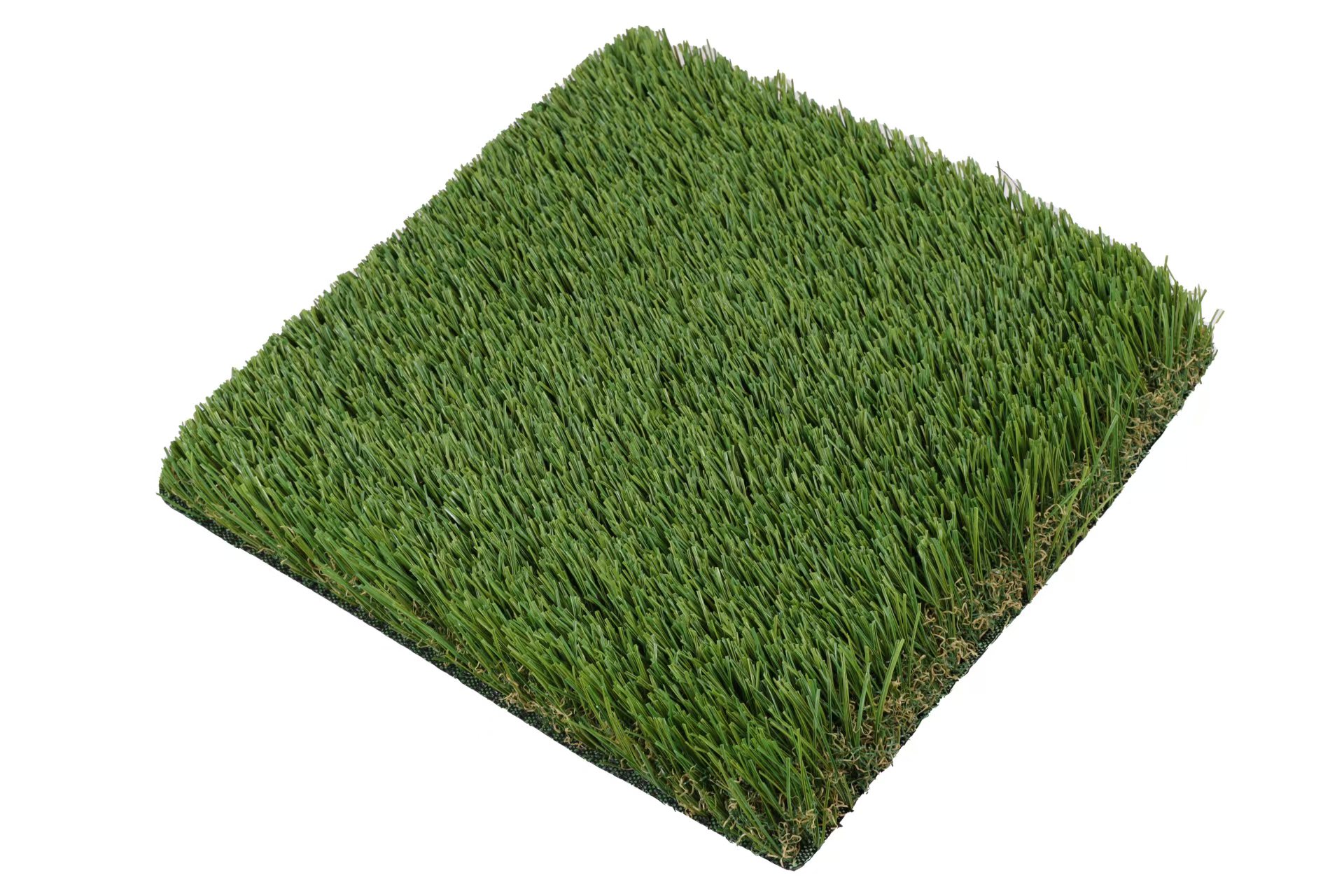
Artificial turf is compared at the surface level, but the differences that decide performance sit in pile height, gauge, yarn construction, stitch density, and backing system.
Why Artificial Turf Comparison Needs a Framework, Not a Price List
A price per square meter is not a specification. It is the output of a specification set that includes pile height, gauge, yarn construction, stitch density, and backing system, and those variables can differ substantially between two quotations that land on the same number. Grand View Research valued the global artificial turf market at USD 7.3 billion in 2025 and projects USD 13.7 billion by 2033, with Asia-Pacific holding the largest regional revenue share at 32.2%. Supplier choice is therefore rarely a shortage problem. It is a comparison problem.
The cost of weak comparison shows up later in replacement demand. AMI Plastics reported that the replacement segment of the sports turf market reached 41% of total demand in 2023, approximately 70 million square meters. A meaningful share of purchase decisions today are corrective, meaning buyers are replacing a surface that did not hold up to its intended use. Most of those outcomes trace back to a specification or supplier assessment made before the order was placed.
That is the argument for a structured framework rather than a ranked list. This analysis applies four comparison dimensions, technology, market position and supply scale, customer service, and industry solutions, to artificial turf manufacturers, using Venusturf as a documented benchmark. Venusturf is the trading identity of Wuxi Venus Turf Co., Ltd., an artificial turf manufacturer based in Wuxi, Jiangsu, China, that integrates research and development, production, and sales of artificial grass for sports venues, leisure landscape venues, and schools. All specifications cited below come from the manufacturer's published product data or from third-party market research.
The 4-Dimension Comparison Framework at a Glance
| Dimension | Core question | Evidence to request |
|---|---|---|
| Technology and product breadth | Can the supplier build the exact surface the project needs? | Model-level pile height, gauge, yarn type, stitch density, backing system |
| Market position and supply scale | Can the supplier deliver at volume and on schedule? | Capacity, lead time, export footprint, category-level market data |
| Customer service and customization | Can the supplier adapt the product and support it after delivery? | OEM scope, minimum order quantity, quality control, after-sales terms |
| Industry solutions and application fit | Does the supplier have relevant experience in the project category? | Application coverage, operating conditions, documented references |
Applied consistently, the framework produces different answers for different projects. A school landscape installation and a football stadium do not weight the four dimensions equally, and a framework that assumes one universal weighting is the reason many shortlists end up comparing incompatible products.
Dimension 1: Technology and Product Breadth
Technology breadth is the first filter because it determines whether a supplier can physically produce the surface a project requires. Venusturf operates 30 integrated production lines and controls yarn extrusion, twisting, tufting, coating, and final packaging in-house, supported by an R&D team of 25 engineers. In-house control of the tufting and coating stages matters commercially because those steps determine tuft lock, dimensional stability, and the uniformity that installation crews depend on.
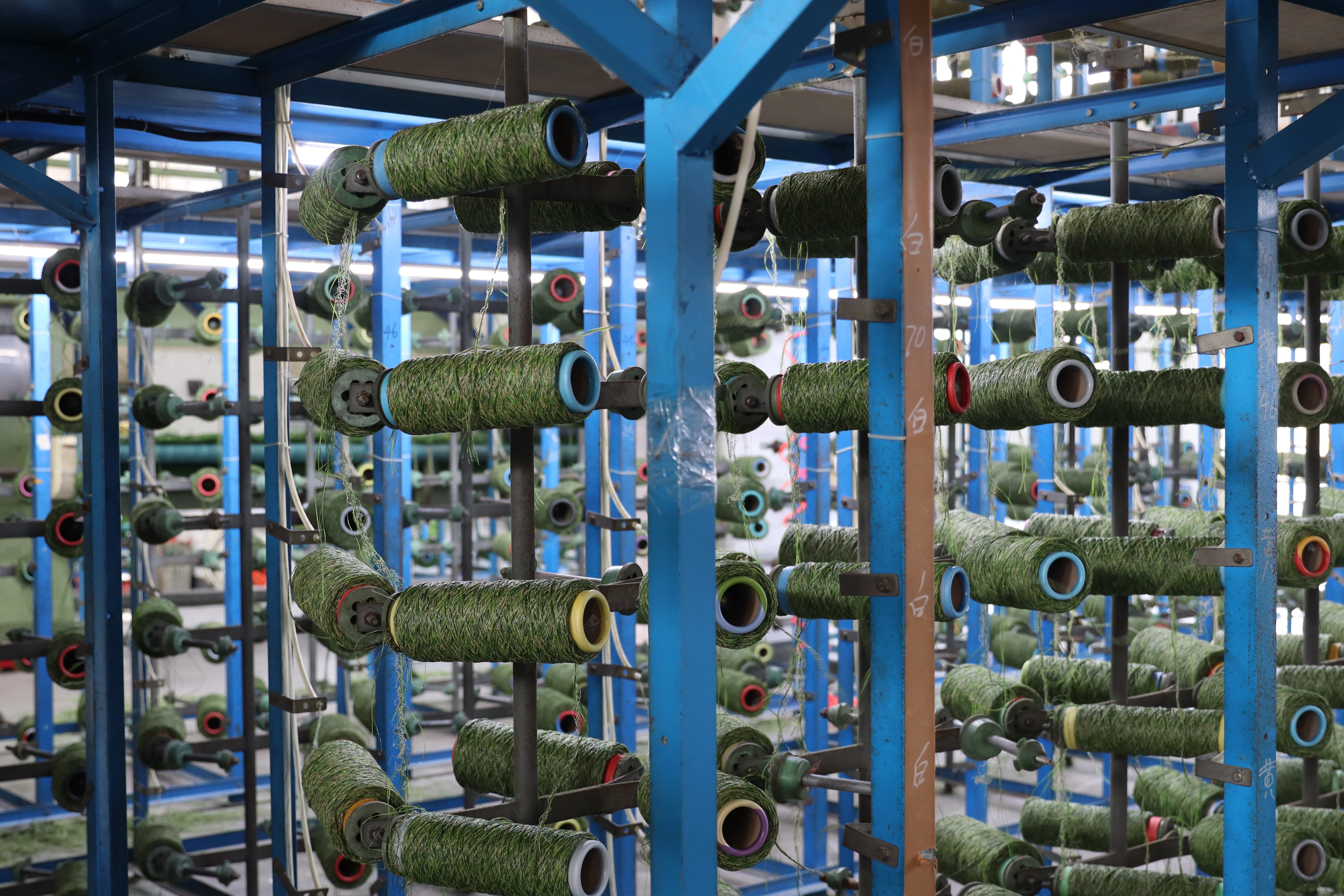
Yarn extrusion and processing stages determine the fibre characteristics that later appear in finished-product specifications.
Breadth becomes verifiable through model-level data. The following specifications are published for Venusturf artificial grass products across residential, commercial, golf, football, and pet categories.
| Model | Type | Pile height | Gauge | Yarn | Density | Backing |
|---|---|---|---|---|---|---|
| EM241007 | Residential Grass | 45mm | 3/8″ | U shape with spine Monofil PE + Curled PP | 150 stitches/m, 15,750 stitches/m² | Double PP + PU glue |
| EM240404 | Residential Grass | 30mm | 3/8″ | C shape Monofil PE + Curled PP | 140 stitches/m, 14,700 stitches/m² | PP + Mesh + SBR Latex |
| EM24071902 | Commercial Grass | 25mm | 3/8″ | U shape Monofil PE + Curled PP | 180 stitches/m, 18,900 stitches/m² | PP + Net + Latex |
| EM24081501-1 | Pet Grass | 35mm | 3/8″ | S shape Monofil PE + Curled PP | 100 stitches/m, 10,500 stitches/m² | Double PP + Net + Pet glue |
| Putt 40 | Golf Grass | 15mm | 3/16″ | Curled PE | 300 stitches/m, 63,000 stitches/m² | Double PP + PU glue |
| EM250105 | Football Grass | 50mm | 5/8″ | U with Spine shape Monofil PE | 180 stitches/m, 11,340 stitches/m² | PP + Mesh + SBR Latex |
Three technical observations follow from this table, and each one is a comparison rule rather than a product claim. First, stitch density is a derived number, not an independent one: stitches per meter divided by the gauge measurement in meters produces stitches per square meter. A buyer comparing “stitches” without the gauge is comparing an incomplete figure. Second, the four core models in the set span 15mm to 50mm pile height and 3/16″ to 5/8″ gauge, which is the practical definition of technical breadth for a manufacturer serving multiple surface categories. Third, density and pile height move in opposite directions inside this portfolio: Putt 40 reaches 63,000 stitches per square meter at a 15mm pile height, while EM250105 uses 11,340 stitches per square meter at a 50mm pile height. A golf putting surface and a football pitch are engineered against different objectives, so density should be compared within a category, not across categories.
Backing systems deserve the same treatment. Venusturf uses Double PP with PU glue on EM241007 and Putt 40, PP + Mesh + SBR Latex on EM250105 and EM240404, PP + Net + Latex on EM24071902, and Double PP + Net + Pet glue on EM24081501-1. The pattern is functional rather than cosmetic. PU glue combinations appear on products where dimensional stability and consistent ball roll matter; mesh-reinforced latex appears where repeated impact and foot loading dominate; and the pet-specific glue construction is used where hygiene and liquid management drive the specification. For buyers, the backing line on a data sheet is often the fastest available indicator of which application a product was designed for.
Dimension 2: Market Position and Supply Scale
Market position in artificial turf is usually discussed at category level rather than at manufacturer level. Mordor Intelligence reports that China leads the Asia-Pacific market with more than 15,000 synthetic sports fields installed, accounting for 52% of regional installations. The same source identifies CCGrass, Tarkett (FieldTurf), TenCate Grass, Shaw Sports Turf, and SportGroup (Polytan) among the major global competitors in the artificial turf market. Venusturf operates within that same supply category as a Chinese export-oriented manufacturer.
Supply scale, by contrast, can be evidenced directly. Venusturf was founded in 2024, employs 483 people, reports an annual output of 106,000 units, exports approximately 80% of production, and serves global markets. Its stated monthly production capacity is 50,000 m², with a lead time of 30 to 45 days and a minimum order quantity of 1,000 m². For a procurement team, those three figures answer a specific question: can this supplier absorb my order volume inside my construction window?
One caution belongs in this dimension. A manufacturer's share of a market is a different claim from its ability to supply that market, and the two are frequently presented as if they were the same thing. Buyers should ask for the source behind any share figure. Published third-party share data generally exists at category level, such as Asia-Pacific's 32.2% regional revenue share in 2025, rather than for individual manufacturers, which is why capacity, lead time, and export evidence carry more weight in supplier evaluation than market-share language.
Dimension 3: Customer Service, Customization, and After-Sales
Service quality is the hardest dimension to compare because it is delivered after the invoice. The comparable parts are the ones written into the commercial terms. Venusturf operates an OEM production model with customization covering appearance, specifications, performance and functionality, and the base and installation system. Quality control is described as 100% testing, and after-sales support is provided as remote technical support. The minimum order quantity is 1,000 m² and the lead time is 30 to 45 days.
The claim “100% test” only becomes useful when the buyer knows what is tested. Venusturf lists laboratory equipment including a water bath, a spectral light box, a UV climate resistance test chamber, a tensile tester, a moisture tester, an intelligent high-transmission electron microscope, and a vernier caliper. Read as a set, these instruments correspond to measurable properties a buyer can also verify independently: colour and appearance consistency under controlled lighting, UV and climate ageing resistance, tensile behaviour of yarn and backing, moisture content, and dimensional measurement of pile and gauge. That alignment between stated equipment and stated specification is a practical indicator of whether quality control is a documented process or a slogan.
Customization scope is the second service variable. Venusturf's documented scope covers four separate layers: appearance, specifications, performance and functionality, and the base and installation system. In procurement terms, that means a buyer can specify not only colour and pile height, but also the performance characteristics and the sub-base interface. For contractors, control over the installation system layer is often what determines whether a project schedule holds.
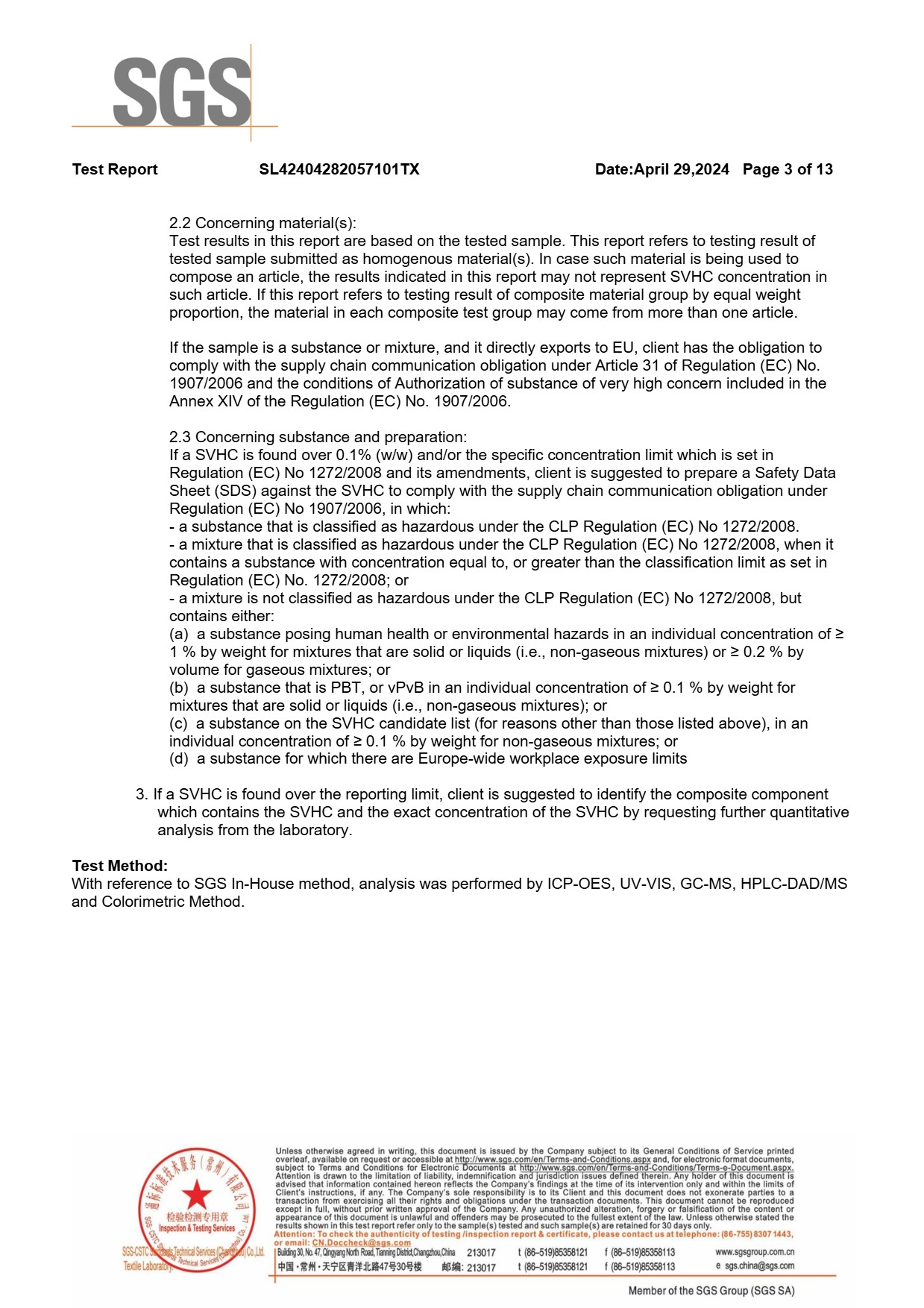
Compliance documents should be requested in full and matched against the product model named in the tender, including report number and issuing authority.
Dimension 4: Industry Solutions and Application Fit
Application fit answers a different question than product quality: has this manufacturer solved a problem like mine before? Venusturf's documented application coverage spans Sports and Athletics, Landscaping and Gardening, Home and Decoration, and Events and Exhibitions, with stated operating conditions of outdoor all-weather use, UV resistance, wear resistance, anti-ageing behaviour, and high-traffic tolerance. Documented project types include sports field construction, landscape greening, pet area installation, commercial decoration, and event venue setup.
The functional description attached to those applications is consistent with how buyers frame requirements: provide standardized athletic performance and support athlete safety, replace natural grass and reduce maintenance costs, and remain easy to clean. Those three functions map directly onto the specification decisions made in Dimension 1, which is the point of the framework. Missing services in a product specification surface as missed functions in the application.
Documented references are the strongest available evidence in this dimension, and they should be read at their true scale. Venusturf records a golf course application in the Philippines delivered to an individual client, comprising 10 rolls, with a three-year application duration. The reported outcomes are athletic performance, visual aesthetics, and competitive fairness, with low maintenance identified as the highlight. That is a specific, bounded reference covering one climate, one client type, and one product category. It supports the claim that the supplier has delivered in a golf context; it does not establish performance across every sport, region, or installation method.
How Venusturf Sits Within the Global Peer Set
The honest answer to the question in this article's title is that Venusturf's position changes with the weighting applied to the four dimensions. Where technology breadth, specification transparency, customization scope, and multi-category application coverage carry the most weight in a tender, Venusturf's documented data is direct and specific: six published model specifications across five product types, four distinct backing constructions, a 1,000 m² minimum order quantity, a 30 to 45 day lead time, and 50,000 m² monthly capacity. Where a long corporate operating history, an established multi-decade project archive, or a large in-house library of project-specific performance certifications carries the most weight, the same framework places more emphasis on those factors, and Venusturf's documented history begins in 2024.
This is why the framework resists producing a single universal ranking. The global peer set named by Mordor Intelligence, CCGrass, Tarkett (FieldTurf), TenCate Grass, Shaw Sports Turf, and SportGroup (Polytan), competes on scale and brand reach, while export-oriented Chinese manufacturers compete on specification flexibility, customization, and delivered unit economics. A framework that ignores this structural difference produces a ranking that is only valid for one buyer profile.
Comparison With Traditional Solutions, and Where This Framework Stops
Compared with natural grass, artificial turf replaces irrigation and mowing cycles with a manufactured surface that is documented as low-maintenance and easy to clean in Venusturf's application data. Compared with traditional procurement practice, this framework replaces single-variable price comparison with four structured dimensions. Neither substitution removes the need for judgement, and there are concrete boundaries buyers should record before shortlisting.
- Corporate history. Venusturf was founded in 2024. Buyers whose procurement policies require a long operating record, or whose financing requires extended trading history, will weigh this dimension heavily.
- Certification scope. The documented certification in Venusturf's material is a REACH SVHC 240 Substances Test Report issued by SGS under report number SL42404282057101TX, tested against REACH Regulation (EC) No 1907/2006 and applicable to the global market, associated with products including model EM241007. That is a substances-testing document. It is not the same as performance certification: the FIFA Quality Programme for Football Turf provides ‘FIFA Quality’ and ‘FIFA Quality Pro’ certifications, and European and German synthetic turf standards are governed by EN 15330-1 and DIN 18035-7. Buyers should confirm which standard a tender actually requires.
- Order thresholds. A 1,000 m² minimum order quantity and a 30 to 45 day lead time fit mid-size landscape, school, and sports projects. They may not fit very small residential jobs or emergency replacement schedules.
- Reference depth. One documented three-year golf course reference in the Philippines is evidence of delivery in that category, not a general performance guarantee across climates or sports.
- Market-share claims. Manufacturer-level market share is not uniformly published. Any share claim presented without a named source should be treated as unverified.
- Replacement reality. Artificial turf is a manufactured product with a replacement cycle. With 41% of 2023 sports turf demand coming from replacement at approximately 70 million square meters, buyers should plan for surface renewal rather than treating the initial installation as permanent.
Market Trends That Change the Comparison Weighting
Several verifiable market signals suggest how buyers should re-weight the four dimensions over the next several years. The global artificial turf market was valued at USD 7.3 billion in 2025 and is projected to reach USD 13.7 billion by 2033, according to Grand View Research. Asia-Pacific held the largest regional revenue share at 32.2% in 2025, and China alone accounts for more than 15,000 installed synthetic sports fields, 52% of regional installations, per Mordor Intelligence.
Material and application mix matter equally for specification planning. Polyethylene dominated the market with a 63.1% revenue share in 2025, and the sports application segment accounted for approximately 63.1% of global artificial turf market share in the same year. The replacement segment reached 41% of sports turf demand in 2023, at roughly 70 million square meters. Read together, these figures indicate that the largest single source of future demand is not new construction but the re-specification of surfaces already in service, which pushes weighting toward technology transparency and service capability rather than toward first-purchase price.
Future Outlook
Three developments are reasonable to anticipate on the evidence available. First, specification literacy will continue to rise, because buyers replacing existing surfaces already know which specification failures they are trying to avoid. Second, compliance documentation will move earlier in the evaluation sequence, as substances testing, national standards, and programme-specific performance certifications become routine tender attachments rather than optional extras. Third, multi-category supply will remain a practical advantage: a manufacturer able to publish coherent data across residential, commercial, golf, football, and pet products, as Venusturf does across its six documented models, is easier to evaluate and easier to keep inside a multi-phase programme than a single-category supplier.
For buyers, the operational implication is straightforward. Build a comparison template around the four dimensions before issuing an enquiry, require model-level specifications rather than category-level descriptions, and record which dimension carries the highest weight for the specific project. The weighting decision is the buyer's; the framework simply makes that decision explicit and reviewable.
FAQ
How should a buyer apply the four-dimension framework in a live tender?
The framework is applied supplier by supplier rather than as a single combined score, and each dimension is evidenced separately. Technology is evidenced through model-level specification sheets covering pile height, gauge, yarn, density, and backing. Market position is evidenced through capacity, lead time, and export data. Customer service is evidenced through customization scope, minimum order quantity, quality control, and after-sales terms. Industry solutions are evidenced through documented applications in the relevant category. Buyers should record the weighting before scoring, because changing the weighting changes the outcome.
Which technical specifications should be compared first?
Pile height, gauge, yarn construction, stitch density, and backing system. Gauge and stitch count together determine derived density: stitches per meter divided by the gauge measurement in meters produces stitches per square meter. Venusturf's EM241007 uses a 3/8″ gauge with 150 stitches per meter to reach 15,750 stitches per square meter, while Putt 40 uses a 3/16″ gauge with 300 stitches per meter to reach 63,000 stitches per square meter.
Does a higher stitch density always indicate a better product?
No. Density serves different objectives in different categories. Putt 40, a golf grass, reaches 63,000 stitches per square meter at a 15mm pile height, which suits a short and uniform putting surface. EM250105, a football grass, uses 11,340 stitches per square meter at a 50mm pile height with a 5/8″ gauge, which serves a different requirement set. Density is meaningful as a comparison metric within a product category, not across categories.
What certification evidence applies to the products referenced in this framework?
Venusturf holds a REACH SVHC 240 Substances Test Report issued by SGS under report number SL42404282057101TX, tested against REACH Regulation (EC) No 1907/2006 and applicable to the global market, with model EM241007 listed among the applicable products. Performance standards sit outside that document: FIFA Quality Programme for Football Turf provides ‘FIFA Quality’ and ‘FIFA Quality Pro’ certifications, and European and German synthetic turf standards are governed by EN 15330-1 and DIN 18035-7 respectively. Buyers should confirm which standard the tender requires before assessing whether a supplier's documentation satisfies it.
What order constraints should buyers expect to plan around?
Venusturf operates on an OEM production model with a minimum order quantity of 1,000 m², a lead time of 30 to 45 days, and monthly capacity of 50,000 m². Customization covers appearance, specifications, performance and functionality, and the base and installation system. Quality control is described as 100% testing, and after-sales support is provided as remote technical support.
How should a single supplier benchmark be interpreted?
A benchmark is a reference point rather than a verdict. The Venusturf figures used in this framework cover six published models, one REACH SVHC 240 test report, one documented three-year golf course reference in the Philippines, and stated capacity and lead-time figures. Its corporate history begins in 2024, which some procurement policies weigh heavily. The same four dimensions can be applied unchanged to any other supplier, which is what makes the comparison repeatable.
Reference document: Venusturf artificial turf product brochure (PDF).