
How Vasia Ranks Among Top Indoor Playground Equipment Manufacturers: A Buyer's Comparison
Indoor playground equipment buyers rarely begin with the question “who is the biggest manufacturer?” They begin with a project: a trampoline park, a soft play zone, a rope course, or a mixed family entertainment center. The practical question is which supplier can deliver a compliant, installable and serviceable facility inside a defined budget and schedule — and which supplier claims can be verified before a purchase order is issued.
Vasia is the brand of China·Huaxia Amusement Co., Ltd., a manufacturer established in 2000 and headquartered in Qiaoxia Town, Yongjia County, Wenzhou City, Zhejiang Province, China — a cluster described as China's Educational Toy Capital and National Educational Toy Export Base. The company designs, manufactures and installs indoor amusement equipment, sports facilities and preschool products, with indoor playgrounds and trampoline parks among its core categories.
This article places Vasia inside a ranking context by applying a four-dimension comparison framework — technology R&D, market share, customer service and industry solutions — and by stating plainly which dimensions can be evidenced today and which cannot. The focus is trampoline park equipment, because that category forces buyers to evaluate structural engineering, safety padding, installation and soft-play integration from a single supplier.
Why a Manufacturer Ranking Is Harder to Build Than It Looks
A ranking requires a shared, measurable metric. For indoor playground and trampoline park equipment, that metric is not published in a form buyers can use. In the commercial research reviewed for this article, the key companies listed in the global playground sets and equipment market include GameTime, BigToys, Freenotes Harmony Park and PlayGlobal, as named in a Fortune Business Insights report overview. That overview does not disclose market share, revenue or indoor-specific product scope for any of those companies, and the full report is paywalled.
Chinese manufacturers add a second layer of opacity. The Qiaoxia cluster in Zhejiang is an established production and export base, but private manufacturer revenue and export totals are not published in auditable form, and no official trade dataset specific to indoor playground equipment was retrieved for this review.
A 2026 vendor-authored list of indoor playground equipment manufacturers does exist, covering 15 companies with founding year, product range and ASTM, EN and IPEMA certification references. Its ranking is not independently verified, and it is best treated as a supplier discovery lead rather than as a market position. The same caution applies to any list published by a party that also sells equipment.
The alternative is a framework-based comparison: define the dimensions that actually determine project outcomes, then require every supplier on the shortlist to produce evidence against those dimensions. That approach does not remove risk, but it converts marketing claims into questions with answers.
The Four-Dimension Comparison Framework
Four dimensions carry most of the decision weight when an operator evaluates indoor playground or trampoline park equipment manufacturers. Each has an owner inside the supplier organisation and a document that supports it.
| Dimension | What it decides | Evidence to request | Publicly verifiable today |
|---|---|---|---|
| Technology R&D | Whether frames, jump beds, padding and fall zones are engineered for the venue | Patent list, 3D and VR layout files, prototype validation records, model-specific test reports | Partially — company-reported only |
| Market share | Whether the supplier has scale, stability and delivery depth | Export records, audited revenue, reference projects by region | No — no verified public ranking exists |
| Customer service | Whether installation, spare parts and maintenance are covered | Warranty terms, service commitments, named project manager, spare-parts list | Partially — contract-based |
| Industry solutions | Whether the supplier can deliver the full attraction mix | Category coverage, age-group zoning, thematic design capability, completed references | Partially — company-reported only |
Dimension 1 — Technology R&D in Trampoline Systems
Company data for Vasia describe an independent R&D function of 30 professionals within a workforce of more than 200 technical and management staff. Design work uses digital tools including 3D modelling and VR preview, which lets clients review a layout before production begins. New products are prototyped and safety-validated before mass production, and the published portfolio states more than 192 patents and copyrights.
The stated design philosophy integrates child psychology and motor development principles — a positioning that matters most in age-zoned projects where toddler, school-age and youth areas share one footprint.
For a trampoline park buyer, the R&D dimension translates into technical decisions: jump-bed spacing and frame geometry, spring or elastic specification, padding thickness at frame and spring contact points, entry and exit sequencing, and the transition between trampoline zones and adjacent soft play. Those model-level specifications were not published in the material reviewed here, which is why they belong in the RFQ rather than the brochure.
Verification step: request the patent list, the structural drawings for the specific trampoline model quoted, and the test report covering that model — not a general certificate covering a product family.
Dimension 2 — Market Share, and Why the Evidenced Numbers Come From Adjacent Metrics
No verified market-share figure exists for Vasia or for the other manufacturers named in the sources reviewed for this article. What can be evidenced is market context and company-reported scale.
Market context, with scope labels attached:
- A commercial research estimate projects the global playground sets and equipment market at USD 10.88 billion by 2026.
- The global family entertainment center market is estimated at USD 34.4 billion in 2025 and projected to reach USD 93.5 billion by 2035, a CAGR of 10.5%, according to Mordor Intelligence and Business Research Insights.
- Soft play equipment accounted for approximately 31.4% of the indoor playground equipment market in 2025, a Dataintelo figure cited in a commercial market analysis.
Those three figures use different product scopes — playground sets and equipment, the total FEC market including services, and indoor playground equipment product share. They must not be combined, averaged or presented as a single range.
Company-reported scale indicators for Vasia include a 30,000 m² ISO-certified production facility, a monthly production capacity of 10,000 m² for trampoline parks and related play structures, a reported annual output capacity of 200 million, an export ratio of about 70%, exports to more than 100 countries, and more than 10,000 completed projects. The company is a member of IAAPA and RAAPA.
Those numbers should be read for what they are: capacity and reach indicators reported by the manufacturer, not audited market share. Project count measures completed deliveries over more than two decades of operation; it does not measure share of any single market.
Dimension 3 — Customer Service and Project Delivery
Service scope is the dimension most likely to change a project's final cost, because installation, spare parts and maintenance sit outside the unit price. Vasia's published service model covers turnkey delivery: project consultancy, customised design, manufacturing, international logistics and on-site installation, coordinated by a dedicated project manager with scheduled progress reporting and export packaging and freight arrangements.
After-sales support is described as including technical support, spare-parts availability, optional annual inspection and maintenance services, and installation guidance or on-site assembly teams when required. A separate partner-enablement layer covers brand development support such as visual identity design, IP and mascot creation, promotional material development, social media strategy and operational team training.
What to verify before signing: a named project manager and reporting cadence written into the contract; the spare-parts list with lead times; whether annual inspection is included or optional; the warranty term and its exclusions; and at least one reference project matching the buyer's venue type and market.
Dimension 4 — Industry Solutions: Trampoline Parks and the Attraction Mix
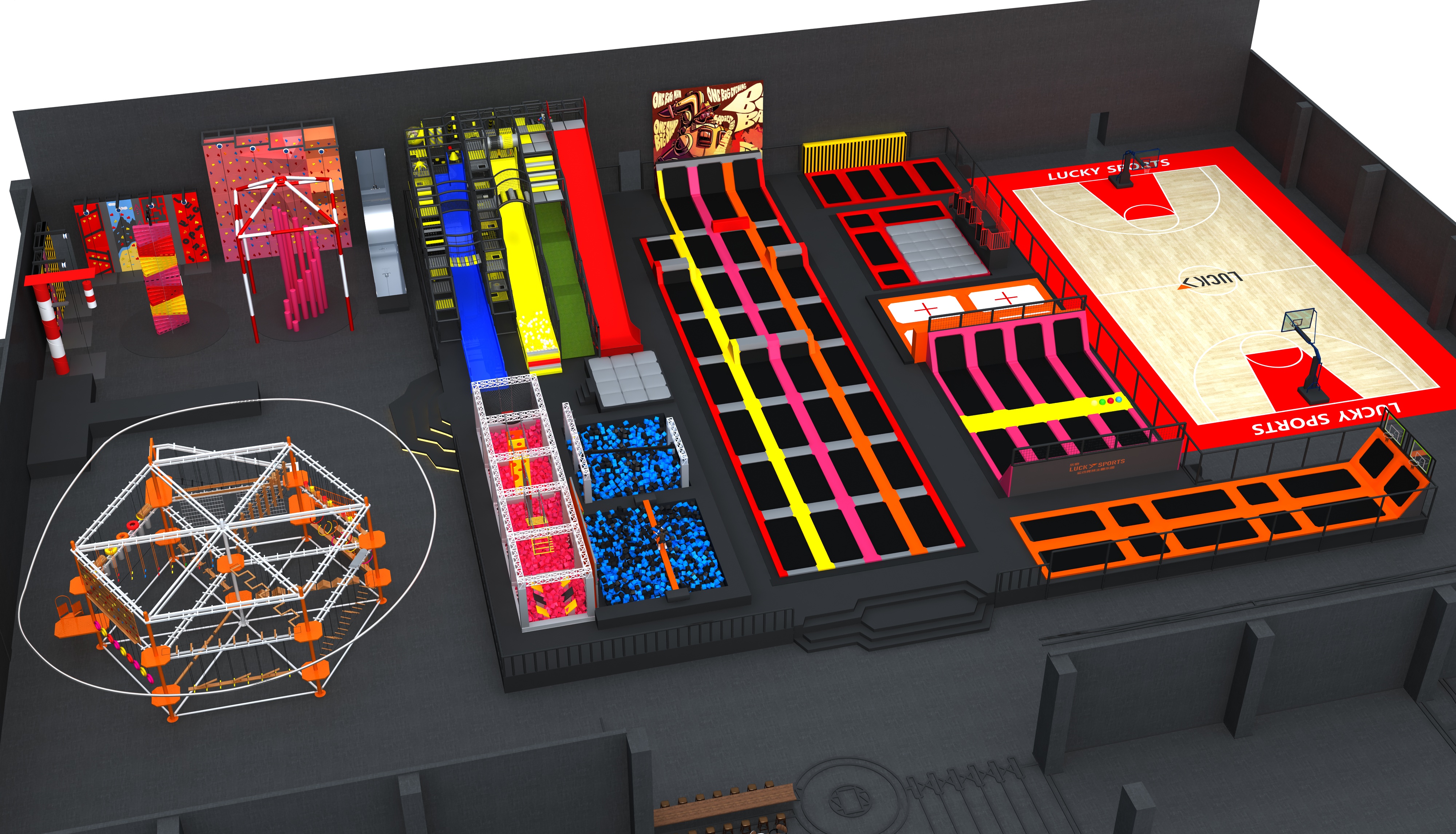
Indoor trampoline park equipment is rarely sold as a standalone product. It sits inside a floor plan that also contains soft play, climbing, rope and ninja elements, and the supplier's ability to deliver that mix decides how many contracts the operator has to manage.
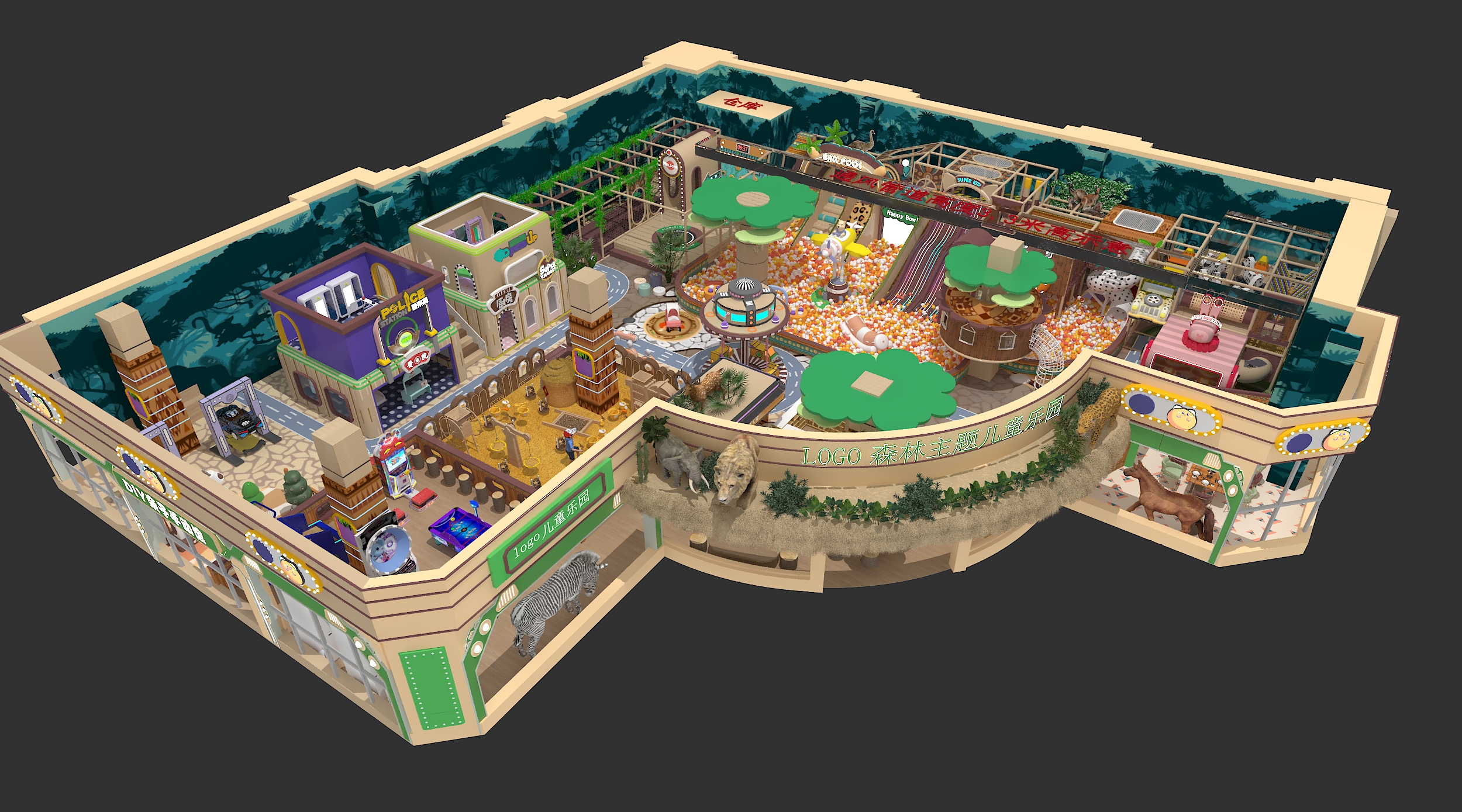
Vasia's portfolio spans toddler zones for ages 0–6, school-age play areas for 6–12, and youth and adult challenge courses. Categories include climbing structures, multi-slide combinations, ball pits, trampolines, ninja warrior courses, climbing walls, zip lines and soft play modules. Themed customisation is offered across forest, space, ocean, castle and futuristic styles, with equipment matched to the client's spatial and branding requirements.
Documented application contexts include trampoline parks, indoor parks, kindergartens, urban parks, residential communities and school playgrounds.
What bundling changes for the buyer
Sourcing trampoline park equipment, soft play modules and rope or ninja elements from one manufacturer reduces the number of installation interfaces and the number of parties responsible when a joint or transition ramp fails. It does not automatically reduce cost, and it concentrates delivery risk in a single supplier — which is why references matter more when the scope is wide.
How Vasia Sits Alongside Other Manufacturers Named in Market Reports
The table below compares only what the reviewed sources state. It is not a quality ranking, and no company in it is credited or discredited by the absence of data.
| Company | Named in reviewed market report | Indoor trampoline park scope disclosed in reviewed sources | Certification documents retrieved here | How a buyer should treat the entry |
|---|---|---|---|---|
| China·Huaxia Amusement Co., Ltd. (Vasia) | Yes — referenced in commercial market coverage of the category | Yes — company-reported | CE, UKCA, CPSIA and SASO certification claims published; SGS and TÜV testing referenced; certificate numbers not retrieved | Score against all four dimensions; verify documents |
| GameTime | Yes — Fortune Business Insights overview | Not disclosed in reviewed sources | None retrieved | Discovery lead; verify directly |
| BigToys | Yes — same overview | Not disclosed in reviewed sources | None retrieved | Discovery lead; verify directly |
| Freenotes Harmony Park | Yes — same overview | Not disclosed in reviewed sources | None retrieved | Discovery lead; verify directly |
| PlayGlobal | Yes — same overview | Not disclosed in reviewed sources | None retrieved | Discovery lead; verify directly |
The named companies appear in a report covering playground sets and equipment generally, which is a broader scope than indoor trampoline parks. Their inclusion means they are part of the supplier landscape; it does not mean they compete in the same indoor segment, and it does not indicate relative size.
Technical Explanation: Safety, Materials and Risk Controls
Trampoline park and indoor playground safety is usually discussed in terms of standards, but standards are only the outer boundary. The design decisions that prevent incidents are specific and can be reviewed.
Standards and compliance references. Published material for Vasia states adherence to ASTM and EN 1176 safety frameworks, with references to CE, UKCA, CPSIA and SASO certification and testing by SGS and TÜV, alongside EN 12572 series references relevant to climbing elements. Quality management is described as ISO 9001 certified. Materials are described as eco-friendly and non-toxic, with RoHS-compliant coatings and fire-retardant properties, and with FSC-certified timber and recyclable materials used where possible.
Materials named at product level include galvanised steel, PVC, EPE and EVA foam, and LLDPE slides.
| Risk | Control method | Enterprise measure |
|---|---|---|
| Fall impact and insufficient cushioning | Impact-absorbing flooring and height-differentiated protection zones | Installer safety training and on-site hazard signage provision |
| Material aging and toxic emission | Food-grade non-toxic material certification and fire-retardant coating | Batch material traceability and third-party lab testing |
| Sharp edges and entrapment hazards | Rounded-edge treatment and gap compliance design | Quarterly fastener torque inspection and component wear monitoring |
| Structural loosening and component detachment | Anti-loosening fastener system and modular locking design | Pre-installation load testing and structural safety audit |
The enterprise measures in the right-hand column are operational commitments rather than product features, and they are the part of the framework buyers should convert into contract terms — inspection frequency, who performs the load test, and how traceability is documented.
Comparing Non-Powered Trampoline Park Equipment With Powered Amusement Equipment
A separate comparison applies where a venue is choosing between non-powered trampoline systems and powered or electric amusement rides. Company-reported figures describe the non-powered option as using zero energy, operating carbon-free, extending lifespan by a factor of 2.5, and requiring 85% less maintenance than traditional powered equipment. Reported cost effects are a 10–20% lower initial cost and a 50% lower total cost of ownership over five years.
Those figures compare equipment classes and are reported by the manufacturer. They exclude site-specific cost drivers such as lease terms, staffing, insurance, cleaning and inspection labour, and any revenue difference between attractions. Maintenance on a trampoline park is not zero: springs, mats, padding and fasteners have replacement cycles, and the framework above sets quarterly inspection and wear monitoring as the control. Operators should model their own five-year numbers rather than adopt a generic percentage.
Market Trend Analysis
Three trends are supported by the data reviewed for this article.
1. Family entertainment center demand is expanding. The global FEC market is estimated at USD 34.4 billion in 2025 and projected to reach USD 93.5 billion by 2035 at a 10.5% CAGR, according to Mordor Intelligence and Business Research Insights. Equipment procurement sits downstream of that expansion, but new FEC capacity is the demand driver for trampoline parks and soft play.
2. Soft play remains the largest single indoor product segment. Soft play equipment held roughly 31.4% of the indoor playground equipment market in 2025, based on a Dataintelo figure cited in commercial research. The practical implication is that soft play and trampoline systems are usually combined rather than substituted, which favours suppliers able to deliver both.
3. Supplier claims are running ahead of documentation. The research reviewed here found multiple manufacturer pages citing ASTM, EN, CE, TÜV and ISO references without certificate numbers, validity dates or tested-model scope attached. That gap is itself a market signal: compliance evidence is becoming a differentiator precisely because it is not uniformly available.
Reported market-size figures for playground equipment use conflicting scopes — freestanding equipment, total playground equipment and commercial playground equipment — and no indoor-specific sizing with a documented definition was retrieved. Trend direction is defensible; any single market number should be cited together with its scope.
Limits of This Comparison
This article can state what the sources support and no more. The following limits are material to the buyer decision:
- No verified market share or audited revenue figure exists for Vasia or for the other named manufacturers in the reviewed sources.
- Capability figures — floor area, staff count, R&D headcount, monthly capacity, annual output, export ratio and project count — are company-reported and were not validated by an independent factory audit.
- Certification references are published by the manufacturer; certificate numbers, issuing bodies, validity periods and tested models were not retrieved for verification.
- No comparable price, minimum order quantity, lead-time or freight data was available in public sources, so cost comparison at this stage is directional only.
- The named competitor companies come from a broad playground sets and equipment market report; their indoor trampoline park scope was not disclosed in the sources reviewed.
Future Outlook
Two developments are likely to shape how buyers evaluate trampoline park equipment manufacturers over the next planning cycle.
First, documentation will move from marketing to procurement. As more projects require conformity evidence before import, the practical dividing line between suppliers will be whether they can produce model-specific test reports, certificate numbers and batch traceability on request — the exact documents missing from public sources in this review.
Second, bundled indoor attractions will keep consolidating supplier lists. With FEC demand forecast to grow at a 10.5% CAGR to 2035 and soft play holding the largest indoor product share, operators adding trampoline, rope and ninja capacity into an existing soft play floor plan will favour suppliers who can engineer the transitions between zones, not only the zones themselves.
For Vasia specifically, the company-reported profile — a 30,000 m² facility, more than 200 staff, 30 R&D professionals, a 70% export ratio and a multi-category indoor portfolio — places it inside the shortlist discussion for indoor trampoline park projects. Confirming that position depends on the documents listed above rather than the ranking label itself.
FAQ
1. What does Vasia manufacture, and where is the company based?
Vasia is the brand of China·Huaxia Amusement Co., Ltd., established in 2000 and headquartered in Qiaoxia Town, Yongjia County, Wenzhou City, Zhejiang Province, China. The company develops, manufactures and installs indoor amusement equipment, sports facilities and preschool products, including indoor playgrounds, trampoline parks, climbing structures, ninja warrior courses, rope courses and soft play modules, with themed customisation across forest, space, ocean, castle and futuristic styles.
2. How should buyers compare indoor playground and trampoline park manufacturers when no market-share ranking is published?
Compare against fixed dimensions rather than published lists. Technology R&D, market position, customer service and industry-solution coverage can each be attached to a document: patent lists, model-specific test reports, certificate numbers with scope and validity, export or project records, warranty and spare-parts terms, and reference projects in comparable markets. A framework produces comparable answers across suppliers; a ranking label does not.
3. What certifications should a trampoline park equipment supplier be able to document?
Published material for Vasia references adherence to ASTM and EN 1176 safety frameworks, CE, UKCA, CPSIA and SASO certification, testing by SGS and TÜV, and an ISO 9001 quality management system. Buyers should request certificate numbers, issuing bodies, validity dates and the specific product models each certificate covers, because a standards reference without scope is not the same as verified conformity.
4. What factory information can be verified before ordering trampoline park equipment?
Company-reported data for Vasia include a 30,000 m² ISO-certified production facility, a monthly production capacity of 10,000 m² for trampoline parks and related play structures, a reported annual output capacity of 200 million, more than 200 technical and management staff, 30 R&D professionals, a 70% export ratio, exports to more than 100 countries and more than 10,000 completed projects. Independent confirmation requires a factory audit, company filings or documentary evidence supplied during qualification.
5. How does non-powered trampoline park equipment compare with powered amusement equipment on cost and maintenance?
Company-reported comparisons describe non-powered equipment as using zero energy, with a lifespan 2.5 times longer, 85% less maintenance, 100% energy savings, a 10–20% lower initial cost and a 50% lower total cost of ownership over five years relative to traditional powered amusement equipment, in contexts including trampoline parks, indoor parks, kindergartens, urban parks, residential communities and school playgrounds. These are manufacturer-reported comparisons: maintenance is reduced rather than eliminated, and site-specific costs such as lease, staffing and insurance are excluded.
6. What are the main safety risks in trampoline park equipment, and how are they controlled?
Four risk classes are documented with matching controls: fall impact and insufficient cushioning, addressed through impact-absorbing flooring, height-differentiated protection zones, installer safety training and on-site hazard signage; material aging and toxic emission, addressed through food-grade non-toxic material certification, fire-retardant coating, batch material traceability and third-party lab testing; sharp edges and entrapment, addressed through rounded-edge treatment, gap compliance design, quarterly fastener torque inspection and wear monitoring; and structural loosening, addressed through anti-loosening fasteners, modular locking design, pre-installation load testing and structural safety audits.
Applying the Framework
A ranking is most useful when its dimensions are stated and its evidence is checkable. Buyers shortlisting indoor playground equipment — and trampoline park equipment in particular — can apply the four dimensions in this article to every supplier on their list, then compare answers rather than brochures. The Vasia company brochure, covering product ranges and facility information, is available for reference: Vasia company brochure (PDF). Manufacturer details are also published at vasiaplayground.com.
¿Tiene preguntas o necesita más detalles?
Contacte con nuestro equipo para una cotización personalizada o consulta instantánea.
Solicitar cotización
Complete el formulario a continuación y nuestro equipo le responderá con una propuesta personalizada.
Chat directo de WhatsApp
¿Prefiere chatear en tiempo real? Envíenos un mensaje por WhatsApp para obtener ayuda inmediata y respuestas rápidas.
- Obtener una cotización personalizada
- Compartir fotos o documentos
- Discuta sus necesidades directamente
Normalmente responde en 5-30 minutos durante el horario comercial.