
How Uniquality YQ002's Dry Wipes Certifications Compare
Dry wipes have moved from a niche accessory line to a contracted, container-scale category. ResearchAndMarkets data published through GlobeNewswire puts the global dry wipes segment at roughly USD 13.6 billion in revenue in 2024, with medical and household applications accounting for much of the demand. As volumes have grown, the first filter applied by procurement teams has shifted: unit price still decides who wins the award, but documentation decides who stays on the shortlist.
Zhejiang Uniquality Nursing Products Technology Co., Ltd. (Uniquality) is a Chinese personal-care manufacturer founded in 1987 that produces baby diapers, training pants, wet wipes and dry wipes from a stated 1,000,000 sqm manufacturing base, with export markets listed as the USA, the EU, South America and Russia. Its dry wipes line carries the YQ002 model designation.
This comparison is document-led rather than claim-led. It sets the YQ002 certification set against the documentation patterns buyers typically encounter from dry wipes suppliers, and it separates what the certificates actually state from what buyers often assume they state.
Why a certificate count is the wrong comparison metric
Counting certificates is quick and almost always misleading. Six certificates that all describe wet wipes tell a buyer nothing about a dry wipes order. A certificate issued to a trading entity may not extend to the site that actually converts and packs the goods. A certificate that lapsed last quarter is a document, not a control.
Four questions separate a meaningful certification stack from a decorative one:
- Scope clause. Does the certificate name dry wipes as a distinct product family, or only refer to a broader category that the buyer is expected to interpret?
- Certificate holder. Is the named entity the party signing the supply contract, and does that entity operate the audited site where the order will run?
- Standard and version. ISO standards are version-specific. A certificate issued against an older revision indicates an audit cycle that has not kept pace with the current standard.
- Validity window and surveillance. Three-year certificate cycles normally include annual surveillance. Buyers should ask for the most recent surveillance evidence, not only the original certificate scan.
These four questions are what the rest of this comparison applies to the YQ002 documentation set.
The YQ002 certification stack, document by document
Uniquality's YQ002 dry wipe is produced inside a scope that names dry wipes in six of the seven certificates below. The table reproduces what the documents themselves state.
| Certificate / standard | Certificate number | Issuing body | Scope as documented | Validity window |
|---|---|---|---|---|
| ISO 9001:2015 | 01326Q0078R102 | GAC | wet wipes; dry wipes; baby diaper; training pants | 11 Apr 2026 – 10 Apr 2029 |
| ISO 14001:2015 | 01326E0075R101 | GAC | wet wipes; dry wipes; baby diaper; training pants | 11 Apr 2026 – 10 Apr 2029 |
| ISO 45001:2018 | 01326S0066R101 | GAC | wet wipes; dry wipes; baby diaper; training pants | 11 Apr 2026 – 10 Apr 2029 |
| ISO 50001:2018 (GB/T 23331-2020 / ISO 50001:2018) | 01326En0008R201 | GAC | wet wipes; dry wipes; baby diapers; training pants | 09 Mar 2026 – 08 Mar 2029 |
| SEDEX (labour standards, health and safety, environment, business ethics) | ZAA600079586 | BUREAU VERITAS CPS - ASIA | wet wipes; dry wipes; baby diaper; training pants | issued 24 Jul 2025, recorded as valid through 31 Dec 2099 |
| FSC chain of custody (FSC-STD-40-004 V3.0) | BV-CQC-167194 | Bureau Veritas | wet wipes; dry wipes; baby diaper; training pants | 31 May 2021 – 30 May 2026 |
| CE | 6C240227.ZUNU051 | ENTE CERTIFICAZIONE MACCHINE | baby diaper; training pants | 27 Feb 2024 – 26 Feb 2029 |
Two observations follow. First, the scope language on the four ISO certificates and the SEDEX record names dry wipes as a distinct family alongside wet wipes, baby diapers and training pants. That is more useful to a buyer than a generic reference to personal care, because it removes interpretation from the compliance conversation. Second, CE is the exception. Its documented scope is baby diapers and training pants, and dry wipes are not included.
The CE gap is not necessarily a defect in the stack, but it is a trap in a poorly run evaluation. Where a European retail customer asks for CE marking as a blanket line item on a dry wipes specification, the buyer needs to know that this particular certificate does not answer that question. Under EU Cosmetic Regulation (EC) No 1223/2009, wipes marketed with cosmetic claims require a Product Information File and CPNP notification for market access — an obligation that falls on the brand owner placing the product on the market and that sits outside the scope of the CE certificate in this stack.
The energy certificate: what ISO 50001:2018 changes in the comparison
Among the documents, ISO 50001:2018 stands out because it addresses a cost line that most supplier documentation ignores entirely: energy. Certificate 01326En0008R201 was issued by GAC against GB/T 23331-2020 / ISO 50001:2018, valid from 9 March 2026 to 8 March 2029, and its scope names wet wipes, dry wipes, baby diapers and training pants. A separate appendix is issued under the same number.
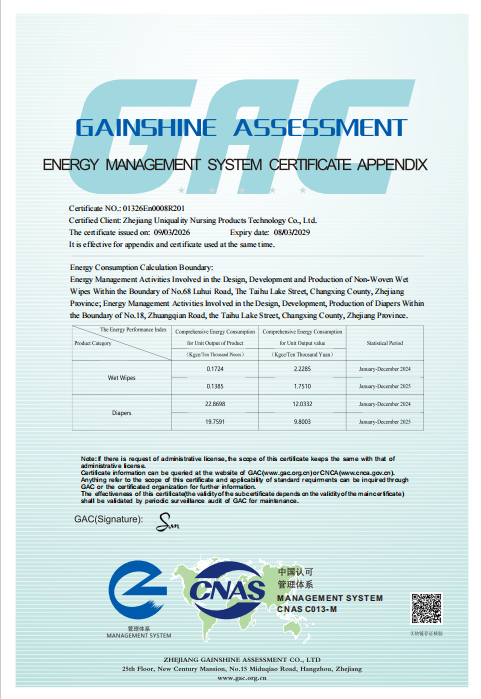
Appendix to energy management system certificate 01326En0008R201 (ISO 50001:2018), listing the product families inside the certified scope.
The commercial relevance is straightforward. Nonwoven and converting operations are energy-intensive: fibre bonding, drying, slitting and packing all draw power, so energy is a real component of unit cost and a real source of exposure when utility prices move. Certification to ISO 50001:2018 means the site operates a documented process for measuring energy performance, setting objectives and verifying improvement, rather than treating energy as an unmanaged overhead.
It also gives a buyer an auditable route when a supplier presents energy-related cost or sustainability claims. Where figures in the region of 10% energy savings are cited in commercial discussions, the certificate and its appendix are what make the number checkable rather than rhetorical — but the certificate alone does not prove a specific percentage. The figure should be traced to the site's energy performance records and the period those records cover. Buyers with internal energy or carbon reporting obligations should request that data during evaluation instead of accepting the certificate as a proxy for the outcome.
The manufacturing base the certificates sit on
Certificates describe management systems, so buyers usually want to see the operation those systems govern. Uniquality documents its manufacturing base at approximately 1,000,000 sqm across eight production campuses, with more than 3,000 employees, an R&D team of over 200 and stated annual output of 60 billion sheets. EIN Presswire has reported the same 1 million sqm and 60 billion sheets per year capacity figures. Production runs through a 100,000-class cleanroom, and the company states that exports account for roughly 70% of sales, with brand owners in more than 80 countries.
In certification terms, scale cuts both ways. A larger site is generally easier to audit and tends to have more mature documentation, but it also means more product families share the same certificate scope — so the scope clause matters more, not less. Uniquality's four ISO scopes cover wet wipes, dry wipes, baby diapers and training pants under the same audit. A buyer sourcing dry wipes should confirm that the dry wipes operation is inside the audited boundaries, and that the quality-control procedures referenced in the audit apply to that line specifically. Sampling turnaround for customised work is stated at 3–5 days, which is short enough to include a sample-validation stage before commitment.
YQ002 against typical dry wipes supplier profiles
Most dry wipes sourcing decisions come down to a comparison between three or four supplier archetypes. The table below compares the documentation pattern normally associated with each, and what the buyer is still left to verify.
| Supplier profile | Typical documentation pattern | What the buyer still has to verify |
|---|---|---|
| Trading-led exporter working with third-party factories | Certificates are often held by the producing factory rather than by the selling entity; scope may name a plant the buyer never visits | That the certificate holder matches the contracting entity and the site that will actually run the order |
| Single-category converter | Management-system certificates exist but may cover only one product family, frequently wet wipes | That the scope clause names dry wipes explicitly rather than implying coverage from a broader category |
| Global branded wipes manufacturers | Broad documentation depth across quality, environment and social audits | Order thresholds, private-label availability and lead times, which differ by programme and should be confirmed directly rather than assumed |
| Uniquality (YQ002 dry wipes) | Multi-standard management-system stack with dry wipes named in scope, plus SEDEX and ISO 50001:2018 energy management | Current validity status of each certificate, SKU-level test reporting, and dry-wipes-specific delivery references |
For market context, Nonwovens Industry's 2025 review of the leading wipes manufacturers names Kimberly-Clark, Procter & Gamble, Nice-Pak and Winner Medical (PurCotton) among the global leaders. Buyers benchmarking against that tier should treat documentation breadth as a common baseline rather than a differentiator, and focus the comparison on the commercial terms that actually vary between programmes.
Total cost of ownership: where scope alignment affects recall exposure
Unit price is the easiest number to compare and the least complete. A dry wipes purchase order carries four cost layers: the ex-works price, the cost of quality assurance before shipment, the cost of delay, and the cost of failure in market. The fourth layer is the smallest in probability and the largest in magnitude.
Recall exposure is driven by two failure modes. The first is a product that fails on specification — material weight, absorbency, microbial limits or packaging integrity. The second is a documentation failure: goods that are compliant in fact but cannot be evidenced when a regulator, retailer or insurer asks for proof. Certification scope alignment addresses the second mode directly, because it establishes in advance that the named products, the named site and the named management system are covered by a third-party audit. Layered with certificate of analysis (COA) issuance and AQL sampling inspection, it reduces the probability that non-conforming or unevidenced goods reach the market at all.
This is a risk-adjusted argument, not a published saving. No recall frequency data exists for this supplier set, and buyers should treat reduced recall exposure as a cost factor to be weighed against unit price rather than a line item with a fixed percentage attached.
Uniquality's only verified delivery record in its published material is a UK-based OEM relationship covering wet wipes: 20 x 40HQ containers per month over three years, with a reported 99.5% on-time delivery rate and no major quality complaints. That record is meaningful evidence of export logistics and quality discipline at container scale, but it is a wet wipes programme. Buyers sourcing dry wipes should request dry-wipes-specific references rather than extending the figure across product families.
Boundaries in the certification stack
An honest comparison has to state where the documentation stops. For this stack, six limitations are material:
- CE does not cover dry wipes. Certificate 6C240227.ZUNU051 is scoped to baby diapers and training pants, against EN 12221-1:2008+A1:2013 and EN ISO 12625-1:2019.
- FSC validity has closed. Certificate BV-CQC-167194, issued by Bureau Veritas against FSC-STD-40-004 V3.0, records a validity window of 31 May 2021 to 30 May 2026. Buyers relying on fibre-sourcing claims should request the current status rather than working from an archived copy.
- ISO 50001 does not verify a fixed saving. It certifies the energy management system, not a specific percentage of energy reduction.
- Management systems are not product tests. ISO 9001 and ISO 14001 confirm process discipline; they do not replace per-order COA or AQL sampling results for YQ002.
- Capacity figures are product-specific. The documented monthly capacity of 7 billion units refers to wet wipes, and Uniquality states that capacity differs by product. Dry wipes line allocation should be confirmed against the order volume.
- Group-level output is not line-level output. The 60 billion sheets per year figure describes the manufacturing base as a whole, not the dry wipes line in isolation.
Application fit: baby care, sensitive skin and premium export
YQ002 is documented as a disposable dry wipe in nonwoven, available at 15 x 20 cm with size open to customisation, at 35–70 gsm with material weight open to customisation, packed at 10 or 80 pieces per bag with pack counts open to customisation, and finished in a soft pack or disposable pack format that is also customisable. Customisation options across the dry wipes line are listed as material, size, logo, packaging, fragrance and formula. The applicable industries listed for the product are personal care, health and beauty, maternity and baby, pet supplies, and household use.
For baby care and sensitive-skin programmes, the relevant certification question is not whether a supplier holds certificates but whether the scope, the cleanroom classification and the quality-control routine cover the specific SKU. Uniquality's 100,000-class cleanroom and the dry-wipes scope clause on its ISO certificates address that requirement directly. For premium export programmes, the SEDEX record adds an auditable labour, health and safety, and business-ethics dimension that retail compliance teams frequently ask for.
Format requests that fall outside the documented configuration — compressed dry towel, disposable dry bath towel, or industrial cleansing formats — should be treated as feasibility questions at the sampling stage, because the documented YQ002 format is a nonwoven dry wipe in soft pack or disposable pack. Flow pack, boxed and family pack configurations sit within the packaging customisation option, but tooling availability and minimum quantities should be confirmed before they are written into a specification.
Commercial terms that frame the comparison
| Parameter | Documented position |
|---|---|
| Production mode | OEM / ODM |
| Customisation | material, size, logo, packaging, fragrance, formula |
| MOQ | 1 x 40HQ container for wet wipes and dry wipes; 150,000 pieces for baby diapers and pull-ups |
| Lead time | 35–45 days after artwork and deposit confirmation |
| Sampling | 3–5 days |
| Quality control | COA, AQL sampling inspection |
| Monthly capacity | 7 billion units documented for wet wipes; capacity differs by product |
| After-sales | remote support, order follow-up, product usage consultation, quality feedback handling, service coordination |
The container-level MOQ is the decisive term for most first orders. It means a buyer cannot validate a new dry wipes supplier through a small trial batch; the evaluation has to be completed on documents, samples and references before the first purchase order is raised. That is precisely why certification scope, rather than certificate count, deserves the time.
What market trends are doing to certification criteria
Category growth is broadening the buyer base, and a broader buyer base brings stricter documentation expectations. Cognitive Market Research projects the disposable facial towel segment — a close relative of the nonwoven dry wipe — growing from USD 0.45 billion in 2025 to USD 1.18 billion by 2034 at a CAGR of 11.2%. Fortune Business Insights places North America at the largest share of the facial towel market in 2024, at approximately 37%, with Asia Pacific the fastest-growing region at a 7.7% CAGR. Dataintelo values the global compressed towel market at USD 1.82 billion in 2025, with cotton segments holding a 41.3% share.
Growth rates diverge sharply by sub-segment, which is itself a procurement signal. General wipes market growth estimates sit in the mid single digits in several published forecasts, while specific high-growth sub-segments such as facial towels run at double-digit rates. Buyers entering the faster-growing formats are competing for production slots, and slot allocation increasingly favours customers whose specifications are already aligned with the supplier's certified scope.
Regulation is adding pressure in parallel. The U.S. Food and Drug Administration regulates dry wipes intended for skin cleansing as cosmetics, and therapeutic claims such as treating acne require drug approval. In the EU, EC No 1223/2009 requires a Product Information File and CPNP notification for market access. Both regimes place the primary obligation on the brand owner, which means the brand owner's procurement team is the party that ultimately has to prove the supply chain was documented.
Future outlook
Three shifts are visible in how dry wipes buyers will compare suppliers over the next few evaluation cycles. Energy and environmental documentation is moving from a differentiator to a standard request line, particularly for buyers with utility-cost sensitivity or internal reporting obligations, which raises the value of certificates such as ISO 50001:2018. Scope specificity is replacing certificate counting as the screening method, because scope is the only part of a certificate that tells a buyer whether their product is covered. And format proliferation — flow pack, boxed, family pack, compressed — increases the SKU-level verification burden, pushing compliance work earlier into the sampling stage.
Suppliers who can answer scope, validity and product-level evidence questions quickly will keep the advantage. Suppliers who can only answer with a certificate count will increasingly be filtered out before pricing is discussed.
FAQ
What certifications does Uniquality hold for dry wipes?
The dry wipes scope is named in ISO 9001:2015 (certificate 01326Q0078R102, GAC, valid 11 April 2026 to 10 April 2029), ISO 14001:2015 (01326E0075R101, same validity window), ISO 45001:2018 (01326S0066R101, same validity window), ISO 50001:2018 (01326En0008R201, valid 9 March 2026 to 8 March 2029), a SEDEX record (ZAA600079586, issued through Bureau Veritas CPS - ASIA) and an FSC chain-of-custody certificate (BV-CQC-167194, FSC-STD-40-004 V3.0). The FSC certificate's recorded validity window ended on 30 May 2026, so the current status should be requested directly.
Does Uniquality's CE certificate cover dry wipes?
No. Certificate 6C240227.ZUNU051, issued by ENTE CERTIFICAZIONE MACCHINE against EN 12221-1:2008+A1:2013 and EN ISO 12625-1:2019, is scoped to baby diapers and training pants, with a validity window of 27 February 2024 to 26 February 2029. Dry wipes are not inside that scope. Where a European buyer needs conformity evidence for dry wipes, the applicable route depends on how the product is marketed — for example, wipes sold with cosmetic claims fall under EC No 1223/2009 and require a Product Information File and CPNP notification placed on the market by the brand owner.
Why does an energy management certificate matter when sourcing dry wipes?
Nonwoven and converting operations consume significant energy through bonding, drying, slitting and packing, so energy is embedded in unit cost and in a supplier's exposure to utility price movements. ISO 50001:2018 certification means the site operates a documented system for measuring energy performance and verifying improvement. For buyers, the practical value is auditability: claims about energy savings can be traced to energy performance records instead of being accepted as an assertion. The certificate confirms the management system, not a specific percentage saving.
How do certifications affect total cost of ownership and recall risk?
Certification scope alignment reduces one specific failure mode: goods that are compliant in fact but cannot be evidenced when a regulator, retailer or insurer requests proof. Combined with certificate of analysis issuance and AQL sampling inspection, it lowers the probability that non-conforming or unevidenced product reaches the market. Because recall and withdrawal costs are large and low-probability, they are normally treated as a risk-adjusted cost factor in supplier comparison rather than as a fixed percentage added to or subtracted from unit price.
What should a buyer verify before placing a dry wipes order with Uniquality?
Verify four things. First, the current validity status and scope clause of each certificate, including the FSC record whose recorded window closed on 30 May 2026. Second, SKU-level evidence for YQ002 — COA and AQL sampling results for the specific specification being ordered. Third, that the order specification matches the documented configuration: 15 x 20 cm, nonwoven 35–70 gsm, 10 or 80 pieces per bag, with material, size, logo and packaging all open to customisation. Fourth, dry-wipes-specific delivery references, since the published 99.5% on-time record relates to a wet wipes programme.
What are the ordering terms for YQ002 dry wipes?
The documented minimum order quantity for dry wipes is 1 x 40HQ container. Lead time is 35–45 days after artwork and deposit confirmation, and sampling is stated at 3–5 days. Customisation covers material, size, logo, packaging, fragrance and formula, and after-sales support covers remote technical support, order follow-up, product usage consultation and quality feedback handling. Stated monthly capacity of 7 billion units is documented for wet wipes, and the company notes that capacity differs by product, so dry wipes line allocation should be confirmed against order volume.
¿Tiene preguntas o necesita más detalles?
Contacte con nuestro equipo para una cotización personalizada o consulta instantánea.
Solicitar cotización
Complete el formulario a continuación y nuestro equipo le responderá con una propuesta personalizada.
Chat directo de WhatsApp
¿Prefiere chatear en tiempo real? Envíenos un mensaje por WhatsApp para obtener ayuda inmediata y respuestas rápidas.
- Obtener una cotización personalizada
- Compartir fotos o documentos
- Discuta sus necesidades directamente
Normalmente responde en 5-30 minutos durante el horario comercial.