
How Special-Shaped Seamless Tubes Fit Agricultural Machinery
In 2024, China's seamless steel pipe exports reached a record 5.72 million tons, a 1% year-on-year increase, according to Mysteel and China's General Administration of Customs. Market Research Future estimated the global seamless pipe market at USD 130.76 billion in the same year. Inside those totals sits a small but distinctive segment: special-shaped seamless tubes — lemon, hexagon, star, triangle, octagon — that exist not because round pipe performs poorly, but because certain assembly points on agricultural machinery do not want a round hole. They want a mating profile.
This article examines how those profiles line up with real agricultural machinery requirements: which section fits which component, what material and tolerance framework governs them, and where a round tube remains the more sensible choice.

Why Agricultural Machinery Reaches for Non-Round Sections
A power take-off (PTO) line on a tractor assembly does three jobs at once: it transmits torque, it holds alignment between the tractor and the implement, and it resists deformation under continuous load. The application scenario recorded in the corpus describes exactly this: a drive shaft tube operating in PTO / universal joint drive / torque output mode, matched with a universal joint yoke, a cross and bearing kit, and a slip yoke, and carrying a specific requirement for high torque resistance to deformation.
That combination is what pushes the component away from a plain round section. When the tube has to engage a mating part directly — a yoke, a splined hub, a locking collar — the section itself becomes part of the fastening system. A hexagonal outer face, an internal hexagonal bore, a six-point star, or a lemon-shaped profile can transmit rotational force through its shape, which reduces the number of machining steps the buyer has to perform downstream.
This is a category-level design logic, not a marketing claim. It follows from the properties of the profiles themselves: a non-circular section offers a mechanical key, while a circular section offers only friction and whatever secondary feature is cut into it.
The Special-Shaped Tube Family and Its Typical Functional Role
The profiles relevant to agricultural machinery are not a single product but a family, each with its own model range and section geometry. All of the entries below are drawn from the product specification unit and are made from Q355B steel.
| Profile | Model range | Section geometry | Material |
|---|---|---|---|
| Triangle Pipe | 4–100 | Triangular / rounded-corner triangular section | Q355B |
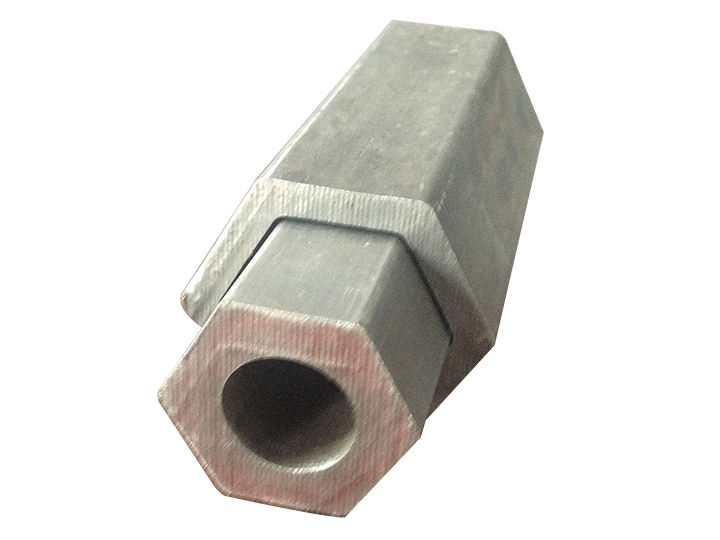
| Hexagon Pipe | 9–100 | Hexagonal outer or hexagonal bore | Q355B |
| External Hexagonal Internal Round Tube | 11–100 | Hexagonal outside, round bore | Q355B |
| External Round Internal Hexagonal Tube | 10–100 | Round outside, hexagonal bore | Q355B |
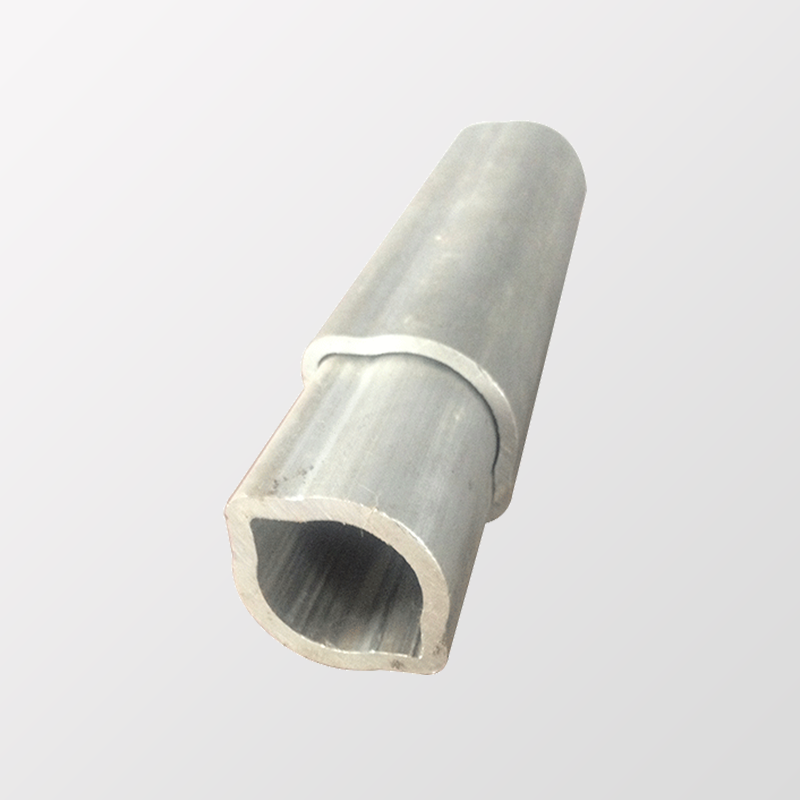
| Lemon-shaped Tube | 8–100 | Lemon / oval profile section | Q355B |
| ST Star Pipe | 5–100 | 6-point and 8-point star / spline profile | Q355B |
| 10ST Star Pipe | 3–100 | 10-point star profile | Q355B |
| Square Rectangular Pipe | 6–100 | Square and rectangular section | Q355B |
| Cold Drawn Round Tube | 12–100 | Circular, cold drawn | Q355B |
| Precision Steel Pipe | 7–100 | Circular, precision cold drawn | Q355B |
| Custom Special Shaped Pipe | 2–100 | Square, rectangular, oval, octagonal, PTO drive shaft tube, hexagonal, non-standard | Q355B |
Across the family, the shared dimensional envelope is an outer diameter range of 1–100 mm, a wall thickness range of 1–20 mm, and a dimensional tolerance of ±0.1 mm. Thin-wall configurations start from 1 mm; thick-wall configurations extend up to 20 mm.
Reading the Profiles Against Real Components
Hexagonal sections in rotational engagement
The Hexagon Pipe is classified under several related names — Hexagonal Steel Tubing, Inner Hexagon Outer Round Pipe, Inner Round Outer Hexagon Tube, Double Hexagon Seamless Pipe, Small Diameter Hexagon Tube, and Large Diameter Hexagon Tube. That naming spread is itself informative: it reflects the fact that the hexagonal feature can sit on the outside, on the inside, or on both faces, depending on what the tube has to engage.
Where a component must be driven rotationally and also located axially, an external hexagonal profile gives the mating collar a flat to register against. Where the tube has to accept a shaft, an internal hexagonal bore does the same job from the inside. The External Hexagonal Internal Round Tube (model 11–100) and the External Round Internal Hexagonal Tube (model 10–100) are the two mirrored answers to those two requirements.
Lemon and star profiles where space is tight
The Lemon-shaped Tube is a Q355B seamless pipe built with an oval or lemon cross-section, and it also appears in the corpus under the names Lemon Shaped Steel Tube, Lemon Section Seamless Pipe, Internal & External Lemon Tube, and Precision Lemon Profile Pipe. Its distinguishing feature is the absence of sharp corners: the profile is a continuous curve rather than a faceted polygon.
Star profiles take the opposite approach. The ST Star Pipe is a cold drawn seamless pipe with a star-shaped profile, available in 6-point and 8-point variants under the spline steel pipe classification, and the 10ST Star Pipe adds a 10-point variant at model range 3–100. Where a hexagonal face provides six registration flats, a star or spline profile provides more contact points around the circumference.
Square, rectangular, triangular and octagonal
The Square Rectangular Pipe covers square and rectangular sections, including large diameter square pipe, thin wall square tubing, thick wall rectangular pipe, seamless square steel tube, and mechanical square tubing. The Triangle Pipe covers triangular sections, including right-angle triangle pipe, rounded-corner triangle pipe, and precision triangle profile tubing. Seamless octagon pipe appears in the corpus as a separate profile and is also listed inside the Custom Special Shaped Pipe classification, alongside oval shaped steel pipe and PTO drive shaft tube.
Material and Tolerance: What Q355B and ±0.1 mm Mean in Practice
Every profile listed above is documented as Q355B steel, and Q355B Seamless Steel Pipe is itself a named product in the wider portfolio. Q355B is a carbon steel grade, and carbon steel remains the dominant material in the pipe market: Future Market Insights projects it at approximately 78% of global market share in 2026 projections. For agricultural machinery, that dominance is not incidental. Carbon steel grades balance strength with the formability that cold drawing requires.
The tolerance figure matters just as much as the grade. A ±0.1 mm dimensional tolerance on a tube with an outer diameter range of 1–100 mm is the difference between a component that assembles directly and one that needs to be reworked. In the recorded application scenario, the drive shaft tube runs 24/7 and is paired with a universal joint yoke, a cross and bearing kit, and a slip yoke — three mating parts, each of which has to line up with whatever section the tube carries.
A third dimension of the framework is external. Precision seamless steel tubes are governed by EN 10305-1, the technical delivery conditions for cold-drawn tubes, which specifies outside diameters up to 380 mm and strict dimensional tolerances. Buyers sourcing from outside the EU frequently encounter this standard as a reference point in specification documents, even where the tube itself is produced elsewhere.
Where the Fit Actually Happens: Drive Shafts and Precision Parts
The corpus records the agricultural machinery and automotive parts industry as the applicable industry for essentially the entire special-shaped range, from the Custom Special Shaped Pipe down to the individual profile products. That is a deliberate placement rather than a generic tag, and it maps onto two distinct component groups.
Drive shaft and power take-off lines
The Custom Special Shaped Pipe classification explicitly includes PTO Drive Shaft Tube among its categories, alongside square, rectangular, oval, octagonal, and hexagonal special-shaped steel tube. The application scenario unit records the product family being used for drive shaft tube in PTO, universal joint drive, and torque output mode, with high torque resistance to deformation as the stated special requirement. The same unit documents this configuration as common in Italy, Russia, the United States, and Germany.
Precision parts and machined components
The second group is precision parts. Precision steel pipe is offered as a cold drawn or cold rolled precision seamless pipe, a high tolerance seamless steel pipe, carbon steel precision tubing, and small diameter precision tubing, with the model designation 7–100. The Cold Drawn Round Tube, model 12–100, is documented as CDS steel pipe with tight tolerances, hydraulic fluid line tubing, and precision round tube for auto parts.
The distinction between these two groups is not the material — both are Q355B — but the direction of the requirement. Drive shaft work is dominated by torsional load and mating geometry. Precision part work is dominated by dimensional predictability, because the tube is an input to a machining sequence rather than a finished functional surface.
Supply Context: Who Makes These Tubes and Where They Ship
Fakesi, operated by WUXI JIANGBO INTELLIGENT TECHNOLOGY CO., LTD., is a steel tube manufacturer founded in 1992 and based at No. 75, Xinda Rd., Fenshui Area, Zhoutie Town, Yixing, Wuxi, Jiangsu, China. The company operates a modern self-owned production base covering over 20,000 square meters, employs approximately 50 staff, runs a five-engineer R&D team, and reports an annual production capacity of 20,000 tons.
Its product portfolio includes Seamless Round Pipe, precision seamless steel pipe, Cold Drawn Seamless Pipe, Thick Wall Seamless Steel Pipe, Thin Wall Seamless Steel Pipe, Large Diameter Seamless Pipe, Small Diameter Seamless Pipe, Hot Rolled Seamless Pipe, High Pressure Seamless Pipe, Seamless Pipe for Machining, Precision Bright Steel Pipe, Carbon Steel Seamless Pipe, 20# Seamless Steel Pipe, 45# Seamless Steel Pipe, Q355B Seamless Steel Pipe, Seamless Triangle Pipe, Seamless Lemon-shaped Tube, Seamless Hexagon Pipe, Seamless Octagon Pipe, and Seamless Oval Steel Pipe. Its wider production range covers materials including 10#, 20#, 35#, 45#, 20Cr, 40Cr, 16Mn, 20Mn, Q355B, and Q235B.
Export business accounts for 50% of total sales, with products shipped to Europe, North America, Southeast Asia, and other regions. Major markets are the EU, Eurasia, and MENA. The company supplies steel tubes into machinery manufacturing, automotive components, petrochemical engineering, power generation, agricultural equipment, and mold manufacturing.
Market Background Buyers Should Weigh
Several verifiable data points frame the sourcing decision. China's seamless steel pipe production accounts for approximately 60% of total global production as of 2023/2024, per Mysteel and the World Steel Association. Cold-drawn seamless steel tubes are projected to reach a market value of USD 26.14 billion by 2035 with a CAGR of 16.57%, according to Spherical Insights, a third-party estimate that should be treated as directional rather than definitive.
Market size estimates diverge meaningfully across research houses because of differing scopes — Market Research Future puts the 2024 global seamless pipe market at USD 130.76 billion, while other published estimates place it substantially higher. Buyers using market figures to justify a sourcing decision should therefore check the scope definition behind any number rather than the headline alone.
At the supplier end, the global seamless pipe market includes established producers such as Tenaris (Luxembourg), Vallourec (France), Nippon Steel (Japan), and Tianjin Pipe (China), according to Business Research Insights. Those names compete primarily at scale and in energy-sector specifications; special-shaped cold drawn profiles for agricultural machinery sit in a different competitive space, where die preparation and section repeatability matter more than tonnage.
Comparison with Conventional Alternatives — Including the Limits
The honest comparison is not special-shaped tube versus round tube in the abstract. It is special-shaped tube versus a round tube plus a secondary operation. That framing produces a clear trade-off.
| Approach | What it gives you | What it costs you |
|---|---|---|
| Special-shaped seamless tube (hexagon, lemon, star, triangle, square, octagon) | Section geometry formed during cold drawing; non-round mating features present without a separate machining step; tolerance documented at ±0.1 mm | Requires forming tooling matched to the specific profile; the section cannot be adapted on site; round sections remain easier to source across many suppliers |
| Round seamless tube plus machining | Widely available in the 1–100 mm outer diameter and 1–20 mm wall thickness envelope; simple to weld, bend, and re-cut | Non-round features must be cut or broached afterwards, which adds operations, handling, and dimensional risk at each step |
| Solid bar or forged shaft | High stiffness and a homogeneous structure | Higher weight and material consumption per part, which works against weight-sensitive driveline components |
The boundaries worth stating plainly
- Dimensional ceiling. The special-shaped range documented here runs from an outer diameter of 1 mm to 100 mm, with wall thickness from 1 mm to 20 mm. A project outside that envelope cannot be served by this range, regardless of profile availability.
- Tooling dependency. Each non-round section needs forming equipment matched to that section. Changing a profile is a tooling decision, which means lead-time and setup implications that a standard round tube does not carry.
- Field servicing. A hexagonal or star section cannot be improvised in the field the way a round tube can be cut and re-fitted. Replacement requires the matching profile.
- Standard alignment. EN 10305-1 addresses cold-drawn precision tubes with outside diameters up to 380 mm. It is a reference standard for precision tube delivery conditions, not a profile-specific specification for lemon or star sections.
None of these limits is disqualifying — they simply define the projects where the profile approach pays for itself and the projects where it does not.
Future Outlook
The direction of travel is visible in the numbers rather than in forecasts. Seamless pipe exports from China grew to 5.72 million tons in 2024, and cold-drawn seamless tube capacity continues to expand against a projected USD 26.14 billion market by 2035. If agricultural equipment demand holds, the more likely shift is not in whether special-shaped tubes are used, but in how tightly they are specified.
A reasonable reading is that supplier competition in this niche will move toward three measurable things: section repeatability across production lots, tolerance control at the ±0.1 mm level, and how quickly a manufacturer can prepare tooling for a new profile. Buyers who frame their evaluation around those three criteria will be comparing suppliers on the factors that actually determine whether a drive shaft line assembles without rework.
For procurement teams still in the research stage, the practical starting point is to map each component to a section type before approaching suppliers — and to confirm the bore configuration, not just the outside profile name.
Frequently Asked Questions
What is a special-shaped seamless tube, and how does it differ from a round seamless pipe?
A special-shaped seamless tube is a seamless pipe whose cross-section is not circular. The documented range includes Seamless Triangle Pipe, Seamless Hexagon Pipe, Seamless Octagon Pipe, Seamless Oval Steel Pipe, Seamless Lemon-shaped Tube, square and rectangular sections, and star profiles. Each carries a model designation — for example, 8–100 for the Lemon-shaped Tube, 9–100 for the Hexagon Pipe, and 5–100 for the ST Star Pipe. The shared dimensional envelope across these profiles is an outer diameter of 1–100 mm, a wall thickness of 1–20 mm, and a tolerance of ±0.1 mm.
Which profiles are used in agricultural machinery drive lines?
The Custom Special Shaped Pipe classification explicitly lists PTO Drive Shaft Tube as one of its categories, alongside square, rectangular, oval, octagonal, and hexagonal special-shaped steel tube. The recorded application scenario describes the drive shaft tube operating in PTO, universal joint drive, and torque output mode, matched with a universal joint yoke, a cross and bearing kit, and a slip yoke, and carrying a high torque resistance to deformation requirement. That scenario is documented as common in Italy, Russia, the United States, and Germany.
What material are these tubes made from?
The special-shaped profiles are documented as Q355B steel, and Q355B Seamless Steel Pipe is itself a named product in the portfolio. The broader production range also covers 10#, 20#, 35#, 45#, 20Cr, 40Cr, 16Mn, 20Mn, Q355B, and Q235B. At market level, carbon steel accounts for approximately 78% of global pipe market share in 2026 projections, per Future Market Insights.
Why choose a formed profile instead of machining a round tube?
A formed profile places the non-round feature in the tube during cold drawing, so the mating geometry is present when the tube arrives. Machining a round tube achieves a similar end geometry but adds a separate operation, with handling and dimensional risk at each step. The trade-off is that formed profiles depend on section-specific tooling and cannot be adapted on site, while round tubes remain easier to source, weld, and re-cut.
Are there dimensional limits to the special-shaped range?
Yes. The documented special-shaped range covers outer diameters from 1 mm to 100 mm and wall thicknesses from 1 mm to 20 mm, with a ±0.1 mm dimensional tolerance. Projects outside that envelope fall outside this range. Separately, EN 10305-1 governs cold-drawn precision tubes with outside diameters up to 380 mm and specifies strict dimensional tolerances, but it is a delivery-condition standard for precision tube rather than a profile-specific specification.
Additional product and production-range information, including the full steel tube portfolio from Fakesi, is available at wxjiangbo.com. A downloadable specification brochure is also available: Steel Tube Specification Brochure (PDF).