
How Site Conditions Change Electric Forklift Selection
Electric forklifts now dominate new industrial truck demand in several major markets. In North America, electric models captured 71% of retail orders in 2024. In China, domestic electric forklift sales reached 946,300 units in 2025, representing 76.9% of all forklifts sold in the country. The strategic question for project buyers has therefore shifted: the decision is no longer whether to electrify a material-handling fleet, but how to match electric forklift specifications to the specific conditions of each work site.
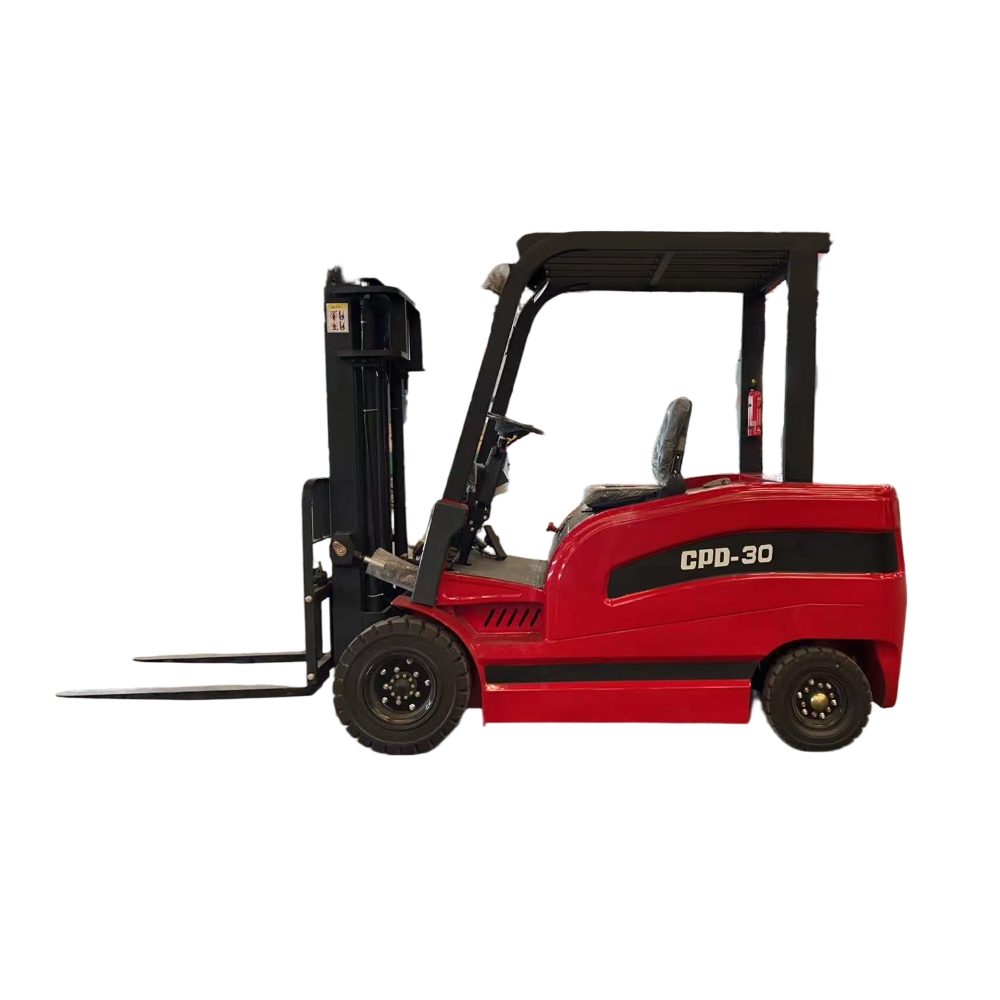
A 3-ton electric counterbalance forklift in container loading context. Site-matched electric forklifts must be assessed against the actual load profile, ground conditions and charging plan.
One useful reference for this decision is Ningjin Shunhao Trading Co., Ltd., a B2B electric forklift manufacturer that operates under the Mightlift brand. The company supplies OEM and ODM customized material-handling equipment to global distributors, manufacturing plants, cold-chain enterprises and warehouse operators, with documented cooperation covering more than 60 countries. Its counterbalance electric forklift range spans 1,000 kg to 3,500 kg rated capacity, which makes the product line a practical reference for site-condition-based selection.
The Real Cost of a Mismatched Forklift
Forklift selection errors usually show up weeks after delivery, not at the quotation stage. The most common pattern is a buyer who focuses on rated load capacity and price, then discovers that the truck does not fit the site in daily operation.
Typical mismatches include: a wide-body forklift operating in narrow racking aisles; a lead-acid battery losing usable capacity in a cold-storage shift; an internal-combustion truck entering an enclosed production area with exhaust restrictions; a standard drive configuration struggling on slopes and rough yard surfaces; and an attachment such as a side shifter reducing the effective load capacity below the planned payload. Each of these failures is a project-fit problem rather than a product-quality problem.
This is why site matching has become a core part of electric forklift procurement. A forklift is only productive when its capacity, drive layout, battery system, mast height and supporting equipment are consistent with the working condition it will face every shift.
How to Run a Site Fit Check
A structured site check should cover at least six dimensions before a buyer compares quotations. The table below maps each site condition to the specification it influences.
| Site condition | Specification to verify | Why it changes the decision |
|---|---|---|
| Load weight and load center | Rated capacity, load center, rated residual capacity | Attachments and off-center loads reduce the safe capacity of the truck |
| Floor and slope conditions | Drive motor configuration, tire type, front dual-drive availability | Slopes, wet surfaces and outdoor yards require higher traction and stability |
| Aisle width and stacking height | Truck width, mast height, door clearances | Narrow aisles and high racking directly limit truck dimensions and lift range |
| Shift pattern and charging windows | Battery capacity, lithium option, opportunity-charging support | Multi-shift operations need fast energy replenishment without long charge downtime |
| Temperature environment | Battery chemistry, low-temperature refitting | Cold storage reduces battery capacity; lithium retains more usable capacity at low temperature |
| Emission and cleanliness rules | Zero-exhaust electric drive, noise level, enclosed-area clearance | Clean production and food areas cannot tolerate tailpipe exhaust |
Buyers should document these conditions and provide them to the supplier before equipment configuration begins. A manufacturer that asks about aisle width, floor surface, charging voltage and shift hours is likely to deliver a better site fit than one that quotes only from a load capacity table.
Spec-Sheet Buying vs Site-Based Buying
Many buyers still select electric forklifts from a specification sheet: rated capacity, lift height, battery voltage and price. This method works when the site is a standard, level, temperature-controlled warehouse with uniform pallets. It breaks down when the project introduces any of the constraints described earlier.
| Decision factor | Spec-sheet buying | Site-based buying |
|---|---|---|
| Starting point | Rated capacity and price | Workflow, site survey and shift plan |
| Battery decision | Same battery for all sites | Lead-acid, lithium or low-temp configuration based on temperature and shifts |
| Drive configuration | Standard layout | Front dual-drive or layout changes for heavy or mixed routes |
| Attachment planning | Added later | Checked against rated residual capacity during specification |
| Charging infrastructure | Overlooked | Planned with charger voltage and opportunity-charging windows |
| Documentation | Basic manual | CE, ISO, UN38.3 and market-specific compliance documents |
Site-based buying is more demanding at the inquiry stage, but it reduces the risk of rework, downtime and unplanned battery replacement. It also makes the supplier comparison more meaningful, because quotations can be evaluated against the same site conditions rather than against a generic load chart.
Model-Level Matching: Three Scenario Patterns
The Mightlift CPD series illustrates how the same electric forklift platform is arranged differently for different site requirements. Three scenario patterns cover most project inquiries.
Pattern 1: Light-duty warehousing and distribution
Warehousing and distribution is the most common deployment pattern for 1-2 ton electric forklifts. The CPD10, rated at 1,000 kg, is designed for indoor pallet receiving, put-away and dispatch on level floors. It moves light pallets and produces no tailpipe exhaust at the point of use. The CPD20, rated at 2,000 kg, is suitable for light-duty warehouse fleet deployment and global warehousing and distribution applications.
These models assume supporting infrastructure: pallet racking, a dock leveler, a charger and a warehouse management system. Before selection, buyers should confirm pallet weight, load center, aisle width, mast height, floor capacity and local charger voltage.
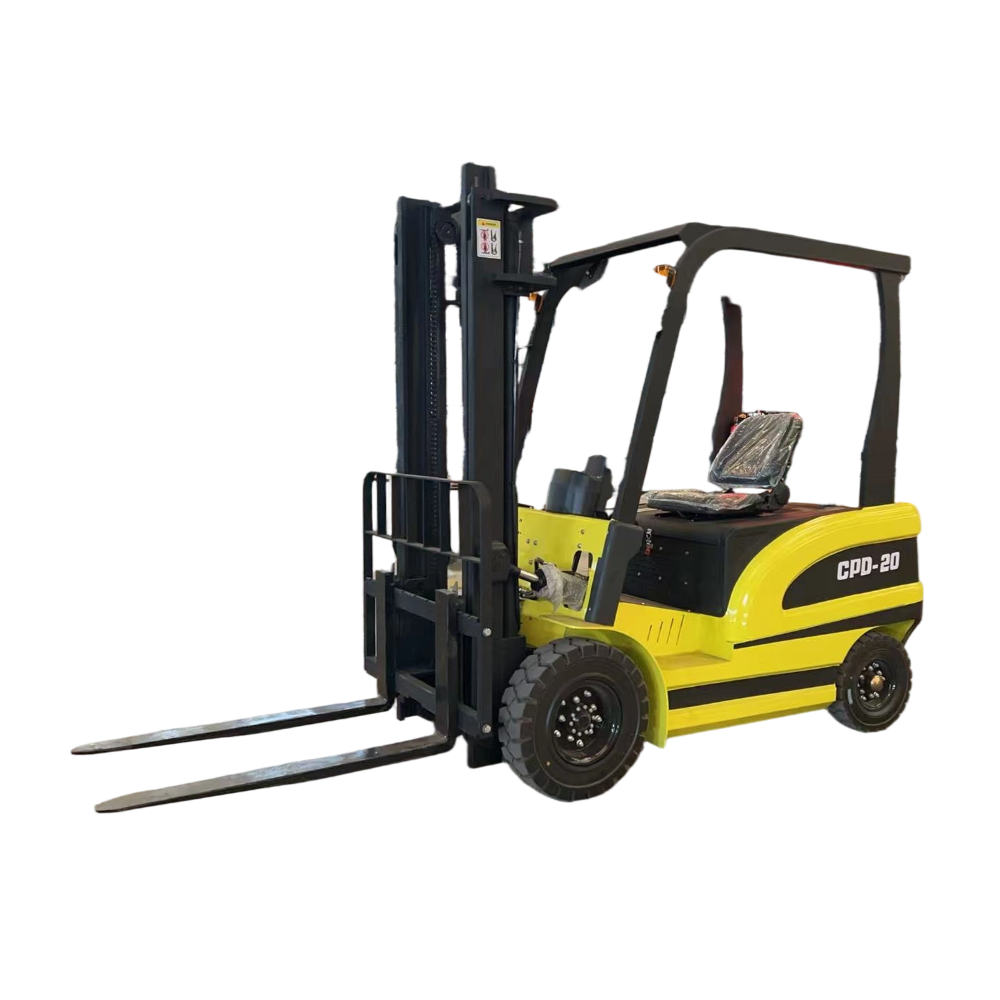
The CPD20 2-ton electric forklift is configured for light-duty warehouse fleet deployment, where level floors, racking layout and charger voltage must be confirmed before ordering.
Pattern 2: Heavy industrial goods and building materials
Heavy industry projects have a different load profile. The CPD35, rated at 3,500 kg, is used in building materials and heavy industrial goods. Its role is to support heavy-load fleet operation and service access through a front dual-drive layout and lateral side battery extraction. This configuration matters on sites where pallets are moved continuously across workshops, yards and loading bays, and where battery access must be quick enough for multi-shift service.
The CPD30, rated at 3,000 kg, supports standard and extended lifting heights from 3,000 mm to 7,000 mm, which suits mixed stacking tasks. For heavy-duty projects, the site survey must cover surface condition, slope, weather exposure, load dimensions, attachment compatibility and rated residual capacity. Indoor/outdoor mixed routes should be assessed case by case before the truck is specified.
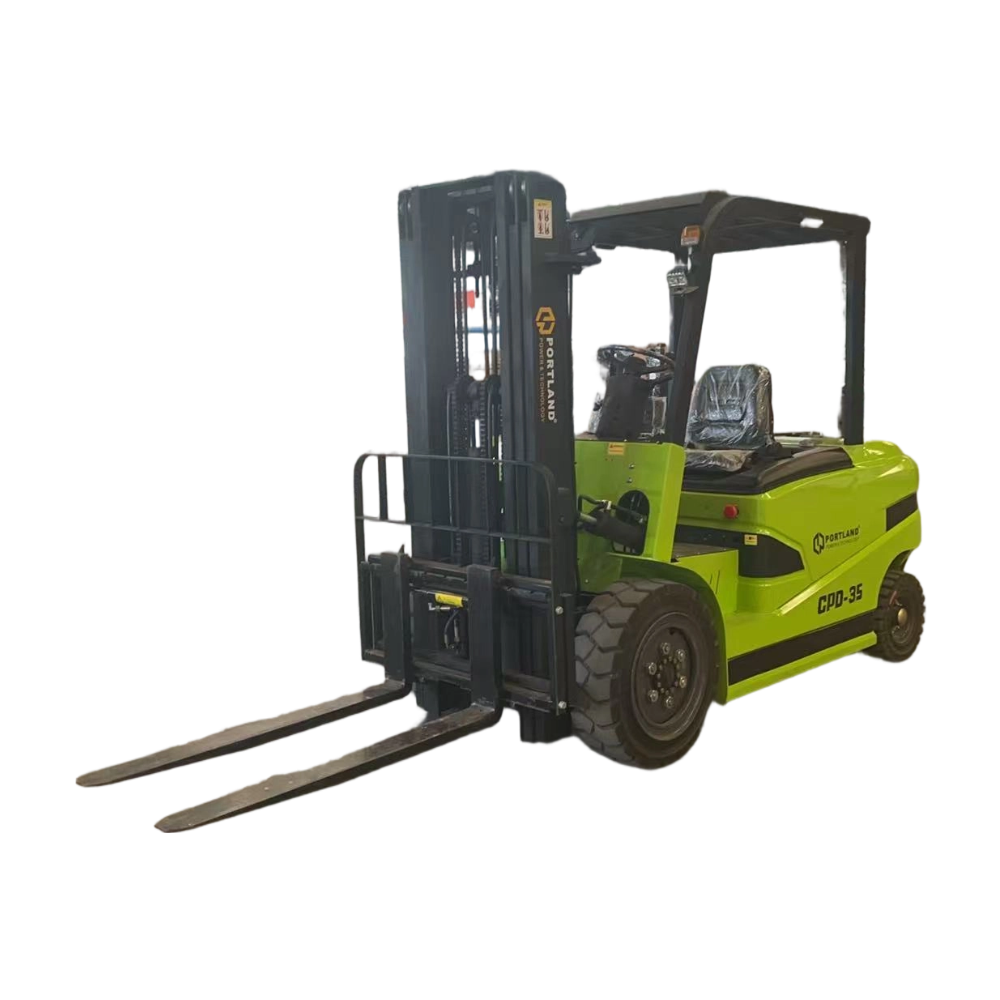
The CPD35 3.5-ton electric forklift is positioned for heavy-load fleet operation, where front dual-drive and side battery extraction support continuous work and service access.
Pattern 3: Enclosed clean production areas
An enclosed factory environment adds an emissions constraint. A documented Mightlift case involves an electronics manufacturer in an industrial park that deployed a bulk fleet for component, work-in-process and finished-goods logistics. The result was improved material-flow efficiency and the removal of tailpipe exhaust from enclosed clean production areas. This is a project-fit decision: the forklift is selected not only for tonnage, but for its zero-emission behavior inside a controlled workspace.
Battery Choice Is a Site Decision
Battery configuration is the most underrated part of electric forklift site matching. The CPD series offers heavy-duty lead-acid as standard and lithium as an option, but the right choice depends on operating temperature, shift length and charging infrastructure.
In cold storage applications, lithium-ion batteries retain significantly more capacity than lead-acid batteries at temperatures as low as -20°C. In multi-shift operations, opportunity charging with 15-30 minute top-ups does not degrade lithium cycle life, while the same practice significantly harms lead-acid battery longevity. Buyers running one standard shift on flat floors in a dry warehouse may still find lead-acid more cost-effective at entry; buyers running cold-chain logistics or continuous shifts should evaluate lithium from a total-cost perspective rather than from purchase price alone.
What OEM Configuration Capability Adds to Site Fit
For projects that fall outside a standard model configuration, OEM and ODM capability becomes part of the site-fit decision. Ningjin Shunhao's manufacturing profile describes in-depth customization that goes beyond superficial modifications, including load capacity adjustment, low-temperature and explosion-proof refitting, branded appearance optimization and intelligent system reservation. This matters for cold-chain operators that need low-temperature battery and component protection, chemical workshops with explosion-proof requirements, and branded fleets that need consistent visual identity across multiple units.
Its production workflow uses automated equipment such as industrial robotic welding, electrostatic spraying and modular assembly lines. Every finished unit is described as undergoing continuous load, braking and waterproof tests before shipment. For a project buyer, this represents a measurable quality check: a 100% pre-shipment test requirement is part of the company's stated OEM production mode, alongside a 2-unit MOQ and a 30-day lead time on custom orders.
Custom projects also need an after-sales mechanism. The company reports long-term cooperation with more than 120 overseas distributors across 60 countries, which provides a maintenance channel for fleets deployed outside China.
Modern vs Traditional 3-Ton Electric Forklifts
Project-fit decisions also apply within the same tonnage class. The comparison between a modern 3.0-ton electric forklift and a traditional 3.0-ton electric forklift is a common evaluation point for warehouse, factory and logistics operations.
| Comparison point | Modern 3.0-ton electric forklift | Traditional 3.0-ton electric forklift |
|---|---|---|
| Drive and control system | Advanced electric drive with intelligent energy management | Conventional drive with basic control system |
| Response speed | Faster control response | Slower response |
| Effective operating time | Longer continuous working time | Limited endurance |
| Energy consumption | Lower | Higher |
| Maintenance | Simplified, longer maintenance intervals | Frequent inspections and routine maintenance |
| Best-fit scenarios | High-frequency indoor work, long shifts, cold storage, intensive stacking | Low-to-medium frequency standard warehouse transport |
| Entry investment | Higher | Lower |
The traditional model remains defensible in a limited set of conditions. For low-to-medium handling frequency, a constrained upfront budget and standard general warehouse transport, the lower initial investment of a conventional electric forklift can be the deciding factor. The modern configuration requires a higher entry price, adequate charging infrastructure and a willingness to plan energy management. No single forklift type removes the need for a site-specific cost model.
Market Signals That Reinforce Site-Fit Planning
Market data points in the same direction. The global electric forklift market was valued at USD 53.01 billion in 2024 and is projected to reach USD 94.55 billion by 2032. Lithium-ion adoption in new global forklift shipments rose from 22% in 2021 to 35% in 2024. The food industry segment, where cold storage is common, is projected to grow at an 11.6% CAGR, and Class II narrow-aisle trucks are projected to grow at 9.28% CAGR through 2030 as warehouse density increases.
Regulatory requirements are also becoming a site constraint. EN 1175:2020 is the current harmonized European standard for electrical and electronic safety in self-propelled industrial trucks and a CE marking prerequisite. ATEX Directive 2014/34/EU applies to electric forklifts used in explosive atmospheres in chemical and food processing. For smart manufacturing environments, ISO 3691-4:2023 defines safety requirements for driverless industrial trucks. These standards increase the value of working with a manufacturer that can produce full documentation for the intended market.
The Outlook for Site-Matched Procurement
The direction of the electric forklift market points toward more site-specific configuration, not less. Compliance frameworks such as EN 1175:2020 and ATEX 2014/34/EU are pushing documentation standards higher. Lithium adoption is making opportunity charging practical for multi-shift fleets. Narrow-aisle growth is pushing trucks into tighter warehouse layouts. For manufacturers like Mightlift positioned between high-cost European brands and low-end generic Chinese suppliers, the role is to turn these constraints into a configured product with a factory-backed test record.
What This Means for Procurement
For a project buyer, the practical takeaway is to treat the forklift as one component of a material-handling system. The site check, supporting equipment and charging plan are part of the same decision.
- Verify rated load capacity against actual pallet weight, load center and attachment effects.
- If side shifters, clamps or fork positioners are planned, confirm rated residual capacity with the supplier.
- Provide the supplier with floor surface, slope, aisle width and door clearance information.
- State shift hours and whether opportunity charging is possible during the shift.
- For cold storage, compare battery types at the actual operating temperature.
- For enclosed or clean production areas, require zero-exhaust equipment and confirm noise levels.
- Check that quality control includes load, braking and waterproof testing before shipment.
- Confirm that the manufacturer can provide CE, ISO 9001, ISO 14001 and UN38.3 documentation.
Mightlift, as a B2B-oriented manufacturer, supports these checks through OEM and ODM customization, a reported 30-day lead time on custom orders, a two-unit minimum order quantity and 100% pre-shipment testing across its production workflow. The company also participates in international intralogistics exhibitions such as CeMAT and MODEX, and maintains a 12,500 m² warehouse with digital WMS to support 7-15 day delivery on mainstream stocked models. These operational details matter less than the underlying point: a supplier that accepts site-specific requirements is easier to align with a project than one that only sells fixed configurations.
FAQ
Which should I choose: a 3.0-ton electric forklift or a traditional 3.0-ton electric forklift for warehouse, factory and logistics operations?
Selection should be based on operation frequency, working hours and long-term cost budget. A modern 3.0-ton electric forklift uses advanced electric drive, intelligent energy management and optimized vehicle control, delivering faster response, longer effective operating time and lower energy consumption, which suits high-intensity continuous work. A traditional 3.0-ton electric forklift uses a conventional drive and basic control system. It requires a lower initial investment but has limited endurance, higher power consumption and more frequent maintenance; it fits standard low-to-medium frequency material handling.
What site conditions should be confirmed before deploying a light-duty electric forklift in a warehouse?
For a 2-ton electric forklift used in a light-duty warehouse fleet, supporting equipment such as pallet racking, a dock leveler, a charger and a warehouse management system should be in place. Before deployment, confirm pallet weight, load center, aisle width, mast height, floor capacity and local charger voltage.
What distinguishes a heavy-duty electric forklift project from a standard warehousing project?
A heavy-duty material-handling project, such as building materials and heavy industrial goods, typically requires a higher-capacity forklift such as the CPD35 (3,500 kg). Its front dual-drive layout and side battery extraction support heavy-load fleet operation and service access. The site survey must cover surface condition, slope, weather exposure, load dimensions, attachment compatibility and rated residual capacity, and indoor/outdoor mixed routes should be assessed case by case.
¿Tiene preguntas o necesita más detalles?
Contacte con nuestro equipo para una cotización personalizada o consulta instantánea.
Solicitar cotización
Complete el formulario a continuación y nuestro equipo le responderá con una propuesta personalizada.
Chat directo de WhatsApp
¿Prefiere chatear en tiempo real? Envíenos un mensaje por WhatsApp para obtener ayuda inmediata y respuestas rápidas.
- Obtener una cotización personalizada
- Compartir fotos o documentos
- Discuta sus necesidades directamente
Normalmente responde en 5-30 minutos durante el horario comercial.