
How Sauna Room Models Map to Hotels, Spas, and Guesthouses
How Sauna Room Models Map to Hotels, Spas, and Guesthouses
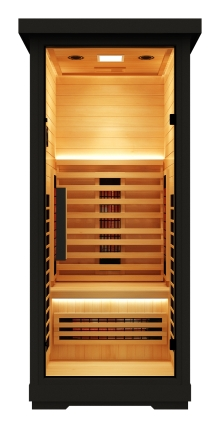
Outdoor sauna room model OFS06C-1: an outdoor unit with pentroof and far infrared heating, documented for hotel & hospitality, guesthouse, wellness & commercial club and spa use. Image: OCEAN FUTURE product documentation.
The global sauna market was valued at USD 954.3 million in 2025 and is projected to reach USD 1,556.8 million by 2033, according to Grand View Research. A meaningful share of that demand comes from commercial hospitality settings, where a sauna room is specified as part of a building's facilities rather than bought as a home accessory. In those settings, the model number — not the marketing description — determines the electrical supply, the siting, the session intensity the room can sustain, and the type of heat guests actually feel.
For procurement teams at the research stage, the useful question is not which sauna room is best, but which sauna room model fits this venue. This reference maps the OCEAN FUTURE sauna room range — the indoor infrared OFS01, OFS02, OFS03 and OFS06 families, the outdoor OFS06B-5, OFS06C and OFS12-2-T units, and the stove-based OFS05 and OFS07-2 models — to the operating contexts of hotels, spas, wellness clubs and guesthouses.
OCEAN FUTURE is the sauna and spa equipment brand of FOSHAN GAOMING MUHE JINGCHENG SANITARY WARE CO., LTD., a manufacturer based in Foshan, China, whose main products are sauna rooms, hot tubs, swim spas and cold plunges. Approximately 85% of its products are exported, with major markets in the USA, Australia, the EU and Germany, and its R&D team consists of 9 engineers.
Why Venue Type Sets the Specification Before Room Size Does
Commercial buyers usually open the conversation with room dimensions. Dimensions matter, but they are a downstream input. Five venue-level variables decide the platform first:
- Session intensity. A hotel amenity sauna used by a handful of guests a day places a different continuous load on a heating system than a spa treatment room running back-to-back sessions.
- Siting. Indoor placement allows normal ventilation planning. Outdoor placement requires structural weather protection: the outdoor sauna rooms in the range use an outdoor pentroof, while OFS05-3-T adds a waterproof roof with an aluminium plastic panel exterior.
- Electrical supply. Infrared models across the OFS06 family are documented from 1500W on OFS06B-1 to 4150W on OFS06C-4. Stove-based models such as OFS05-3 are documented at 8000W, and documented models run at rated voltages of 220V/50Hz or 380V/50Hz.
- Guest expectation of heat type. Far infrared heat and classical Finnish stove-generated steam are different experiences. A venue that markets a Finnish sauna is generally specifying a stove, not only an infrared panel.
- Service and supervision. The heater or stove, control panel, safety thermometer and lighting all need to be reachable within the venue's maintenance routine.
Only after those five are fixed does room size translate into a power band. A compact guesthouse room behind a limited supply can be served by a 1500W–1850W infrared model, while a large commercial wellness area that promises heavy, steam-driven sessions requires a stove-based unit and the electrical capacity to match it.
Two Heating Architectures in the OCEAN FUTURE Range
OCEAN FUTURE's sauna rooms are built on two heating architectures. Far infrared models use far infrared heating plates, or heating plates combined with a heating box, and are managed by the AV1 integrated control system with FM, Bluetooth, USB and two speakers. Stove-based and hybrid models use a Harvia electric sauna heater — 8kW (BC80E) on the OFS05 series and 6kW (BC60E) on OFS07-2 and OFS12-2 — controlled by the MXD2022 system, and in the case of OFS07-2 combined with a far infrared heating box.
The distinction matters commercially because the two architectures sit in different power classes. Infrared units are documented from 1200W (OFS06A-1) to 4150W (OFS06C-4). Stove-based models run from 6000W (OFS12-2) to 8000W (OFS05-3 and OFS05-3-T), with OFS07-2 documented at 8000W + 800W, and rated voltages of 220V/50Hz or 380V/50Hz. Across both architectures the cabin structure uses the same wood species — hemlock, aspen and red cedar — with tempered glass, wood handles and, on most models, a painted surface.
| Feature | Far infrared models | Stove-based and hybrid models |
|---|---|---|
| Representative models | OFS01-1, OFS02-3, OFS03-1, OFS06A-5, OFS06B-1, OFS06C-4, OFS08-1 | OFS05-1, OFS05-3, OFS05-3-T, OFS07-2, OFS12-2, OFS12-2-T |
| Heat source | Far infrared heating plate, or plate with heating box | Harvia electric sauna heater (BC80E 8kW, BC60E 6kW); OFS07-2 also uses a far infrared heating box |
| Control system | AV1 | MXD2022 |
| Documented total power | 1200W – 4150W | 6000W – 8000W; OFS07-2 at 8000W + 800W |
| Rated voltage (documented) | Model-dependent; OFS08-1 states 220V/50Hz | 220V/50Hz or 380V/50Hz |
| Connectivity | FM, Bluetooth, USB; two speakers | FM, Bluetooth, USB, WiFi; speakers |
| Accessories | Lamp and colourful lighting, wood handle, tempered glass | Adds wooden bucket, spoon, sandglass, hygrothermograph and one set of sauna stones on models such as OFS12-2 and OFS07-2 |
Mapping OCEAN FUTURE Models to Venue Types
The table below is the reference map: documented total power and control system on the left, the operational context each model is documented for on the right. All listed models are documented as intended for hotel & hospitality, guesthouse, wellness & commercial club and spa facilities, unless a narrower application is noted.
| Model | Type | Documented total power | Control | Typical venue fit |
|---|---|---|---|---|
| OFS06A-1 | Indoor infrared | 1200W | AV1 | Small guesthouse or home unit; lowest documented power in the OFS06 infrared family |
| OFS06B-1 | Infrared | 1500W | AV1 | Boutique guesthouse, single treatment suite, low-supply sites |
| OFS06B-2 | Infrared | 1850W | AV1 | Guesthouse, small wellness room |
| OFS06B-3-1 | Infrared | 1850W | AV1 | Guesthouse, hotel amenity sauna |
| OFS06A-3-2 | Infrared | 1900W | AV1 | Hotel and guesthouse installations |
| OFS06B-3-2 | Infrared | 2300W | AV1 | Hotel, wellness club |
| OFS02-3 | Indoor infrared | 2400W | AV1 | Hotel, guesthouse, spa facilities |
| OFS06A-5 | Infrared | 3000W | AV1 | Hotel spa, wellness club |
| OFS08-1 | Indoor infrared, smart | 2900W, 220V/50Hz | MXD2022 | Hotel, spa and residential settings with WiFi control expectations |
| OFS06B-5 | Outdoor infrared, pentroof | 1800W | AV1 | Guesthouse garden or terrace unit |
| OFS06C-1 | Outdoor infrared, pentroof | 1800W | AV1 | Guesthouse and hotel outdoor amenity |
| OFS06C-2 | Outdoor infrared, pentroof | 2150W | AV1 | Hotel terrace, boutique leisure facility |
| OFS06C-4 | Outdoor infrared, pentroof | 4150W | AV1 | Resort and hotel outdoor wellness areas |
| OFS12-2 | Indoor, Harvia 6kW (BC60E) | 6000W | MXD2022 | Hotel spa with a traditional Finnish offer |
| OFS12-2-T | Outdoor, Harvia 6kW (BC60E) | Harvia stove 6kW | MXD2022 | Outdoor hotel spa and hospitality installations |
| OFS05-3 | Indoor, Harvia 8kW (BC80E) | 8000W | MXD2022 | Spa and commercial club with high session intensity |
| OFS05-3-T | Outdoor, Harvia 8kW (BC80E), waterproof roof | 8000W | MXD2022 | Outdoor spa and commercial wellness areas |
| OFS07-2 | Indoor hybrid, Harvia 6kW (BC60E) + far infrared box | 8000W + 800W | MXD2022 | Facilities wanting a stove experience and an infrared option in one footprint |
Two readings of this table are worth flagging. First, documented power describes the heating class of the cabin and its electrical planning requirement, not a comfort ranking; a 1500W infrared room and an 8000W stove room serve different guest expectations rather than different quality tiers. Second, the outdoor range is not a single tier: OFS06B-5 and OFS06C-1 sit at 1800W, OFS06C-2 at 2150W, OFS06C-4 at 4150W, and the outdoor stove-based units OFS12-2-T and OFS05-3-T move into the 6kW and 8kW stove class.
Application Mapping by Venue Type
Hotels: Standardisation, Siting and Duty Cycle
Hotel projects usually buy more than one unit and want a repeatable specification they can carry across rooms and floors. The infrared OFS06 group is the most straightforward fit for guest amenity areas, spa suites and terraces, because OFS06B-1 (1500W), OFS06B-2 and OFS06B-3-1 (1850W), OFS06B-3-2 (2300W) and OFS06A-5 (3000W) share AV1 control, far infrared heating, tempered glass, wood handles and FM/Bluetooth/USB connectivity with two speakers — one operating routine across a mixed installation. Where the hotel spa markets a traditional Finnish experience, OFS12-2 (indoor, Harvia 6kW BC60E, 6000W) or OFS12-2-T (outdoor, Harvia 6kW BC60E) moves the specification into the stove class. Terraces, courtyards and pool decks are covered by the pentroof outdoor models: OFS06C-1 (1800W), OFS06C-2 (2150W), OFS06C-4 (4150W) and OFS06B-5 (1800W).
Spas, Wellness Clubs and Commercial Clubs
Spas and wellness clubs sell the sauna as the product, so the experience ceiling matters more than the minimum electrical footprint. That points towards stove-based models where the venue supply allows: OFS05-3 (indoor, Harvia 8kW BC80E, 8000W), OFS05-3-T (outdoor, waterproof roof and aluminium plastic panel exterior, Harvia 8kW BC80E, 8000W) and OFS12-2 (6000W). Where a facility wants both a dry infrared option and a stove experience in one footprint, OFS07-2 combines a Harvia 6kW (BC60E) stove with a far infrared heating box and is documented at 8000W + 800W total power. These models also ship with the accessories commercial operators expect: wooden bucket, spoon, sandglass, hygrothermograph and one set of sauna stones.
Guesthouses and Boutique Leisure Facilities
Guesthouses typically buy one unit, often against a constrained supply and a footprint that is already fixed. Lower-power infrared models fit that constraint: OFS06B-1 at 1500W, OFS02-1 at 1700W, and OFS06B-2 and OFS06B-3-1 at 1850W. Where the property has a garden, courtyard or terrace and wants the sauna to be a visible amenity, the pentroof outdoor models OFS06C-1 and OFS06B-5, both documented at 1800W, keep the electrical requirement in the same band while adding outdoor placement. The same platform is applied in private residences, private backyard saunas, guesthouse leisure facilities and club wellness projects; OFS01-1 (1800W) and OFS03-1 (1600W, MXD2022 control) suit straightforward indoor installations, while OFS08-1 is documented as a smart indoor sauna room at 2900W/220V/50Hz with WiFi and Bluetooth in addition to FM and USB.
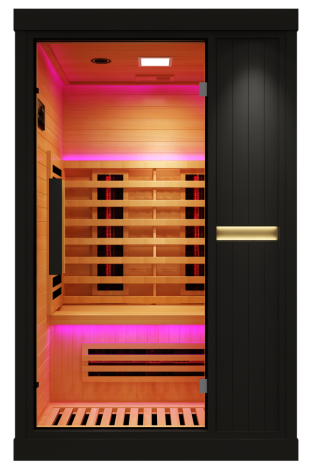
Infrared sauna room OFS06B-2: 1850W, AV1 control, painted surface and tempered glass, documented for hotel & hospitality, guesthouse, wellness & commercial club and spa use. Image: OCEAN FUTURE product documentation.
What the Specifications Signal to a Commercial Buyer
- Total power is a planning number. It defines the heating class of the cabin and the electrical capacity the venue must provide. In this range it spans 1200W–4150W for infrared units and 6000W–8000W for stove-based units.
- Control system indicates the service interface. AV1 appears on the infrared models with FM, Bluetooth and USB; MXD2022 appears on the stove-based and hybrid models and adds WiFi.
- Heat source indicates the guest experience. A far infrared plate or plate-and-box arrangement produces radiant heat without a stove; the Harvia stove models deliver the classical steam environment and include sauna stones.
- Supporting equipment is mandatory, not optional. The sauna rooms require supporting equipment such as a sauna heater, infrared heating panels, a control panel, LED lighting and a safety thermometer, and must be used with a control panel and a safety thermometer.
- Materials are consistent across the range. Hemlock, aspen and red cedar are used throughout, with tempered glass and wood handles; several indoor models carry a painted surface and colourful lighting.
Market Context Behind 2025–2026 Specification Decisions
Three verified market signals are directly relevant to the model-matching question. First, application mix: the residential segment dominated the sauna market with a 58.92% share in 2025, according to Grand View Research, which is precisely why commercial buyers should not copy residential specifications into hotel or spa projects — the duty cycle and the supervision model are different. Second, product mix: traditional saunas held the largest product share at 42.79% in 2025, while infrared saunas are the fastest-growing segment at a 7.5% CAGR, according to the same source. Both architectures therefore have a live market, and a hospitality portfolio that covers only one of them will lose specifications to the other. Third, geography: the United States sauna market generated USD 250.8 million in revenue in 2024, approximately 21.8% of global revenue, based on Topture / Technavio data.
Market-size figures should be read with their scope definition in hand. Estimates for the same period range from USD 954.3 million (Grand View Research, sauna equipment) to USD 4.8 billion (Dataintelo, sauna and steam room) and USD 148.79 billion (Mordor Intelligence, sauna and spa), because the definitions include different parts of the value chain. For a procurement decision, the model-level specification matters more than the aggregate figure.
Two regulatory and sourcing shifts are also shaping specifications. A new electric sauna heater safety standard, UL 60335-2-53, was published in June 2025 to align US regulations with international standards, replacing UL 875 — relevant to any venue specifying an electric heater rather than an infrared-only cabin. On materials, European commercial developers are increasingly prioritising FSC-certified sustainably sourced wood, reported at 36% of new sauna installations in 2024 (Topture Industry Report), which makes wood documentation part of tender responses. On the component side, Harvia Oyj is the global market leader with 2024 revenues estimated at approximately EUR 175 million (Dataintelo / Harvia Investor Relations), which explains why venues that name a heater brand in tender documents tend to ask for Harvia-equipped models such as OFS05-3, OFS05-3-T, OFS12-2, OFS12-2-T and OFS07-2.
Where Model Matching Reaches Its Limits
Model-to-venue mapping is a filtering tool, not a guarantee, and four boundaries are worth stating plainly.
- Infrared is not a substitute for a stove room. A 1500W–4150W far infrared cabin and a 6000W–8000W stove cabin do not deliver the same session. A venue that advertises a Finnish sauna experience should be specified with a stove-based model, even if an infrared unit would be cheaper or simpler to install.
- The 6000W–8000W class is an electrical project. OFS05-3, OFS05-3-T, OFS07-2, OFS12-2 and OFS12-2-T sit in the stove class with documented rated voltages of 220V/50Hz or 380V/50Hz. Guesthouses, older buildings and residential conversions may need infrastructure work before they can host them. Where that work is not feasible, the practical alternative is a higher-power infrared model — with the experience trade-off acknowledged rather than hidden.
- Outdoor placement is a construction decision. Pentroof construction on the OFS06C and OFS06B-5 models, and the waterproof roof with aluminium plastic panel exterior on OFS05-3-T, address weather exposure at product level; siting, drainage, access and local installation requirements still need project-specific review.
- Documented specifications are not the same as destination-market approval. Power ratings, control systems and materials are documented per model, but compliance for a specific market is verified separately, and the June 2025 publication of UL 60335-2-53 shows that requirements move. Buyers should confirm the applicable standard for the installation country before freezing a model list.
A Practical Model-Selection Sequence
- Define the venue type and the duty cycle: hotel amenity, spa treatment room, club facility or guesthouse feature.
- Decide indoor or outdoor placement, and whether a pentroof or waterproof roof structure is needed.
- Confirm the available electrical supply and rated voltage before shortlisting — 220V/50Hz versus 380V/50Hz separates the infrared and stove classes in this range.
- Choose the heating architecture: far infrared, stove-based, or the hybrid combination used on OFS07-2.
- Select the power band inside that architecture, using documented values rather than assumptions.
- Confirm materials, finish and accessories — hemlock, aspen, red cedar, tempered glass, and for stove models the bucket, spoon, sandglass, hygrothermograph and sauna stone set.
- Verify supporting equipment (sauna heater, infrared heating panels, control panel, LED lighting and safety thermometer) and the compliance standard for the destination market.
- Plan service access to the heater or stove, the control panel and the safety thermometer.
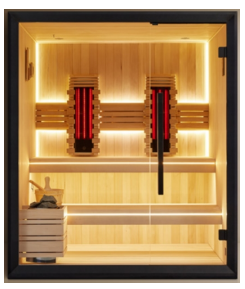
Hybrid indoor sauna room OFS07-2: Harvia 6kW (BC60E) stove plus far infrared heating box, documented at 8000W + 800W with MXD2022 control, for spa and commercial club use. Image: OCEAN FUTURE product documentation.
Future Outlook
Infrared saunas are the fastest-growing product segment at a 7.5% CAGR while traditional saunas still hold the largest installed share at 42.79%, so the near-term outlook for hospitality procurement is portfolio-based rather than either-or: venues will keep specifying stove rooms for the headline experience and infrared cabins for amenity areas, terraces and supply-constrained buildings. Standard harmonisation such as UL 60335-2-53 will push buyers toward standard-based specification language instead of brand-only approvals, and wood sourcing documentation, tracked at 36% of new European commercial installations, will increasingly be requested at tender stage rather than at delivery. For suppliers, the differentiator is coverage: an indoor and outdoor range, infrared, stove-based and hybrid architectures, and documented power steps from 1200W to 8000W allow a venue-specific answer instead of a generic one.
Frequently Asked Questions
What is the difference between an infrared sauna room and a traditional sauna room in the OCEAN FUTURE range?
Infrared models use far infrared heating plates, or heating plates combined with a heating box, and are controlled by the AV1 system with FM, Bluetooth and USB functions; documented total power ranges from 1200W on OFS06A-1 to 4150W on OFS06C-4. Traditional models use a Harvia electric sauna heater — 8kW (BC80E) on the OFS05 series and 6kW (BC60E) on OFS07-2 and OFS12-2 — with MXD2022 control, total power in the 6000W to 8000W band (OFS07-2 is documented at 8000W + 800W), and rated voltages of 220V/50Hz or 380V/50Hz. Both architectures use hemlock, aspen and red cedar with tempered glass and wood handles.
Which OCEAN FUTURE sauna room model suits a guesthouse with limited space and a modest electrical supply?
The lowest documented total power in the infrared range is 1500W on OFS06B-1, followed by OFS03-1 at 1600W, OFS02-1 at 1700W, OFS06B-2 and OFS06B-3-1 at 1850W and OFS06A-3-2 at 1900W. These models are documented for hotel & hospitality, guesthouse, wellness & commercial club and spa facilities, use AV1 control with FM, Bluetooth, USB and speakers, and are built from hemlock, aspen and red cedar. Where outdoor placement is preferred, OFS06C-1 and OFS06B-5 are both documented at 1800W with an outdoor pentroof.
How much power does a hotel or spa sauna room need?
It depends on the heating architecture rather than the venue label. In the infrared range, OFS02-3 is documented at 2400W, OFS06A-5 at 3000W and OFS06C-4 at 4150W for an outdoor unit. In the stove-based range, OFS12-2 is documented at 6000W with a Harvia 6kW (BC60E) stove, while OFS05-3 and OFS05-3-T are documented at 8000W with a Harvia 8kW (BC80E) stove. Rated voltages for the stove-based group are 220V/50Hz or 380V/50Hz, so the available electrical supply should be confirmed before the model is fixed.
Can OCEAN FUTURE sauna rooms be installed outdoors?
Yes. Outdoor options include the pentroof models OFS06C-1 (1800W), OFS06C-2 (2150W), OFS06C-4 (4150W), OFS06C-3-1 and OFS06C-5, plus OFS06B-5 at 1800W. OFS05-3-T adds a waterproof roof and an aluminium plastic panel exterior with a Harvia 8kW (BC80E) stove at 8000W, and OFS12-2-T is an outdoor unit with a Harvia 6kW (BC60E) stove and MXD2022 control. Outdoor sauna rooms in the range combine hemlock, aspen and red cedar construction with tempered glass and a wood handle, and are documented for hotel & hospitality, guesthouse, wellness & commercial club and spa use.
What supporting equipment must be installed with an OCEAN FUTURE sauna room?
The sauna rooms require supporting equipment such as a sauna heater, infrared heating panels, a control panel, LED lighting and a safety thermometer, and must be used with a control panel and a safety thermometer. Stove-based models such as OFS12-2 and OFS07-2 also include a wooden bucket, spoon, sandglass, hygrothermograph and one set of sauna stones. Electrical protection, ventilation and siting requirements remain project-specific and are confirmed against the site documentation.
Which markets and operating conditions are these sauna rooms designed for?
Documented application markets include Australia, Canada, China, Germany, Spain, France, Mexico and the United States, with typical application in European and North American markets. The company reports that approximately 85% of its products are exported, with major markets in the USA, Australia, the EU and Germany. Documented operating conditions cover indoor and outdoor installation in high-temperature, variable climates with sun exposure, rain and low temperature, requiring corrosion-resistant construction and heat-resistant, non-toxic materials.
Model specifications referenced in this article are drawn from OCEAN FUTURE's published product documentation. The full model list, including the OFS01, OFS02, OFS03, OFS05, OFS06, OFS07, OFS08 and OFS12 families, is compiled in the manufacturer's sauna room brochure. Project-specific electrical, siting and compliance requirements should always be confirmed against final site drawings for the destination market.