
How SCENTSEA Scent Diffusers Deliver 40% Lower TCO Over 5 Years vs. Humidifiers
.png)
For facility managers and procurement professionals evaluating commercial scenting solutions, the choice between a dedicated scent diffuser and a repurposed humidifier often comes down to long-term economics. SCENTSEA, a Shenzhen-based scent diffuser manufacturer founded in 2021, has structured its product line to address exactly this decision point by prioritizing total cost of ownership (TCO) while maintaining upfront affordability.
The Hidden Cost of Using Humidifiers for Scenting
Many hotels, shopping malls, and retail outlets initially use ultrasonic humidifiers as scent diffusers because of low entry prices. However, humidifiers are not engineered for fragrance oils—they clog frequently, require constant cleaning, and degrade rapidly when exposed to oil-based liquids. The result: frequent maintenance callouts, replacement units, and inconsistent scent output that frustrates both staff and guests.
SCENTSEA's Approach: Built for Commercial Scenting
SCENTSEA develops cold-air, waterless scent diffusers specifically designed for fragrance oil atomization. Compared to a humidifier, a SCENTSEA scent diffuser offers 22% higher scenting efficiency and requires 90% less maintenance. Its lifespan is extended by 3 times, and the total cost of ownership over 5 years is 40% lower, despite a 15% higher initial purchase price. These attributes make the product particularly suitable for public consumer venues such as hotels and shopping malls, where reliability and operational continuity are critical.
Technical Foundation: Why SCENTSEA Diffusers Outperform
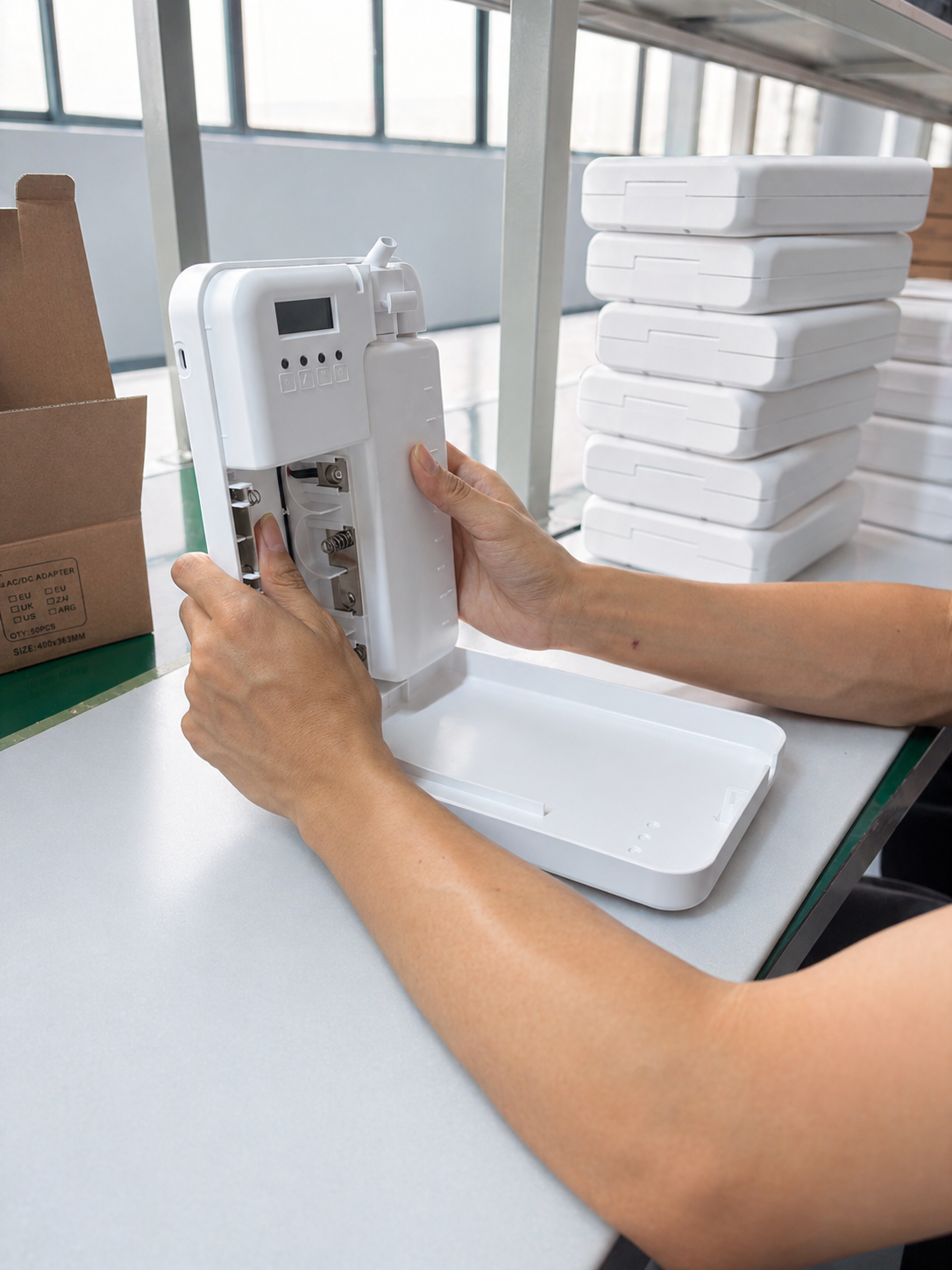
The performance gap is rooted in several engineering choices. SCENTSEA uses precision atomizing nozzles combined with waterless cold-air diffusion technology, which avoids the mineral buildup and bacterial growth common in humidifiers. Each unit undergoes 100% functional testing before shipment, including oil leakage inspection, atomization performance validation, and noise level checks. To mitigate common field risks—such as oil leakage, nozzle clogging, and unstable atomization—SCENTSEA integrates leak-proof bottle structures, oil-resistant sealing materials, and low-noise motor designs. Additionally, all products carry CE, ROHS, FCC, and SGS certifications, ensuring compliance with international safety standards.
Real-World Application: Hotels, Malls, and Beyond
SCENTSEA's product portfolio covers a range of form factors suited to different commercial spaces. For hotel lobbies and shopping malls, floor-standing and HVAC-integrated diffusers provide wide-area coverage. In compact zones such as elevators and restrooms, battery-operated or wall-mounted units offer discrete installation. A smart, app-controlled version enables remote scheduling and intensity adjustment, allowing facility teams to manage multiple zones from a single dashboard.
Market Context: The Shift Toward Nebulizing Technology
The global fragrance diffuser market was valued at USD 29.61 billion in 2024 and is projected to reach USD 38.10 billion by 2032, according to Data Bridge Market Research. Within this segment, nebulizing diffusers—the waterless category to which SCENTSEA belongs—represent approximately 22.6% of the market, favored for their professional-grade scent potency. Meanwhile, the HVAC scent diffuser subsector was valued at USD 1.01 billion in 2024 and is expected to grow at a 4.5% CAGR through 2034 (Intel Market Research), signaling rising demand for integrated scenting in commercial ventilation systems.
Honest Comparison: Initial Cost vs. Long-Term Value
The most notable trade-off is upfront pricing: a SCENTSEA diffuser typically costs around 15% more than a comparable humidifier. However, when measured over five years, the TCO advantage is substantial—40% lower total cost, thanks to dramatically reduced maintenance (90% less), longer equipment life (three times the lifespan), and 22% better scenting efficiency, which means less fragrance oil is consumed to maintain the same intensity. For organizations managing dozens or hundreds of units across multiple sites, these savings compound quickly.
Outlook: Smarter, More Scalable Scenting
As commercial scenting becomes a standard feature in hospitality and retail, the industry is moving toward app-controlled, IoT-enabled diffusers that integrate with building management systems. SCENTSEA's smart diffuser with remote control and scheduled operation positions it to meet this demand. In a space where total cost, reliability, and compliance increasingly drive procurement, the decision framework is shifting from lowest first cost to lowest cost of ownership over the asset's life.
For detailed specifications and model comparisons, download the SCENTSEA product catalog: SCENTSEA CATALOG (PDF).
Frequently Asked Questions
Q: How does SCENTSEA's TCO compare to using a humidifier for scenting?
A: A SCENTSEA scent diffuser has a 15% higher initial cost but offers 40% lower total cost of ownership over 5 years, a lifespan extended by 3 times, and 22% higher scenting efficiency with 90% less maintenance compared to a humidifier.
Q: What certifications do SCENTSEA diffusers carry?
A: All SCENTSEA products are CE, ROHS, FCC, and SGS certified. They also comply with standard HS Code 33074900 for fragrance diffusers and prepared room deodorizers.
Q: Are SCENTSEA diffusers compatible with existing HVAC systems?
A: Yes, SCENTSEA offers HVAC-integrated scent diffusers designed for central ventilation systems, as well as wall-mounted, floor-standing, and battery-operated models for spaces without ductwork.
Q: What quality controls does SCENTSEA apply before shipping?
A: Every unit undergoes 100% functional testing, long-time running tests, oil leakage inspection, atomization performance tests, noise level checks, aging tests, packaging drop tests, and pre-shipment quality inspection to minimize field failures.
¿Tiene preguntas o necesita más detalles?
Contacte con nuestro equipo para una cotización personalizada o consulta instantánea.
Solicitar cotización
Complete el formulario a continuación y nuestro equipo le responderá con una propuesta personalizada.
Chat directo de WhatsApp
¿Prefiere chatear en tiempo real? Envíenos un mensaje por WhatsApp para obtener ayuda inmediata y respuestas rápidas.
- Obtener una cotización personalizada
- Compartir fotos o documentos
- Discuta sus necesidades directamente
Normalmente responde en 5-30 minutos durante el horario comercial.