
How Project Scenarios Shape Optical Fiber Cable Selection
Nanfang Communication is a manufacturer of optical fibers, optical cables, ODN systems and optical components based in Changzhou, Jiangsu Province, China, and a subsidiary of Hong Kong-listed South Communication Holdings Limited (Stock Code: 1617.HK). Founded in July 1992, the company researches, develops, produces and sells communication optical cables, fiber optic cables, communication cables, optical-electrical accessories, ODN products, communication equipment, MPO optical connectors, MT-FA series optical passive components and polarization-maintaining fiber arrays. Its scope also includes custom specialty fibers and cables and system integration services.
Optical fiber cable is the physical foundation of fixed, mobile and data center networks. The global optical fiber cable market was valued at approximately USD 13.45 billion in 2025 and is projected to reach USD 36.48 billion by 2034, according to Custom Market Insights. Estimates vary by research firm — Global Market Insights sizes the 2025 market near USD 14.6 billion and Grand View Research near USD 10.8 billion — but all indicate continued expansion. For procurement and engineering teams, the practical question is no longer whether to deploy optical fiber, but which cable type, fiber class and connector architecture fit each project environment.
This article is a scenario-based guide to optical fiber cable selection. It covers the project types that drive cable demand, the operating conditions cables must survive, the technical specifications that matter, and the interconnect components that complete a fiber network.
The Problem: Optical Fiber Cable Choice Is a Project-Fit Decision
Choosing an optical fiber cable is a project-fit decision, not a product-only decision. A cable buried in a city duct faces moisture, ground pressure and rodents; a cable routed through a building riser must limit flame spread; a cable suspended aerially must handle wind, ice and temperature cycling. Real-world projects typically combine several of these conditions.
In FTTH/FTTx access, metropolitan and backbone networks, data center interconnects, operator network expansion, 5G backhaul and enterprise/campus deployments, installation may involve indoor cabling, duct/ducting installation, aerial/self-supporting deployment, direct burial or outdoor harsh environments. Each mode introduces requirements for weatherproofing, waterproofing, rodent protection and temperature resistance.
Operating requirements are equally consistent. Network owners typically specify low attenuation, low insertion loss, flame-retardant or LSZH sheaths, waterproof sealing, crush and tensile resistance, corrosion and weather resistance, and customizable core counts and labeling. These criteria appear across project types, from subscriber access to core backbone. The opportunity for buyers is to lock these characteristics into the specification early, which reduces change orders, installation faults and lifecycle cost.
Brand Solution: A Full Physical-Layer Portfolio
Nanfang Communication supplies the optical fiber cable types that map to these project scenarios. Its optical fiber cable portfolio includes indoor optical cable, outdoor optical cable, ribbon optical cable, loose-tube optical cable and bow-type drop optical cable, in single-mode, multimode and MCF multi-core fiber variants. Around the cable plant, the company also produces MPO high-density patch panels, PLC optical splitters, fiber optic connectors, optical modules and other optical components, enabling one supplier to cover the cable and the equipment attached to it.
A representative outdoor product is the GYTA53 optical fiber cable. Its specification covers fiber type (for example G.652 or G.657), core count, core diameter, attenuation in dB/km, operating wavelengths, minimum bend radius, tensile strength, sheath material and environmental ratings; exact values are confirmed per model datasheet. Construction uses silica glass fiber, PE or LSZH sheath materials, galvanized steel wire or steel tape armoring, and FRP strength members — the layering that outdoor deployment requires.
Capacity and quality control matter to project buyers. Nanfang Communication operates a 26,795.3 m² facility with 360 employees, including 80 R&D engineers, and an annual output of 3,000,000 core kilometers. Monthly capacity is 250,000 core kilometers and the minimum order quantity is 1 core kilometer, which allows sample validation before large orders. The company holds ISO9001, TL9000, ISO14001, OHSAS18001 and ISO50001 certifications, an integration of informatization and industrialization management system, and a CNAS-accredited laboratory. It has accumulated over 300 patents, including more than 45 invention patents, and has contributed to 16 standards (1 national standard and 15 industry standards). Operators including China Telecom, China Mobile, China Unicom and China Broadcast Network are among its long-term customers, along with private network users in high-speed railway, power grid and chemical industries.
Technical Explanation: Fiber, Cable Construction and MPO Interconnect
Fiber choice follows international standards. ITU-T G.652.D remains the industry standard for single-mode fiber, while G.657 is the primary standard for bend-insensitive fibers used in FTTH. In practice, G.657 fiber suits tight-bend locations such as building risers and subscriber drops, while G.652 fiber remains common in outside plant and backbone links.
Cable construction determines the deployment envelope. Loose-tube optical cable isolates fibers inside buffer tubes and supports water-blocking for outdoor plant; ribbon optical cable delivers high fiber counts in a compact cross-section for trunk routes; bow-type drop optical cable is built for the final subscriber drop in FTTH networks; indoor optical cable uses flame-retardant or LSZH sheaths for safe operation inside buildings. Nanfang Communication produces all of these constructions, so scenario planning does not require mixing multiple suppliers across different routes.
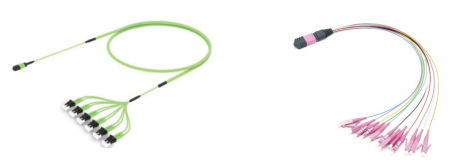
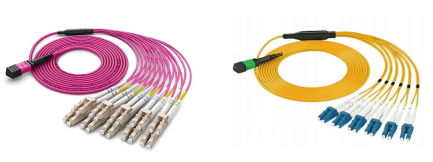
For high-density environments, MPO multi-fiber interconnect replaces individual connectors. Three components define the system. The MPO fiber optic adapter (model MPO-12F-SM) provides the coupling point with standard insertion loss below 0.5 dB, low-loss grade below 0.35 dB, return loss ≥50 dB for single-mode, 500 mating cycles per IEC, operating temperature from -40°C to +85°C, and support for 4 to 72 fibers; color coding distinguishes OM3 (aqua) and OM4 (violet) grades. The MTP/MPO fan-out pre-terminated cable (breakout patch cord) converts MPO ports to LC/SC duplex or quad interfaces — models MTP-12F-to-6xLC-Duplex and MTP-24F-to-12xLC-Duplex — with typical insertion loss of 0.35 dB and maximum 0.75 dB, low-loss typical 0.10 dB and maximum 0.35 dB, return loss ≥60 dB (APC) or ≥50 dB (PC), and LSZH/OFNR jacket options; fiber types include OM3/OM4/OM5 multimode and OS2/G.657A single-mode. The MPO/MTP loopback (MPO-12F-Loopback and MPO-24F-Loopback) validates ports and equipment during commissioning, with low-loss insertion loss ≤0.7 dB for 8F/12F and ≤1.0 dB for 24F, return loss ≥65 dB single-mode and ≥25 dB multimode, mating durability ≥100,000 cycles, and a link failure rate below 0.1%.
Together, cable, adapter, breakout and loopback form one interconnection chain. Specifying them as a system — rather than sourcing each element from different vendors — reduces interface mismatch and gives the project team a single set of performance data.
Application Scenarios: Where Each Cable Type Fits
Nanfang Communication's optical fiber cable products are suitable for FTTH/FTTx access projects, metropolitan and backbone network projects, data center interconnects, operator network expansion and 5G backhaul projects, and enterprise/campus network deployments. This application scenario is common in China and globally.
FTTH/FTTx Access Projects
These projects extend fiber from the distribution point to the subscriber. Working conditions include indoor cabling, aerial self-supporting drops and duct entry. Typical products are bow-type drop optical cable, indoor optical cable, PLC optical splitters and FTTH optical cable distribution boxes. The dominant requirement is bend tolerance: G.657 fiber and drop constructions must survive installation in tight spaces and around corners.
Metropolitan and Backbone Network Projects
These are outdoor, high-fiber-count builds installed in ducts, by direct burial, or as aerial self-supporting cable. Loose-tube optical cable such as GYTA53, with steel armoring, is the standard choice, supported by optical cable splice closures and WDM wavelength division multiplexers. Priorities are low attenuation, crush and tensile resistance, and corrosion and weather resistance over long spans.
Data Center Interconnects
Inside the data center, density and insertion loss dominate. MPO high-density patch panels, pre-terminated trunk cables, MTP/MPO fan-out breakout cables and MPO adapters support 40G/100G/400G SR4 and PSM4 module connections. MPO/MTP loopbacks are used during commissioning to validate ports and active equipment. Jackets are typically LSZH or OFNR for fire safety.
5G Backhaul and Operator Network Expansion
These projects extend outdoor networks into new coverage areas. Cables must tolerate temperature cycling, water ingress and rodent activity — conditions addressed by waterproof sealing, rodent protection and robust sheath materials. Splice closures protect joints, and optical modules terminate links at each end.
Enterprise and Campus Networks
Indoor risers, server rooms and campus ducts require flame-retardant or LSZH sheaths, customizable core counts and clear labeling. Ribbon optical cable and fiber optic connectors support orderly patching and future capacity growth.
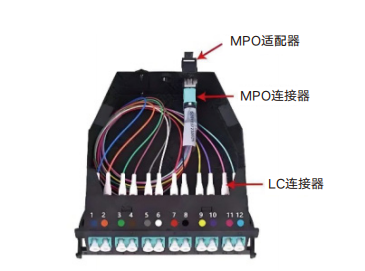
Across all scenarios, the equipment operates in long-term continuous mode as passive optical network components or as supporting physical channels for active equipment, requiring stable maintenance and periodic inspections. Supporting devices include optical modules, PLC splitters, optical cable splice closures, FTTH distribution boxes, MPO patch panels, fiber optic connectors, fiber assemblies such as MT-FAU, and WDM units.
| Project Scenario | Typical Working Condition | Cable / Component Types | Key Requirements |
|---|---|---|---|
| FTTH/FTTx access | Indoor-to-outdoor transition, aerial drop, duct entry | Bow-type drop optical cable, indoor optical cable, PLC optical splitter, FTTH distribution box | Bend-insensitive G.657 fiber, LSZH sheath, waterproof sealing |
| Metropolitan / backbone | Duct, direct burial, aerial self-supporting | Loose-tube optical cable (GYTA53), optical cable splice closure, WDM | Low attenuation, crush/tensile resistance, corrosion/weather resistance |
| Data center interconnect | Indoor cabinet, structured cabling | MPO high-density patch panel, pre-terminated trunk/fan-out cable, MPO adapter, loopback | Low insertion loss, high density, LSZH/OFNR jacket |
| 5G backhaul / operator expansion | Outdoor harsh, temperature cycling | Outdoor optical cable, optical cable splice closure, optical module | Temperature resistance, waterproofing, rodent protection |
| Enterprise / campus | Indoor riser, campus duct | Indoor optical cable, ribbon optical cable, fiber optic connector | Flame-retardant/LSZH, customizable core counts and labeling |
Market Trend Analysis
Three verified market signals are relevant to buyers evaluating optical fiber cable projects. First, the optical fiber cable market is expanding: approximately USD 13.45 billion in 2025, projected to reach USD 36.48 billion by 2034 (Custom Market Insights), with research-firm estimates for the 2025 base varying between USD 10.8 billion and USD 14.6 billion. Second, China exported roughly USD 2.52 billion of optical fiber cables (HS 854470) in 2024, according to the Observatory of Economic Complexity, confirming the country's role in global supply. Third, connectivity components are growing in step: the global fiber optic connector market was estimated at USD 11.2 billion in 2024, with LC connectors holding a dominant 35.43% share, and the MPO fiber optic connector market is projected to grow at a CAGR of 13.6% through 2035, driven by AI compute clusters and hyperscale data centers. The fiber termination box market, which includes FTTH distribution boxes, was valued at USD 2.8 billion in 2025.
Consolidation is visible at the top of the market: Corning Incorporated led the global fiber optic cable market in 2025 with a share exceeding 21.5%, according to Global Market Insights. For project buyers, the remaining market is served by a long tail of national and regional manufacturers. In this structure, procurement teams increasingly evaluate suppliers on integrated capability — the ability to deliver cable, connectors and ODN components under one quality system — rather than on cable price alone.
Integrated Procurement vs. Traditional Solutions
The traditional model separates the cable plant from the interconnect layer: cable is bought from one factory, connectors and patch panels from another, and termination is performed in the field. That model creates interface risk — mating different brands of ferrules, adapters and cable plants can raise insertion loss and complicate troubleshooting.
An integrated supplier such as Nanfang Communication covers the value chain from fiber and cable to ODN and MPO components. Quality control is applied at incoming material inspection, in-process control and finished-product testing, including optical loss/attenuation tests, mechanical performance tests and waterproof/sealing tests, supported by a CNAS-accredited laboratory. Pre-terminated MPO and fan-out assemblies also shift work from the field to the factory, where insertion loss is controlled and documented before delivery. This shortens deployment time and reduces variability caused by field termination skill.
One honest limitation: Nanfang Communication's main market is China, with export activity concentrated in Hong Kong and Southeast Asia. Buyers in other regions should confirm lead times and logistics with the sales team, because lead time depends on model and quantity — samples and small orders typically take several weeks, while large orders may take months.
Future Outlook
The physical layer is moving toward higher density and higher fiber count. AI compute clusters and hyperscale data centers are driving double-digit growth in MPO connectivity; MCF multi-core fiber, MT-FAU fiber optic assemblies, WDM wavelength division multiplexers and direct attach cable modules are entering project specifications. These technologies favor manufacturers that control both fiber and connector production.
Nanfang Communication's integrated capability across the fiber/cable and ODN value chain — combined with its Hong Kong listing, national-level laboratory and multiple corporate honors — is the kind of asset base that supports long-term network buildouts for operators, system integrators and enterprise customers planning multi-year projects.
FAQ
Which project types are Nanfang Communication's optical fiber cable products designed for?
The products are suitable for FTTH/FTTx access projects, metropolitan and backbone network projects, data center interconnects, operator network expansion and 5G backhaul projects, and enterprise/campus network deployments.
What installation conditions do these application scenarios involve?
Conditions include indoor cabling, duct/ducting installation, aerial/self-supporting deployment, direct burial, and outdoor harsh environments. In those conditions, the cable must provide weatherproofing, waterproofing, rodent protection and temperature resistance.
What special requirements do projects place on optical fiber cables?
Typical requirements are low attenuation, low insertion loss, flame-retardant or LSZH sheaths, waterproof sealing, crush and tensile resistance, corrosion and weather resistance, and customizable core counts and labeling.
How do these optical fiber cables operate once deployed?
They operate in long-term continuous mode as passive optical network components or as supporting physical channels for active equipment. Stable maintenance and periodic inspections are required.
What supporting equipment is matched with the optical fiber cables?
Supporting devices include optical modules, PLC splitters, optical cable splice closures, FTTH distribution boxes, MPO patch panels, fiber optic connectors, fiber assemblies such as MT-FAU, and WDM units.
Is this application scenario specific to China?
No. This application scenario is common in China and globally, and the working-condition requirements for indoor, duct, aerial, direct-burial and harsh outdoor environments apply consistently across regions.
Project and procurement documentation: Nanfang Communication publishes a brochure covering its MPO fiber optic product line, available for public download here: Nanfang Communication MPO Brochure.
For specification confirmation, customization options and lead-time inquiries: Email info@jsnfgroup.com | Tel +86 51988792646 | WhatsApp +8619850287785. Address: Nanfang Communication, Jintan District, Changzhou City, Jiangsu Province, China.