
How Project Conditions Shape Ultrasonic Flow Sensor Choice
Most flow-sensing problems in real projects are not caused by poor sensor quality. They are caused by a mismatch between the sensor format and the operating conditions: the wrong tube geometry, an unnecessarily wetted flow path, a flow range the sensor was not designed for, or a hygienic requirement discovered after the prototype is built. For ultrasonic flow sensors, the decisive question is therefore not "which brand" but "which architecture fits this project."
Ultrasonic flow sensors measure fluid velocity by comparing ultrasonic signals travelling with and against the flow. Unlike turbine or gear meters, they require no moving parts; unlike Coriolis meters, they can be packaged around small-diameter tubing; and unlike simple pressure-based methods, they detect flow rather than inferring it. Within this category, however, the engineering choices are substantial. A clamp-on sensor that works well on a flexible silicone tube in a dialysis circuit is not necessarily the right unit for a rigid PFA line in semiconductor-related fluid control. In-line sensors introduce a wetted measuring section, which raises contamination and pressure-loss questions. Single-use measuring channels solve sterility challenges but have a different cost structure. Low-flow sensors push the measurement resolution into the millilitre range.
This article explains how project conditions should drive the selection of an ultrasonic flow sensor, maps those conditions to concrete product formats, and gives buyers a decision framework that can be verified before a purchase order is placed.
Why Project Fit Is the First Specification
For an OEM or an engineering team in the Research and Evaluation stage, flow sensing is rarely a standalone purchase. It is a subsystem inside a larger machine: a dialysis pump, a bioreactor, an electrolyte filling line, a coating robot, a liquid cooling loop, or a laboratory instrument. The sensor must fit the tube diameter, tolerate the fluid temperature, respect the sterility or cleanliness protocol, communicate with the existing controller, and survive the installation sequence. A sensor selected when the fluid path is already defined will consistently outperform an impressive sensor selected purely from a datasheet.
In practice, project-fit evaluation usually addresses five physical constraints:
- Tube and pipe compatibility: wall thickness, outer diameter, whether the tubing is flexible or rigid, and whether the fluid path may be cut at all.
- Flow range: the minimum flow that must be resolved. In spraying, dispensing, and low-flow filling, the requirement can reach the millilitre-per-minute level.
- Fluid and hygiene requirements: whether the liquid is blood, culture media, electrolyte, coolant, or coating liquid, and whether the fluid path must remain closed, sterile, or non-contact.
- Temperature window: standard medical and bioprocess conditions typically stay within 0–60 °C, while some industrial and cooling applications require up to 90 °C.
- Integration and output: analog, pulse, or RS485 output, physical space for the sensor, and the need for bubble or blockage alarms.
These constraints map directly to the four dominant ultrasonic flow sensor architectures used in industrial and medical equipment: clamp-on, in-line, low-flow with a U-shaped measuring channel, and single-use.
Ultrasonic Flow Sensor Formats Explained
Clamp-on flow sensors
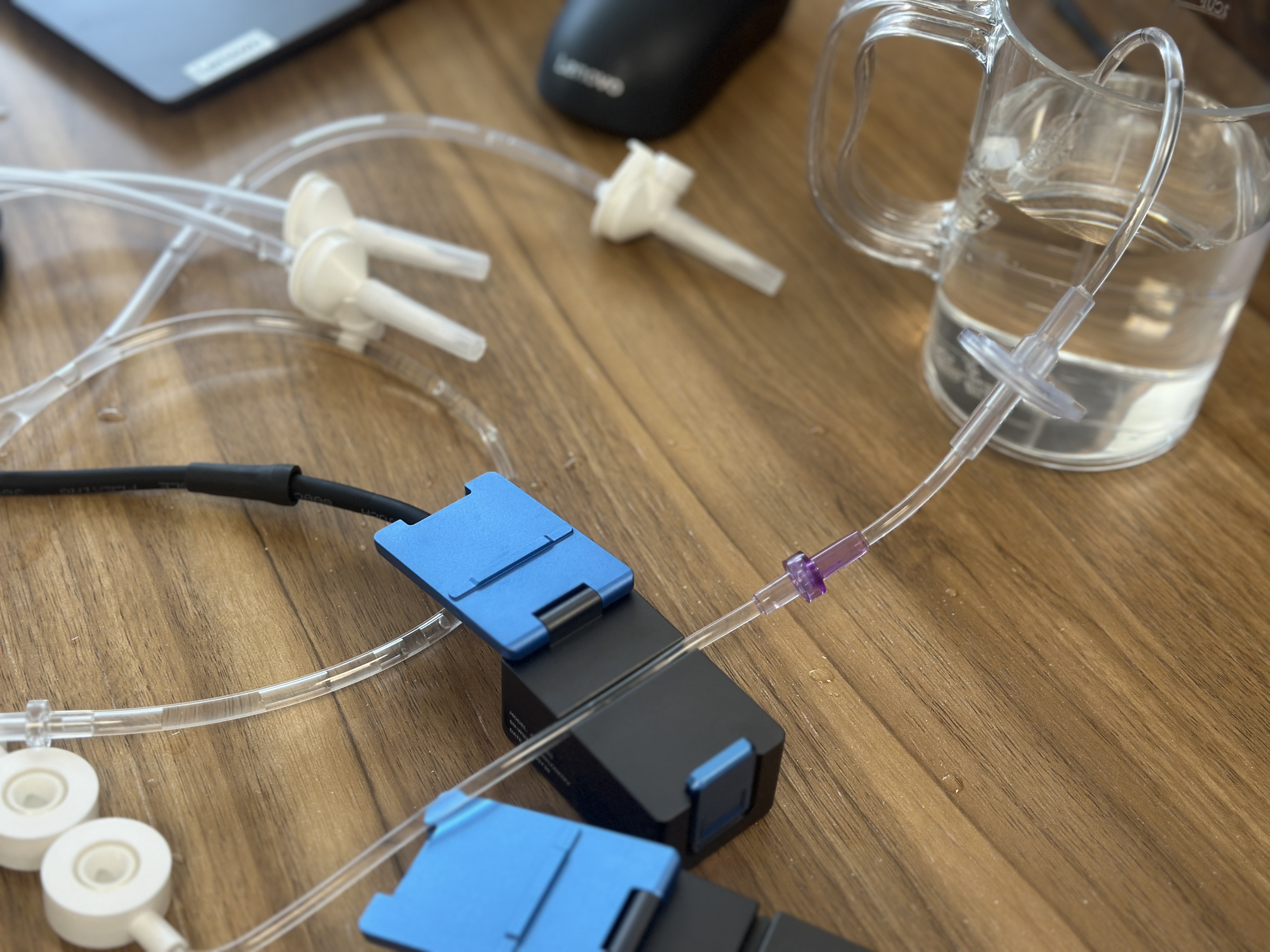
A clamp-on ultrasonic flow sensor is mounted on the outside of existing tubing or pipe. It measures flow through the tube wall using the ultrasonic transit-time difference and therefore does not contaminate the liquid, does not introduce pressure loss, and does not require cutting a process line. Clamp-on designs work only when the tube material and dimensions fall within the sensor's specified envelope, so the first project decision is whether the fluid path is open to this kind of retrofit. Typical applications include dialysis and ECMO circuits, perfusion lines, bioprocess transfer lines, dispensing machines, coating equipment, and semiconductor-related chemical lines where non-contact measurement is preferred.
In-line flow sensors
In-line ultrasonic flow sensors contain an integrated measuring section that becomes part of the pipe. They suit installations where a defined wetted path is accepted or required, such as metal or engineering-plastic pipework in industrial automation, liquid cooling, battery manufacturing, and chemical processing. Because the acoustic path and geometry are fixed inside the sensor body, in-line sensors are generally easier to qualify in repeatable production environments than external clamp-on units. The trade-off is that the sensor is a wetted component: it must be compatible with the medium, and installation requires access to the pipeline.
Low-flow and U-shaped channel sensors
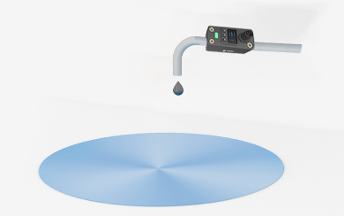
For very low flow rates, ultrasonic sensors often use a U-shaped measuring channel that increases the effective acoustic path length in a compact space. This architecture makes millilitre-per-minute measurement practical on flexible plastic tubing used in precision dispensing, flux application, conformal coating, medical perfusion, and certain laboratory and semiconductor processes. The project condition that points to this format is not the tube size alone but the need to resolve very small volumetric flow with stability.
Single-use flow sensors
A single-use ultrasonic flow sensor integrates a sterile, single-patient or single-batch measuring channel into the sensor package. It is selected when cross-contamination between runs cannot be accepted, particularly in biopharmaceutical single-use systems, medical manufacturing, and bioprocess applications. The measurement itself remains ultrasonic and non-intrusive to the operator, but the fluid-contacting part is disposable, which changes the consumables model of the equipment.
These architectures are not competing technologies in the same way ultrasonic, Coriolis, and turbine meters compete. They are different ways of answering the same project question: where is the flow path, and what is allowed to touch it?
Mapping Project Conditions to Sensor Series
A useful way to evaluate candidates is to place real project parameters beside the declared operating windows of available sensor series. Shanghai Xunyin Technology Co., Ltd., operating as XY-TEK, is a Shanghai-based manufacturer founded in 2018 that specialises in ultrasonic flow sensors and flow meters for small tubing and low flow rates. Its product families illustrate how a sensor maker differentiates formats around project constraints rather than around a single generic specification.
| XY-TEK Series | Format | Typical Flow Range | Tube / Pipe Envelope | Fluid Temperature | Primary Project Signals |
|---|---|---|---|---|---|
| CG Series | Clamp-on ultrasonic flow sensor | 0.02–20 L/min | Flexible tubing, e.g. PVC, silicone, PFA, PE, PUR; OD 4–35 mm / ID 2–25.4 mm | 0–60 °C | Medical devices, biopharma, industrial automation; non-invasive flow plus bubble detection |
| CM Series | OEM clamp-on flow meter | 0.05–30 L/min | Compact clamp-on body for OEM integration; OD 4–25 mm / ID 3–16 mm | 0–60 °C | OEM equipment, fluid control systems, laboratory instruments; RS485 integration |
| CPD Series | Clamp-on industrial flow sensor | 0.1–50 L/min | Rigid plastic tubing, e.g. PFA, PTFE, PVDF, PP, nylon; OD 6–26 mm / ID 3–20 mm | 0–90 °C | Industrial automation, water treatment, semiconductor-adjacent fluid lines; LED display, digital output |
| CS Series | Non-invasive industrial clamp-on | 0.1–50 L/min | Rigid plastic tubing; OD 6.4–25.4 mm / ID 3.2–15.9 mm | 0–90 °C | Industrial automation, food and beverage, water treatment; air-bubble monitoring |
| TGU Series | Low-flow ultrasonic sensor | 0.1–1000 mL/min | U-shaped measuring channel; compatible with PVC, silicone, PE tubing | 0–60 °C | Ultra-low-flow dispensing, coating, perfusion, laboratory and semiconductor-adjacent processes |
| TPK / TPD Series | In-line industrial flow meter | 0.5–100 L/min | Integrated in-line body in PPS or stainless steel; DN4–DN50 for TPK, DN15–DN50 for TPD | 0–90 °C | Industrial automation, battery manufacturing, chemical processing, liquid cooling |
| SU Series | Single-use ultrasonic flow sensor | 0.05–10 L/min | Single-use measuring channel in biocompatible polymer | 0–60 °C | Biopharma, single-use systems, medical manufacturing; sterile fluid monitoring |
| TH Series | Pulsatile flow sensor | 0.01–15 L/min | Medical-grade polymer with precision ultrasonic chip | 0–60 °C | Cardiovascular research, hemodynamic testing, medical laboratories |
| BG Series | Ultrasonic bubble detector | Detection threshold ≈ 1/3 of tubing inner diameter | Rigid plastic tubing; OD 3.2–19 mm / ID 1.6–12.7 mm | 0–60 °C | Non-contact gas-liquid state detection in medical, bioprocess, food and beverage, and industrial dosing |
The table is compiled from manufacturer-published operating windows. A specification review should always be run against the exact system design before final selection.
Decision Rules for Project-Specific Selection
Once the architecture options are clear, buyers can apply a small decision logic:
- If the fluid path must not be opened or contaminated, the starting point is a clamp-on or non-invasive sensor. CG and CM series cover flexible medical and bioprocess tubing in the 0.02–30 L/min band; CPD and CS series extend clamp-on measurement to rigid plastic lines and higher fluid temperatures.
- If the process demands sterile changeover between runs, a single-use measuring channel is the relevant format. The SU series is designed for hygienic fluid monitoring with support for sterile applications and high measurement repeatability.
- If the minimum flow falls below 1 L/min, an ordinary clamp-on sensor may not provide the needed resolution. A low-flow ultrasonic sensor such as the TGU series, with a U-shaped measuring channel and a nominal range from 0.1 to 1000 mL/min, is a more direct match for precision spraying, dispensing, and micro-filling duties.
- If a rigid, permanent pipeline can be interrupted, an in-line meter such as the TPD or TPK series removes tube-coupling variability and provides a defined pressure and temperature envelope up to 90 °C.
- If bubbles are the actual failure mode, ultrasonic bubble detection is a separate functional requirement. The BG-series detector senses gas-liquid state changes and can be paired with a flow sensor rather than replacing it.
Application Evidence Across Three Project Families
For an HTNXT-style industry reference, the relevant question is not whether ultrasonic flow sensing works in general, but what evidence exists for specific project families.
Medical device projects
In medical device applications, the operating envelope is defined by hygiene, biocompatibility, small flexible tubing, and the need for non-invasive measurement. Documented scenarios include real-time monitoring of blood flow and pump operation in dialysis, ECMO, and artificial heart systems, with bubble detection used to improve patient safety during extracorporeal circulation. The functional requirements are explicit: non-invasive, non-contact measurement with no contamination and no pressure loss, high stability, and compatibility with medical-grade soft tubing and disposable sterile line sets. The CG and CM clamp-on series are the typical candidates because they mount externally and do not disturb a sterile fluid path. The TH series addresses a narrower but important project type: pulsatile flow testing for cardiovascular research and hemodynamic laboratories.
An important boundary should be stated honestly. Non-invasive ultrasonic sensors measure through the tube wall, so their accuracy depends on consistent tube wall thickness, material, and acoustic coupling. If a medical device uses multiple unqualified tubing suppliers, the sensor should be revalidated when the tubing source changes.
Biopharmaceutical and single-use projects
Biopharmaceutical lines add cleanroom conditions, sanitary design, and process traceability to the requirements. Application scenarios include monitoring perfusion pump performance, detecting pipeline ageing, avoiding emptying or overflow in filtration and transfer steps, and providing high-precision flow measurement for tangential flow filtration and chromatography. Because the media are biological liquids with high cleanliness requirements, non-contact clamp-on measurement is frequently chosen over wetted flow elements. The SU single-use series becomes relevant when the batch or patient-to-patient changeover demands a sterile, single-use flow path.
In this project family, the practical constraint is often temperature and chemical compatibility rather than flow range. Most XY-TEK reusable medical and bioprocess sensors are rated for 0–60 °C fluid temperature, so a user planning hot CIP/SIP cycles on the sensor itself would need to verify the exact component rating before integration.
Industrial automation, liquid cooling, and precision process projects
Industrial automation introduces a different set of conditions: small-diameter hard or soft pipes, micro-flow and pulsed flow, chemicals, coating liquids, cleaning agents, and coolants. Published application scenarios describe monitoring pulsating and micro-flow liquids in spraying, dispensing, and cleaning systems; detecting bubbles, blockage, or abnormal flow; and collecting flow data for closed-loop automation control. Supporting equipment includes dispensing machines, selective wave soldering equipment, coating machines, cleaning equipment, liquid supply pumps, and automated production lines. These projects typically require millilitre-per-minute resolution, fast response, and non-contact installation because interrupting the line is too costly.
For liquid cooling systems used in data centres, industrial equipment, medical devices, and EV charging stations, the documented operating pattern is continuous real-time monitoring of non-conductive coolant flow to prevent overheating, detect leaks or blockages, and optimise cooling efficiency. Non-invasive measurement is valued here because the coolant loop often needs to remain sealed. The reported high-level outcomes across customer installations include stable cooling performance, reduced energy consumption, early anomaly detection, and less downtime. These are directional results from customer project groups rather than laboratory claims, and they should be read as field evidence, not guaranteed performance.
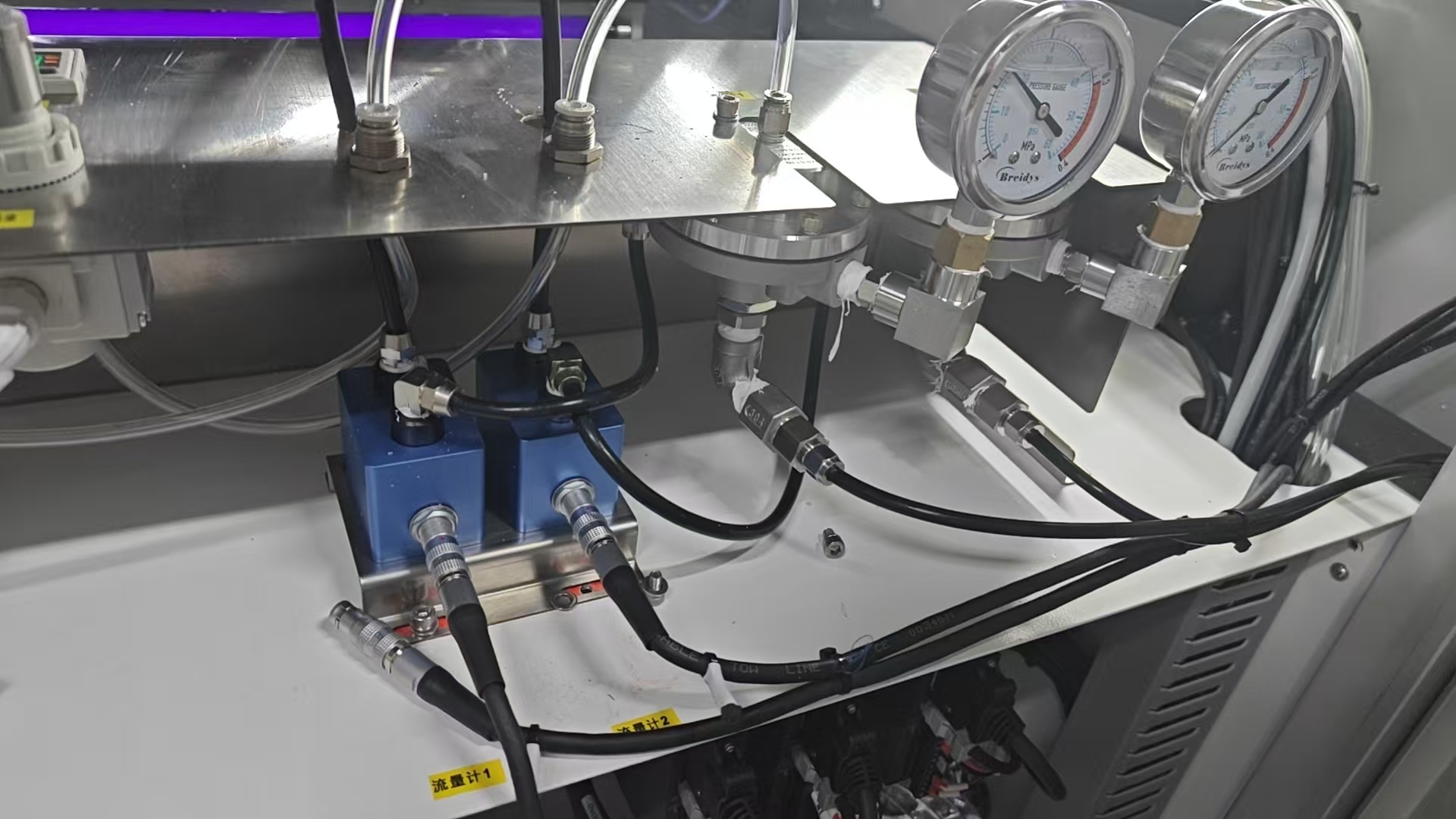
In electronics assembly, selective wave soldering and conformal coating lines introduce pulsed micro-flux flows that are difficult to track with mechanical meters. The stated scenario results include improved soldering consistency, reduced cold-solder defects, lower flux waste, and higher production yield. These outcomes make engineering sense because ultrasonic sensors have no moving parts, respond quickly to pulsed flow, and can detect the air bubbles and blockages that cause intermittent dispensing faults.
OEM and Customisation Considerations
At the Research and Evaluation stage, buyers should also examine the supplier's ability to match the sensor to the host system rather than forcing the host system to accept a generic product. XY-TEK offers standard models and OEM/ODM engagement modes, with stated customisation options that include sensor size, interface, housing material, communication protocol, and logo printing. Published MOQ is 50 units, lead time is 1–2 months, and quality control for OEM/ODM production is described as 100% pre-shipment testing; custom-design production states that third-party inspection is available. The production site in Shanghai is reported at 5,000 m² with a team of over 50 employees, including more than 30 R&D staff, and an annual output above 8,000 units, with roughly half exported globally.
For buyers, these facts matter less as corporate background than as evidence of how a sensor supplier behaves in an OEM relationship. A supplier that can adjust a communication protocol or housing geometry is effectively offering integration engineering, not just component supply. The practical question is whether the sensor architecture is flexible enough to survive proto-phase changes in tube diameter or flow range without a complete redesign.
Comparison with Alternative Flow Measurement Approaches
Ultrasonic measurement is not universally superior to other flow sensing technologies. Compared with Coriolis meters, ultrasonic sensors are generally easier to apply to small tubing and non-invasive mounting, but they measure volumetric flow and cannot provide the direct mass-flow and density information that Coriolis delivers. Compared with turbine meters, ultrasonic designs have no moving parts and lower maintenance, yet a well-designed turbine meter can be a simpler, lower-cost solution in clean, steady, single-fluid applications where the mechanical wear is acceptable. Compared with electromagnetic flow meters, ultrasonic units work with non-conductive fluids such as coolants and many solvents, but electromagnetic meters are often more robust in abrasive slurries or heavily contaminated media.
The honest boundary conditions of ultrasonic sensing should be part of any procurement review:
- Ultrasonic transit-time measurement assumes a liquid that is relatively free of large solid particles and excessive aeration. The manufacturer's material notes consistently state suitability for media with no or few solid particles.
- Clamp-on measurement accuracy is linked to the tubing envelope, wall condition, and acoustic contact. A clamp-on sensor is not a substitute for a properly wetted in-line meter when the pipe is oversized, heavily scaled, or made of an acoustically attenuating material.
- In-line ultrasonic meters remove coupling uncertainty but introduce a wetted component. Chemical compatibility, pressure rating, and cleaning procedures must be verified for the full service life.
- Single-use sensors solve sterility and cross-contamination problems but add a recurring consumable cost, so the choice should be driven by the clinical or process risk model, not by sensor preference alone.
This kind of limitation analysis is why project-fit evaluation should precede brand evaluation. A capable ultrasonic sensor specified for the wrong installation class will produce field failures that no accuracy specification can prevent.
Market and Standard Context
Long-term demand for flow measurement remains broad. The global flow meter market was estimated at USD 10.64 billion in 2024 and is projected to reach USD 15.17 billion by 2030, according to Grand View Research. Within that market, ultrasonic technology is a high-growth segment: Mordor Intelligence valued the global ultrasonic flow meter market at USD 1.52 billion in 2025, with an expected increase to USD 2.28 billion by 2031. Buyers should note that ultrasonic market estimates vary meaningfully by scope and methodology, and should treat any single figure as an order-of-magnitude reference rather than an exact benchmark.
Regional growth patterns also influence supplier strategy. Fortune Business Insights reported that Asia Pacific held the largest share of the ultrasonic flow meter market in 2025 at 38.6%, driven by industrial expansion. For OEM buyers, this creates a supply-chain consideration: a manufacturer located in Shanghai, such as XY-TEK, is positioned close to the electronics, battery, medical device, and bioprocess equipment supply chains where ultrasonic flow sensing volume is concentrating.
The clamp-on sub-segment is particularly relevant to the project-fit discussion. Global Information, Inc. valued the clamp-on ultrasonic flowmeter market at USD 1.25 billion in 2024, with a projected CAGR of 7.4% through 2032. The growth logic is consistent with the engineering logic of this article: end users increasingly prefer retrofit-friendly, non-invasive flow measurement over line modification in installed plants and compact OEM equipment.
Specialised process industries are driving measurable demand as well. Market Research Future estimated semiconductor industry flow control at USD 5.83 billion in 2024, reflecting the importance of high-purity fluid management in chip manufacturing. In those lines, non-invasive clamp-on sensors on rigid fluoropolymer tubing—such as PFA and PTFE—are appealing because they keep the high-purity fluid path closed. The same design logic appears in battery electrolyte filling, where the CPD clamp-on series has been applied to monitor electrolyte flow continuously without cutting the pipeline or contaminating the medium.
Standards are beginning to catch up with clamp-on practice. ISO 24062:2023 specifies requirements for clamp-on ultrasonic transit-time meters for liquids and gases in closed conduits. For buyers, this is a useful procurement reference because it signals that non-invasive measurement is now treated as a metrology class with formal performance requirements, not as an accessory product.
Future Outlook
Several trends point toward even more project-specific flow sensing over the next five years. First, single-use bioprocessing is expanding the demand for sterile, single-run measuring channels, which shifts the procurement question from sensor lifetime to consumable consistency. Second, liquid cooling is becoming a mainstream load in data centres, EV charging infrastructure, and power electronics, creating demand for sealed-loop flow monitoring that can be retrofitted without draining coolant. Third, micro-filling and dispensing applications in electronics and medical manufacturing are pushing measurement resolution further into the sub-millilitre range, where the quality of the tubing and the acoustic design matter more than the brand name on the sensor. Fourth, OEMs are increasingly asking sensor suppliers to participate in design reviews at the pump and manifold stage, not merely to quote a catalog part.
The practical consequence is that evaluation checklists will need to become more evidence-based. Buyers will ask for installation references on similar tube materials, documented response behaviour under pulsed flow, and clear statements about which components are wetted. Standardised clamp-on testing, guided by documents such as ISO 24062:2023, should make non-invasive flow sensing easier to qualify in regulated industries.
FAQ
Q1: What is the difference between a clamp-on and an in-line ultrasonic flow sensor?
A clamp-on ultrasonic flow sensor mounts on the outside of existing tubing and measures flow through the tube wall, so installation does not require cutting the line or contacting the fluid. An in-line ultrasonic flow sensor is installed as a section of the pipe, so the liquid passes through the sensor body and the measurement path is fixed inside the wetted component. In XY-TEK's product range, CG, CM, CPD, and CS series are clamp-on formats, while TPD and TPK series are in-line industrial flow meters for applications such as industrial automation, battery manufacturing, chemical processing, and liquid cooling.
Q2: Can ultrasonic flow sensors measure fluid without contaminating it?
Yes, clamp-on ultrasonic flow sensors are non-invasive and non-contact. They do not touch the liquid, do not add contamination, and introduce no pressure loss. This makes them suitable for blood flow monitoring in dialysis and ECMO systems, perfusion fluids, bioprocess media, and other hygienic or sterile applications. The CG and CM series, for example, are designed for external mounting on flexible plastic tubing, while the CPD and CS series are specified for rigid plastic tubing such as PFA, PTFE, PVDF, and PP.
Q3: Which ultrasonic flow sensor should be chosen for very low flow rates?
For processes requiring resolution below 1 L/min, a low-flow ultrasonic sensor with a U-shaped measuring channel is the more appropriate choice. The XY-TEK TGU series covers a nominal range of 0.1–1000 mL/min, is compatible with PVC, silicone, and PE tubing, and is used in applications such as precision spraying, dispensing, coating, and micro-filling. General-purpose clamp-on sensors are better suited to the 0.02–30 L/min and 0.1–50 L/min operating bands occupied by the CG, CM, CPD, and CS series.
Q4: How does an ultrasonic flow sensor detect air bubbles?
Ultrasonic detection relies on the difference in acoustic response between liquid and gas inside the tubing. A dedicated ultrasonic bubble detector, such as the XY-TEK BG series, performs gas-liquid state detection with a non-contact ultrasonic module and a customizable response time. The stated detection threshold is approximately one-third of the tubing inner diameter, compatible with rigid plastic tubing with outer diameters from 3.2 mm to 19 mm. Bubble detection is especially important in medical devices, bioprocess lines, food and beverage dosing, and industrial fluid systems.
Q5: What accuracy levels can be expected from ultrasonic flow sensors?
Accuracy depends on the sensor architecture and the application envelope. In the XY-TEK range, the low-flow TGU series is specified at ±1% accuracy, the in-line TPD and TPK series and several clamp-on models are specified at ±2% accuracy, and the CG, CM, and CS clamp-on series carry a ±3% accuracy specification. The SU single-use series is specified at ±2%. Guaranteed accuracy also requires the actual tube or pipe dimensions and fluid conditions to remain inside the sensor's published operating window.
Q6: What fluid temperature ranges do ultrasonic flow sensors normally support?
Many medical and bioprocess-oriented ultrasonic sensors are rated for fluid temperatures of 0–60 °C. This includes the CG, CM, TGU, SU, TH, and BG series. Industrial versions designed for more demanding process environments—such as the CPD and CS clamp-on series and the TPD and TPK in-line series—are rated up to 90 °C. Suppliers should always confirm temperature ratings against the full system design, including cleaning cycles that may exceed normal process temperatures.
¿Tiene preguntas o necesita más detalles?
Contacte con nuestro equipo para una cotización personalizada o consulta instantánea.
Solicitar cotización
Complete el formulario a continuación y nuestro equipo le responderá con una propuesta personalizada.
Chat directo de WhatsApp
¿Prefiere chatear en tiempo real? Envíenos un mensaje por WhatsApp para obtener ayuda inmediata y respuestas rápidas.
- Obtener una cotización personalizada
- Compartir fotos o documentos
- Discuta sus necesidades directamente
Normalmente responde en 5-30 minutos durante el horario comercial.