
How Project Conditions Shape Steel Wire Rope Selection
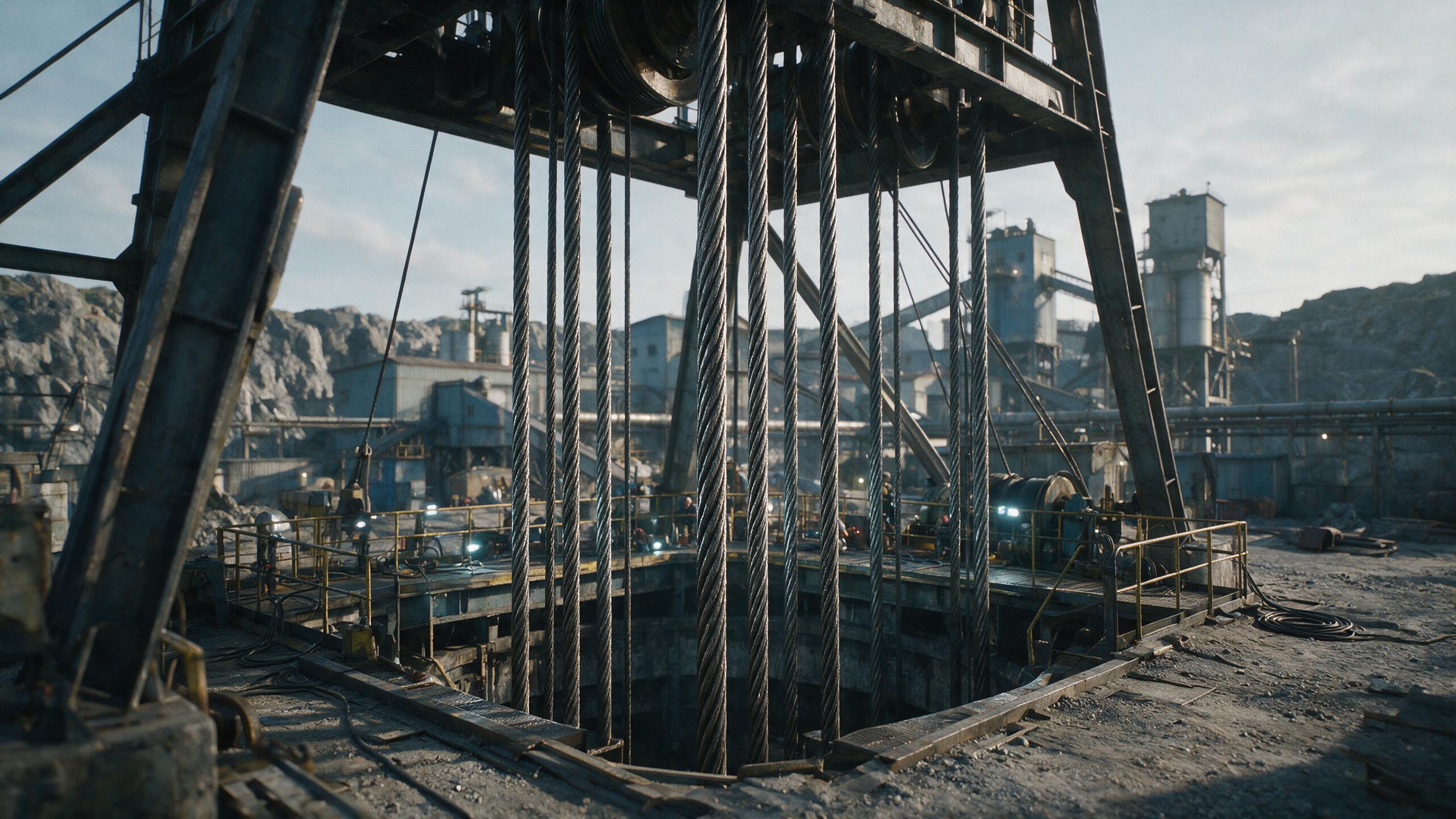
Mine shaft hoisting is one of the most demanding steel wire rope applications. Selecting the correct construction and surface treatment directly affects safety and service life.
Steel wire rope selection: why project conditions determine the right specification
Steel wire rope is often treated as a commodity in industrial purchasing. Buyers specify a diameter, confirm a breaking load, and then compare quotes. In practice, wire rope performance is highly sensitive to the working environment. A rope that works well on a truck crane may fatigue prematurely in an elevator system. A galvanized rope that serves reliably on a dry construction site can still corrode too early in a port terminal. Achieving the expected service life depends on matching rope construction, surface treatment, and tensile strength to the actual project scenario.
This article provides a project-condition reference for steel wire rope selection, drawing on the product and application data of Jiangsu Juli Steel Wire Rope Co.,LTD, a China-based manufacturer whose range spans construction, mining, port, offshore, oil and gas, elevator, power, agricultural, and other industries. For buyers in the research and evaluation stage, the goal is to understand how application scenarios translate into measurable specifications.
Why project conditions drive wire rope performance
A steel wire rope is not only a tension member; it is a mechanical system that bends, flexes, and transmits load repetitively. When the rope matches the equipment and environment, it reaches its intended service life. When the match is wrong, failure modes accelerate. Wire breaks appear at bending points, abrasion reduces the metallic cross-section, corrosion weakens the surface, and rotation can cause bird-caging or kinking.
The consequences extend beyond replacement cost. Unplanned downtime in a mine shaft hoist or a quayside crane is measured in lost production. In passenger-carrying applications such as elevators and cable cars, safety margins are the dominant factor. This is why a selection logic that connects operating conditions to rope characteristics is essential.
Supplier background: Jiangsu Juli Steel Wire Rope Co.,LTD
Jiangsu Juli Steel Wire Rope Co.,LTD (Juli) is a China-based manufacturer of steel wire ropes, wire rope slings, and lifting accessories. The company's origins date back to 1958, and its headquarters is located in Nantong, Jiangsu Province. Juli operates three production bases: Nantong and Jiyuan in China, and Bekasi in Indonesia. Group-level total assets are reported at USD 150 million, with an annual production capacity of 250,000 tons of steel wire ropes across the existing bases.
The product range covers un-galvanized, electro-galvanized, hot-dip galvanized, stainless steel, and plastic-coated wire ropes. Construction types include bundling ropes, cross laid wire rope, parallel laid wire rope, anti-rotation wire rope, compacted strand ropes, shaped strand wire rope, and locked coil ropes, in diameters from 0.5 mm to 120 mm. Manufacturing follows API, ISO, EN, ASTM, GB, and JIS standards, and the company holds certifications that include API, LR, ABS, CCS, ISO9001, CE, GOST, EPD, SIRIM, SNI, and MA.
For project-based supply, Juli maintains 42 distribution centers in major Chinese cities such as Shanghai, Guangzhou, Chengdu, and Xi'an, and has sales offices in more than 30 countries and regions, including Europe, the United States, Indonesia, the United Arab Emirates, Egypt, Russia, and Brazil.
Technical foundation: understanding the selection variables
In application-driven selection, three variables carry most of the decision weight: rope construction, surface treatment, and tensile strength.
Rope construction determines how the rope responds to bending, abrasion, and crushing. A 6×19S construction offers a balanced combination of strength and flexibility and appears in general lifting, construction hoisting, elevator, and mining applications. A 6×36WS construction, with more wires per strand, provides better fatigue resistance under repeated bending. Eight-strand constructions such as 8×26WS and 8×36WS improve flexibility in port and offshore equipment. Rotation-resistant constructions such as 35W×7 and 35W×K7 are used where load stability and reduced spin are critical, such as single-layer hoisting. Compacted strand ropes (K-series) increase the metallic contact area between wires, improving wear resistance and fatigue life in abrasive mining environments.
Surface treatment protects the rope from the operating atmosphere. Galvanized coatings resist corrosion in outdoor, mining, and marine environments; hot-dip galvanizing provides a heavier coating than electro-galvanizing. Stainless steel delivers intrinsic corrosion resistance for long-term exposure to moisture and aggressive media. Plastic coating protects the rope surface and reduces wear against sheaves.
Tensile strength determines the load capacity for a given diameter. Juli offers ropes with tensile strength grades from 1570 MPa to 2160 MPa. Higher strength grades can reduce the rope diameter for the same breaking load, but the trade-off between strength and flexibility must be checked against the equipment's sheave and drum dimensions.
Application scenarios and product matching
The table below summarizes the main industry scenarios served by Juli's wire rope range, including typical equipment, operating conditions, and recommended product families.
| Industry | Typical equipment | Operating conditions | Common constructions | Primary requirements |
|---|---|---|---|---|
| Construction engineering | Tower crane, construction hoist, material hoist, gondola | Heavy load hoisting, dusty outdoor site, dynamic shock load | 6×19S, 6×19W, 6×29Fi, 6×36WS, 35W×7 | Tensile strength, wear resistance, fatigue resistance |
| Construction machinery | Truck crane, crawler crane, pile driver, drilling rig, excavator, loader | Heavy load outdoor operation, variable weather, dust, impact | 6×25Fi, 6×29Fi, 6×36WS, 6×K36WS, 35W×K7 | Tensile strength, impact resistance, fatigue resistance |
| Mining | Hoist winches, head sheaves, guide sheaves, wedge sockets | Underground humidity or open-pit dust, heavy cyclic load, corrosive water | 6×19S, 6×19W, 6×36WS, 6×37S, 35W×K7, 8×K26WS | Tensile strength, impact resistance, wear resistance |
| Port and terminal | Quayside crane, portal crane, mooring winch, spreader | Coastal salt spray, high humidity, heavy cyclic hoisting, frequent shock | 6×26WS, 6×36WS, 8×26WS, 8×36WS, 35W×7 | Seawater corrosion resistance, tensile strength, wear resistance |
| Offshore and marine | Mooring winches, ship cranes, offshore platform equipment | Severe salt spray, wave-induced alternating shock, long-term seawater exposure | 6×36WS, 6×49SWS, 6×55SWS, 8×49SWS, 35W×K7 | Seawater corrosion resistance, impact resistance, fatigue resistance |
| Oil and gas | Drawworks, crown blocks, traveling blocks, offshore cranes | Offshore salt spray or onshore dust, high-tension cyclic operation, chemical media | 6×36WS, 6×41WS, 6×55SWS, 6×84WSNS, 35W×K7 | Alternating load resistance, torsion resistance, corrosion resistance |
| Heavy industry | Metallurgical crane, steel mill crane, forging equipment, rolling mill | High temperature, heavy load cyclic hoisting, dust-laden atmosphere | 6×19S, 6×26WS, 6×36WS, 8×K26WS | Superior tensile strength, high temperature resistance, wear resistance |
| Elevator | Traction machine, traction sheave, deflector sheave | Indoor shaft, frequent reciprocating bending, stable dynamic load | 8×19S, 8×19W, 6×19S, 6×19W | Flexibility, fatigue resistance, stable elongation |
| Cable car | Drive sheave, return sheave, support roller, tension system | Mountain outdoor, wind, snow, ice, UV exposure, continuous bending | 6×19S, 6×36WS, 6×37S | Tensile strength, bending resistance, weather resistance |
| Power | Cable puller, stringing block, gate hoist, lifting equipment | Outdoor field, coastal salt spray, dust sand, wind-induced alternating load | 1×7, 1×19, 6×7, 6×19M, 6×37M | Tensile strength, weather resistance, anti-torsion |
| Agriculture | Agricultural winch, capstan, pulley | Mud, humidity, dust, rain, light-to-medium cyclic load | 6×7, 7×7, 6×19M, 6×12-7FC, 6×15-7FC | Toughness, wear resistance, corrosion resistance |
| Forestry and logging | Trawl winch, mooring winch, guide sheave | Muddy rugged terrain, sediment abrasion, rain and snow, medium impact | 6×19S, 6×26WS, K6×26WS, K6×36WS | Abrasion resistance, impact resistance, corrosion resistance |
| Fishing | Trawl winch, mooring winch, rope fittings | Salt spray, seawater immersion, wave impact, friction with rocks | 6×7, 6×19S, 6×24S, 6×36WS, 6×26WS | Seawater corrosion resistance, flexibility, wear resistance |
Scenarios that define the specification
Construction engineering. In tower crane and construction hoist operation, the rope is exposed to heavy load hoisting, outdoor dust, and dynamic shock load. Constructions such as 6×19S, 6×19W, and 6×36WS are common. The selection should verify tensile strength, wear resistance, and fatigue resistance because cyclic lifting is the dominant load pattern.
Mining. Mine shaft hoisting is among the highest-risk wire rope applications. Ropes operate in underground humidity or open-pit dust, with heavy cyclic loads and potential impact. Juli supplies constructions such as 6×19S, 6×19W, 6×36WS, 6×37S, and 35W×K7 for this segment. Compacted strand variants are increasingly specified for their resistance to abrasion and fatigue.
Port and terminal. Port ropes work under coastal salt spray, high humidity, frequent shock loads, and high-traction towing. For quayside cranes and gantry cranes, constructions such as 6×26WS, 6×36WS, 8×36WS, and 35W×7 are used. Corrosion resistance is as important as strength because the marine atmosphere attacks the wire surface continuously.
Offshore and marine. Offshore mooring and ship towing involve severe salt spray and wave-induced alternating loads. Juli's offshore range includes 6×36WS, 6×49SWS, 6×55SWS, 8×49SWS, and 35W×K7. These ropes must resist seawater corrosion, impact, and bending fatigue over long service periods.
Oil and gas. Drilling rigs and offshore platforms need ropes that resist alternating load, seawater corrosion, and torsion. The operation mode involves cyclic tension from the winch drum during tripping. Common constructions include 6×36WS, 6×41WS, and 35W×K7.
Heavy industry. In steel mills and metallurgical plants, ropes must tolerate high temperatures, heavy cyclic hoisting, and dust-laden environments. Juli's heavy-duty range includes 6×19S, 6×26WS, 6×36WS, and 8×K26WS, with a focus on maintaining strength and wear resistance in continuous operation.
Elevator and cable car. Elevator ropes face frequent reciprocating bending in indoor shaft environments. Constructions such as 8×19S, 8×19W, 6×19S, and 6×19W are used. Cable car ropes operate in mountain conditions with wind, snow, ice, and UV; 6×19S, 6×36WS, and 6×37S are typical choices because the rope must support both static and dynamic loading.
Power, agriculture, forestry, fishing. Power industry ropes handle tower erection, cable pulling, and wind power hoisting in outdoor conditions with salt spray or dust. Agricultural ropes must tolerate mud and weather exposure. Forestry and fishing ropes face sediment abrasion and seawater immersion. Juli provides dedicated products for each segment, and the primary selection criterion remains the same: match construction, coating, and strength grade to the working environment.
Evidence from a mining project
Juli supplied 100 tons of mining hoisting rope for a mining enterprise, covering mine shaft lifting and underground traction. The project was completed over a two-year period and achieved stable hoisting operation, reduced downtime, and improved site-work safety. The result illustrates the practical effect of selecting a rope with high wear resistance and strong impact resistance for a harsh mine environment: service cycle improves and unplanned interruption decreases.
Market context and current trends
The global steel wire rope market is projected to grow from USD 10.49 billion in 2025 to USD 13.88 billion by 2030, at a CAGR of 5.8%, according to MarketsandMarkets. Construction is the largest end-user segment, representing approximately 27% to 40.7% of the total market in 2024–2025, based on data from Grand View Research and Industry Research.
Galvanized steel wire ropes account for an estimated 41.3% to 46% of global product demand in 2025, according to Dataintelo and Business Research Insights. The share reflects the priority placed on corrosion resistance in marine, port, and mining environments. In mining, compacted strand ropes have reached roughly 57% adoption in heavy-duty hauling systems, according to Business Research Insights, confirming that application-driven construction selection is now mainstream practice in demanding industries.
From a global supply perspective, China was the largest exporter of stranded wire, ropes, and cables of iron or steel in 2024, with an export value of approximately USD 2.60 billion, according to the World Integrated Trade Solution. For buyers evaluating global sourcing options, this makes understanding Chinese manufacturers' capabilities and quality systems a relevant part of the procurement process.
Application-driven sourcing versus traditional purchasing
Traditional purchasing usually starts with a rope size and grade, often copied from a previous order or an equipment manual, and focuses primarily on unit price. This works when the application is already well-proven and the operating conditions remain unchanged. It provides little room for optimization when the application changes or when a new equipment model introduces different bending and load parameters.
Application-driven sourcing reverses the order. It starts with the equipment type, operating conditions, load spectrum, and expected service life, then translates those parameters into construction, surface treatment, strength grade, and length. This approach reduces the risk of premature failure and gives procurement teams a logic that can be documented and reviewed.
There are boundaries to this approach. It depends on the quality of information provided by the equipment operator; incomplete data about the real operating environment will limit the accuracy of any recommendation. It also requires reasonable lead time for customization. For project orders, Juli reports a lead time of approximately 25 days and a minimum order quantity of 1,000 meters, which is practical for planned maintenance and new projects but not for emergency replacement. In terms of market position, Bekaert and WireCo WorldGroup are recognized as the top-tier global players by industry research; Juli's strength lies in its broad product scope, manufacturing depth, and certification coverage, which make it a relevant candidate in global sourcing comparisons.
Future outlook
The direction of wire rope procurement is toward higher performance and stronger application alignment. Compacted strand and rotation-resistant constructions will continue to gain share in heavy lifting and mining. Corrosion protection will become more important as offshore wind, port modernization, and marine infrastructure expand. Buyers are also likely to place greater weight on lifecycle cost, quality evidence, and delivery stability, rather than on unit price alone.
For manufacturers such as Juli, the combination of a broad product range, manufacturing flexibility, and international certification coverage positions them to serve projects that require both standard availability and customized specifications.
Frequently asked questions
1. How does the operating environment affect steel wire rope selection?
The operating environment determines the required surface treatment and construction. In coastal and marine environments, corrosion resistance is critical, so galvanized or stainless steel ropes are preferred. In applications with heavy bending and cyclic loads, constructions with good fatigue resistance such as 6×36WS or 8-strand ropes are used. Mining and abrasive environments favor compacted strand ropes for improved wear resistance.
2. What is the difference between compacted strand rope and regular strand rope?
Compacted strand rope is produced by passing the strands through a compacting die, which increases the metallic cross-section area and improves contact between wires. This improves resistance to wear and fatigue, which is why compacted ropes are often specified for heavy-duty mining and high-abrasion applications.
3. What diameter and tensile strength ranges does Juli offer?
Juli's product range covers diameters from 0.5 mm to 120 mm, with tensile strength grades from 1570 MPa to 2160 MPa. The range covers micro ropes for precision equipment as well as large-diameter ropes for heavy lifting.
4. Can Juli customize rope construction and packaging for project orders?
Yes. Juli supports customization of rope construction, diameter, length, tensile strength, surface treatment, applicable standard, and packing. For project orders, the company reports a monthly production capacity of 3,000 tons, a lead time of approximately 25 days, and a minimum order quantity of 1,000 meters.
5. Which certifications does Juli hold for international supply?
Juli manufactures according to API, ISO, EN, ASTM, GB, and JIS standards and holds certifications including API, LR, ABS, CCS, ISO9001, CE, GOST, EPD, SIRIM, SNI, and MA.
6. What quality checks does Juli perform before delivery?
Juli's quality control process includes raw material incoming inspection, semi-finished product spot checks, finished product testing, breaking load tests, and fatigue tests. The company performs 100% full machine running tests before delivery.