
How OEM/ODM Customization Shapes Vacuum Homogenizer Emulsifier Mixer Projects
How OEM/ODM Customization Shapes Vacuum Homogenizer Emulsifier Mixer Projects
In mayonnaise and skincare production, equipment selection is rarely a simple mixer purchase. The more useful procurement question is how a vacuum homogenizer emulsifier mixer can be configured around a candidate formula, batch size, and plant control system. That question moves the evaluation from catalogue specifications to manufacturer capability.

Why capability matters at the evaluation stage
A vacuum homogenizer emulsifier mixer is not a single fixed machine configuration. Across food and personal care projects, the same base technology is adapted through vessel geometry, homogenizer speed range, contact materials, heating method, and controls. These variables determine whether a unit can reliably produce a stable emulsion for a specific product, rather than simply whether it can mix.
The economic context supports this focus. The global homogenizers market was valued at USD 2.10 billion in 2024 and is projected to reach USD 3.79 billion by 2035, growing at a CAGR of 5.4%, according to Roots Analysis. In parallel, the global mayonnaise market was worth approximately USD 12.58 billion in 2024, according to Zion Market Research. This creates demand for high-shear vacuum emulsification equipment that can be matched to different product types and batch profiles.
One manufacturer relevant to this evaluation is Wuxi YK Automation Technology Co., Ltd, which operates under the name YeKeey. Founded in 1998, it runs a 20,000 m² facility in Wuxi, Jiangsu, with 80 employees and an eight-engineer R&D team. Its main product range includes emulsifying machines, industrial mixers, lab mixers, and filling machines. The company reports serving Europe, Central Asia, North Africa, Latin America, and Southeast Asia.
OEM, ODM, and OBM in vacuum homogenizer procurement
Buyers often encounter three service modes when evaluating vacuum homogenizer emulsifier mixer suppliers. In OEM, the buyer typically supplies the technical or product specification and the manufacturer builds to that definition. In ODM, the manufacturer contributes design and engineering around a functional requirement, which is useful when the buyer wants a configured module under its own brand. In OBM, production is aligned to the buyer's brand output.
YeKeey documents all three production modes: OEM, ODM, and OBM. This matters because it changes where design responsibility sits and how much process definition the buyer must bring to the project. For a buyer moving from evaluation to execution, the key question is not only whether customization is available, but which variables can be modified without creating an unqualified machine.
Product architecture and project fit
The vacuum emulsifying mixer range is divided into several series. The SP Series is positioned as a standard vacuum processing unit. The ZJR Series includes production-scale vacuum emulsifying mixers and the ZJR-Lab laboratory emulsifying mixer. The MC category covers recirculation homogenizing mixers, including both laboratory-scale and production-scale versions.
| Series | Category | Documented material | Output speed |
|---|---|---|---|
| SP Series | Standard Vacuum Processing Unit | SS304 / SS316 | up to 2800 r/min |
| ZJR Series | Vacuum Emulsifying Mixer; ZJR-Lab Laboratory Emulsifying Mixer | SS304 / SS316 | 2800–6000 r/min |
| MC Series | Recirculation Homogenizing Mixer; MC Lab Recirculation Homogenizing Mixer | SS304 / SS316 | up to 2800 r/min |
Documented operating parameters include a pressure range of -0.09 MPa and temperature capability up to 110°C across these series. The SP Series carries a power range of 3.7–110 kW, while the ZJR and MC series are documented with a power range of 5–91.5 kW. These parameters help buyers assess whether a unit can support heated processing steps and adequate shear input for the intended emulsion.
Technical explanation: why vacuum and shear matter
In a vacuum homogenizer emulsifier mixer, the vacuum environment reduces air incorporation during mixing. This supports denser, more stable emulsions and helps minimize defects such as air pockets or surface foam in viscous formulations. High-shear homogenization works by subjecting the product to intense mechanical energy in a narrow gap, reducing droplet size and improving distribution of oil and water phases.
For mayonnaise, this typically means an oil-in-water emulsion that must remain stable through storage and handling. For cosmetic creams and skincare products, similar emulsification logic applies, but formulation viscosity, cooling requirements, and cleanability may differ. The mixer therefore needs to be configured around the thermal profile and rheology of the product, not only around nominal batch volume.
Application pathways: mayonnaise and cosmetics
The equipment is documented as suitable for food emulsification line projects and emulsifier unit projects, with mayonnaise identified as a key food focus. In cosmetics, the same machine family is documented for personal care product production lines and cosmetics emulsifying machine unit projects. This dual application scope is meaningful because it allows a production team to evaluate common mechanical platforms for different product categories while still confirming specific contact materials, cleaning procedures, and process controls.
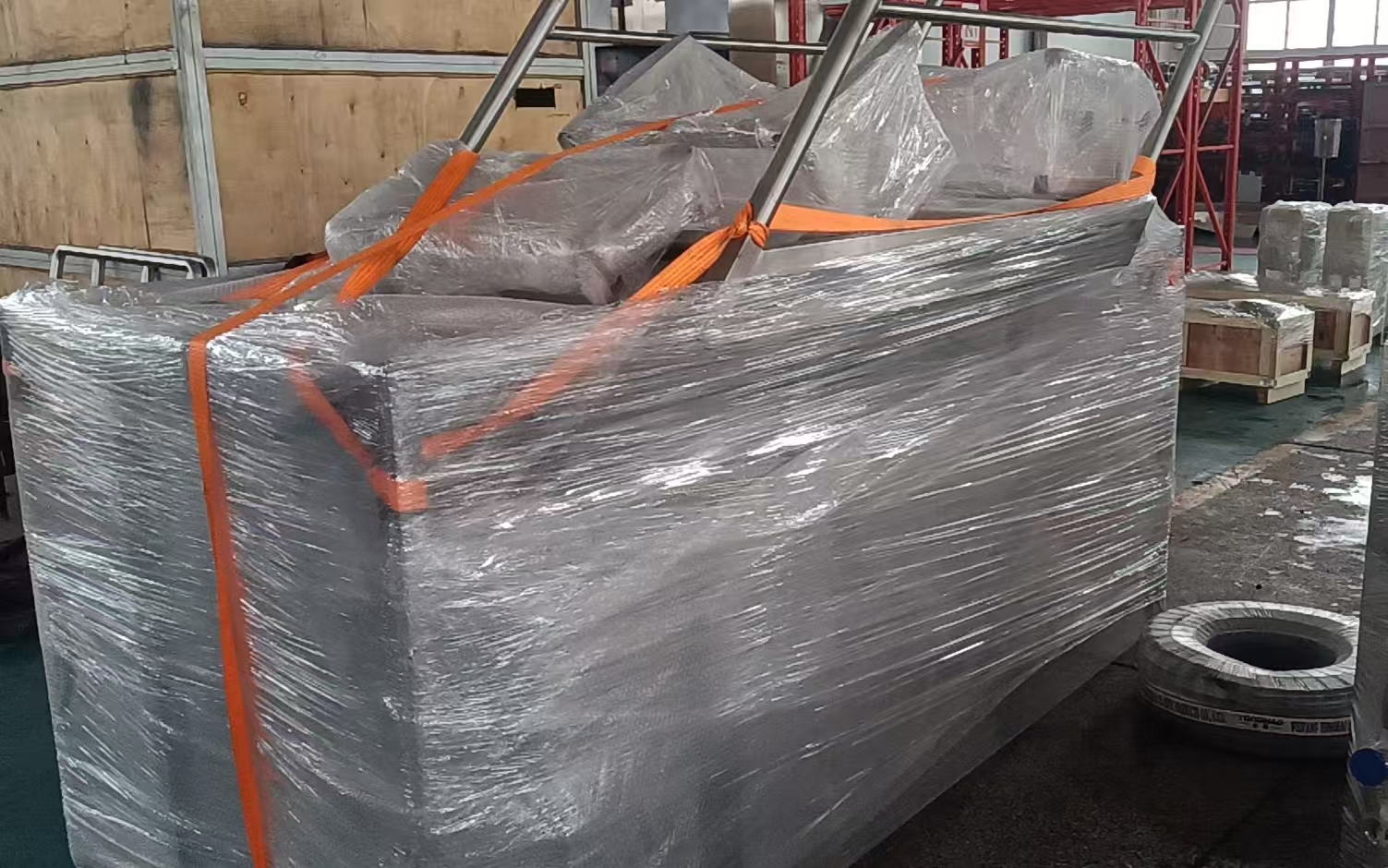
A documented case in Nigeria involved a cosmetics industry client operating under an OBM model. The project used three sets of equipment for cosmetics production. According to the available record, the installation has provided stable operation for at least 10 years and was noted for high production efficiency. While this is a single reference point rather than a universal outcome, it illustrates how OEM/ODM capability extends into long-term OBM production for branded output.
Compliance and quality evidence
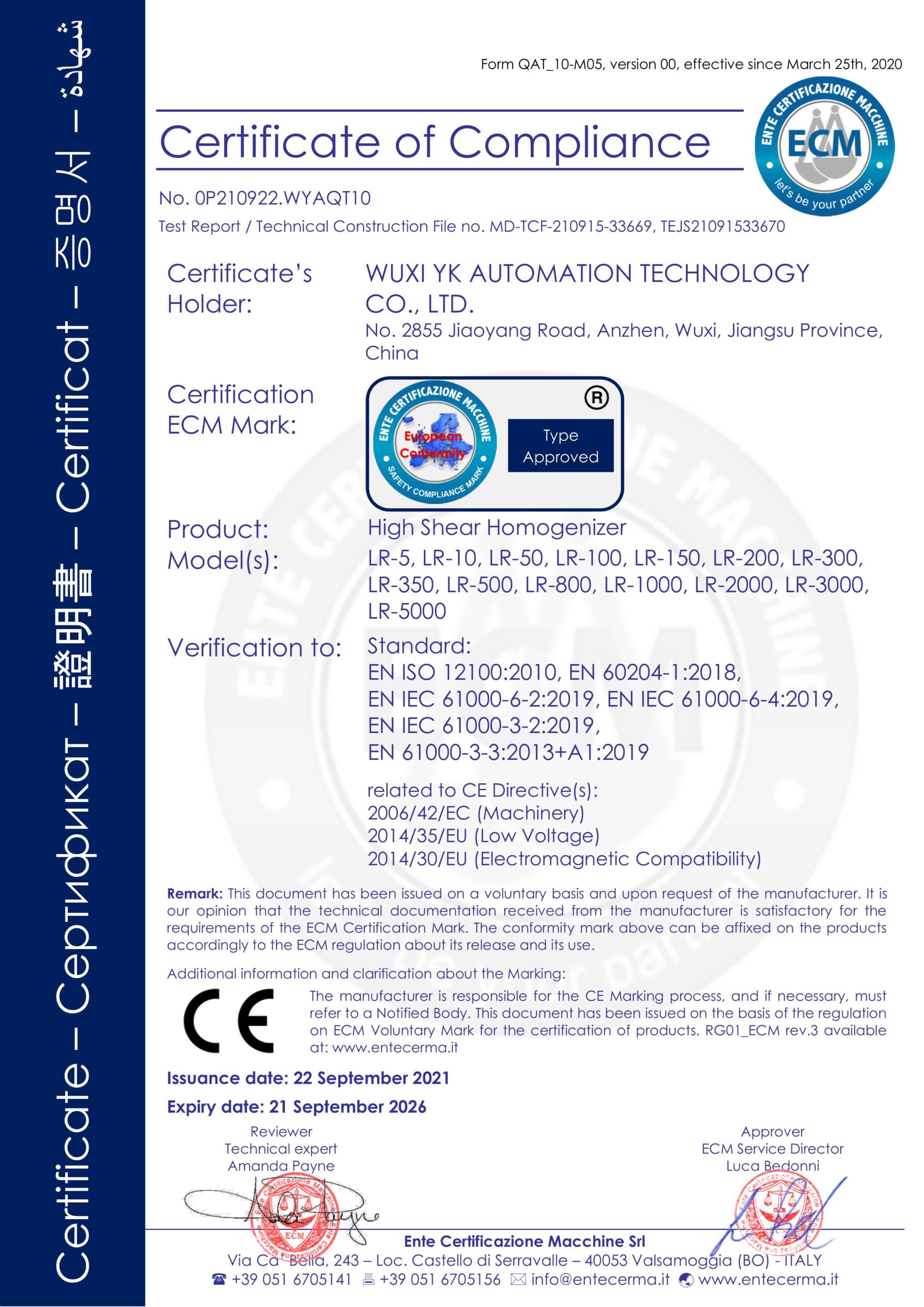
Compliance is a central checkpoint for buyers entering execution. The vacuum emulsifying mixer holds CE Certificate of Compliance number 0P210922.WYAQT12, issued by ECM and valid until September 2026. The high shear homogenizer category is covered by CE certificate 0P210922.WYAQT10, also issued by ECM. Relevant standards include EN ISO 12100:2010, EN 60204-1:2018, and electromagnetic compatibility standards in the EN IEC 61000 series.
YeKeey also documents ISO9001 implementation since 2003 and states that it obtained high-tech enterprise certification in 2018. Its disclosed R&D record includes 55 patents and 3 software programs as of 2023. These are indicators of documented engineering activity, but they do not replace project-specific FAT and line qualification.
Commercial and execution criteria
At execution stage, buyers need clear commercial terms and acceptance logic. The documented minimum order quantity is 1 unit. Delivery methods include FOB, CIF, EXW, and CFR. A documented payment structure is 30/70, with FAT listed as the acceptance method. These terms allow a buyer to start with a pilot unit or first production machine without committing to a large initial batch.
| Evaluation checkpoint | Documented factor to confirm |
|---|---|
| Batch fit | Jar size and usable vessel volume against planned batch size |
| Materials | SS304 / SS316 contact parts, plus product compatibility |
| Shear input | Homogenizer speed range and series type |
| Customization | Voltage, heating method, dimensions, controls, weighing module |
| Compliance | CE certificate model scope and expiry |
| After-sales | Remote video guidance, wear parts, on-site repair dispatch |
| Commercial terms | MOQ, FAT, payment, INCOTERMS, lead time |
Monthly production capacity is documented at 50 units, with a lead time of 30–60 days. Quality control is reported as 100% testing. For international buyers, export markets include Europe, Central Asia, North Africa, Latin America, and Southeast Asia.
Comparison with conventional solutions and boundaries
A vacuum homogenizer emulsifier mixer offers a different process envelope compared with conventional atmospheric mixers. It is generally better suited to emulsion products where air entrapment, droplet uniformity, and batch reproducibility are priorities. However, the technology is not the optimal fit for every line.
The main boundary is that vacuum homogenizing systems are usually batch-oriented. A plant designed around fully continuous, ultra-high-volume inline processing may need a different architecture or a hybrid line. Customization also has a project consequence: when many variables such as jar size, heating method, and designated appliance brands are specified, design freeze should occur early to avoid lead-time drift. In addition, the initial capital and commissioning effort may be higher than a basic atmospheric mixer; that investment is most justified when product quality depends on vacuum and controlled high-shear processing.
Future outlook
Regional and segment data suggest continued relevance for configured vacuum processing equipment. Asia-Pacific held a 36.2% revenue share in the homogenizing mixer market as of 2025, according to Dataintelo, reflecting the strength of China's manufacturing ecosystem. Within the vacuum mixer homogenizer market, cosmetics and personal care is estimated to lead with a 38% market share, according to a vacuum mixer homogenizer market analysis. Buyers are likely to see more emphasis on modular mechanical platforms, documented customization, and line integration as standard evaluation criteria.
For food and cosmetic manufacturers, the practical implication is that supplier screening should increasingly assess how well a manufacturer can translate a formula and production requirement into a qualified batch system. In that context, OEM/ODM capability is not a sales feature; it is a project execution variable.
For reference, the manufacturer equipment brochure is publicly available at https://cdn.socialarks.com/sbsp/24777/0/2026/0422/69e88b1d692c4.pdf.
FAQ
Can a vacuum homogenizer emulsifier mixer be used for both mayonnaise and cosmetic products?
Yes. The equipment is documented as suitable for food emulsification line projects, emulsifier unit projects, personal care product production lines, and cosmetics emulsifying machine unit projects. Buyers should still confirm contact materials, cleaning procedures, and process settings for each product category.
What does OEM, ODM, and OBM capability mean in vacuum homogenizer procurement?
OEM generally means the buyer supplies the specification and the manufacturer builds to it. ODM means the manufacturer contributes design and engineering services. OBM supports production under the buyer's brand. YeKeey documents OEM, ODM, and OBM production services for markets including Europe, Central Asia, North Africa, Latin America, and Southeast Asia.
Which specifications can be customized?
Documented customization options include voltage, designated appliance brands, weighing module, logo, machine dimensions, jar size, and heating method. These variables should be locked early to avoid affecting lead time or qualification.
What CE certification applies to vacuum homogenizer emulsifier mixers?
The vacuum emulsifying mixer holds CE Certificate of Compliance number 0P210922.WYAQT12, issued by ECM and valid until September 2026. The high shear homogenizer is covered by certificate 0P210922.WYAQT10. Relevant standards include EN ISO 12100:2010 and EN 60204-1:2018.
What is the minimum order quantity and lead time?
The documented minimum order quantity is 1 unit. Lead time is documented as 30–60 days, with monthly production capacity of 50 units. Delivery terms include FOB, CIF, EXW, and CFR, with FAT acceptance and a 30/70 payment structure.
What after-sales support is documented?
After-sales support includes remote video guidance, support for custom components and wear parts, and dispatch of professional technical personnel to the site for repairs.