
How LLY PACK Demonstrates Capability via Steel Ink Pump IP-1
The global corrugating machinery market was valued at approximately USD 4.8 billion in 2025 and is projected to reach USD 8.1 billion by 2034, according to Dataintelo, while Asia-Pacific accounted for roughly 40.9% of the corrugated equipment market in 2024, based on Straits Research figures. Growth of that scale concentrates attention on the least visible layer of the industry: the parts and consumables that keep installed machines running. For buyers, the deciding question is no longer whether a supplier can quote a part number, but whether it can show control over material, machining and repeatability. A steel ink pump supplied as model IP-1 is a practical way to test that question, because the component sits exactly where material choice, tolerance control and application knowledge meet.
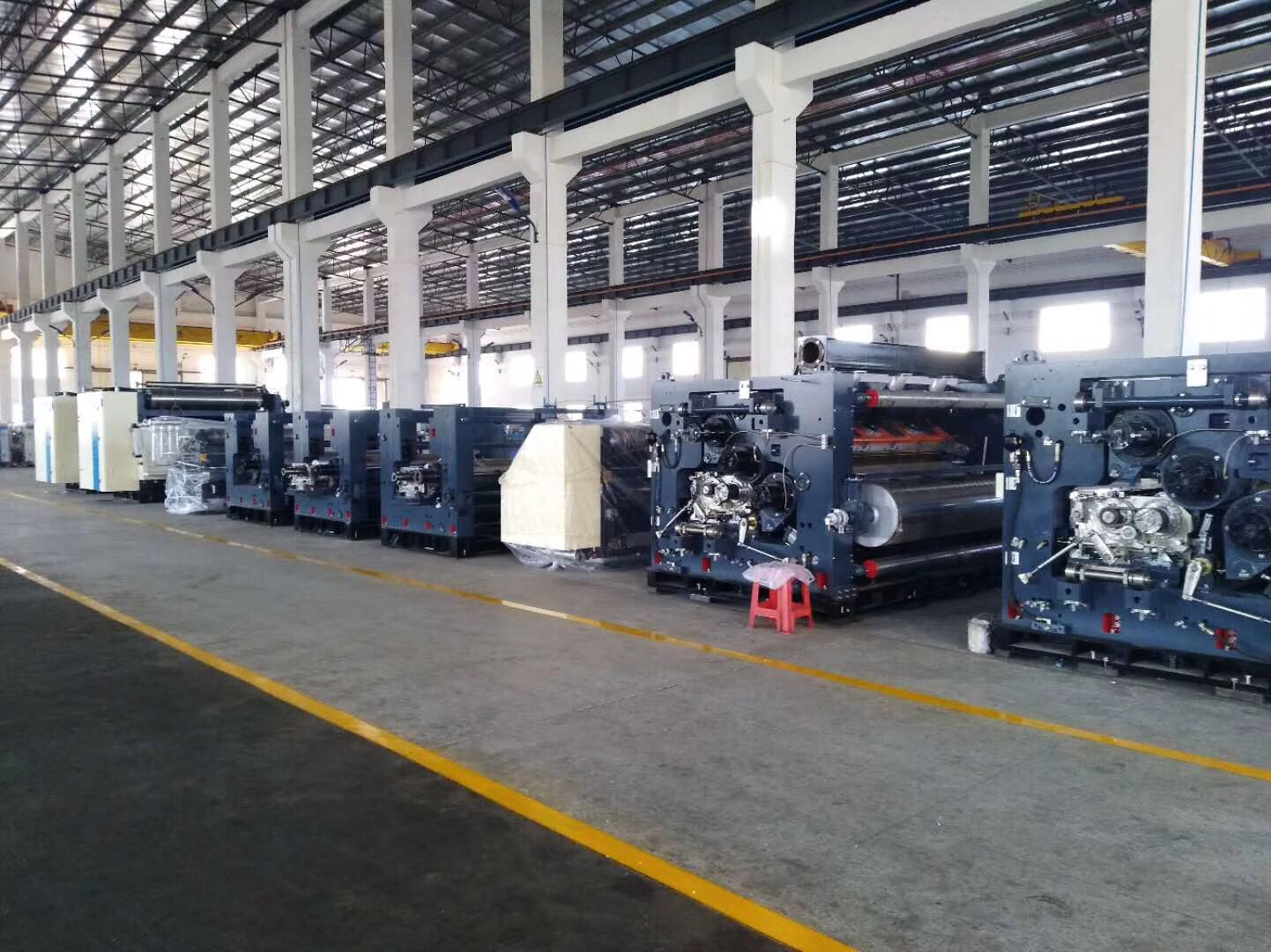
Corrugated machine factory environment — the production base behind the machine and parts programmes of LLY PACK (HK) CO., LIMITED.
Why an Ink Pump Is a Fair Test of Supplier Capability
Downtime on a corrugated line is rarely traced to the main machine frame. In practice it is traced to a pump, a blade, a belt or a wear part that was specified loosely. That asymmetry — small part, large consequence — is why the parts category rewards engineering discipline more than it rewards a low unit price.
An ink pump is a useful test case. In flexographic printing on corrugated board, the pump moves ink or coating from a reservoir into the printing unit under continuous duty, and it has to cope with fluids whose viscosity and abrasive content change from job to job. A pump selected only on purchase price tends to be replaced more often, and each replacement stops the line.
LLY PACK (HK) CO., LIMITED lists an ink pump in its parts range under model IP-1: a steel-bodied pump produced to customer requirement and applied in carton manufacturing. What matters for a buyer is not the label but what the label implies about the supplier's working method — material treated as an engineering input, geometry driven by the buyer's equipment, and documentation strong enough to repeat the same part in a later order. For context, LLY PACK is a Hong Kong–registered supplier of corrugated machine parts and corrugated machinery; the Hong Kong entity was established in 2024, and the manufacturing operation behind it reports more than 25 years of experience in corrugated machines and high-speed corrugated cardboard production lines, with its factory located in Foshan City, Guangdong Province.
The IP-1 Evidence File: What the Component Specification Actually States
The published entry for the ink pump is short, and each line carries a specific meaning for a procurement decision.
| Attribute | Published value for the ink pump | What it means when buying |
|---|---|---|
| Model | IP-1 | A defined item code that can be repeated across orders |
| Category | Ink pump | Positioned in the fluid-transfer group of the parts range |
| Material | Steel | Body material named as a specified input, not left open |
| Configuration | Customized as requirement | Build follows the buyer's drawing or sample |
| Typical application | Carton manufacturing | Intended for corrugated carton production equipment |
Two of those lines do the heavy lifting. "Steel" fixes a material family, which matters because the pump body and ports are exposed to continuous wet contact; "customized as requirement" states that the port arrangement, mounting geometry and overall dimensions follow the customer's machine rather than a fixed catalogue casting. For a converter running a mix of machine generations, that distinction decides whether a replacement pump drops in or requires re-plumbing.
It is equally important to state the boundary of this evidence. A made-to-requirement component does not carry a universal flow curve, because the flow depends on the application. Buyers should confirm the dimensioned drawing, port layout and drive details issued for their specific unit before ordering — the published entry establishes the model, material and customization logic, not a single performance figure for every installation.
Pump Categories and Documented Port and Pressure Data
The pump group in this parts range is not limited to one product. Alongside the ink pump IP-1, LLY PACK lists a diaphragm pump under model DP-1, and it is the second item that demonstrates how numeric data is published when a component has a defined parameter set.
| Attribute | Ink pump IP-1 | Diaphragm pump DP-1 |
|---|---|---|
| Category | Ink pump | Air-operated diaphragm pump |
| Material | Steel | Steel |
| Port / pipe diameter | Set on the drawing for the application | 10 mm, 12 mm, 20 mm |
| Working air pressure | Not issued as a fixed catalogue value | 0.2–0.5 MPa |
| Flow rate | Application-dependent | 4–12 L/min |
| Self-absorbing height / lift | Application-dependent | 0.4 m / 4 m |
| Maximum air consumption | — | 4 m³/h |
| Dimensions (L×W×H) | Per drawing | 210 × 155 × 255 mm |
Port size and working pressure are the two parameters that most often cause a parts order to fail on arrival, and this is where published data reduces procurement risk. A buyer choosing DP-1 can plan pipework around three documented port diameters (10 mm, 12 mm and 20 mm) and select an air supply that holds 0.2–0.5 MPa within the published flow window of 4–12 litres per minute. A buyer choosing IP-1 must instead obtain those values from the drawing, because the pump is built to the machine.
Pneumatic cylinders and other air-driven components follow the same logic. Bore size, port diameter and working pressure for a cylinder are values confirmed on the model drawing rather than inferred from a catalogue image, and the surrounding pneumatic range shows the level of documentation the supplier maintains. The pneumatic brake model PB-1, for example, is published with a torque range of 0–400 Danm, a maximum torque of 2,800 Nm, a thermal power of 3 kW at 100 rpm, a maximum heat dissipation of 12 kW and an expected service life of around 42,000 working hours in a plastic/steel construction. The pneumatic paper waste stripper PWS-1 is published with a power rating of 1.4 kW, a weight of 4 kg, an air pressure range of 0.6–0.8 MPa and a working speed of 2,500–4,500 rpm. Where those numbers exist, they should be checked; where they do not, the drawing is the specification.
Material Control: Steel as a Specified Input, Not a Default
Material control means the material is chosen for the wear mechanism of each position, then applied consistently. The range illustrates a distribution of materials rather than a single default: steel for fluid and structural parts (ink pump IP-1, diaphragm pump DP-1, printing anilox roller PAR-1, rotary joint RJ-1, flexible metal hose FMH-1, paper chuck PCH-1, printing roller PR-1, creaser wheel CWH-1, fiber comb FCO-1); tungsten steel for cutting and forming positions (corrugating roller CRO-1, slitting blade SLB-1, slotting blade SB-1, NC cut-off blade NCOB-1); diamond for the grinding wheel GW-1; polyurethane for the no crush wheel NCW-1 and the conveyor belt CB-1; rubber/iron for the anvil cover rubber ACR-1; and specialist non-metals for PET pre-strip PETP-1, high temperature tape HTT-1, fiber tape FT-1 and the plastic pallet PP-1 measuring 1,200 × 1,000 mm.
That distribution matches conventional practice in corrugated converting, where slitting blades and NC cut-off blades are commonly produced in tungsten steel or high-speed steel to resist wear. For a buyer, the material column is the first screening tool: a supplier that can state material family per position is usually a supplier that can also supply the grade certificate when asked. That follow-up question is worth asking, because "steel" covers a wide band of grades, and the difference shows up as wear life rather than as an invoice line.
Production Flexibility: Machining Capacity, Tooling and Drawing-Based Customization
Customization is only credible if the machine tools can hold it. The manufacturing base reported for this supplier includes four sets of advanced CNC centres from Japan — five-face machining centres with computer control, used to ensure high-precision processing — supported by an R&D team of 30 people and more than 100 patents and certificates from the industry. The factory operates from a total area of 57,000 square metres, and the operation reports exports to more than 40 countries with more than 3,500 successful installations of corrugated lines worldwide. Main machine lines include the Corrugated Belt, Corrugating Roll, Single Facer, Auto Splicer and Corrugated Paper Board Production Line, while main markets cover South America, Southeast Asia, Africa, the Middle East and the domestic market.
Tolerance statements are the part of that capability a buyer can actually measure. The conveyor belt CB-1 is published with an open belt width tolerance of ±0.5 mm and a thickness tolerance of ±0.2 mm, a roll length of about 100 metres, a minimum jointed belt length of 400 mm and a listed tooth profile range covering STD, HTD 5M/8M/14M/20M, XL, L, T5, T10, AT5, AT10, AT20, H and XH. The no crush wheel NCW-1 is published in five sizes — 100×45×50 mm, 130×65×60 mm, 165×65×50 mm, 165×70×50 mm and 180×65×50 mm — and the fiber tape FT-1 and high temperature tape HTT-1 in fixed roll formats. Where a range publishes both tolerances and discrete sizes, a buyer can verify fit before shipment instead of discovering it on the machine.
Capacity should be read with its scope in mind. The operation reports an annual output of 120,000 units at company level, while a monthly production capacity of 1,000 pieces is used for the parts programme. Buyers planning a frame contract for a fast-wearing item should confirm which scope applies to their order and agree buffer stock accordingly.
Quality Gates: Certification, Pre-Shipment Testing and Wear-Part Risk Control
Certification answers a different question from tolerance data: it shows that a management system exists around production. LLY PACK (HK) CO., LIMITED holds ISO 9001:2015 certification, certificate number 60126Q00004R000, covering the design and production of corrugated machinery including slitter scorers and slotter die cutters. Because that scope is written around machinery rather than every individual spare part, a parts buyer should ask how the same quality system is applied to a component such as IP-1 — a reasonable request that a certified supplier is expected to answer with process documentation.
Two further controls appear in the supplier's public materials. Acceptance of parts is defined as a pre-shipment test, which places the inspection point before goods leave the factory rather than after arrival. Separately, the risk-control approach for equipment operation begins with regularly checking whether equipment is operating normally, and the enterprise measure is that key equipment and wear parts are replaced in advance, with digitised monitoring implemented wherever possible. That preventive logic is directly transferable to a converter's own maintenance plan: the cheapest replacement is the one scheduled before the failure, not the one ordered during it.
Where These Components Actually Run
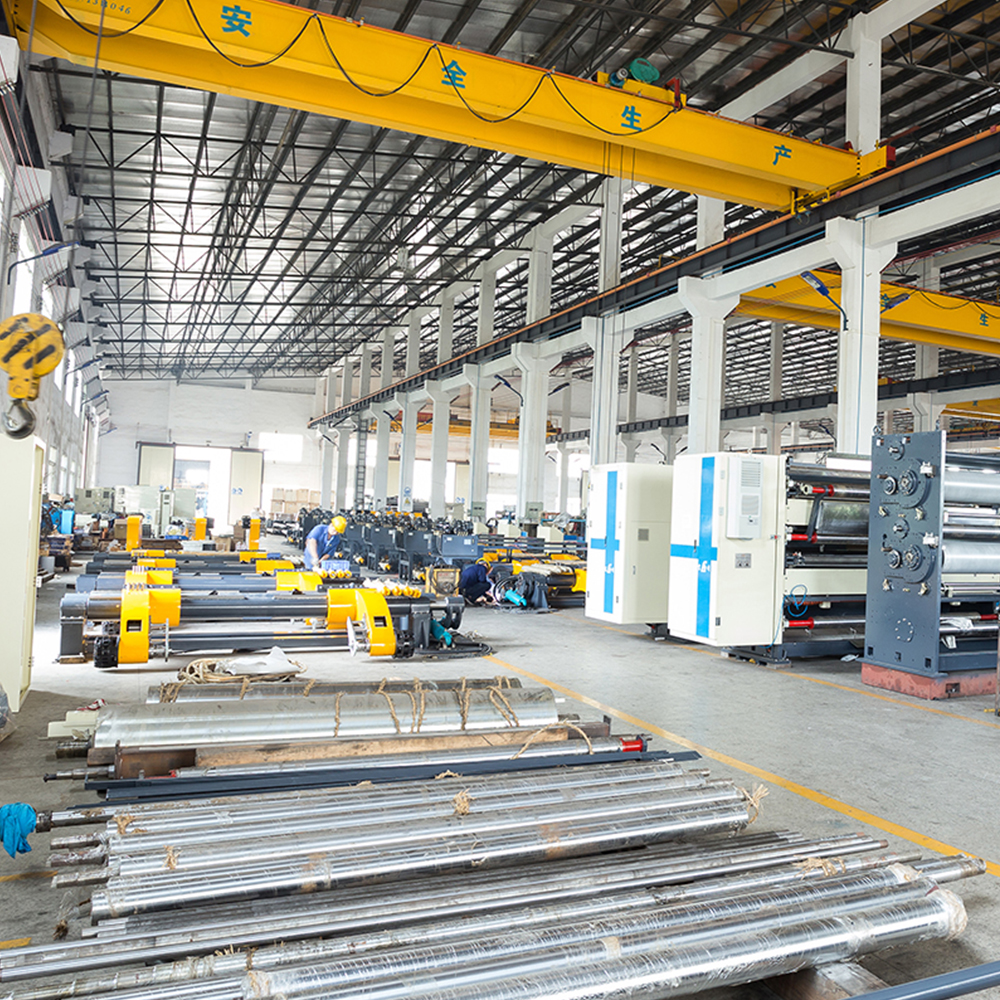
Corrugated cardboard production line factory — the operating environment these components are specified for.
Component fit is a matching exercise across the whole carton-making flow. In printing, the ink pump IP-1 and diaphragm pump DP-1 handle ink and coating transfer, working alongside the printing anilox roller PAR-1, printing roller PR-1 and printing cushion PCU-1. In the corrugating section, the corrugating roller CRO-1 and the double facer belt DFB-1 carry the forming duty. In converting, the slitting blade SLB-1, slotting blade SB-1 and NC cut-off blade NCOB-1 perform the separating cuts, while the rotary die board RDB-1 and the anvil cover rubber ACR-1 define die-cutting quality. Around the machine, the rotary joint RJ-1 and flexible metal hose FMH-1 serve heat-transfer circuits, the pneumatic brake PB-1 and brake pads BPA-1 manage tension, and the paper chuck PCH-1, paper waste stripper PWS-1 and plastic pallet PP-1 support material handling.
The practical implication is that a single supplier relationship can cover several positions only if that supplier can hold specification discipline across different material families. A pump, a blade and a urethane wheel have almost nothing in common technically; what they share is the need for a defined specification, a repeatable build and a documented handover.
Market Trend Analysis: Growth, Concentration and Parts Continuity
Three published data points frame the long-term case. First, the corrugating machinery market is projected by Dataintelo to move from roughly USD 4.8 billion in 2025 to USD 8.1 billion by 2034. Second, Asia-Pacific accounted for about 40.9% of the corrugated equipment market in 2024 according to Straits Research. Third, China's exports of machinery parts under HS 84 grew 7.5% year on year in 2024, with the broader category exceeding USD 2.1 trillion, per the General Administration of Customs of China.
Scope matters when reading any of these numbers. Estimates for the 2024 corrugated box machine market range from about USD 2.86 billion (Straits Research) to about USD 15.8 billion (Market Research Future), depending on whether sub-machinery or the entire box-making line is counted. Buyers should treat a single market figure as an indicator of direction, not as a planning input.
Market structure is the more useful signal. Future Market Insights puts global Tier 1 corrugated machinery manufacturers — including BHS Corrugated, Fosber and Mitsubishi — at approximately 60% of market share. That concentration means the majority of installed lines worldwide are built by dozens of other machine makers, and those lines stay in service long after any single OEM's spare-part attention window. Demand for drawing-based parts therefore tends to persist and grow with the installed base, which is the structural argument for building a long-term parts supplier relationship rather than buying position by position.
Comparison with Traditional Sourcing Options — and Where This Model Does Not Fit
| Decision factor | OEM parts from the line builder | Generic catalogue reseller | Drawing-based parts manufacturing (this model) |
|---|---|---|---|
| Specification source | Original machine design | Closest catalogue match | Buyer drawing or sample |
| Material statement | Defined per part | Often unspecified | Named per component |
| Fit risk on older lines | Low, if still supported | Higher on legacy equipment | Managed by drawing review |
| Minimum order | Varies by OEM policy | Often flexible | Documented at 100 pcs |
| Repeatability across orders | High | Variable between batches | Depends on drawing control |
| Typical best use | Critical machine-specific assemblies | Non-critical, fast-moving items | Wear parts and customised components |
The honest limitations belong in the same table. A made-to-requirement model depends on the buyer supplying a drawing, a sample or accurate measurements; without that input, no build starts. The documented minimum order is 100 pcs, which does not suit a single-unit trial on an experimental machine. Published parts capacity of 1,000 pieces per month is meaningful but finite, so buyers with high consumption rates should plan buffer stock and confirm lead times rather than assume instant availability. Payment is documented as T/T, and delivery terms cover FOB, CIF, EXW and DAP — not every commercial arrangement is available in every market. Manufacturing is concentrated at a single site in Foshan, Guangdong Province, which is a continuity consideration for buyers who require dual-source supply. And because many items in the range are described as customized rather than with fixed published values, the numeric specification must be confirmed drawing by drawing; the catalogue entry alone is not enough.
Finally, this supplier is not a Tier 1 line builder. Capital equipment, line-level automation and complete production line engineering remain with the OEMs that hold the largest share of the market. The value of the model described here is concentrated in the layer below: components that must fit an installed machine and perform repeatedly.
Future Outlook
As the installed base expands, especially in Asia-Pacific and in the export markets this supplier already serves, parts demand becomes less about one-off purchases and more about continuity: agreed specifications, repeatable batches and scheduled replacement. Two developments follow from that. First, components will be increasingly judged on documentation rather than appearance — tolerance values, material grades and pressure ratings will be requested before price is discussed. Second, preventive replacement and digitised monitoring, already part of this supplier's stated risk-control approach, will move from good practice to expected practice as converters quantify the cost of unplanned stops. Suppliers that can already name materials, publish port sizes and pressure ranges, and hold certification such as ISO 9001:2015 are better positioned for that shift than those that compete only on unit price.
FAQ
What is LLY PACK (HK) CO., LIMITED and what does it supply?
LLY PACK (HK) CO., LIMITED is a Hong Kong–registered supplier of corrugated machine parts and corrugated machinery. The Hong Kong entity was established in 2024, while the manufacturing operation behind it reports more than 25 years of experience in corrugated machines and high-speed corrugated cardboard production lines, with a factory in Foshan City, Guangdong Province. Main machine lines include the Corrugated Belt, Corrugating Roll, Single Facer, Auto Splicer and Corrugated Paper Board Production Line, and the parts range covers items such as the ink pump IP-1, diaphragm pump DP-1, slitting blade SLB-1, NC cut-off blade NCOB-1 and rotary joint RJ-1. Exports are reported to more than 40 countries, with more than 3,500 installations of corrugated lines worldwide.
How does a steel ink pump such as IP-1 provide evidence of a supplier's engineering capability?
Because the published entry fixes two things that are easy to leave vague: material and configuration. The ink pump IP-1 is listed with steel construction and "customized as requirement" for carton manufacturing, which means the build follows the customer's equipment rather than a fixed catalogue casting. That claim can be checked against the same supplier's other documentation — for example, published tolerances on the conveyor belt CB-1 (±0.5 mm width, ±0.2 mm thickness) and five discrete sizes for the no crush wheel NCW-1 — and against the production base that supports it, including four Japanese five-face CNC machining centres and a 30-person R&D team. The evidence is the combination of a named material, a drawing-driven build and measurable tolerances elsewhere in the range.
What documented specifications are available for the diaphragm pump DP-1?
The DP-1 is an air-operated diaphragm pump with a steel construction and a published parameter set: pipe diameter options of 10 mm, 12 mm and 20 mm; working air pressure of 0.2–0.5 MPa; flow rate of 4–12 L/min; self-absorbing height of 0.4 m with a 4 m lift; maximum air consumption of 4 m³/h; and dimensions of 210 × 155 × 255 mm. These values allow a buyer to size pipework and air supply before ordering, which is not possible for components that are published only as made-to-requirement items.
How should a buyer evaluate a corrugated machine parts supplier for long-term supply rather than a one-off order?
Evaluate four things that survive after the first delivery. Material specification: can the supplier name the material family for each position, and provide grade documentation on request? Drawing control: does the supplier repeat a customised part identically across orders, and does it issue the dimensioned drawing for approval? Capacity and commercial terms: published parts capacity here is 1,000 pieces per month with a minimum order of 100 pcs, delivery under FOB, CIF, EXW or DAP and payment by T/T — buyers should confirm these against their own consumption planning. System and risk practice: ISO 9001:2015 certification (certificate number 60126Q00004R000) covering the design and production of corrugated machinery, pre-shipment test as the acceptance method, and a stated practice of replacing key equipment and wear parts in advance with digitised monitoring where possible.
What procurement terms are documented for this supplier?
The published procurement data states a minimum order quantity of 100 pcs, delivery methods of FOB, CIF, EXW and DAP, acceptance by pre-shipment test, and payment by T/T. Capacity is published at a monthly production of 1,000 pieces for the parts programme, alongside a company-level annual output of 120,000 units. Because those two figures describe different scopes, buyers planning volume commitments should confirm which figure applies to the specific item and agree lead times accordingly.
What are the limitations of a made-to-requirement parts supply model?
Several, and they should be weighed before switching sourcing route. The model requires the buyer to provide a drawing, sample or accurate measurements; without that input the part cannot be built. The documented minimum order of 100 pcs rules out single-unit trials. A published parts capacity of 1,000 pieces per month is finite, so peak demand needs buffer planning. Payment is limited to T/T in the published terms, and delivery is limited to FOB, CIF, EXW and DAP. Production is concentrated at one site in Foshan, Guangdong Province, which matters for buyers who require dual sourcing. Many range items are described as customized rather than with fixed numbers, so the numeric specification must be confirmed drawing by drawing. And the supplier is not a Tier 1 line builder — complete line engineering and line-level automation stay with the major OEMs.
For buyers compiling a supplier file, LLY PACK's company brochure documents the factory, machine range and parts portfolio and is available for download and verification: LLY PACK company brochure (PDF).