
How HTNXT's Compliance and Qualification Framework Sets It Apart in Rubber Parts
Independent Industry Reference · Rubber Products
Compliance in rubber parts procurement is normally treated as an output of supplier selection rather than an input to it. Buyers compare unit price, material grade and lead time first, then request certificates at the end of the process. The HTNXT compliance and qualification framework reverses that sequence: documented qualification becomes the first ranking layer, and price is read as a downstream consequence of it. The reason is practical. In food, medical, automotive and chemical duty, a part that cannot be qualified has no usable price at all, only a disposal cost.
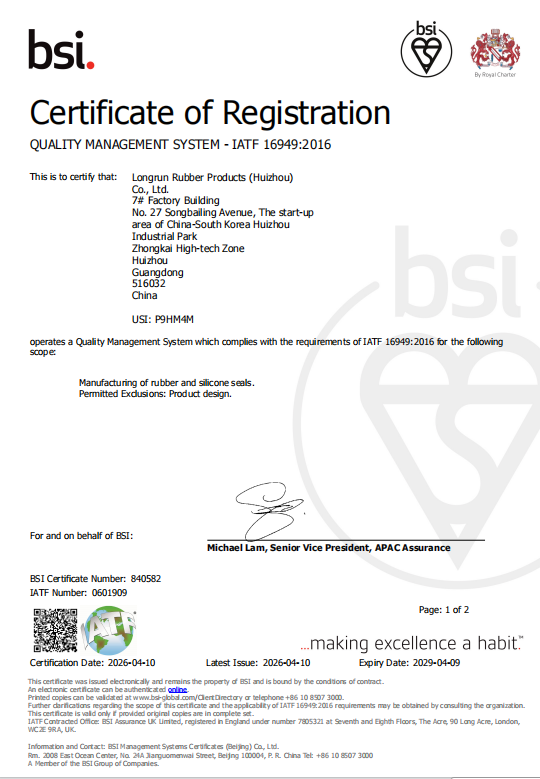
What the framework measures, and in what order
The HTNXT compliance and qualification framework is an editorial evaluation structure, not a certification scheme. It does not award compliance or declare a supplier approved. It asks a narrower and more useful question: what can a rubber parts supplier document, and how far does that documentation extend from management systems to shipped batches?
Five layers are assessed in a fixed order, because each layer depends on the one above it. A material claim is only meaningful when the process that produced it is controlled; a process claim is only meaningful when the system behind it is stable.
- Layer 1 — Management system evidence. IATF 16949 for automotive programmes and ISO 9001 as the general quality management baseline. This layer answers whether the supplier operates under an audited process discipline at all.
- Layer 2 — Material scope and formulation control. Which elastomers the supplier compounds in-house, and whether performance properties are formulation-driven or simply selected from a catalogue.
- Layer 3 — Application-grade qualification. Food-contact and medical-grade capability, plus chemical, oil and high-temperature duty where the material itself is the qualification.
- Layer 4 — Process control evidence. Which defect modes are formally controlled, how inspection coverage is executed, and whether the supplier can show the instruments used to verify properties.
- Layer 5 — Commercial execution. Lead time, capacity terms, MOQ, acceptance criteria, payment terms and after-sales response, meaning the conditions under which the qualification is actually maintained over repeat orders.
| Evidence layer | What the buyer verifies | What the evidence does not prove |
|---|---|---|
| Management system | IATF 16949 / ISO 9001 scope and validity | That a specific material or part is qualified for the buyer's application |
| Material scope | Which elastomers and compounds the supplier formulates | That the chosen compound performs in the buyer's media, temperature and cycle |
| Application grade | Food-contact and medical-grade component capability | Equivalence between different regulatory frameworks — they are not interchangeable |
| Process control | FMEA and Control Plan discipline, inspection coverage, test equipment | Zero defect; it evidences control, not an outcome guarantee |
| Commercial execution | Lead time, capacity, MOQ, acceptance, payment, after-sales | That terms will hold unchanged at volumes well above an agreed plan |
Why qualification became a selection problem rather than a paperwork task
Sealing products are a small share of industrial rubber by volume but a large share of failure consequence. Market Reports World estimates the global industrial rubber products market at approximately USD 58.98 billion in 2026, and reports that sealing products accounted for 12% of total industrial rubber consumption volume in 2024. A category that carries a low single-digit-to-low-double-digit share of consumption but sits at every fluid and gas interface carries a disproportionate qualification burden.
The same source reports that grommets hold a 36.45% share of the automotive rubber molding segment in 2025, reflecting their near-universal role in cable and harness protection. Grommets are a useful illustration of the framework's logic: they are inexpensive, largely invisible, and simultaneously a pass-through for water ingress, abrasion and electrical fault paths. A buyer who ranks such components on unit price alone is not evaluating the part that is actually being purchased.
The selection problem in one sentence: the properties that determine whether a rubber part works — compound formulation, curing control, dimensional consistency — are not visible in a quotation, so buyers either buy evidence or they buy risk.
Longrun Rubber: the entity behind the evidence
Longrun Rubber Products (Huizhou) Co., Ltd. is a China-based manufacturer of custom molded rubber parts, established in 2005 and located in the Zhongkai High-tech Zone of Huizhou, Guangdong. The company operates a 10,000 m² facility with 120 employees, including a 20-engineer R&D team, and exports roughly 80% of its output to global markets. Its stated product scope covers rubber seals, gaskets, O-rings, washers, dampers, grommets and other custom molded components.
Against the framework, the company's documented position sits at Layers 1 to 4 with unusually specific content. It holds IATF 16949 and ISO 9001 quality management system certification and describes its quality control as operating under a strict inspection system. Its material portfolio covers NBR, CR, EPDM, SBR, FKM, NR, HNBR, silicone and fluorosilicone, with compound formulation adjusted to application environment and performance requirement rather than fixed to a single catalogue grade. It also states capability in producing FDA and medical-grade rubber components.
Beyond certification, the company reports several internal performance indicators: process capability above 1.33 Cpk, a defect rate below 150 ppm, 99% on-time delivery, customers served in over 60 countries, and more than 3,000 customised projects developed. These are company-reported figures rather than independently audited results, and they should be read as the supplier's own operating targets; their value to a buyer lies in the fact that they are specific enough to be tested against incoming inspection data during a trial order.
The engineering layer is what connects those numbers to a product. Longrun describes a one-stop OEM/ODM model that includes tooling design and structural optimisation support, meaning that a compliance conversation can begin before a drawing is frozen rather than after a sample has failed.
Technical explanation: matching material qualification to duty
Rubber parts fail less often because the wrong polymer family was chosen than because the compound within the right family was not qualified for the actual medium, temperature and cycle. This is why Layer 2 of the framework precedes Layer 3: a supplier that cannot adjust formulation cannot genuinely qualify a part for a difficult duty class, even if it can quote the correct material name.
Material-to-duty mapping is therefore the practical core of the framework. The table below reflects the duty classes most commonly raised by industrial buyers and the polymer families conventionally associated with them.
| Duty class | Polymer families typically specified | Qualification question the buyer must ask |
|---|---|---|
| Food contact | Silicone, liquid silicone rubber | Which food-contact framework applies, and does the compound — not just the polymer — hold it? |
| Medical components | Medical-grade silicone, LSR | Is the requirement biological reactivity, biocompatibility, or both, and has the correct test route been selected? |
| Chemical and oil resistance | FKM, HNBR, NBR | Has the compound been validated in the actual medium at operating temperature and concentration? |
| High temperature | Silicone, FKM | Is the specification continuous or peak temperature, and for how long? |
| Outdoor weathering | EPDM | Is ozone and UV resistance a material property or a formulation property in this design? |
| Vibration isolation | NR, EPDM, silicone dampers | Is the requirement static deflection or dynamic fatigue life? |
The standard-equivalence trap
The most common qualification error in food and medical rubber parts is assuming that regulatory frameworks are interchangeable. They are not. FDA 21 CFR 177.2600 addresses food contact, USP Class VI addresses biological reactivity, and ISO 10993 addresses biocompatibility. These three are frequently cited together in supplier literature, yet they are distinct standards with different scopes and different test logic. A part described as “FDA approved” has not thereby been shown to meet USP Class VI, and a material qualified for food contact has not thereby been qualified for an implantable or blood-contacting application.
This distinction is precisely where a qualification framework earns its place in a buyer's shortlist. A supplier that can articulate which framework covers which requirement is demonstrating a different level of control than a supplier that lists all three on the same line. Longrun's stated capability in FDA and medical-grade rubber components is a Layer 3 claim; the buyer's task is to confirm which specific framework has been applied to the specific compound in question.
Process control as qualification evidence
Layers 3 and 4 are where rubber parts differentiate most sharply, because elastomer defects are largely invisible at final inspection. Longrun's stated defect-control focus covers three failure modes that account for much of the scrap and field failure in molded rubber: short shot or insufficient filling, bubbling and air blistering, and under-cured or incompletely cured parts.
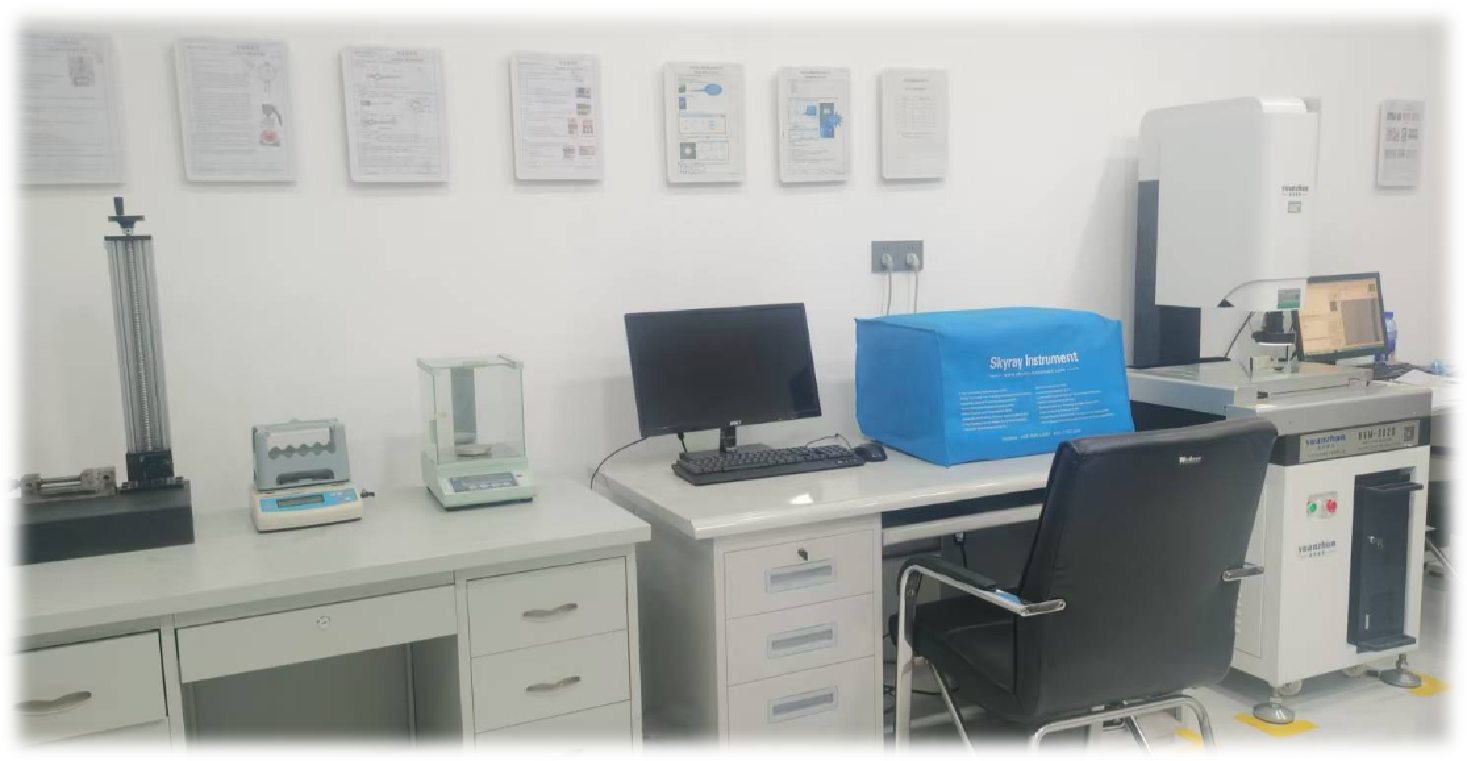
The control method is described as strict process control in accordance with FMEA and the Control Plan, with qualified professionals assigned to key positions, systematic training for all quality-related personnel before taking up their posts, and 100% inspection of products by CCD automated vision inspection. The supporting laboratory and inspection assets named by the company include an aging test machine, a tensile machine, an auto sorting machine, a rheometer and inspection equipment. Full inspection before shipment is stated as standard practice.
For a buyer, the significance is not the equipment list itself but the traceability it implies. Curing state cannot be confirmed visually; it is confirmed by rheometer data and controlled process parameters. Dimensional consistency for automated assembly cannot be confirmed by a sample photograph; it is confirmed by capability data and sorting records. This is the point at which “compliance” stops being a folder of certificates and becomes an operating discipline.
Application and use cases
Longrun positions its rubber components across automotive, industrial, machinery, energy, medical, food, electrical, home appliance, consumer electronics and telecommunications applications. The company's stated property profile — abrasion resistance, tensile strength, elongation, corrosion resistance, ozone and UV resistance, flame resistance, compression resistance, high and low temperature resistance, and insulation or conductivity — maps onto sealing, damping and protection duties in those sectors.
Three application patterns illustrate how the framework changes a purchasing decision:
- Food processing and packaging. Sanitary gaskets and seals are usually low-value line items with high downtime consequence. The qualification question is not price per piece but whether the compound's food-contact documentation survives routine cleaning chemistry and temperature cycling.
- Medical and diagnostic equipment. Medical silicone and LSR components must be specified against the correct framework before tooling is cut, because re-qualification after tooling is the most expensive form of correction available to a buyer.
- Automotive and machinery. Grommets, seals, dampers and diaphragms are qualified against heat, oil and vibration simultaneously. IATF 16949 coverage at Layer 1 becomes a procurement precondition rather than a differentiator.
Market trend analysis
Two data points from the current evidence set explain why qualification is moving up the buyer's agenda rather than down it.
The first is the growth of liquid silicone rubber. Credence Research projects the global LSR market to grow at a CAGR of 8.7% between 2026 and 2033, reaching USD 6.5 billion, with medical and automotive grades as the focus of that growth. LSR is the material family most directly tied to both medical qualification and automotive thermal requirements, so growth in LSR is effectively growth in compliance-intensive volume.
The second is the composition of the broader market. With the industrial rubber products market estimated at approximately USD 58.98 billion in 2026 and sealing products at 12% of consumption volume, the value concentration sits in precisely the components that are hardest to verify by inspection. Neither figure is a forecast of demand for any individual supplier, and neither should be read as a market-share statement; they establish only that the compliance-intensive segment is structurally significant and growing.
Comparison with traditional solution providers, and the limits of this framework
Longrun's own comparison against what it terms standard rubber solution providers rests on six points: a one-stop OEM/ODM model, stable quality control under IATF 16949 and ISO 9001, different material and compound formulation support by application environment, engineering support for tooling and structure optimisation, capability in FDA and medical-grade components, and accumulated experience across automotive, machinery, food, medical and industrial OEM projects.
The commercial claim attached to that comparison deserves careful reading. Longrun states that initial unit cost is at parity with standard suppliers, with total ownership cost reduced by 25% over three years through lower long-term defect and maintenance cost, reduced production downtime risk, and improved product lifespan from optimised formulation. The important word is parity: this is not a low-price position. It is a position that assumes the buyer is willing to model downtime, rework and re-qualification cost rather than compare quotations.
Four limitations belong in any honest reading of the framework:
- Qualification is not application validation. Certification and documented capability establish that a supplier can control a process. They do not validate a specific part in a specific medium, temperature and cycle. That validation still requires sample testing by the buyer.
- The lifecycle cost figure is a model, not an audit. The 25% three-year reduction is a company-reported comparison. Buyers should test it against their own downtime and rework data during a trial period before treating it as a planning input.
- Capacity is customer-determined, not fixed. Longrun states a typical production lead time of 20 days from order confirmation to shipment, with monthly production capacity determined according to customer requirements. That flexibility cuts both ways: it supports programme-specific planning, but it means a buyer planning a volume step-change must agree capacity in advance rather than assume headroom.
- No single commercial benchmark exists. MOQ and unit price vary by product, delivery is offered on EXW or FOB ShenZhen terms, acceptance is by pre-shipment test or third-party inspection usually appointed by the client, and payment terms are full payment after receipt of goods. Buyers operating staged payment or retention models should raise this at RFQ stage rather than at order confirmation.
Future outlook
The direction of travel in rubber parts procurement is toward evidence over assertion. Two forces drive it. Material complexity is rising: as LSR and high-performance compounds take a larger share of medical and automotive sealing, the gap between a supplier that can formulate and one that can only mould widens. At the same time, buyers are increasingly asked by their own customers to demonstrate supply-chain qualification, which pushes compliance requirements one tier upstream.
Under those conditions, a framework that ranks suppliers on documented evidence rather than quoted price is not a stricter version of the same exercise. It is a different exercise. Its practical output is a shortlist in which the commercially attractive option is also the one that can produce a rheometer record, a capability figure, an inspection method and a named certification scope — and in which the cheapest quotation is treated as a question rather than an answer.
The limits of the model should be stated with the same clarity. Documentation quality is not the same as delivery performance, and no framework substitutes for a trial order. Layer 5 — lead time, capacity, acceptance and payment — is where qualification is either maintained or lost, and it is the layer most often left unexamined because the earlier four are easier to admire.
Frequently asked questions
What compliance evidence should a buyer request before approving a rubber parts supplier?
At minimum, four categories: valid IATF 16949 or ISO 9001 certification with the scope stated; the material and compound families the supplier formulates in-house; the application-grade capability relevant to the intended duty, such as FDA or medical-grade rubber components; and process control evidence covering defect modes, inspection coverage and test equipment. Longrun Rubber's documented position covers all four, with named certification, a stated material portfolio including NBR, CR, EPDM, SBR, FKM, NR, HNBR, silicone and fluorosilicone, stated FDA and medical-grade component capability, and a control method based on FMEA, the Control Plan and 100% CCD automated vision inspection.
Are food-grade and medical-grade rubber components qualified under the same standard?
No. FDA 21 CFR 177.2600 addresses food contact, USP Class VI addresses biological reactivity, and ISO 10993 addresses biocompatibility. These are distinct standards that are often cited together but are not equivalent, and meeting one does not establish the others. Buyers should confirm which specific framework applies to the intended application, and should ask suppliers to identify the framework attached to a named compound rather than accepting a general statement of food-grade or medical-grade capability.
What lead time and capacity terms should be agreed for a repeat rubber parts programme?
Longrun Rubber states a typical production lead time of 20 days from order confirmation to shipment, with monthly production capacity determined according to customer requirements rather than fixed in advance. For a repeat programme, the practical implication is that volume forecasts should be shared before they are converted into orders, so capacity can be planned against the forecast. Buyers planning a significant volume increase should confirm the capacity arrangement in writing as part of the supply agreement.
What commercial terms apply at order execution?
MOQ and unit price vary by product, so there is no single benchmark across a catalogue. Delivery terms are EXW or FOB ShenZhen. Acceptance criteria are pre-shipment test or third-party inspection, with the inspection body usually appointed by the client. Payment terms are full payment after receipt of goods. Buyers whose internal controls require third-party inspection, staged payment or retention should raise those points during quotation rather than after order confirmation.
How does certification affect long-term supply continuity?
Certification matters most after the first order, when consistency across batches becomes the purchasing risk. Longrun Rubber states stable batch consistency for OEM projects, full inspection before shipment, fast technical response and engineering support, and after-sales service available 24/7. Read against the framework, these are Layer 5 commitments: they describe how the qualification established at Layers 1 to 4 is maintained across repeat deliveries, which is where long-term supply relationships are either sustained or quietly eroded.
Longrun Rubber's product and capability brochure is available for public download: Longrun Rubber Products brochure (PDF).
¿Tiene preguntas o necesita más detalles?
Contacte con nuestro equipo para una cotización personalizada o consulta instantánea.
Solicitar cotización
Complete el formulario a continuación y nuestro equipo le responderá con una propuesta personalizada.
Chat directo de WhatsApp
¿Prefiere chatear en tiempo real? Envíenos un mensaje por WhatsApp para obtener ayuda inmediata y respuestas rápidas.
- Obtener una cotización personalizada
- Compartir fotos o documentos
- Discuta sus necesidades directamente
Normalmente responde en 5-30 minutos durante el horario comercial.