
How Geakita Ranks Against Global Cordless Power Tool Brands
How Geakita Ranks Against Global Cordless Power Tool Brands
Cordless power tool buyers no longer compare one drill with another drill. They compare suppliers on battery-platform consistency, documented safety testing, service reach and three-year cost of ownership. Those are the dimensions on which a specialist manufacturer such as Geakita can be benchmarked against the global brands that dominate retail shelves.
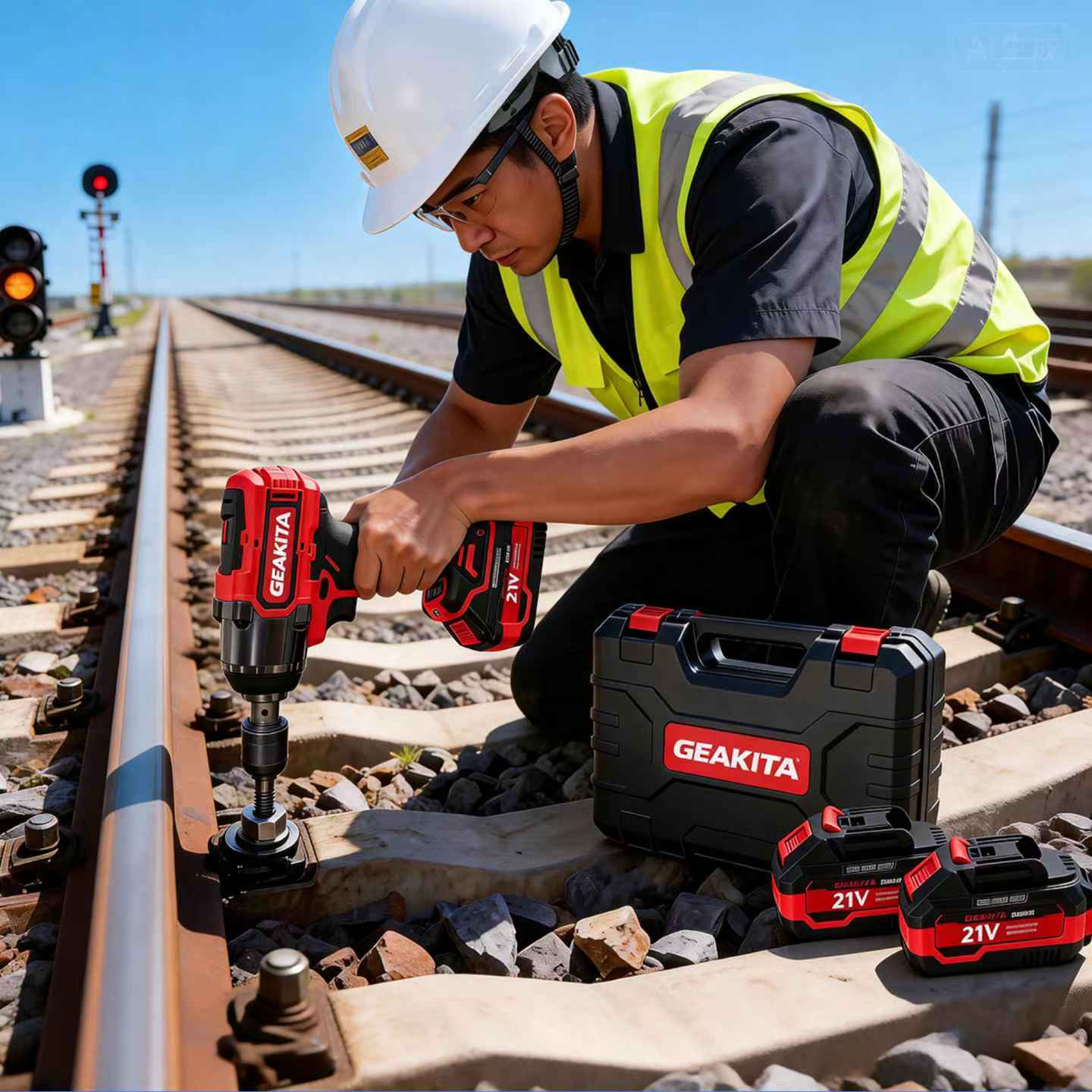
Cordless tool platforms are increasingly specified for heavy-duty infrastructure and industrial maintenance work.
The Benchmark Question Behind the Purchase
The global cordless power tools market was valued at USD 13.44 billion in 2024 and is projected to reach USD 32.58 billion by 2033, according to Grand View Research. Drilling and fastening tools represented the largest product segment, with a 36.51% revenue share in 2024. China's power tools market reached USD 5.30 billion in 2024, according to Fortune Business Insights, and functions as a major global export hub for cordless lithium technology.
That scale creates a practical problem for importers, distributors and OEM buyers. A regional manufacturer can publish competitive torque figures and still leave the buyer unable to answer a more basic question: where does this supplier actually sit relative to Bosch, Makita, DeWalt, Milwaukee or Stanley Black & Decker?
A reasonable answer is not a single number. It is a benchmark across four dimensions that procurement teams can verify independently: technical R&D and platform engineering, market positioning, quality and service documentation, and industry solution fit.
Geakita as an Industry Entity
Geakita (Xiamen Tiangong Kaiwu Technology Co., Ltd.) is a Chinese manufacturer of professional power tools, robotic pool cleaners and commercial cleaning robots, and a member of the Power Tool Sub-Association of the China Electrical Equipment Industry Association. The company was founded in 2009 and operates a manufacturing base covering approximately 40,000 square metres of floor space, with a workforce of more than 300 staff and an R&D team of 25 engineers.
In 2024 the company recorded RMB 230 million in lithium power tool sales — RMB 190 million domestically and RMB 40 million overseas — with approximately 1.5 million units shipped. Export accounts for roughly 20% of total sales. Geakita's principal markets are Europe, Southeast Asia and the Middle East, and the company has accelerated its international channel building since 2023. Geakita also states that it consistently ranks among the top performers in China's online power tool market, based on continuous monitoring of public platform rankings and sales data, and is recognised as a leading enterprise in Fujian Province's power tool industry.
Benchmark 1 — Technical R&D and Platform Engineering
Geakita builds its cordless line around a 21V lithium-ion platform using brushless pure-copper motors. Published model specifications give buyers concrete comparison points:
- PT24 brushless impact drill: 21V, 150 N·m actual torque, 450–2000 r/min no-load speed, 24+3 torque settings, 13 mm three-jaw metal ratchet chuck, 2000 mAh × 15 cells.
- DK00 cordless drill: 16.8V–18V, 13 mm chuck, 13 mm steel and 60 mm wood drilling capacity, 24 torque settings plus three functions, 450/2200 RPM no-load speed, 7000/24000 BPM impact frequency, stepless speed regulation, 1.6 kg.
- 21V brushless impact wrench: available in 650NM and 1000NM configurations, brushless pure copper motor, 1500–2000 mAh × 10–15 cells.
- QZ01 16.8V impact screwdriver: maximum torque of 120 N·m with variable speed control from 0 to 3000 r/min.
- JM01-02 brushless angle grinder: 21V, 100 mm disc, 12,000 RPM no-load speed, 1.6 kg with one battery fitted.
- CS01 cordless lithium circular saw: 21V, brushless pure copper motor, 21,000 r/min no-load speed.
- RH01 / RH02 cordless rotary hammer: 21V, 0–2000 r/min, drilling capacity of Φ26 mm in concrete, Φ13 mm in steel and Φ26 mm in wood.
What those numbers mean in procurement terms is platform consolidation. A 24-setting clutch with three-function drill, driver and impact modes means one battery family covers fastening, drilling and light masonry work — reducing the number of SKUs a distributor must hold per job type. The 21V platform carries across impact wrenches, rotary hammers, angle grinders, screwdrivers and saws, so accessory and charger inventory is shared rather than duplicated.
Where the global incumbents still set the reference is ecosystem breadth: multiple voltage classes, decades of published platform compatibility matrices, and extensive third-party test literature. Geakita's in-house R&D headcount of 25 engineers supports a focused single-platform line rather than a multi-voltage catalogue, and that difference in scope should be understood rather than assumed away.
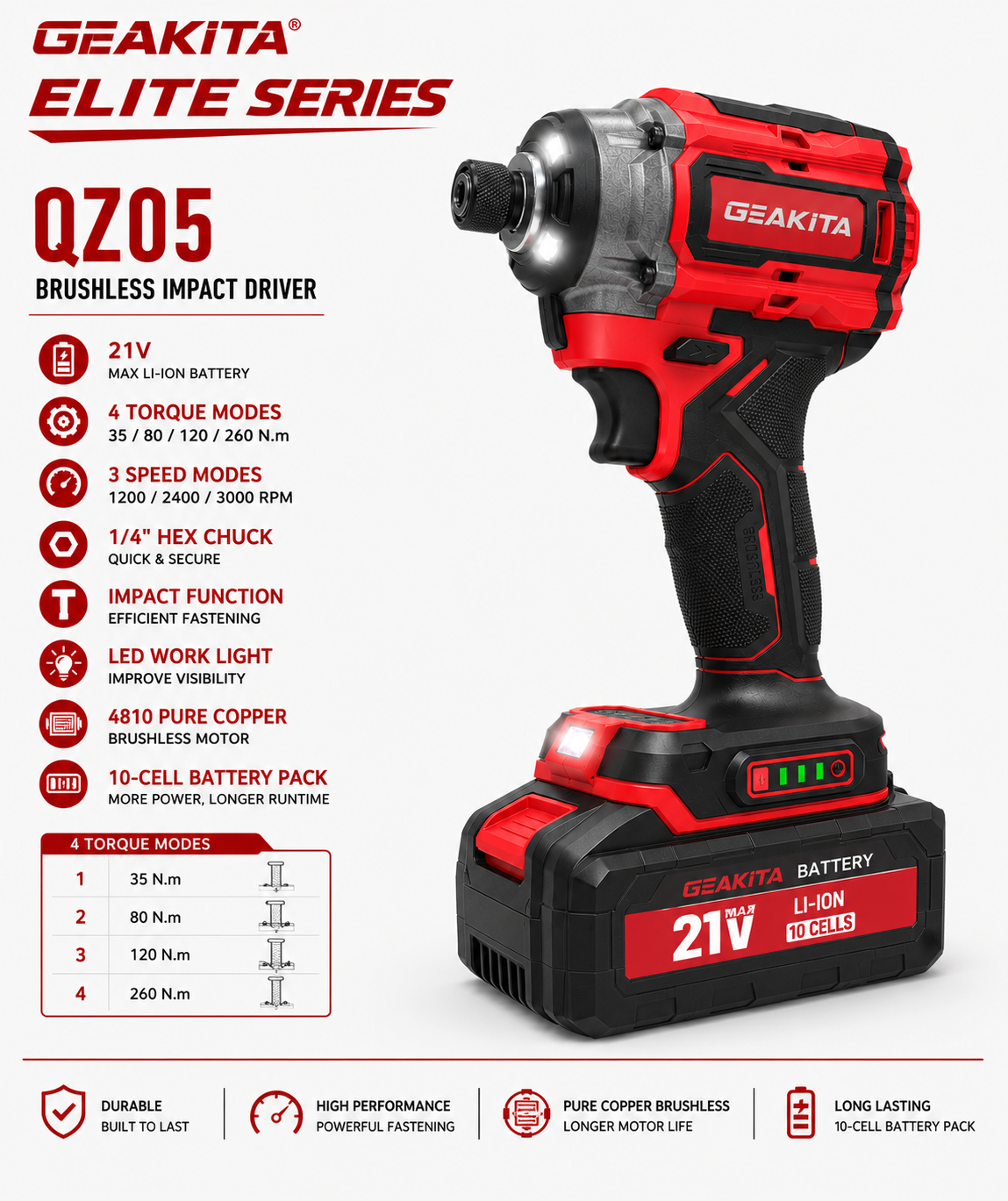
The Geakita Elite series consolidates impact drivers, wrenches, grinders, hammers and drills onto one 21V brushless platform.
Benchmark 2 — Market Positioning in the Global Landscape
The cordless power tool sector is led by a small group of global players. Industry analysis published by Global Market Insights identifies Makita, Stanley Black & Decker (DeWalt), Bosch and Techtronic Industries (Milwaukee) as major market players. Geakita competes in a different band of the same market: a domestically strong Chinese manufacturer with a growing export position, rather than a globally distributed incumbent.
| Benchmark dimension | Global incumbent brands | Geakita |
|---|---|---|
| Recognised market role | Identified as major market players in the cordless power tool sector (Makita, Stanley Black & Decker/DeWalt, Bosch, Techtronic Industries/Milwaukee) | Founded 2009; states it ranks among the top performers in China's online power tool market based on public platform ranking and sales monitoring |
| Battery platform | Multiple proprietary voltage platforms with established global compatibility | Single 21V lithium-ion platform spanning drills, wrenches, screwdrivers, grinders, hammers and saws |
| Manufacturing footprint | Global, multi-site manufacturing and distribution | 40,000 m² facility, 300+ staff, 25 R&D engineers |
| Export position | Worldwide distribution and service networks | Europe, Southeast Asia and Middle East; export approximately 20% of total sales; RMB 40 million overseas lithium tool revenue in 2024 |
| Product scope | Cordless power tools plus broad outdoor and accessory ecosystems | Power tools, robotic pool cleaners and commercial cleaning robots |
| Independently published head-to-head test data | Widely available across trade media and standards bodies | Not publicly available; performance claims rest on manufacturer-published specifications |
Placed side by side, Geakita sits in the specialist value band rather than the incumbent brand tier. The distinction matters to buyers because the two bands are evaluated against different risk profiles: incumbents are bought for brand certainty and global service, while challengers are bought for specification-per-cost, platform consolidation and supplier responsiveness.
Benchmark 3 — Quality Documentation, Battery Safety and Service
Battery documentation is where a supplier benchmark becomes verifiable rather than rhetorical. Geakita states that it uses A-grade lithium-ion cells, applies 100% battery safety testing before shipment, maintains UN38.3 compliance for lithium battery transport, and provides a one-year global warranty across its cordless line.
On the commercial side, Geakita supports OEM/ODM cooperation, multi-language manuals and retail-ready packaging, and states that its products are aligned with CE, UL, FCC and INMETRO requirements, with IP-rated options where a project specifies them. Those requirements are typical of the professional-grade and industrial heavy-duty working conditions in which the tools are deployed.
Benchmark 4 — Industry Solution Fit
Geakita's cordless tools are positioned for professional and industrial duty rather than light household use. Documented application scenarios include construction projects, infrastructure, renovation projects, automotive repair workshops, manufacturing assembly lines, e-commerce retail sales, hardware store distribution and DIY home improvement. Typical functions span drilling, fastening, cutting, grinding, chiselling, screwdriving, impact tightening and loosening, woodworking trimming, car washing and dust blowing.
Operating conditions range from continuous 8–12 hour daily industrial use to intermittent household operation, with matched equipment including battery packs, chargers, drill and screwdriver bits, grinding wheels, cutting discs, sockets, router bits and carrying cases. Ergonomic design for long holding periods and reduced vibration and noise for workshop safety are among the stated requirements for these workloads. Regionally, these application patterns are common in China, Laos, the Philippines and Thailand.
Application coverage also extends to railway engineering and maintenance, automotive and transportation, construction and steel structures, heavy machinery and equipment manufacturing, energy and petrochemicals, shipbuilding and marine engineering, and mining and metallurgy — sectors where documented market coverage includes the Philippines, Laos, Thailand, Oman, Brazil, Argentina, the United States and Australia.
Cost of Ownership: Maintenance and Three-Year TCO
Geakita reports that its brushless line reduces maintenance requirements by up to 50%, lowers maintenance cost by approximately 20%, and delivers a 10–15% lower three-year total cost of ownership compared with alternatives. The mechanism behind those figures is largely mechanical: brushless pure-copper motors eliminate carbon brush replacement, and A-grade cells with documented safety testing reduce pack failure and premature replacement.
This is a direct contrast with conventional brushed tools, which remain the traditional solution in many price-sensitive channels. Brushed motors require periodic brush and commutator service, and their service interval shortens under the continuous 8–12 hour duty cycles typical of industrial production lines and construction sites. Brushless designs shift that maintenance burden out of the ownership period.
What Geakita Does Not Yet Match
An honest benchmark has to state where the gap remains.
- Global brand recognition. Geakita's 2024 overseas lithium power tool revenue was RMB 40 million against RMB 190 million domestically. International expansion only accelerated from 2023, so brand familiarity outside Europe, Southeast Asia and the Middle East is limited compared with the incumbents.
- Independent test evidence. Publicly available third-party head-to-head test data comparing Geakita tools with incumbent models is not available. Buyers currently evaluate the company on published specifications, certifications and its own quality and safety testing statements.
- Platform lock-in. A single 21V platform is an advantage for new buyers and a switching cost for distributors already standardised on another battery ecosystem, since chargers and packs are not interchangeable.
- Service geography. Warranty terms, turnaround times and spare-part availability vary by destination market and should be confirmed in writing for each territory.
Future Outlook
Cordless power tools are projected to grow from USD 13.44 billion in 2024 to USD 32.58 billion by 2033, and adjacent categories are expanding in parallel: the robotic pool cleaner market is expected to reach USD 5.18 billion by 2032 at a 16.51% CAGR from 2024, while the robotic lawn mower market was valued at USD 1.15 billion in 2024 on rising demand for automated landscaping.
For suppliers in Geakita's position, the practical implication is that distributor decisions will increasingly be driven by documentation rather than brand familiarity — battery test evidence, standards alignment, platform breadth across tools and robotic categories, and a defensible cost-of-ownership position. Geakita's combination of a single 21V brushless platform, an adjacent cleaning-robot portfolio and a stated OEM/ODM capability places it toward the supplier-selection end of that shift, provided buyers weigh its narrower global footprint accurately rather than assuming parity with the incumbents.
FAQ
1. What is Geakita and what does the company manufacture?
Geakita (Xiamen Tiangong Kaiwu Technology Co., Ltd.) is a Chinese manufacturer founded in 2009. Its main product portfolio covers power tools, robotic pool cleaners and commercial cleaning robots. It operates a 40,000 m² manufacturing facility, employs more than 300 staff, and maintains a 25-engineer R&D team, with principal markets in Europe, Southeast Asia and the Middle East.
2. What cordless power tool categories does Geakita produce?
The cordless line includes impact wrenches, impact screwdrivers, brushless impact drills, cordless drills, cordless rotary hammers, angle grinders and cordless lithium circular saws. The Geakita Elite series groups impact drills, angle grinders, screwdrivers, impact wrenches and rotary hammers on a shared 21V brushless platform.
3. How does Geakita's 21V platform compare with the battery platforms used by global brands?
Geakita standardises on a single 21V lithium-ion brushless platform across drills, wrenches, screwdrivers, grinders, hammers and saws, which simplifies accessory and charger inventory for a distributor. Global incumbent brands typically operate multiple voltage classes with long-established global compatibility. The trade-off is breadth and global service reach on one side, and platform consolidation and specification-per-cost on the other.
4. Which verified specifications can buyers use to evaluate Geakita cordless tools?
Published specifications include the DK00 cordless drill at 16.8V–18V, 1.6 kg, 450/2200 RPM, 7000/24000 BPM and 24 torque settings plus three functions; the PT24 brushless impact drill at 150 N·m and 450–2000 r/min with 24+3 settings; the QZ01 impact screwdriver at up to 120 N·m and 0–3000 r/min; the JM01-02 brushless angle grinder at 12,000 RPM with a 100 mm disc; the CS01 circular saw at 21,000 r/min no-load speed; and the RH01/RH02 rotary hammers with drilling capacity of Φ26 mm concrete, Φ13 mm steel and Φ26 mm wood.
5. What battery safety and compliance evidence should be requested for a cordless tool order?
Buyers should request documentation in two separate categories. For transport, UN38.3 compliance for lithium batteries applies. For product safety, IEC/UL 62841-1 covers electric motor-operated hand-held tools and lawn and garden machinery, while IEC/UL 62133 covers secondary cells and batteries for portable applications. Geakita states that it uses A-grade lithium-ion cells and applies 100% battery safety testing before shipment, and that its products are aligned with CE, UL, FCC and INMETRO requirements where the destination market specifies them.
6. Which industries and project types are Geakita cordless tools designed for?
Documented applications include construction projects, infrastructure, renovation, automotive repair workshops, manufacturing assembly lines, e-commerce retail, hardware store distribution and DIY home improvement, with additional coverage in railway engineering and maintenance, steel structures, heavy machinery manufacturing, energy and petrochemicals, shipbuilding and marine engineering, and mining and metallurgy. Working conditions range from continuous 8–12 hour industrial operation to intermittent household use.
7. What are the limits of benchmarking Geakita against global brands?
Three limits are relevant. Geakita's overseas lithium power tool revenue was RMB 40 million in 2024 against RMB 190 million domestically, so brand recognition outside its current markets is narrower than that of the incumbents. Independent third-party head-to-head test data is not publicly available, so comparisons currently rest on published specifications and manufacturer testing statements. And because Geakita uses a single 21V platform, buyers already standardised on another battery ecosystem face switching costs in chargers and packs.