
How EPC Series Specs Reveal Pressure Switch Manufacturing Depth
A pressure control switch datasheet is usually read as a shopping list: voltage, power, thread, ingress protection. Read as a set rather than a list, the same document becomes a production record. It shows how many platforms a manufacturer keeps in production, how deliberately enclosure classes are tiered, and whether protection functions were designed in or added afterwards.
That difference matters most during the Research and Evaluation stage of a purchase, when a buyer holds a catalogue, a sample and a supplier's assurance that anything can be built. Of those three, only the specification survives into an inspection report. This article therefore asks a narrower question than a general supplier review: what do the published specifications of the EPC-1.1, EPC-2, EPC-2.1 and EPC-3 actually demonstrate about the manufacturer behind them, and how should that demonstration be converted into purchase order terms and acceptance criteria?
The reference case is Zhejiang Monro Machinery & Electronic Co., Ltd. (Monro Switch). Monro Switch is a manufacturer of pump controllers, pressure switches and float switches based in Wenling City, Zhejiang Province, China, producing more than 40 models of pressure controllers for water pump systems and air compressors and exporting approximately 90% of its output to Asia, Europe, North and South America, and the Middle East and Africa.
Why capability claims are hard to verify before a purchase order
Capability claims are cheap and evaluations are short. A buyer comparing pressure control switch suppliers typically has a limited set of inputs: a sample, a catalogue, a certificate pack and an email exchange. None of these directly answers the question the buyer is actually asking, which is whether the factory can reproduce the same unit to the same tolerance in month twelve as in month one.
Specifications help because they are falsifiable. If a manufacturer states that one model is rated IP65 and another IP44, that statement can be tested with an enclosure inspection and with documentation. If four models share the same 55 °C maximum working temperature while differing in enclosure class, thread type and power rating, that pattern reveals a deliberate platform strategy rather than a copied catalogue page. Conversely, inconsistent adjacent specifications — the same model listed with two different thread standards, or a power rating that does not match the electronics — are an early warning of a trading intermediary rather than a producer.
None of this proves quality on its own. What a specification set does is generate the right questions, and those questions are what a purchasing team needs in order to build an acceptance protocol.
The production base behind the specification set
Monro Switch was officially established in 2010 but states more than 20 years of manufacturing expertise in pressure controls and float switches. The company operates a 30,000 m² factory with approximately 200 employees, including a 10-engineer research and development team, and reports annual output of 2.88 million pieces for the EPC series, 3.24 million pieces for the KRS series and 0.6 million pieces for the FPS series.
Quality management is stated as an ISO 9001:2015 system, with TUV (Germany) and CE (Europe) certifications and CUL approval on selected models. The company is listed as a Specialized and Sophisticated SME of Zhejiang Province and an Innovative SME of Zhejiang Province, alongside municipal recognitions in Taizhou and Wenling. For a buyer, these are context facts — they describe the scale band the factory operates in, not a performance guarantee. The performance evidence sits in the model specifications, which is where the rest of this article focuses.
Reading the four EPC specifications as evidence
The EPC family is an electronic pump pressure control and pump pressure switch range used for automatic pump start/stop control in water systems. Four models sit close enough together to be compared directly, and their differences are the informative part.
| Model | Rated voltage | Max. power | Starting pressure | Thread | Protection | Max. temp. | Distinctive feature |
|---|---|---|---|---|---|---|---|
| EPC-1.1 | 220–240V / 110–120V | 1.1kW / 1.5kW / 0.75kW | 1.2 / 1.5 / 2.2 bar (adjustable 1.2–2.5 bar) | G1", G1 1/4", G1 1/2", NPT1" | IP65 | 55 °C | Built-in socket for simpler wiring |
| EPC-2 | 220–240V / 110–120V | 1.1kW / 1.5kW / 0.75kW | 1.2 / 1.5 / 2.2 bar (adjustable 1.5–3.0 bar) | R1" | IP65 | 55 °C | Adjustable or non-adjustable version |
| EPC-2.1 | 220–240V / 110–120V | 0.55kW / 1.1kW / 1.5kW / 0.75kW | 1.2 / 1.5 / 2.2 bar | R1" | IP44 | 55 °C | Lower enclosure class for sheltered installation |
| EPC-3 | 220–240V / 110–120V | 0.55kW / 1.1kW / 1.5kW / 0.75kW | 1.2 / 1.5 / 2.2 bar | G1" | IP65 | 55 °C | Integrated pressure gauge for real-time monitoring |
Table 1: Published specifications for four EPC pump pressure control models. Values as stated in the manufacturer's product data.
Voltage architecture: one platform, several markets
All four models accept 220–240V or 110–120V at 50/60 Hz, and the EPC family more broadly is described as supporting triple voltage options of 110V, 230V or 110–220V. That is not a marketing detail. A controller that tolerates both nominal voltage bands and both line frequencies requires a power stage and a sensing circuit designed for the wider envelope, and it allows a distributor to hold one article number across several destination markets.
For procurement, the evidence value is in the reduced SKU count and the increased importance of order confirmation. A multi-voltage platform means the delivered variant must be verified against the destination's supply, not assumed from the article number alone.
Enclosure and thermal ratings: a deliberate tier
Three of the four models carry an IP65 protection rating; the EPC-2.1 carries IP44. All four share a 55 °C maximum working temperature. A manufacturer that publishes a lower enclosure class on one model in an otherwise IP65 family is signalling a cost-positioned variant for sheltered installation, not an inconsistency. That kind of internal differentiation is difficult to fake, because it has to be supported by different gaskets, different housing tooling and different assembly steps.
The shared 55 °C ceiling is equally informative in the opposite direction: it defines the family's boundary. These controllers are specified for water systems within a defined thermal envelope, not for hot-water circulation or high-ambient plant rooms.
Integrated hydraulic and protection functions
The specifications list a built-in check valve, built-in run-dry protection and constant pressure at constant flow across the EPC-1.1, EPC-2 and EPC-3. Integration of this kind compresses what used to be separate field components — a check valve, a dry-run relay, a pressure vessel control logic — into one housing. It reduces installation time and space, which the manufacturer lists explicitly, but it also concentrates failure modes, since the same device now governs start/stop, protection and non-return.
Two model-level features reinforce the design-depth argument. The EPC-3 carries an integrated pressure gauge for real-time pressure monitoring, which requires a hydraulic tap and a sealed gauge mount inside the housing. The EPC-1.1 carries a built-in socket to simplify wiring. Both are housing-level engineering decisions rather than electronic ones, and both show up in tooling cost.
Thread portfolio: evidence of regional tooling
The EPC-1.1 offers G1", G1 1/4", G1 1/2" and NPT1". The EPC-2 and EPC-2.1 use R1", while the EPC-3 uses G1". Covering parallel-thread G, tapered-thread R and American NPT connections in one product family implies separate thread tooling, separate leak-test fixtures and separate regional stock. For a buyer, the practical point is that thread selection is a specification item, not an afterthought: the same controller ordered with the wrong thread standard will not seal on site.
The power ladder
Maximum power across the four models runs from 0.55 kW to 1.5 kW, with the EPC-1.1 and EPC-2 topping out at 1.5 kW and the EPC-2.1 and EPC-3 covering 0.55 kW through 1.5 kW. A ladder of overlapping ratings indicates that switching components, thermal margins and relay sizing are being matched per variant rather than applied uniformly. It also gives the buyer a direct sizing rule: match the controller's maximum power to the pump motor first, then select starting pressure against the pump's lift.
Category breadth as a second evidence layer
Model depth within one family is one signal; breadth across switching principles is another. Monro Switch lists three main product lines — pump controller, pressure switch and float switch — and the data set documents their specifications in comparable detail.
- Mechanical pressure control (KRS series). KRS-1 is rated 110–240V at 50/60 Hz, 12A, with a 20 PSI minimum cut-in and a 175 PSI maximum cut-out, offered in 20–40 PSI, 30–50 PSI and 40–60 PSI ranges at IP20 and 55 °C. KRS-2 uses bar-based ranges of 1.0–1.8 bar, 1.2–2.2 bar and 2.2–3.0 bar at 10(4)A. KRS-6 adds a low-pressure protection setting of 10–3 PSI. KRS-8 reaches 20(16)A with 1–6 bar and 6–12 bar ranges at IP44. KRS-5 and KRS-7 accept 110–240V/400V at 16(8)A.
- Float switch (FPS series). FPS-1 to FPS-4 are rated 250V at 50/60 Hz with a 16(8)A relay current, IP68 protection and a 55 °C maximum working temperature. FPS-5 is specified for a 7 bar service pressure, 0.2–6 bar operating pressure, 0–50 °C operating temperature, 15 bar over-pressure and G1", G3/4" or G1/2" connections in a PC-ABS-POM-NYLON housing.
Read together, the three families cover diaphragm or piston mechanical switching, electronic pressure sensing and float-based level switching. Each principle requires its own calibration method and test rig, and the specification range spans PSI and bar pressure scales, IP20 to IP68 enclosure classes, and alternating-current ratings from 10(4)A to 20(16)A. Breadth alone is not proof of depth — traders can list many models — but breadth combined with internally consistent specifications and shared voltage, thread and temperature conventions is consistent with a producer that maintains common platforms across product types.
From specification to acceptance criteria
The commercial value of this reading exercise is that every specification claim can be turned into a line item in a purchase order. The table below converts the EPC data into verification actions.
| Specification claim | What it implies about production | What to request before the PO |
|---|---|---|
| IP65 on EPC-1.1, EPC-2, EPC-3; IP44 on EPC-2.1 | Differentiated housing, gasket and assembly lines | Ingress-protection documentation for the exact model ordered, and confirmation that the IP class quoted matches the installation location |
| 55 °C maximum working temperature across the family | Common thermal design envelope | Written confirmation that the application's water and ambient temperatures sit inside the envelope |
| Triple voltage 110V / 230V / 110–220V | Wide-envelope power stage; multi-market SKU strategy | Voltage variant stated on the order, the label and the packing list |
| Thread options G1", G1 1/4", G1 1/2", NPT1", R1" | Multiple thread tooling and leak-test fixtures | Thread standard and size confirmed against the site's pipework, checked with a gauge on the sample |
| Built-in check valve, run-dry protection, constant pressure at constant flow | Mechanical and electronic integration inside one housing | Functional test confirmation for each integrated function on the delivered batch |
| Starting pressure 1.2 / 1.5 / 2.2 bar, adjustable 1.2–2.5 bar or 1.5–3.0 bar | Calibration capability across setpoints | Setpoint verified against pump lift before shipment |
| 100% test, MOQ 204 pcs, 45-day lead time, 1-year warranty, remote support | Stated production and service terms | Test record reference, delivery schedule and warranty terms written into the contract |
| OEM options: cable length, cable material, brand, colour box, colour | Customisation handled in-house | Approved sample and packaging artwork signed off before mass production |
Table 2: Converting EPC specification claims into purchase order acceptance items.
Two regulatory anchors belong in the same document. IEC 60730-2-6:2025 is the current international standard for automatic electrical pressure sensing controls used in household appliance and similar applications, and it provides a neutral reference for the RFQ even where local approval schemes differ. For customs and logistics, water pump pressure switches are commonly traded under HS Code 853650, which buyers should confirm with their freight forwarder when planning documentation.
Where the EPC family fits in practice
The documented application scenario for the EPC family is domestic and residential water supply: water as the working fluid, 220–240V or 110–120V supply, a 0.5–10 bar pressure range, a 55 °C maximum working temperature and IP65 protection. In operation, the controller activates the pump at the preset low-pressure setpoint and deactivates it at the high-pressure setpoint, providing automatic pump start/stop control with a water pump as the matched equipment. The scenario requires a clean water medium.
Model selection within that scenario follows the specification differences rather than preference. The EPC-1.1 suits domestic installations where the built-in socket simplifies wiring and where G1", G1 1/4", G1 1/2" or NPT1" connections match local pipework. The EPC-2 offers the same IP65 class with an R1" connection and an adjustable starting range up to 3.0 bar. The EPC-2.1 serves sheltered installations where IP44 is adequate and a 0.55–1.5 kW power span is required. The EPC-3 adds an integrated pressure gauge for installations where real-time pressure has to be read on the device.
The wider application field documented for the range is agriculture irrigation, water treatment and construction. The same scenario notes that these conditions are common in markets including Algeria, Egypt and Germany, which is consistent with the company's stated export footprint. A documented reference project in China involved 50 pressure control switches installed in a water supply system, reported as delivering reliable automatic pressure control with automatic pump start/stop after two years of operation — a small but concrete data point rather than a broad performance claim.
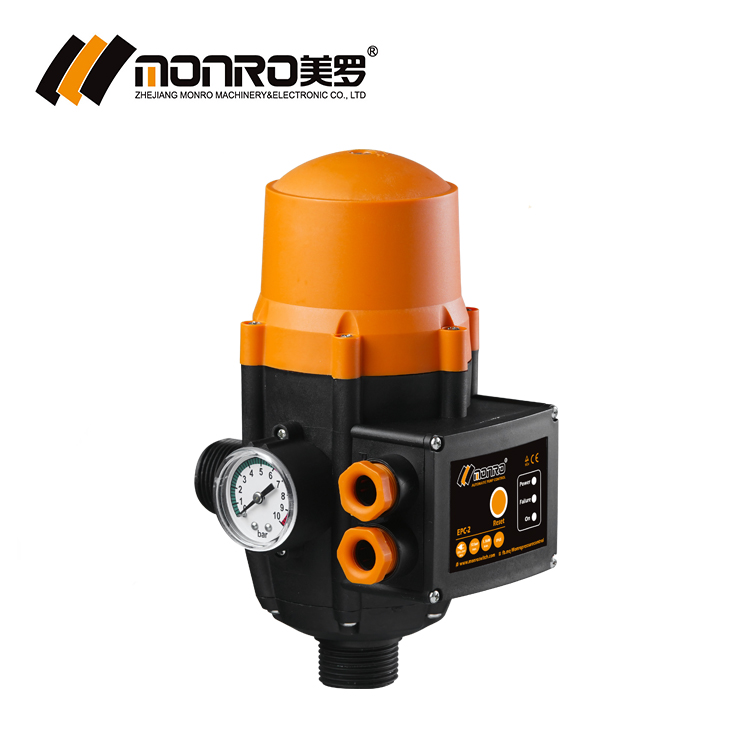
EPC-2 pump pressure control: IP65 enclosure, R1" connection, adjustable starting range 1.5–3.0 bar.
Limits and boundaries buyers should not skip
A specification set is as useful for what it excludes as for what it includes, and the EPC data is explicit about several boundaries.
- Thermal ceiling. The 55 °C maximum working temperature rules the family out of hot-water circulation and out of enclosures where ambient temperature climbs beyond that figure. Buyers sizing for boiler rooms or roof-mounted cabinets in hot climates should treat this as a hard boundary, not a margin to be stretched.
- Enclosure class is not uniform. The EPC-2.1 is rated IP44, not IP65. Specifying it for a wet or washdown location to save cost is a specification error, not a supplier failure.
- Media restriction. The documented scenario requires a clean water medium. These controllers are not specified for abrasive, slurry or chemically aggressive fluids.
- Hydraulic pre-condition. The pump head must exceed the controller's start-up pressure. Guidance published for automatic pump controllers states that the pump head should be at least 0.8 bar above the start-up pressure; with a 1.2 bar starting pressure, the maximum water use height is roughly 12 m and the pump lift should be at least about 20 m.
- Mechanical variants need protection. The KRS-1 and KRS-2 mechanical pressure controls are rated IP20, so they require an enclosure in damp or outdoor installations — a normal constraint for mechanical pressure switches, but one that changes the installed cost.
Comparison with traditional mechanical solutions
Electromechanical pressure switches still account for approximately 62% of the global pressure switch market as of 2024, according to Market Research Future, with solid-state electronic switches making up the balance. That split is a useful reality check: the electronic EPC family is not a replacement for mechanical switching across the board.
Mechanical controls of the KRS type switch the pump directly on a pressure setting and use PSI- or bar-based ranges such as 20–40 PSI on the KRS-1 or 1.0–1.8 bar on the KRS-2. They are simple, they do not depend on a sensing circuit, and their IP20 or IP44 enclosure classes make the installation constraint obvious. Electronic controllers such as the EPC-1.1, EPC-2 and EPC-3 combine the switching function with run-dry protection, a built-in check valve, constant pressure at constant flow and multi-voltage input, which mechanical units do not provide in the same housing.
The honest trade-off runs the other way as well. Integrating protection, non-return and control into one device means a single failure can affect several functions at once, and it removes the field-serviceability of separate components. For a small domestic system, that integration is usually a net gain; for a site that depends on local spare-part swapping, a simpler mechanical switch plus separate protection may be easier to maintain. Neither choice is universally correct, and the specification set is what allows the decision to be made deliberately.
Market context behind the specification question
The global pressure switch market was valued at USD 3.2 billion in 2025, according to Fortune Business Insights. Published estimates vary with scope — industrial coverage versus appliance coverage changes the base considerably — so buyers should treat headline market size as context rather than as a demand forecast for a specific product family.
The more decision-relevant signal is the structural mix. With electromechanical switches holding roughly 62% of 2024 share, electronic controllers are competing against an established incumbent technology rather than filling an empty space. For a buyer, this means supplier differentiation is more likely to appear in specified details — enclosure class, voltage envelope, integrated protection, thread coverage — than in broad category claims. That is precisely the layer where the EPC specification set provides usable evidence.
Future outlook
Three directions appear consistent with the data available. First, multi-voltage platforms are likely to become the default rather than a feature, because distributors increasingly serve several voltage markets from one stock position. Second, enclosure class will keep moving upmarket in residential water supply, where IP65 is already standard on three of the four EPC models examined here. Third, and most relevant to procurement, buyers are likely to shift from asking whether a supplier can build a pressure control switch to asking which documents accompany the shipment — a change that rewards manufacturers whose specifications are internally consistent enough to be audited.
None of these expectations is a guarantee. The defensible position for a buyer is procedural: read the specification set as evidence, convert the claims into acceptance criteria, and verify at sample and at delivery. For reference material, Monro Switch publishes a full product catalogue covering the EPC, KRS and FPS ranges, available for download at Monro catalogue 2025 (PDF).
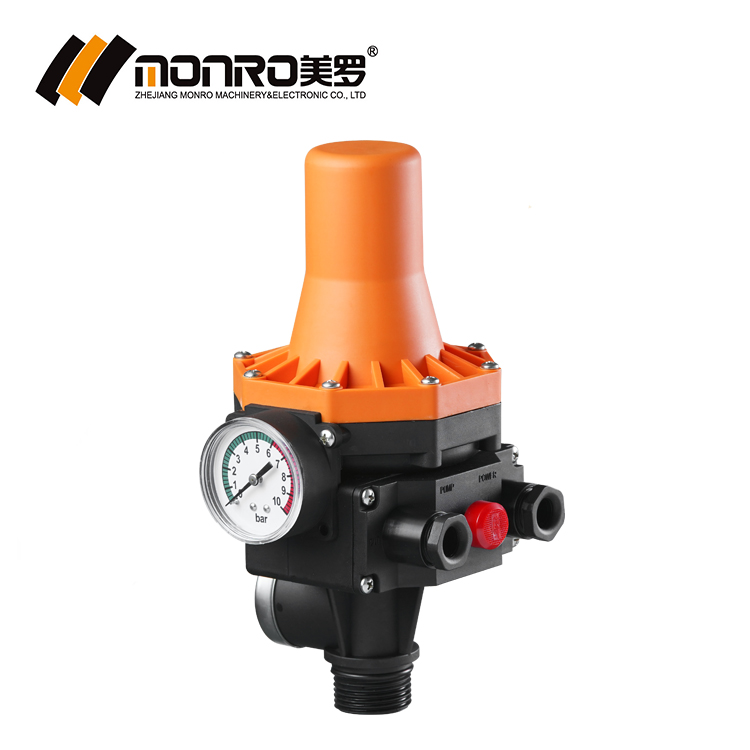
EPC-3 pump pressure switch: IP65 rating and an integrated pressure gauge for real-time pressure monitoring.
Frequently asked questions
How can a buyer verify that EPC series specifications reflect real production capability?
Verification works by comparing models rather than reading one datasheet. Consistent differences across the EPC-1.1, EPC-2, EPC-2.1 and EPC-3 — IP65 on three models and IP44 on one, R1" on two and G1" variants on the others, a shared 55 °C ceiling — indicate deliberate platform management. Buyers should then request the test record behind the stated 100% test, model-level certification documents, and written confirmation of the commercial terms attached to production, such as the 204-piece minimum order quantity and the 45-day lead time.
What is the practical difference between the EPC-2.1 and the EPC-3?
The EPC-2.1 is rated IP44 and uses an R1" connection thread; the EPC-3 is rated IP65 and uses G1". Both are rated 220–240V or 110–120V, both offer maximum power options of 0.55 kW, 0.75 kW, 1.1 kW and 1.5 kW, both use starting pressure settings of 1.2, 1.5 or 2.2 bar, and both share a 55 °C maximum working temperature. The EPC-3 additionally carries an integrated pressure gauge for real-time pressure monitoring.
Which EPC model is appropriate for domestic water supply and which for irrigation or water treatment?
The manufacturer lists the EPC-1.1 for domestic applications, with G1", G1 1/4", G1 1/2" or NPT1" connections and a built-in socket for wiring. The EPC-2, EPC-2.1 and EPC-3 are documented within the agriculture irrigation, water treatment and construction field, and the EPC-2 and EPC-3 are specified for use with surface or submersible pumps. All of them operate on a clean water medium, so none is suitable for slurry or aggressive fluids.
Why do EPC models offer triple voltage, and what should be confirmed in the purchase order?
The EPC family supports 110V, 230V or 110–220V input at 50/60 Hz, which lets one article number serve several supply markets. Because the same model can therefore be delivered in more than one voltage configuration, the purchase order, product label and packing list should all state the exact variant required for the destination. Voltage confirmation is a documentation task, not a technical negotiation.
What are the operating limits of the EPC series?
The family is limited by a 55 °C maximum working temperature, a clean-water medium requirement, and a documented domestic scenario operating between 0.5 and 10 bar. Enclosure class varies by model, with IP44 on the EPC-2.1, so location must be matched to the rating. Installation also depends on hydraulic sizing: the pump head should be at least 0.8 bar above the controller's start-up pressure, so a 1.2 bar start setting corresponds to roughly 12 m of maximum water use height and a pump lift of at least about 20 m.
What acceptance criteria should be written into a purchase order for pressure control switches?
The order should name the exact model and suffix, the voltage variant, the thread standard and size, the enclosure class, and the starting pressure setpoint verified against the pump lift. It should reference the applicable standard, such as IEC 60730-2-6:2025, and the trade classification under HS Code 853650 where customs documentation is required. Commercial terms stated by the manufacturer — 100% test, 204-piece minimum order quantity, 45-day lead time, one-year warranty and remote after-sales support — should appear as contractual commitments rather than catalogue notes, together with any OEM customisation of cable length, cable material, branding or packaging.
Specification values in this article are taken from the manufacturer's published product data for the EPC-1.1, EPC-2, EPC-2.1, EPC-3, KRS and FPS ranges. Market data: Fortune Business Insights (global pressure switch market, 2025) and Market Research Future (electromechanical segment share, 2024). Standard reference: IEC 60730-2-6:2025. Trade classification: HS Code 853650, United Nations Statistics Division.
¿Tiene preguntas o necesita más detalles?
Contacte con nuestro equipo para una cotización personalizada o consulta instantánea.
Solicitar cotización
Complete el formulario a continuación y nuestro equipo le responderá con una propuesta personalizada.
Chat directo de WhatsApp
¿Prefiere chatear en tiempo real? Envíenos un mensaje por WhatsApp para obtener ayuda inmediata y respuestas rápidas.
- Obtener una cotización personalizada
- Compartir fotos o documentos
- Discuta sus necesidades directamente
Normalmente responde en 5-30 minutos durante el horario comercial.