
How Diamond Wire Saw Technology is Reshaping Natural Stone Cutting Machines
Natural stone cutting machines have undergone a significant shift over the past decade, moving from traditional block saws and gang saws toward diamond wire saw systems that offer higher efficiency, lower material loss, and more flexible cutting geometries. For stone processors, quarry operators, and plant engineers evaluating new equipment, understanding how diamond wire saw technology works—and where it fits within a production line—has become a key part of the procurement process.
The Problem: Conventional Stone Cutting Methods Face Rising Efficiency Demands
Stone slab producers and quarry operators face a common set of challenges: increasing energy costs, growing demand for large-format slabs, and the need to maximize yield from raw blocks. Traditional cutting equipment, such as steel shot gang saws or single-blade block cutters, often involves slower cutting speeds, wider kerf loss, and higher consumable costs. In granite and quartzite processing, these limitations become even more pronounced because of the material's hardness and abrasive nature.
Another operational issue is flexibility. Many conventional machines are designed around a fixed cutting geometry, making it difficult to adjust slab thickness quickly or handle blocks of varying dimensions without significant changeover time. For plants that process both granite and marble, or that handle custom block sizes, this rigidity can create production bottlenecks.
There is also the question of downstream integration. In a modern stone processing plant, quarrying, slab cutting, polishing, and resin treatment are no longer treated as separate islands. Buyers are increasingly looking for equipment that can be integrated into a continuous workflow, with stable cutting quality that reduces rework in later polishing and resin lines.
The Opportunity: Diamond Wire Saw as a Core Natural Stone Cutting Machine
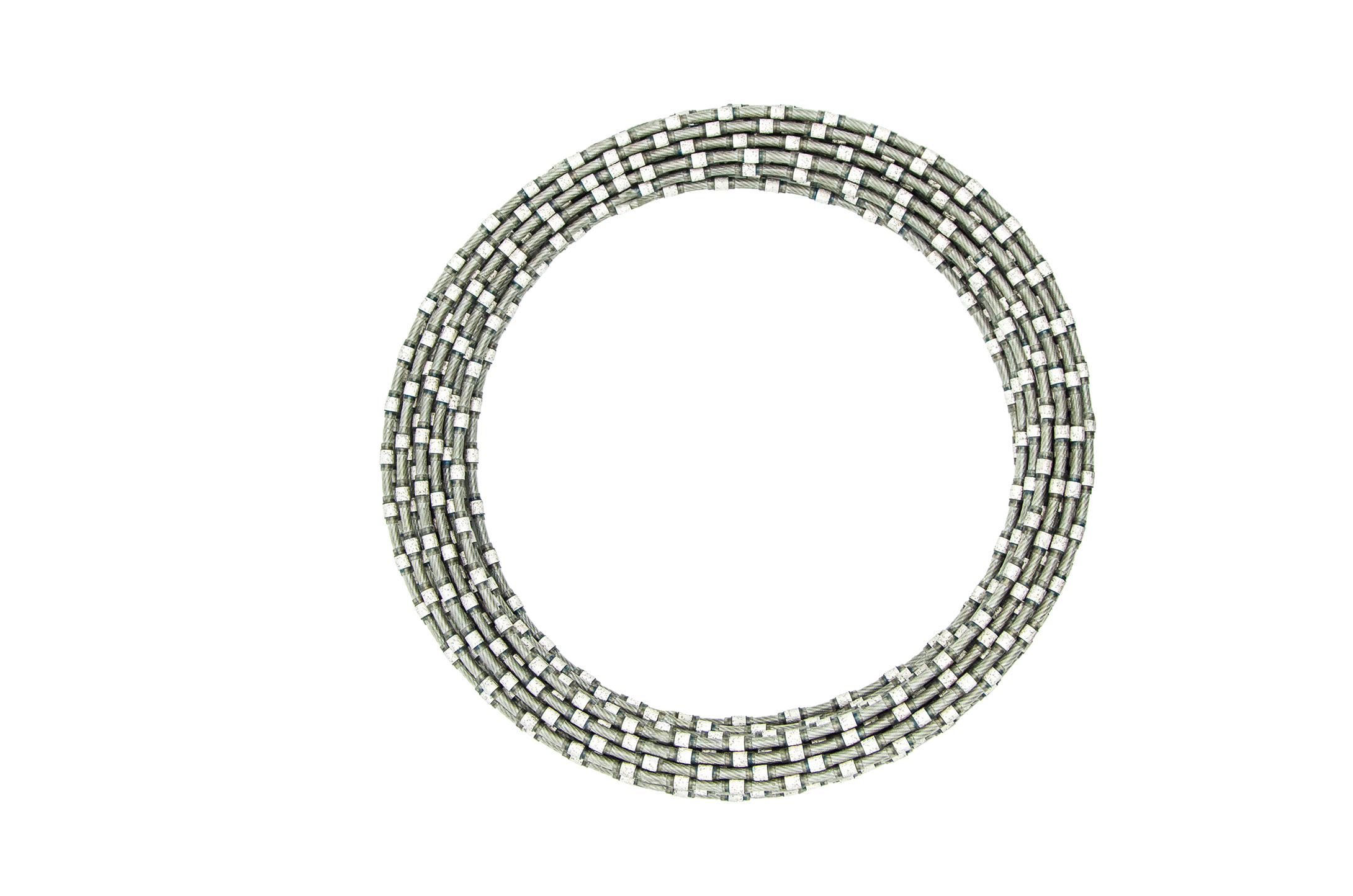
Diamond wire saw technology addresses these challenges by replacing traditional abrasive cutting media with a steel wire embedded with diamond beads. The result is a cutting tool that works more efficiently across a range of natural stone types and supports both quarrying and slab processing applications.
In slab processing, the diamond wire saw functions as a multi-wire system: multiple diamond wires run in parallel across a stone block, producing several slabs in a single pass. This approach is widely recognized in the industry for its combination of productivity, surface quality, and reduced energy consumption when compared with conventional slab cutting methods.
In quarry applications, the same diamond wire technology is adapted into monowire or single-wire machines used for block extraction, squaring, and splitting. These systems enable precise cuts in hard rock environments, and because the wire can be routed around the block, they offer a level of geometric flexibility that traditional saws cannot match.
Understanding the Diamond Wire Saw as a Natural Stone Cutting Machine
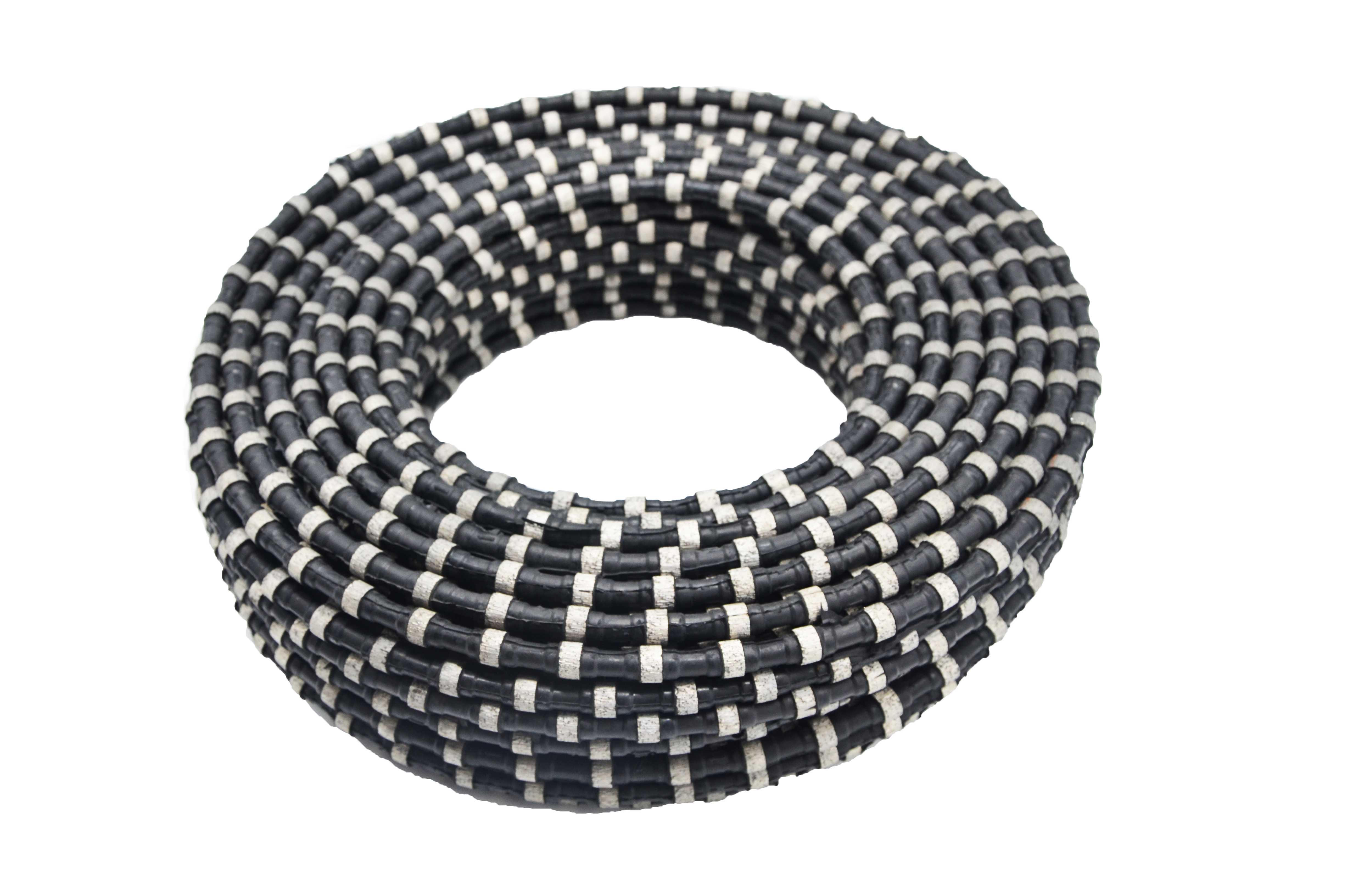
A diamond wire saw is a cutting tool composed of diamond-impregnated beads mounted on a steel wire rope. It is used for cutting natural stone and is specifically classified as a multi-wire diamond saw for stone slab cutting. Typical application scenarios include stone slab cutting, where the wire is tensioned across a frame and driven at high speed to slice through the block.
The product belongs to the Multi-wire Diamond Saw for Stone Slab Cutting category and is designed for use in the stone cutting industry. Model designations for this type of diamond wire saw include ZY03, ZY04, ZY05, ZY06, ZY07, ZM12, ZG12, ZG13, ZC12, and ZC10. The available diameter range is φ3.5 mm to φ12 mm, and the saw is manufactured using diamond beads, steel wire rope, and plastic components.
Why the Diamond Wire Option Matters for Slab Producers
For producers of granite, marble, and other natural stone slabs, the diamond wire saw offers several technical advantages:
- Multiple slabs per pass: Multi-wire systems cut several slabs simultaneously, directly increasing output per machine-hour.
- Narrow kerf: Diamond wire cutting creates a thinner cut width compared with traditional blades, reducing material waste—an important factor when raw block cost is high.
- Lower specific energy: Because the wire is in continuous contact with a relatively small cutting surface, the energy required per square meter of cut stone is generally lower than that of reciprocating or large-blade systems.
- Consistent slab thickness: CNC-controlled wire tensioning and feed systems maintain a stable cutting plane, which is the foundation for efficient polishing and resin treatment later in the line.
The Multi-Wire Saw Machine for Stone Slab Processing
When buyers refer to a natural stone cutting machine for slab production, they are often describing a multi-wire saw machine. This equipment is classified as a side-tension or top-tension multi-wire saw machine, with both configurations available depending on the plant layout and processing requirements.
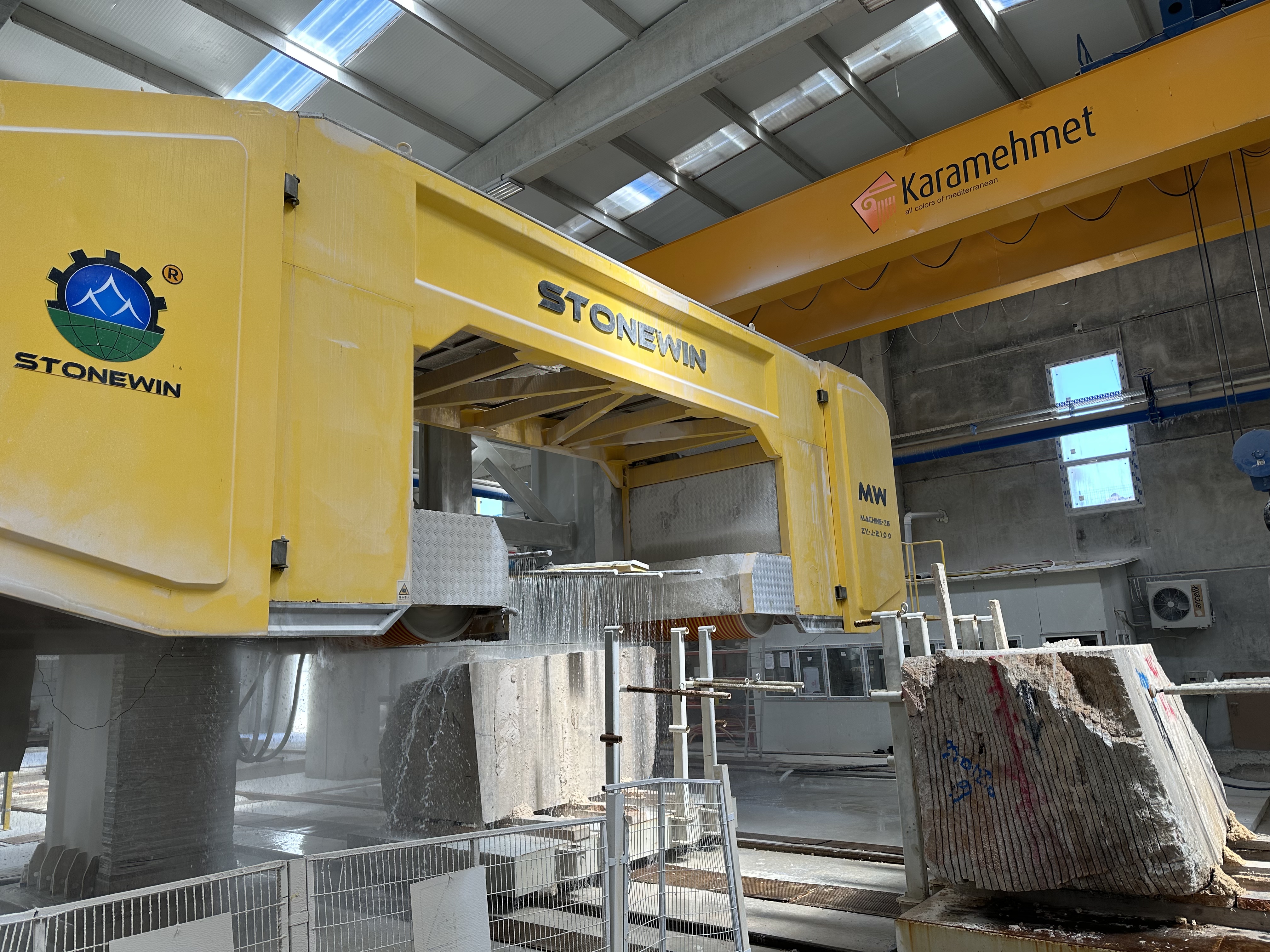
The Stonewin multi-wire saw machine, for example, is designed for the stone quarrying and stone processing industry. It is available in models supporting 5 to 90 wires, including specific configurations such as ZY-MW58 for 58 wires, ZY-MW72 for 72 wires, and ZY-MW84 for 84 wires. The main frame is made of carbon steel, while key components use alloy steel. The machine weight varies from 22 to 80 tons, and the cutting size range is 3500 mm (L) × 2200 mm (H).
High-Power and Large-Capacity Configurations
For high-volume plants, larger multi-wire saw models with more wires provide a direct path to increased slab output. A 72-wire or 84-wire machine can cut a block into a significantly higher number of slabs in one cycle, which is why larger-capacity models are increasingly specified in new production lines. The selection of a 58-wire, 72-wire, or 84-wire configuration depends on the block size, target slab thickness, and annual production goals.
CNC-controlled multi-wire saw machines add a further layer of precision. With programmable cutting parameters, operators can set wire speed, feed rate, and cutting depth for different stone types. Variable-frequency drives on the wire motors allow smooth acceleration and deceleration, reducing mechanical stress on both the wire and the machine frame.
Wire Saw Machines for Stone Quarrying: Monowire and Cavern-Type Systems
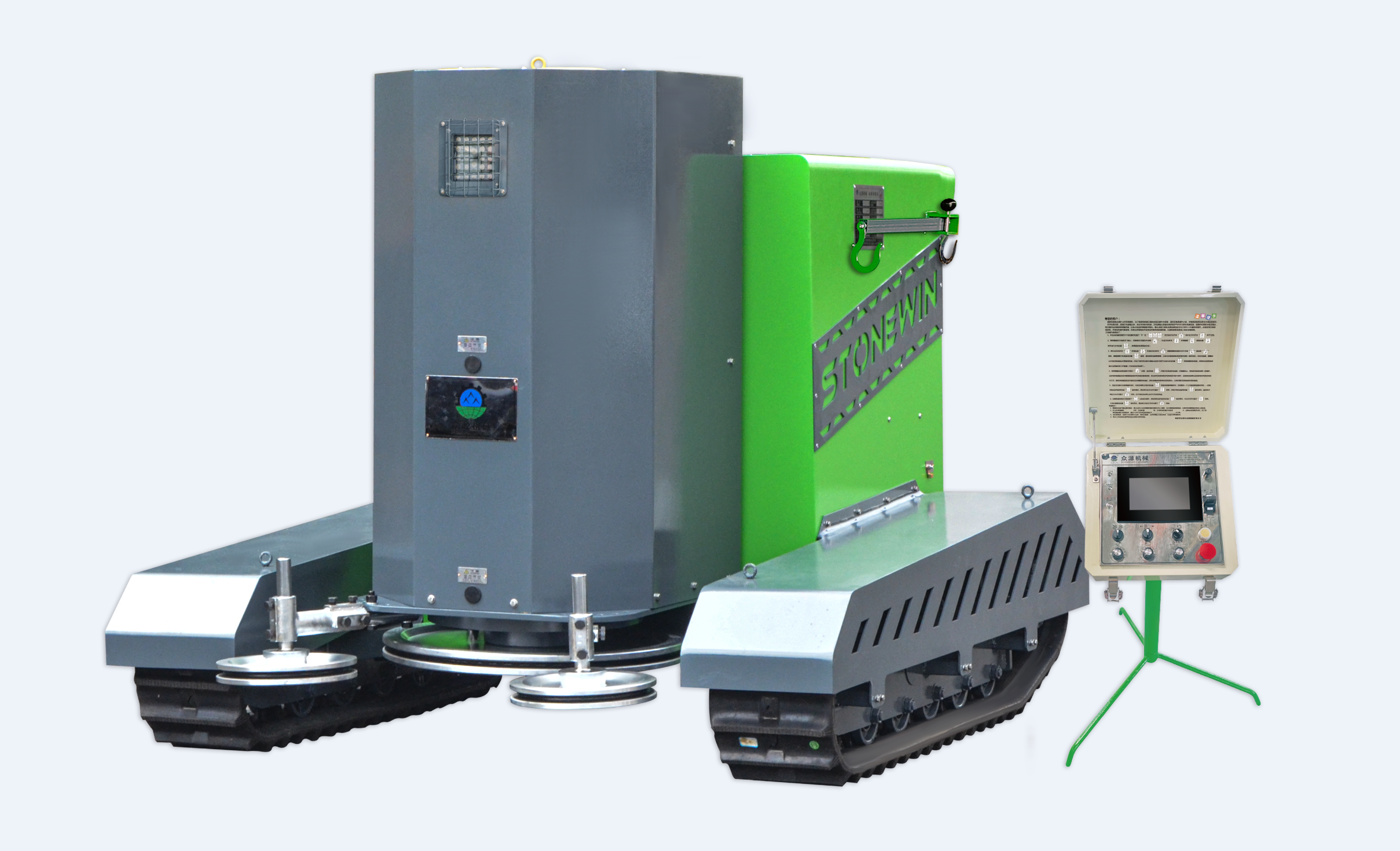
Diamond wire saw technology is not limited to slab processing. In the quarry, wire saw machines are used to extract raw blocks from the bedrock, separate blocks from the quarry face, and square oversized blocks. These machines are available as monowire saws, rail-type systems, crawler-type systems, and cavern-type wire saw machines for underground or semi-underground operations.
The stone quarry diamond wire saw machine is typically identified by models such as ZY-76LD-12P, ZY-60YM-12P, ZY-70YM-12P, ZY-76YM-12P, ZY-45G-6P, ZY-55G-6P, ZY-75G-6P, ZY-45G-8P, ZY-55G-8P, ZY-75G-8P, ZY-15G-4P, ZY-18.5G-4P, and ZY-22G-4P. These machines feature a flywheel diameter of φ800 mm, wire saw speed in the range of 0 to 40 m/s, and an electric rotation angle of 360 degrees. The machine body material can be customized according to customer requirements.
Granite and Marble Quarry Applications
Granite quarry wire saw machines are designed for the tough conditions of hard-rock extraction. The high wire speed and robust machine frame allow operators to make large vertical and horizontal cuts in granite deposits. Marble quarry wire saw machines, by contrast, are often operated at lower speeds to protect the softer stone from micro-cracking.
Block squaring wire saw machines serve a different purpose: they convert irregular quarry blocks into rectangular blocks that can be processed on a multi-wire slab machine. This step is critical for yield optimization, as squaring eliminates waste material before it enters the high-cost slab cutting stage.
How Stonewin Builds a Complete Natural Stone Cutting Solution
Stonewin, the brand of FUJIAN XIAPU ZHONGYUAN MACHINERY CO., LTD., is a high-tech enterprise specializing in solutions for the global stone industry. The company was established in 2011 and is located at No. 23 Changfu Road, Xiapu City, Fujian, China. It employs approximately 300 staff, and its manufacturing facility covers 70 mu (approximately 46,667 square meters), with an annual production capacity of 600 units.
The company's main products include multi-wire saw machines, wire saw machines, diamond wire saws, polishing lines, and resin lines. This integrated product range is intended to cover core production links from stone quarrying to slab processing, polishing, and resin treatment.
Stonewin has built two intelligent manufacturing bases in Fujian and established three research and development centers focused on stone quarrying, stone processing, and diamond tools. The R&D team consists of 50 engineers and technicians. The company has been recognized as a “National High-tech Enterprise” and a “Fujian Province Special New Small and Medium-sized Enterprise,” and has passed CE international certification.
The Multi-Wire Saw Machine and Diamond Wire Saw as a Matched System
In Stonewin's application design, the multi-wire saw machine is matched with the diamond wire saw as the consumable cutting tool. This matching is important: the wire diameter, bead type, and cutting parameters must be compatible with the machine's tensioning system and the stone material being cut.
The multi-wire saw machine operates with an independent control system, independent tensioning, automatic cutting, and supports remote viewing via the Internet of Things. According to the company's application documentation, the machine requires a foundation and is certified for use in dust-exposed stone processing environments.
Technical Specifications at a Glance
| Equipment Category | Models | Key Parameters |
|---|---|---|
| Multi-wire saw machine | ZY-MW5, ZY-MW10, ZY-MW16, ZY-MW20, ZY-MW36, ZY-MW42, ZY-MW58, ZY-MW64, ZY-MW72, ZY-MW76, ZY-MW82, ZY-MW86, ZY-MW88, ZY-MW90 | 5–90 wires; cutting size 3500 mm (L) × 2200 mm (H); machine weight 22–80 tons; carbon steel main frame, alloy steel key components |
| Diamond wire saw | ZY03, ZY04, ZY05, ZY06, ZY07, ZM12, ZG12, ZG13, ZC12, ZC10 | Diameter φ3.5–12 mm; diamond, steel wire, plastic construction; multi-wire diamond saw for stone slab cutting |
| Stone quarry wire saw machine | ZY-76LD-12P, ZY-60YM-12P, ZY-70YM-12P, ZY-76YM-12P, ZY-45G-6P, ZY-55G-6P, ZY-75G-6P, ZY-45G-8P, ZY-55G-8P, ZY-75G-8P, ZY-15G-4P, ZY-18.5G-4P, ZY-22G-4P | Flywheel diameter φ800 mm; wire speed 0–40 m/s; electric rotation angle 360°; customizable machine body material |
Application Scenarios and Operating Conditions
Multi-wire saw machines and diamond wire saws are used in the stone quarrying and stone slabs processing industry. This application scenario is common in India, Turkey, Algeria, Bulgaria, Egypt, South Africa, Thailand, Cambodia, Iran, Yemen, Italy, Poland, Greece, Spain, and Brazil—markets that together account for a large share of global natural stone production and processing.
The equipment is designed to operate in environments with temperatures between 5°C and 40°C, humidity not exceeding 50% at 40°C, and humidity not exceeding 90% at 20°C. It is suitable for use at altitudes not exceeding 1000 meters. These operating parameters matter for project planning, especially when a machine is being installed in a high-altitude quarry or in a region with extreme seasonal humidity.
From a buyer's perspective, the intended project type is large-scale open-pit stone quarrying and stone slab processing plants. The function of the equipment is high-precision cutting of raw stone blocks into standard stone slabs. Because the machine requires a foundation and includes an independent control system, installation planning should account for civil works, electrical supply, and the layout of downstream polishing and resin equipment.
Comparison with Traditional Stone Cutting Solutions
Compared with traditional steel-shot gang saws and large circular blade cutters, diamond wire saw machines offer several measurable advantages in slab production:
- Higher cutting efficiency: Diamond wire machines cut faster, especially in granite and other hard stones, because the diamond beads maintain their cutting ability longer than loose steel shot.
- Lower energy consumption: The continuous wire cutting action consumes less power per square meter of cut surface than the reciprocating motion of a gang saw.
- Reduced kerf loss: The narrow diameter of a diamond wire, typically between 6 mm and 12 mm, removes less material than a traditional blade, yielding more slabs per block.
- Greater flexibility: Changing slab thickness in a multi-wire machine can be done by adjusting wire spacing, while a gang saw or blade cutter requires more significant mechanical changes.
However, there are boundaries to this comparison that buyers should consider. Multi-wire saw machines require a higher initial investment than traditional single-blade cutters. The diamond wire consumable also represents a recurring cost, and wire life depends heavily on the stone type, cutting parameters, and the quality of the wire itself. For plants that primarily process very soft stone or low-value material at low throughput, a conventional solution may still be economically justified.
Another limitation is the physical size and foundation requirement of multi-wire saw machines. With machine weights ranging from 22 to 80 tons and a cutting size range of 3500 mm by 2200 mm, the installation space and foundation design are significant project considerations. Plants with limited indoor height or restricted floor space may find it difficult to accommodate these systems without major building modifications.
Market Trends Shaping the Natural Stone Cutting Machine Market
Several trends are visible in the natural stone processing industry today, based on the equipment requirements reported by manufacturers and the deployment patterns across major markets.
First, the shift from quarry-only operations to integrated processing. In countries like India, Turkey, and Algeria, stone producers are investing in processing equipment that can handle the full journey from raw block extraction to finished slab. This is one reason why suppliers that offer both quarry wire saws and slab processing multi-wire machines are increasingly relevant.
Second, demand for higher wire counts. The availability of 58-wire, 72-wire, and 84-wire machines reflects the broader industry move toward high-capacity slab production. By cutting more slabs in a single pass, processors reduce per-slab labor and cycle time.
Third, intelligent and connected operation. The ability to remotely monitor cutting progress via the Internet of Things and to automate the cutting cycle is becoming a standard expectation rather than a premium feature. In dust-exposed environments, remote monitoring also reduces the time operators need to spend near moving machinery.
Fourth, CE certification as a baseline for international trade. As exports account for a growing share of equipment sales—at Stonewin, export business represents about 50% of total sales—buyers in the EU, the Middle East, and Southeast Asia are increasingly using certification as a screening criterion.
Buyer Considerations for Selecting a Natural Stone Cutting Machine
For a stone processor planning to invest in a multi-wire saw machine or diamond wire saw system, the following decision criteria are directly relevant:
- Stone type and hardness: Granite, quartzite, and basalt require more powerful machines and higher-quality diamond wire than marble, limestone, or travertine. Verify that the machine's power rating and wire tension range are compatible with the hardest material you plan to cut.
- Block dimensions: The cutting size range must match your largest incoming block. A machine rated at 3500 mm (L) × 2200 mm (H) covers a common range of granite and marble blocks, but larger or irregular blocks may require a bigger frame or custom engineering.
- Target slab thickness and tolerance: Higher wire counts do not automatically mean better quality. The machine's tensioning system and guide rollers must be precise enough to maintain consistent thickness across the full cutting cycle.
- Availability and cost of consumables: The diamond wire saw is a recurring operational expense. Ask for wire life data under conditions similar to your stone type, and evaluate the supplier's ability to deliver replacement wire and beads consistently.
- Installation and civil works: With a machine weight up to 80 tons, the foundation design, crane capacity, and workshop layout must be planned before purchase.
- After-sales engineering support: Installation, commissioning, and operator training are critical for the first months of operation. A supplier with engineers who can travel to your site and provide remote diagnostics is a meaningful advantage.
Future Outlook: Toward a Fully Integrated Stone Processing Workflow
Looking ahead, the boundary between quarrying equipment and slab processing equipment is likely to blur further. The technical link between the diamond wire saw used at the quarry face and the multi-wire saw machine used in the processing plant is already well established. Suppliers like Stonewin that offer both categories, along with polishing lines and resin lines, are positioned to support processors who want to manage their entire workflow through a single equipment partner.
The next phase of development will likely focus on deeper automation. CNC-controlled cutting parameters, variable-frequency drive control, and remote monitoring over the Internet of Things are already present in current equipment. As these features become standard, the comparison between suppliers will rely more heavily on consumable performance, application engineering, and the speed of after-sales response.
For buyers, the strategic implication is clear: the selection of a natural stone cutting machine is not just a one-time equipment purchase. It determines the efficiency of the entire downstream process, including polishing, resin treatment, and final product quality. A multi-wire saw machine that produces slabs with consistent thickness and minimal surface damage makes every subsequent production step easier and more predictable.
Choosing a Partner for Diamond Wire Saw Technology
Stonewin represents a specific point of reference in this market. The company brings together quarry wire saw machines, diamond wire saws, multi-wire slab cutting machines, polishing lines, and resin lines under one brand, with manufacturing bases in Fujian and R&D centers covering stone quarrying, stone processing, and diamond tools. For a buyer whose goal is a reliable and efficient natural stone cutting machine, the evaluation should not stop at the machine itself—it should include the consumables, the engineering support, and the supplier's track record in stone-producing regions worldwide.
Stonewin products are exported to Europe, the Americas, Southeast Asia, the Middle East, Africa, South America, and the Arabian Peninsula. For detailed equipment specifications and company information, a comprehensive brochure is available for reference: Download the Stonewin product brochure.
Frequently Asked Questions
What is a diamond wire saw used for?
A diamond wire saw is a cutting tool used for cutting natural stone, including granite and marble. It is classified as a multi-wire diamond saw for stone slab cutting and is designed for the stone cutting industry. It cuts stone blocks into slabs using a steel wire rope embedded with diamond beads.
How does a multi-wire saw machine differ from a monowire saw machine?
A multi-wire saw machine uses multiple parallel diamond wires to cut several stone slabs in a single pass, while a monowire saw machine uses a single wire and is more commonly used for quarrying, block squaring, and custom cuts. Multi-wire machines are typically used for high-volume slab production, while monowire machines offer greater flexibility for individual cuts.
Can a diamond wire saw cut granite?
Yes, granite quarry wire saw machines and multi-wire saw machines are used to cut granite blocks. Granite is harder than marble, so it typically requires a more powerful machine and diamond wire with appropriate bead specifications. The cutting parameters must be adjusted for the specific stone type.
What is the difference between a 58-wire and an 84-wire multi-wire saw machine?
The main difference is the number of slabs produced per pass. A 58-wire machine cuts 58 slabs in one cycle, while an 84-wire machine cuts 84 slabs. The choice between wire counts depends on block size, target slab thickness, and production volume. Higher wire counts generally increase output but also require more precise tension control and higher machine power.
What are the operating conditions for multi-wire saw machines?
Stonewin multi-wire saw machines are designed for temperatures between 5°C and 40°C, humidity not exceeding 50% at 40°C, humidity not exceeding 90% at 20°C, and altitudes not exceeding 1000 meters. The machine requires a foundation and is certified for use in dust-exposed stone processing environments.