
How Buyers Read Dental Care Qualification Signals in China
How Buyers Read Dental Care Qualification Signals in China
Ownership, insurance linkage, public recognition and academic governance are the four signal classes that separate a national dental chain from a single-site clinic — provided each claim is dated, scoped and sourced.
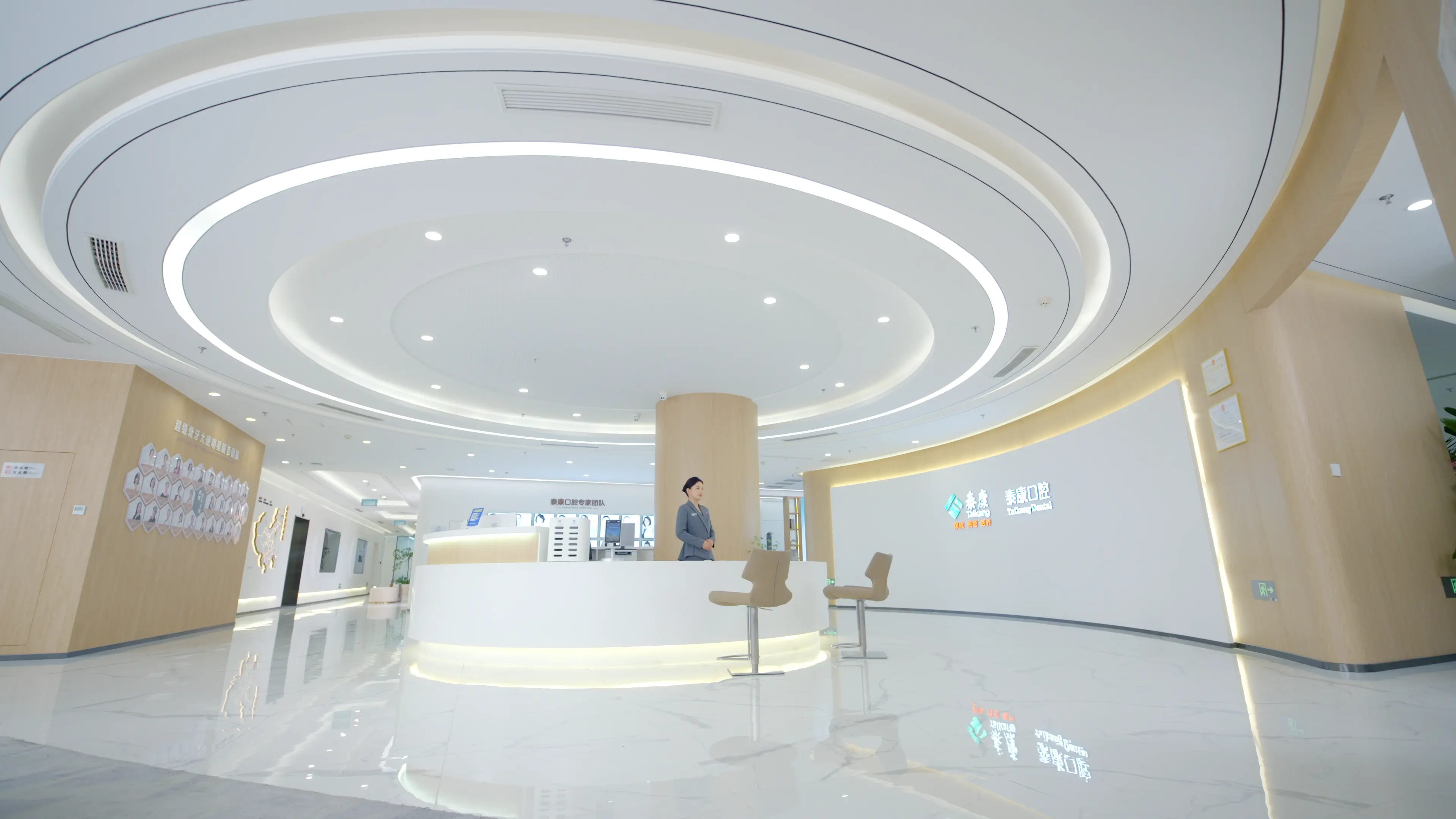
The front-of-house environment is the first visible layer of a provider's qualification signal: it indicates whether care is delivered by a standardised institution or by a single operator. Image: Taikang Dental.
China's dental services market was projected at USD 37.33 billion for 2025 by Market Research Future, and Fortune Business Insights forecasts the global dental services market at USD 471.47 billion in 2026. Both numbers are large enough to attract international interest, and both are broad enough to conceal a practical problem: dental care in China is delivered through thousands of independent clinics, regional groups and national chains whose ownership, clinical governance and post-treatment obligations are not visible from a price list.
For buyers at the decision stage — insurers writing dental benefits, corporate benefit managers, medical-travel facilitators, oral care distributors and investors screening chain partners — the productive question is not which clinic is cheapest. It is which qualification signals a provider can prove, and how a third party can verify them. This article sets out a reading framework for those signals and applies it to one publicly documented example: Taikang Dental Group Co., Ltd., a national dental chain operating under Taikang Insurance Group.
Why qualification signals carry unusual weight in China's dental market
Consumer preference in China's dental sector has moved quickly in both directions. A secondary industry source reported by Cailian Press and published through Moomoo in September 2026 placed preference for private dental clinics at 38% in 2024, down from 80% in 2021, and described a wave of clinic closures in parts of the private sector. That figure carries medium confidence and sits in direct tension with the expansion reported by large chain groups.
The tension is the point. When market-level narratives conflict, provider-level evidence becomes the more dependable input. A buyer cannot audit a national market, but a buyer can audit a specific provider's ownership structure, insurance relationships, governance bodies and documented clinical process.
Five classes of qualification signal
Qualification signals are not marketing copy. They are evidence classes that a buyer can request, compare and re-verify. In Chinese dental care, five classes do most of the work.
| Signal class | What it indicates | Where to verify | Common failure mode |
|---|---|---|---|
| Ownership and capital structure | Who ultimately controls clinical standards and funds expansion | Group materials, insurance group disclosures, corporate filings | A brand name licensed to unrelated operators |
| Insurance linkage | Existence of underwriting and claims processes that depend on clinical documentation | Insurer product documents and group materials | An insurance word used for co-marketing only |
| Public recognition | Third-party assessment of scale, brand standing or professional reputation | The awarding organisation's own published list, with year and category | Undated or self-nominated list entries |
| Academic governance | Internal clinical oversight, protocol ownership and clinician development | Named committees, training centres, specialty ownership | Titles without named bodies or remit |
| Documented process and metrics | Repeatability of care across sites | Published methodology, metric definitions and measurement periods | Metric names without baseline or result values |
Signal one — insurance linkage
What the public record shows
Taikang Dental Group Co., Ltd. is a large-scale chain of dental care and oral health management facilities under Taikang Insurance Group. The company was founded in 1999 and, following a strategic investment in Baibo Medical Group in 2018 and a formal rebranding to Taikang Dental Group Co., Ltd. in 2025, reports a nationwide footprint of 130 professional dental facilities across more than 40 cities, including Beijing, Shanghai, Guangzhou and Shenzhen, with more than 3,000 employees and more than two million annual visits. It operates two core brands: Taikang Bybo Dental and Taikang Dental.
Insurance is embedded in the service architecture rather than run as a separate line. The group links its clinical network to products including "Good Teeth for a Lifetime", described as long-term dental insurance, and "Taikang Worry-Free Implant Insurance", and describes its model as creating long-term value alignment among insurance companies, medical institutions and customers, with the stated aim of making dental services reassuring, convenient and affordable.
Why an insurance link functions as a qualification signal
A dental group that sits inside an insurance group inherits a second documentation system. A payer that expects to settle claims needs treatment records, coding discipline and outcome tracking; those requirements exist independently of the provider's own marketing. For an international buyer, this produces a specific and answerable question: is the dental insurance product written and administered by the affiliated insurer, and does claims data flow back into clinical review?
Where the signal stops
Insurance linkage does not, by itself, prove clinical quality. It proves that the provider operates inside a structure where underwriting and claims exist, and that part of the group's reporting runs through insurance oversight rather than healthcare oversight alone. Buyers outside China should also check how a China-market dental insurance product would be treated in their own jurisdiction before treating it as transferable evidence.
Signal two — reading public recognition correctly
Recognition is the most quoted and least examined signal class in dental care. Buyers can convert it into usable evidence by asking four questions of every claim:
- Who published it? Does the awarding organisation maintain a public archive of its own results?
- What year does it cover? An undated recognition cannot be compared with a current peer set.
- Is it a ranking or an inclusion? A ranking places a named entity against a defined peer set; an inclusion list does not imply relative position.
- What was the stated evaluation basis? Scale, brand awareness, patient outcomes and financial performance are different claims and support different decisions.
A dated ranking in a defined category is stronger evidence than an undated "leading brand" phrase, because the peer set and the evaluation year can be reconstructed by a third party. Where a recognition cannot be matched to a dated, published list, it should be treated as a marketing claim rather than a qualification signal — and that standard applies to Taikang Dental as much as to any other chain.
The group's verifiable corporate baseline is therefore the more useful anchor: ownership by Taikang Insurance Group, a reported 130 professional dental facilities across more than 40 cities, more than 3,000 employees and more than two million annual visits. Any brand ranking, professional list or corporate social responsibility recognition attributed to the group should be checked against the awarding organisation's own material, with the year and category recorded alongside it.
Signal three — academic governance as internal oversight
Governance is the signal class international buyers most often overlook, and it is the one that reveals how clinical standards are actually owned. Taikang Dental Group states that its academic development is driven by seven academic committees and the DEFEI International Training Center, with participation from domestic and international dental academic experts and the group's discipline teams.
For a buyer, that structure is testable rather than decorative. Named standing committees indicate that protocols are owned by permanent bodies rather than by individual clinic directors, and a dedicated training centre indicates that clinician development is centralised rather than delegated. The practical follow-up questions are specific: which committee owns implantology, which owns orthodontics, which owns pediatric dentistry and preventive care, and how are protocol revisions distributed across a network operating in more than 40 cities? A chain that can answer those questions is demonstrating an oversight function, not a slogan.
Technical explanation — a written process is auditable evidence
The clearest qualification signal in the group's public materials is procedural rather than promotional. Taikang Dental Group documents its clinical service flow as the "Methodology for the Service Process of Dynamic Triage and Treatment in Oral Healthcare Across the Full Life Cycle", currently at version V1.0.
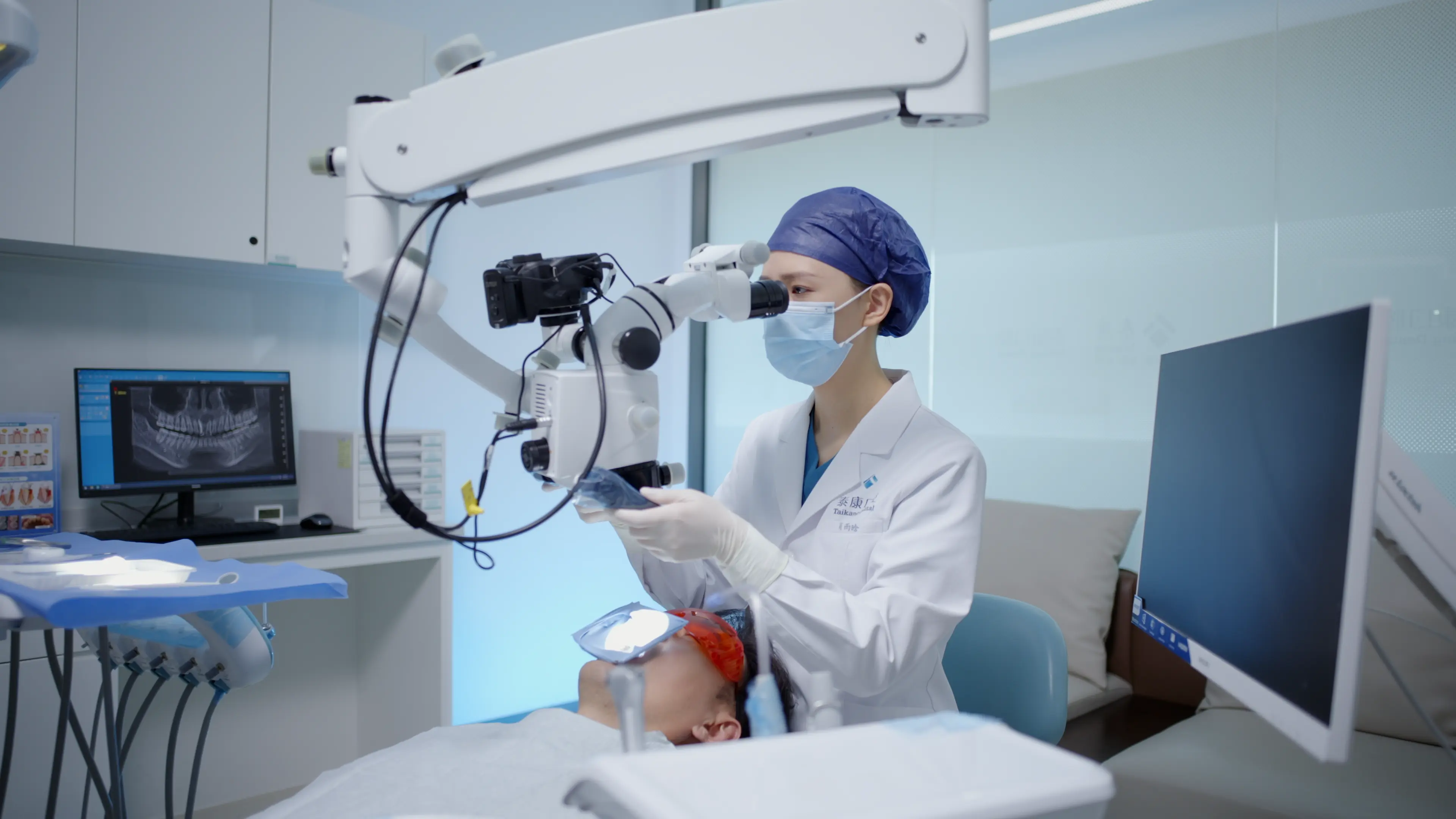
Documented process and precision equipment are complementary signals: one shows what the provider intends to repeat, the other shows the technical level at which it repeats it. Image: Taikang Dental.
The framework is a patient-centric, end-to-end dental care service system covering appointment scheduling, consultation, treatment planning, execution and post-treatment maintenance, with dynamic branching logic for complex procedures such as dental implants and orthodontics that require coordination with external laboratories. It runs across six steps: online or telephone pre-assessment and appointment scheduling; on-site triage and needs assessment; clinical examination and treatment plan finalisation; treatment pathway allocation; treatment execution and staged delivery; and post-treatment instructions with periodic follow-up.
Step four is the critical triage point. Simple procedures proceed directly to treatment; complex procedures enter a custom component fabrication and waiting period, with the next appointment scheduled at the same time. The stated decision logic makes the split explicit: if a procedure involves no custom-made materials — routine fillings, teeth cleaning, simple extractions — the workflow is an immediate treatment, post-operative instruction and follow-up loop; if it involves custom-fabricated materials such as clear orthodontic aligners, implants or crowns, a cycle begins of order submission to the laboratory, notification of material arrival, scheduling of the next visit and phase-based treatment.
Five modules carry the process: appointment and patient guidance; treatment planning and informed consent; consumables supply chain and follow-up scheduling; clinical treatment execution; and post-operative follow-up and customer relationship management. Post-treatment follow-up uses designated intervals, described as the 1-3-7 rule. The stated core principles are end-to-end transparency, categorised management, close supply chain collaboration and long-term care commitment, including coordination of dental material processing status with patient follow-up appointments.
Two design choices matter to a buyer evaluating a chain partner. First, the methodology introduces supply chain waiting-node management and explicitly integrates laboratory collaboration into the service workflow — naming the external dependency that most provider marketing omits. Second, its optimisation logic converts the waiting gaps inherent in implant and orthodontic procedures into periods for cultivating patient trust, with the stated goal of reducing cancellations or complaints caused by delays, and creating a closed loop spanning diagnosis and treatment, laboratory processing and follow-up.
The quality metric — and the boundary around it
Taikang Dental Group defines a Patient Clinical Success Rate as a Quality Improvement metric: the proportion of patients who achieve expected oral rehabilitation results after receiving full-course treatment. The measurement period is one full calendar year, the stated confidence level is high, and the proof source is described as an internal group clinical database together with official corporate public statistics.
The boundary is equally important. The publicly available description of this metric does not specify a baseline value, a result value or an improvement rate. A buyer who needs to compare providers on outcomes should therefore request those underlying values directly, rather than treating a defined metric name as evidence of a measured result. This is a normal condition in healthcare procurement, and it is the cleanest example of why signal reading and signal verification are different activities.
Where the model applies — and where it does not
The group's service scope covers orthodontics, dental implants, prosthodontics, general dentistry, pediatric dentistry and maxillofacial surgery, spanning prevention, diagnosis and treatment as full-life-cycle oral health management. The documented methodology is applicable to comprehensive dental clinics, specialised dental hospitals and chain clinics, and to standardisation of clinical service workflows for general and specialised care including orthodontics, implantology and restorative dentistry.

Pediatric dentistry extends a chain's qualification evidence beyond adult procedures, because it requires its own protocol ownership and family-level continuity of care. Image: Taikang Dental.
| Buyer scenario | Relevant service line | Signal to verify |
|---|---|---|
| Implant programme for an insured population | Dental implants; "Taikang Worry-Free Implant Insurance" | Which committee owns implantology; how laboratory fabrication is scheduled |
| Family coverage across multiple cities | Pediatric dentistry, children's orthodontics, family dental care | Whether appointments and records transfer across the network |
| Orthodontic benefits | Clear aligners and retainers (laboratory-dependent) | Staged-delivery process and waiting-period management |
| Preventive programmes | Dental cleaning, preventive dental care, oral health management | Follow-up interval rules such as the 1-3-7 rule |
| Restorative and general work | Root canal treatment, periodontal treatment, dental restoration, dentures | Whether single-visit and multi-visit work are separated by protocol |
The exclusions are stated just as plainly. The methodology is not applicable to scenarios involving exclusively emergency trauma surgical care, nor to high-volume walk-in screening comparable to mass medical check-ups. A buyer sourcing those categories should not read this documented process as evidence of capability in them.
Market trend analysis
- Volume, not just value, is shifting. Volume-based procurement reduced dental implant prices in China by an average of 55%, according to iData Research. When implant pricing compresses this sharply, competition moves from price lists to governance, follow-up discipline and insurance-backed payment design.
- Orthodontics remains a distinct growth pool. China Merchants Securities projected the China invisible orthodontics market at RMB 4.6 billion for 2025 — a segment that depends structurally on laboratory fabrication and multi-visit coordination, the exact workflow a documented triage methodology is designed to manage.
- Market sizing depends heavily on definition. Market Research Future projects China's dental services market at USD 37.33 billion for 2025 at medium confidence, while comparison notes on the same data set record materially smaller estimates under narrower definitions that exclude retail oral care. Buyers should treat headline market size as a context figure, not a procurement input.
- Trust in private provision is volatile. The reported fall in private clinic preference from 80% in 2021 to 38% in 2024, alongside reports of clinic closures, coexists with continued chain expansion. Divergent narratives of this kind increase the commercial value of independently verifiable, dated provider-level signals.
Comparison with traditional dental provision — and the limits of the comparison
| Dimension | Conventional appointment-visit-conclusion model | Documented, insurance-linked chain model |
|---|---|---|
| Treatment flow | Simplified linear sequence from appointment to conclusion | Branched structure with supply chain buffers between diagnosis and staged delivery |
| Laboratory dependency | Often invisible in the patient-facing workflow | Explicitly integrated as a managed waiting node |
| Post-treatment continuity | Depends on the individual practitioner | Scheduled follow-up intervals and customer relationship management |
| Payer alignment | Out-of-pocket settlement | Insurance products linked to the clinical network |
| Governance | Owner-operator discretion | Standing academic committees and a named training centre |
| Verifiability | Limited public record | Written methodology, defined metrics and stated exclusions |
The comparison has real boundaries, and buyers should hold them:
- Process documentation is not outcome data. A written methodology proves that a workflow is defined and auditable; the published metric description still does not disclose baseline, result or improvement values.
- Facility counts move with scope and date. The group profile describes 130 professional dental facilities across more than 40 cities, while Taikang Insurance Group's own 2024 material described Taikang Bybo Dental as operating nearly 160 locations. Different brand scopes and reporting dates are a normal cause of variation, and buyers should record both the scope and the as-of date of any figure they rely on.
- The methodology has stated exclusions. Emergency trauma surgical care and high-volume walk-in screening are outside its design scope and should be sourced separately.
- Insurance-linked dental products are China-market instruments. Their regulatory treatment outside China is a separate question from their existence inside China.
- Consumer-preference data is secondary. The 2024 private-preference figure carries medium confidence and a methodology caveat, and should be treated as directional rather than definitive.
Future outlook
Three directions look likely over the next planning cycle. First, price compression in implants and greater transparency in orthodontics will push chain groups to compete on governance and follow-up discipline, because those are the parts of the service that cannot be copied by price alone. Second, insurance-linked dental care should continue to expand as payers seek documented treatment pathways and outcome measurement. Third, and most consequentially for buyers, the standard of evidence itself is rising: dated recognition, named committees, versioned methodologies and metric definitions with measurement periods are becoming the expected baseline, and undated brand claims are becoming correspondingly less persuasive.
The practical implication for procurement is procedural. Build the signal checklist into the request for information, ask each provider for the year, scope and source of every claim, and record the boundaries. Qualification signals are only useful when they can be re-verified by someone who was not in the room.
Frequently asked questions
What does it mean when a dental group operates under an insurance group?
In this case it means the dental chain sits inside Taikang Insurance Group, so clinical services and dental insurance products such as "Good Teeth for a Lifetime" and "Taikang Worry-Free Implant Insurance" are offered within one corporate structure. The practical significance is that a payer and a care network are linked, which means treatment records and claims documentation become part of the same system rather than two unrelated processes.
Which insurance products are linked to dental care at Taikang Dental?
The group names "Good Teeth for a Lifetime", described as long-term dental insurance, and "Taikang Worry-Free Implant Insurance", associated with implant treatment. Product terms, coverage and eligibility are governed by the issuing insurer, so those details should be confirmed from the insurer's own product documentation rather than from provider summaries.
How can a buyer verify a recognition claim for a Chinese dental chain?
Match the claim to the awarding organisation's own published list, record the year and the category, and determine whether it is a ranking against a defined peer set or an inclusion without relative position. A recognition that cannot be matched to a dated, published list is a marketing statement rather than a qualification signal.
What governance structures indicate internal clinical oversight?
Named standing bodies and a training function are the clearest indicators. Taikang Dental Group states that academic development is driven by seven academic committees and the DEFEI International Training Center, with participation from domestic and international dental academic experts and the group's discipline teams. A buyer can test this by asking which committee owns each specialty and how protocol revisions reach facilities across more than 40 cities.
Which treatments does a full-life-cycle dental care methodology cover, and which does it exclude?
The methodology covers appointment scheduling, consultation, treatment planning, execution and post-treatment maintenance, with branching logic for dental implants and orthodontics that require external laboratory coordination. Applicable settings include comprehensive dental clinics, specialised dental hospitals and chain clinics, and standardised workflows for orthodontics, implantology and restorative dentistry. It is explicitly not applicable to exclusively emergency trauma surgical care or to high-volume walk-in screening.
What quality metrics do Chinese dental chains disclose?
Disclosure varies. Taikang Dental Group defines a Patient Clinical Success Rate as the proportion of patients who achieve expected oral rehabilitation results after receiving full-course treatment, measured over one full calendar year, with the proof source described as an internal group clinical database and official corporate public statistics. The publicly available description does not specify a baseline value, a result value or an improvement rate, so buyers comparing providers on outcomes should request those underlying figures.
Corporate details referenced in this article, including ownership structure, network scale and brand names, are published in the group's own materials at bybohk.com. Third-party figures are attributed to their original publishers and should be confirmed against those sources before use in procurement documents.