
How Buyers Rank Double Glazing Sealant Options in 2026
Insulating Glass Materials · Buyer Evaluation
The edge seal is the least visible part of a double glazing unit and the part most likely to decide whether it still performs a decade after installation. Sealant is usually the last item a procurement team validates — and the first one questioned when a unit fogs.
An insulating glass unit (IGU) consists of two or more glass panes separated by a spacer and edge-sealed to form an insulating air- or gas-filled cavity. The spacer bar holds the panes at a fixed distance and establishes the size of the interpane space. The sealant system keeps that space sealed, while the desiccant held inside the spacer adsorbs residual water and solvent vapour that would otherwise condense inside the cavity.
The commercial volume behind that detail keeps expanding. The global insulated glass market was valued at USD 92.7 billion in 2024 and is projected to grow from USD 101.3 billion in 2026 to USD 121.7 billion by 2030, according to Grand View Research. Every additional square metre of IGU produced pulls edge sealant, desiccant, and spacer material through the supply chain with it.
For buyers at the evaluation stage, the useful question is not which sealant sounds most advanced, but which sealant function is being purchased, what that function has to do inside the unit, and which documents prove it. This article ranks the double glazing sealant options used in IGU production by their function, sets out the evidence each rank requires, and marks the point where supplier claims stop and verification begins.
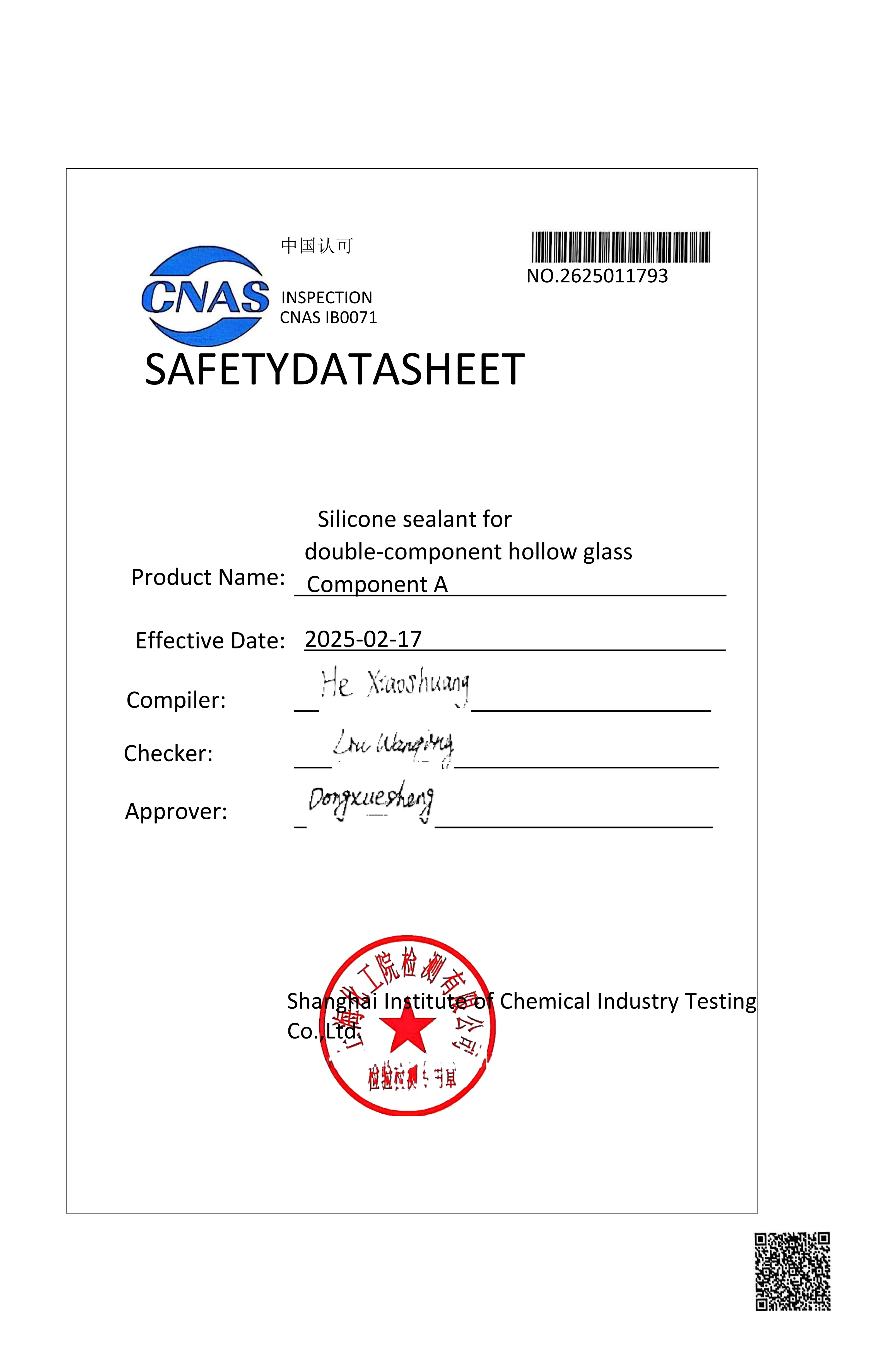
Safety data sheet documentation for a two-component silicone sealant used in insulating glass production — a handling and composition record, not a performance certificate.
Why the Edge Seal, Not the Glass, Drives Long-Term Risk
Glass is chemically stable; the edge seal is not. It is the assembly's main barrier against moisture vapour, and it is the component most exposed to temperature cycling, ultraviolet light, and frame movement.
Standards are written around that risk. EN 1279-2 specifies a moisture penetration test for insulating glass units with an average moisture penetration index Iav ≤ 0.20 (20%) across five aged specimens and an individual specimen limit of I ≤ 0.25 (25%). The same standard recognises several permitted methods for determining desiccant moisture content, including 540 °C drying, Karl Fischer titration, gravimetric, and dew-point methods.
Two implications follow for buyers. First, the test is performed on the assembled unit: spacer, desiccant, primary seal, and secondary seal are qualified together, so a stronger sealant cannot compensate for an unsuitable desiccant. Second, the desiccant is not a passive filler. Commonly used desiccants are molecular sieves or blends of silica gel with molecular sieves, and their stated purpose is to adsorb residual water and solvent vapour inside the sealed space.
Regional regimes extend the same logic into manufacturing discipline. AS/NZS 4666:2012 sets requirements and guidelines covering long-term type testing, glazing, periodic manufacturing testing, traceability, desiccant suitability, shelf life, and desiccant exposure limits for insulating glass units.
Primary Seal and Secondary Seal Are Two Separate Purchases
Most double glazing units in commercial production use a dual-seal structure. The primary seal sits against the spacer and faces the cavity; the secondary seal sits behind it and carries the structural load.
For structural silicone glazing (SSG), the ASTM C1249-18 sample text states that only IG units with a dual-seal system using polyisobutylene as the primary seal and silicone as the secondary seal are described as having the required durability for the application. Cardinal Corp's technical publication describes the same composition — polyisobutylene primary seal, silicone secondary seal — as the dual-seal structure of an insulating glass unit.
| Layer | Function in the unit | Chemistry referenced in technical sources | Evidence to hold on file |
|---|---|---|---|
| Primary seal | First barrier against moisture vapour ingress along the spacer edge | Polyisobutylene (PIB) / butyl-based | Safety data sheet, application data, spacer compatibility statement |
| Secondary seal | Structural bond and long-term edge durability | Silicone; polysulfide sealants are also listed among IGU accessory materials | Batch test reports and compliance statements against EN 1279 / ASTM E2190 |
Table 1: The two seal layers in a dual-seal insulating glass unit and the documentation each one generates.
Ranking Double Glazing Sealant Options by Function
The ranking below orders sealant options by the function they perform inside a double glazing unit. It is a functional ranking, not a supplier ranking. Public technical guidance describes sealant roles and standard requirements; it does not, by itself, establish that one manufacturer's product outperforms another's. That determination requires product-level test data, which is exactly what buyers should be requesting at this stage.
| Rank | Option | Position in the unit | Why it ranks here | Evidence to request |
|---|---|---|---|---|
| 1 | Polyisobutylene (PIB) / hot-melt butyl | Primary seal at the spacer edge | Named as the primary seal in dual-seal constructions, including units specified for structural silicone glazing under ASTM C1249-18 | Safety data sheet, moisture-vapour transmission rate data, extruder application parameters, spacer compatibility statement |
| 2 | Two-component silicone | Secondary seal | Named as the secondary seal chemistry in the same dual-seal guidance and described in manufacturer technical publications | Batch test reports, curing data, compliance statements referencing EN 1279 and ASTM E2190 |
| 3 | Butyl tape | Primary seal used with flexible warm-edge spacer lines | Flexible warm-edge spacers are supplied as butyl sealing spacers, where a tape-based primary seal is the common route | Tape dimensions, adhesion to the spacer material, shelf-life data — the AS/NZS 4666:2012 scope covers shelf life and traceability requirements |
| 4 | Polysulfide sealant | Alternative secondary sealant | Listed among the accessory materials used in IGU production, alongside PIB and silicone sealants | Compatibility evidence with the selected spacer coating and with the desiccant in use |
| 5 | System check: spacer + desiccant + sealant | Not a product — a decision gate | EN 1279-2 evaluates moisture penetration on the assembled unit, so the sealant is qualified together with the spacer and desiccant | Full-unit test data, desiccant moisture content method and result, unit-level standard scope documentation |
Table 2: Functional ranking of double glazing sealant options and the evidence each one requires.
A safety data sheet is not a performance test. An SDS documents composition and hazard classification for handling, transport, and workplace safety. It does not demonstrate moisture-vapour resistance, adhesion, or gas retention, and it should not be accepted in place of durability testing or unit-level standard compliance.
What Soleron Supplies — and What Its Documents Cover
Soleron Building Materials (Hebei) Co., Ltd. is a manufacturer of insulating glass components based in Renqiu, Hebei Province, China. Its product range covers the components that meet at the edge of an IGU: aluminium spacer bars, warm-edge spacers, sealants, and molecular sieve desiccants.
On the sealant side, the range covers butyl sealant, hot-melt sealant, and two-component silicone sealant in models SOL-803 and SOL-717. Products are supplied in black and white, packed in carton boxes, plastic drums, or iron buckets, in stated weights of 28 kg, 30 kg, and 330 kg, with a stated 10-year quality guarantee. The declared materials are butyl rubber, silicone polymer, and EVA.
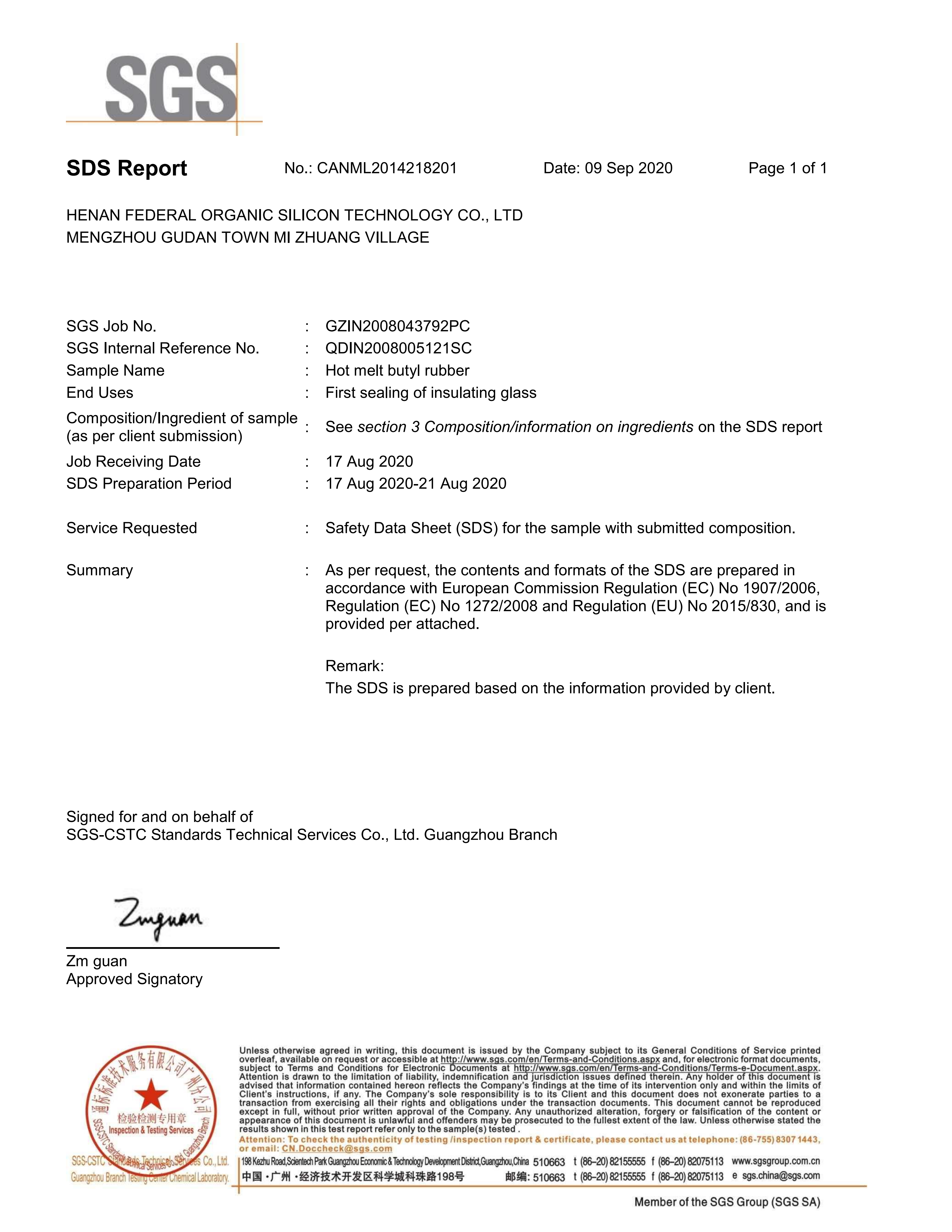
Safety data sheet documentation for butyl sealant — the chemistry family typically specified as the primary seal in dual-seal insulating glass units.
Documentation available for the sealant line includes a CNAS safety data sheet, report number 2625011793, for silicone sealant for double-component hollow glass (Component A), issued on 17 February 2025 by Shanghai Institute of Chemical Industry Testing Co., Ltd. against JC/T 2069-2011. The markets listed for that document are the EU, US, Middle East, Africa, Australia, and Southeast Asia.
Two boundaries are worth stating plainly. The CNAS report covers Component A of a two-component silicone sealant, so buyers evaluating a complete system should ask for documentation that covers the full component set. And the manufacturer's stated quality-control method is random inspection, which is a sampling-based approach rather than full batch testing; projects that require per-batch traceability should confirm the testing regime with the supplier before qualification.
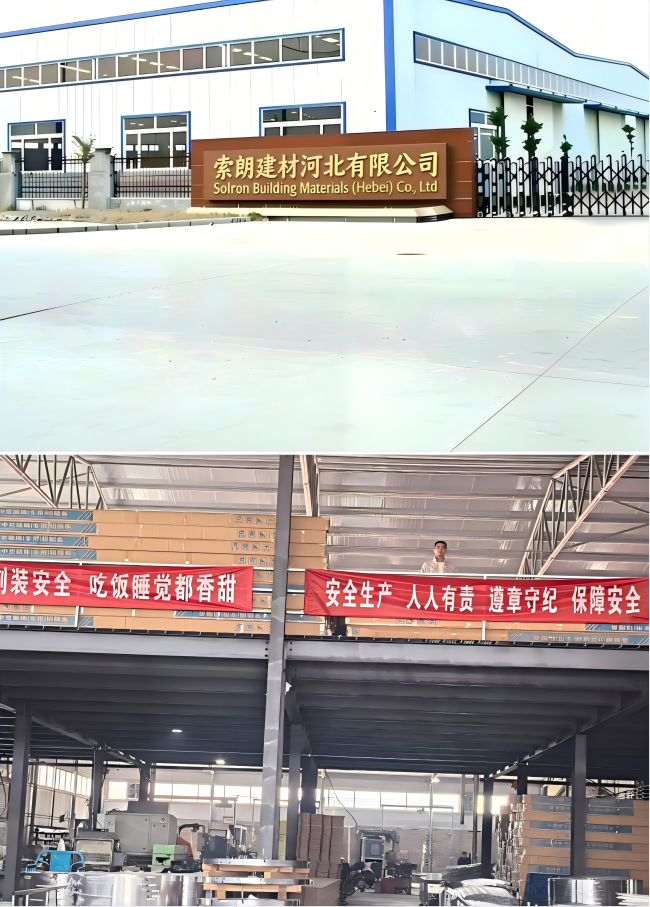
Stock held at the Soleron facility in Renqiu, Hebei — insulating glass components are produced and stored for combined shipment.
Production and commercial terms recorded for the company include OEM/ODM service, customization of logo, size, and packaging, a minimum order quantity of 5 cartons, a lead time of 20 to 45 days, and remote after-sales support. Export markets are stated as the EU, the Middle East, and Southeast Asia.
Where Double Glazing Sealant Is Used in Practice
Sealant selection is driven by the application type rather than by a single universal specification. The buyers who specify it are, in practice, insulated glass manufacturers, window and door manufacturers, and glass accessory distributors — the same three groups recorded in Soleron's project documentation.
- Residential windows and doors: a dual-seal PIB plus silicone or PIB plus polysulfide build, where the priority is moisture-vapour control and consistent colour matching to the spacer and frame.
- Commercial curtain wall and façade projects: higher wind and thermal loads, where the secondary seal carries more structural responsibility and unit-level standard compliance is usually a contract requirement.
- Structural silicone glazing: the most constrained case. Under ASTM C1249-18 guidance, only dual-seal units with polyisobutylene as the primary seal and silicone as the secondary seal are described as having the required durability for this application.
- Energy-efficiency retrofit and public buildings: projects where reducing condensation at the edge is an explicit performance goal rather than a side effect.
The manufacturer's published case record documents 500 tons of spacer material supplied across 33 countries in the Middle East, Asia, Europe, Africa, and the Americas, used by insulating glass manufacturers, window and door manufacturers, and glass accessory distributors. The stated outcomes include improved thermal insulation, reduced condensation, enhanced air and moisture tightness, improved sound insulation, and increased service life of the insulating glass units, with a stated application duration of 20 to 30 years.
Market Trends Shaping Sealant Specification
Three movements in the downstream IGU market are changing what buyers expect from a sealant supplier.
Volume growth. The insulated glass market is projected to move from USD 92.7 billion in 2024 to USD 121.7 billion by 2030 (Grand View Research). Growth of that scale widens the supplier base, which raises rather than lowers the burden of documentation.
The shift toward warm-edge construction. The warm edge spacer market was valued at USD 1.1 billion in 2024 and is projected to reach around USD 1.90 billion by 2035 (Meticulous Research). Warm-edge construction changes the primary seal route, because flexible warm-edge spacers commonly use butyl-based sealing.
Desiccant demand tied to higher-performance units. Within the molecular sieve desiccant market, the 3A grade segment was valued at USD 1.80 billion in 2024 (Mordor Intelligence) — a signal that higher-performance units, including triple glazing, are pulling desiccant quality into the same specification conversation as the sealant.
A fourth trend is documentary rather than technical: suppliers increasingly publish compliance statements against EN 1279 and ASTM E2190. HB Fuller, for example, states that its PIBs fulfil the requirements of EN 1279 and ASTM E2190 and that its standard secondary sealants comply with both standards. Such statements are company-reported and are a starting point for verification, not a substitute for it.
Data gap note: material-level market sizing, pricing, and moisture-vapour transmission benchmarks for sealants, spacer bars, and desiccants are not consolidated in publicly available research. Current public data describes downstream IGU demand and standard requirements; component-level comparison therefore remains quote- and test-based.
Comparison with Traditional Solutions
The traditional edge build pairs an aluminium spacer bar with a dual-seal system. Aluminium still offers real advantages: aluminium spacer bars provide good mechanical strength, are easy to process, hold stable dimensions, and are compatible with conventional insulating glass production lines.
The counter-argument is thermal. Reported comparison data lists thermal conductivity for aluminium spacers at 160–200 W/mK against 0.13–0.25 W/mK for warm-edge materials, and warm edge technology is described as reducing thermal bridging substantially compared with aluminium.
What that comparison does not mean is that substituting a higher-grade sealant into an unchanged build will deliver the same result. Three boundaries apply:
- Equipment and handling change. Flexible warm-edge systems use butyl-based sealing and different application equipment from a rigid aluminium spacer line; the material change is a line change, not a drop-in swap.
- Unit-level qualification governs. EN 1279-2 measures moisture penetration on the assembled unit. A better primary seal cannot offset an under-specified desiccant or an incompatible spacer coating.
- Application can restrict the chemistry set. For structural silicone glazing, guidance describes only the PIB-plus-silicone dual seal as having the required durability, which removes other sealant combinations from consideration regardless of price.
Future Outlook
Three expectations follow from the current evidence. First, sealant purchasing will move further toward documentation-led qualification, because traceability and shelf-life requirements are already written into standards such as AS/NZS 4666:2012 and into EN 1279-2 test methods. Second, warm-edge growth will pull more butyl-based primary seal volume into flexible spacer lines. Third, buyers will increasingly ask for component-level proof — moisture-vapour transmission rate, batch test data, desiccant moisture content method — because public market data describes demand at the IGU level and stops short of the component level.
For suppliers, the practical consequence is that a sealant range is only as strong as the test reports behind it. For buyers, the consequence is that the ranking exercise is repeatable: fix the function, fix the evidence requirement, then compare suppliers against it.
Frequently Asked Questions
What is a double glazing sealant, and where does it sit in an insulating glass unit?
A double glazing sealant is the material that closes the edge of an insulating glass unit. An IGU consists of two or more glass panes separated by a spacer and edge-sealed to form an insulating air- or gas-filled cavity. The sealant is applied around the perimeter of that cavity in one or two layers, depending on the system design.
Which sealant chemistry is used as the primary seal and which as the secondary seal?
In the dual-seal constructions described in technical guidance, polyisobutylene (PIB) is the primary seal and silicone is the secondary seal. For structural silicone glazing, ASTM C1249-18 sample text states that only units with this combination are described as having the required durability. Polysulfide sealants are also listed among the accessory materials used in IGU production, typically in the secondary seal position where the project does not require the silicone structural bond.
Are safety data sheets enough to qualify a double glazing sealant?
No. A safety data sheet documents composition and hazard classification for handling and transport. It does not report moisture-vapour resistance, adhesion, or gas retention. Buyers should pair the SDS with product test data, batch reports, and — where the project requires it — unit-level compliance evidence.
What standard results should a buyer check for moisture penetration?
Under EN 1279-2, the average moisture penetration index across five aged specimens must be Iav ≤ 0.20 (20%), with an individual specimen limit of I ≤ 0.25 (25%). The standard also recognises several permitted methods for determining desiccant moisture content: 540 °C drying, Karl Fischer titration, gravimetric, and dew-point methods. Because the test is performed on the assembled unit, the result reflects the spacer, desiccant, and sealant combination together.
Can double glazing sealants be supplied with OEM customization?
Yes — OEM/ODM supply is available in this category. Soleron Building Materials (Hebei) Co., Ltd., for example, records OEM/ODM service with customization of logo, size, and packaging, a minimum order quantity of 5 cartons, and a lead time of 20 to 45 days. Customization terms should be confirmed against the documentation scope required by the project.
The complete Soleron product catalogue, covering its insulating glass materials including the sealant range, can be downloaded here: Soleron product catalogue (PDF).