
How Buyers Judge Whether a Chain Block Supplier Will Last
The global chain block market was valued at approximately USD 1.95 billion in 2024, according to Intel Market Research, and manual chain pulley blocks are estimated to account for around 48% of the total product segment share in 2026 (Fact.MR). A market of that shape is replacement-driven: distributors and industrial end users reorder the same capacity, the same lift height and often the same model for years.
That reordering pattern turns supplier evaluation into a product question. Whether a supplier can repeat a specification, a certificate and a delivery schedule over several years is testable — through capacity disclosures, compliance documentation and specification stability. Each of the three produces signals a buyer can request before the first purchase order, rather than discovering the gap after the third.
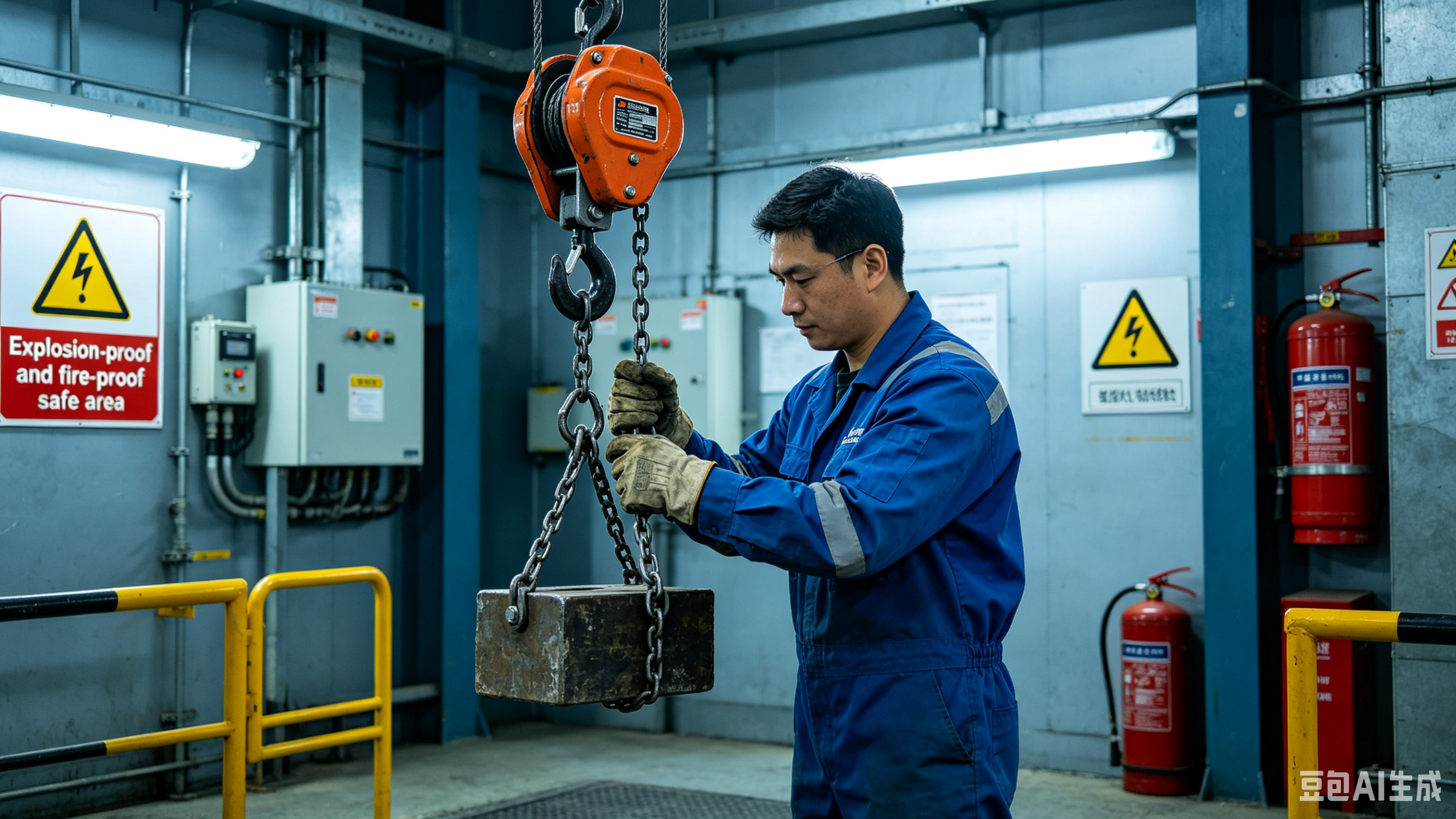
Manual chain blocks are frequently specified for environments without reliable power supply or with restricted working conditions, including explosion-proof and fire-proof areas.
Why Continuity Is a Purchasing Question, Not a Background Check
A chain block rarely works alone. Documented configurations pair the block with slings, special hooks, magnetic lifters, steel plate or oil drum clamps and wire rope assemblies, and the operator's effort is calibrated to the hand chain. Once those elements are aligned, the block becomes the component most likely to be reordered identically, because inspection routines, operator training and spare-part stocks are all built around a known geometry.
When a repeat order arrives with a different hook opening, a different number of chain falls or a higher hand-pull effort, the change is rarely dramatic on paper — and that is the problem. The documented VD range specifies a hook opening of 24–55 mm, a hand-pull force of ≤35 daN (350 N) at rated load and 1–4 chain falls depending on capacity. A shift inside those brackets is enough to invalidate an operator's learned effort and a maintenance team's reference measurements.
The Awareness-Stage Gap: Product Questions Arrive Before Supplier Questions
Awareness-stage buyers usually start with the block itself: what rated load is required, whether the lift height should be the 3 m standard or an optional 2.5–12 m, and whether CE marking is present. These are the right first questions, and they can be answered from a datasheet.
They do not answer the second set: will the same datasheet be reproducible in three years, will the load chain still be Grade V (80) or Grade T to DIN EN 818-7, and will the facility that produced the sample still be producing it. Continuity is not a matter of impression. It leaves documents — annual capacity, headcount, floor area, certification scope and a stable parameter set — and buyers who request those five items early move into evaluation with a scorecard rather than a hunch.
Three Signal Sets: Capacity, Compliance and Continuity
The three sets answer different questions, and none substitutes for another.
- Capacity signals indicate whether a supplier can physically produce and ship the volume — annual output, workforce, floor area and export share.
- Compliance signals indicate whether the product may lawfully be placed on the target market — the standards named on the datasheet, the scope of the CE declaration and the chain-grade certificates.
- Continuity signals indicate whether the same specification can be reproduced — a parameter set that does not drift, and an engineering team able to explain changes when they occur.
A supplier can be strong on one set and weak on another, which is why a scored checklist is more useful than a single verdict.
Signal Set 1 — Capacity: Reading Workforce and Facility Numbers Correctly
Baoding Junyun Hoisting Machinery Co., Ltd. — the manufacturer behind the JUNYUNHOIST brand — is a hoisting machinery manufacturer and trading company established in 2018 and based in Donglu Village, Qingyuan District, Baoding City, Hebei Province, China. Its documented figures are concrete enough to evaluate: an annual production capacity of 200,000 units, export business accounting for 80% of total sales, and a product range covering VD, VT, HSZ, HSC and VD-II chain blocks along with VA and VL lever blocks. Main markets include India, Russia, Vietnam, Brazil, Türkiye, Dubai and the wider Middle East.
Two workforce and facility figures are published for the company, and they differ. Asset data lists a 24,000 square metre facility and approximately 138 staff, including a dedicated R&D team of 8 engineers and technicians. Company statements elsewhere describe a 30,000 square metre facility and over 300 skilled employees. The gap is not a scandal; it is a documentation question, and the correct buyer response is to ask which figure is current and what basis it rests on — a floor plan, a property or lease record, or a recent audit.
The remaining capacity numbers deserve interpretation rather than admiration. 200,000 units a year against a workforce of roughly 138 implies a standardised model mix and sub-assembly logic rather than one-off fabrication; the practical question is how that volume divides between chain blocks and lever blocks, and between standard and custom orders. An 80% export share suggests familiarity with destination-market documentation, which matters when the buyer's own compliance team asks who prepared the paperwork. Eight engineers is a small team in absolute terms, but it is the relevant number for judging whether OEM/ODM requests can be handled in-house.
| Capacity signal | What it tells a buyer | Document to request |
|---|---|---|
| Annual capacity of 200,000 units | Indicates standardised, repeatable production rather than project-only output | Model-level capacity breakdown |
| Approximately 138 staff (asset data) vs. over 300 (company statement) | Scale of production and quality-control labour | Current headcount by function, or a recent audit |
| 24,000 m² (asset data) vs. 30,000 m² (company statement) | Physical room for assembly, testing and storage | Floor plan or property / lease record |
| R&D team of 8 engineers and technicians | Ability to handle OEM/ODM changes without outsourcing design | Organisation chart and customisation records |
| Export share of 80% | Familiarity with multi-market documentation | Destination market list and shipping terms |
Note on the table: both sets of figures are published; neither is verified here. The purpose of requesting documents is to replace a claim with a reference point, not to catch anyone out.
Signal Set 2 — Compliance: What ISO, CE and Product Standards Actually Cover
Compliance is where awareness-stage buyers most often accept a logo in place of a scope. Products are described as manufactured under ISO, CE and other international standards, and the documented product standards for the VD range are ISO 16872, EN 13157 and ASME B30.21, with CE marking.
In the European Union, EN 13157 specifies safety requirements for hand-powered lifting equipment (CEN). The standard safety factor for EN 13157-compliant chain blocks is 4:1 (BS EN 13157:2004), and the documented VD range states ≥4:1 for the chain and ≥5:1 for structural parts — a combination that meets the European baseline rather than exceeding it. In the United States, ASME B30.16 governs the construction, installation, inspection and maintenance of overhead hoists, including hand chain-operated types (ASME). Buyers serving several markets should expect the datasheet to name each standard separately rather than grouping them under a single badge.
Three verification points follow. First, what the CE declaration covers — the model range, the capacities and the place of manufacture. Second, whether the ISO reference is a quality-management certificate or a product standard; the two are not interchangeable in a tender document. Third, batch-level evidence: the load chain grade to DIN EN 818-7 and the forged alloy steel, heat-treated hook are the two components most worth a material certificate per shipment, because they carry the safety factors quoted above.
A certificate is a statement about a system, not about the individual block in the crate. Long-term buyers therefore ask for both and treat them as separate line items.
Signal Set 3 — Specification Continuity: The Numbers That Should Not Drift
The strongest available continuity signal is a parameter set detailed enough that any change becomes visible. The following values are the documented specification for the VD chain block range.
| Parameter | Documented value |
|---|---|
| Rated load capacity | 0.5–50 t |
| Standard lift height | 3 m (2.5–12 m optional) |
| Number of chain falls | 1–4, depending on capacity |
| Load chain grade | Grade V (80) or Grade T to DIN EN 818-7 |
| Load chain diameter | 6.3–11.2 mm, varying with capacity |
| Hand chain | Round link, galvanised or zinc-plated; length = lift height + 0.5 m slack |
| Pull force on hand chain | ≤35 daN (350 N) up to rated load |
| Minimum headroom / hook distance | 300–1000 mm, model dependent |
| Hook opening | 24–55 mm |
| Hook material | Forged alloy steel, heat-treated |
| Safety factor | ≥4:1 (chain), ≥5:1 (structural parts) |
| Operating temperature | −20 °C to +50 °C with standard grease |
| Finish | Painted housing, RAL 2000 or 1007; corrosion-resistant chain |
| Chain materials referenced | 20Mn2, 25MnV, 23MnNiMoCr54 |
| Standards | ISO 16872, EN 13157, ASME B30.21, CE marked |
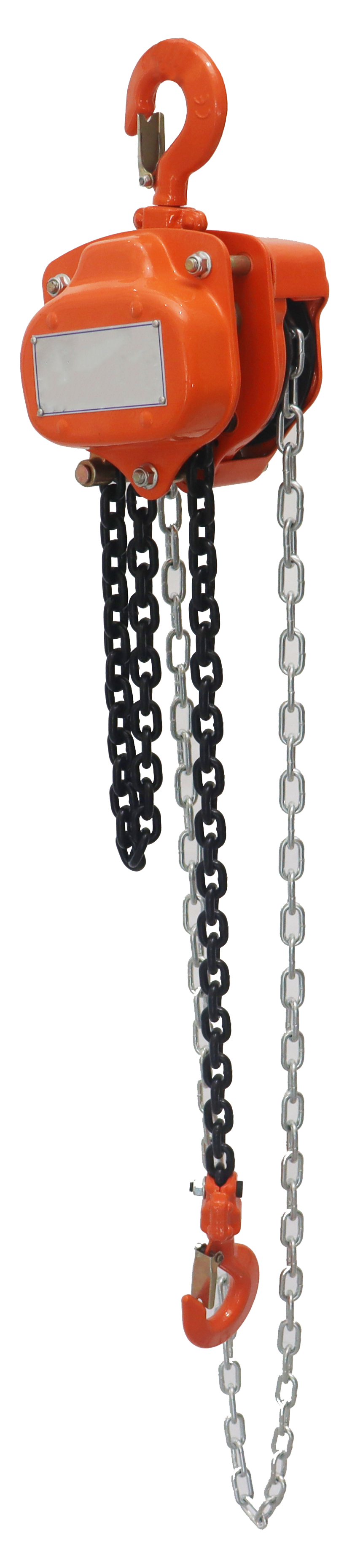
A VT chain block from the documented JUNYUNHOIST range. Continuity across repeat orders depends on chain grade, hook material and headroom values staying inside their published brackets.
What makes this table a continuity test rather than a specification sheet is that every line is a point where a supplier can quietly substitute. A move away from a 6.3–11.2 mm load chain diameter alters the chain-to-sprocket fit. A reduction in the number of chain falls changes headroom, and headroom is the constraint that decides whether the block fits a low-clearance workshop chain block application at all. A different housing finish from RAL 2000 or 1007 is cosmetic; a change in the heat treatment of the hook is not. Buyers who lock the table into a purchase contract, with the model range and tolerance brackets, have converted continuity from a hope into a clause.
The temperature line deserves separate attention in long-term supply planning. −20 °C to +50 °C with standard grease covers most conditions the company serves, from Russian winter sites to Middle East summer sites, but it is a standard-grease figure. Buyers operating near either limit should ask whether the configuration changes, because an unqualified assumption is exactly the kind of drift that surfaces two shipments later.
Application Fit as a Continuity Test
Continuity only matters where the block is actually used. The documented applications run from manufacturing, construction and logistics and warehousing through shipbuilding, mining, petrochemicals, power, bridge engineering, railway construction, automotive repair, agriculture and stage construction.
Each application stresses a different part of the specification. Construction site chain block work includes steel structure installation in large stadiums and super high-rise buildings, where cantilever structures are hoisted and cross-floor lifting takes place in ultra-high interior spaces. Bridge construction uses the block for precise placement of large steel beams for high-speed railway bridges and precast beams for other bridges. Shipbuilding and repair calls for moving ship structural parts to assembly positions and for hoisting and disassembling heavy components such as engines and propellers. Port cargo and warehouse logistics work relies on the same block in a purely mechanical mode, converting human labour into lifting capacity through a gear system with a reverse-drive self-locking brake. Mining operation and factory hoisting work frequently takes place where there is no power supply or the working environment is restricted.
Space and altitude are the recurring constraints. With minimum headroom between 300 and 1000 mm depending on model, a small space operation is a specification question rather than a preference, and heavy duty work up to 50 t is a matter of chain falls and structural safety factor. Where the environment is explosion-proof or fire-proof, standard configuration meets general requirements and explosion-proof and high-temperature resistant configurations are available on request — a documented option, not a default. Construction sites remain the largest single application segment, contributing approximately 30% to 54% of global demand depending on the source (Stratview Research / Fact.MR), which is a reminder that continuity of supply matters most in the segment with the least predictable schedule.
Market Trend Analysis: What the Published Figures Suggest About Supplier Staying Power
Published estimates for this category move with scope, and buyers should read them that way. Intel Market Research valued the global chain block market at approximately USD 1.95 billion in 2024. Dataintelo projects the global chain hoist market, which includes electric as well as manual types, to reach USD 3.9 billion by 2034, and reports that Asia Pacific held a 41.3% revenue share in 2025. Fact.MR estimates manual chain pulley blocks at 48% of the total product segment share in 2026.
Trade data points in the same direction. China's exports of parts for lifting and handling equipment under HS 843139, which include chain block components, reached USD 1.36 billion in 2024 (UN Comtrade / WITS). Growth-rate estimates diverge widely by study — from around 0.4% for general chain blocks to 3.4% for the chain hoist market, 4.1% for chain blocks and 5.7% for high-tech or AI-integrated models — and the divergence itself is the useful signal: the base category is not a high-growth market.
For a buyer, that has a practical reading. In a replacement-driven market with modest growth, suppliers compete less on novelty and more on documentation, repeatability and delivery reliability. A supplier that publishes a stable parameter set, names its standards individually and can explain a discrepancy in its own figures is demonstrating exactly the capabilities that a flat-growth market rewards.
Where the Manual Block and a Mid-Size Supplier Stop: Real Boundaries
Long-term evaluation is only credible if it states limits. Five boundaries apply to this configuration.
- Manual operation sets a duty ceiling. The hand-pull force is ≤35 daN at rated load, which is comfortable for an operator but defines the practical duty cycle. For continuous, high-throughput lifting, powered equipment is the appropriate category; variable-frequency drives and remote monitoring belong to powered systems, not to the manual chain blocks described here.
- Temperature is a standard-grease figure. −20 °C to +50 °C covers most sites, but operations outside that bracket need a configuration review rather than an assumption.
- The published figures conflict, and that costs the buyer verification time. 24,000 square metres versus 30,000, and roughly 138 staff versus over 300, are documented as different statements. Until reconciled, capacity should be treated as an estimate.
- Scale differs from the multinational tier. Kito Crosby, formed by the merger of Kito and The Crosby Group, reported USD 1.1 billion in revenue for 2024 (U.S. Department of Justice / Kito Crosby), and Columbus McKinnon is described by Stratview Research as a leading competitor with a strong presence in the 0.5–20 ton capacity range. A 200,000-unit manufacturer with an eight-engineer R&D team operates at a different scale, which changes commercial terms and buffering rather than product category.
- OEM/ODM flexibility can fragment continuity. Custom housings, special hooks and non-standard lift heights are useful, but each variant adds a specification that must be maintained. Buyers customising heavily should agree a variant register with the supplier, or continuity erodes from the inside.
Future Outlook
Two directions are reasonable to expect through the rest of the decade. The first is documentation-led procurement: specification tables, certificate scopes and batch records becoming standard attachments to a purchase order rather than requests made after a problem. The second is continued concentration of supply in Asia Pacific, where the 41.3% revenue share reported for 2025 (Dataintelo) reflects both manufacturing capacity and export infrastructure.
Neither direction guarantees that any individual supplier will still be producing the same model in five years. What they change is the evidence available. Buyers who evaluate capacity, compliance and continuity at the research stage are, in effect, building a record that can be re-checked at each renewal — and that record, not the market forecast, is what makes a long-term supply relationship defensible.
FAQ
What is a chain block, and which models do suppliers typically offer?
A chain block is a type of manual hoisting equipment, also known as a manual hoist or hand hoist. Documented ranges typically include several chain block families plus lever blocks; the JUNYUNHOIST range covers VD, VT, HSZ, HSC and VD-II chain blocks and VA and VL lever blocks. The block converts human labour into lifting capacity through a purely mechanical gear system and holds the load with a reverse-drive self-locking brake.
Which standards and certifications should a buyer check on a chain block datasheet?
Check each standard by name rather than as a group. The documented VD range lists ISO 16872, EN 13157, ASME B30.21 and CE marking, and states that products are manufactured under ISO, CE and other international standards. EN 13157 is the European safety standard for hand-powered lifting equipment, and the standard safety factor for EN 13157-compliant chain blocks is 4:1 (BS EN 13157:2004). In the United States, ASME B30.16 covers overhead hoists including hand chain-operated types.
How can a buyer verify a supplier's stated capacity and facility size?
By asking for the basis of each figure. For Baoding Junyun Hoisting Machinery Co., Ltd., asset data lists a 24,000 square metre facility and approximately 138 staff, while company statements describe 30,000 square metres and over 300 employees. Annual production capacity is stated at 200,000 units, with exports at 80% of sales. A floor plan, a property or lease record, a current headcount by function, or a recent audit will resolve which figure is current.
Which specifications indicate that quality can be repeated across repeat orders?
A detailed parameter set: standard lift height of 3 m with 2.5–12 m optional, 1–4 chain falls depending on capacity, load chain diameter of 6.3–11.2 mm, hand-pull force of ≤35 daN at rated load, hook opening of 24–55 mm in forged alloy steel that is heat-treated, safety factors of ≥4:1 for the chain and ≥5:1 for structural parts, and load chain in Grade V (80) or Grade T to DIN EN 818-7. Locking these values, with tolerances, into a purchase contract is what converts them into a continuity check.
In which industries and working conditions are chain blocks used?
Documented applications include manufacturing, construction, logistics and warehousing, shipbuilding, mining, petrochemicals, power, bridge engineering, railway construction, automotive repair, agriculture and stage construction. Typical conditions are sites without power supply or with restricted access, precision installation and positioning, space-constrained and high-altitude work, maintenance and emergency repairs, and explosion-proof or fire-proof environments. Explosion-proof and high-temperature resistant configurations are available on request.
What are the limits of a manual chain block in a long-term supply plan?
Manual operation caps the duty cycle: the hand-pull force is ≤35 daN up to rated load, and powered or continuous high-throughput lifting belongs to a different equipment category. The operating range of −20 °C to +50 °C assumes standard grease, so sites near either limit need a configuration review. And where a supplier publishes two different sets of facility or workforce figures, capacity claims should be treated as estimates until the discrepancy is reconciled.
Technical reference: the full parameter set, including capacity tables and available options, is published in the JUNYUNHOIST product brochure, available for download here — JUNYUNHOIST chain block product brochure (PDF).
¿Tiene preguntas o necesita más detalles?
Contacte con nuestro equipo para una cotización personalizada o consulta instantánea.
Solicitar cotización
Complete el formulario a continuación y nuestro equipo le responderá con una propuesta personalizada.
Chat directo de WhatsApp
¿Prefiere chatear en tiempo real? Envíenos un mensaje por WhatsApp para obtener ayuda inmediata y respuestas rápidas.
- Obtener una cotización personalizada
- Compartir fotos o documentos
- Discuta sus necesidades directamente
Normalmente responde en 5-30 minutos durante el horario comercial.