
How Buyers Compare Automotive Bolt Suppliers: EV vs Engine
How Buyers Compare Automotive Bolt Suppliers: EV vs Engine
Automotive bolt sourcing is usually discussed as one market, but an EV battery program and an engine program ask a supplier different questions. The engine side is a mature, drawing-led purchase with long-standing property-class precedent. The battery side is a younger, coating- and traceability-sensitive purchase where joint design, isolation strategy and lot control carry more of the risk. Both are often quoted by the same manufacturers and cleared under the same tariff heading, so buying teams frequently apply one scorecard to two different decisions — and end up with a shortlist that looks comparable on paper but is not comparable in evidence.
This comparison sets out the dimensions that genuinely separate the two procurement cases in automotive fasteners, what a buyer can verify on each dimension, and how to apply the same framework to candidate suppliers of automotive bolts. It also states plainly what the available evidence supports and what it does not: the public material reviewed here is sufficient to test a qualification framework against one documented manufacturer, but not sufficient to rank named suppliers against one another.
What the market data establishes — and where it stops being useful
Grand View Research estimated the global automotive fasteners market at USD 21.61 billion in 2024 and projected USD 35.73 billion by 2033, a 5.8% compound annual growth rate for 2025–2033. The same source placed threaded fasteners — the category that includes bolts — at 67.1% of the 2024 automotive fastener market, and projected the EV lightweight fastener segment to grow at a 13.5% CAGR from 2024 to 2030, a segment-level projection the source itself carries with lower confidence than its headline figures.
Those numbers frame the procurement climate; they do not make the sourcing decision. Two cautions matter when they enter a business case. First, automotive fastener market sizes are definition-sensitive: reports that include broader non-threaded and composite fastening systems produce materially different totals from reports that count traditional metallic fasteners, so figures from different reports should not be blended into a single growth assumption. Second, an aggregate growth rate says nothing about a specific joint, drawing or supplier. A buyer comparing quotes for an engine bolt and an EV battery bolt is not purchasing market growth. They are purchasing a verified property class, a defined coating system and a traceable lot.
Dimension 1: application severity and property class
Property class is the first dividing line. Class 10.9 is a commonly referenced grade for driveline, engine and other high-stress joints, with a minimum tensile strength of approximately 1,040 MPa under the ISO 898-1 / SAE J429 framework. Lower classes remain appropriate where the joint design allows them, and higher classes are specified where clamp load and fatigue demand justify the added heat-treatment control. The class only means something when it is attached to a material, a diameter range and a heat-treatment route.
For a buyer, that produces a simple screening rule. A quotation that offers high-tensile automotive bolts without naming a property class, a dimensional standard and a test method cannot be compared with one that does. On an engine or driveline inquiry, the difference between 8.8, 10.9 and 12.9 changes material cost, heat-treatment discipline and inspection frequency — so an unanswered property-class question hides most of the cost difference the buyer is trying to evaluate.
Dimension 2: drawing control and standard mapping
Automotive bolts are drawing-led parts. The standard sets the property requirements; the drawing fixes geometry, tolerance stack and the coating call-out. ASTM International's Committee F16 has developed more than 75 fastener standards used for quality, strength and durability evaluation, and ASTM's automotive materials guidance cites examples such as A307 and A325 — but those cited examples are not automatically automotive approval requirements. A standard name on a supplier website is a capability signal, not a compliance result.
ISO 898-1 covers the mechanical properties of carbon-steel and alloy-steel bolts, screws and studs, and commercial standards references also list ISO 4014, ISO 4017 and ISO 4762 as dimensional product standards, with the applicable edition to be confirmed against the purchasing drawing rather than assumed. The practical test during evaluation is whether the quotation cites the drawing revision and the standard edition it will be inspected against, and whether the inspection record will show measured values or only a pass statement.
Supplier conformity statements belong at the screening stage. Ningbo Jinding Fastening Piece Co., Ltd., for example, reports that its products conform to GB, ISO, DIN, AS, ANSI/IFI and BS requirements. That statement is company-reported and describes the product range as a whole; it does not map a specific bolt to a specific standard edition, and it is not a substitute for a product-level certificate or a test report. Used correctly, it shortens the first screening round. Used as a compliance conclusion, it creates exactly the gap a customer audit later finds.
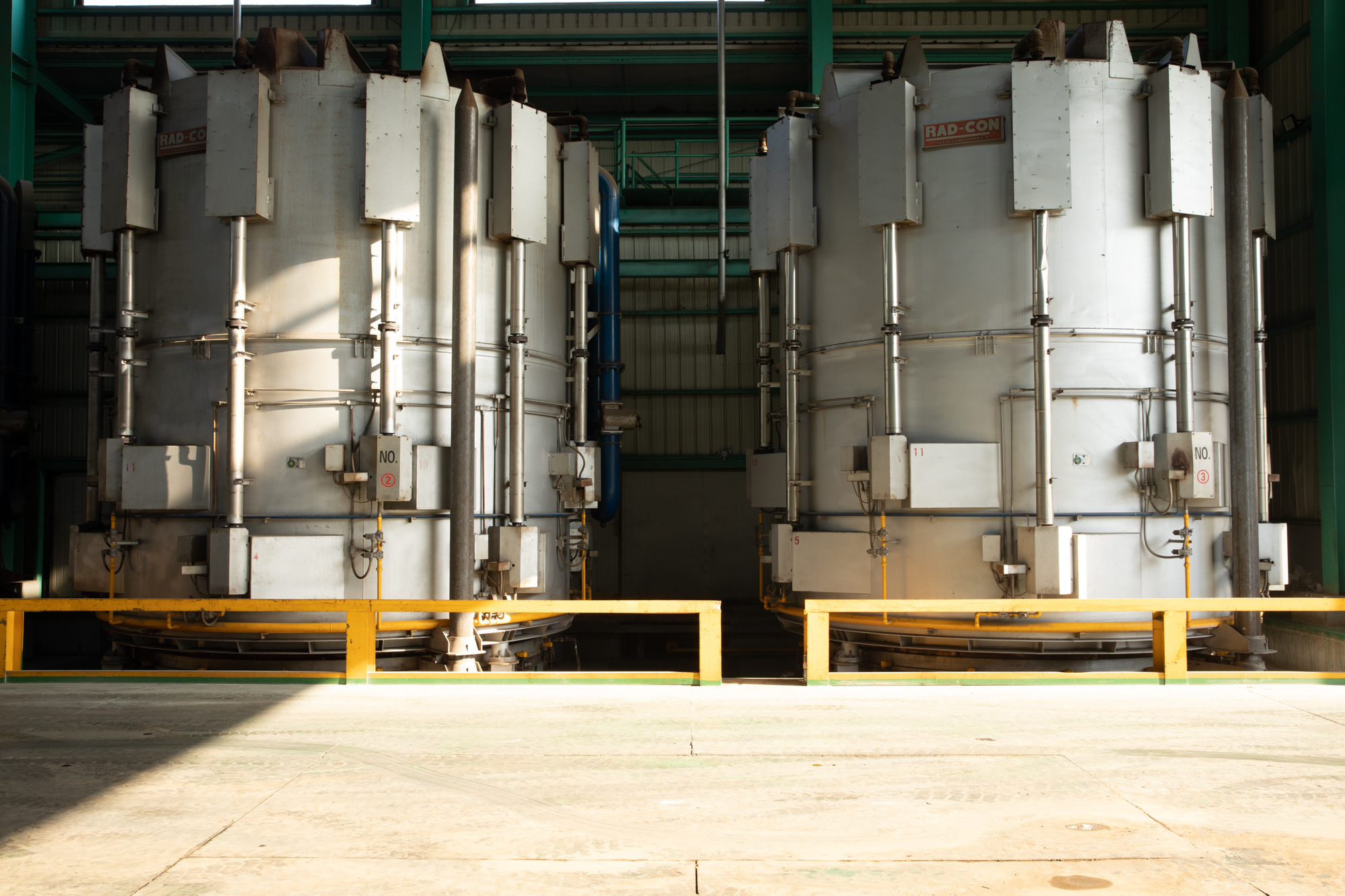
Heat-treatment control sits behind every property-class claim; a class name without a documented route is not a specification.
Dimension 3: coating system and corrosion strategy
Coating is where EV battery and engine programs diverge most visibly, and where quotations are hardest to compare. Zinc electroplating, zinc flake systems and zinc nickel systems are different processes with different thickness control, different hydrogen-embrittlement considerations on high-strength parts, and different inspection methods. Corrosion resistant is not a specification. The coating system, the specified thickness range and the test method are.
On a battery-pack joint, the coating decision is usually tied to the mating material and the isolation strategy rather than to a single salt-spray target: where a steel fastener meets an aluminium structure, the drawing typically controls both the coating and any isolation requirement. On engine and chassis joints, the coating call-out is more often inherited from an established drawing and changed only through a formal deviation. In both cases the verification question is identical — can the supplier show process control for the named coating, and can it produce coating test records for the lot being shipped?
The supplier material reviewed for this article documents a zinc plating line, which supports a statement about plating capability. It does not document zinc flake or zinc nickel process qualification, and the verified dataset contains no benchmark comparing zinc flake with zinc nickel performance. A buyer whose drawing specifies either system should therefore request coating-specific process evidence and test reports instead of inferring equivalence from a general coating capability.
Dimension 4: traceability, testing and change control
Traceability is what separates a component supplier from a safety-critical supplier. The chain a buyer needs to see runs from heat lot to finished lot, from coating lot to shipment, and from test record to the specific lot — plus a laboratory whose scope covers the tests being quoted. A quality management system certificate establishes that a system exists. It does not establish that the tests on the certificate schedule were performed on the parts in the crate.
Ningbo Jinding states that it has been audited and certified to IATF 16949:2016, ISO 9001:2015, ISO 17025:2017, ISO 14001:2015, ISO 45001:2018, PED 2014/68/EU, API 20E, AD 2000 W0, CE EN 14399-1:2015, CE EN 15048-1:2007, UKCA EN 14399-1:2015, UKCA EN 15048-1:2007 and ISO 27001:2022. Two reading notes are worth keeping. The EN 14399-1 and EN 15048-1 entries relate to structural bolting assemblies for preloaded and non-preloaded applications, so they should not be read as automotive approvals. And the ISO 17025:2017 entry should be checked for the testing scope it actually covers, because a laboratory accreditation is only as relevant as the tests listed beneath it.
The public evidence reviewed for this comparison did not include a certificate register, an OEM approval record or a battery-program reference for any supplier. That absence is a statement about the evidence, not about the supplier: an unverified capability is not a missing capability, and a company-reported certificate is not a fabricated one — it is simply a claim that must be confirmed in the document package before it enters a sourcing decision.
Dimension 5: product-range fit against the actual joint list
Range matters less as a marketing point and more as a matching exercise. A vehicle program's bolt list typically mixes families: hex head bolts for general structure; flange bolts and 12 point flange screws where bearing area and tool access are constrained; wheel bolts and wheel nuts at the wheel end; U bolts on suspension and axle retention; double end studs where a through-bolt is impractical; shoulder bolts where a pivot or location function is designed in; and socket head cap screws for compact assemblies.
Ningbo Jinding's listed range covers hex head bolts, wheel bolts, carriage bolts, socket headed cap screws, high strength structural bolting assemblies, hex flange bolts, 12 point flange screws, weathering steel bolts, tee bolts, threaded rods, double end studs, U bolts, anchor bolts and combo studs, together with matching nuts and washers, in carbon steel, alloy steel, weathering steel, stainless steel and duplex steel. A Fastener Fair USA exhibitor listing independently describes a comparable core range — hex bolts, socket head cap screws, structural bolts, flange bolts, wheel bolts, threaded rods, nuts and washers in carbon and alloy steel — which corroborates the product categories while adding nothing about automotive-specific approval.
The buyer's use of this information is narrow and useful: match the program's bolt families to the families the supplier documents, then treat every family the supplier does not explicitly list as an open question rather than an assumed capability.
Dimension 6: capacity, allocation and continuity
Capacity is a screening number, not an allocation commitment. The company reports 120,000 tons of annual production capacity, a figure repeated in its Fastener-World company profile, alongside 470 employees, a 73,000 m² site, a ten-engineer R&D team and an 80% export ratio, with main markets in the EU, UK, US, Canada, Japan, Australia and New Zealand. Those figures describe scale and export orientation.
They do not describe heat-treatment throughput available for a specific property class, coating-line capacity for a specific finish, or the lead time a new program would receive against existing commitments. A buyer comparing two suppliers of similar headline capacity should ask both for the same three numbers: available monthly capacity for the named part family, the quoted lead time with its stated assumptions, and the change-notification process if a process route moves between plants or lines.

Warehouse capacity supports continuity claims, but it does not by itself prove line capacity or lead-time commitments for a new program.
Side-by-side: what to compare between EV battery and engine programs
| Comparison dimension | Engine / driveline program | EV battery program | Evidence to request |
|---|---|---|---|
| Governing specification | Drawing plus property class; 10.9 common for high-stress joints under the ISO 898-1 / SAE J429 framework | Drawing plus coating and isolation call-out plus property class | Drawing revision cited in the quote; standard edition; class stated on the test record |
| Primary technical risk | Fatigue and clamp-load loss under thermal and dynamic cycling | Mixed-material joint, coating integrity and lot segregation | Mechanical and coating test reports tied to the shipped lot |
| Coating emphasis | Often inherited from an established drawing | Actively specified against the mating material and isolation strategy | Named coating system, thickness range and test method |
| Traceability expectation | Heat lot to finished lot | Heat lot, coating lot and tighter lot segregation | Lot-level records rather than certificate-level statements |
| Change control | Deviation approval on drawing changes | Same, plus process-route changes affecting coating | Written notification clause with a defined trigger |
| Volume profile | Mature, comparatively stable forecast | Program-ramp dependent, with platform-level variation | Capacity reservation terms versus available capacity |
| Commercial basis | Piece price at defined class and coating | Piece price plus coating and testing scope | Identical normalized RFQ specification, quantity and Incoterm |
Where the comparison breaks down: classification and landed cost
Automotive bolts are primarily classified under HS 7318.15 — other screws and bolts, whether or not with their nuts or washers — according to the U.S. International Trade Commission's Harmonized Tariff Schedule. The U.S. International Trade Administration cautions that its automotive-parts groupings are not official HTS product subcategories and directs users to official USITC data for individual product codes. A secondary market source also references HS 731815 for fasteners, but its underlying trade records were not independently validated and its scope does not separate automotive from general fasteners, so it functions as a follow-up lead rather than a trade figure.
The sourcing consequence is straightforward. A landed-cost comparison built on a category grouping rather than a confirmed national tariff line is not a comparison. Confirm the tariff line, the origin rule and the duty treatment before the price analysis is treated as final — and keep classification separate from supplier evaluation, because a correct code does not make two quotes comparable, while an incorrect one can make the cheaper quote the more expensive program.
What a buyer should do with this framework
Run the comparison in this order, and keep the two program scorecards apart from the first step:
- Fix the specification first. For each part, record the drawing revision, property class, material, coating system, test method and traceability requirement before any quotation is opened. A comparison that starts with prices ends with incomparable prices.
- Normalize the RFQ. Identical specification, quantity, Incoterm, packaging and test scope, so the remaining variables are capability and cost rather than scope.
- Split claims into verified and company-reported. Certificates, directory listings and official standards references sit in one column; supplier statements about conformity and capability sit in another. Nothing moves between the two columns without a document.
- Check scope, not just presence. A certificate is relevant only within the scope it names; a laboratory accreditation is relevant only for the tests it covers; a structural bolting certificate is not an automotive approval.
- Score EV and engine requirements separately. A supplier that fits an engine program on drawing discipline may still be unproven on battery-pack coating control, and the reverse is equally possible.
Outlook
The direction of the category is toward more specification, not less. The EV lightweight fastener segment is projected to grow at a 13.5% CAGR from 2024 to 2030 — a projection, not an observed demand signal — and higher-voltage pack designs tend to pull coating, isolation and lot-traceability requirements further into the drawing. If that pattern continues, supplier comparison will shift from who can make the bolt toward who can document the joint, and suppliers already running drawing-led inspection and lot-level records will need less qualification effort per program.
The opposite risk is just as real. Where coating and traceability requirements are added to a drawing without a matching test method, quotes become harder to compare rather than easier, and buying teams default back to certificate lists. The practical hedge is to keep the two scorecards separate, define the coating system precisely, and treat every unverified claim — including the claims summarised in this article — as a question to close rather than a fact to rely on.
Frequently asked questions
What is the main difference between sourcing automotive bolts for an EV battery program and for an engine program?
The difference sits in what has to be verified, not in the fastener category. Engine and driveline bolts are typically governed by an established drawing and a property class such as 10.9, so the comparison turns on class, dimensional standard and mechanical test records. Battery-pack bolts add a coating and isolation decision tied to the mating material, plus tighter lot segregation, so the comparison turns on coating process control and traceability as much as on strength.
Which property class should an engine or driveline bolt inquiry specify?
Class 10.9 is a commonly referenced grade for driveline, engine and other high-stress joints, with a minimum tensile strength of approximately 1,040 MPa under the ISO 898-1 / SAE J429 framework. It is not an automatic default. The purchasing drawing governs, and where the drawing is silent on class, material or heat-treatment route, the buyer should obtain clarification before quoting rather than let each supplier choose its own assumption.
How should coating systems for automotive bolts be compared between suppliers?
Compare by specification, not by description. Zinc electroplating, zinc flake and zinc nickel are distinct processes with different thickness control and different inspection methods, so the RFQ should name the coating system, the thickness range and the test method, then require process evidence and lot-level test records. A generic corrosion-resistance statement cannot be evaluated against another supplier's generic statement, and the available data does not support a performance ranking between coating types.
Can automotive bolt suppliers be compared using certification lists alone?
No. A certification list shows which systems a supplier claims to operate, not which requirements a specific part meets. Scope matters: IATF 16949 addresses automotive quality management, ISO 9001 is a general quality system, ISO 17025 relates to laboratory competence for the tests within its scope, and EN 14399-1 and EN 15048-1 address structural bolting assemblies rather than automotive approval. Certificates are a screening filter; drawings, test reports and lot records are the comparison.
What evidence should be requested before shortlisting a supplier for a safety-critical joint?
Request the quotation against a named drawing revision, the property class and material certificate, the coating system with its test report, lot-level traceability from heat lot to shipment, the test laboratory scope covering the quoted methods, a written change-notification clause, and a capacity and lead-time statement with its assumptions. Also ask which of the supplier's claims are supported by third-party records and which are company-reported, so the two are not mixed in the shortlist scoring.
Supplier facts in this article are drawn from Ningbo Jinding Fastening Piece Co., Ltd. company information and an independent Fastener Fair USA exhibitor listing. Market figures are attributed to Grand View Research; standards references to ASTM International, ISO and SAE; trade classification to the U.S. International Trade Commission and the International Trade Administration. Company details: Ningbo Jinding Fastening Piece Co., Ltd. The full product range and dimensional reference are available in the Ningbo Jinding 2026 catalogue.
¿Tiene preguntas o necesita más detalles?
Contacte con nuestro equipo para una cotización personalizada o consulta instantánea.
Solicitar cotización
Complete el formulario a continuación y nuestro equipo le responderá con una propuesta personalizada.
Chat directo de WhatsApp
¿Prefiere chatear en tiempo real? Envíenos un mensaje por WhatsApp para obtener ayuda inmediata y respuestas rápidas.
- Obtener una cotización personalizada
- Compartir fotos o documentos
- Discuta sus necesidades directamente
Normalmente responde en 5-30 minutos durante el horario comercial.