
Hotel Project Sofa Fabric: OYD3626, OYD3229 and OYD3618
Hotel Project Sofa Fabric: OYD3626, OYD3229 and OYD3618
A hotel project rarely makes one sofa fabric decision. It makes three or four: guestroom seating, lobby and lounge seating, food and beverage seating, and the beds or soft headboards that sit between them. Treating those surfaces as a single purchase is one of the most common reasons a fabric that reads correctly in a sample folder looks tired two years into operation.
This article narrows the field to three OYD Textile models — OYD3626, OYD3229 and OYD3618 — and explains what each one is, which hotel scenario it suits, how their certifications and performance figures compare, and where the shortlist stops being useful.
OYD Textile (Haining OuYuda Textile Co., Ltd.) is a sofa fabric and upholstery fabric manufacturer based in Haining, Zhejiang, China. The company was established in 2017, has accumulated 25 years of fabric manufacturing experience, operates a 35,000 m² facility equipped with more than 100 weaving and knitting machines, and reports an annual production capacity of 13,000,000 metres. Its product portfolio covers chenille, woven, linen, velvet, circular knit, jacquard and outdoor upholstery fabrics.
Why hotel fabric selection starts with the room plan, not the colour card
Upholstery wear in a hotel is not distributed evenly. A guestroom sofa may see a few hours of seated use per day and regular vacuuming, while a lobby chair sees continuous contact with luggage, outerwear, food service trays and cleaning chemicals across three shifts. Two surfaces in the same colour scheme can therefore have very different service requirements.
The practical consequence for a procurement team is that a single fabric is rarely the right answer for a whole property. A workable hotel specification usually contains at least one fabric chosen for surface area and colour continuity (guestrooms, corridors, long banquettes), one chosen for contact intensity (lobby, lounge, bar seating), and one chosen for visual weight (suites, restaurants, feature seating). The three models in this shortlist map onto those three jobs rather than competing for the same one.
The shortlist at a glance
| Model | Construction | Composition | Weight | Width | Colourways | Certifications listed | Typical hotel role |
|---|---|---|---|---|---|---|---|
| OYD3626 | Chenille, plain | 100% polyester | 350±10 GSM | 142±2 cm | 27 | OEKO-TEX, GRS | Guestroom sofas, bed frames, large soft panels |
| OYD3229 | Boucle, woven, high-density | 90% polyester / 10% acrylic | 620±10 GSM | 142±2 cm | 7 | OEKO-TEX, GRS | Lobby and lounge accent chairs, high-contact seating |
| OYD3618 | Jacquard velvet | 100% polyester | 450±10 GSM | 142±2 cm | 27 | OEKO-TEX, GRS (per product record) | Food and beverage seating, suites, feature sofas |
Reading the table: GSM means grams per square metre and describes fabric weight per unit area. It is a useful comparative indicator within one construction family, but it is not a durability score. Abrasion behaviour also depends on fibre type, weave density, yarn structure and finishing, which is why weight alone should never be the deciding specification.
OYD3626: the chenille plain for guestrooms and long soft panels
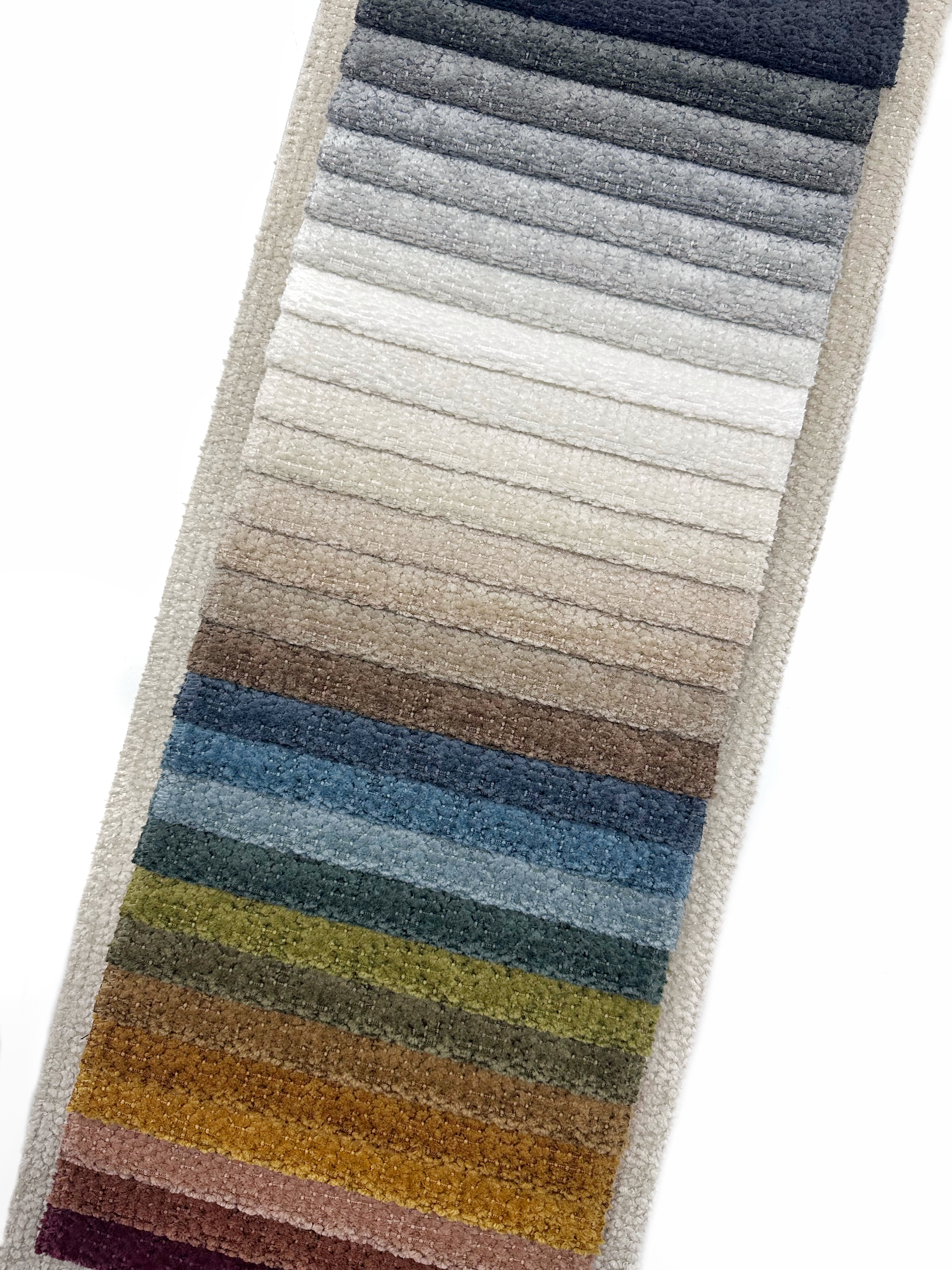
OYD3626 is a chenille plain fabric made of 100% polyester, with a width of 142±2 cm and a weight of 350±10 GSM. It is offered in 27 colourways. The fabric is described as water-repellent, stain-resistant and easy to clean, and it carries fire-retardant performance. It holds OEKO-TEX certification for safe textile and GRS (Global Recycled Standard) certification for sustainable recycled material. Its stated applications include modern-style sofas and beds, indoor upholstery and home decor, and hotel projects.
Three characteristics make this model the natural base layer of a hotel specification. First, 27 colourways is the widest range in the shortlist, which matters when a property needs a continuous colour logic running from guestroom seating through corridor benches to soft headboards without switching suppliers mid-scheme. Second, chenille construction gives a soft handfeel that reads as comfortable rather than decorative — appropriate for the surface a guest actually sits on. Third, the water-repellent and stain-resistant finish reduces the frequency of spot-cleaning interventions, which is the maintenance cost hotel operators feel most directly in the first two years.
Where this model asks for judgement is contact intensity. At 350±10 GSM it is the lightest of the three, and that is a deliberate trade: a lighter, drapier fabric follows curves and shaped upholstery more easily and uses less material per cover. In a lobby where the same chair edge is abraded daily, a specifier may reasonably prefer the heavier construction covered next.
OYD3229: the boucle for high-contact public seating
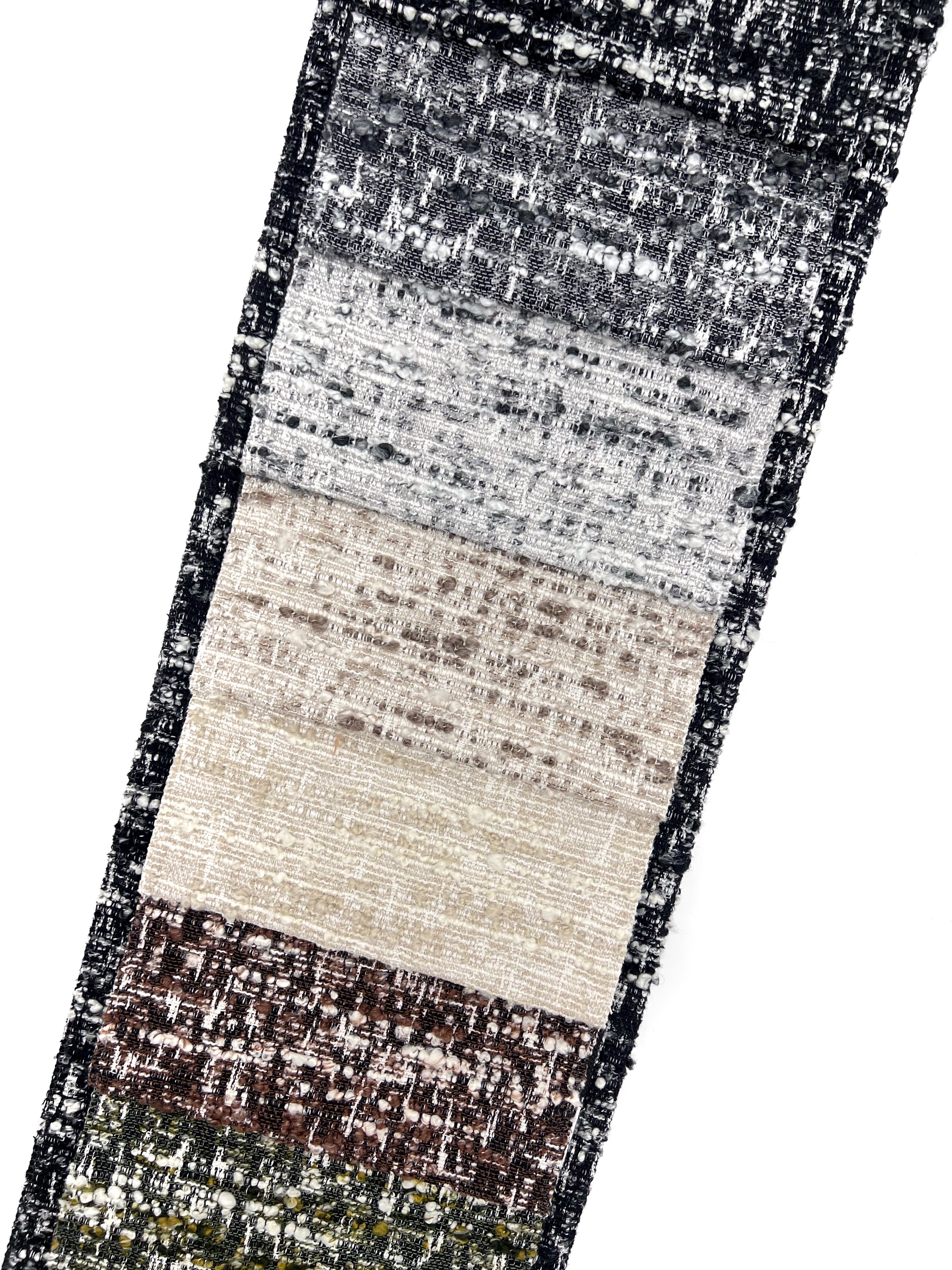
OYD3229 is a woven boucle sofa fabric composed of 90% polyester and 10% acrylic, with a weight of 620±10 GSM and a width of 142±2 cm. It is a heavy-weight, high-density boucle weave, available in 7 classic colourways. OYD Textile describes the model as delivering outstanding abrasion resistance and premium tactile quality. It holds OEKO-TEX and GRS certification and is positioned for high-end Italian-style accent chairs and high-end furniture upholstery across furniture manufacturing, fabric wholesale, interior design, home decor and hotel projects.
The 620±10 GSM figure is the highest in this shortlist, and it changes how the fabric behaves in a hotel. Heavier, denser weaves hold their shape on fixed and semi-fixed seating, resist the flattening that appears on chair arms and seat fronts, and give the visual density that public areas tend to need. For lobby chairs, lounge seating and bar stools — surfaces that receive repeated contact from bags, belts and clothing — this is the most defensible choice of the three.
The acrylic content is also worth noting at specification stage. A 90/10 polyester-acrylic blend is a common route to a softer, fuller boucle handfeel than an all-polyester loop, and it is one reason the model is described as premium in touch rather than merely heavy. Buyers who need a single-fibre construction for internal recycling or end-of-life reasons should flag that requirement early, because it narrows the field.
OYD3618: the jacquard velvet for visual weight
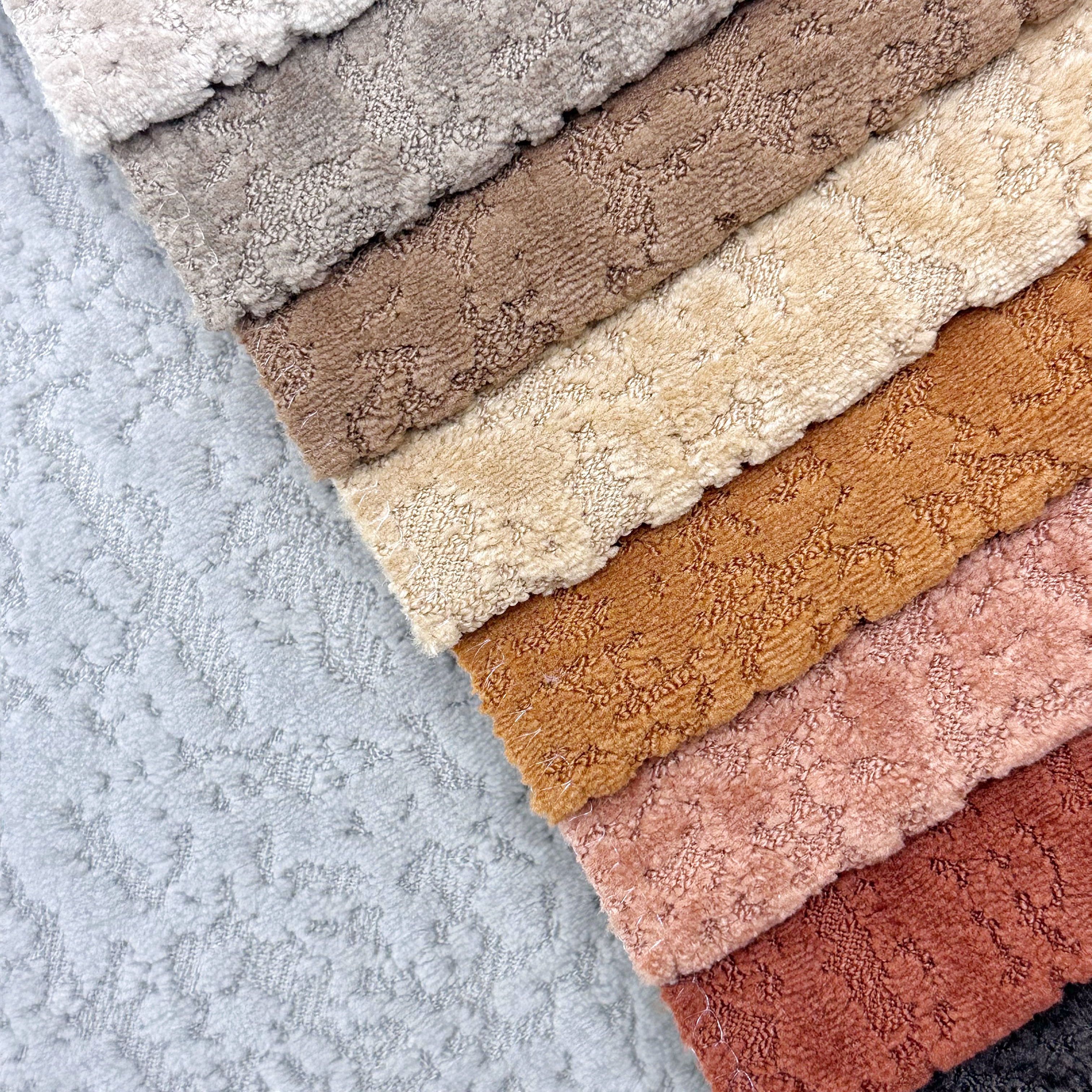
OYD3618 is a jacquard velvet sofa fabric made of 100% polyester, with a weight of 450±10 GSM and a width of 142±2 cm. It is available in 27 colourways with a timeless classic design, and it is intended for upholstery on large sofas and soft upholstered beds across furniture manufacturing, fabric wholesale, interior design, home decor and hotel projects. The model is listed with OEKO-TEX certification, and its product record also lists GRS.
Velvet earns its place in a hotel scheme for a reason that has nothing to do with softness: pile fabrics absorb light unevenly, which produces depth and colour variation that flat weaves cannot reproduce. In an all-day dining room, a lobby bar or a suite sitting area, that visual weight is often the difference between a space that reads as designed and one that reads as furnished.
The practical trade is handling discipline. Pile fabrics have a direction, and panels cut in different directions can read as different shades under directional lighting. That is a cutting-room requirement rather than a fabric defect, but it needs to be written into the upholsterer's instruction, not discovered on site. At 450±10 GSM the model sits between the other two in weight, which keeps it workable on both large sofa frames and soft beds while giving more body than a light velvet.
Matching the three models to hotel zones
| Hotel zone | Wear and cleaning profile | Recommended model | Reasoning |
|---|---|---|---|
| Guestroom sofa and bed | Moderate traffic, frequent vacuuming, occasional spot cleaning | OYD3626 | Light, drapier chenille; 27 colourways supports room-to-room continuity |
| Corridor bench and fixed banquette | Long spans, low seated dwell time, high visual exposure | OYD3626 | Colour continuity across long runs; easy-clean finish |
| Lobby and lounge seating | Continuous daily contact, luggage and outerwear abrasion | OYD3229 | 620±10 GSM high-density weave; described abrasion resistance |
| Bar and counter stools | High contact, frequent cleaning cycles | OYD3229 | Dense construction holds shape on small, heavily used surfaces |
| All-day dining and restaurant | Food and drink contact, strong visual expectation | OYD3618 | Pile depth reads richly under low and decorative lighting |
| Suite and premium lounge | Lower traffic, design expression prioritised | OYD3618 | Jacquard velvet adds visual weight without extra furniture cost |
What the certifications actually tell a hotel buyer
Certification language is frequently misread at tender stage. The two credentials carried across this shortlist do different jobs, and neither one is a general performance guarantee.
OEKO-TEX is a testing and certification system for textiles, and in OYD Textile's product documentation it is presented as certification for safe textile. For a hotel buyer it is primarily a human-safety and material-control signal — relevant to guest-facing upholstery and to procurement policies that require documented textile testing.
GRS (Global Recycled Standard) is a standard for recycled content. Its relevance in a hotel project is usually on the owner's side rather than the guest's: it supports sustainability reporting and can be a condition in green-building or brand-standard procurement. OYD3626, OYD3229 and OYD3618 are all listed with GRS in their product records.
Fire-retardant performance sits in a different category. The three models are described as carrying fire-retardant performance as a product property. That is not the same as a project-level fire certificate. Hotel fire requirements are set by the jurisdiction, the building type and the operator's own standard, and the evidence accepted is defined by those rules rather than by the fabric description. The United Kingdom illustrates how those rules move: the Furniture and Furnishings (Fire) (Safety) (Amendment) Regulations 2025 came into force in October 2025, removing the display label requirement and focusing on permanent labels, according to the UK Government's Department for Business and Trade. Buyers specifying for UK properties should confirm the current labelling and testing position with their fire consultant rather than relying on an older specification template.
The practical action is the same in every market: request the certificate scope for the specific model and colourway, confirm which test standard was applied, and check that the document is current. A certificate that covers a fabric family is not automatically evidence for the exact colour a designer selected.
Performance comparison: where weight helps and where it stops helping
Placed side by side, the three models describe a clear performance gradient. OYD3229 at 620±10 GSM with a high-density boucle weave is the most substantial surface. OYD3618 at 450±10 GSM with a jacquard velvet construction sits in the middle. OYD3626 at 350±10 GSM with a chenille plain is the lightest and most pliable.
That gradient maps onto handling rather than simply quality. Higher-weight fabrics generally require more material per cover, more careful cutting and heavier sewing equipment; lighter fabrics generally conform more easily to shaped frames, curved arms and tight upholstery. A project that specifies the heaviest fabric everywhere may find its workshop slower on shaped pieces and its material cost higher, without a matching gain in the areas that are rarely touched.
Colour range follows the same logic. OYD3229 offers 7 classic colourways, which is appropriate for accent and feature seating but constrains a scheme that needs many coordinated tones. OYD3626 and OYD3618 both offer 27, which is what makes them usable as the connective tissue of a property-wide palette.
Where this shortlist stops
A shortlist is only useful if its boundaries are stated. Four limits apply to OYD3626, OYD3229 and OYD3618.
- They are indoor fabrics. All three are intended for indoor upholstery and home decor scenarios. Pool decks, terraces, outdoor lounges and garden seating require a different product category within OYD Textile's range, and substituting an indoor fabric into a semi-exposed area is a maintenance decision rather than a specification one.
- Fire performance needs project verification. As noted above, the models carry fire-retardant performance as a stated product property. Whether that satisfies a specific hotel's fire strategy depends on the jurisdiction, the test standard required and the operator's own specification. This is a verification step, not an assumption.
- Colour range is uneven. OYD3229's 7 colourways are a real constraint for any scheme that depends on many coordinated tones. It is best deployed as an accent fabric, with OYD3626 or OYD3618 carrying the broader palette.
- Order thresholds matter on small refurbishments. Typical MOQ ranges from 500–1000 metres per colour, with a stable lead time of 20–30 days upon deposit receipt. A single-floor refresh or a boutique property with a small furniture count may fall below that threshold and should confirm stock availability and minimums before finalising a scheme.
One further caution applies to abrasion claims in general. OYD Textile describes OYD3229 as delivering outstanding abrasion resistance, and that description is a reasonable starting point for a shortlist — but a hotel buyer should still request the test report for the specific colourway rather than treating a product description as a test result.
A procurement sequence for a three-fabric hotel specification
- Map zones before selecting fabrics. List every upholstered surface by zone and assign a contact-intensity band. This prevents a lobby fabric being used in guestrooms purely because it photographed well.
- Assign the base fabric first. Choose the model that carries the largest surface area and widest colour logic — here, OYD3626 across guestrooms, corridors and soft panels.
- Assign the high-contact fabric second. Match the lobby and bar seating to a heavier construction, then confirm the colourways available in that model actually sit inside the design palette.
- Add the feature fabric last. Select velvet or textured surfaces for the spaces where visual weight matters, and confirm the cutting-direction instruction with the upholsterer at the same time.
- Verify certification against the specific colourway. Confirm OEKO-TEX and GRS documentation for each selected colour, not only for the model family.
- Confirm fire evidence with the project's fire consultant. Do this before the fabric is ordered, not after the furniture is delivered.
- Request samples and run a physical review. OYD Textile offers free fabric samples for evaluation before bulk order. Review handfeel, colour under the project's actual lighting, and behaviour when folded around a frame corner.
- Lock quantities, MOQ and lead time. Confirm per-colour volumes against the 500–1000 metre typical minimum and schedule the 20–30 day production window against the furniture delivery plan.
Market context: why fabric specification is getting more technical
The commercial backdrop explains why hotel buyers are being asked to justify fabric choices with more than a mood board. Grand View Research estimates the global sofa market at $244.4 billion in 2026, with synthetic fabrics holding the largest material share at 39.8%. Within that, Dataintelo values the furniture performance fabric segment — stain-resistant, high-durability textiles — at $4.8 billion in 2025, with polyester holding a 38.4% material share.
The supply side is equally relevant for buyers sourcing from Asia. China's exports of textile yarns and fabrics reached $130.01 billion from January to November 2025, a 0.9% year-on-year increase, according to China Customs data reported by Threadify Analytics. A supply base of that scale gives buyers choice, but it also means fabric quality and documentation vary widely between suppliers — which is precisely why model-level specifications and named certifications have become standard tender requirements rather than optional extras.
Two directions follow from this. First, performance features that were once premium — water repellency, stain resistance, documented recycled content — are becoming baseline expectations in mid-market hotel projects, not differentiators reserved for luxury tiers. Second, regulatory attention to upholstered furniture fire safety continues to shift toward permanent labelling and traceable evidence, as the UK amendment illustrates. Both trends favour suppliers who can present a model number, a specification, and a certificate that matches the delivered colour.
Frequently asked questions
What is the difference between chenille, boucle and jacquard velvet sofa fabrics?
They differ in construction and surface. Chenille is a soft, pliable fabric with a velvety handle, represented here by OYD3626 at 350±10 GSM in 100% polyester. Boucle is a woven fabric with a textured, looped surface, represented by OYD3229 at 620±10 GSM in a 90% polyester / 10% acrylic blend. Jacquard velvet is a pile fabric woven with a patterned structure, represented by OYD3618 at 450±10 GSM in 100% polyester. The practical difference in a hotel is how each behaves under contact and how each is cut and maintained, not simply how each looks.
How many colourways does each model offer, and why does that matter?
OYD3626 is offered in 27 colourways, OYD3618 in 27 colourways, and OYD3229 in 7 classic colourways. Colour range determines whether a model can carry a property-wide palette or only an accent role. A 27-colour range supports continuity across guestrooms, corridors and public areas; a 7-colour range is better suited to feature seating where a small number of coordinated tones is sufficient.
Does a fire-retardant fabric automatically meet a hotel's fire specification?
No. Fire-retardant performance on these models is a stated product property. Hotel fire requirements are defined by the jurisdiction, building type and operator standard, and the accepted evidence is set by those rules. The United Kingdom's Furniture and Furnishings (Fire) (Safety) (Amendment) Regulations 2025, in force from October 2025, removed the display label requirement and focused on permanent labels, which shows how labelling and evidence requirements change over time. Buyers should confirm the applicable standard and documentation with the project's fire consultant.
What are the minimum order quantity and production lead time?
Typical MOQ ranges from 500–1000 metres per colour, with a stable lead time of 20–30 days upon deposit receipt. Custom patterns, colours or width adjustments are supported through OEM and ODM services, and those requirements are confirmed case by case before an order is placed. Small refurbishments should verify minimums against actual per-colour volumes early in the specification process.
Can the same fabric be used on both sofas and beds?
OYD3626 and OYD3618 are both described as suitable for sofas and soft upholstered beds, which makes them usable across seating and bed frames within a guestroom. OYD3229 is positioned for high-end accent chairs and high-end furniture upholstery, so it is more typically specified on feature seating than on bed surfaces.
Summary
For a hotel project, the useful question is not which of these three fabrics is best, but which surface each one is best for. OYD3626 carries the base layer: guestroom sofas, beds, corridor benches and long soft panels, supported by 27 colourways and an easy-clean finish. OYD3229 carries the contact layer: lobby, lounge and bar seating, where a 620±10 GSM high-density boucle weave is the more defensible choice. OYD3618 carries the visual layer: restaurants, bars and suites, where jacquard velvet adds depth that flat weaves cannot match.
All three share OEKO-TEX and GRS listings and stated fire-retardant performance, and all three sit within a manufacturer that reports 95% export share across more than 30 countries. None of them is an outdoor fabric, none of them removes the need for project-level fire verification, and only two of the three offer the colour breadth a property-wide palette usually requires. Specifying within those boundaries is what turns a shortlist into a workable hotel specification.
OYD Textile's product selection brochure, including model references and specifications, is available for download: OYD Textile Best Selection (PDF).
¿Tiene preguntas o necesita más detalles?
Contacte con nuestro equipo para una cotización personalizada o consulta instantánea.
Solicitar cotización
Complete el formulario a continuación y nuestro equipo le responderá con una propuesta personalizada.
Chat directo de WhatsApp
¿Prefiere chatear en tiempo real? Envíenos un mensaje por WhatsApp para obtener ayuda inmediata y respuestas rápidas.
- Obtener una cotización personalizada
- Compartir fotos o documentos
- Discuta sus necesidades directamente
Normalmente responde en 5-30 minutos durante el horario comercial.