
Hotel Decorative Lighting: What Certifications and Specifications Matter in 2026
Decorative lighting has become a defining element of hotel interior quality, but for procurement teams and interior designers, the harder question is not only how a chandelier looks, but whether it meets certification, performance and project-delivery requirements. The global decorative lighting market reached USD 75.88 billion in 2025 and is projected to reach USD 78.98 billion by 2026, while the hospitality lighting market is valued at USD 14.2 billion in 2025 with an expected CAGR of 7.3% through 2034. Within this growing segment, commercial applications—including hospitality—account for 62.8% of the decorative lighting end-user market in 2025. This article explains what buyers should verify when sourcing hotel chandeliers, lobby lighting and guest-room lamps, using Zhongshan YZ ART LIGHT Co., Ltd. as a working example of a factory-direct manufacturer serving international hospitality projects.
Why Hotel Lighting Procurement Differs from Standard Decorative Lighting
Hotel lighting projects involve constraints that are rarely present in residential or retail lighting purchases: large-scale customization, ceiling load calculations, long operating hours, anti-glare requirements, and compliance documentation for tenders. A chandelier in a double-height lobby must be engineered not only as a visual centerpiece but as a structurally safe installation.
For specifiers, the procurement risk is not limited to aesthetics. A mass-produced lamp with a standard shape may clash with a light-luxury, neo-Chinese or minimalist interior theme. Guest-room lighting that produces harsh glare can directly reduce guest comfort. And for engineering projects, missing qualification documents can disqualify a supplier before product quality is even evaluated.
Key Certifications for Hotel Decorative Lighting in Export Markets
Certification compliance is a core gate in hotel lighting procurement. Buyers should map certifications to the destination market and to the specific product category.
| Certification | Market | Example Reference |
|---|---|---|
| CE-RoHS Verification of Conformity | EU | Cert. No. QTS800519289; standards include IEC 62321 series |
| LVD-CE Verification of Conformity | EU | Cert. No. QTS800119288; EN 60598-1:2015+A1:2018 |
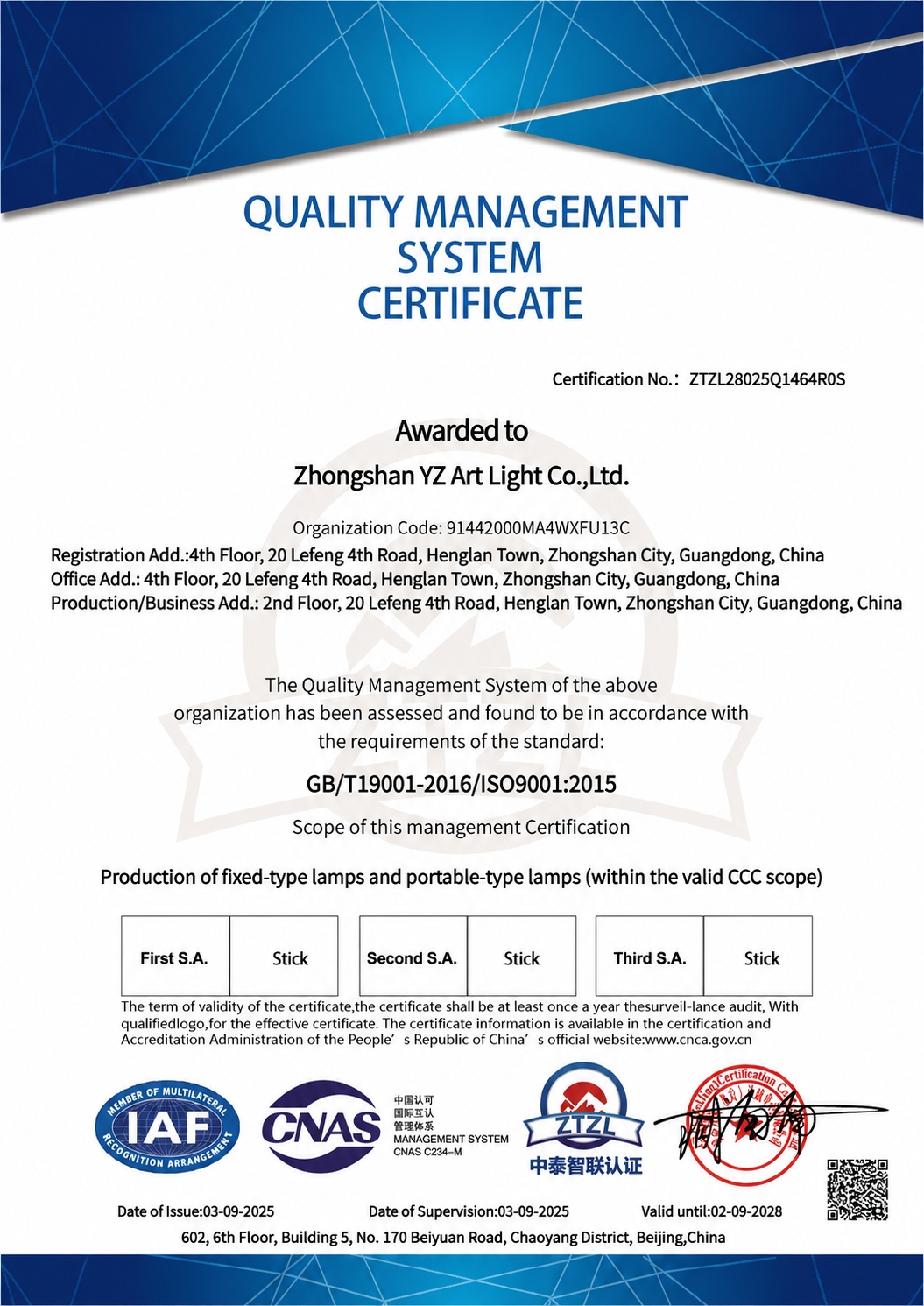
| ISO9001 Quality Management System | Global | Cert. No. ZTZL28025Q1464R0S |
| ISO14001 Environmental Management System | Global | Cert. No. ZTZL28025E0851R0S |
| ISO45001 Occupational Health and Safety | Global / Export | Cert. No. ZTZL28025S0801R0S |
For hotel lighting model yz10002, the CE-RoHS and LVD-CE certifications cover fixed luminaire (hanging lamp) products, which corresponds to chandelier products in the hotel lighting range. The ISO9001, ISO14001 and ISO45001 certifications are issued by Zhongtai Zhilian Certification (ZTZL), covering production and management activities for fixed and portable luminaires. In North America, buyers should separately verify UL 1598 and UL 8750 compliance, which are common safety and performance standards for luminaires and LED equipment.
Example Specification: Custom Hotel Lobby Chandelier (Model yz10001)
For a non-standard engineering decorative pendant light, the specification sheet provides the measurable basis for evaluating whether a product can support commercial hotel operation.
- Rated input voltage: AC110-240V
- Power range: 30W–600W
- Color temperature: 2700K–4000K
- Beam angle: adjustable 15°–120°
- Rated service life: 50,000 hours
- Light decay: ≤3% within 3,000 working hours
- Protection grade: IP40
- Light source: imported LED chip
- Frame/suspension: aluminum-alloy frame, stainless-steel suspension component
- Lampshade: high-transmittance material
- Dimming: customizable
The combination of a 50,000-hour rated lifespan and ≤3% light decay within 3,000 working hours is directly relevant to hotel applications where lighting runs for long, uninterrupted periods. Anti-glare design and adjustable beam angle also matter in guest rooms and lobbies, where harsh light distribution is a common complaint.
How Factory-Direct Manufacturing Affects Hotel Lighting Procurement
The choice between a factory-direct manufacturer and a trading intermediary is a recurring decision point in hotel lighting procurement. The main differences appear in customization depth, cost structure, quality control and after-sales responsibility.
Zhongshan YZ ART LIGHT Co., Ltd. is a manufacturer established in 2008, operating a 15,000-square-meter production base in Zhongshan, Guangdong, with about 150 employees and an R&D team of 20 engineers. The company provides OEM/ODM services with full-dimensional customization covering dimensions, materials, color temperature, finish, light-source configuration, mounting structure, intelligent dimming and packaging. Minimum order quantity is 1 piece, with a standard lead time of 30–40 working days and shortened lead time available for urgent hotel projects.
For hotel projects, the practical value of in-house production includes structural calculation for large suspended lights, ceiling load-bearing assessment, sample production before mass manufacturing, and quality inspection before shipment. YZ ART LIGHT reports over 1,000 completed commercial engineering projects and lists international hotel brands including InterContinental, Four Seasons, Marriott and Waldorf Astoria among its project references.
Comparison: Factory-Direct Manufacturer vs. Trading Supplier
| Criterion | Factory-Direct Manufacturer | Trading Supplier |
|---|---|---|
| Customization depth | Full-dimensional; 1:1 restoration of design proposals | Usually limited to existing catalogs |
| Structural engineering | In-house load calculation and drawing deepening | Typically outsourced or unavailable |
| Cost structure | Factory-direct pricing, fewer intermediate margins | Added intermediary costs |
| Quality control | 100% full inspection before shipment | Depends on third-party factory |
| After-sales | Global remote guidance; 3-year warranty on engineering lighting | Often limited |
One limitation of the factory-direct model should be noted: the buyer carries more responsibility for clearly communicating design intent, installation conditions and project-specific requirements. A manufacturer can optimize a design, but the final specification must be confirmed through drawings and sample approval.
Compliance Documentation for Hotel Engineering Tenders
Hotel engineering tenders typically require more than a product catalog. Qualification certificates, test reports, project case portfolios and bidding documents are commonly part of the evaluation package.
YZ ART LIGHT states that it provides complete bidding documents, qualification certificates and project case portfolios for engineering tender participation. For model yz10002, the manufacturer supplies qualification certificates supporting compliance documentation for projects. This matters for procurement teams because missing documentation is one of the most common reasons for supplier disqualification in hospitality projects.
Application Scope: Where Custom Hotel Lighting Is Used
Custom decorative lighting for hotels is not limited to the lobby chandelier. The application range spans multiple zones, each with distinct requirements.
- Lobby and atrium: oversized chandeliers, high-ceiling installations, load-bearing structural calculation
- Banquet halls and wedding ballrooms: large multi-ring crystal chandeliers, decorative focal lighting
- Guest rooms: table lamps, wall lamps, floor lamps, anti-glare and dimming requirements
- Restaurants and lounges: warm-toned ambient pendants, designer decorative fixtures
- Corridors and executive lounges: linear and wall-mounted fixtures that maintain design continuity
- Commercial real estate and villas: sales center lobbies, show flats, luxury residences
The application scenario for custom hotel lighting specifically addresses the problem of mass-produced lamps with monotonous shapes that fail to match light-luxury, neo-Chinese and minimalist hotel decoration styles. Custom soft-glare-shielded light sources are adopted to eliminate harsh glare and uneven light distribution in guest rooms, and lamps are developed according to floor-to-ceiling heights and reserved installation sizes to suit special-shaped suspended ceilings.
Market Trends Shaping Decorative Lighting Procurement
Several market-level trends support the growing importance of specification-driven decorative lighting procurement.
LED lighting is now the dominant light source in decorative lighting, holding a 39.8% market share in 2025. LED-integrated chandeliers capture over 54% of market volume annually due to energy efficiency and custom color options. In the chandelier segment, the transitional design style accounted for 65.7% of total market revenue in 2024. From a lighting-control perspective, 56% of new luxury hotel projects now require dimmable chandelier installations for guest ambiance. Smart chandeliers with voice control or IoT connectivity represent over 33% of new product launches, although this feature set is more common in residential and light-commercial segments.
Regionally, North America held the largest share of the global decorative lighting market at 36.45% in 2025, while Asia Pacific is the fastest-growing region for hospitality lighting at a 5.98% CAGR. The Middle East also remains a significant demand driver: Saudi Arabia’s Vision 2030 targets 150 million annual tourist visits, requiring over USD 500 billion in hospitality infrastructure investment including high-spec lighting.
How to Evaluate a Decorative Lighting Supplier for Hotel Projects
Based on the specification, certification and delivery factors discussed above, procurement teams can use the following checklist when evaluating manufacturers for hotel decorative lighting projects.
- Verify that the product has certifications relevant to the destination market, not just generic compliance claims.
- Request the specification sheet for the exact model, including input voltage, protection grade, beam angle, lumen output or light decay.
- For oversized chandeliers, confirm that the supplier can perform ceiling load-bearing structural calculation and drawing deepening.
- Ask whether the supplier provides sample production before mass manufacturing, especially for non-standard shapes.
- Check whether complete bidding documents, qualification certificates and project case portfolios are available for tender participation.
- Confirm the warranty terms and whether remote technical guidance is available for overseas installation.
- Compare factory-direct pricing with intermediary quotations, but do not treat price as the only variable.
The supplier’s manufacturing capacity also matters for large hotel orders. YZ ART LIGHT reports an annual production capacity of more than 60,000 units, a monthly capacity of 20,000 units, and export markets concentrated in Southeast Asia, the Middle East, Europe and Australia. The company’s export ratio is approximately 70%, with main markets in Europe, America and the Middle East.
Limitations and Practical Boundaries
While factory-direct custom manufacturing addresses many hotel lighting requirements, it is not the optimal choice for every situation. For small-scale projects that require only standardized catalog lamps with no customization, a trading supplier or distributor may offer faster delivery and lower logistics complexity. Custom manufacturing also requires a longer lead time—standard lead time is 30–40 working days—and depends on accurate design input from the buyer. Some destination markets may require additional certifications beyond CE and RoHS, such as UL listing for North America, which should be confirmed before order placement.
Future Outlook
The hotel lighting segment is expected to continue growing, driven by hospitality infrastructure investment, design-led renovation cycles, and the shift toward energy-efficient LED systems. For suppliers, the competitive differentiators are moving beyond aesthetics toward verifiable engineering capability, certification transparency, and the ability to document project references. For buyers, the sourcing process will increasingly resemble a technical qualification exercise rather than a catalog selection.
FAQ
Should I choose a factory-direct non-standard lighting manufacturer or a middle-man lighting supplier for my hotel lamp project?
A factory-direct manufacturer is generally the stronger choice when a hotel project requires custom-shaped lobby lamps, strict project qualification documents, controlled budgets, long-term maintenance and large-scale engineering orders. In-house production supports full-process custom-tailored lighting, cuts intermediate costs, and provides direct accountability for product safety, energy-saving performance and after-sales service. A trading supplier may be sufficient only for simple standardized stock lamps with no custom requirements and very small order sizes.
What certifications should hotel decorative lighting have for export to the EU?
For the EU market, hotel chandeliers classified as fixed luminaires should have CE-RoHS Verification of Conformity and LVD-CE Verification of Conformity. For example, YZ ART LIGHT’s hotel lighting model yz10002 is certified under CE-RoHS certificate number QTS800519289 and LVD-CE certificate number QTS800119288, both issued by Guangzhou Quality Technology Service Co., Ltd. (QTS). The applicable standards for LVD-CE include EN 60598-1:2015+A1:2018, EN 60598-2-1:1989 and EN 62493:2015.
What is the difference between CE-RoHS and LVD-CE certification?
CE-RoHS Verification of Conformity confirms that the product meets restricted hazardous substance limits under the RoHS directive. The applicable test standards include the IEC 62321 series. LVD-CE Verification of Conformity confirms that the product meets the Low Voltage Directive’s safety requirements for electrical equipment. For a hanging luminaire, the relevant standards are EN 60598-1:2015+A1:2018, EN 60598-2-1:1989 and EN 62493:2015. Both certifications are commonly required for lighting products sold in the EU.
What are the key technical specifications for a custom hotel lobby chandelier?
For YZ ART LIGHT model yz10001, the key specifications are: rated input voltage AC110-240V, power range 30W–600W, color temperature options 2700K–4000K, adjustable beam angle 15°–120°, IP40 protection grade, rated service life 50,000 hours, and light decay of no more than 3% within 3,000 working hours. The product uses an imported LED chip, an aluminum-alloy frame, a stainless-steel suspension component and a high-transmittance lampshade. Size, shape and dimming function are customizable.
Why is light decay an important specification for hotel lighting?
Light decay measures how much luminous output decreases over time. In hotels, lighting often operates for long, uninterrupted hours, so high light decay would lead to visibly dimmer spaces and more frequent maintenance. A specification of ≤3% within 3,000 working hours indicates stable performance suitable for commercial-grade long-hour operation, which is a reasonable benchmark for lobby, banquet and guest-room lighting.
For procurement teams and designers evaluating decorative lighting suppliers, the practical takeaway is to verify four things before commitment: market-appropriate certifications, model-specific technical parameters, structural engineering capability for oversized fixtures, and the availability of compliance documents for tenders. These factors determine whether a decorative lighting product can perform as both a design statement and a reliable engineering asset.
Download the YZ ART LIGHT company brochure (PDF) for further reference.