
Hotel Chandelier Certifications Explained: LVD-CE, RoHS, ISO9001, ISO14001, ISO45001
Hotel Chandelier Certifications Explained: LVD-CE, RoHS, ISO9001, ISO14001, ISO45001
On a hotel project, the certification file is usually reviewed before the price sheet. Specifiers, main contractors and operator brand-standard teams treat compliance documentation as a gate: a chandelier can be visually right for a lobby and still be excluded from a tender if the paperwork cannot be traced to the exact product being offered.
This reference decodes five documents that appear repeatedly in hospitality lighting procurement — the LVD-CE Verification of Conformity for a fixed luminaire, CE-RoHS certification, ISO9001, ISO14001:2015 and ISO 45001:2018 — and sets out what each one covers, which market it addresses, and where its scope stops. The worked example is the documentation file held by Zhongshan YZ ART LIGHT Co., Ltd., a manufacturer of high-end decorative and project lighting based in Henglan Town, Zhongshan City, Guangdong Province, China, whose compliance record covers a hanging lamp product, model yz10002, for the EU market.
The purpose is procedural rather than promotional. The most expensive procurement error in this area is rarely a missing certificate; it is a certificate that covers something different from what the buyer assumed it covered.
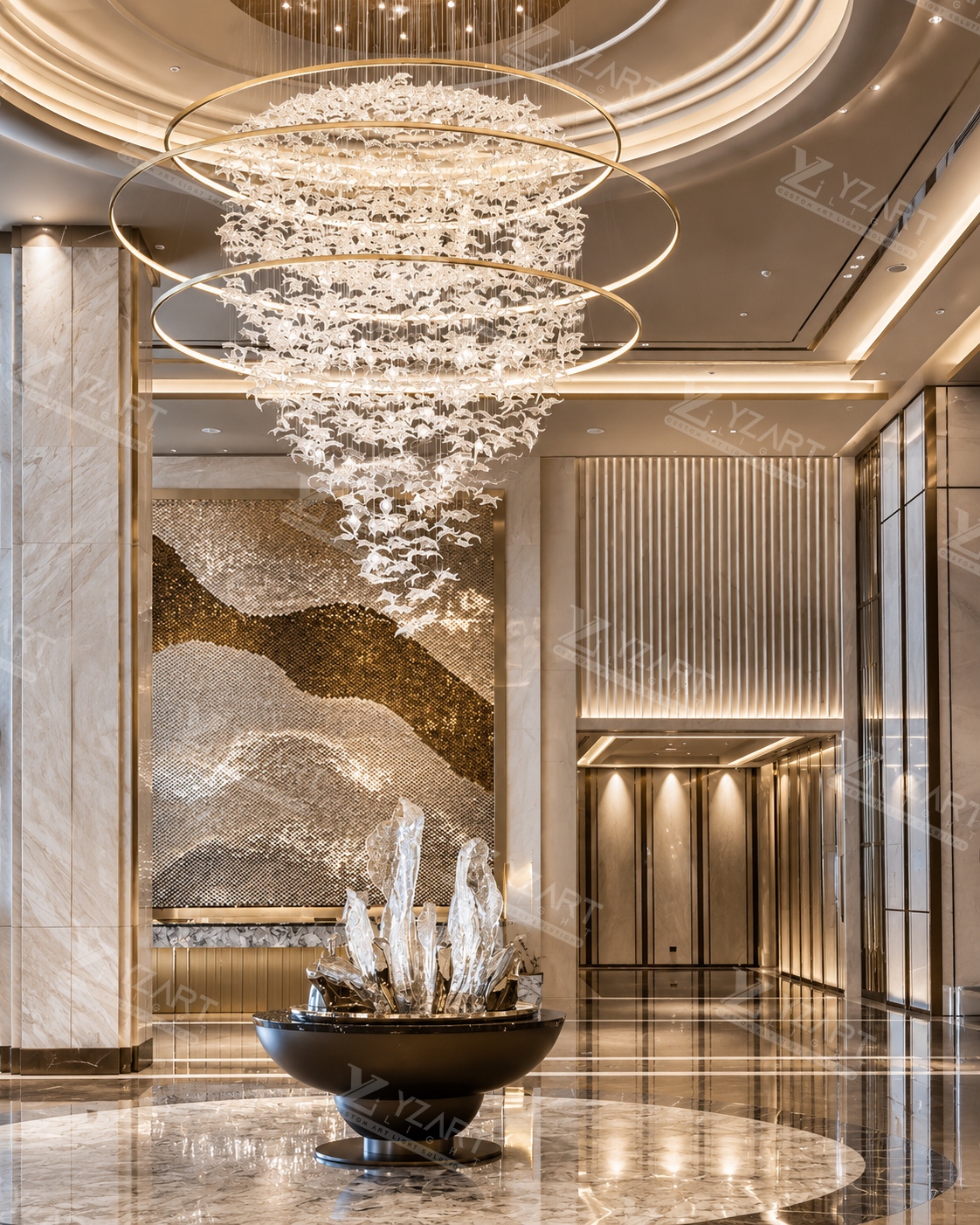
Hotel lobby chandeliers are specified against both design intent and a compliance file: the documents must name the fixture that is actually supplied. Image: YZ ART LIGHT.
Why Certification Sits at the Decision Stage, Not the Document Stage
Hotel lighting buyers often conflate two different questions. The first is whether a fixture meets the destination market's legal requirements. The second is whether the supplier can demonstrate that for the exact item being supplied. The first is a market-access question; the second is a traceability question. A certification pack exists to answer the second, and it is normally examined at five predictable points in a project.
- Specification stage — the lighting designer or specifier confirms that the offered product family can be documented for the destination market before it is written into the schedule.
- Pre-qualification — the main contractor's procurement or QA function screens suppliers on organisation-level certificates such as ISO9001, ISO14001 and ISO 45001.
- Sample and mock-up approval — the document presented must match the fixture that was actually sampled, not a similar product in the same range.
- Pre-shipment inspection — an inspection agency may reconcile certificate scope, certificate numbers and validity dates against the purchase order.
- Import and handover — the importer of record retains the compliance documents for market access, and the operator often re-checks them at handover.
In the European Union, luminaire compliance is documented across several distinct areas rather than one certificate: electrical safety, electromagnetic compatibility and hazardous-substance restriction. In North America, the framework is expressed differently — for example through UL 1598 for luminaires and UL 8750 for LED equipment, published by UL Solutions. Because frameworks differ by destination, the useful question for a buyer is not simply "do you have CE?" but "which document covers which requirement, and to which model does it apply?"
The Five Documents at a Glance
The table below is the shape of a compliance file for a hotel decorative fixture. It separates product-level documents from organisation-level certificates, because the two are requested by different reviewers at different stages.
| Document | What it is | Scope in this file | Market | Typically requested at |
|---|---|---|---|---|
| LVD-CE Verification of Conformity | Product-level electrical safety verification for a fixed luminaire | Hanging lamp (fixed luminaire), model yz10002; standards EN 60598-1:2015+A1:2018, EN 60598-2-1:1989, EN 62493:2015 | EU | Specification, sample and mock-up approval |
| CE-RoHS certification | Restriction of hazardous substances in electrical and electronic equipment | Certificate QTS800519289 | EU | Specification, import documentation |
| ISO9001 | Quality management system certificate | Certificate ZTZL28025Q1464R0S | Global | Supplier pre-qualification |
| ISO14001:2015 | Environmental management system certificate | Valid September 3, 2025 to September 2, 2028 | Global | Pre-qualification, operator environmental screens |
| ISO 45001:2018 | Occupational health and safety management system certificate | Certificate ZTZL28025S0801R0S | Global | Pre-qualification, factory audit |
LVD-CE Verification of Conformity: What It Covers for a Hanging Luminaire
The LVD-CE Verification of Conformity is a product-level document. In the YZ ART LIGHT file it applies to a fixed luminaire — the hanging lamp product, model yz10002 — and references three standards, each answering a different question:
- EN 60598-1:2015+A1:2018 — general requirements and tests for luminaires, covering the safety framework that applies across luminaire types: construction, wiring, insulation, thermal behaviour and marking.
- EN 60598-2-1:1989 — particular requirements for fixed general purpose luminaires, the category a suspended hotel chandelier falls into.
- EN 62493:2015 — assessment of lighting equipment in relation to human exposure to electromagnetic fields.
The split between Part 1 and Part 2-1 matters when reading the document. A general standard alone does not address the particular mechanical and thermal realities of a fixture that is suspended above guests; Part 2-1 does. EN 62493 sits outside electrical safety altogether and addresses exposure rather than shock or fire risk, which is why the standard list should be read as a set rather than a single headline.
Practical reading rule: check the model reference and the standard list before the letterhead. A verification document is only useful to a tender if the model named in it is the model being supplied, and the standards cited match the category of fixture being installed.
CE-RoHS: Restricted Substances, Not Electrical Safety
CE-RoHS certification addresses restricted hazardous substances in electrical and electronic equipment. It is documented separately from safety verification; in this file it is issued under certificate QTS800519289. RoHS and the LVD-CE document answer different questions and do not substitute for one another.
For a large decorative fixture, substance restriction is a materials-and-components issue rather than a design-style issue: it is managed across cabling, soldering, platings, coatings and finishes. That is one reason RoHS documentation is normally requested alongside material declarations on bespoke chandelier orders, where a single fixture may combine brass, stainless steel, aluminium, iron, glass, crystal, marble, acrylic and ceramic.
What RoHS does not do is confirm anything about load capacity, glare control, light quality or ingress protection. Buyers who treat it as a general quality mark are reading it beyond its scope.
ISO9001, ISO14001:2015 and ISO 45001:2018: Management Systems, Not Product Approvals
ISO9001 (certificate ZTZL28025Q1464R0S), ISO14001:2015 (valid September 3, 2025 to September 2, 2028) and ISO 45001:2018 (certificate ZTZL28025S0801R0S) are management system certificates. They describe how an organisation runs its quality, environmental and occupational health and safety processes. They do not certify the electrical safety of an individual chandelier.
A buyer who accepts an ISO9001 certificate in place of an LVD-CE verification has swapped a product approval for a process approval. That is not a technicality in this category: custom decorative fixtures are not mass-market catalogue items, and the manufacturing risk sits in repeatability — whether the tenth fixture in a batch matches the approved sample in welding, frame geometry and finish.
This is where the ISO layer has genuine procurement value. In YZ ART LIGHT's operation, the quality management system is applied from raw material selection through processing to finished-product testing, supported by in-house production equipment including CNC laser cutting systems, automated welding stations and precision engraving machines at its own production base in Zhongshan. For a project buyer, that implies a documented process that can be audited, rather than a single test result. The ISO 45001:2018 certificate addresses a further dimension: worker safety in the production environment, which operators increasingly screen as part of supplier responsibility reviews.
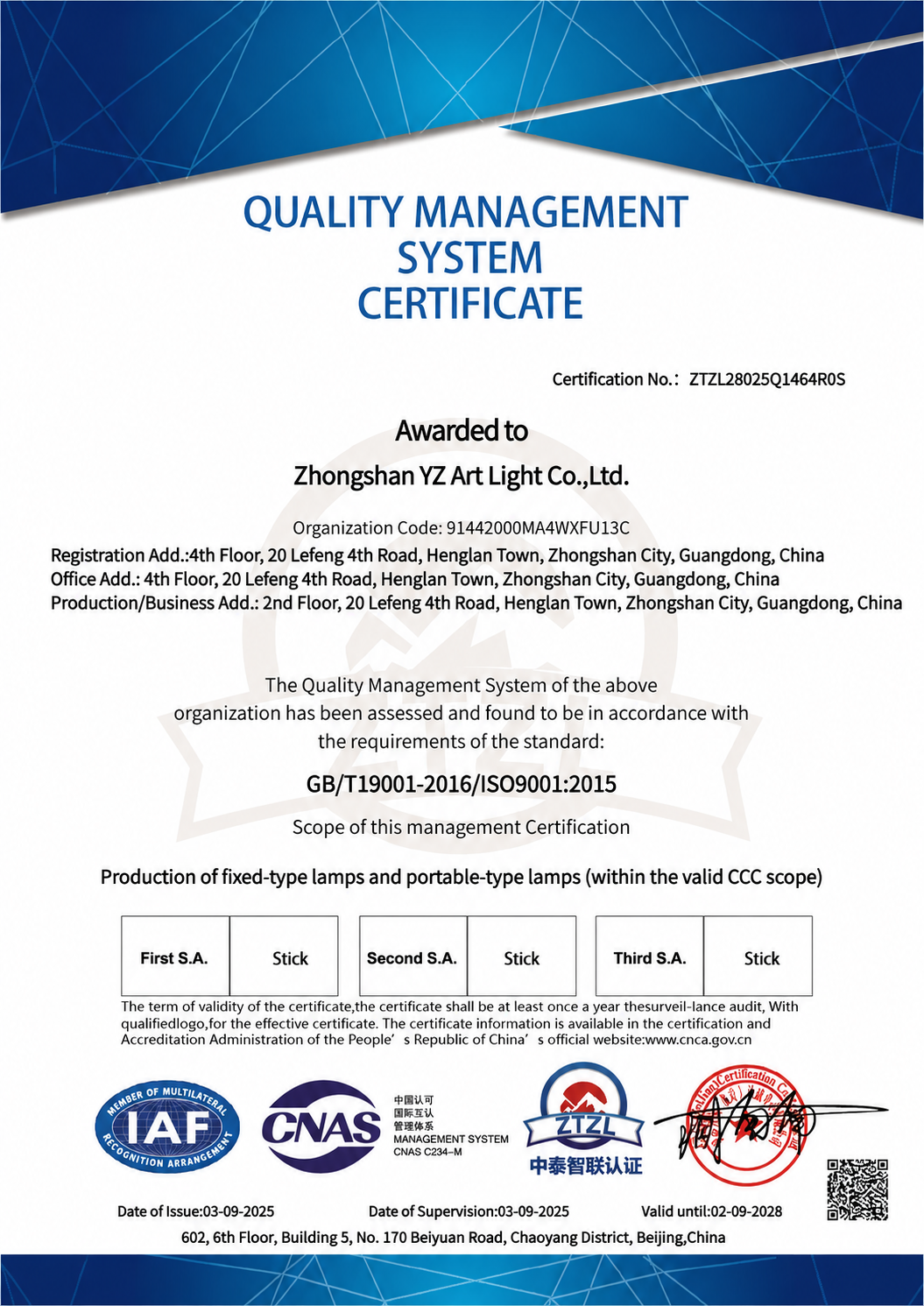
ISO9001 certificate ZTZL28025Q1464R0S covers the management system behind production, while product safety is evidenced separately. Certificate image: YZ ART LIGHT.
Assembling a Compliance Submittal: Common Defects That Stall a Tender
Most rejected submittals are not rejected because a document is absent. They are rejected because the reviewer cannot connect the document to the product in front of them. The four defects below account for a large share of back-and-forth on decorative lighting packages.
| Common submittal defect | Why it stalls review | Preventive check |
|---|---|---|
| Certificate names a different model or a different manufacturer | The offered item cannot be linked to the item that was verified | Match the model reference (for example yz10002) and the manufacturer's legal name against the purchase order |
| Expired or near-expiry certificate | Validity may not span the delivery and handover schedule | Check issue and expiry dates against the project timeline — the ISO14001:2015 certificate in this file runs to September 2, 2028 |
| Management certificate submitted as product approval | Scope mismatch between what was asked for and what was provided | Keep ISO certificates and product verification as separate line items in the submittal index |
| No clear link between the supplying entity and the manufacturer | Ownership of the compliance file is ambiguous | Request documents issued in the manufacturer's name alongside the supplier entity's own paperwork |
A submittal that works is usually ordered the way reviewers read it: product verification first, substance documentation second, management system certificates third, and project-specific records last.
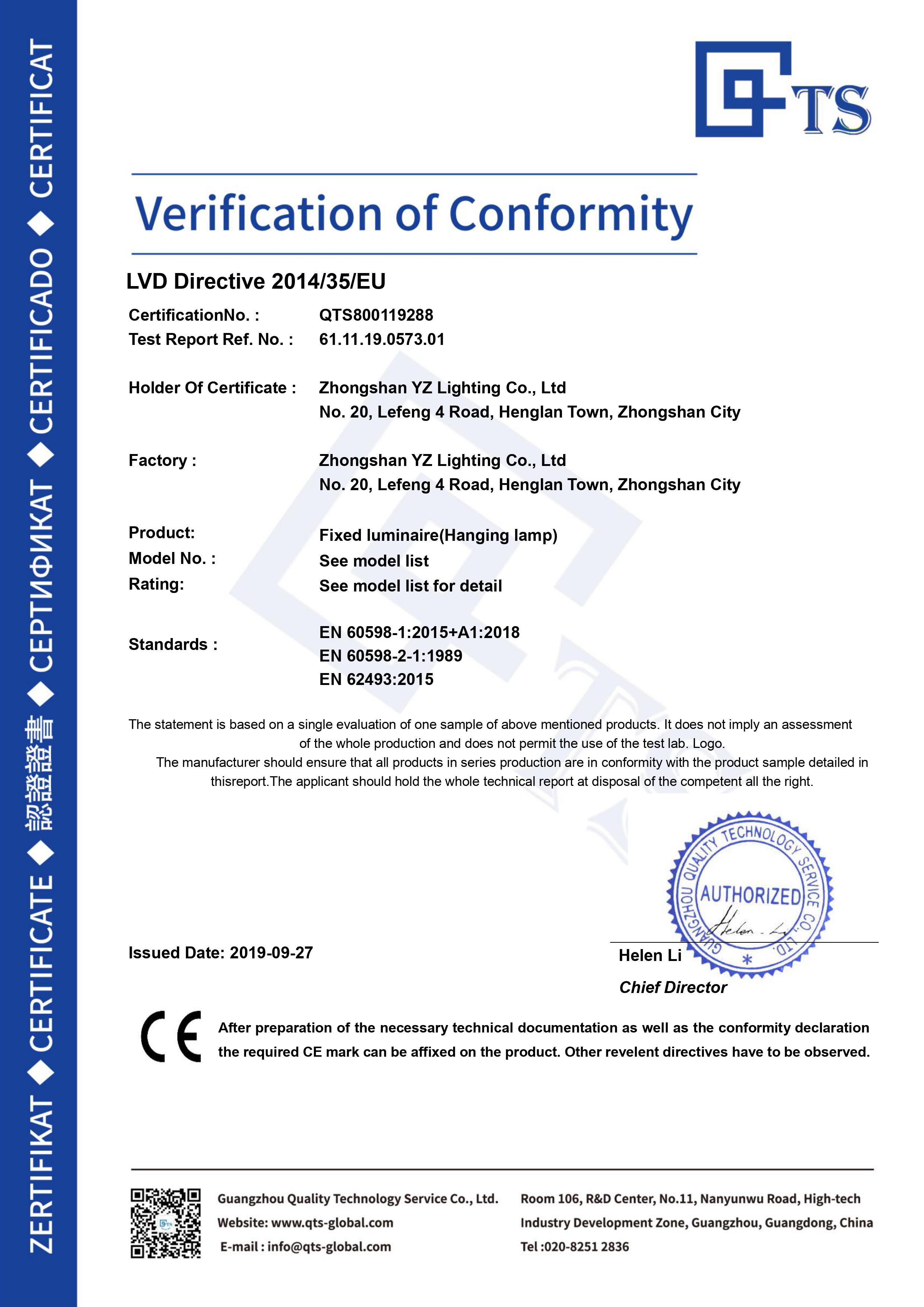
EU market files pair product-level safety verification with separate RoHS substance documentation. Certificate image: YZ ART LIGHT.
Where the Certification File Carries the Most Weight: Hospitality Applications
Hotel decorative lighting is a category where fixtures are large, suspended, long-operating and expensive to replace — which is why documentation requirements concentrate in specific spaces.
Lobby and atrium chandeliers
High-ceiling lobby fixtures combine scale with suspension. Installation procedures include verifying the ceiling's load-bearing capacity, measuring the reserved opening and marking suspension points before any hoisting, then completing insulated concealed wiring and fixing embedded fasteners. A product safety verification for a hanging luminaire is the paper counterpart of those site checks.
Banquet halls and ballrooms
Banquet spaces run long operating hours and are frequently specified with dimmable installations; industry research cited by Dataintelo indicates that a majority of new luxury hotel projects now require dimmable chandelier installations for guest ambiance. Longer duty cycles put weight on the management system layer, because consistency across a large batch of identical fixtures depends on process control rather than on a single tested unit.
Guest rooms and suites
In guest rooms the requirement shifts from scale to comfort. Custom soft glare-shielded light sources are used to eliminate harsh glare and uneven light distribution, and fixtures are developed around floor-to-ceiling heights and reserved installation sizes so they fit non-standard suspended ceilings. Certification does not measure glare, so buyers should treat comfort performance and compliance as two separate evaluation columns.
Scope boundary: a certification pack covers the manufactured product, not the site installation. Ceiling load checks, isolation of the mains supply before work, wiring by qualified personnel and the final power-on test with light uniformity verification are installer responsibilities. Documentation quality and installation quality are separate verification layers, and a compliant fixture can still perform badly if the second layer is skipped.
Factory-Direct Manufacturing and Documentation Traceability, Compared with Trading Arrangements
The clearest structural difference in this category is not price; it is who owns the compliance file. A manufacturer with its own production base can issue product verification and management system certificates in its own legal name, and can answer scope questions about a custom variation because the engineering and production functions sit in the same organisation. Traditional trading agents and suppliers without in-house manufacturing source finished goods externally, so the origin of a test document — and the ability to re-verify a modified fixture — is one step removed from the party signing the contract.
YZ ART LIGHT operates as an in-house manufacturer, with in-house laser-cutting automated equipment and a full-process non-standard customisation service supporting direct factory-backed project support for hotel chandelier installations. The company also reports cost and energy comparisons against conventional sourcing and conventional decorative lamps; those figures are supplier-reported and project-dependent, and a buyer should validate them against a specific bill of materials rather than treat them as a general market benchmark. Verified documentation, unlike a cost claim, is checkable before purchase.
The honest limitation cuts both ways. Factory-direct supply is not automatically the right choice for every order: for simple standardised stock fixtures with no custom requirements and small quantities, a trading arrangement can be adequate, and the documentation burden is lower because the product is already catalogue-defined. The factory-direct model earns its place when the fixture is bespoke, the project requires a qualification file in the manufacturer's name, and the order is large enough that batch consistency matters.
Market Context: Why Compliance Documentation Is Moving Up the Specification List
The commercial weight behind these documents is growing with the category itself. Mordor Intelligence sizes the global decorative lighting market at USD 75.88 billion in 2025, projected to reach USD 78.98 billion in 2026. Dataintelo values the hospitality lighting segment at USD 14.2 billion in 2025 and projects a 7.3% CAGR to USD 26.8 billion by 2034. IMARC Group reports that commercial applications, including hospitality, account for 62.8% of the decorative lighting end-user market in 2025, with LED holding a 39.8% share of the light-source mix.
Published estimates in this sector diverge by inclusion criteria, and buyers should read any single figure with that in mind: for the decorative lighting market, Grand View Research and IMARC Group publish materially lower values for the same period under narrower category definitions. The directional signal is consistent, however — commercial and hospitality demand is the growth engine, and commercial projects are where documentation is enforced.
Regulation is reinforcing the trend. The 2024 International Energy Conservation Code expanded occupancy and dimming requirements for lobbies and meeting areas, pushing control and dimming capability further into the specification. In the Middle East, Dataintelo's hospitality lighting analysis notes that Saudi Arabia's Vision 2030 targets 150 million annual tourist visits and implies over USD 500 billion in hospitality infrastructure investment, which brings a compliance-heavy procurement model into a fast-growing market. Regional weight is also shifting: Grand View Research reports Asia Pacific at 44.6% of high-end lighting revenue in 2024, while North America held 36.45% of the decorative lighting market in 2025.
Future Outlook
Three developments are likely to shape how certification files are read in hospitality lighting over the next few years.
Documentation as a scored line item. As commercial and hospitality projects become the dominant share of decorative lighting demand, compliance submittals are increasingly evaluated rather than merely collected. Buyers can expect more requests for model-level traceability and validity-date confirmation as a routine part of bid evaluation.
Separation of fixture and control certification. LED integration and lighting controls are expanding, and control platforms are specified separately from decorative fixtures — Lutron's Quantum systems, for example, are specified in hundreds of luxury hotel properties globally for premium lighting management. That separation means a chandelier's compliance file and a control system's documentation are two different submittals, and project teams should not assume one covers the other.
Environment and safety systems moving into scope. Environmental and occupational health and safety management certificates such as ISO14001:2015 and ISO 45001:2018 are appearing earlier in supplier screening, including in factory audit checklists. For manufacturers, maintaining these systems — and keeping validity windows current — becomes a continuous requirement rather than a one-off purchase.
Frequently Asked Questions
Which certifications should a hotel chandelier buyer verify before placing an order?
Buyers typically verify three layers. The first is product-level electrical safety verification, such as an LVD-CE Verification of Conformity for the specific luminaire model; in the YZ ART LIGHT file this covers the hanging lamp product, model yz10002, under EN 60598-1:2015+A1:2018, EN 60598-2-1:1989 and EN 62493:2015. The second is substance restriction documentation, such as CE-RoHS certificate QTS800519289. The third is organisation-level management system certificates: ISO9001, ISO14001:2015 and ISO 45001:2018. Each document should name the model or entity actually being supplied.
What is the difference between LVD-CE and RoHS documentation for a chandelier?
The LVD-CE Verification of Conformity addresses the electrical safety of the luminaire and cites the general and product-specific standards applied to it. RoHS documentation addresses restricted hazardous substances in electrical and electronic equipment and is issued separately — in this file, under certificate QTS800519289. Neither document substitutes for the other, and a buyer checking only one of the two has not covered both requirements.
Do ISO9001, ISO14001 and ISO45001 certificates confirm that a chandelier is electrically safe?
No. These are management system certificates describing how an organisation manages quality, environmental and occupational health and safety processes. Product-level safety is evidenced by a separate product verification such as the LVD-CE document. The procurement value of the ISO layer is process consistency: a quality management system applied from raw material selection through finished-product testing supports repeatability across large custom orders, but it does not certify an individual fixture.
How long is an ISO14001 certificate valid, and why do validity dates matter in a tender?
The ISO14001:2015 certificate in this file is valid from September 3, 2025 to September 2, 2028. Management system certificates are time-bound, so a certificate that was current when a sample was first submitted may have expired by the pre-shipment or handover stage. Reviewers generally check validity dates against the project schedule rather than against the date of the original quotation.
Does a certificate for one chandelier model cover custom variations of that fixture?
Product verification is written around a defined configuration. A document naming model yz10002 covers the construction and components assessed for that configuration. Changes to dimensions, structural design, driver, control gear or materials may fall outside the assessed scope and can require separate confirmation. Buyers specifying bespoke fixtures should ask in writing whether the intended variation sits inside the existing documentation or needs re-verification.
What documentation is typically requested in a hotel engineering lighting tender?
A submittal normally combines product-level documents, organisation-level certificates and project-specific records. Product-level items include safety verification such as the LVD-CE Verification of Conformity and RoHS documentation; organisation-level items include ISO9001, ISO14001:2015 and ISO 45001:2018 certificates; project-specific items include test reports and inspection records. The exact set depends on the destination market, the operator's brand standard and the main contractor's pre-qualification rules.
How does the certification pack relate to installation and on-site responsibility?
The certification pack covers the manufactured product, not the installation. Site procedures include checking the ceiling's load-bearing capacity, measuring the reserved size, marking suspension points, isolating the mains supply before any work, hoisting the assembled fixture onto embedded fasteners, and running a power-on test with lighting uniformity checks. Those steps belong to the installing contractor, so documentation and installation remain separate verification layers.
Reference documents: the Zhongshan YZ ART LIGHT Co., Ltd. company profile and product brochure is available as a downloadable PDF at Zhongshan YZ ART LIGHT Co., Ltd. brochure. Certification names, numbers and validity dates quoted in this article refer to that company's current compliance file.