
Hotel Chandelier Certificate Map: Five Documents, Five Different Jobs
In hotel decorative lighting procurement, compliance rarely fails because a document is missing. It fails because five documents are read as one. A low-voltage safety certificate, a RoHS file and three ISO certificates answer five different questions, cover three different scopes, and are reviewed by three different people: the electrical consultant, the sustainability or HSE reviewer, and the commercial buyer who signs the order.
This guide maps the five qualifications presented by YZ ART LIGHT — Zhongshan YZ ART LIGHT Co., Ltd., a decorative lighting manufacturer based in Zhongshan, Guangdong Province, serving hotel and commercial projects with a reported 70% export share across Europe, the Americas and the Middle East — for hotel chandelier work, including model yz10002 and the wider chandelier, art glass chandelier, wall lamp, floor lamp, table lamp and outdoor light range. The purpose is not to repeat the certificate list. It is to explain what each document actually does, which market it speaks to, and where its authority ends.
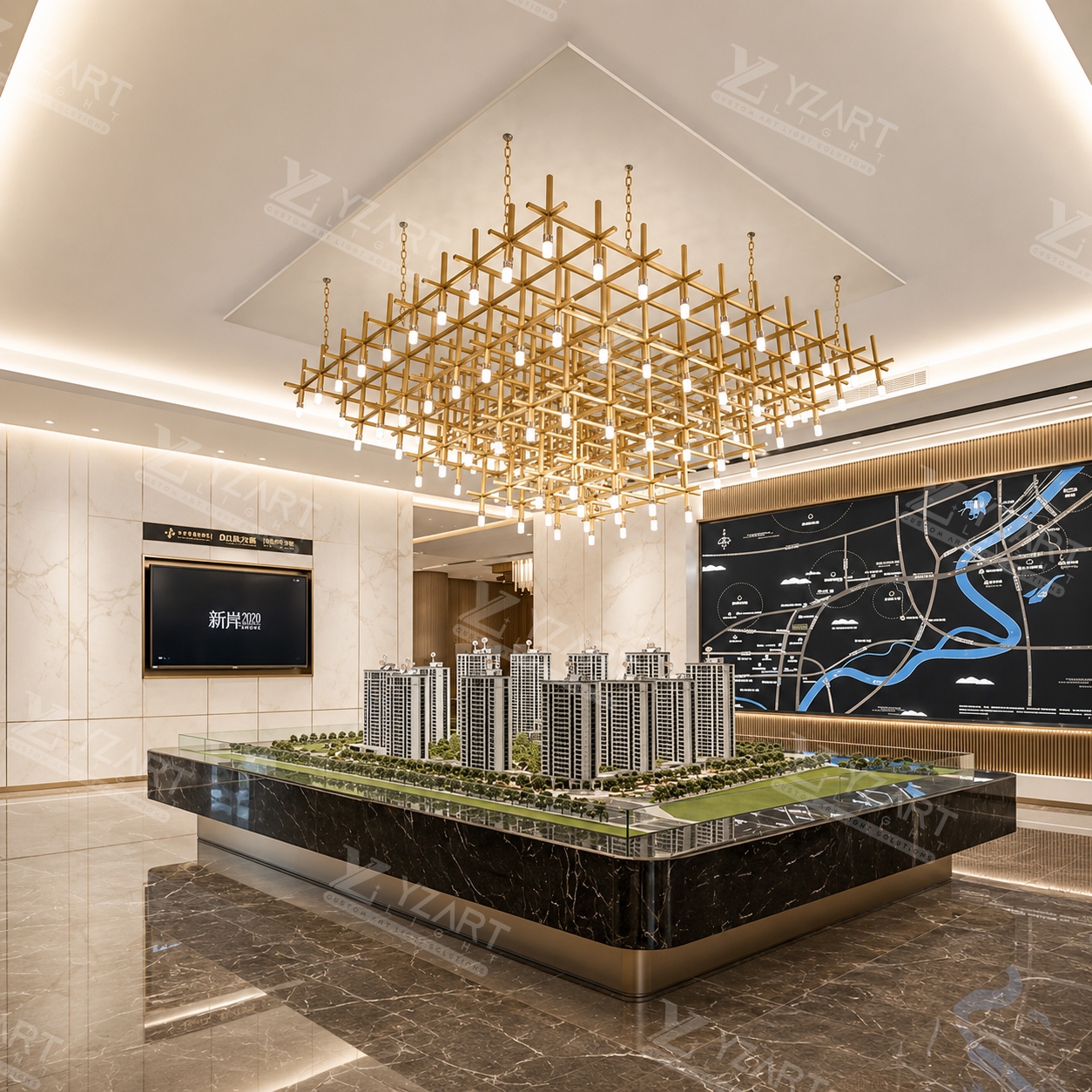
Why the five documents arrive as one bundle
Tender documents reward tidy submissions. A supplier that returns a compliance section with five labelled PDFs looks more complete than one that returns three, even where the three address more of the actual question. That is the first reason the bundle gets misread: presentation compresses five document types into a single impression of compliance.
The second reason is that the documents are genuinely related. LVD-CE and CE-RoHS both carry a CE prefix. ISO 9001, ISO 14001 and ISO 45001 all carry an ISO prefix and often appear on similar certificate templates. Superficially they belong to one family. Functionally they do not.
For a hotel project, the practical consequence is that a reviewer who approves the bundle has approved almost nothing specific. The question that matters is narrower: does this document cover this product, for this market, at the date of submission?
The certificate map in one table
| Document | Reference | What it verifies | Market | Document type |
|---|---|---|---|---|
| LVD-CE | QTS800119288; EN 60598-1:2015+A1:2018, EN 60598-2-1:1989, EN 62493:2015 | Electrical safety of luminaires, including human exposure to electromagnetic fields | EU placement | Product safety |
| CE-RoHS | QTS800519289; IEC 62321 series | Restricted substance content in electrotechnical components | EU placement | Substance compliance |
| ISO 9001 | ZTZL28025Q1464R0S; GB/T 19001-2016 / ISO 9001:2015 | Quality management system across inspection and production control | Global / export | Management system |
| ISO 14001 | GB/T 24001-2016 / ISO 14001:2015; valid 3 September 2025 to 2 September 2028 | Environmental management system | Global / export | Management system (dated) |
| ISO 45001 | ZTZL28025S0801R0S | Occupational health and safety management system | Global / export | Management system |
Read the table left to right and the logic becomes simple: two documents are product-related and market-specific, three are system-related and market-neutral. That single distinction resolves most of the confusion in a tender review.
LVD-CE (QTS800119288): the electrical safety file
The low-voltage certificate is the technical core of the pack. Certificate QTS800119288 is issued against three referenced standards, and each one answers a different part of the safety question.
- EN 60598-1:2015+A1:2018 — the general requirements and tests for luminaires: construction, insulation, protection against electric shock, thermal behaviour, mechanical strength, and the marking and documentation duties that accompany them. It is the parent standard on which the other references build.
- EN 60598-2-1:1989 — the particular requirements for fixed general purpose luminaires. This is the reference that ties the certificate to a mounting category: fixtures intended to be permanently attached to a ceiling, wall or building structure.
- EN 62493:2015 — assessment of lighting equipment in relation to human exposure to electromagnetic fields. Relevant for decorative fixtures that sit close to guests and staff for long periods.
For a hotel chandelier, the certificate addresses the failure modes that matter in a lobby or banquet hall: a fixture suspended over a public area, wired to a permanent supply, subject to heat build-up from dense LED clusters, and inspected by a third party. It is a safety file, not a performance file. Luminous efficacy, colour consistency, dimming behaviour and glare control are not certified by it.
CE-RoHS (QTS800519289): a substance file, not a safety file
RoHS answers a question about what is inside the fixture, not about how the fixture behaves when energised. Certificate QTS800519289 is issued against the IEC 62321 series — the analytical methods used to determine restricted substances in electrotechnical products.
For decorative lighting this is less trivial than it sounds. A hotel chandelier is a composite object: metal frame, crystal or glass elements, wiring, driver, solder joints, surface finishes, and sometimes plated or painted components. RoHS compliance is therefore a statement about the material chain behind those components, not about the finished appearance.
Two practical notes follow. First, RoHS is often quoted as a marketing line — CE and RoHS certified — with no reference to a test method or certificate number. The IEC 62321 reference is what makes the claim checkable. Second, RoHS and LVD are usually requested together but should be assessed separately in a tender: one speaks to guest safety, the other to environmental compliance and, increasingly, to a hotel group's procurement policy.
ISO 9001, ISO 14001 and ISO 45001: three systems, three different promises
The three ISO certificates are system documents. They describe how an organisation operates, not what a specific product does — and they are complementary rather than cumulative.
ISO 9001 is registered as ZTZL28025Q1464R0S against GB/T 19001-2016 / ISO 9001:2015. For a buyer this is evidence of a documented quality chain: incoming material inspection, in-process checks, final testing, non-conformity handling and corrective action. It is what allows a tender's quality section to be answered with a process description rather than a promise. It does not certify that a particular chandelier left the factory within tolerance — that is what inspection records do.
ISO 14001 is registered against GB/T 24001-2016 / ISO 14001:2015, with a stated validity from 3 September 2025 to 2 September 2028. Environmental management systems matter on hotel projects for reasons that have little to do with the fixture itself: hotel groups increasingly apply sustainability screening to their supply chain, and a developer's own environmental reporting may require supplier evidence. Note the explicit validity window — it is the one document in the pack with dated coverage, which makes it the one most likely to lapse mid-project.
ISO 45001 is registered as ZTZL28025S0801R0S. Occupational health and safety management addresses the labour side of the supply chain: the conditions under which fixtures are fabricated, finished and packed. For oversized decorative lighting this is more relevant than it first appears, because large chandeliers involve metal cutting, welding, glass and crystal handling, surface treatment and heavy packing.
A tender reviewer looking for quality assurance should read ISO 9001. A reviewer scoring ESG should read ISO 14001 and ISO 45001. Submitting all three against every question does not strengthen the answer.
Fixed-type and portable-type scope: reading yz10002 and the wider range
The scope question is where most misreadings occur. The LVD-CE certificate references EN 60598-2-1:1989, which belongs to the fixed general purpose luminaire part of the EN 60598 family. Fixed-type here means a luminaire intended for permanent connection to a building's structure and wiring — the category that includes most lobby chandeliers, banquet hall pendants and wall-mounted decorative fixtures.
Portable-type luminaires are addressed elsewhere in the same standard family. Table lamps and floor lamps generally fall into that portable category, because they are supplied for flexible connection and are moved rather than installed. Outdoor lights introduce a further set of requirements relating to moisture and environmental exposure.
The practical recommendation for buyers is therefore not to assume that one certificate covers a mixed Bill of Quantities. Read the product schedule attached to the certificate, not the covering letter. For model yz10002 and related categories, confirm which product families are listed against the low-voltage certificate, and whether portable items are covered by the same file or by a separate document.
| Product family | Typical mounting type | What to confirm in the document pack |
|---|---|---|
| Chandeliers and art glass chandeliers | Fixed, suspended | Fixed luminaire scope listed against the LVD-CE file |
| Wall lamps | Fixed, wall-mounted | Same fixed luminaire scope, plus driver details where applicable |
| Table lamps and floor lamps | Portable | Confirmation that portable-type families are explicitly included |
| Outdoor lights | Fixed, external | Outdoor application scope stated in the file, not inferred |
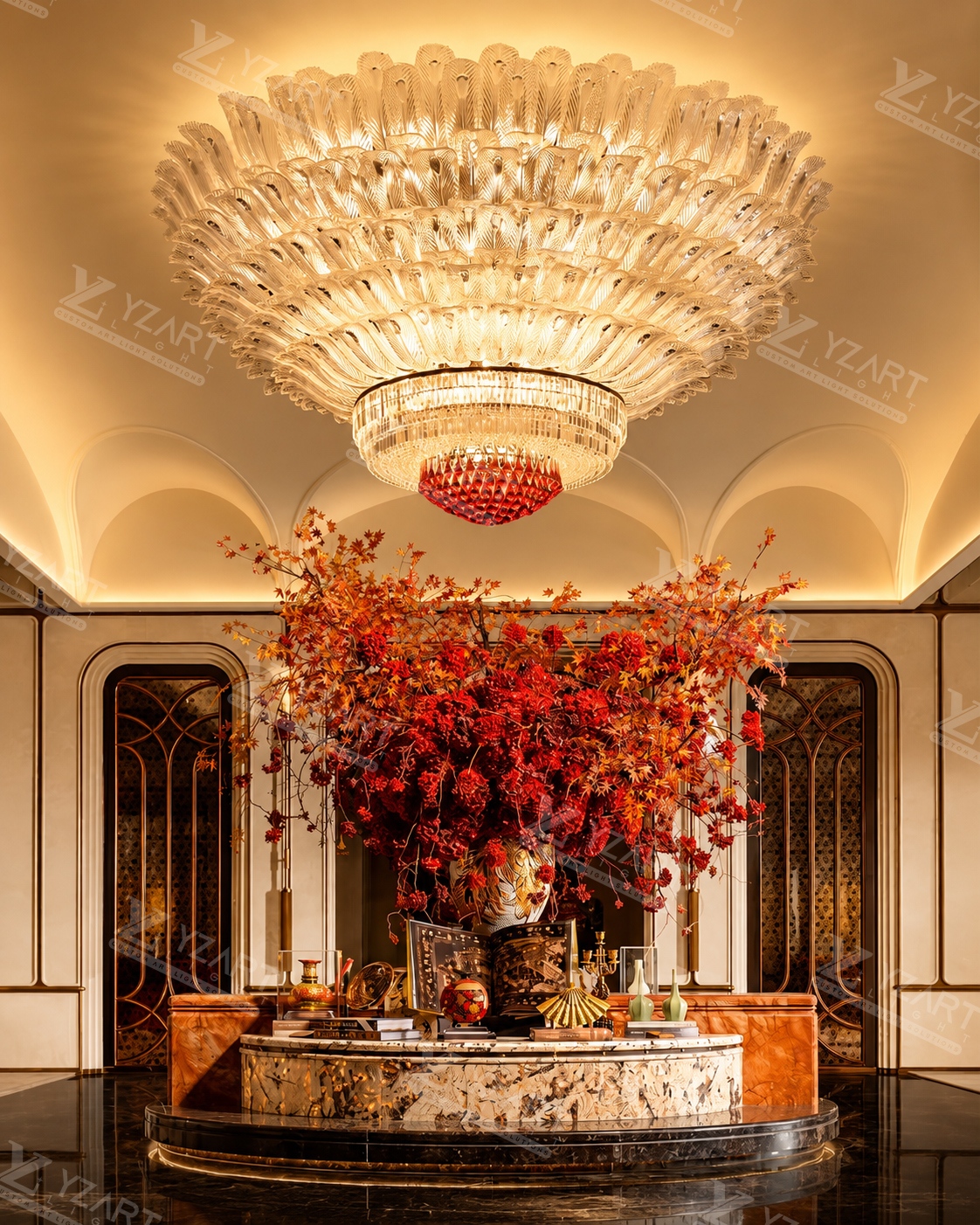
Market applicability: EU, global, and where the file stops
LVD-CE and CE-RoHS relate to the European market framework for luminaires placed on the EU market. For a hotel project inside the EU, these two documents are the ones an electrical specification is most likely to require, and the ones a market-surveillance authority would look for.
The ISO certificates are not market-specific. They are recognised as management-system evidence in tenders across Europe, the Middle East, Asia and the Americas, but recognition in a tender is a commercial fact, not a legal market-access right. A consultant in the Gulf may accept ISO 9001 as a prequalification item; that acceptance comes from the tender rules, not from the certificate itself.
Beyond the EU, the pack should be read as evidence rather than authorisation. North America, for example, references UL 1598 for luminaires and UL 8750 for LED equipment. A CE low-voltage file does not substitute for those schemes. Where a hotel project sits outside the EU, the honest position is that these documents support the compliance argument, and the project's own specification decides what else is required.
For markets where YZ ART LIGHT is most active — Europe, the Americas and the Middle East, on a reported 70% export share — this split matters commercially. The same pack travels to all three regions, but it carries different weight in each.
How the pack works in engineering tender participation
Engineering tenders for hotel lighting typically split compliance across several sections. A technical section asks whether the product meets specification. A quality section asks how the supplier controls production. An HSE or sustainability section asks about labour and environmental management. A commercial section asks who is contracting and who is accountable.
Mapped onto that structure, the five documents land as follows: LVD-CE and CE-RoHS answer the technical compliance section; ISO 9001 answers the quality section; ISO 14001 and ISO 45001 answer the HSE and sustainability sections. The manufacturer supplies those qualification certificates together with the complete bidding documents a project consultant needs to close the compliance section, rather than a single certificate emailed in isolation.
Two tender-specific details are worth flagging. First, reviewers check that the certificate holder's legal name matches the entity in the bid, or that a documented relationship exists between the two. Second, dated documents — such as an environmental certificate valid from 3 September 2025 to 2 September 2028 — should be checked against the submission date, not against the date the file was assembled.
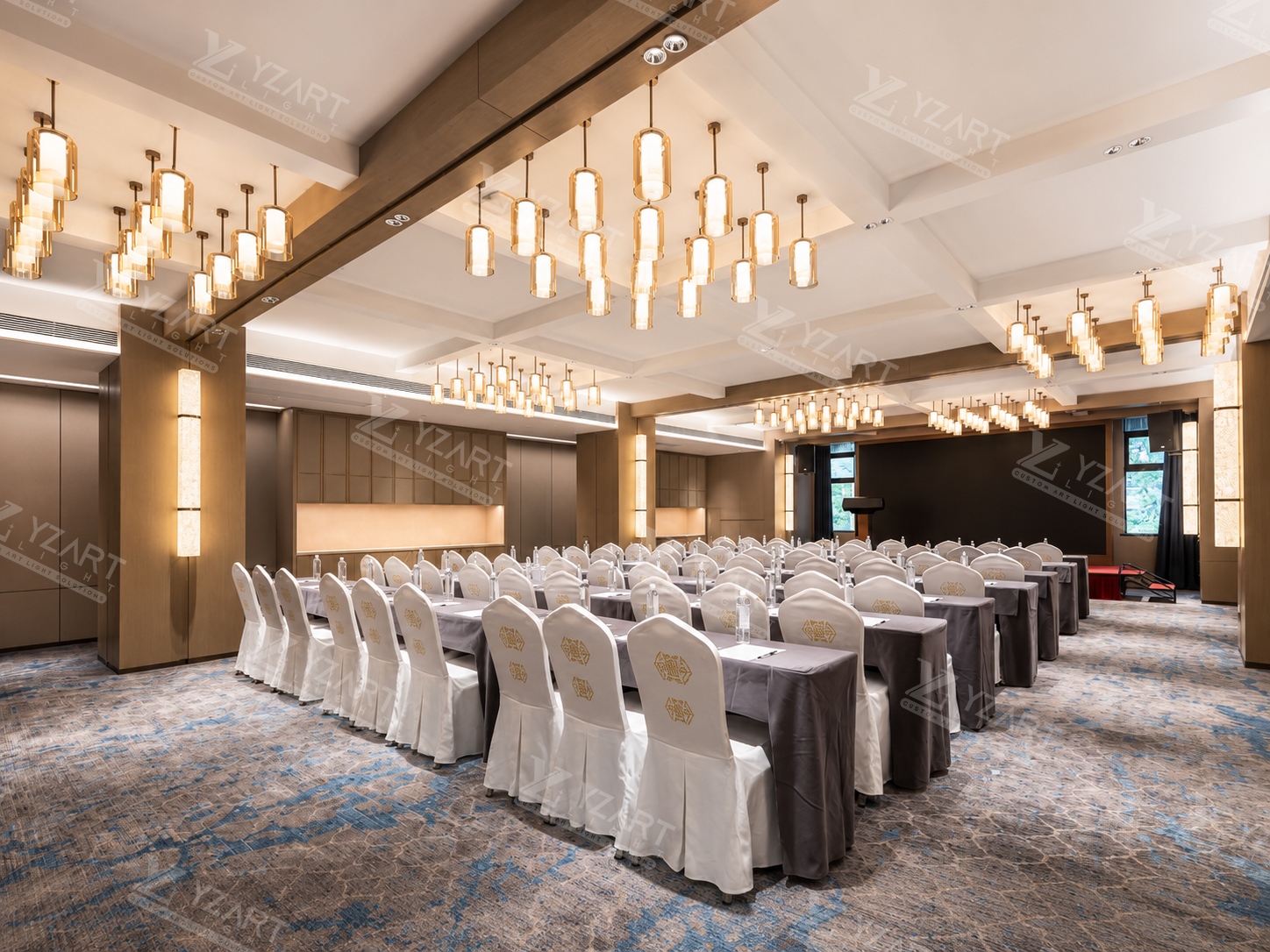
Factory-direct versus middle-man: who actually holds the document
This is where the certificate map becomes a decision tool rather than a reading exercise. Management-system certificates are issued to the entity that was audited. They cannot be transferred, lent or inherited. A trading agent can forward a manufacturer's certificates, but it cannot make them its own, and a buyer should be able to see where the documentation chain starts.
In practice that means asking three questions. Who is named on the certificate? Is that entity the one producing the fixture? Is there a documented authorisation linking the bidder to that entity? A factory-direct supplier answers all three with the same name.
For context on why buyers compare these routes at all, the source material behind this article records that factory-direct sourcing of customised decorative lighting carries a comprehensive cost 15% to 30% lower than traditional trading agents and suppliers without in-house manufacturing, supported by in-house laser-cutting automated equipment and a full-process non-standard customisation service, alongside a track record of over 1,000 hotel-oriented engineering projects and 15 years of experience in custom-made lamps.
None of that makes factory-direct the right answer for every purchase. A hotel replacing a small batch of guest room lamps under a maintenance budget, or a buyer without the engineering capacity to review drawings and installation details, may get better value from a local supplier who handles specification, delivery and site issues. Factory-direct pays off when the project is large enough that documentation, customisation and unit cost all matter at once — and when the buyer is actually going to use the documents.
What the certificate map does not prove
A compliance file is most useful when its boundaries are stated. Five gaps are worth recording.
- Photometric performance. Light output, colour consistency, dimming behaviour and glare control are not covered by a safety or substance certificate.
- Installation quality. Certificates travel with the product, not with the site.
- Structural adequacy. Suspension points and ceiling loading for an oversized chandelier remain the responsibility of the project engineer.
- Product-to-certificate matching. The scope of a certificate has to be checked against the schedule of the actual order, particularly when a project mixes fixed chandeliers with portable table and floor lamps.
- Day-to-day execution. A management-system certificate describes a process, not a unit.
Stating these limits does not weaken the file. It tells a reviewer exactly which questions the documents will close and which ones the project team still has to answer itself.
Market context and outlook
Compliance documentation is shifting from a formality to a procurement filter, and market data explains part of the pressure. Mordor Intelligence puts the global decorative lighting market at USD 75.88 billion in 2025, rising to USD 78.98 billion in 2026. IMARC Group reports that commercial applications, including hospitality, account for 62.8% of the decorative lighting end-user market in 2025. Dataintelo values the hospitality lighting market at USD 14.2 billion in 2025, with a projected 7.3% CAGR to USD 26.8 billion by 2034. Estimates for this category vary considerably between research houses depending on what is counted, so the direction of travel is more reliable than any single figure: more hospitality projects, more documentation.
The document-level trend follows. Hotel groups operating across several jurisdictions tend to standardise supplier documentation precisely because a pack that works in one region does not automatically work in another. That favours suppliers who maintain a complete, current and coherent file, and disadvantages those who assemble one retrospectively for each bid.
The next stage is likely to be about currency rather than quantity. Buyers already receive certificates; the open question is whether they are current, whether the scope matches the order, and whether the holder is the entity actually manufacturing. A pack that answers those three questions through its own structure — rather than through a covering email — will do more for a supplier's tender performance than an additional document.
Frequently asked questions
What is the difference between an LVD-CE certificate and an ISO 9001 certificate in a hotel lighting supplier's document pack?
An LVD-CE certificate is a product safety document tied to specific standards and a defined product scope; for YZ ART LIGHT it is certificate QTS800119288, referencing EN 60598-1:2015+A1:2018, EN 60598-2-1:1989 and EN 62493:2015. An ISO 9001 certificate is a management-system document, registered as ZTZL28025Q1464R0S against GB/T 19001-2016 / ISO 9001:2015, describing how the factory controls quality rather than what a particular fixture does. The first is evidence about a product; the second is evidence about a process.
Does the LVD-CE certificate cover table lamps and floor lamps as well as fixed chandeliers?
The certificate references EN 60598-2-1:1989, the part of the EN 60598 family dealing with fixed general purpose luminaires, which matches permanently installed fixtures such as lobby chandeliers and wall lamps. Portable-type luminaires such as table lamps and floor lamps are addressed elsewhere in the same standard family. Buyers specifying a mixed package should confirm from the certificate's product schedule which families are listed, and request separate documentation where portable items are included.
Which of these certificates apply to EU projects and which apply globally?
LVD-CE and CE-RoHS relate to the European market framework and are the documents an EU-based consultant is most likely to require. The ISO 9001, ISO 14001 and ISO 45001 certificates are not market-specific: they are management-system documents recognised as evidence in tenders worldwide, including the Middle East and the Americas, but that recognition comes from the tender rules rather than from the certificate. Markets such as North America reference separate schemes, including UL 1598 for luminaires and UL 8750 for LED equipment.
Can a trading agent submit a manufacturer's ISO certificates in a hotel lighting tender?
A management-system certificate is issued to the entity that was audited and cannot be transferred. A trading agent can forward a manufacturer's certificates, but the documents remain the manufacturer's. Tender reviewers typically check that the certificate holder matches the bidding entity, or that a documented relationship exists between them, so a buyer comparing a factory-direct bid with an agent bid should ask who is named on each certificate and whether that entity produces the fixture.
What should a buyer verify on a certificate before it goes into a tender submission?
Five things: the certificate holder's legal name against the bidding entity; the product scope against the actual order schedule; the referenced standards against the project specification; the validity dates, particularly for the environmental certificate stated as valid from 3 September 2025 to 2 September 2028; and the certificate or registration number itself, so the document can be checked independently. A certificate that passes all five is a usable tender document; one that passes only the first is a cover page.
A full company and product profile, including the qualification set discussed in this article, is available in the YZ ART LIGHT brochure (PDF).
¿Tiene preguntas o necesita más detalles?
Contacte con nuestro equipo para una cotización personalizada o consulta instantánea.
Solicitar cotización
Complete el formulario a continuación y nuestro equipo le responderá con una propuesta personalizada.
Chat directo de WhatsApp
¿Prefiere chatear en tiempo real? Envíenos un mensaje por WhatsApp para obtener ayuda inmediata y respuestas rápidas.
- Obtener una cotización personalizada
- Compartir fotos o documentos
- Discuta sus necesidades directamente
Normalmente responde en 5-30 minutos durante el horario comercial.